Introduction
Cone-beam computed tomography (CBCT) which pro- vides three-dimensional (3D) images, was developed for the dental use in the late 1990s.1The advantages of CBCT include a lower entrance dose, higher resolution, and lower cost than conventional computed tomography (CT). More- over, CBCT provides 3D information via multiplanar and 3D reconstructed images. For this reason, its use in dental practice has rapidly increased and is commonly used in
preoperative implant planning, the localization of impacted teeth, the diagnostic and surgical planning of oral and maxillofacial radiology, the evaluation of periodontal and periapical lesions, endodontic problems, and orthodontic treatment planning.2-5Although the dose of CBCT is lower than that of conventional CT, it is higher than that of conventional radiography mainly used in dental practice.
There have been numerous studies about effective doses of CBCT using thermoluminescent dosemeter (TLD) chips.6-12 However, this estimation method using TLD chips is laborious and time-consuming.
The establishment of diagnostic reference levels in medi- cal imaging was recommended by the International Com- mission on Radiation Protection (ICRP) to promote the optimization of patient radiation exposure.13In Korea, dia- gnostic reference levels for diagnostic radiology including dental radiographic procedures were reported by the Korea
Conversion coefficients for the estimation of effective dose in cone-beam CT
Dong-Soo Kim1, Oyuntugs Rashsuren1, Eun-Kyung Kim1,*
1Department of Oral and Maxillofacial Radiology, Dankook University College of Dentistry, Cheonan, Korea
ABSTRACT
Purpose: To determine the conversion coefficients (CCs) from the dose-area product (DAP) value to effective dose in cone-beam CT.
Materials and Methods: A CBCT scanner with four fields of view (FOV) was used. Using two exposure settings of the adult standard and low dose exposure, DAP values were measured with a DAP meter in C mode (200 mm×
179 mm), P mode (154 mm×154 mm), I mode (102 mm×102 mm), and D mode (51 mm×51 mm). The effective doses were also investigated at each mode using an adult male head and neck phantom and thermoluminescent chips.
Linear regressive analysis of the DAP and effective dose values was used to calculate the CCs for each CBCT examination.
Results: For the C mode, the P mode at the maxilla, and the P mode at the mandible, the CCs were 0.049 μSv/
mGycm2, 0.067 μSv/mGycm2, and 0.064 μSv/mGycm2, respectively. For the I mode, the CCs at the maxilla and mandible were 0.076 μSv/mGycm2and 0.095 μSv/mGycm2, respectively. For the D mode at the maxillary incisors, molars, and mandibular molars, the CCs were 0.038 μSv/mGycm2, 0.041 μSv/mGycm2, and 0.146 μSv/mGycm2, respectively.
Conclusion: The CCs in one CBCT device with fixed 80 kV ranged from 0.038 μSv/mGycm2to 0.146 μSv/mGycm2 according to the imaging modes and irradiated region and were highest for the D mode at the mandibular molar.
(Imaging Sci Dent 2014; 44 : 21-9)
KEY WORDS: Radiation Dosage; Radiography, Dental; Cone-Beam Computed Tomography; Effective Dose
*This research was supported by Basic Science Research Program through the National Research Foundation of Korea (NRF) funded by the Ministry of Education, Science and Technology (NRF-2010-0012131).
Received July 28, 2013; Revised August 17, 2013; Accepted September 4, 2013
*Correspondence to : Prof. Eun-Kyung Kim
Department of Oral and Maxillofacial Radiology, Dankook University College of Dentistry, 119 Dandae-ro, Dongnam-gu, Cheonan, Chungnam 330-714, Korea Tel) 82-41-550-1924, Fax) 82-41-556-7127, E-mail) [email protected]
http://dx.doi.org/10.5624/isd.2014.44.1.21
Copyright ⓒ 2014 by Korean Academy of Oral and Maxillofacial Radiology
This is an Open Access article distributed under the terms of the Creative Commons Attribution Non-Commercial License (http://creativecommons.org/licenses/by-nc/3.0) which permits unrestricted non-commercial use, distribution, and reproduction in any medium, provided the original work is properly cited.
Imaging Science in Dentistry∙pISSN 2233-7822 eISSN 2233-7830
Food and Drug Administration.14-17Since the entrance sur- face dose (ESD) and dose-area product (DAP) are well- defined and easy-to-use methods, they have been frequent- ly used as the adequate dose quantities for DRLs.18,19Espe- cially, DAP was recommended as a dose quantity for CBCT by Health Protection Agency (HPA) in the United King- dom.20Lofthag-Hansen et al21compared two methods of the CT dose index (CTDI) and DAP to calculate the effec- tive dose of CBCT examination, and they proposed that the DAP measurement was the appropriate method to determine the effective dose. In addition, they comment- ed that the conversion factors should be determined accord- ing to the dental regions and radiographic techniques.21
In diagnostic medical radiology, the conversion factors from DAP to effective dose have been suggested by a num- ber of authors.22-24There has been a very few reports about those in dental radiology. Looe et al25,26 suggested the conversion coefficients for the estimation of effective dose of the intraoral, panoramic, and lateral cephalometric ra- diography. However, the conversion coefficient for CBCT remains unknown.
The objectives of this study were to measure the DAP and effective dose in one CBCT device and to determine the conversion coefficients from the DAP value to effec- tive dose.
Materials and Methods
The Alphard VEGA (Asahi Roentgen Ind. Co., Kyoto, Japan) CBCT scanner, which has four fields of view (FOVs) including the C mode (200 mm×179 mm), P mode (154 mm×154 mm), I mode (102 mm×102 mm), and D mode (51 mm×51 mm), was used in this study.
The DAP was measured using the DIAMENTOR M4-
KDK (PTW, Freiburg, Germany) (Fig. 1). In addition, the effective dose was measured using TLD-100 LiF chips (1.8
×1.8×0.035 inch; Harshaw Chemical Co., Solon, OH, USA) in an adult male Alderson Radiation Therapy phan- tom of the head and neck (Radiology Support Devices, Inc., Long Beach, CA, USA) (Fig. 2).
Measurement of the DAP
An ionization chamber of DAP meter was located on the tube side of the CBCT scanner (Fig. 3). The DAP value was measured with two different exposure settings (the standard adult and low-dose exposure setting) at the four FOVs. Table 1 shows the exposure parameters and spe- cifications of the CBCT scanner used in this study. The tube voltage and exposure time were fixed at 80 kV for 17 seconds. The tube current, the only exposure para-
Fig. 1.DIAMENTOR M4-KDK (PTW, Freiburg, Germany) used for the measurement of DAP.
Fig. 2.Adult male ART head and neck phantom (A) and TLD-100 Li F chips (B) used for the measure- ment of effective dose.
A B
meter selectable by the operator, was set at 6 mA for the adult exposure and 4 mA for the low dose exposure in C mode, 9 mA and 5 mA in P mode, 8 mA and 4 mA in I mode, and 9 and 6 mA in D mode. For the calculation of the conversion coefficients, the child exposure setting was considered the low-dose exposure in this study. All measurements were repeated three times and averaged for both exposure settings. The measured values were cor- rected by correction factors considering the temperature and air pressure during the DAP measurement.
Measurement of the patient effective dose
Location of TLD chips and CBCT image taking The TLD chips were calibrated and annealed by the Iljin Radiation Engineering Company (Hwaseong, Republic of Korea). Twenty-two TLD chips were inserted in the adult male phantom and CBCT examinations were performed using the two different exposure settings. The CBCT exa- minations were done in the C mode, P mode (maxilla and mandible), I mode (maxilla and mandible), and D mode (maxillary incisors, maxillary molars, and mandibular molars) (Fig. 4).
Measurement of the TLD chips and calculation of the effective dose
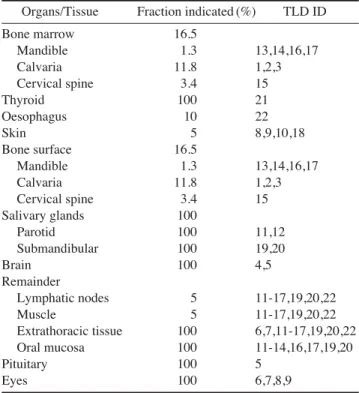
The effective dose was calculated using the method by Ludlow et al.27 The TLD chips were used to record the absorbed dose at 22 locations in the head and neck of the phantom (Table 2). One TLD chip was placed in the thy- roid gland, four in the salivary gland, eight in the bone marrow, one in the esophagus, four in the skin, two in the brain, four in the eye. Two chips in the lenses of eye were
Fig. 4.Adult male ART head and neck phantom is positioned for CBCT taking.
Fig. 3.Ionization chamber of DAP meter is located at the tube side of CBCT machine for the measure- ment of DAP.
Table 1.Exposure parameters and specifications of Alphard VEGA CBCT
Mode Exposure setting Tube voltage Tube current Total filtration Exposure time Voxel size
(FOV; mm) (kV) (mA) (mm Al) (sec) (mm)
C mode (200×179) Adult 80 6 2.8 17 0.39
Low dose 80 4 2.8 17 0.39
P mode (154×154) Adult 80 9 2.8 17 0.3
Low dose 80 5 2.8 17 0.3
I mode (102×102) Adult 80 8 2.8 17 0.2
Low dose 80 4 2.8 17 0.2
D mode (51×51) Adult 80 9 2.8 17 0.1
Low dose 80 6 2.8 17 0.1
used to measure the dose in the eyes and skin. Only TLD chips that were calibrated within a 5% error were used in this experiment. For each examination, background radia- tion was also measured using five TLD chips that were
not exposed to radiation. The measured background radia- tion was subtracted from the measured dose of each irra- diated TLD chip. The tissue-absorbed doses (in μGy) at each anatomical site were calculated from irradiated TLDs readout. The products of these values and the percentage of a tissue or organ irradiated in a radiographic examina- tion (Table 3) were used to calculate the equivalent dose (HT) in μSv. Effective dose (E), expressed in μSv, was cal- culated using the equation: E==»WT×HT, where E is the product of tissue weighting factor (WT) and the equivalent dose (HT). Table 4 shows the 2007 ICRP tissue-weighting factors.28
Determination of conversion coefficients
The measured DAP value and effective dose was in-
Table 2. The locations of TLD chips in ART head and neck phantom
Phantom location Phantom level TLD ID
Calvarium posterior 1 1
Calvarium anterior 2 2
Calvarium left 2 3
Midbrain 2 4
Pituitary 3 5
Right orbit 3 6
Left orbit 3 7
Right lens of eye 3 8
Left lens of eye 3 9
Right cheek 5 10
Right parotid 6 11
Left parotid 6 12
Right ramus 6 13
Left ramus 6 14
Center cervical spine 6 15
Right mandible body 6 16
Left mandible body 6 17
Left back of neck 7 18
Right submandibular gland 7 19
Left submandibular gland 7 20
Midline thyroid 9 21
Esophagus 9 22
Table 3.Estimated fraction of tissue irradiated and the dosimeters used to provide an indication of dose to each organ
Organs/Tissue Fraction indicated (%) TLD ID
Bone marrow 16.5
Mandible 1.3 13,14,16,17
Calvaria 11.8 1,2,3
Cervical spine 3.4 15
Thyroid 100 21
Oesophagus 10 22
Skin 5 8,9,10,18
Bone surface 16.5
Mandible 1.3 13,14,16,17
Calvaria 11.8 1,2,3
Cervical spine 3.4 15
Salivary glands 100
Parotid 100 11,12
Submandibular 100 19,20
Brain 100 4,5
Remainder
Lymphatic nodes 5 11-17,19,20,22
Muscle 5 11-17,19,20,22
Extrathoracic tissue 100 6,7,11-17,19,20,22 Oral mucosa 100 11-14,16,17,19,20
Pituitary 100 5
Eyes 100 6,7,8,9
Table 4.Current International Commission on Radiological Pro- tection (ICRP) tissue weighting factors (WT)28for calculation of effective dose
Organs/tissue 2007 WT
Gonads 0.08
Bone marrow (red) 0.12
Colon 0.12
Lung 0.12
Stomach 0.12
Bladder 0.04
Breast 0.12
Liver 0.04
Oesophagus 0.04
Thyroid 0.04
Skin 0.01
Bone surface 0.01
Brain 0.01
Salivary glands 0.01
Remainder 0.12*
*: adrenals, extrathoracic tissue, gall bladder, heart, kidneys, lymphatic nodes, muscle, oral mucosa, pancreas, prostate, small intestine, spleen, thymus and uterus/cervix
Table 5.The DAP values measured at different modes of Alphard VEGA CBCT
Mode Exposure kV mA DAP
(FOV; mm) setting (mGycm2)
C mode (200×179) Adult 80 6 3704
Low dose 80 4 2485
P mode (154×154) Adult 80 9 4499
Low dose 80 5 2508
I mode (102×102) Adult 80 8 1910
Low dose 80 4 956
D mode (51×51) Adult 80 9 644
Low dose 80 6 429
serted into a linear regression model to calculate the con- version coefficients for each CBCT examination. The linear regression analysis was performed using the IBM SPSS software (version 19, IBM Corp., Somers, NY, USA).
Results
DAP
The DAP values for each mode and exposure setting of CBCT used in this study are shown in Table 5. At the adult exposure level, the DAP values were 3704 mGycm2, 4499 mGycm2, 1910 mGycm2, and 644 mGycm2in the C, P, I, and D modes, respectively.
The patient effective dose
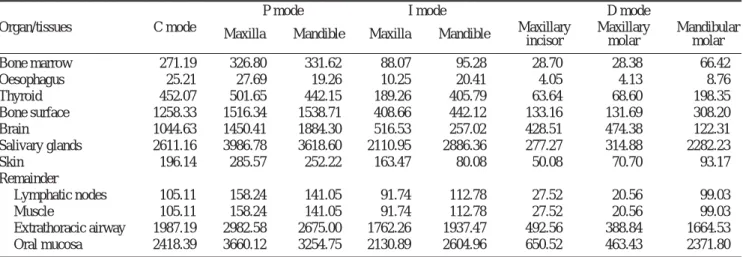
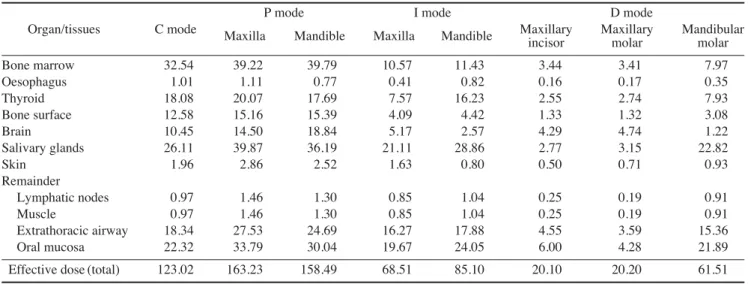
The equivalent and effective doses for each CBCT exa-
mination are shown in Tables 6-9. The effective doses in the adult exposure setting were 183.07μSv in the C mode and 303.66μSv and 288.48 μSv in the P mode for the maxilla and mandible, respectively. Additionally, the effec- tive doses for the I mode in the maxilla and mandible were 145.85μSv and 184.33 μSv, respectively. In the D mode, the effective doses were 22.34μSv, 25.26 μSv, and 93.67μSv for the maxillary incisors, maxillary molars, and mandibular molars, respectively.
The conversion coefficients
The conversion coefficients for each of the eight differ- ent CBCT examinations are shown in Table 10. For the C mode, the P mode at the maxilla, and the P mode at the mandible, the conversion coefficients were 0.049μSv/
mGycm2, 0.067μSv/mGycm2, and 0.064μSv/mGycm2, respectively. For the I mode, the conversion coefficients
Table 6.Equivalent dose (μSv) at various organ and tissues exposed on the adult standard exposure setting according to the imaging modes
P mode I mode D mode
Organ/tissues C mode
Maxilla Mandible Maxilla Mandible Maxillary Maxillary Mandibular incisor molar molar Bone marrow 427.20 627.60 609.27 195.50 217.46 42.94 41.28 95.36
Oesophagus 27.77 44.55 35.70 17.11 43.39 2.56 5.95 17.36
Thyroid 533.06 919.01 821.49 403.31 871.90 99.17 104.13 315.70 Bone surface 1982.22 2912.07 2827.00 907.14 1009.02 199.25 191.54 442.46 Brain 1529.75 2554.96 2833.88 1019.42 496.28 114.88 168.60 75.21 Salivary glands 4089.67 7355.99 6930.99 4544.42 6233.26 363.64 494.42 3570.25
Skin 292.24 512.18 420.73 308.08 147.07 72.80 132.99 130.64
Remainder
Lymphatic nodes 157.19 292.73 262.23 192.76 242.10 29.65 31.13 154.16 Muscle 157.19 292.73 262.23 192.76 242.10 29.65 31.13 154.16 Extrathoracic airway 2982.09 5530.58 4995.11 3707.09 4148.76 549.04 590.29 2586.57 Oral mucosa 3615.70 6721.28 6081.10 4476.34 5608.16 667.56 710.23 3694.11
Table 7.Equivalent dose (μSv) at various organ and tissues exposed on the low dose exposure setting according to the imaging modes
P mode I mode D mode
Organ/tissues C mode
Maxilla Mandible Maxilla Mandible Maxillary Maxillary Mandibular incisor molar molar Bone marrow 271.19 326.80 331.62 88.07 95.28 28.70 28.38 66.42
Oesophagus 25.21 27.69 19.26 10.25 20.41 4.05 4.13 8.76
Thyroid 452.07 501.65 442.15 189.26 405.79 63.64 68.60 198.35
Bone surface 1258.33 1516.34 1538.71 408.66 442.12 133.16 131.69 308.20 Brain 1044.63 1450.41 1884.30 516.53 257.02 428.51 474.38 122.31 Salivary glands 2611.16 3986.78 3618.60 2110.95 2886.36 277.27 314.88 2282.23
Skin 196.14 285.57 252.22 163.47 80.08 50.08 70.70 93.17
Remainder
Lymphatic nodes 105.11 158.24 141.05 91.74 112.78 27.52 20.56 99.03
Muscle 105.11 158.24 141.05 91.74 112.78 27.52 20.56 99.03
Extrathoracic airway 1987.19 2982.58 2675.00 1762.26 1937.47 492.56 388.84 1664.53 Oral mucosa 2418.39 3660.12 3254.75 2130.89 2604.96 650.52 463.43 2371.80
Table 8.Effective dose (μSv) on the adult standard exposure setting according to the imaging modes
P mode I mode D mode
Organ/tissues C mode Maxilla Mandible Maxilla Mandible Maxillary Maxillary Mandibular incisor molar molar
Bone marrow 51.26 75.31 73.11 23.46 26.10 5.15 4.95 11.44
Oesophagus 1.11 1.78 1.43 0.68 1.74 0.10 0.24 0.69
Thyroid 21.32 36.76 32.86 16.13 34.88 3.97 4.17 12.63
Bone surface 19.82 29.12 28.27 9.07 10.09 1.99 1.92 4.42
Brain 15.30 25.55 28.34 10.19 4.96 1.15 1.69 0.75
Salivary glands 40.90 73.56 69.31 45.44 62.33 3.64 4.94 35.70
Skin 2.92 5.12 4.21 3.08 1.47 0.73 1.33 1.31
Remainder
Lymphatic nodes 1.45 2.70 2.42 1.78 2.23 0.27 0.29 1.42
Muscle 1.45 2.70 2.42 1.78 2.23 0.27 0.29 1.42
Extrathoracic airway 27.53 51.05 46.11 34.22 38.30 5.07 5.45 23.88
Oral mucosa 33.38 62.04 56.13 41.32 51.77 6.16 6.56 34.10
Effective dose (total) 183.07 303.66 288.48 145.85 184.33 22.34 25.26 93.67
Table 9.Effective dose (μSv) on the low dose exposure setting according to the imaging modes
P mode I mode D mode
Organ/tissues C mode Maxilla Mandible Maxilla Mandible Maxillary Maxillary Mandibular incisor molar molar
Bone marrow 32.54 39.22 39.79 10.57 11.43 3.44 3.41 7.97
Oesophagus 1.01 1.11 0.77 0.41 0.82 0.16 0.17 0.35
Thyroid 18.08 20.07 17.69 7.57 16.23 2.55 2.74 7.93
Bone surface 12.58 15.16 15.39 4.09 4.42 1.33 1.32 3.08
Brain 10.45 14.50 18.84 5.17 2.57 4.29 4.74 1.22
Salivary glands 26.11 39.87 36.19 21.11 28.86 2.77 3.15 22.82
Skin 1.96 2.86 2.52 1.63 0.80 0.50 0.71 0.93
Remainder
Lymphatic nodes 0.97 1.46 1.30 0.85 1.04 0.25 0.19 0.91
Muscle 0.97 1.46 1.30 0.85 1.04 0.25 0.19 0.91
Extrathoracic airway 18.34 27.53 24.69 16.27 17.88 4.55 3.59 15.36
Oral mucosa 22.32 33.79 30.04 19.67 24.05 6.00 4.28 21.89
Effective dose (total) 123.02 163.23 158.49 68.51 85.10 20.10 20.20 61.51
Table 10.Conversion coefficients (E/DAP) according to the CBCT imaging modes
Imaging modes kV mA DAP
E (μSv) Conversion
(mGy cm2) coefficient (E/DAP)
C mode standard 80 6 3704 183
0.049
80 4 2485 123
P mode for maxilla 80 9 4499 304
0.067
80 5 2508 163
P mode for mandible 80 9 4499 288
0.064
80 5 2508 158
I mode for maxilla 80 8 1910 146
0.076
80 4 956 69
I mode for mandible 80 8 1910 184
0.095
80 4 956 85
D mode for maxillary incisors 80 9 644 22
0.038
80 6 429 20
D mode for maxillary molars 80 9 644 25
0.041
80 6 429 20
D mode for mandibular molars 80 9 644 94
0.146
80 6 429 62
at the maxilla and mandible were 0.076 μSv/mGycm2and 0.095 μSv/mGycm2, respectively. For the D mode at the maxillary incisors, molars, and mandibular molars, the conversion coefficients were 0.038 μSv/mGycm2, 0.041 μSv/mGycm2, and 0.146 μSv/mGycm2, respectively.
Discussion
Recently, investigation into the patient dose exposed during CBCT examination has been of increasing interest due to the profound dissemination of CBCT equipment in dental practice. This study showed that the DAP values of the Alphard VEGA CBCT examinations ranged from 644 mGycm2to 4499 mGycm2, the effective doses from 22 μSv to 304 μSv at the adult standard exposure. The voxel sizes in the CBCT scanner were 0.39 mm, 0.3 mm, 0.2 mm, and 0.1 mm in the C, P, I, and D modes, respectively.
In practice, each mode serves a specific purpose. The C mode (200 mm×179 mm) is primarily used for orthodon- tic analysis; the P mode (154 mm×154 mm) for the evaluation of both impacted third molars or the diagnosis of lesions at the maxillofacial region; the I mode (102 mm
×102 mm) for implant treatment planning involving more than three teeth or for the diagnosis of a jaw cyst;
and the D mode (51 mm×51 mm) for implant treatment planning involving one or two teeth, one impacted tooth, the diagnosis of a small jaw cyst, or unilateral TMJ eval- uation.
In descending order, the DAP values at the adult ex- posure setting were the highest in the P mode followed by the values in the C, I, and D mode. The differences among the DAP values tended to be proportional to the field size.21However, the DAP value in the C mode, the largest FOV, was lower than that in the P mode in this study. This may be because the tube current for the C mode was two- thirds of that in the P mode. This result is in agreement with a previous study that observed an increasing DAP value at each mode as the tube current value increased.21
The Health Protection Agency of the United Kingdom proposed the use of the DAP as the dose quantity for the regular assessment of patient dose for dental CBCT.20,29 The Health Protection Agency Working Party on dental CBCT suggested that DRLs should be set for both adult and child radiography and the adult protocol should be that used for the placement of the upper first molar im- plant in a standard adult patient and the child measure- ment should be made using the clinical protocol used to image a single impacted maxillary canine in a 12 year old
male.20 Given the wide range of DAP measurements re- corded for different CBCT models, it was not considered appropriate to derive a National Reference Doses based on the third quartile DAP measurement of a dose survey as this would be little benefit for dose optimization.20 Instead they presented the achievable dose, which was based on the third quartile DAP value of a dose survey, where the X-ray field size had been normalized to an appropriate size to adequately image the two views propos- ed above, 4 cm diameter × 4 cm height cylindrical vol- ume.20And an achievable dose of 250 mGycm2was pro- posed for the adult procedure based on data by 41 CBCT units.20The adjusted DAP value at D mode normalized to an area of 16 cm2was 396 mGycm2. Since this value was higher than the achievable dose suggested by the Health Protection Agency, it was required to investigate methods to reduce patient dose in the CBCT device used in this study.
The effective doses are different according to the irra- diated organs and areas of the body, despite being expos- ed by radiation with the same DAP value. The effective doses were calculated to determine the conversion coeffi- cients at each mode of different sites. The effective doses at the adult exposure setting ranged from 22 μSv to 304 μSv across all CBCT examinations. These values were similar to those of Pauwels et al9 who reported that the effective doses from 14 CBCT devices ranged from 19 μSv to 368 μSv. In this study, the effective dose for the P mode at the maxilla was the highest. This might be due to the high tube current and large FOV in the P mode as well as the involvement of the radiosensitive salivary glands at the maxilla. In the D mode, a high variation from 22 μSv to 94 μSv was found according to the irra- diated regions, and the effective dose at the maxillary in- cisors was lowest, but that of the mandibular molars was the highest. The high irradiation among these radiosen- sitive salivary glands may have influenced these results.
Previous studies about the conversion coefficients for other imaging modalities in dental radiology reported 0.009-0.108 μSv/mGycm2for intraoral periapical radiogra- phy,250.087-0.131 μSv/mGycm2for panoramic radiogra- phy,25 and 0.056-0.077 μSv/mGycm2 for lateral cephalo- metric radiography (ICRP 2006, draft).26 In this study, ICRP 103 tissue weighting factors were used to calculate the effective doses. In the D mode, the conversion coeffi- cient for the maxillary incisors was the lowest and that for the mandibular molars was the highest. These results were similar to those from the intraoral periapical radiographic
study,25which showed the lowest conversion factors for maxillary incisor and highest for mandibular molar.25 In addition, the conversion coefficients tended to be dependent on tube voltage.25,26However, we did not investigate the effect of tube voltage on the conversion coefficient because the CBCT scanner used in this study had a fixed tube vol- tage. Further research using a CBCT scanner with an ad- justable tube voltage is needed.
In summary, the present study demonstrates the conver- sion coefficients in one CBCT device with fixed 80kV ranged from 0.038 μSv/mGycm2 to 0.146 μSv/mGycm2 according to the imaging modes and irradiated region and were highest for the D mode at the mandibular molar.
References
1. Arai Y, Tammisalo E, Iwai K, Hashimoto K, Shinoda K.
Development of a compact computed tomographic apparatus for dental use. Dentomaxillofac Radiol 1999; 28: 245-8.
2. Momin MA, Matsumoto K, Ejima K, Asaumi R, Kawai T, Arai Y, et al. Correlation of mandibular impacted tooth and bone morphology determined by cone beam computed topo- graphy on a premise of third molar operation. Surg Radiol Anat 2013; 35: 311-8.
3. Patel S, Dawood A, Whaites E, Pitt Ford T. New dimensions in endodontic imaging: part 1. Conventional and alternative radiographic systems. Int Endod J 2009; 42: 447-62.
4. Silva MA, Wolf U, Heinicke F, Bumann A, Visser H, Hirsch E. Cone-beam computed tomography for routine orthodontic treatment planning: a radiation dose evaluation. Am J Orthod Dentofacial Orthop 2008; 133: 640.e1-5.
5. Lofthag-Hansen S, Gröndahl K, Ekestubbe A. Cone-beam CT for preoperative implant planning in the posterior mandible:
visibility of anatomic landmarks. Clin Implant Dent Relat Res 2009; 11: 246-55.
6. Loubele M, Bogaerts R, Van Dijck E, Pauwels R, Vanheus- den S, Suetens P, et al. Comparison between effective radiation dose of CBCT and MSCT scanners for dentomaxillofacial applications. Eur J Radiol 2009; 71: 461-8.
7. Jeong DK, Lee SC, Huh KH, Yi WJ, Heo MS, Lee SS, et al.
Comparison of effective dose for imaging of mandible bet- ween multi-detector CT and cone-beam CT. Imaging Sci Dent 2012; 42: 65-70.
8. Roberts JA, Drage NA, Davies J, Thomas DW. Effective dose from cone beam CT examinations in dentistry. Br J Radiol 2009; 82: 35-40.
9. Pauwels R, Beinsberger J, Collaert B, Theodorakou C, Rogers J, Walker A, et al. Effective dose range for dental cone beam computed tomography scanners. Eur J Radiol 2012; 81: 267- 71.
10. Qu XM, Li G, Ludlow JB, Zhang ZY, Ma XC. Effective radiation dose of ProMax 3D cone-beam computerized tomo- graphy scanner with different dental protocols. Oral Surg Oral Med Oral Pathol Oral Radiol Endod 2010; 110: 770-6.
11. Davies J, Johnson B, Drage N. Effective doses from cone beam
CT investigation of the jaws. Dentomaxillofac Radiol 2012;
41: 30-6.
12. Theodorakou C, Walker A, Horner K, Pauwels R, Bogaerts R, Jacobs R, et al. Estimation of paediatric organ and effective doses from dental cone beam CT using anthropomorphic phan- toms. Br J Radiol 2012; 85: 153-60.
13. ICRP. Diagnostic reference levels in medical imaging: review and additional advice. A web module produced by Committee 3 of the International Commission on Radiological Protection (ICRP) [Internet]. Otawa: ICRP; 2001 [cited 2012 September 30]. Available from http://www.icrp.org/docs/DRL_for_web.
pdf.
14. Kim EK. Development of diagnostic reference level in dental x-ray examination in Korea [Internet]. Osong: Korea Food and Drug Administration; 2009 [cited 2012 September 30]. Avail- able from: http://rnd.mfds.go.kr.
15. Goo HW. Development of the diagnostic reference level of pediatric chest radiography [Internet]. Osong: Korea Food and Drug Administration; 2009 [cited 2012 September 30]. Avail- able from: http://rnd.mfds.go.kr.
16. Kim HJ. Study for establishment of diagnostic reference level of patient dose in skull radiography [Internet]. Osong: Korea Food and Drug Administration; 2009 [cited 2012 September 30]. Available from: http://rnd.mfds.go.kr/.
17. Sung DW. Investigation of patient dose for diagnostic refer- ence levels (DRL) in radiographic examination: National sur- vey in Korea [Internet]. Osong: Korea Food and Drug Admi- nistration; 2011 [cited 2012 September 30]. Available from:
http://rnd.mfds.go.kr.
18. Thilander-Klang A, Helmrot E. Methods of determining the effective dose in dental radiology. Radiat Prot Dosimetry 2010;
139: 306-9.
19. Helmrot E, Alm Carlsson G. Measurement of radiation dose in dental radiology. Radiat Prot Dosimetry 2005; 114: 168-71.
20. Holroyd JR, Walker A. HPA-RPD-065. Recommendations for the design of X-ray facilities and quality assurance of den- tal Cone Beam CT (Computed Tomography) systems. Chilton:
Health Protection Agency; 2010.
21. Lofthag-Hansen S, Thilander-Klang A, Ekestubbe A, Helmrot E, Gröndahl K. Calculating effective dose on a cone beam computed tomography device: 3D Accuitomo and 3D Accui- tomo FPD. Dentomaxillofac Radiol 2008; 37: 72-9.
22. Schultz FW, Zoetelief J. Dose conversion coefficients for interventional procedures. Radiat Prot Dosimetry 2005; 117:
225-30.
23. Compagnone G, Giampalma E, Domenichelli S, Renzulli M, Golfieri R. Calculation of conversion factors for effective dose for various interventional radiology procedures. Med Phys 2012; 39: 2491-8.
24. Hart D, Wall BF. NRPB-W4. Radiation exposure of the UK population from medical and dental X-ray examinations.
Chilton: National Radiological Protection Board; 2002.
25. Looe HK, Eenboom F, Chofor N, Pfaffenberger A, Steinhoff M, Rühmann A, et al. Conversion coefficients for the esti- mation of effective doses in intraoral and panoramic dental radiology from dose-area product values. Radiat Prot Dosi- metry 2008; 131: 365-73.
26. Looe HK, Eenboom F, Chofor N, Pfaffenberger A, Sering M,
Rühmann A, et al. Dose-area product measurements and de- termination of conversion coefficients for the estimation of effective dose in dental lateral cephalometric radiology. Ra- diat Prot Dosimetry 2007; 124: 181-6.
27. Ludlow JB, Ivanovic M. Comparative dosimetry of dental CBCT devices and 64-slice CT for oral and maxillofacial radiology. Oral Surg Oral Med Oral Pathol Oral Radiol Endod 2008; 106: 106-14.
28. The 2007 Recommendations of the International Commission on Radiological Protection. ICRP publication 103. Ann ICRP 2007; 37: 1-332.
29. Radiation protection No. 172. Evidence based guidelines on cone beam CT for dental and maxillofacial radiology [Inter- net]. Luxemburg: European commission; 2012 [cited 2012 September 30]. Available from: http://ec.europa.eu/energy/
nuclear/radiation_protection/doc/publication/172.pdf.