Vol. 16, No. 12 pp. 8424-8436, 2015
Effect of Leadership Style of CEO on Self-leadership and Organizational Effectiveness
Joon-Ho Kim
1, Jeong-Ho Heo
2, Hyuk-Soo Jang
3, Bum-Ki Park
4, Hyo-Jin Shin
5*1Education Team, Garam Education
2Research Team, Showple Innovation
3EHS Team, Ernst & Young Han Young
4Department of Multicultural Welfare, Seoul Social Welfare Graduate University
5Department of Business Administration, Seoul School of Integrated Sciences & Technologies
상사의 리더십 유형이 셀프리더십과 조직유효성에 미치는 영향
김준호1, 허정호2, 장혁수3, 박범기4, 신효진5*
1가람 에듀케이션 교육팀, 2쇼플 이노베이션 리서치팀, 3EY한영 EHS팀,
4서울사회복지대학원 대학교 다문화복지학과, 5서울과학종합대학원 경영학과
Abstract This research recognizes the importance of the study on leadership for the management of enterprises.
Among the financial institutes, the employees at the banks were targeted in this study to empirically analyze the effects of superiors’ leadership (transformational leadership, transactional leadership, and servant leadership) on the subordinates’ self-leadership and organizational effectiveness (organizational commitment and organizational citizenship behavior). In particular, this study analyzed the influencing relationship between the superior’s leadership style and the subordinates’ self-leadership, to identify the leadership style most suitable for enhancing the subordinates’ self-leadership and to further determine if it can lead to the enhancement of organizational commitment and organizational citizenship behavior. The employees at approximately 50 branches of domestic large corporate banks located in Seoul and Gyeonggi area were targeted, and the survey was conducted in the form of self-response questionnaire. The statistical analysis was conducted on a total of 338 valid data by using structural equation modeling analysis. The result of the analysis was as follows. The transformational and servant leadership of the superior had a positive effect on the self-leadership of the subordinate, and transactional leadership did not show a significant effect. Furthermore, self-leadership was shown to have a positive effect on organizational commitment and organizational citizenship behavior.
요 약 본 연구는 기업 경영에서 리더십 연구의 중요성을 이해하고 금융업 중, 은행 종사자를 대상으로 상사의 리더십(변혁 적, 거래적, 서번트)이 부하의 셀프리더십과 조직유효성(조직몰입, 조직시민행동)에 어떠한 영향을 미치는지를 실증적으로 분석하였다. 특히 본 연구는 상사의 리더십 유형과 부하의 셀프리더십 영향관계를 분석하여 부하의 셀프리더십을 향상 시키 는 적합한 상사의 리더십 유형이 무엇인지를 밝히고자 하였으며, 이를 통해 조직몰입과 조직시민행동을 높일 수 있는지를 규명하고자 하였다. 따라서 국내 서울/경기지역에 위치한 대기업 은행의 약 50여개 영업점 직원들을 대상으로 자기 응답형식 방법으로 설문조사를 진행하였고, 유효한 338명의 데이터를 바탕으로 구조방정식 모형 분석으로 통계분석을 실시하였으며, 분석결과는 다음과 같다. 상사의 변혁적, 서번트 리더십은 부하의 셀프리더십에 긍정적인 영향을 미치며, 거래적 리더십은 유의한 영향을 미치지 못하는 것으로 분석되었다. 또한 셀프리더십은 조직몰입과 조직시민행동에 긍정적인 영향을 미치고 있음이 확인되었다. 이에 본 연구는 다양하고 복잡한 은행 업무환경에서 조직구성원들을 하나로 융합시키고 셀프리더십을 높일 수 있는 상사의 리더십 유형을 실증적으로 규명하였다는 것에 연구의의가 있다고 할 수 있다.
Keywords : Superiors’ Leadership, Transformational Leadership, Transactional Leadership, Servant Leadership, Subordinates’
Self-leadership, Organizational Effectiveness
*Corresponding Author : Hyo-Jin Shin (aSSIST) Tel: +82-10-3287-6156 email: [email protected] Received August 28, 2015
Accepted December 4, 2015
Revised (1st November 2, 2015, 2nd November 18, 2015) Published December 31, 2015
1. Introduction
The reason why leadership is important in the management of an enterprise is not simply because it is a role for leading an organization. Leadership induces active participation and motivation of the organization members in their jobs and for the organization, and it contributes to performance achievement which is an ultimate goal of an enterprise.
Jack Welch, the former president of GE (General Electric), has stated that excellent superior is a friend, teacher, and an ally of the organization members, as well as the source for inspirations. Such superior can even transform the lives of the employees. The leadership is the primary point for management that the top executives should focus on. However, according to the survey by LG Economic Research Institute in 2008, the rate of satisfaction on leadership that the employees in Korea have reported was only 44.1 out of 100 points. The leadership satisfaction rate between the staff and manager, which is the relationship greatly influenced by the superiors’ leadership, was only 40.8.
Therefore, the lower ranks were shown with significantly worse satisfaction rate. Excellent management and effective leadership are the most fundamental and yet the most difficult resource to obtain. Therefore, there is an urgent need for studies on the superiors’ leadership styles.
The importance of superiors’ leadership within an organization has also been shown in the result of survey conducted by Samsung Economic Research Institute in 2013. The happy employees showed their satisfaction rate regarding support from organization and their superiors to be 68 points, which is 27 points higher than the unhappy employees who rated with 41 points. The work engagement was 80 points for the happy employees, which showed a great difference from the 60 points by the unhappy employees. This shows that the superiors’ leadership has a great influence on the employees’ happiness as well as on their commitment to organization and jobs.
Furthermore, setting an example by the superior is a voluntary and sacrificial behavior which is not linked to direct reward, but it has a great influence on the organization. The recognition of the problem and intention for making improvement would intellectually stimulate the subordinates, which positively effects on the organization in overall[1].
Particularly in the service industry, the human resource management has mostly been considering from the production-oriented aspects, but it is recently becoming more important to approach from the members’ perspectives[2]. Since the IMF financial crisis of the late 1990’s, merges between banks have been continuously occurring. In this environment, the study on leadership is crucial for unifying the organization members who come from different organizational cultures. The attitudes and behaviors of the organization members are directly related to the growth and survival of the service corporates, so the studies on leadership is very important in the servicing institutes such as banks, because the job requires direct contact with customers.
In the previous studies on superiors’ leadership, the empirical studies have been conducted by generally distinguishing the leadership styles as follows. First, transformational leadership induces trust and belief of the subordinates. The leader selects definite goal for the subordinates, to provide appropriate stimulation leading to performances of the organization and satisfaction of the members[3]. Second, transactional leadership is when the subordinates comply with the leader while being diligent in their jobs. In return, leader would provide reward to the subordinate, which makes the transactional relationship the focus of this leadership style. The leader can provide reward or penalty to motivate the subordinates to enhance their performances[4]. Third, servant leadership is having respect for the subordinates and providing opportunities for them to express their creativity. The organization is led to become a true community, which would enhance the organizational effectiveness[5].
Concluding the above previous studies, the representative leadership styles are transformational, transactional, and servant leadership, which have been analyzed to show that they enhance the organizational effectiveness. However, there are insufficient studies on how diverse leadership styles of superiors can enhance the self-leadership of the subordinates, which can in turn increase organization effectiveness. Especially, there is no empirical analysis on the bank employees, among the financial institute. In this study, the effect of superiors’ leadership (transformational, transactional, and servant) on the subordinates’ self-leadership and the significant effect of self-leadership on organizational effectiveness (organizational commitment and organizational citizenship behavior) were highlighted by using empirical analysis. Furthermore, this study analyzed the influencing relationship between superiors’ leadership style and subordinates’ self-leadership, and the appropriate superiors’ leadership style that enhances subordinates’ self-leadership was identified to determine if this can enhance organizational commitment and organizational citizenship behavior.
2. Theoretical Background
2.1 Leadership
The leadership is defined as the process of social influence where one person receives support and help from other members, and it is leading the members toward consistent direction in order to achieve the goal of the organization[6]. Leadership occurs in the process of interaction between two or more people within an organization, and it is the process where a leader influences on the subordinates intentionally[7].
Leadership occurs when the leader influences on each organization member’s ability or behaviors in order to achieve the goal, and it is the ability to lead them toward the desirable direction. In this study, the leadership styles of superior were distinguished into transformational leadership, transactional leadership, and servant leadership, and the previous studies related
to self-leadership were reviewed.
2.2 Transformational Leadership
Transformational leadership is primarily focused on organization members’ transformations, and it further aims for the transformation of the organization in overall[1]. This leadership requires charisma for the organization members to trust the leader, and it requires the ability to detect demands for changes in the organization and to induce changes by providing new visions. This is greatly different from the traditional transactional leadership[8].
The transformational leadership constructs the unity of an organization, and the vision and strategies are specifically indicated, so that positive thinking and hope can be created in any situations[9,10,11].
Transformational leadership can produce collective intelligence, rather than focusing on an individual. The leader and the organization members strive toward the common goal. As they share the success with the organization members, the leader can gain the members’ passion and affection[1,12,13]. The leader’s transformational leadership would provide environmental stimulation and enhance the subordinates’ self-leadership. This would bring performance outcomes and induce the organization members to develop affection, pride, and devotion about their organization[14]. Therefore, the organization members who follow the transformational leader would become the self-leaders. The entire organization would produce creativity and productivity.
This would have positive effect on organization members’ performances and their tasks, which would lead them to develop favorable attitude toward their tasks and goals[14].
2.3 Transactional Leadership
Transactional leadership is providing reward in return for the appropriate level of effort and outcomes, by understanding the desires of the employees for them to perform the assigned tasks more effectively. This leadership is based on the transaction between the
leader and the subordinates[15]. In this transactional leadership, the leader clearly shows the goal and the details of reward that the subordinate would get once the goal is achieved. The subordinate would clearly recognize the value of reward and would put efforts to achieve the goal[16]. The members under this leadership would receive reward in return for their performances, and the leaders would receive profit from the completion of this job[17].
The subordinates of the transactional leader would produce efforts corresponding to the reward and support that they received, in order to achieve the assigned task and goal. A transactional leader assigns and categorizes the tasks to be performed in order to achieve a goal, and the organization members would perform the task by putting appropriate amount of effort. Then, they would receive the reward in return for their performances. The stability and effort are integrated within the entire organization[4]. The transactional leadership induces the organization members to develop potential for diligently performing their tasks. The workers are stimulated through rewards rather than by external control. This energizes and invigorates the employees, allowing them to perform autonomously[18]. In other words, the transactional leadership fundamentally contains the relationship of mutual profit between leader and subordinates.
However, it also has a characteristic of exchanging psychological satisfaction with the benefits, so the self-leadership of the subordinates are stimulated.
Therefore, it leads them to set the achievement goals and to have autonomy regarding rewards and criticism for their goal achievement, which has a positive effect on job performances[19,20].
2.4 Servant Leadership
Servant leadership is a theory of leadership as an act of services. This theory suggests that the leader who is attending and listening to the demands and suggestions of the organization members and having servant-like attitude to help the members would be respected by the
members and become an excellent leader[21].
According to the servant leadership, in order to become a respected leader, one should lead the members to maximally perform their abilities by respectfully and sacrificially servicing the subordinates[22].
The servant leader may provide support and create working environment for the organization members. An individual who is just starting to work at a new organization may have self-leadership, but it would not be easy to perform one’s leadership in an unfamiliar environment. In such situation, the subordinate is greatly effected by the superior. The superior would provide instructions and the subordinate can learn by watching the superior; this helps one to adapt to the new working environment[5]. This act of leading a subordinate to adapt well to the environment is the servant leadership. Therefore, the servant leader recognizes the environment surrounding the organization and knows the outcomes of the work. The leader considers the subordinates’ competency when assigning tasks, so that the subordinates can maximally perform[23].
Self-leadership is basically the individual’s independent behavior of improving one’s attitude and mindset. Such self-leadership can be developed through training and education from the superior’s servant leadership[24]. The servant leadership allows organization members to freely express diversity and creativity, and it lets them have sense of responsibility on their jobs and to be able to actively react to the changing environment[25].
2.5 Self-leadership
Self-leadership is autonomous leadership or one’s own leadership, and it indicates individual’s leading oneself. If the super leadership, from the perspective of a leader, is a process of supporting the followers to be able to control and regulate themselves, make necessary decisions, and to facilitate their leading abilities, the followers would perceive that they are the leaders responsible for their behaviors and being in
control; this is called the self-leadership[26].
The self-leadership allows an individual to direct ones behavior and perception in the desirable direction for performing ones tasks. The driving force of an individual is the belief that one is in charge of the given task. The self-leaders develop ownership in the process of performing their tasks, and through this they develop greater amount of affection and passion[27].
When the organization members perform self-leadership and express ownership in their job, they show greater level of commitment and citizenship behavior compared to other members without the self-leadership[28]. An individual, who is performing self-leadership, would motivate oneself to enhance the satisfaction on one’s job, and one would be able to have persistence to continuously strive for self-development. This will further enhance the sense of loyalty and belongingness toward one’s organization. Utilizing self-leadership as a strategy may be an important variable determining success or failure of a business management.
3. Research Method
3.1 Research Model and Hypothesis
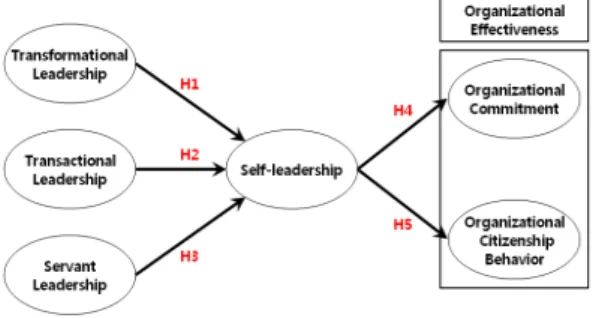
The aim of this study is to find the effect of superiors’ transformational, transactional, and servant leadership on the subordinates’ self-leadership, and to empirically investigate if self-leadership has a positive effect on organizational commitment and organizational citizenship behavior. This study developed the following research model, based on the previous studies and theoretical foundation, and the hypotheses were set.
Fig. 1. Research model
[Hypothesis 1] The transformational leadership of a superior will have a positive effect on the self-leadership of the subordinates.
[Hypothesis 2] The transactional leadership of a superior will have a positive effect on the self-leadership of the subordinates.
[Hypothesis 3] The servant leadership of a superior will have a positive effect on the self-leadership of the subordinates.
[Hypothesis 4] The self-leadership will have a positive effect on the organizational commitment.
[Hypothesis 5] The self-leadership will have a positive effect on the organizational citizenship behavior.
3.2 Measurement Tool and Method
The transformational leadership and transactional leadership were based on the MLQ (Multifactor Leadership Questionnaire), which is the measurement tool developed by Bass & Avolio[29]. For the transformational leadership, 6 questions from the study by Yang & Shim[1] were used, which were tested for reliability and validity. For the transactional leadership, 4 questions from the study by Lee et al.[16], which were tested for reliability and validity, were used after modifying according to the objective of this study. For servant leadership, measurement tool from the study by Barbuto & Wheeler[24] was used. The 5 questions from the study by Koo, Jung, & Eu[30], which were tested for reliability and validity, were used after modifying according to the objective of this study. For self-leadership, the measurement tool from the study by Neck & Houghton[31] was used. The 6 questions from the study by Chang & Chong[32], which were tested for reliability and validity, were used after modifying according to the objective of this study. For the organizational commitment in organizational effectiveness, the measurement tool developed by Meyer, Allen, & Smith[33] was used. The 4 questions from the study by Kim & Kim[34], which were tested
for reliability and validity, were used after modifying according to the objective of this study. For the organizational citizenship behavior, the items from the study by Organ[35] were used. The four questions from the study by Kil & Kwahk[36], which were tested for reliability and validity, were used after modifying according to the objective of this study.
4. Empirical Analysis
4.1 Study Target and Data Collection The survey of this study was conducted for approximately 45 days, from November 15th to December 28th of 2014, on the employees at about 50 branches of domestic large corporate banks within Seoul and Gyeonggi areas. The survey was conducted in the form of self-response questionnaires. In order to obtain good responses on the survey, cooperation was obtained from the related personnel such as sales department manager and the branch manager. A total of 400 questionnaires were distributed, and 362 were collected. Among these, 24 questionnaires were excluded from this study due to insufficient responses, and the 338 (84.5%) questionnaires were used in this study.
4.2 Demographic Characteristics
Demographic characteristics for the total of 338 respondents were as follows. There were 182 (53.8%) females and 156 (46.2%) males. For the age groups, there were 129 (38.2%) in their 30’s, 117 (34.6%) in their 40’s, 62 (18.3%) in their 20’s, and 30 (8.9%) in their 50’s or above. For the education levels, 232 (68.6%) had bachelor’s degree, 48 (14.2%) had high school diploma, and 28 (8.3%) had associate’s degree and master’s degree respectively, and 2 (0.6%) had doctor’s degree. For work experiences, 102 (30.2%) had 1-5 years of experience, 59 (17.5%) had 16-20 years, 57 (16.9%) had 6-10 years, 53 (15.7%) had 21-25 years, 35 (10.4%) had 11-15 years, and 32
(9.5%) had 26 years or above. For the job positions, there were 99 staffs (29.3%), 75 assistant managers (22.2%), 46 managers (13.6%), 92 deputy general manager (27.2%), and 26 branch managers (7.7%).
4.3 Reliability and Validity of the Measurement Tool
4.3.1 Reliability Analysis
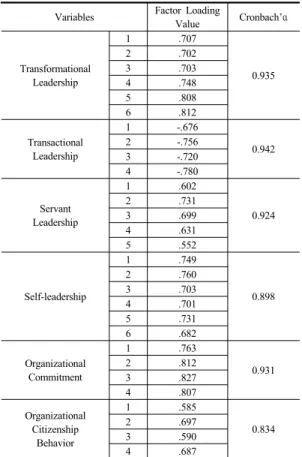
Variables Factor Loading
Value Cronbach’α
Transformational Leadership
1 .707
0.935
2 .702
3 .703
4 .748
5 .808
6 .812
Transactional Leadership
1 -.676
0.942
2 -.756
3 -.720
4 -.780
Servant Leadership
1 .602
0.924
2 .731
3 .699
4 .631
5 .552
Self-leadership
1 .749
0.898
2 .760
3 .703
4 .701
5 .731
6 .682
Organizational Commitment
1 .763
0.931
2 .812
3 .827
4 .807
Organizational Citizenship
Behavior
1 .585
0.834
2 .697
3 .590
4 .687
Note) The factors with Eigen value of greater than 1 were extracted after Varimax rotation. The accumulation factors of the explained variance for each extracted factor was 76.141%.
Table 1. Reliability of the variables and the exploratory factor analysis result
The Cronbach’s alpha coefficient is the most commonly used measurement for reliability index in research papers. When Cronbach’s alpha coefficient is 0.6 or above, it is good. When it is above 0.7, the reliability can be considered to be high. In this study, the reliability test on all factors showed 0.7 or above.
Route Standardized
Coefficients S·E C·R P AVE C·C·R
Transformational Leadership
→ 1 0.853 Fix - -
.942 .731
→ 2 0.877 0.042 26.231 .000
→ 3 0.795 0.052 17.573 .000
→ 4 0.836 0.051 19.069 .000
→ 5 0.780 0.057 17.105 .000
→ 6 0.804 0.055 17.970 .000
Transactional Leadership
→ 1 0.924 Fix - -
.956 .845
→ 2 0.923 0.033 30.339 .000
→ 3 0.966 0.029 35.488 .000
→ 4 0.768 0.044 19.322 .000
Servant Leadership
→ 1 0.825 Fix - -
.940 .760
→ 2 0.817 0.052 17.831 .000
→ 3 0.813 0.055 17.730 .000
→ 4 0.829 0.055 18.280 .000
→ 5 0.896 0.052 20.653 .000
Self-leadership
→ 1 0.710 Fix - -
.948 .752
→ 2 0.713 0.056 16.105 .000
→ 3 0.813 0.086 14.055 .000
→ 4 0.837 0.087 14.448 .000
→ 5 0.765 0.077 13.263 .000
→ 6 0.747 0.077 12.965 .000
Organizational Commitment
→ 1 0.825 Fix - -
.954 .839
→ 2 0.887 0.057 20.349 .000
→ 3 0.897 0.055 20.726 .000
→ 4 0.907 0.059 21.097 .000
Organizational Citizenship
Behavior
→ 1 0.773 Fix - -
.920 .742
→ 2 0.734 0.072 13.603 .000
→ 3 0.736 0.083 13.630 .000
→ 4 0.750 0.075 13.923 .000
χ²=777.742, df=357, p=0.000, RMR=0.020, GFI=0.871, AGFI=0.843, CFI=0.953, RMSEA=0.059 Table 2. Confirmatory Factor Analysis Result of Variables
Therefore, the reliability is shown to be high.
Furthermore, in order to test validity, the exploratory factor analysis was conducted through Varimax rotation. The analysis result showed that the loading values for all factors were 0.5 or above, which shows a high level of validity.
4.3.2 Confirmatory Factor Analysis
In this study, confirmatory factor analysis was performed in order to derive measurement model for each research units for the measurement items. The fitness was evaluated to derive optimal configuration of each item, and the following were used: χ², GFI, AGFI, CFI, RMR. Commonly, when GFI, AGFI, and CFI are above 0.8∼0.9, it is considered to be good.
When RMR is below 0.05 and RMSEA is in the range of .05∼.08, it is considered to be acceptable. [Table 2]
shows the result of confirmatory factor analysis, and all
indicators, with the exclusion of a portion of goodness of fit index, were shown to meet the recommended level. Furthermore, t-values for the factor load value of the each measurement items were all statistically significant. The measurement of each concept constructing the model was shown to have convergent validity. In addition, AVE and CR for each latent factor were shown to be 0.7 or above and 0.6 or above, respectively. The CCR (Composite Construct Reliability) is shown to be .731∼.845, so it was determined to have convergent validity.
4.4 Hypotheses Testing 4.4.1 Correlation Analysis
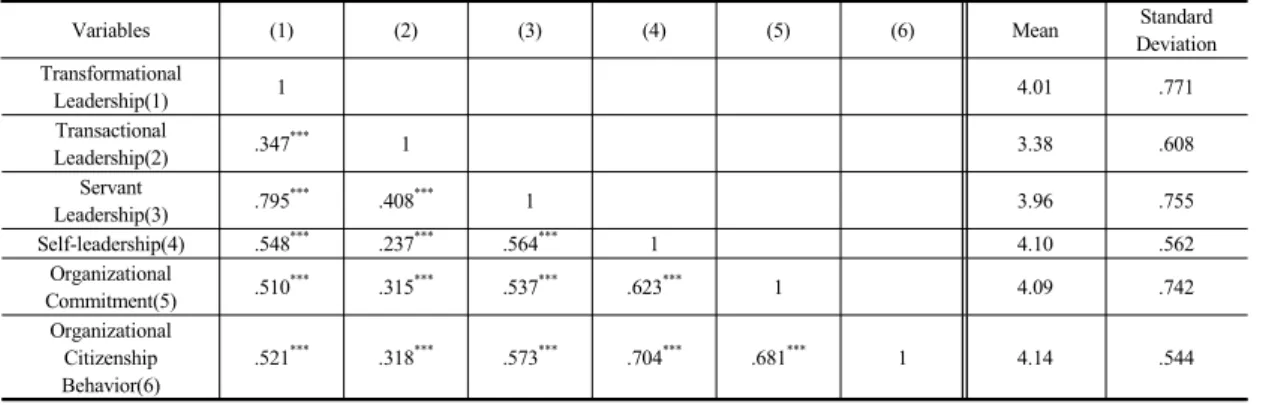
This study used the Pearson correlation coefficient, which is most commonly used, for the correlation analysis. [Table 3] shows the result of correlation analysis between the variables.
Variables (1) (2) (3) (4) (5) (6) Mean Standard Deviation Transformational
Leadership(1) 1 4.01 .771
Transactional
Leadership(2) .347*** 1 3.38 .608
Servant
Leadership(3) .795*** .408*** 1 3.96 .755
Self-leadership(4) .548*** .237*** .564*** 1 4.10 .562
Organizational
Commitment(5) .510*** .315*** .537*** .623*** 1 4.09 .742 Organizational
Citizenship Behavior(6)
.521*** .318*** .573*** .704*** .681*** 1 4.14 .544
*** p<.01
Table 3. Correlation Coefficient
When the correlation coefficient between two variables is 0.8 or above, the two variables can be considered as the same variable; and this can cause problems of multi-collinearity. However, correlation coefficient of the variables was shown to be less than 0.8 in this study, so discriminant validity is secured.
4.4.2 Structural equation analysis
To test the research model in this study, the measurement model which was derived from exploratory factor analysis and confirmatory factor analysis was reconstructed into structural equation model to fit for hypothesis. AMOS 18.0 was used to determine statistical significance of the hypothesis. The maximum likelihood was used for parameter estimation, and the results are shown in [Table 4].
Finally, for the evaluation of goodness of fit of the research model, normed-χ²=2.304 was shown to meet empirical criterion of 3 or below, and GFI=0.862, AGFI=0.835, NFI=0.910, CFI=0.947 were all shown to be 0.8 or above. RMR=0.031, RMSEA=0.062 were shown, so structural equation model was evaluated to be fit. The significance level in this study was set to at least p<.10, which meets the standard for social sciences. Then, the hypotheses were determined to be supported or not supported. Since study sample had broad range in age, work years, etc. the error range was set by expanding it to 90% of reliability level. As the result of structural model analysis, the result of the
hypotheses test in this study was as follows.
[Hypothesis 1] “The transformational leadership will have significantly positive effect on the self-leadership”
was supported, with the standardized coefficient of .265(t=1.921, p<.10). Therefore, the transformational leadership was statistically shown to have a positive effect on the subordinate’s self-leadership.
[Hypothesis 2] “The transactional leadership will have significantly positive effect on self-leadership”
was not supported, with the standardized coefficient of -.018(t=-0.191, p>.10). The transactional leadership was shown to have no statistically significant effect on the subordinate’s self-leadership. Although the hypothesis was not supported, the transactional leadership was shown to have a negative influence on the self-leadership of the subordinates.
[Hypothesis 3] “The servant leadership will have significantly positive effect on the self-leadership” was supported, with the standardized coefficient of .412(t=2.956, p<.01). The servant leadership was statistically shown to have a positive effect on the subordinate’s self-leadership. Furthermore, the servant leadership was shown to have the greatest effect on the subordinate’s self-leadership.
[Hypothesis 4] “The self-leadership will have significantly positive effect on the organizational commitment” was supported, with the standardized coefficient of .737(t=11.263, p<.01). The employee with the greater level of self-leadership was shown to
Hypothesis Route S·C S·E C·R P S·M·C Supported/
Not Supported H1 Transformational-L → Self-L .265 .092 1.921 .055
.454
Supported H2 Transactional-L → Self-L -.018 .057 -0.191 .849 Not Supported
H3 Servant-L → Self-L .412 .094 2.956 .003 Supported
H4 Self-L → OC .737 .084 11.263 .000 .543 Supported
H5 Self-L → OCB .865 .071 11.930 .000 .747 Supported
Table 4. Hypothesis Test Results for the Influencing Relationships between Variables
have a greater degree of organizational commitment.
[Hypothesis 5] “The self-leadership will have significantly positive effect on the organizational citizenship behavior” was supported, with the standardized coefficient of .865(t=11.930, p<.01). The subordinates with the higher level of self-leadership was shown to have a greater degree of organizational citizenship behavior.
5. Conclusion
This research recognizes the importance of the study on leadership for the management of enterprises.
Among the financial institutes, the employees at the banks were targeted in this study to empirically analyze the effects of superiors’ leadership (transformational leadership, transactional leadership, and servant leadership) on the subordinates’ self-leadership and organizational effectiveness (organizational commitment and organizational citizenship behavior).
In particular, this study analyzed the influencing relationship between the superior’s leadership style on the subordinates’ self-leadership, to identify the leadership style most suitable for enhancing the subordinates’ self-leadership and to further determine if it can lead to the enhancement of organizational commitment and organizational citizenship behavior.
The result of the analysis can be summarized as follows.
First, the transformational leadership of a superior was shown to have a positive effect on the self-leadership of the subordinates. This supports the previous study by Ma & Oh[14]. The superior would motivate by providing clear vision regarding the goal,
and this would stimulate positive energy in the subordinates, leading one to develop stronger self-leadership. In conclusion, the vision and influence coming from a superior induce sense of duty in the subordinates.
This in turn positively effects on the perception, behaviors, and attitudes of the subordinate, which serves as a driving force for spontaneously enhancing the self-leadership.
Second, the transactional leadership of a superior was not shown to have a significant effect on the self-leadership of the subordinates. When a subordinate follows the transactional leadership of a superior, the individual can obtain what one desires. However, the subordinate would not perform the self-leadership such as trying to solve the problems in order to carry out the given tasks or creating suitable working environment.
Even though a transactional leadership has a system of setting organizational goal and providing rewards, if the organization members do not place values in such system, it will not be able to have positive effect.
According to the characteristic of the jobs in banking, the superior should stimulate internal influence and energy, instead of imposing external controls, so that the autonomous control could be activated.
Third, the servant leadership of a superior was shown to have a positive effect on the self-leadership of the subordinates. This supports the previous study by Barbuto & Wheeler[24], Kim & Jung[25]. Based on the characteristic of the job, communicating and coming into agreement through interactions, instead of receiving instructions from the superior, may lead the members to consider themselves as a part of the organization; and forming consensus among the members and having a sense of belonging to the
organization served an important role in determining the performances of the organization. Conclusively, a superior should hold an attitude of listening carefully to the subordinates and should try to share perceptions with them. In making decisions, the superior should generate subordinates’ opinions as much as possible, before putting forth one’s own suggestion.
Fourth, the self-leadership of the subordinates was shown to have significantly positive effect on the organizational effectiveness of organizational commitment and organizational citizenship behavior.
This is in line with the study by Oh & Yook[27], Lee
& Yang[28]. Through the right leadership of the superior, the subordinates may carry out self-management and job performances, and there is a high possibility of simulating desires to be recognized as the key player or important position. Furthermore, this can be interpreted as performing additional behaviors outside of the required tasks, in order to provide positive help to the organization. Conclusively, when an individual has a strong self-leadership, it will lead to the motivational reward and positive habits or behaviors. This would enhance one’s devotion and will power in performing the tasks. Then, the job itself would be enjoyable and the employee would develop affection toward the organization that one belongs to.
Based on these study results, the following constructive implications are suggested.
First, it is very important to evaluate self-leadership in the process of promoting a bank employee. The promotions involved with the employees who have personal connections may bring special treatments, which is unfair. This may cause issues in the human resource management of a corporate, and it may also demotivate other employees. If the self-leadership is evaluated as a criteria for promotions, it establishes fairness, eliminates special treatment due to personal connections, and incorporates objective assessment.
Furthermore, the self-leadership can also be useful for evaluating the job applicants in the recruiting process.
It can assess whether one has a positive mind set, a
good working attitude, long term potential, and is being self-directed.
Second, in the emotional aspect, the employees that are exhausted will reduce the productivity of the organization. Therefore, the leader’s major task will be to provide a working environment that is emotionally stable. The discussions should be done without emotional conflicts, and the members should be earnest about their organization. When the members can freely express about their thoughts and ideas, their self-leadership and organizational effectiveness would greatly enhance. Then, it is keeping ones words and being an example for others to follow. Leader should give efforts in order to have the subordinates to put in their efforts. The leader should act out the leadership that one believes in, to show the subordinates how to carry out the words and to become a role model. Such coaching should be done consistently.
Despite of these results, there are following limitations in this study. First, the target of this study was limited to major cities of Seoul and Gyeonggi areas, so there will be difficulty in generalizing the result. Second, among the financial institutes, only the employees at banks were targeted. More surveys should be conducted on the employees at other financial institutes, such as insurance, stocks, and credit card companies, so that multi-dimensional analysis could be conducted. Third, the superiors’ leadership was only distinguished into the three categories of transformational, transactional, and servant leadership.
Therefore, more analysis should be conducted to find if other types of leaderships such as emotional and coaching leadership would also enhance self-leadership of the subordinates.
References
[1] D. M. Yang and D. S. Shim, “The effects of transformational leadership on in-role behavior, OCB and innovative behavior: The mediating effects of personal identification and social identification”, Korean Management Review, 42(1), pp.121-152, 2013.
[2] J. H. Jeon and K. I. Han, “Impact of supervisor’s leadership styles on organizational citizenship behavior:
Mediation effects of multi-dimensional measure of justice in the service industry”, Journal of Digital Convergence, 13(3), pp.75-84, 2015.
DOI: http://dx.doi.org/10.14400/JDC.2015.13.3.75 [3] H. G. Kwon, “The effects of transformation leadership
and transactional leadership on organizational performance: Moderating roles of self-efficacy and job satisfaction”, Management & Information Systems Review, 31(2), pp.1-20, 2012.
[4] Y. K. Jeong, H. R. Moon and K. H. Seok, “Study on the influences of transactional leadership in five-star hotel on employee’s organizational effectiveness and management performance”, Korean Journal of Tourism Research, 27(5), pp.501-520, 2012.
[5] T. S. Rhee, H. Jin and D. R. Lee, “A study on the effect of servant leadership on organizational effectiveness:
The mediating role of leader trust and the moderating role of collectivism”, Journal of Business Research, 30(1), pp.197-230, 2015.
[6] D. I. Jung, and B. J. Avolio, “Opening the black box:
An experimental investigation of the mediating effects of trust and value congruence on transformational and transactional leadership”, Journal of Organizational Behavior, 21(8), pp.949-964, 2000.
DOI: http://dx.doi.org/10.1002/1099-1379(200012)21:8%
3C949::AID-JOB64%3E3.3.CO;2-6
[7] T. S. Bateman and D. W. Organ, “Job satisfaction and the good soldier: The relationship between affect and employee ‘citizenship’”, Academy of Management Journal, 26(4), pp.587-595, 1983.
DOI: http://dx.doi.org/10.2307/255908
[8] B. Shibru and G. M. Darshan, “Effects of transformational leadership on subordinate job satisfaction in leather companies in Ethiopia”, International Journal of Business Management &
Economic Research, 3(5), pp.284-296, 2011.
[9] J. W. Kim, S. H. Chae and S. H. Bae, “A study on the influence of transformational leadership and trust on organizational commitment: Focusing on the moderating effect of trust”, Journal of Organization and Management, 29(4), pp.93-122, 2005.
[10] M. J. Kim and S. I. Chang, “Effect of transformational
& transactional leadership on organizational commitment: Mediating effect of job satisfaction”, Journal of Human Resource Management Research, 22(1), pp.25-43, 2015.
DOI: http://dx.doi.org/10.14396/jhrmr.2015.22.1.25 [11] H. K. Hwang and S. K. Choi, “The effects of
transformational leadership on organizational effectiveness: The mediation of group identification and trust”, Journal of Human Resource Management Research, 22(2), pp.171-192, 2015.
DOI: http://dx.doi.org/10.14396/jhrmr.2015.22.2.171 [12] K. H. Chung and Y. S. Hyun, “The impact of leader’s
learning-support leadership on the subordinator’s organizational commitment”, The Journal of Training and Development, 14, pp.51-65, 2007.
[13] Y. S. Kim, H. S. Lee and H. Y. Shin, “The relationship between transformational leadership of NGO leaders and organization effectiveness: Focused on the mediated effects of organization trust”, Korean Public Management Review, 26(2), pp.1-31, 2012.
[14] E. G. Ma and M. O. Oh, “A study on the mediating effect of self-leadership in the relationship between the transformational leadership and the satisfaction of volunteering activities”, The Korean Journal of Local Government Studies, 18(1), pp.147-168, 2014.
[15] J. K. Lee and J. H. Park, “The role of trust and value congruence as a mediator between superior’s transformational, transactional leadership and outcomes”, Korean Management Review, 32(4), pp.925-954, 2003.
[16] D. R. Lee, D. W. Suh and Y. S. Kim, “A study on the effect of transformational·transactional leadership on organizational citizenship behavior: Focusing th mediating variables of trust”, Korean Management Review, 32(2), pp.449-474, 2003.
[17] J. H. Kim, “The effects of transformational/Transactional leadership on teamwork, organizational cynicism and organizational citizenship behavior”, Korean Journal of Management, 16(4), pp.1-40, 2008.
[18] J. K. Lee and D. H. Kim, “A study of the relationship between leadership style and organizational effectiveness: Interaction effects of charismatic and transactional leadership”, Korean Journal of Business Administration, 21(4), pp.1495-1521, 2008.
[19] S. K. Lee, D. J. Lee, E. Y. Jang, D. K. Choi and K. H.
Son, “A study on the relationships between self-leadership and organizational citizenship behavior according to styles of leadership”, Journal of Digital Convergence, 8(4), pp.123-136, 2010.
[20] H. S. Koh, “The effects of the supervisor’s leadership and individual self-leadership on the organizational commitment and organizational citizenship behavior”, Korean Business Education Review, 26(5), pp.347-377, 2011.
[21] S. S. Son and J. K. Tak, “The effect of servant leadership on employee behaviors: mediating effects of supervisory trust and organizational trust”, The Korean Journal of Industrial and Organizational Psychology, 25(2), pp.373-395, 2012.
[22] R. K. Jang, Y. J. Lee, S. K. Park and H. J. Park,
“Effects on servant leadership of buffet restaurants‘
managers on organizational effectiveness”, Journal of Tourism Sciences, 37(1), pp.325-344, 2013.
[23] M. S. Yi, S. H. Shin and Y. C. Chang, “The influence of servant leadership on organizational effectiveness:
The roles of leader trust and emotional intelligence”, Korean Journal of Business Administration, 25(2), pp.907-929, 2012.
[24] J. E. Barbuto and D. W. Wheeler, “Scale development and construct clarification of servant leadership”, Group
& Organization Management, 31(3), pp.300-326, 2006.
DOI: http://dx.doi.org/10.1177/1059601106287091 [25] D. H. Kim and S. H. Jung, “Literature review on servant
leadership”, Industrial Management Research, 29(4), pp.127-148, 2006.
[26] K. S. Kim, S. S. Ki, H. J. Noe, I. S. Kim and D. M.
Yang, “The effects of superleadership on followersʼ self-leadership and performance: A test of mediating and moderating effects”, Korean Journal of Management, 19(3), pp.31-65, 2011.
[27] J. H. Oh and P. R. Yook, “The relationship between casino employees’ self-leadership and organizational efficiency: Developing a structural model applied by multi-sample SEM”, Korea Academic Society of Hotel Administration, 19(3), pp.61-84, 2010.
[28] Y. H. Lee and G. S. Yang, “A study on the intermediating effect of LMX(leader-member exchange) in the influencing relation between hotel employees’s self leadership and organization effectiveness”, International Journal of Tourism and Hospitality Research, 26(6), pp.525-539, 2012.
[29] B. M. Bass and B. J. Avolio, “Multifactor Leadership Questionnaire: Short form 6s binghamton”, NY: Center for Leadership Studies, 1992.
[30] D. W. Koo, K. I. Jung and Y. S. Eu, “The antecedents of team cohesiveness in hotel team organizations: A study on servant leadership, leader trust, and team trust”, Journal of Tourism Sciences, 36(8), pp.71-97, 2012.
[31] C. P. Neck and J. D. Houghton, “Two decades of self-leadership theory and research: Past developments, present trends, and future possibilities”, Journal of Managerial Psychology, 21(4), pp.270-295, 2006.
DOI: http://dx.doi.org/10.1108/02683940610663097 [32] S. J. Chang and Y. K. Chong, “The effect of self
leadership and leader-member exchange(LMX) quality on psychological empowerment and organizational citizenship behavior: Focused on employees with 10years or more experience in hotels”, Korea Academic Society of Hotel Administration, 22(6), pp.213-231, 2013.
[33] J. P. Meyer, N. J. Allen and C. A. Smith, “Commitment to organizations and occupations: Extension and test of a three-component conceptualization”, Journal of Applied Psychology, 78(4), 538-551, 1993.
DOI: http://dx.doi.org/10.1037/0021-9010.78.4.538 [34] Y. W. Kim and D. J. Kim, “The effects of organizational
citizenship behavior on burnout and organizational commitment”, Korean Management Review, 41(4), 693-722, 2012.
[35] D. W. Organ, “Organizational citizenship behavior: The good soldier syndrome”, Lexington Books/DC Heath and Com, 1988.
[36] J. H. Kil and K. Y. Kwahk, “The determinants of ERP system usage performance: A role of organizational citizenship behavior and absorptive capacity”, Korean Management Review, 39(2), pp.409-436, 2010.
Joon-Ho Kim [Regular member]
•Jan. 2015 ~ Current : Garam Education, Research Professor
•Aug. 2015 ~ Current : Reviewer for “International Social Work”
(SSCI International Journal)
•Oct. 2015 ~ Current : Reviewer for “Tourism and Hospitality Research”
(SCOPUS International Journal)
•Aug. 2015 : Presented thesis at 75th Annual Conference
“Academy of Management”.
<Research Interests>
Organizational Behavior, SNS Service, Social Welfare Policy
Jeong-Ho Heo [Regular member]
•Aug. 2012 : Sejong University, Master of Business Administration
•Apr. 2013 ~ Current : Showple Innovation, Senior Researcher
<Research Interests>
Service Management, Organizational Culture, Emotional Leadership, Consumer Behavior
Hyuk-Soo Jang [Regular member]
•Sep. 2010 : Stony Brook University, Master of Science-Technology Management
•Mar. 2011 ~ Current : Yonsei University, Doctor's Course
•Jan. 2015 ~ Current : Environmental Health & Safety, Team Leader
•Mar. 2015 ~ Current : Daejeon University, Adjunct Professor
<Research Interests>
Corporate Sustainability Management, Climate Change, Information and Communications, Media Industry Policy
Bum-Ki Park [Regular member]
•Aug. 2006 : Korea University, Bachelor of Sociology
•Aug. 2015 : Seoul Social Welfare Graduate University, Master of Social Welfare
•Sep. 2015 ~ Current : Seoul Social Welfare Graduate University, Assistant Professor
<Research Interests>
Multicultural and Welfare, Job Stress and Burnout, Social Welfare Policy
Hyo-Jin Shin [Regular member]
•Dec. 2007 : KDI School of Public Policy and Management, Master of Business Administration
•Aug. 2015 : Seoul School of Integrated Sciences & Technologies, Doctor of Business Administration
•Oct. 2015 ~ Current : Seoul School of Integrated Sciences &
Technologies, Adjunct Professor
<Research Interests>
HR Organization, Organizational Culture, Organizational Behavior, Job Performance