Korean Society for Biotechnology and Bioengineering Journal 29(3): 179-182 (2014)
http://dx.doi.org/10.7841/ksbbj.2014.29.3.179 ISSN 1225-7117 / eISSN 2288-8268
Antimicrobial Activity of Essential Oil of Pinus koraiensis Seed Against Pathogens Related to Acne
Jae-Wan Choi and Ran Kim1*
접수: 2014년 4월 15일 / 게재승인: 2014년 5월 2일
© 2014 The Korean Society for Biotechnology and Bioengineering
Abstract: The purpose of the present research was to evalu- ate the antimicrobial activity of the essential oil extracted from Pinus koraiensis seed against pathogens related to acne. The essential oil was extracted by steam distillation method. The chemical compositions of essential oil were analyzed by GC- MS. Alpha-pinene (29.87%), D-limonene (19.26%), beta- pinene (11.19%), beta-myrcene (3.84%), n-hexadecanoi acid (3.2%), beta-caryphyllene (2.72%), and cyclohexene (2.17%) were main components. This essential oil had antimicrobial activities against Malasseizia furfur, Propionibacterium acnes, and Staphylococcus epidermidis.
Keywords: Pinus koraiensis seed, Essential oil, Antimicrobial activity
1. INTRODUCTION
Pinus koraiensis, commonly called Korean nut pine, is an ever- green tree species across Korea, Japan, and the north-eastern part of China. It only grows in locations higher than 1,000 m above sea level and can reach 1.0 m in diameter and 20~30 m in height. The seed of P. koraiensis have been used as food supplement and the plant has been used in oriental medicine for thousands of years. It has also been reported Pinus bark
extract, including that from P. koraiensis, exhibits antitumor, antioxidant, antiaging, and antimutation activities based on removing superfluous free radicals and enhancing immunity [1,2]. Essential oil, as odorous and volatile of the secondary metabolism of plants that are normally formed in special cells or groups of cell, have a wide application in folk medicine.
Food flavoring and preservation, and fragrance industries, however, their applicability has recently expanded because of their antioxidant, antiaging, antimutation, and sedative effects [3,4]. Antimicrobial properties of essential oils have also been known for many countries and various essential oils have al- ready been studied for antimicrobial properties against bacteria and fungi [5,6]. The antimicrobial actives of essential oils pre- pared from the needles of three coniferous trees, P. densiflora, P. koraiensis, and C. obtus were investigated [7], whereas es- sential oils from P. densiflora and C. obtuse showed some degree of antibacterial activity. Kim et al. investigated the anti- hyperlipidemic activities of the essential oil from the leaves of P. koraiensis SIEB that has been used as a folk remedy for heart disease. [8]. Previously, author investigated proximate composition and amino acid of seed and fatty acid and phy- sicochemical properties of the oil to study chemical composi- tion of P. koraiensis seed. In addition, DPPH radical scaven- ging activity and reducing power, nitrite scavenging activity, and the inhibitory activities of elastase and collagenase using various extracts of P. koraiensis seed were investigated [9].
Nonetheless, there was no information on antimicrobial acti- vity of essential oil of P. koraiensis seed against pathogens related to acne such as Malasseizia furfur, Propionibacterium acnes, and Staphylococcus epidermidis so far.
In this study, to investigate antimicrobial activity of the essential oil extracted from P. koraiensis seed, the essential oil was extracted by steam distillation method and antimicrobial activity against pathogens related to acne was evaluated.
건국대학교 의료생명대학 생명공학과
Department of Biotechnology, College of Biomedical and Health Sci- ence, Konkuk University, Chungju 380-701, Korea
1원광보건대학교 허브테라피향장과
1Department of Herbtherapy & Cosmetics, Wonkwang Health Sci- ence University, Jeonbuk 570-750, Korea
Tel: +82-63-840-1541, Fax: +82-63-840-1549 e-mail: [email protected]
연구논문
180 Korean Society for Biotechnology and Bioengineering Journal 29(3): 179-182 (2014)
2. MATERIAL AND METHODS
2.1. Sample preparation
P. koraiensis seed in October 2011 were collected at Hamra mountain at Jeonbuk, South Korea.
2.2. Essential oil extraction
The collected P. koraiensis seed with cone were cut into 1~2 cm pieces and the essential oil was extracted by steam distil- lation method for 7 hr (100 g of sample in 300 mL of distilled water). The volatile compounds containing the water-soluble fraction were allowed to settle for 1 hr. The essential oil layer was separated and stored in sealed glass vials at 4oC prior to analysis.
2.3. Identification of chemical compositions of the essen- tial oil
GC-MS analysis method was carried out to determine the composition of the essential oil. The essential oil was analyzed on a HP-5MS capillary column (30 m× 0.35 mm × 0.2 m), and GC-2010 (Shimadzu, Japan) coupled with a GC-MS-QP2010 plus (Shimadzu, Japan). Oven temperature was increased 50~
100oC at 3oC/min, 100~200oC at 2oC/min and then 200~280oC at 5oC/min, with helium as a carrier gas at 1.2 L/min and the injector temperature was 200oC. The compounds were identified by retention indices, peak matching library searches, and from the database of National Institute of Standards and Technology .
2.4. Antimicrobial Activity
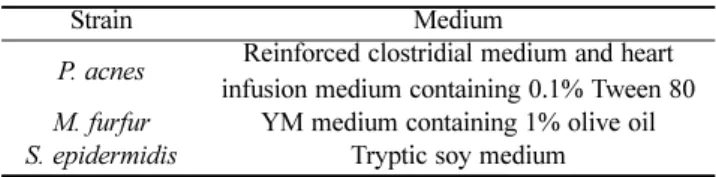
To investigate antimicrobial activity of essential oil of P. korai- ensis seed aganist pathogens related to acne, Propionibacterium acnes KCTC2358, Staphylococcus epidermidis ATCC1228, Malasseizia furfur KCCM 12679 were used. The each medium was shown in Table 1. P. acnes were cultivated at anaerobic jar CO2 incubator at 37oC for 72 hr. M. furfur was cultivated at 37oC for 24 hr. S. epidermidis was cultivated at 37oC for 24 hr.
An essential oil was added to the flasks (20, 40, 60µL/100 mL concentration). The control was cultured without essential oil.
3. RESULT AND DISCUSSION
The chemical composition of essential oil of P. koraiensis seed was analyzed by GC-MS and 23 components were identified among 31 compounds. The results are shown in Table 2. The main components of essential oil of P. koraiensis seed were alpha-pinene (29.87%), D-limonene (19.26%), beta-pinene (11.19%), beta-myrcene (3.84%), n-hexadecanoi acid (3.2%), beta-caryphyllene (2.72%), and cyclohexene (2.17%). Part of
our result is similar with those of Krauze-Baranowska et al., who reported that essential oil from pine needles contained α- pinene, β-pinene, limonene, camphene, 3-carene, myrcene, and so on [10]. Lee et al. [1] reported the chemical composition and antimicrobial activity of essential oil from cones of P. koraiensis without seeds. They identified 87 components comprising about 96.8% of the total oil. The main oil components were limonene (29.70%), alpha-pinene (23.89%), beta-pinene (12.02%), 3- carene (4.95%), beta-pinene (4.53%), isolongfolene (3.35%), bornylacetate (2.02%), caryophyllene (1.71%), and comphene (1.54%). Yang et al. [11] reported the analysis of essential oils of pine cones of P. koraienssis steb.Et Zucc and P. sylvestris L.
from China. They identified 35 and 31 components. Alpha- pinene (35.2%), D-limonene (18.4%), beta-pinene (8.7%), beta- caryophylllene (3.5%) and myrcene (3.0%) were the main com- ponents of P. koraienssis. In the case of P. sylvestris, aromaden- drene (20.2%), alpha-pinene (18.5%), alpha-longipinene (10.5%) and alpha-terpineol (5.5%) were the main components. Liu and Xu [12] reported characterization of essential oil in pine nut shells from commodity waste in China by steam distillation and GC-MS. They determined 48 volatile chemical compositions.
Alpha-pinene, beta-pinene, 3-carene, 1-methy-4-(1-methyl- Table 1. Medium used in this experiment
Strain Medium
P. acnes Reinforced clostridial medium and heart infusion medium containing 0.1% Tween 80 M. furfur YM medium containing 1% olive oil S. epidermidis Tryptic soy medium
Table 2. Chemical compositions of essential oil of P. koraiensis seed
Volatile compounds Concentration (Peak area, %)
alpha-Thujene 0.22
Tricyclene 0.14
Santene 0.11
alpha-Pinene 29.87
Camphene 1.23
alpha-Phellandrene 0.42
beta-Pinene 11.19
beta-Myrcene 3.84
beta-Caryphyllene 2.72
3-Carene 1.85
Cyclohexene 2.17
p-Cymmene 0.58
D-Limonene 19.26
alpha-Terpinolene 1.87
Isolongifolene 1.27
n-Hexadecanoi acid 3.2
gamma-Muurolene 0.48
gamma-Cadinene 1.2
Terpinen-4-ol 0.23
p-Cymen-8-ol 0.17
Bornyl acetate 2.56
잣나무 씨앗 정유의 여드름 병원균에 대한 항균력 효과 181 ethenyl)-(S)-cyclohexene, and n-hexadecanoic acid are predo-
minant volatile compositions in pine nut shells. Kohsuke et al.
[13] reported compositions of the essential oils from the leaves of nine Pinus species and the cones of three of Pinus. The main components of P. densiflora cone oil were D-germacrene (20.6%), beta-caryophyllene (8.9%), delta-cadinene (8.4%) and longifo- lene (8.0%). The major constituents of P. rigida cone oil were beta-phellandrene (15.0%), pinocarveol (7.6%), alpha-terpineol (7.4%), alpha-pinene (6.5%), myrtenol (6.1%) and beta-pinene (6.0%). Those of P. taeda cone oil were alpha-pinene (51.8%), verbenone (4.8%), p-mentha-1,5-dien-8-ol (4.8%), pinocarveol (4.5%), beta-pinene (3.8%) and borneol (3.8%) (only P. taeda lists major compounds over 3.5%). The present work shows quantitative and qualitative differences from previous research.
These results indicate that they were affected by the influence of the age of the plant, the harvesting period, the climate and the geographic circumstances on the components of the essen- tial oil [12,13].
Essential oils are natural complex compounds characterized by a strong odour with volatility, formed by aromatic plants as secondary metabolites [14]. They are obtained from flowers, buds, seeds, leaves, bark, fruits and roots as aromatic oils [15].
They are highly volatile in the air and their fragrances differ from every species or plant materials. In nature, essential oils play an important role in the protection of the plants as antibac- terials, antivirals, antifungals, insecticides and herbivores by reducing their appetite for such plants [16]. Many researches are being carried out to inhibit the food and plant pathogens (Salmonella enteritidis, Escherichia coli and Botrytis cinerea etc.) by using antimicrobial activities of essential oils [17,18].
The essential oils from conifers are also applied to the cosme- tics and medicines and especially good antimicrobial properties of essential oils from Cryptomeria japonica and Chamaecyparis obtusa have been reported [19]. Therefore, this study examined the antimicrobial activity of essential oils obtained from P. ko- raiensis seed against pathogens related to acne such as P. acnes KCTC2358, S. epidermidis ATCC1228, M. furfur KCCM 12679.
Fig. 1 shows the effect of essential oil of P. koraiensis seed on growth of P. acnes in Brain Heart infusion broth containing 0.1% Tween 80 during incubation for 72 hr at 37oC.The growth of P. acnes was decreased with the increase of culture and essential oil concentration of P. koraiensis seed. Especially, when 20µL of essential oil of P. koraiensis was used, the growth of P. acnes at 36 hr was repressed a little. However, at after 72 hr of culture, it was repressed by 10.0×10⁴ CFU/mL.
At 60µL of essential oil, the growth of P. acnes was repressed to 8.4×10⁴ CFU/mL after 72 hr of culture, which was about 23.6% of decrease compared to control (without essential oil addition). Fig. 2 is effect of essential oil of P. koraiensis seed
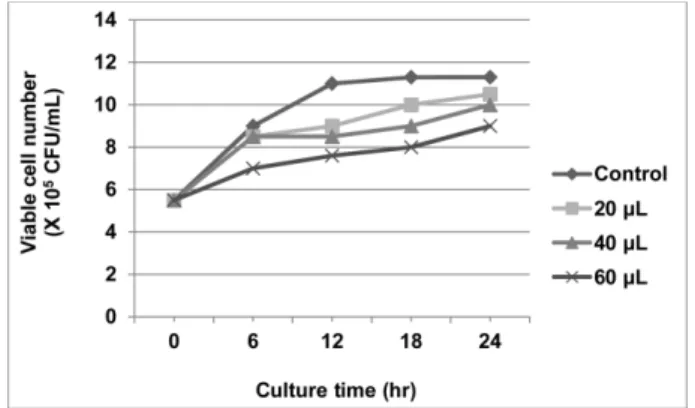
on growth of S. epidermidis in trypic soy broth during incubation for 24 hr at 37oC. The growth of S. epidermidis was decreased with the increase of culture and essential oil concen- tration of P. koraiensis seed. However, at 6 hr of culture, they were similar, irrespective of essential oil concentrations except 60µL of essential oil. When 20 and 40 µL of essential oil of P koraiensis seed were used, they were 10.5 and 10.1×10⁵ CFU/
Fig. 1. Effect of essential oil of P. koraiensis seed on growth of P.
acnes.
Fig. 2. Effect of essential oil of P. koraiensis seed on growth of S.
epidermidis.
Fig. 3. Effect of essential oil of P. koraiensis seed on growth of M.
furfur.
182 Korean Society for Biotechnology and Bioengineering Journal 29(3): 179-182 (2014)
mL, respectively after 24 hr of culture. When 60µL of essen- tial oil of P. koraiensis seed was used, it was strongly affected.
Especially, at 24 hr of culture, the viable cell number was 8.9× 10⁵ CFU/mL, which was about 20.0% of decrease compared to control (without essential oil addition). Fig. 3 is effect of essen- tial oil of P. koraiensis seed on growth of M. furfur in YM broth containing 1% olive oil during incubation for 24 hr at 37oC. The growth of M. furfur was decreased with the increase of culture and essential oil concentration of P. koraiensis seed.
When 20µL of essential oil was used, the growth of M. furfur was increased with the increase of culture by 18 hr and the viable cell number was 10.7×10⁵ CFU/mL after 24 hr of culture.
When 40 and 60µL of essential oil were used, the growth of M. furfur was strongly affected. Especially, at 24 hr of culture using 60µL of essential oil, the viable cell number was dec- reased from 8.3×10⁵ CFU/mL which was about 31.2% of dec- rease compared to control (without essential oil addition). These results indicate that the essential oil extracted from P. koraien- sis seed, which have mild antimicrobial properties, can inhibit the growth of other pathogens related to acne.
4. CONCLUSION
The author identified 23 chemical compositions in essential oil from P. koraiensis seed by GC-MS. The essential oil had inhi- bitory activity against pathogens related to acne. In particular, the essential oil showed stronger inhibitory activity against M.
furfur. Based on the results, the essential oil of P. koraiensis seed can be used as natural cosmetic or antimicrobial substances.
We are investigating a relationship between the chemical struc- tures of the main ingredients of essential oil and their antimicro- bial activities.
Acknowledgements
This study Wonkwang Health Science University 2014 Confer- ence has been done by the application fee.
REFERENCES
1. Lee, J. H., H. Y. Yang, H. S. Lee, and S. K. Hong (2008) Chemi- cal composition and antimicrobial activity of essential oil from cones of Pinus koraiensis. J. Microbiol. Biotechnol.18: 497-502.
2. Sugano, M., I. Ikeda, K. Wakamatsu, and T. Oka (1994) Influence of Korean pine (Pinus koraiensis) seed oil containing cis-5,cis-9, cis-12-octadecatrienoic acid on polyunsaturated fatty acid metabo-
lism, eicosanoid production and blood pressure of rats. Br. J. Nutr.
72: 775-783.
3. Cowan, M. M. (1999) Plant products as antimicrobial agents. Clin.
Microbiol. Rev. 12: 564-582.
4. Saller, R., T. Berger, J. Reichling, and M. Harkenthal (1998) Phar- maceutical and medicinal aspects of australian te tree oil. Phyto- medicine. 5: 489-495.
5. Harkenthal, M., J. Reichling, H. K. Geiss, and R. Saller (1999) Comparative study on the in vitro antibacterial activity of Austra- lian tea tree oil cajuput oil, niaoili oil, manuka oil, Kanuka oil, eucalyptus oil. Pharmazie. 54: 460-463.
6. Wiiiams, L. R. and V. Home (1995) A comparative study of some essential oils for potential use in topical applications for the treat- ment of Candida albicans. Aust. J. Med. Herbalism. 7: 57-62.
7. Hong, E. J., A. Na, B. G. Choi, C. S. Choi, and E. B. Jeung (2004) Antibacterial and antifungal effects of essential oil from conifer- ous trees. Bio. Pharm. Bull. 27: 863-866.
8. Kim, J. H., H. J. Lee, S. J. Jeong, M. H. Lee, and S. H. Kim (2012) Essential oil of Pinus koraiensis leaves exerts antihyperlipidemic effects via up-regulation of low-density lipoprotein receptor and inhibition of acyl-coenzyme A. Phytother. Res. 26: 1314-1319.
9. Kim, R. (2013) Chemical composition of Pinus koraiensis seed and its biological activity. Kor. Biotech. Bioeng. J. 28: 1-7.
10. Krauze-Baranowska M., M. Mardarowicz, M. Wiwart, L. Pob - ocka, and M. Dynowska (2002) Antifungal activity of the essen- tial oils from some species of the genus Pinus. Naturforsch. 57:
478-482
11. Yang, X., H. Zhang, H. Zhao, A. Dong, D. Xu., L. Yang, Y. Ma, and J. Wong (2010) anaylsis of essential oils of pine cones of Pinus Koraienssis and P. sylvestris L. from China. J. Essentiol. oil Res. 22: 446-448.
12. Liu. R. and B. Xu (2014) characterization of essential oil in pine nut shells from commodity waste in china by steam distillation and GC-MS. Food Anal. Methods. 5: 435-440.
13. Kurose, K., D. Okamura and M. Yatagai (2007) Composition of the essential oils from the leaves of nine Pinus species and the cones of three of Pinus Species. Flavour Fragr. J. 22: 10-20 14. Bakkali, F., S. Averbeck, D. Averbeck, and M. Idaomar (2008)
Biological effects of essential oils. Food Chem. Toxicol. 46: 446- 475.
15. Burt, S. (2003) Essential oils: their antibacterial properties and potential applications in foods. Inter. J. Food Micro. 94: 223-253.
16. Han, K. H. (2007) Antifungal activity of essential oil from Asarum sieboldii against epidermal and opportunistic pathogenic fungi.
Kor. J. Mycol. 35: 58-60.
17. Farag, R. S., Z. Y. Daw, F. M. Hewedi, and G. S. A. El-Baroty (1989) Antimicrobial activity of some Egyptian spice essential oils.
J. Food Protection. 52: 665-667.
18. Hammer, K. A., C. F. Carson, and T. V. Riley (1999) Antimicro- bial activity of essential oils and other plant extracts. J. Appl.
Microbiol. 86: 985-990.
19. Cheng, S. S., H. Y. Lin, and S. T. Chang (2005) Chemical compo- sition and antifungal activity of essential oils from different tissues of Japanese cedar J. Agric. Food Chem. 53: 614-619.
l