이다. 의료기기국제조화기구(global harmonization task force, GHTF)에 의하면 체외진단제품은 ‘인체 유래의 검체를 체외에서 검사함으로써 환자의 진단, 모니터링 또는 적합성을 판단할 수 있 는 정보를 제공하는 것을 목적으로 하는 의료기기, 시약, 캘리브레 이터, 정도관리물질, 검체용기, 소프트웨어, 관련된 기기 또는 장 비, 기타 물품을 포함’한다[1]. 의료기기국제조화기구는 1992년 의 료기기제도의 선진국인 5개국(미국, 캐나다, 일본, 유럽연합, 호주) 의 규제 당국과 제조 기업들이 의료기기 안전관리제도의 통합화 와 효율화를 통한 무역거래 활성화 및 국민건강 보호증진이라는 목적 하에 결성된 국제조직이다.
체외진단제품은 다른 의약품 또는 의료기기와는 달리 해당 검 사의 결과를 통해서만 영향을 미칠 뿐 그 자체가 인체에 직접적인 영향을 미치지는 않는다. 이런 특성이 의료기기국제조화기구 및 유럽, 미국 등 선진국이 별도의 제도 또는 법령을 통해 시약과 장
서 론
체외진단제품(In Vitro Diagnostic Medical Devices or In vitro Diagnostic products, IVDD)은 검사시약과 장비를 포괄하는 용어
한국형 체외진단제품 품목 및 등급분류 체계 제안
A Draft Proposal for Korean Classification and Coding System for In Vitro Diagnostic Medical Devices
임영애1·엄태현2·장윤환3·김혜련4·박준석5·김용구6
Young Ae Lim, M.D.1, Tae Hyun Um, M.D.2, Yoon Hwan Chang, M.D.3, Hye Ryoun Kim, M.D.4, Joonseok Park, M.D.5, Yonggoo Kim, M.D.6
아주대학교 의과대학 진단검사의학교실1, 인제대학교 일산백병원 진단검사의학과2, 한국원자력의학원 원자력병원 진단검사의학과3,
중앙대학교 의과대학 진단검사의학교실4, 한미약품5, 가톨릭대학교 의과대학 진단검사의학교실6
Department of Laboratory Medicine1, Ajou University School of Medicine, Suwon; Department of Laboratory Medicine2, Inje University Ilsan Paik Hospital, Goyang; Department of Laboratory Medicine3, Korea Institute of Radiological and Medical Sciences, Seoul; Department of Laboratory Medicine4, Chung-Ang University College of Medicine, Seoul; Hanmi Holdings Inc.5, Seoul; Department of Laboratory Medicine6, The Catholic University of Korea College of Medicine, Seoul, Korea
http://dx.doi.org/10.3343/lmo.2012.2.3.148
Corresponding author: Tae Hyun Um, M.D.
Department of Laboratory Medicine, Inje University Ilsan Paik Hospital, 2240 Daehwa-dong, Ilsanseo-gu, Goyang 411-706, Korea
Tel: +82-31-910-7283, Fax: +82-31-910-7286, E-mail: [email protected]
Received: November 7, 2011 Revision received: December 21, 2011 Accepted: December 23, 2011
This article is available from http://www.labmedonline.org 2012, Laboratory Medicine Online
This is an Open Access article distributed under the terms of the Creative Commons Attribution Non-Commercial License (http://creativecommons.org/licenses/by-nc/3.0/) which permits unrestricted non-commercial use, distribution, and reproduction in any medium, provided the original work is properly cited.
Background: The Global harmonization task force (GHTF) recommends a separate regulation system for in vitro diagnostic medical devices (IVDD), because false test results can pose a risk to individual and/or public health. However, in Korea, many reagents for IVDD are not monitored, although IVD analyzers and some reagents are monitored under the Medical Device Act and Pharmaceutical Affairs Act, respectively. Our aim was to propose a draft for a Korean coding and classification system for IVDD.
Methods: For preparing the draft, we reviewed the Korean Current Procedural Terminology for Health Insurance and principles of the coding and classification system for IVDD of the GHTF, the USA, Japan, Canada, Australia, and the EU. The draft was reviewed by consultants from relevant societies, such as Korean Medical Association, Korean Society for Laboratory Medicine, The Korea Association of Medical Technologists, and Korea Association for Diagnostic Laboratory Reagents, and was then publicly discussed at a conference.
Results: IVDD were classified into 4 classes on the basis of the risks they pose to individual (IR) and public health (PR): class 1 (low IR and low PR), class 2 (moderate IR and low PR), class 3 (high IR and/or moderate PR), and class 4 (high IR and high PR). IVD analyzers, reagents and other general laboratory equipments were categorized and coded using the letter D and 7 (2+3+2) digits.
Conclusions: This draft for the Korean IVDD classification and coding system could be used for effective management and regulation of IVDD in Korea.
Key Words: In vitro diagnostic medical devices (IVDD), Classification, Coding, Risk
비를 포괄하여 체외진단제품을 관리하는 이유이다.
우리나라에서는 일부 체외진단제품이 약사법과 의료기기법에 의해 체외진단용의약품과 의료기기로서 관리되고 있었는데, 많은 수의 체외진단시약이 보조시약류로 분류되어 체외진단용의약품 에서 제외됨으로써 법적 관리의 사각지대에 놓여 있었다. 그러던 것이 2011년 7월 28일 개정된 ‘의료기기 품목 및 품목별 등급에 관 한 규정(식품의약품안전청 고시 제2011-38호)’에 따라 ‘(D)체외진 단분석기용 시약 Analyzing products for in vitro diagnosis’이 신설 됨으로써 의료기기에 포함되게 되었다. 체외진단분석기용 시약과 체외진단분석기가 하나의 규정으로 관리를 받게 되었다는 점은 고무적인 발전이라고 볼 수 있지만, 여전히 체외진단분석기용 시약 과 체외진단분석기의 관련성이 제대로 반영되지 못하고 있다는 점 은 아쉬운 점이다. 예를 들면, 체외진단분석기들이 ‘(A)기구 기계 [기구 · 기계] Medical Instruments’에 포함되어 있고, 일부 체외진단 시약은 ‘(B)의료용품 Medical supplies’에 포함되어 있다. 또한 체외 진단용의약품이 여전히 약사법에 규정되어 있으므로 시약도 체외 진단용의약품과 체외진단분석기용 시약으로 분리되게 되었다. 홀 로 기능을 수행하는 체외진단분석기와 체외진단시약은 있을 수 없으므로 향후 통합적으로 관리되어야 할 것이다.
이에 본 연구에서는 국제기준과 조화되면서 우리나라 현실을 반영하는 체외진단제품 품목 분류 및 등급체계를 제시하고자 하 였다.
대상 및 방법
1. 국내 문헌조사
체외진단제품의 분류체계에 관한 국내 현황 자료를 조사하였다.
국내 자료로서는 식품의약품안전청 고시 제2011-38호인 ‘의료기 기 품목 및 품목별 등급에 관한 규정’과 ‘건강보험 행위 급여 · 비 급여 목록표 및 급여 상대가치점수(보건복지부 고시 제2010-123 호)’중 검체 검사와 관련된 분류를 참고하였다. 체외진단분석기와 시약은 각각 해당되는 검사종목에 따라 함께 사용되어야 하는 것 이므로, 체외진단제품은 검사종목을 기준으로 하여 진단검사의학
회에서 발행한 교과서[2]에 기재되어 있는 검사명을 가능한 한 포 함하도록 하였다. 또한 감염병 진단에 사용되는 체외진단제품의 등급 분류를 위해 ‘감염병의 예방 및 관리에 관한 법률(법률 제 9932호)’과 동 법률 시행규칙(보건복지부령 제32호)에 각각 규정되 어 있는 감염병 및 고위험병원체 목록을 참고하였다.
2. 국외 문헌조사
선진외국의 현황에 관한 문헌들은 의료기기국제조화기구에서 발간한 가이드라인[1]을 중심으로, 미국, 일본, 호주, 캐나다 및 유 럽의 규제기관 홈페이지 조사 등을 통해 관련 규정, 지침 등에 대 한 자료를 수집하였으며[3-7], 체외진단제품과 관련하여 국내에서 발간된 각종 연구보고서들을 참고하였다[8-10].
3. 전문가 자문회의 및 공개간담회 개최
수집된 문헌 등 자료 조사를 바탕으로 체외진단제품의 품목 분 류 및 등급체계에 관한 일차 초안을 작성하였으며, 초안의 검토를 위해 관련 5개 단체에서 각 1인을 추천받아 전문가 자문회의를 구 성하였다. 대한진단검사의학회와 대한임상병리사협회는 체외진단 제품 사용자 및 검사서비스의 제공자로서, 한국진단검사시약협회 와 체외진단기업협의회는 체외진단제품의 공급자로서, 대한의사 협회는 체외진단 검사서비스의 임상적 사용자로서의 의견을 수렴 하기 위함이었다. 자문회의에서 논의된 의견을 수렴하여 초안을 보완하였으며, 보완된 안은 체외진단제품의 공급자인 관련 기업들 에게 회람하여 의견을 구하였고, 2회의 공개간담회를 개최하여 종 합적인 의견 수렴을 하였다.
결 과
1. 국외 현황
조사한 국외 현황을 살펴보면 체외진단제품을 의약품이 아닌 의료기기의 일종으로서 관리하고 있다는 점에서 일치하고 있었다 (Table 1). 하지만 실제 법령 및 규제시스템에서는 차이가 있는데, GHTF, 호주, 캐나다 및 유럽 등에서는 체외진단제품을 의료기기
Table 1. In vitro diagnostic medical devices (IVDD) classification system in developed countries
Country GHTF USA Japan Australia EU Canada
Coding system None Medical specialty Medical specialty None None None
Classification system IVD medical device IVD reagent
(medical device*)
IVD IVD IVD
Number of Class 4 3 3 (1*/4) 4 4 4
Principle of classification
level of risk posed to individual and public health
Intended use, indication and level of risk
Level of risk level of risk posed to individual and public health
Level of risk Level of risk Applied rules 7 rules and examples Lists Rules and lists 7 rules and examples Rules and lists 9 rules and examples
*Japan has a separate system for classifying reagents and medical devices for IVDD, and all IVD medical devices are classified into Class I.
나 의약품과는 별도의 체계로 국가에서 관리하고 있으며, 미국은 의료기기에서, 일본은 체외진단분석기는 의료기기, 체외진단시약 은 체외진단제품으로 별도 관리하고 있었다. 일본의 약사법은 의 약품, 의약외품, 체외진단용의약품, 의료기기를 모두 포함하고 있 었다.
2. 우리나라 체외진단제품 품목분류체계(안) (Categorization and Coding System)
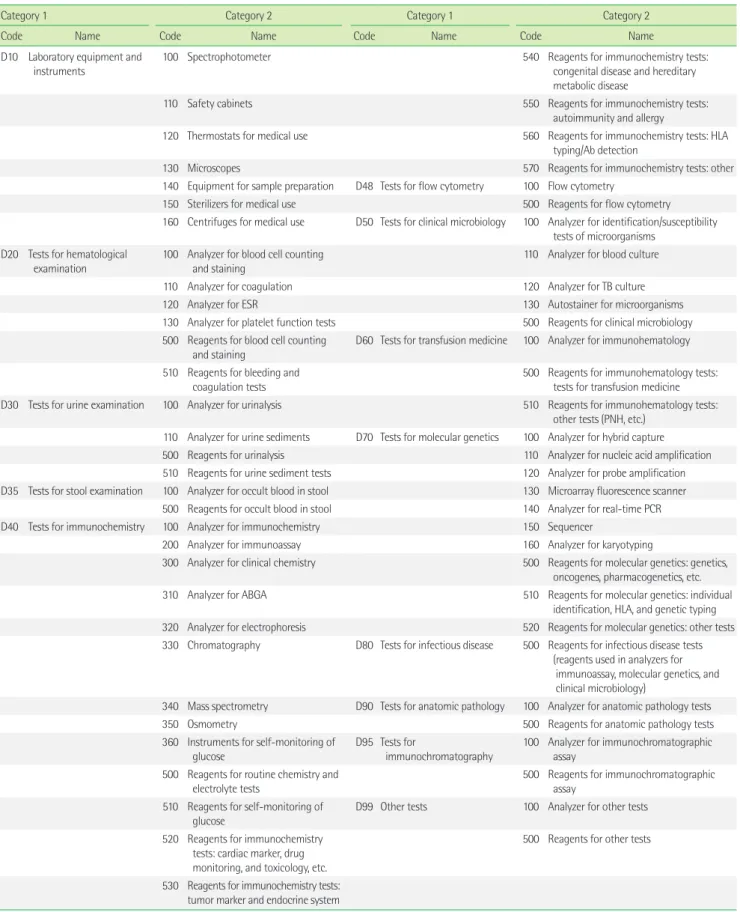
실제 검사행위가 이루어지는 진단검사의학과의 검사실 업무분 야와 건강보험 행위목록의 분류를 참조하여 대분류, 중분류, 소분 류로 하였으며, 각 분류의 수는 대분류 13, 중분류 63, 소분류 117 종이다. 대분류는 원칙적으로 진단검사의학과 검사실 업무분야를 반영하여 코드 D10-99을 부여하였는데, 예외적으로 D10과 D80은 각각 검사실 범용장비와 감염질환표지자 검사에 부여하였다. 중 분류는 건강보험 행위목록 1절 검체검사료와 2절 병리검사료의 분 류를 반영하여 3자리 번호를 부여하였는데, 장비(체외진단분석기) 는 100-499, 시약은 500-999 를 부여하였다. 시약은 체외진단분석 기용시약과 체외진단의약품을 구분하지 않았다. 소분류는 중분 류를 세분할 필요가 있는 경우에 대비해 2자리 숫자를 부여하였는 데, 소분류가 필요 없는 경우는 (-) 또는 (00)을 부여하였다. 대분 류, 중분류, 소분류의 구분을 명확하게 하기 위해 번호의 시작은 01이 아닌 10으로 하였다(Table 2).
3. 우리나라 체외진단제품 등급분류체계(안) (Classification System)
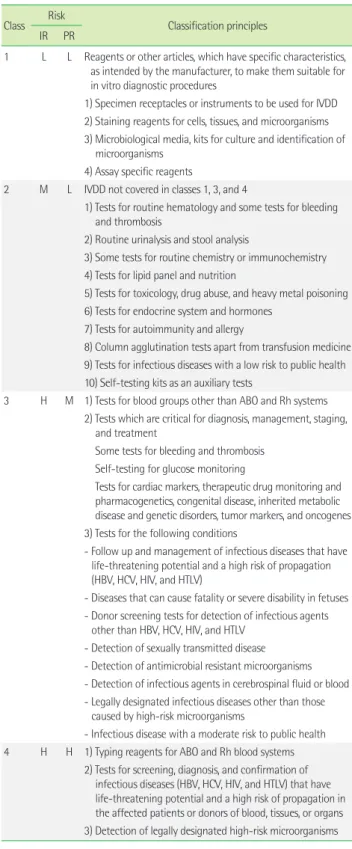
체외진단제품 등급분류(classification)는 개인위해도(individual risk, IR)와 공중위해도(public risk, PR)에 따라 1-4등급으로 구분 하였다. 개인위해도와 공중위해도가 모두 낮은 경우는 1등급, 개인 위해도가 중등도이고 공중위해도는 낮은 경우는 2등급, 개인위해 도가 높거나 공중위해도가 중등도인 경우는 3등급, 개인위해도와 공중위해도가 모두 높은 경우는 4등급으로 분류하였다(Table 3).
등급분류의 원칙을 간략하면, 1등급에는 대부분의 체외진단분석 기와 범용의 진단 목적 제품이 분류되었으며, 4등급에는 ABO, Rh(D) 혈액형 판정용 시약과 치명적인 위험이나 감염능이 높은 HIV, HBV, HCV, HTLV에 대하여 헌혈, 장기 공여자 및 환자의 선 별, 진단 및 확인용 검사와 고위험병원체 법정감염병 진단용 검사 를 진단하는 제품들이 분류되었고, 3등급에는 ABO, Rh 이외의 혈 액형검사 및 면역적합성검사에 사용되는 제품과 진단, 처치, 질병 단계결정 및 치료에 결정적인 영향을 미치는 검사에 사용되는 제 품, 그리고 치명적인 위험이나 감염능이 높은 감염질환 환자의 환 자관리검사 및 중등도 위험 이상의 감염질환을 진단하는 제품들 이 분류되었으며, 2등급에는 1, 3, 4등급을 제외한 제품으로 의학
적으로 중대한 결정을 내리는 데 단독으로 사용되지 않는 검사 제 품들을 분류하였다(Table 4).
4. 우리나라 체외진단제품 품목 및 등급분류체계(안) (Categorization and Classification System)
체외진단제품들을 상기의 분류 원칙에 따라 분류하였다. 각 품 목분류코드에 해당되는 제품들은 동일한 하나의 등급을 갖도록 하였다(부록 1).
고 찰
본 연구는 국내 체외진단제품에 대한 효율적이고 이상적인 관리 체계를 제안한다는 측면에서 수행되었는데, 본 연구의 개념과 원 칙은 다음과 같다.
첫째, 체외진단제품을 현행 진단검사의학과 검사실 업무분야와 건강보험 행위목록을 반영하여 대분류, 중분류, 소분류함으로써, 실제 업무현장에서 활용될 수 있도록 하였다. 검사실 업무에 따른 분류는 미국과 일본에서도 채택하고 있다. 미국 식약청(FDA)의 경 우 체외진단제품은 코드 862 Clinical chemistry (CH) and clinical toxicology (TX), 864 Hematology (HE) and pathology (PA)와 866 Immunology (IM) and microbiology (MI)인데, 각 코드는 4-11개의 세부 파트로 구성되어 있다[3]. 일본은 범용시약, 혈액검사용 시약, 생화학검사용 시약, 면역검사용 시약, 내분비검사용 시약, 면역조 직학검사용 시약, 세균검사용 시약, 일반용 검사약(over the coun- ter, OTC)과 시리즈 검사용 시약으로 품목 분류하고 있다[4].
둘째, 본 연구에서는 등급분류의 원칙이 되는 개인위해도와 공 중위해도를 정의하고, 이에 따라 검사종목을 등급분류하였다 (Table 2). 선진국에서도 위해도의 정도에 따라 등급을 결정하고 있으나, 개인위해도와 공중위해도에 대한 정의는 찾아볼 수 없었 다. 체외진단제품에 대한 등급 결정은 개인위해도와 공중위해도 의 평가와 직결되므로, 등급분류의 객관성을 담보하는데 도움이 될 것으로 기대한다. 본 연구에서는 선진국들의 자료를 종합적으 로 검토하여 등급분류에 대한 원칙을 제시하였으며(Table 4), 이러 한 원칙하에 대부분의 검사명을 등급과 품목 분류 체계에 따라 제 시하였다(부록 1). 일부 체외진단제품에 대해서는 국가간에 등급 분류의 차이가 있었는데, 이는 각 국가의 특수한 입장, 등급체계의 차이(3등급체계 vs 4등급체계)에 기인하거나, 혹은 구체적인 지침 을 제시하기가 곤란하였기 때문으로 생각된다. 예를 들면, 본 연구 에서 1등급으로 분류한 ‘D50.500.40 임상미생물 검사용 분석시약 류: 약제감수성검사’는 일본에서는 1등급인 반면, 미국, 의료기기 국제조화기구, 호주에서는 2등급으로 분류하고 있다. 또한 본 연구 에서 2등급으로 분류한 ‘D80.500.60 감염질환표지자용분석시약
Table 2. Proposal for the Korean IVDD categorization and coding system
Category 1 Category 2 Category 1 Category 2
Code Name Code Name Code Name Code Name
D10 Laboratory equipment and instruments
100 Spectrophotometer 540 Reagents for immunochemistry tests:
congenital disease and hereditary metabolic disease
110 Safety cabinets 550 Reagents for immunochemistry tests:
autoimmunity and allergy
120 Thermostats for medical use 560 Reagents for immunochemistry tests: HLA
typing/Ab detection
130 Microscopes 570 Reagents for immunochemistry tests: other
140 Equipment for sample preparation D48 Tests for flow cytometry 100 Flow cytometry
150 Sterilizers for medical use 500 Reagents for flow cytometry
160 Centrifuges for medical use D50 Tests for clinical microbiology 100 Analyzer for identification/susceptibility tests of microorganisms
D20 Tests for hematological
examination 100 Analyzer for blood cell counting
and staining 110 Analyzer for blood culture
110 Analyzer for coagulation 120 Analyzer for TB culture
120 Analyzer for ESR 130 Autostainer for microorganisms
130 Analyzer for platelet function tests 500 Reagents for clinical microbiology 500 Reagents for blood cell counting
and staining
D60 Tests for transfusion medicine 100 Analyzer for immunohematology 510 Reagents for bleeding and
coagulation tests 500 Reagents for immunohematology tests:
tests for transfusion medicine
D30 Tests for urine examination 100 Analyzer for urinalysis 510 Reagents for immunohematology tests:
other tests (PNH, etc.) 110 Analyzer for urine sediments D70 Tests for molecular genetics 100 Analyzer for hybrid capture
500 Reagents for urinalysis 110 Analyzer for nucleic acid amplification
510 Reagents for urine sediment tests 120 Analyzer for probe amplification
D35 Tests for stool examination 100 Analyzer for occult blood in stool 130 Microarray fluorescence scanner
500 Reagents for occult blood in stool 140 Analyzer for real-time PCR
D40 Tests for immunochemistry 100 Analyzer for immunochemistry 150 Sequencer
200 Analyzer for immunoassay 160 Analyzer for karyotyping
300 Analyzer for clinical chemistry 500 Reagents for molecular genetics: genetics,
oncogenes, pharmacogenetics, etc.
310 Analyzer for ABGA 510 Reagents for molecular genetics: individual
identification, HLA, and genetic typing
320 Analyzer for electrophoresis 520 Reagents for molecular genetics: other tests
330 Chromatography D80 Tests for infectious disease 500 Reagents for infectious disease tests (reagents used in analyzers for immunoassay, molecular genetics, and clinical microbiology)
340 Mass spectrometry D90 Tests for anatomic pathology 100 Analyzer for anatomic pathology tests
350 Osmometry 500 Reagents for anatomic pathology tests
360 Instruments for self-monitoring of
glucose D95 Tests for
immunochromatography 100 Analyzer for immunochromatographic assay
500 Reagents for routine chemistry and
electrolyte tests 500 Reagents for immunochromatographic
assay 510 Reagents for self-monitoring of
glucose
D99 Other tests 100 Analyzer for other tests 520 Reagents for immunochemistry
tests: cardiac marker, drug monitoring, and toxicology, etc.
500 Reagents for other tests
530 Reagents for immunochemistry tests:
tumor marker and endocrine system
Abbreviations: ESR, erythrocyte sedimentation rate; ABGA, arterial blood gas analysis; HLA, human leukocyte antigen; PNH, paroxysmal nocturnal hemoglobinuria; PCR, poly- merase chain reaction.
류: 감염력이 낮은 감염원 검출용’은 Clostridium difficile, Adeno- virus, Rotavirus 검출용 시약이 해당되는데, 의료기기국제조화기 구, 캐나다, 유럽 및 호주는 2등급으로 분류하고 있으나, 미국은 1 등급, 일본은 3등급으로 분류하고 있다. 호주에서는 호주 National Notifiable Diseases Surveillance System (NNDSS)에 기술된 감염 원을[11] 검출하는 제품은 3등급으로, 높은 공중전파 위험성을 가 진 감염체를 검출하는 제품은 4등급으로 분류하고 있다. 이를 참 고하여 본 연구에서도 ‘감염병의 예방 및 관리에 관한 법률’에 명시 되어 있는 감염병은 공중위해도가 중등도 이상이 되는 것으로 간 주하여 3등급 이상으로 정의하였고, 이중 ‘고위험병원체 법정감염 병(감염병의 예방 및 관리에 관한 법률 시행규칙, 별표 1)’을 진단 하는 제품은 4등급으로 분류하였다.
셋째, 본 연구의 품목 분류 및 등급 체계안과 현행 국내 규정인
‘의료기기 품목 및 품목별 등급에 관한 규정(식품의약품안전청 고 시 제2011-38호)’은 다음의 5 가지 측면에서 차이가 있다.
1) 현 고시에는 체외진단분석기용 시약의 등급분류에 일부의 검 사종목만이 예시되어 있으나, 본 연구에서는 전반적인 시약들의 품목 분류에 따라 개인위해도, 공중위해도 및 등급을 제시하여 객 관적이고 구체적인 체외진단제품의 허가 심사지침을 제공하고자 하였다(부록 1).
2) 현 고시에는 동일한 품목 분류에 해당하는 시약들이 1-4등급 까지의 등급을 가질 수 있는데 반하여, 본 연구에서는 동일한 품 목 분류 코드에 해당되는 체외진단제품들은 하나의 등급만을 갖 도록 하여, 신고와 허가과정에서 객관적으로 등급을 결정하는데 도움을 주고자 하였다.
3) 본 연구에서는 향후 새로 개발되어 기존의 품목 코드에 분류 하기 곤란한 제품들을 위하여 대분류, 중분류, 소분류에 ‘기타 코 드’를 설정하여 분류시 융통성을 두고자 두었다.
4) 일부 품목에서는 등급분류를 달리 하였다. 즉, 현 고시에 2등 급으로 분류되어 있는 A22510.01 마이크로어레이칩분석장치, A22520.01 유전자증폭장치, A32020.01 의료용냉동원심분리기, A32030.01 헤마토크릿용원심분리기, A32040.01 혈구세척원심분리 기와, 3등급으로 분류되어 있는 A22030.02 개인용혈당측정기는 모
두 1등급으로 분류하였으며, 1등급으로 분류되어 있는 B10010.01 혈당측정검사지와 B10010.02 혈액응고시간측정검사지는 각각 3등 급과 2-3등급으로 분류하였다. 이런 분류의 변화는 검체검사에 있 Table 4. Proposal for the Korean IVDD classification principles
Class Risk
Classification principles
IR PR
1 L L R eagents or other articles, which have specific characteristics, as intended by the manufacturer, to make them suitable for in vitro diagnostic procedures
1) Specimen receptacles or instruments to be used for IVDD 2) Staining reagents for cells, tissues, and microorganisms 3) Microbiological media, kits for culture and identification of
microorganisms 4) Assay specific reagents
2 M L IVDD not covered in classes 1, 3, and 4
1) Tests for routine hematology and some tests for bleeding and thrombosis
2) Routine urinalysis and stool analysis
3) Some tests for routine chemistry or immunochemistry 4) Tests for lipid panel and nutrition
5) Tests for toxicology, drug abuse, and heavy metal poisoning 6) Tests for endocrine system and hormones
7) Tests for autoimmunity and allergy
8) Column agglutination tests apart from transfusion medicine 9) Tests for infectious diseases with a low risk to public health 10) Self-testing kits as an auxiliary tests
3 H M 1) Tests for blood groups other than ABO and Rh systems 2) Tests which are critical for diagnosis, management, staging,
and treatment
Some tests for bleeding and thrombosis Self-testing for glucose monitoring
Tests for cardiac markers, therapeutic drug monitoring and pharmacogenetics, congenital disease, inherited metabolic disease and genetic disorders, tumor markers, and oncogenes 3) Tests for the following conditions
- Follow up and management of infectious diseases that have life-threatening potential and a high risk of propagation (HBV, HCV, HIV, and HTLV)
- Diseases that can cause fatality or severe disability in fetuses - Donor screening tests for detection of infectious agents
other than HBV, HCV, HIV, and HTLV - Detection of sexually transmitted disease - Detection of antimicrobial resistant microorganisms - Detection of infectious agents in cerebrospinal fluid or blood - Legally designated infectious diseases other than those
caused by high-risk microorganisms
- Infectious disease with a moderate risk to public health 4 H H 1) Typing reagents for ABO and Rh blood systems
2) Tests for screening, diagnosis, and confirmation of infectious diseases (HBV, HCV, HIV, and HTLV) that have life-threatening potential and a high risk of propagation in the affected patients or donors of blood, tissues, or organs 3) Detection of legally designated high-risk microorganisms Abbreviations: IR, individual risk; PR, public health risk; L, low; M, moderate; H, high.
Table 3. Proposal for the definition of individual and public health risks
Risk Grade Definition*
Individual Low No or few
Moderate A few
High Severe
Public health Low No or few
Moderate A few
High Severe
*Impact of false-positive or false-negative test results.
어 장비보다는 시약이 더 중요하다는 사실을 반영하기 위한 것이다.
5) 본 연구에서는 체외진단분석기용 시약과 체외진단용의약품 을 구분하지 않고 모두 분석시약류로 포괄 분류하였다.
결론적으로 본 연구에서 제안한 체외진단제품에 대한 품목 및 등급분류체계는 체외진단용 분석기와 체외진단 시약을 포괄하는 분류체계로서, 향후 우리나라의 체외진단제품을 효율적으로 관리 하는 데 도움을 줌으로써 국제조화를 통해 체외진단제품과 관련 한 산업계의 발전뿐 아니라 궁극적으로 국민보건 증진에 도움이 될 수 있을 것으로 생각한다.
요 약
배경: 잘못된 검사 결과는 개인 및 공중보건에 위해를 가할 수 있 으므로, 의료기기국제조화기구(Global Harmonization Task Force, GHTF)는 체외진단제품에 대한 별도의 규제체계를 권장하고 있 다. 그러나 우리나라는 비록 체외진단분석기와 일부의 시약을 의 료기기법과 약사법으로 관리하고 있기는 하지만, 상당수의 시약은 규제되고 있지 않다. 본 연구에서는 체외진단제품에 대하여 우리 나라의 포괄적인 품목 및 등급 분류 체계를 제안하고자 하였다.
방법: 초안 작성을 위하여 우리나라의 보험분류 현황과 의료기기 국제조화기구, 미국, 일본, 캐나다, 호주 및 유럽의 자료를 검토하였 다. 초안은 전문가 자문회의와 공개간담회를 통해 의견을 수렴하 였다.
결과: 체외진단제품의 등급은 개인위해도(IR)와 공중위해도(PR) 에 따라 1등급(낮은 IR과 낮은 PR), 2등급(중등도 IR과 낮은 PR), 3 등급(높은 IR과/혹은 중등도 PR), 4등급(높은 IR과 높은 PR)으로 분류하였다. 국내 진단검사의학과 검사실 현황을 반영하여 체외진 단분석기, 체외진단시약 및 기타 검사실범용장비들을 분류하고, 7 자리(alphabet D + 2 + 3 + 2)로 코드화 하였다.
결론: 본 연구의 체외진단제품 품목 및 등급분류(안)은 국내 체외 진단제품을 적절히 관리하는 데 도움을 줄 것이다.
감사의 글
이 연구는 2010년 식품의약품안전청 용역연구개발과제(10122의 료기444)의 지원에 의해 이루어졌음.
참고문헌
1. Study Group 1 of the Global Harmonization Task Force. Principles of in vitro diagnostic (IVD) medical devices classification. Final document.
GHTF/SG1/N045:2008. Global harmonization task force, 2008.
2. The Korean Society for Laboratory Medicine. Laboratory medicine. 4th ed. Seoul, Korea: E-Public, 2009.
3. US Food and Drug Administration. Product classification. http://www.
accessdata.fda.gov/scripts/cdrh/cfdocs/cfpcd/classification.cfm (Up- dated on Apr 2012).
4. Notice of No. 0401031 from Japan drug and food administration. April 1st 2005, For common name of in vitro diagnostics.
5. Department of Health and Ageing, Australian Government. Classifica- tion of IVD medical devices. http://www.tga.gov.au/pdf/ivd-classifica- tion.pdf (Updated on Nov 2011).
6. Health Canada. Guidance for the risk based classification system of in vitro diagnostic devices. http://www.hc-sc.gc.ca/dhp-mps/alt_formats/
hpfb-dgpsa/pdf/md-im/ivd-rsk_idiv-rsq-eng.pdf (Updated on Apr 1998).
7. European Commission. European standards In vitro diagnostic medi- cal devices (98/79/EC). http://ec.europa.eu/enterprise/policies/euro- pean-standards/harmonised-standards/iv-diagnostic-medical-devices/
(Updated on mar 2012).
8. Sohn HJ, Kang HY, Park MS, Seo IC. A study on regulations of USA, Europe and Japan for in-vitro diagnostic devices. Report from Korea food and drug administration (05092 SAENUIPYEONG 352). Korea Food and Drug Administration, 2005.
9. Park YJ, Jeong EW, Choi KS, Ahn MR, Noh HS, Kim HJ, et al. Studies on international harmonization for management of in vitro diagnostics.
Final report of R & D project from Korea food and drug administration (09121 CHEOMDANPYEONG 393). Korea Food and Drug Administra- tion, 2009.
10. Kim Y. A study of a regulatory system for medical devices based on classification. Report from Korea food and drug administration (07112 KITASA 795). Korea Food and Drug Administration, 2007.
11. Australian Government. Australian national notifiable diseases case definitions. http://www.health.gov.au/internet/main/publishing.nsf/
content/cdna-casedefinitions.htm (Updated on Jul 2011).
부록 1. 우리나라 체외진단제품 분류 및 등급(안) 대분류 D10: 검사실 범용장비 중분류 (코드)중분류(명칭)소분류 (코드)소분류(명칭)코드명소분류(설명)개인 위해도공중 위해도등급 분류예시(검사 kit와 시약)건강보험 행위목록 100(분광)광도계-(분광)광도계D10.100단색광 또는 다색광을 검체에 조사하여 흡수되는 빛의 세기나 양을 측정하여 분 석물질을 검출하거나 측정하는 검사장비 LL1 10광도계D10.100.10다색광을 검체에 조사하여 흡수되는 빛 의 세기나 양을 측정하여 분석물질을 검 출하거나 측정하는 검사장비
LL1 20분광광도계D10.100.20단색광을 검체에 조사하여 흡수되는 빛 의 세기나 양을 측정하여 분석물질을 검 출하거나 측정하는 검사장비 LL1 110생물학적안전상자-생물학적안전상자D10.110검사자를 검체의 생물학적 위험으로부 터 보호하거나 대기에 의한 검체의 오염 을 방지하기 위한 장비
LL1 120온도의존장비-온도의존장비D10.120보관 및 배양 등의 목적에 맞는 특정 온 도를 유지시켜주는 장비LL1 130현미경-현미경D10.130눈으로는 볼 수 없을 만큼 작은 물체나 물질을 확대해서 보는 장비 (측정 목적 에 따라 광학, 형광, 편광, 위상차, 암시 야 및 전자 현미경 등이 있음)
LL1 140검체전처리장비-검체전처리장비D10.140검체의 원심분리, 분주 등의 검체 전처 리를 위한 장비LL1 150의료용소독기-의료용소독기D10.150의료목적으로 소독하는데 사용하는 장비LL1 160의료용범용원심분리기10의료용범용원심분리기D10.160.10혈구와 혈청(장)을 분리하거나 혈구를 침전시킬 목적으로 사용하는 의료용 원 심분리기
LL1 20의료용고속원심분리기D10.160.20혈청(장)을 성분별로 분리할 목적으로 고속으로 회전하는 원심분리기LL1 30혈액제제분리용원심분리기D10.160.30혈액성분제제를 제조하기 위해 사용되 는 원심분리기LL1 40의료용혈구세척원심분리기D10.160.40검사목적으로 혈구를 세척하기 위해 사 용되는 의료용 원심분리기LL1 50의료용모세관전용원심분리기D10.160.50헤마토크릿 등을 측정하기 위해 사용하 는 모세관전용 원심분리기LL1
대분류 D20: 진단혈액검사 중분류 (코드)중분류(명칭)소분류 (코드)소분류(명칭)코드명소분류(설명)개인 위해도공중 위해도등급 분류예시(검사 kit와 시약)건강보험 행위목록 100혈구검사기10혈구검사기/도말표본염색장비D20.100.10혈액내의 백혈구, 적혈구, 혈소판, 적혈 구 지수 등을 측정, 계수 및 도말표본하 여 염색하는 기기
LL1 20혈구검사기D20.100.20혈액내의 백혈구, 적혈구, 혈소판, 적혈 구 지수 등을 측정 및 계수하는 기기LL1 110혈액응고검사기-혈액응고검사기D20.110혈액의 응고와 관련된 응고인자들의 응 고기능, 응고요소시험 등 일련의 검사를 수행하는 기기
LL1 10혈액응고시간검사기D20.110.10혈액응고시간을 측정하기 위해 사용되 는 장비LL1 20혈액응고인자검사기D20.110.20혈액응고인자를 측정하기 위해 사용되 는 장비LL1 120적혈구침강속도검사기-적혈구침강속도검사기D20.120적혈구 침강속도를 측정하는 장비LL1 130혈소판기능검사기-혈소판기능검사기D20.130혈소판의 응집능을 평가하기 위해 사용 되는 장비LL1 140체액검사기-D20.140체액 세포들을 평가하기 위해 사용되는 장비LL1 500혈액학적 검사용 분석시 약류10혈액학적 검사용 분석시약류: 혈구검사D20.500.10혈구검사시 사용되는 분석시약류ML2Reagents for complete blood cell count혈액학검사 20혈액학적 검사용 분석시약류: 적혈구침 강속도검사D20.500.20적혈구침강속도 검사시 사용되는 분석 시약류LL1ESR 관련 물품 30혈액학적 검사용 분석시약류: 염색검사D20.500.30혈구의 염색시 사용되는 분석시약류LL1stain reagent (예: Wright 염색 시약) 510출혈 및 혈전질환 검사용 분석시약류10출혈 및 혈전 질환 검사용 분석시약류: 처치 및 치료에 결정적인 영향을 미치지 는 않는 검사
D20.510.10처치 및 치료에 결정적인 영향을 미치지 는 않는 출혈 및 혈전 질환 검사용 분석 시약류 ML2혈액응고인자(fibrinogen 제외), 혈액응 고인자 분해산물(FDP, D-dimer 제외), vWF assay, Antithrombin, Protein C & S, Lupus anticoagulant, Platelet factor 4, be- ta-thromboglobulin test, PIVKA-II 키트, Fibrinolysis test (FDP, D-dimer)
출혈,혈전검사 20출혈 및 혈전질환 검사용 분석시약류: 처치 및 치료에 결정적인 영향을 미치는 검사
D20.510.20처치 및 치료에 결정적인 영향을 미치는 출혈 및 혈전 질환 검사용 분석시약류HL3PT, aPTT, Thrombin time, Fibrinogen, Platelet function test, Anti-factor Xa, ACT, LMWH