1. INTRODUCTION
The users of Global Navigation Satellite System (GNSS) calculate a distance between user and GNSS satellite by using signals sent from GNSS satellites, and using the calculated distance, identify their own locations. However, since signals from GNSS satellites that arrived at user’s receivers contain many error elements such as clock error between satellite and receiver, delay, and tropospheric delay, and ionospheric delay, it is difficult to identify user’s own location accurately (Misra & Enge 2006). The largest error element among them is the ionospheric delay. The ionospheric delay can be eliminated using dual frequency but for single frequency
A Study on Accuracy Improvement of SBAS Ionospheric Correction Using Electron Density Distribution Model
Bong-Kwan Choi, Deok-Hwa Han, Dong-Uk Kim, Changdon Kee
†School of Mechanical and Aerospace Engineering and the SNU-IAMD, Seoul National University, Seoul 08826, Korea
ABSTRACT
This paper proposed a method to estimate the vertical delay from the slant delay, which can improve accuracy of the ionospheric correction of SBAS. Proposed method used Chapman profile which is a model for the vertical electron density distribution of the ionosphere. In the proposed method, we assumed that parameters of Chapman profile are given and the vertical ionospheric can be modeled with linear function. We also divided ionosphere into multi-layer. For the verification, we converted slant ionospheric delays to vertical ionospheric delays by using the proposed method and generated the ionospheric correction of SBAS with vertical delays. We used International Reference Ionosphere (IRI) model for the simulation to verification. As a result, the accuracy of ionospheric correction from proposed method has been improved for 17.3% in daytime, 10.2% in evening, 2.1% in nighttime, compared with correction from thin shell model. Finally, we verified the method in the SBAS user domain, by comparing slant ionospheric delays of users. Using the proposed method, root mean square value of slant delay error decreased for 23.6% and max error value decreased for 27.2%.
Keywords: SBAS, ionospheric correction, Chapman profile, IRI, obliquity factor
users, it cannot be removed. To overcome this, a Satellite Based Augmentation System (SBAS) can be used. An SBAS provides users with ionospheric correction information, and users can calculate their location more accurately using this information.
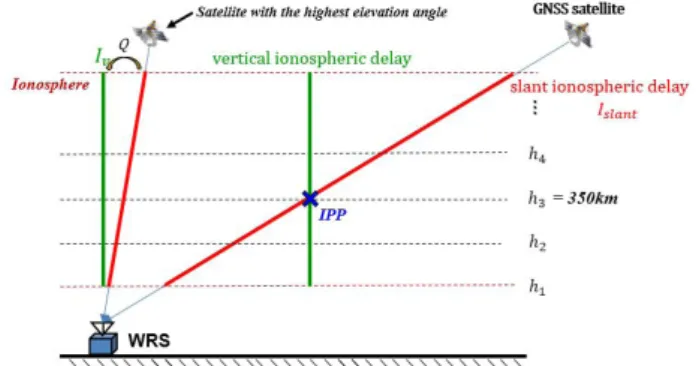
The ionospheric correction information is generated in the master station of SBAS, at which a process that converts the slant ionospheric delay between SBAS wide area reference station and satellite, which is calculated using dual frequency, into vertical ionospheric delay is needed. Currently, SBASs employ obliquity factor of thin shell model to calculate the vertical ionospheric delay. However, a thin shell model is a method that uses only simple geometric equations without consideration of spatial changes in the ionosphere. As a result, errors exist in the vertical ionospheric delay calculated using a thin shell model from the slant ionospheric delay.
Since the ionospheric correction information in SBAS is calculated using the vertical ionospheric delay, the ionospheric correction information is inevitably inaccurate due to the aforementioned error.
To address this, the multiple shell method proposed by Received Feb 25, 2019 Revised Mar 22, 2019 Accepted May 15, 2019
†
Corresponding Author E-mail: [email protected]
Tel: +82-2-880-1912 Fax: +82-2-888-2069
Bong-Kwan Choi https://orcid.org/0000-0003-4148-2715
Deok-Hwa Han https://orcid.org/0000-0002-5549-5413
Dong-Uk Kim https://orcid.org/0000-0001-9151-4434
Changdon Kee https://orcid.org/0000-0002-8691-7068
Komjathy et al. (2002) has been employed. The method proposed by Komjathy can generate more accurate ionospheric correction information than when using a thin shell model because it can consider a vertical distribution of electron density, which a thin shell model could not do.
However, there was a drawback that the format of currently broadcast SBAS messages should be changed to apply the multiple shell method to actual SBASs (Rao 2007, Kim et al. 2015, Tao & Jan 2016). Another method was previously proposed by Hoque (Hoque & Jakowski 2013, Hoque, Jakowski & Berdermann 2014). Hoque’s method considers a vertical distribution of electron density in the ionosphere using the Chapman profile. When the vertical ionospheric delay is given through Hoque's method, GNSS users can reduce the estimated slant ionospheric delay error more efficiently than when using a thin shell model. However, since Hoque's method is a process to convert the vertical ionospheric delay into the slant ionospheric delay, it cannot be used to generate ionospheric correction information of SBAS. Thus, this study proposed a new method that can reduce estimated errors when generating ionospheric correction information of SBAS without changing the existing SBAS message structure.
2. PROPOSAL OF METHOD TO GENERATE SBAS IONOSPHERIC CORRECTION
INFORMATION
2.1 Assumptions Used in the Proposed Method
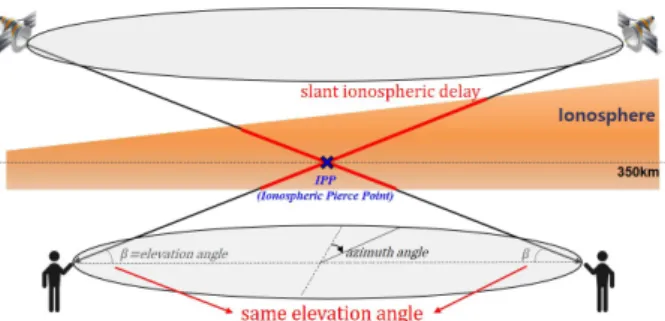
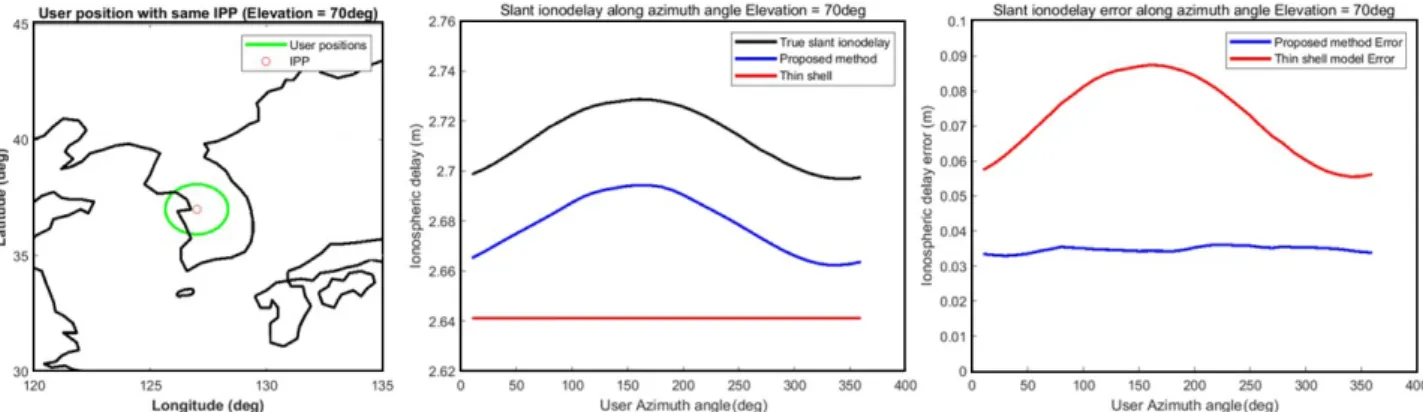
To generate ionospheric correction information in SBASs, vertical ionospheric delays at the ionospheric pierce point (IPP) are needed. To calculate the vertical ionospheric delay at the IPP, currently, SBAS uses a method that divides the slant ionospheric delay at the corresponding IPP using obliquity factor of thin shell model. However, obliquity factor of thin shell model is a function that uses only elevation without considering the spatial change in the ionosphere, thus generating estimated errors. For example, let us assume that there are line of sight (LOS) vectors that pass through the same IPP and have the same elevation. Since two vectors pass through two different paths, they have different slant ionospheric delays. However, since the elevation is the same, two vectors have the same obliquity factor, resulting in obtaining the different vertical ionospheric delays at the same IPP. When the LOS vector direction is significantly different at the nearby IPP, even if they do not pass the same IPP, there will be a significant difference in estimation of vertical ionospheric delays using the thin shell model. Since
the activities in the ionosphere environment do not change rapidly according to distance, the vertical ionospheric delay at the nearby IPP should change gradually, but it does not change gradually if the thin shell model is used. Thus, this study proposed a method to reduce the aforementioned estimated error that occurs due to the use of thin shell model when generating the ionospheric correction information in SBASs.
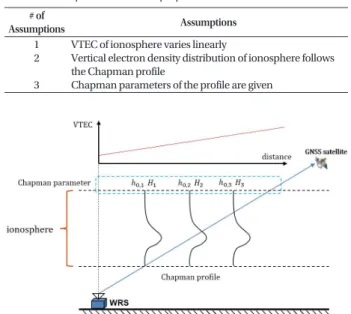
Hoque's study mentioned in Introduction proposed a method that calculates the slant ionospheric delay when the vertical ionospheric delay is known (Hoque & Jakowski 2013). The basic idea of the proposed method in this study was based on the algorithm proposed by Hoque. However, it is impossible to apply the algorithm proposed by Hoque simply in the opposite way to obtain the vertical ionospheric delay from the slant ionospheric delay. Thus, the algorithm proposed in this study employed the assumptions described in Table 1.
Fig. 1 is presented to help readers understand the assumptions used in the proposed method. Assumption 1 is established to supplement insufficient information to calculate the vertical ionospheric delay from the slant ionospheric delay. Through Assumption 1, a linear equation can be obtained to calculate the vertical ionospheric delay, which will be described in relation to the algorithm later.
Assumptions 2 and 3 are set to consider the change according to the horizontal difference in the ionosphere. The Chapman profile is equivalent to Eqs. (1-3) that model the vertical electron density distribution in the ionosphere (Feltens et al.
1998).
Fig. 1. Assumptions used in the proposed method.
Table 1. Assumptions used in the proposed method.
# of
Assumptions Assumptions
1 2 3
VTEC of ionosphere varies linearly
Vertical electron density distribution of ionosphere follows the Chapman profile
Chapman parameters of the profile are given
0
( , ) 1
0( , , ) exp (1 exp( )) ( , ) ( )
2 2
e
N
n h z z N Chap h
eH
λ φ λ φ λ φ
π
= − − − = (1)
z h h
0H
= − (2)
( ) 1 Chap h =
∫ (3)
In Eq. (1), λ, ϕ, and h refer to the preferred longitude, latitude, and height, respectively. n
erefers to the electron density at altitude h, and N
0signifies the largest electron density. In Eq. (2), h
0refers to the altitude where the largest electron density is located, and H refers to the atmospheric scale height. As presented in Eq. (3), a value of Chapman profile becomes 1 when integrated according to altitude.
In addition, Chapman profile can be expressed by two parameters h
0and H, which are called Chapman parameters in this study. The vertical characteristics in the ionosphere can be taken into consideration by assuming the vertical electron density distribution in the ionosphere as the Chapman profile, and the horizontal characteristics in the ionosphere can also be taken into consideration by assuming that the Chapman parameters can be known.
2.2 Algorithm of the Proposed Method
The algorithm of the proposed method is described below.
Figs. 2-4 aim to help readers to understand the proposed algorithm. The equations used in the algorithm are presented in Eqs. (4-8).
( )
ii v
d
vI x I I
= − d + (4)
1
, i
( , , )
0,i ih
v i i h i i i
I = × I ∫
+Chap h H h dh I C = (5)
1
1 ,
( )
n
slant v i i
i
I
−I Q f x
=
= ∑ × = (6)
2
1 ( )cos(El) 1
i
RX e
i e
Q h R
h R
=
+
− +
(7)
1 1 1 2 2 2
3 3 1 1 1 2 2 2 4 4 4
(( ) ( ) )
slant v