본 연구는 정부(교육부)의 재원으로 한국연구재단의 지원을 받아 Brain Korea 21 Plus Project의 연구결과로 수행되었음. (과제번호:10Z20130000013)
*주저자: 성균관대학교 인터렉션사이언스학과 e-mail: [email protected]
**공동저자: 성균관대학교 인터렉션사이언스학과 교수 e-mail: [email protected]
†교신저자: 성균관대학교 인터랙션사이언스학과 교수 e-mail: [email protected]
■ 접수일:2014년 3월 5일 / 심사일:2014년 4월 16일 / 게재확정일:2014년 5월 14일
이용자 중심의 얼굴 표정을 통한 감정 인식 TV의 상호관계 연구
인간의 표정을 통한 감정 인식기반의 TV과 인간의 상호 작용 연구
The interaction between emotion recognition through facial expression based on cognitive user-centered television
이종식, Jong-Sik Lee*, 신동희, Dong-Hee Shin**†
Abstract In this study we focus on the effect of the interaction between humans and reactive television when emotion recognition through facial expression mechanism is used. Most of today’s user interfaces in electronic products are passive and are not properly fitted into users’ needs. In terms of the user centered device, we propose that the emotion based reactive television is the most effective in interaction compared to other passive input products. We have developed and researched next generation cognitive TV models in user centered. In this paper we present a result of the experiment that had been taken with Fraunhofer IIS SHORE™ demo software version to measure emotion recognition. This new approach was based on the real time cognitive TV models and through this approach we studied the relationship between humans and cognitive TV. This study follows following steps: 1) Cognitive TV systems can be on automatic ON/OFF mode responding to motions of people 2) Cognitive TV can directly select channels as face changes (ex, Neutral Mode and Happy Mode, Sad Mode, Angry Mode) 3) Cognitive TV can detect emotion recognition from facial expression of people within the fixed time and then if Happy mode is detected the programs of TV would be shifted into funny or interesting shows and if Angry mode is detected it would be changed to moving or touching shows. In addition, we focus on improving the emotion recognition through facial expression. Furthermore, the improvement of cognition TV based on personal characteristics is needed for the different personality of users in human to computer interaction.
In this manner, the study on how people feel and how cognitive TV responds accordingly, plus the effects of media as cognitive mechanism will be thoroughly discussed.
핵심어: Emotion based on Reactive TV, Emotion Recognition through Facial Expression, Cognitive TV
1. INTRODUCTION
We have conducted a research on cognitive systems that has been increasing significance because intelligent research groups around the world are developing algorithm and systems based on the face, iris and voice. In our research we will clarify the relationship between humans and cognitive TV systems. In this paper we present emotion recognition embedded software via facial expression within fixed and real time, which is possible real-time response by happy mode, angry mode or normal mode in the embedded system. In this paper we focused on improving the accuracy of emotion recognition on Cognitive TV system. Additional performance of face recognition methods using subspace projection is directly related to the characteristics of their base images, especially in the cases of local distortion. In order for a subspace projection method to be robust regarding local distortion and partial occlusion, the base images generated by the method should exhibit a part-based local representation.
The Cognitive TV method only employs locally salient information from important facial parts in order to maximize the benefit of applying the idea of “recognition by parts.” The part-based local base images are put into full use with additional localization constraint in the process of computing new face algorithm data.
In this paper we present the result of theeffectiveness of user interface on emotion recognition of cognitive TV in user centered. In Human-Computer Interaction machine recognition of humans’ emotional state is very important because Individual emotions play a crucial role during the interaction.
Identifying person’s emotional state and providing personalized feedback is very difficult. To improve the detection, the procedure of the experiment was as follows;
1) Personality test in individual user with MBTI (Myers-Briggs Type Indicator) of introverted type, outgoing type and mixed type
2) Participants were categorized according to personal tendency
3) Detect of face status within categorized tendency.
“Cognitive theory is a learning theory of psychology that attempts to explain human behavior by understanding the thought processes. The assumption is that humans are logical beings that make the choices that make the most sense to them. “Information processing” is a commonly used
to a computer.” (Google)
“Cognitive theory is focused on the individual's thoughts as the determinate of his or her emotions and behaviors and therefore personality. Many cognitive theorists believe that without these thought processes
Social Cognitive Theory, used in psychology, education, and communication, posits that portions of an individual's knowledge acquisition can be directly related to observing others within the context of social interactions, experiences, and outside media influences.” (From Wikipedia, the free encyclopedia Mar 2010)
Emotions play an important role in human-to-human communication and interaction. The emotion-expression relationship is greatly clarified by the componential approach to emotion (e.g., Frida,1986; Lang,1995;Laza,) and according to that approach, emotions are structures of moderately correlated components. Affect, appraisal, action disposition, and physiological response are the major components.
Emotional feelings are considered as one’s awareness of one or more if there components. Different emotions can be viewed as structures that differ in one or more of these components.
Experiment who was thinking with feeling of deep happiness, sadness status in user centered. (James A. Russell and Jose Miguel Fernandez-Dols “The psychology of facial expression”
97page)
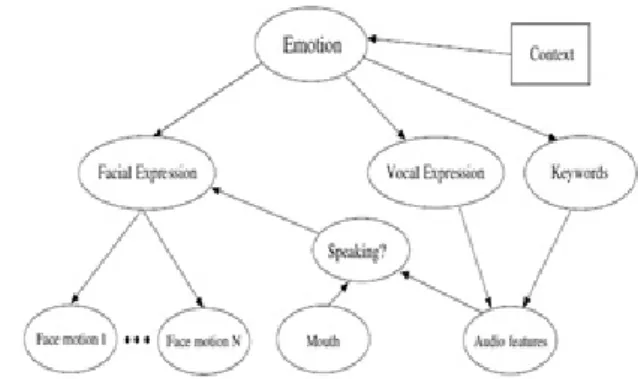
<Figure 1. Bayesian network topology for bimodal emotion expression recognition>
Figure 1 shows the structure of the relationship between emotion and various expressions.
Based on cognitive and emotion theories, we applied these essential principles into our research.
2. Architecture of Emotion recognition as face expression
Emotion recognition software is based on the cognitive TV models.
<Figure 2 Architecture of Emotion recognition>
Different emotions can be viewed as structures that differ in one or more of these components.
The emotion levels are not the same for everybody by anytime. So, Cognitive TV needs accurate detection of emotion process from face expression by real time. We should consider different emotions deep from face expression to personality type and stress status. So, Figure 3 showed the improved emotion recognition which is featured by individual personality in user centered.
<Figure 3. Modified structure of emotion recognition>
3. SOFTWARE BASE ON TEST
Fraunhofer IIS SH.ORE™ demo version of Emotion recognition software used in experiment as below
To improve the accuracy of Emotion recognition in Software, the following standard parameter should be changed as personal tendency.
Pi = AiW happy + BiW Anger + CiW sad + DiW Surprise If participant emotions scores are measured fewer than 50% then the parameter should be amplified because the figures under 50% will not be displayed, especially for the introverted type personality.
4. METHOD OF EXPERIMENT 1) Participants
The 12 samples consisted between 25 and 35 years.
2) Procedure
Testing took place over two days. On the first day, participants completed a MBTI test with grouping the personality type
On the next day, each participant completed the emotion recognition in face expression based on the result of MBTI test and additionally participants have experience as normal TV within the fixed time.
3) Analysis
Modified parameter was adapted to measure accuracy of facial expression and 7 scale questionnaires was used to measure satisfaction of cognitive TV.
5. Result
1) Accuracy of facial expression
Table 1. Accuracy of facial expression
NO Gender Age Personality Accuracy Happy Sad Anger Surprise 1 Male 23~35 Outgoing 66% 100% 20% 48% 95%
2 Male 23~35 Outgoing 48% 100% 10% 30% 50%
3 Male 23~35 Introverted 59% 70% 40% 50% 75%
4 Male 23~35 Introverted 50% 60% 40% 40% 60%
5 Male 23~35 Mixed 39% 65% 20% 20% 50%
6 Male 23~35 Mixed 60% 75% 60% 30% 75%
7 Female 23~35 Outgoing 48% 80% 20% 10% 80%
8 Female 23~35 Outgoing 50% 80% 10% 20% 90%
9 Female 23~35 Introverted 66% 30% 100% 75% 60%
10 Female 23~35 Introverted 48% 40% 30% 60% 60%
11 Female 23~35 Mixed 55% 75% 49% 20% 75%
12 Female 23~35 Mixed 37% 74% 15% 20% 40%
71% 35% 35% 68%
Average
NO Gender Age Personality Accuracy Happy Sad Anger Surprise 1 Male 23~35 Outgoing 76% 100% 40% 68% 95%
2 Male 23~35 Outgoing 58% 100% 20% 60% 50%
3 Male 23~35 Introverted 59% 70% 40% 50% 75%
4 Male 23~35 Introverted 50% 60% 40% 40% 60%
5 Male 23~35 Mixed 39% 65% 20% 20% 50%
6 Male 23~35 Mixed 60% 75% 60% 30% 75%
7 Female 23~35 Outgoing 56% 85% 40% 20% 80%
8 Female 23~35 Outgoing 60% 85% 25% 40% 90%
9 Female 23~35 Introverted 66% 30% 100% 75% 60%
10 Female 23~35 Introverted 55% 40% 60% 60% 60%
11 Female 23~35 Mixed 55% 75% 49% 20% 75%
12 Female 23~35 Mixed 37% 74% 15% 20% 40%
72% 42% 42% 68%
Average
This table 1 shows the higher scores of emotion recognition with outgoing type for both male and female in happy and surprise status. On the contrary, both male and female with introverted type show lower level of emotion recognition in angry and sad status.
In sad and angry mode, the outgoing persons show lower accuracy compared to introverted persons. However, after the improvement of the accuracy in emotion recognition, the outgoing persons’ emotion recognition accuracy rate was increased. The red color score shows the improvement of the accuracy in emotion recognition from parameter in software
Improved accuracy of Emotion recognition to angry mode was significant value as below.
Table 2. Result of Emotion recognition to angry mode>
Experimental #1 <Angry mode>
Mean 7.91 SD 24.44
Experimental #2 <Angry mode>
Mean 37.33 SD 32.09
2) Satisfaction of Cognitive TV
In human-computer interaction, machine recognition of human emotional state is very important. Individual emotions play a crucial role during the interaction. Identifying person’s emotion state and providing personalized feedback is very difficult. We propose a novel and yet effective system to recognize human emotional state.
Cognitive TV shown interaction between emotion of humans and contents of TV. In case Happy mode is detected the programs of TV would be shifted into funny or interesting shows and if Angry mode is detected it would be changed to moving or touching shows.
The following series of tables show the satisfaction of cognitive TV.
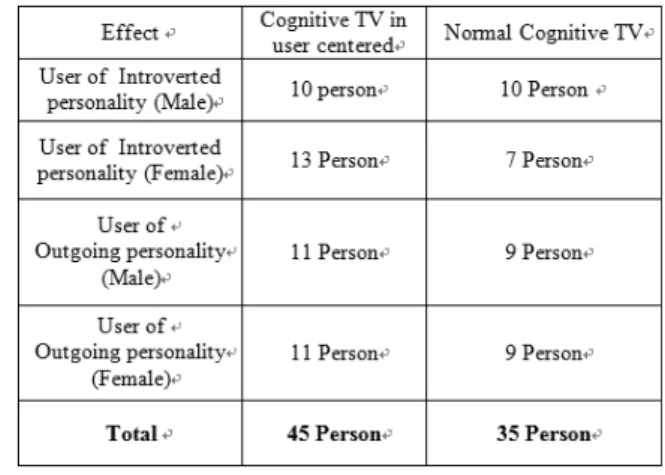
Table 3.1. Satisfactions Level Test / Happy, Surprise
Table 3.2. Satisfactions Level Test / Sad, Angry
6. CONCLUSIONS
The result of (Table2) shows the improved accuracy of Emotion recognition to angry mode was significant status as statistics. It is important result value to improved cognitive TV in user centered. According to this result shows most of cognitive TV &device need to accuracy user interface in user center.
Additionally, the result of (Table3.1) and (Table 3.2) shows the satisfaction ratio of participants. Female participants who have high cognitive level feel higher satisfaction than the male participants who have high cognitive level when sad mode and angry mode and female participants with high cognitive level also feel higher satisfaction ratio than the male participants who have high cognitive level when normal mode and happy mode. We suggested new cognitive mechanism and relationship between new cognitive TV and Human in this research and we will have the opportunity of conducting similar research in the future.
REFERENCES
[1] Nakano, T., Ando, H., Ishizu, H., Morie, T.,
&Iwata, A. "Coarse image region segmentation using resistive-fuse networks implemented in FPGA." 7th World Multiconference on Systemics, Cybernetics and Informatics. Vol. 4, pp. 186-191. 2003.
[2] T.Nakano, T.Morie,and A.Iwata “A Face/Object Recognition System Using FPGA Implementation of Carse Region Segmentation. (SICE Annual Conference in Fukui, Fukui University, Japan, 2003.
[3] Morizet, N., Amiel, F., Hamed, I. D., &Ea, T. "A comparative implementation of PCA face recognition algorithm." Electronics, Circuits and Systems, 2007.
ICECS 2007. 14th IEEE International Conference on.
IEEE, pp. 865-868. 2007.
[4] Sannella, Michael John. Constraint satisfaction and debugging for interactive user interfaces. Diss.
University of Washington, 1994.
[5] Morizet, N., Amiel, F., Hamed, I. D., &Ea, T. "A comparative implementation of PCA face recognition algorithm." Electronics, Circuits and Systems, 2007.
ICECS 2007. 14th IEEE International Conference on.
IEEE, p. 865-868. 2007.
[6] Sharma, Sudhir, and Wang Chen. "Using model- based design to accelerate FPGA development for automotive applications." The MathWorks (2009).
[7] Madi, R., Lahoud, R., Sawan, B., &Saghir, M.
"Face Recognition on FPGA." Spring Term Report, EECE 501 (2006).
[8] Veloso, M. Pinkal H. Uszkoreit M., W. Wahlster, and M. J. Wooldridge. "Cognitive Technologies." 2007.
[9] Stork, Hans-Georg. "Towards a Scientific Foundation for Engineering Cognitive Systems-an interim report."
2007.
[10] Dan BurnsAir Force Research Laboratory (AFRL) FPGA Hardware Acceleration of DNA Code Library Design (and Cognitive Models)2008.
[11] Farabet, Cl ment, Cyril Poulet, and Yann LeCun.
"An fpga-based stream processor for embedded real-time vision with convolutional networks."
Computer Vision Workshops (ICCV Workshops), 2009 IEEE 12th International Conference on. pp.
878-885, IEEE, 2009.
[12] Jiang, Jintao, et al. "On the relationship between face movements, tongue movements, and speech acoustics." EURASIP Journal on Applied Signal Processing 11, pp. 1174-1188. 2002
[13] Oviatt, Sharon. "Human-centered design meets cognitive load theory: designing interfaces that help people think." Proceedings of the 14th annual ACM international conference on Multimedia. pp 871-880. 2006.
[14] So, Hayden Kwok-Hay, and Robert Brodersen. "A unified hardware/software runtime environment for FPGA-based reconfigurable computers using BORPH." ACM Transactions on Embedded Computing Systems (TECS) 7.2. 14 2008
[15] Deivamani, M., R. Baskaran, and P. Dhavachelvan.
"Improving Emotion Recognition with a Learning Multi-agent system." Department of Computer Science &Engineering, Anna University, Chennai, India
[16] Vogt, Thurid, and Elisabeth Andr. "Improving automatic emotion recognition from speech via gender differentiation." Proc. Language Resources and Evaluation Conference (LREC 2006), Genoa.
2006.
[17] Stephen M. Fiore, Ph.D. Editor, Cognitive Technology http://www.cognitivetechnologyjournal.com/Default .aspx.html Apr.20 .2014
[18] Richard E. Mayer and Roxana Moreno University of California, Santa Barbara “A Cognitive Theory of Multimedia Learning: Implications for Design Principles.” 2000
[19] Jim Sullivan University of Colorado 2003
http://portal.acm.org/citation.cfm?id=957205.95723 2. html Apr.23 2014
[20] Chapter 11: Cognitive Theory
http://allpsych.com/personalitysynopsis/cognitive.
html Apr.23 2014 [21] Social cognitive theory
http://en.wikipedia.org/wiki/Social_cognitive_theor y.html Apr.23 2014
[22] Pao Chung and Chao “Face recognition system based on front-end facial feature extraction using FPGA.” 2009
[23] Sex-related differences in spatial cognition http:/ /e n. wi kipe dia.or g/wi ki/ Se x-re l at ed _differences_in_spatial_cognition. html Apr.23 2014 [24] Fraunhofer IIS SHORE™
http://www.iis.fraunhofer.de/bf/bsy/produkte/shor e/.html Apr.25 2014
신 동 희
2004년 5월:Syracuse University, Information and Telecommuni-cations (석박사)
2004년 6월 ~ 2009년 5월:Pennsylvania State University, College of Information Sciences and Technology 교수 (Assistant Pro-fessor)
▪2009년 6월 ~ 현재: 성균관대학교 인터랙션 사이언스학과 교 수 (Professor), 연구소장, 학과장
<관심분야>:디지털커뮤니케이션, 정보과학, HCI
이 종 식
2005년 7월:한양대학교 전자공학과(공학 석사)
2010년 8월 ~ 현재:성균관대학교 인터랙 션 사이언스학과 박사
<관심분야>:감정인식, HCI, HRI, UI, 인지공학