http://dx.doi.org/10.5468/ogs.2016.59.1.24 pISSN 2287-8572 · eISSN 2287-8580
Introduction
Endometrial adenocarcinoma (EC) is the most common gyne- cological malignancy in developed countries, and is the third most common cause of gynecological cancer death [1]. Com- plex atypical hyperplasia (CAH) is an immediate precursor of EC [2]. The majority of women with EC are postmenopausal.
However, 15.0% to 25.0% of EC cases occur prior to the menopause [3-9], 10.0% will be aged <45 years and 4.0%
aged <40 years [4,8], of which 70.0% are nulliparous [10].
Most women diagnosed with CAH or grade 1 endometrial
Fertility-preserving treatment in complex atypical hyperplasia and early endometrial cancer in young women with oral progestin: Is it effective?
Ji Sun Baek, Wan Ho Lee, Woo Dae Kang, Seok Mo Kim
Department of Obstetrics and Gynecology, Chonnam National University Medical School, Gwangju, Korea
Objective
The aim of this study is to assess the effectiveness of oral progestin treatment in women diagnosed with complex atypical hyperplasia (CAH) or grade 1 endometrial cancer (G1EC), who desire to preserve their fertility, as alternative treatment to a hysterectomy.
Methods
We reviewed the medical records of women younger than 45 years old that had been diagnosed with CAH or G1EC, who expressed a desire to preserve their fertility using alternative treatment at our institution. Women without evidence of myometrial invasion on pelvic magnetic resonance imaging scans were included. The study period was between 2004 and 2014. Endometrial biopsies were taken at follow-up appointments.
Results
We identified 31 young women with CAH or G1EC. The median age was 33 years old (range, 20 to 41), and the median period of time undertaking the treatment was 5 months (range, 1 to 12). Twenty-three patients (74.2%) achieved complete remission (CR; median time to CR was 3 months; range, 1 to 22), 16 patients (88.9%) with CAH and 7 (53.8%) with G1EC achieved CR. 6 patients (26.1%) who had achieved CR, had recurrence of the disease (median time from CR to recurrence was 12.5 months; range, 4 to 18). Eight patients (25.8%) finally underwent a hysterectomy.
Conclusion
Oral progestin therapy is an alternative treatment for women with CAH or G1EC who desire fertility preservation.
However, more prospective studies are needed for standard progestin regimen. Also, there still remains a risk of disease progression and recurrence. Therefore, close follow-up is important during treatment and after CR. In addition, a hysterectomy is recommended as a definitive treatment after completion of childbearing.
Keywords: Endometrial hyperplasia; Endometrial cancer; Fertility; Progestins
Received: 2015.5.27. Revised: 2015.8.4. Accepted: 2015.8.8.
Corresponding author: Seok Mo Kim
Department of Obstetrics and Gynecology, Chonnam National University Medical School, 160 Baekseo-ro, Dong-gu, Gwangju 61469, Korea
Tel: +82-61-379-7687 Fax: +82-62-227-1637 E-mail: [email protected]
http://orcid.org/0000-0003-2318-0334
Articles published in Obstet Gynecol Sci are open-access, distributed under the terms of the Creative Commons Attribution Non-Commercial License (http://creativecommons.
org/licenses/by-nc/3.0/) which permits unrestricted non-commercial use, distribution, and reproduction in any medium, provided the original work is properly cited.
Copyright © 2016 Korean Society of Obstetrics and Gynecology
cancer (G1EC) have a strong desire to preserve their fertility [11].
In addition, the number of patients with EC who desire fertil- ity preservation will increase in the future, considering social trends such as increasing tendency to marry later in life.
The standard treatment for endometrial cancer is a hysterec- tomy and bilateral salpingo-oophorectomy. Younger women tend to be diagnosed with low grade, early stage disease and have an excellent prognosis with five- and ten-year disease- free survival rates of up to 99.2% and 98.0%, respectively [2,12-14]. Here, we consider an alternative treatment to a hys- terectomy, until the completion of childbearing, for women with CAH or G1EC who desire fertility preservation. The most- studied fertility-preserving treatment for CAH and G1EC in young women is oral progestin. This alternative therapy using progestin should be restricted to patients with disease up to grade I, with no evidence of myometrial invasion or extrauter- ine disease upon imaging, and motivation to achieve preg- nancy soon after disease remission [15].
Various success rates are reported in the literature with the administration of different progestin regimens. However, de- finitive treatment guidelines do not exist, therefore it remains unclear which type of progestin and duration of therapy is the most effective. In addition, it is unclear which patients have a more effective response to progestin therapy based on their characteristics.
The objective of our study is to assess the efficacy of oral progestin treatment in women with CAH or G1EC as alterna- tive treatment to a hysterectomy. Also, we analyzed various characteristics as predictors of treatment response.
Materials and methods
We performed a retrospective analysis and identified 31 women with CAH or G1EC, including those younger than 45 years old, who were treated with oral progestin for fertility preservation at Chonnam National University Hospital. The study period included cases from 2004 to 2014. Clinical data was obtained from medical records. Women with a histologi- cal diagnosis of CAH or G1EC, without evidence of myometri- al invasion on pelvic magnetic resonance imaging scans, were included. Diagnosis and assessment of response to treatment were based on the results of an endometrial biopsy or dilata- tion and curettage, with hysteroscopy being used for biopsy of focal endometrial lesions or a more accurate endometrial
curettage. Follow-up biopsy was performed at 1 month after initiation of progestin treatment, and every 3 months since then. Resulting specimens were reviewed by a gynecological pathologist. Complete remission (CR) was defined as no mi- croscopic evidence of either hyperplasia or cancer cells in the endometrial histopathology. A proliferative phase, secretary phase, or hormonal effect found in the endometrial histo- pathology were considered as normal. The period of time to CR was measured from the initiation of progestin treatment to the first negative biopsy. Recurrence was defined as either hyperplasia with atypia or cancer cells present in histopathol- ogy following CR. The time to recurrence was measured from CR to the first positive biopsy. Progestin therapy consisted of megestrol acetate (MA, 80–160 mg) or medroxyprogesterone acetate (MPA, 40–120 mg).
Continuous variables were described using median values and ranges. Categorical variables were described using frequencies and proportions. A body mass index (BMI) greater than 25 kg/
m
2was considered obese. Comparisons were performed us- ing Fisher’s exact test, the χ
2test, and the Mann-Whitney test.
Statistical significance was set at the standard value of P<0.05.
IBM SPSS ver. 21.0 (IBM Corp., Armonk, NY, USA) was used for all statistical analyses.
Result
A total of 31 patients met the study criteria. At initial diagno- sis, 18 patients (58.1%) had CAH and 13 patients (41.9%)
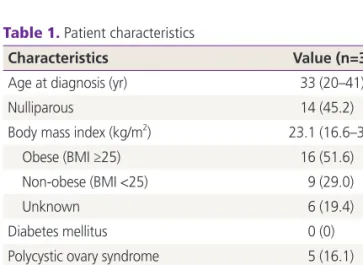
Table 1. Patient characteristics
Characteristics Value (n=31)
Age at diagnosis (yr) 33 (20–41)
Nulliparous 14 (45.2)
Body mass index (kg/m
2) 23.1 (16.6–39.5)
Obese (BMI ≥25) 16 (51.6)
Non-obese (BMI <25) 9 (29.0)
Unknown 6 (19.4)
Diabetes mellitus 0 (0)
Polycystic ovary syndrome 5 (16.1)
Progestin type
Megestrol acetate 25 (80.6)
Medroxyprogesterone 6 (19.4)
Data are presented as median (range) or number (%).
had G1EC. There was no difference between the proportion of women with CAH and G1EC. All patients were evaluated using pelvic magnetic resonance imaging before treatment, and had no evidence of myometrial invasion or extrauterine disease. Population characteristics are described in Table 1.
Among these patients, 11 (35.5%) were unmarried and 14 (45.2%) were nulliparous. The median age was 33 years old (range, 20 to 41). Five patients (16.1%) had polycystic ovary syndrome (PCOS) at the time of diagnosis. The median BMI was 23.1 (range, 16.6 to 39.5). No patients in study popula- tion had diabetes. The median time receiving treatment was 5 months (range, 1 to 12). Twenty five patients (80.6%) were on MA and 6 patients (19.4%) were on MPA. The median follow-up from the start of progestin treatment was 11.5 months (range, 3 to 29).
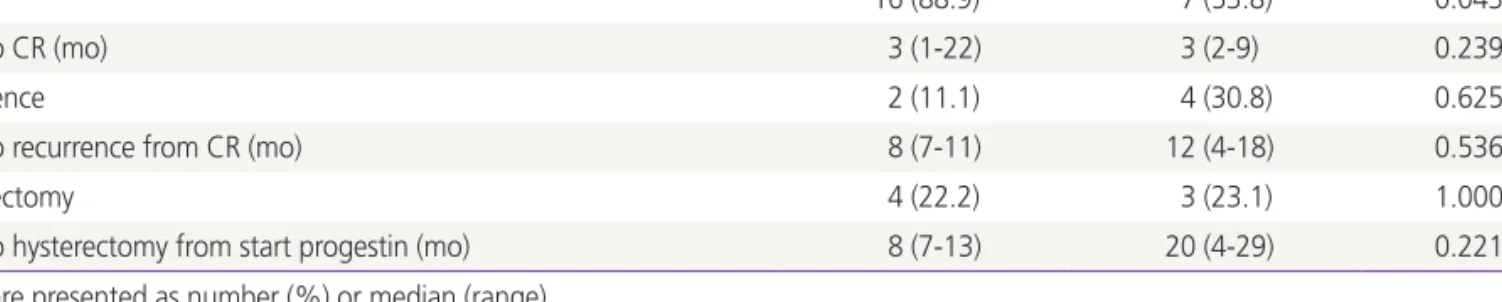
The response to treatment and oncological outcomes as histological diagnoses are presented in Table 2. There was no
difference in the period of time to CR, recurrence rates, time to recurrence, hysterectomy rates, and time to hysterectomy between CAH and G1EC.
The distribution of evaluated patients is presented in Fig. 1.
Twenty three patients (74.2%) achieved CR; 16 (88.9%) with CAH and 7 (53.8%) with G1EC. Of the patients who did not achieve CR, 4 underwent a hysterectomy due to persistent dis- ease and 4 were a follow-up loss. CAH at initial diagnosis was associated with more likelihood of CR ( P=0.04; odd ratio, 6.88;
95% confidence interval, 1.10 to 42.76). No other variables were found to be associated with CR (Table 3). The women who achieved CR were similarly proportioned between non- obese (BMI <25) and obese (BMI ≥25) (75.0% vs. 77.8%).
In addition, the probability of CR was not significantly differ- ent between the patients with or without PCOS (80.0% vs.
73.1%). In addition, progestin type was not associated with CR ( P=0.63). The median time to CR was 3 months (range, Table 2. Response to treatment and oncological outcomes as histological diagnoses
CAH (n=18) G1EC (n=13) P-value
CR 16 (88.9) 7 (53.8) 0.043
Time to CR (mo) 3 (1-22) 3 (2-9) 0.239
Recurrence 2 (11.1) 4 (30.8) 0.625
Time to recurrence from CR (mo) 8 (7-11) 12 (4-18) 0.536
Hysterectomy 4 (22.2) 3 (23.1) 1.000
Time to hysterectomy from start progestin (mo) 8 (7-13) 20 (4-29) 0.221
Values are presented as number (%) or median (range).
CAH, complex atypical hyperplasia; G1EC, grade 1 endometrial cancer; CR, complete remission.
Fig. 1. The distribution of evaluated patients.
31 Total patients
18 Complex atypical hyperplasia 13 Grade 1 endometrial cancer
16 Complete remission 2 Persistent disease 7 Complete remission 6 Persistent disease
14 No
recurrence 2
Recurrence 2 Hysterectomy 3 No
recurrence 4
Recurrence 2
Hysterectomy 4 Follow-up
loss
1 to 22). Only 8 patients received maintenance therapy with low-dose cyclic progestin after CR (duration 3 to 6 months).
Six patients (26.1%) who had achieved CR recurred (Table 4). Of these patients, 2 patients had CAH and 4 patients had
G1EC at initial diagnosis. Maintenance treatment was admin- istered in 3 of 6 patients but not in the other 3 patients. Four of the patients with recurrent disease started a second course of progestin therapy. Three of these (75.0%) responded to Table 3. Variables associated with complete remission
Variable Complete remission (%) Odds ratio (95% CI) P-value
Body mass index (kg/m
2)
Obese vs. non-obese
a)75.0 vs. 77.8 0.86 (0.12–5.94) 1.00
Polycystic ovary syndrome
Yes vs. no 80.0 vs. 73.1 0.06 (0.06–7.16) 0.13
Histologic diagnosis
CAH vs. G1EC 88.9 vs. 53.8 6.88 (1.10–42.76) 0.04
Progestin type
MA vs. MPA 76.0 vs. 66.7 1.58 (0.23–10.90) 0.63
CI, confidence interval; CAH, complex atypical hyperplasia; G1EC, grade 1 endometrial cancer; MA, megestrol acetate; MPA, medroxyproges- terone acetate.
a)
Obese, BMI ≥25; non-obese, BMI <25.
Table 4. Patients who recurred after achievement of complete remission Age at
diagnosis (yr)
Initial diagnosis
Maintenance treatment
Time to recurred (mo)
Diagnosis at the time of
recurrence
Second progestin treatment
Outcomes
41 CAH No 8 CAH No Hysterectomy
39 CAH Yes 13 G1EC Yes Hysterectomy
33 G1EC No 12 CAH Yes Complete remission
34 G1EC No 4 CAH Yes Complete remission
38 G1EC Yes 17 G1EC No Hysterectomy
33 G1EC Yes 18 G1EC Yes Complete remission
CAH, complex atypical hyperplasia; G1EC, grade 1 endometrial cancer.
Table 5. Patients who underwent a hysterectomy
Age at diagnosis (yr) Initial diagnosis Response Operation Final diagnosis
39 CAH Persist TLH CAH
41 CAH Recur TLH CAH
39
a)CAH Progress TLH+BSO IAG1
33 CAH Persist TVH CAH
34 G1EC Persist TLH CAH
37 G1EC Persist TLH IAG1
38 G1EC Recur TLH IAG1
32
a)G1EC Persist LMRH+PLND IAG1
CAH, complex atypical hyperplasia; TLH, total laparoscopic hysterectomy; BSO, bilateral salpingo-oophorectomy; IAG1, endometrial cancer stage IA grade1; TVH, transvaginal hysterectomy; G1EC, grade 1 endometrial cancer; LMRH+PLND, laparoscopic modified radical hysterec- tomy and pelvic lymph node dissection.
a)