https://doi.org/10.20307/nps.2018.24.2.109
109
Simultaneous Determination of Four Compounds from Artemisia capillaris using High Performance Liquid Chromatography-Ultraviolet Detector (HPLC-UVD)
and Their Quantitative Study in Artemisia Genus
Kiwon Ko
1, In Kee Hong
2, Hyun-Jong Cho
1, Young Ho Kim
3,*, and Heejung Yang
1,*
1
College of Pharmacy, Kangwon National University, Chuncheon 24341, Republic of Korea
2
R&D Center, Radiant Ltd., Chuncheon 24398, Republic of Korea
3
College of Pharmacy, Chungnam National University, Daejeon 34134, Republic of Korea
Abstract − Artemisia capillaris Thunb. (Compositae) is a native herb of East Asian countries and has used for the treatment of jaundice, high liver fever, and digestive diseases for a long time, as well as being developed as the source of herbal preparations until now. The major components from A. capillaris were chlorogenic acid (1) and its derivatives substituted with caffeoyl moieties, such as 3,5-dicaffeoylquinic acid (2) and 4,5-dicaffeoylquinic acid (3), and coumarins, such as scoparone. In the study, four compounds, chlorogenic acid, 3,5-dicaffeoylquinic acid, 4,5-dicaffeoylquinic acid and scoparone (4) in the 70% ethanolic extract of A. capillaris were simultaneously determined by using HPLC-UVD system. This method was validated with the terms of linearity, precious and accuracy according to ICH guidelines. The developed method was successfully applied for the quantitative analysis of Artemisia genus, A. capillaris, A. iwayomogi, A. princeps, and A. argyi, distributed in Korea.
Keywords − Artemisia capillaris, Artemisia iwayomogi, Artemisia princeps, Artemisia argyi, Scoparone, HPLC-UV
Introduction
Artemisia capillaris Thunb. (Compositae) is an edible herbal medicine in Asian countries, Korea, China and Japan, for a long time. It has been traditionally used for the treatment of jaundice, high liver fever, and digestive diseases.
1,2Extracts of A. capillaris and its components have the wide range of pharmacological activities, such as anti-inflammatory, hepatoprotective, and neuroprotective effects.
3-5Also, it inhibited atopic dermatitis-like skin lesions, such as hyperkeratosis, hypertrophy and hemorrhage.
6Major components of A. capillaris were simple phenolic compounds including of chlorogenic acid derivatives, coumarins and flavonoids.
7,8Among them, scoparone, a coumarin derivative, is the marker compound of A.
capillaris in a guideline for approval and declaration of herbal preparation (No. C0-2012-3-006) published by Ministry of Food and Drug Safety (MFDS), Korea. It can
inhibit the release of inflammatory mediators in interferon- γ or LPS-stimulated RAW 264.7 and BV-2 cells.
9,10Also it was reported that scoparone inhibited the NF- κB activity in phorbol 12-myristate 13-acetate-stimulated U937 cells.
11In the present study, we developed the simultaneous determination of scoparone (SP), along with three phenolic compounds, chlorogenic acid (CA), 3,5-dicaffeoylquinic acid (3,5-DQA) and 4,5-dicaffeoylquinic acid (4,5-DQA), using HPLC-UV methods. Then, we applied the developed method for the quantification of four compounds in the dried herbs of Artemisia genus including of A. capillaris, A. iwayomogi, A. princeps, and A. argyi, which is being distributed in Korea.
Experimental
Chemicals and Reagents − The 70% ethanolic extract of A. capillaris was gifted from Dr. In Kee Hong, R&D Center, Radiant Ltd. Briefly, it was prepared by Soxhlet extraction of dried A. capillaris (20 kg) with 70% ethanol (200 L) on 65
oC for 3 hr. Then the extract was powdered by freeze-drying and used for the HPLC analysis. CA, 3,5-DQA and 4,5-DQA were purchased from Chemfaces (Wuhan, Hubei, China). SP was provided by Dr. Hyun- Jong Cho, a professor of College of Pharmacy, Kangwon
*Author for correspondence
Young Ho Kim (Ph.D), College of Pharmacy, Chungnam National University, Daejeon 34134, Republic of Korea.
Tel: +82-42-821-5933; E-mail: [email protected]
Heejung Yang (Ph.D), College of Pharmacy, Kangwon National University,Chuncheon 24341, Republic of Korea.
Tel: +82-33-250-6919; E-mail: [email protected]
National University. Their purities were above 98%.
HPLC-grade acetonitrile and water were purchased from TEDIA (Fairfield, OH, USA). Formic acid (FA) was purchased from Daejung Chemicals & Metals Co. Ltd.
(Siheung, Korea).
Plant Materials − Thirty-one dried whole herbs of Artemisia samples, 5 of A. capillary, 16 of A. iwayomogi, 8 of A. princeps, and 2 of A. argyi, were provided from Prof. Young Ho Kim, a professor of College of Pharmacy, Chungnam National University, identified by Dr. Yong Soo Kwon, a professor of College of Pharmacy, Kangwon National University. The samples were deposited in the Herbarium of College of Pharmacy, Kangwon National University (KNUPH-AC-1~5 for A. capillaris, KNUPH- AI-1~16 for A. iwayomogi, KNUPH-AP-1~8 for A.
princeps and KNUPH-AA-1~2 for A. argyi).
HPLC Analytical Conditions − The HPLC equipment used was consisted of a Agilent system (Agilent, Santa, CA, USA) connected with a pump (Agilent 1260 Quat Pump), an auto sampler (Agilent 1260 ALS), a column oven (Agilent 1260 TCC), UV detector (Agilent 1260 MWD). HPLC analysis was conducted on a HECTOR C18-M column (M51002546, 4.6 × 250 mm, i.d., 4.5- μm pore size). The mobile phase, 0.1% FA water (A) and acetonitrile (B) operating at a flow rate of 1.0 mL/min.
The HPLC linear gradient profile was as follows: 10% B at 0 min, 10 – 12% B at 0 – 12 min, 12 – 16% B at 12 – 17 min, 16 – 25% B at 17 – 40 min, 25 – 38% B at 40 – 50 min, 38 – 10% B at 50 – 50.1 min, 10% B at 50.1 – 60 min. The injection volume was 10 μL. The column tem- perature was set at 35
oC and UV spectra was acquired at 330 nm.
Preparation of Standard and Sample Solutions − Standard stock solutions of CA, 3,5-DQA, 4,5-DQA and SP were prepared at the concentration of 1000 μg/mL in methanol. These standard stock solutions were diluted to 5 different concentrations, 10 - 500 μg/mL for each standard in methanol to establish the calibration curves. These standard stock solutions also mixed with samples and diluted to 3 different concentrations to validate method in precision and accuracy test, CA and 4,5-DQA added 100, 200 and 300 μg/mL, respectively, to the same amount of sample, and 3,5-DQA and SP added 20, 50 and 100 μg/
mL, respectively, to the same amount of sample. These sample stock solutions also mixed with samples and diluted to 3 different concentrations to validate method in precision test, 2, 5 and 10 mg/ml, respectively. Before HPLC analysis, all the sample solutions were filtered through a 0.45- μm membrane filter.
Validation of the HPLC Method − The established
HPLC method was validated according to the ICH guidelines. The validation was performed in terms of linearity, precision, and accuracy. Calibration curves were established by plotting the peak area (y) versus con- centration (x) of each standard. The correlation coefficient (R
2) values were used as a measure of linearity. Limit of detection (LOD) and quantification (LOQ) were determined using signal-to-noise ratios (S/N) of 3 and 10, respectively.
For the precision results, intra- and inter-day test were performed to determine the precision of the developed HPLC analytical method. The relative standard deviation (RSD) was taken as a measure of repeatability. Then, recovery test was used to investigate the accuracy of this analysis method. The standard solutions with three different concentrations (100, 200 and 300 ppm) were added to the 70% ethanolic extract of A. capillaris (10 mg/mL) and then analyzed in triplicate.
Quantification of Four Standards in the Dried Herbs of Artemisia genus − The contents of four standards, CA, 3,5-DQA, 4,5-DQA and SP, were measured from thirty- one samples of Artemisia genus, A. capillaris (5 samples), A. iwayomogi (16 samples), A. princeps (8 samples) and A. argyi (2 samples) under the developed analytical condition. The box plot was visualized by the ‘ggplot’
package in R software (ver. 3.4.1, R Core Team).
Result and Discussion
Optimization of Chromatographic Conditions − Four compounds, CA, 3,5-DQA, 4,5-DQA and SP, were selected as the standards for the analysis of the 70%
ethanolic extract of A. capillaris (Fig. 1).
7,9The chromato- graphic conditions were developed to optimize chromato- grams with good resolution between adjacent peaks.
Three different columns, HECTOR C18-M column (4.6 × 250 mm, i.d., 4.5 μm), YMC-Triart C18 (4.6 × 250 mm, i.d., 5 μm) and Hypersil GOLD (4.6 × 250 mm, i.d., 5 μm), were applied to the HPLC-UV system, but a HECTOR C18-M column showed better performance for the separation of four standards than others and used to the further analyses. The solvent system buffered with 0.1%
formic acid enhanced to resolution and lessening the peak tailing of the standards compared to 0.1% phosphoric acid.
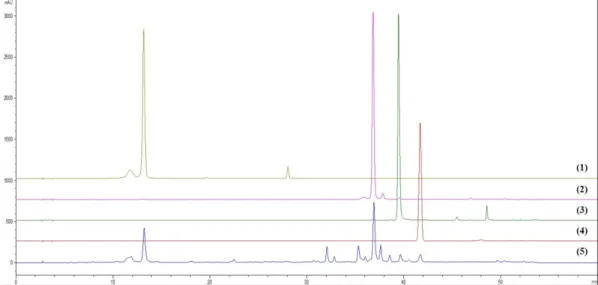
12In the optimized conditions, four standards, CA, 3,5-DQA, 4,5-DQA and SP, were eluted at 13.2, 36.9, 39.5 and 41.7 min, respectively (Fig. 2). All the UV spectra were measured at 330 nm, in which four standards were well absorbed (Fig. 3).
Method Validation − Calibration curves were plotted
for each standard compound, and the relative regression
coefficients (R
2) were calculated to validate their linearities.
All the calibration data of the four standard compounds showed good linearity (R
2> 0.9997) in a relatively wide concentration range (Table 1). The LOD and LOQ values of all standard compounds were in the range 0.6 – 3.6 and 1.7 – 11.0 ng/mL, respectively, which showed a high sensitivity under the optimized conditions. The precision of the developed method was verified by intra- and inter- day variations, and it was expressed by the relative standard deviation (RSD). The RSD values of intra- and inter-day were less than 4.49% and 6.10%, respectively,
which exhibited a good precision of the developed method (Table 2). To verify the accuracy, the standard solutions with three different concentrations were spiked to the 70% ethanolic extract of A. capillaris (10 mg/mL).
Four standards were well recovered in the range of 92.52 – 104.64% (Table 2).
Quantification of Four Standards in Artemisia genus Samples − Thirty-one Artemisia samples distributed from Korea traditional herb markets were applied to quantify four standards, CA, 3,5-DQA, 4,5-DQA and SP under the analytical conditions developed in the method validation
Fig. 2. HPLC chromatogram of four standards, chlorogenic acid (1), 3,5–dicaffeoylquinic acid (2), 4,5–dicaffeoylquinic acid (3), scoparone (4), and the 70% ethanolic extract of A. capillaris (5).
Fig. 1. Structures of four standards, chlorogenic acid (1), 3,5–dicaffeoylquinic acid (2), 4,5–dicaffeoylquinic acid (3) and scoparone (4),
from A. capillaris.
Fig. 3. UV spectra of four standards, chlorogenic acid (1), 3,5–dicaffeoylquinic acid (2), 4,5–dicaffeoylquinic acid (3) and scoparone (4).
Table 1. Calibration curves for LOD and LOQ of A. capillaris
Compounds Retention time Linear regression equation R
2LOD ( µg) LOQ ( µg)
CA
a13.2 y = 25041x − 92.957 0.9997 0.0021 0.0063
3,5-DQA 36.9 y = 36831x − 162.99 0.9999 0.0029 0.0087
4,5-DQA 39.5 y = 29271x − 139.2 0.9999 0.0036 0.0110
SP 41.7 y = 27270x − 29.067 0.9999 0.0006 0.0017
a
CA: chlorogenic acid, 3,5-DQA: 3,5–dicaffeoylquinic acid, 4,5-DQA: 4,5–dicaffeoylquinic acid, SP: scoparone
Table 2. Precision and accuracy data of standard in A. capillaris
Compounds
Precision Accuracy
Intra day Inter day Spiked amount
(µg/g) Accuracy (%)
RSD amount (µg/g) RSD (%) amount (µg/g) RSD (%) (%)
CA
a3.365 4.499 0.659 3.218 3.508 95.92 4.50
3.072 1.409 1.489 1.420 3.000 102.41 1.41
2.488 0.090 2.922 2.762 2.500 99.54 0.09
3,5-DQA
3.347 1.796 0.600 0.675 3.523 95.02 1.80
2.988 1.839 1.422 5.617 3.023 98.87 1.84
2.455 1.501 3.002 2.573 2.523 97.33 1.50
4,5-DQA
0.746 0.966 0.143 1.276 0.806 92.52 0.97
0.525 0.691 0.304 5.096 0.556 94.38 0.69
0.389 1.208 0.618 5.480 0.406 95.75 1.21
SP
0.806 1.487 0.132 0.934 0.788 102.27 1.49
0.560 0.884 0.318 6.099 0.538 104.07 0.88
0.406 1.019 0.625 4.106 0.388 104.65 1.02
a
CA: chlorogenic acid, 3,5-DQA: 3,5–dicaffeoylquinic acid, 4,5-DQA: 4,5–dicaffeoylquinic acid, SP: scoparone
study. Interestingly, three standards except for SP were detected in all the samples, but their amounts were different according to the species (Table 3 and Fig. 4).
Among four standards, SP, the standard for A. capillaris suggested in a guideline for approval and declaration of herbal preparation (No. C0-2012-3-006) published by Ministry of Food and Drug Safety (MFDS), was only measured in A. capillaris samples. Other phenolic com- pounds, CA, 3,5-DQA and 4,5-DQA, were present in all Artemisia samples, but their contents were different according to species. In particular, 3,5-DQA was the
major compound in A. capillaris and A. iwaymogi, but even existed in different amounts in the same species.
In this study, four compounds, CA, 3,5-DQA, 4,5-DQA and SP, in the 70% ethanolic extract of A. capillaris were simultaneously determined using HPLC-UV system and validated in terms of specificity, linearity, precision and accuracy. The validated method was successfully applied to quantify all four compounds in the Artemisia samples distributed in Korean traditional markets. Scoparone, which was only detected in A. capillaris samples, could be used as the chemical marker to distinguish A. capillaris Table 3. The amounts of four standards, CA, 3,5-DQA, 4,5-DQA and SP from Artemisia genus
Mean ± SD (µg/g)
CA
a3,5-DQA 4,5-DQA SP
AC-1
b2.83 ± 0.07 3.11 ± 0.05 0.64 ± 0.01 0.61 ± 0.05
AC-2 2.99 ± 0.06 3.25 ± 0.07 0.65 ± 0.01 0.63 ± 0.07
AC- 3 2.86 ± 0.07 3.01 ± 0.08 0.62 ± 0.01 0.63 ± 0.01
AC-4 1.49 ± 0.03 1.95 ± 0.03 0.89 ± 0.01 0.89 ± 0.01
AC-5 1.08 ± 0.06 1.64 ± 0.07 0.67 ± 0.02 0.74 ± 0.02
AI-1 2.18 ± 0.01 4.00 ± 0.01 2.06 ± 0.01 n.d.
cAI-2 1.96 ± 0.06 6.03 ± 0.17 2.77 ± 0.05 n.d
AI-3 1.67 ± 0.03 4.18 ± 0.13 1.42 ± 0.02 n.d
AI-4 1.39 ± 0.03 2.05 ± 0.04 1.00 ± 0.01 n.d
AI-5 1.06 ± 0.02 3.17 ± 0.06 2.01 ± 0.02 n.d
AI-6 1.47 ± 0.02 3.47 ± 0.09 2.45 ± 0.04 n.d
AI-7 1.10 ± 0.00 3.07 ± 0.00 1.08 ± 0.01 n.d
AI-8 1.34 ± 0.04 3.73 ± 0.09 2.49 ± 0.04 n.d
AI-9 1.17 ± 0.02 0.84 ± 0.02 1.75 ± 0.02 n.d
AI-10 1.22 ± 0.05 3.81 ± 0.08 2.59 ± 0.03 n.d
AI-11 2.36 ± 0.06 7.17 ± 0.01 1.93 ± 0.00 n.d
AI-12 2.46 ± 0.02 7.35 ± 0.05 2.07 ± 0.01 n.d
AI-13 2.40 ± 0.01 6.88 ± 0.03 1.97 ± 0.01 n.d
AI-14 1.49 ± 0.04 3.89 ± 0.05 1.47 ± 0.01 n.d
AI-15 1.62 ± 0.03 4.36 ± 0.07 1.66 ± 0.02 n.d
AI-16 1.71 ± 0.08 4.15 ± 0.07 1.56 ± 0.02 n.d
AP-1 1.08 ± 0.06 1.93 ± 0.01 1.84 ± 0.01 n.d
AP-2 0.33 ± 0.01 1.00 ± 0.01 0.99 ± 0.00 n.d
AP-3 1.25 ± 0.07 1.80 ± 0.01 1.74 ± 0.00 n.d
AP-4 0.54 ± 0.03 0.92 ± 0.02 1.11 ± 0.02 n.d
AP-5 1.02 ± 0.02 1.62 ± 0.04 1.45 ± 0.02 n.d
AP-6 1.15 ± 0.09 2.28 ± 0.09 1.61 ± 0.05 n.d
AP-7 0.49 ± 0.00 1.45 ± 0.03 0.98 ± 0.01 n.d
AP-8 0.40 ± 0.01 1.25 ± 0.01 0.75 ± 0.01 n.d
AA-1 0.32 ± 0.01 0.52 ± 0.01 0.58 ± 0.01 n.d
AA-2 0.35 ± 0.01 1.03 ± 0.03 0.76 ± 0.01 n.d
a
CA: chlorogenic acid, 3,5-DQA: 3,5–dicaffeoylquinic acid, 4,5-DQA: 4,5–dicaffeoylquinic acid, SP: scoparone
b
AC: Artemisia capillaris, AI: Artemisia iwayomogi, AP: Artemisia princeps, AA: Artemisia argyi
c