• 검색 결과가 없습니다.

Pain perception among patients treated with passive self-ligating fixed appliances and Invisalign® aligners during the first week of orthodontic treatment

N/A
N/A
Protected

Academic year: 2022

Share "Pain perception among patients treated with passive self-ligating fixed appliances and Invisalign® aligners during the first week of orthodontic treatment"

Copied!
7
0
0

로드 중.... (전체 텍스트 보기)

전체 글

(1)

Pain perception among patients treated with

passive self-ligating fixed appliances and Invisalign ® aligners during the first week of orthodontic

treatment

Objective: This study was performed to compare the perception of pain between patients treated with passive self-ligating fixed appliances and those treated with Invisalign aligners. Methods: This prospective study conducted in Saudi Arabia used an estimated sample of 64 patients from a private dental clinic.

After obtaining written informed consent, the patients were divided into two groups; one group (n = 32) was treated using passive self-ligating fixed appliances and the other group (n = 32) using Invisalign

®

aligners. Immediately after fitting the appliances, the patients’ perception of pain was evaluated through a close- ended and coded self-administrated questionnaire by using a visual analog scale (VAS). Their responses were recorded at 4 hours, 24 hours, day 3, and day 7.

Mann-Whitney U-test, Kruskal-Wallis test, and Pearson’s chi-square test were performed for statistical analysis. Results: A lower percentage of patients treated with Invisalign aligners reported pain than did patients treated with passive self- ligating fixed appliances, and these differences were statistically significant (p = 0.001). Similarly, the mean VAS score for the Invisalign group was significantly lower than that for the passive self-ligating fixed appliance group at different intervals during the first week of treatment. The intensity of pain with both appliances peaked at 24 hours (mean VAS score, 3.87) and was lowest (mean VAS score, 1.62) on day 7. Conclusions: During the first week of orthodontic treatment, patients treated with Invisalign aligners reported lower pain than did those treated with passive self-ligating fixed appliances.

[Korean J Orthod 2018;48(5):326-332]

Key words: Pain, Invisalign, Passive self-ligating, Analgesics Naif N. Almasoud

Department of Preventive Dental Sciences, College of Dentistry, Imam Abdulrahman Bin Faisal University, Dammam, Saudi Arabia

Received October 24, 2017; Revised January 25, 2018; Accepted February 7, 2018.

Corresponding author: Naif N. Almasoud.

Assistant Professor, Department of Preventive Dental Sciences, College of Dentistry, Imam Abdulrahman Bin Faisal University, King Faisal Bin Abdulaziz Road, P. O. Box 1982, Dammam 31441, Saudi Arabia.

Tel +009613-333-2400 e-mail [email protected]

How to cite this article: Almasoud NN. Pain perception among patients treated with passive self-ligating fixed appliances and Invisalign aligners during the first week of orthodontic treatment. Korean J Orthod 2018;48:326-332.

© 2018 The Korean Association of Orthodontists.

This is an Open Access article distributed under the terms of the Creative Commons Attribution Non-Commercial License (http://creativecommons.org/licenses/by-nc/4.0) which permits unrestricted non-commercial use, distribution, and reproduction in any medium, provided the original work is properly cited.

pISSN 2234-7518 • eISSN 2005-372X

https://doi.org/10.4041/kjod.2018.48.5.326

(2)

INTRODUCTION

The number of patients undergoing orthodontic treatment has been increasing with time,

1

and a ma- jor concern for patients is the pain during orthodontic treatment.

2

Studies have shown that 71% of study par- ticipants experience some degree of pain, regardless of the type of orthodontic appliance.

3

Similarly, studies have reported that 91–95% of patients experienced pain when the orthodontic treatment was being performed.

4-6

Patients also reported pain as one of the main reasons for fear and anxiety before the commencement of orth- odontic treatment.

7

Various types of discomforts expe- rienced by the patients were categorized as pressure, strain, stress, and pain.

8

Previous studies have investigated the pain experi- enced with respect to different orthodontic appliance treatments. Stewart et al.

9

and Sergl et al.

10

identified that greater levels of pain are reported with fixed orth- odontic appliances than with removable appliances.

Furthermore, studies have evaluated the intensity of pain after bonding different types of brackets. Miles et al.

11

revealed greater comfort with self-ligating brackets than with conventional twin brackets. Similarly, Pringle et al.

12

found that patients with passive self-ligating brackets reported significantly lower pain intensity than did those treated with Tru Straight brackets (Ormco Europe, Amersfoort, The Netherlands). Tecco et al.

13

also observed significantly reduced pain with the use of self-ligating brackets than with the use of conventional brackets during orthodontic treatment.

On the other hand, Scott et al.

14

found no difference in the perception of pain associated with self-ligating brackets and conventional fixed appliance brackets.

Similar results were reported by Fleming et al.

15

who discovered no difference in pain experience after 4 hours through to 7 days following the bonding of self-ligating and conventional pre-adjusted brackets. However, they observed more discomfort during the insertion and re- moval of archwires with self-ligating brackets. A recent study by Rahman et al.

16

showed that patients treated with self-ligating (3M SmartClip; 3M Unitek, Monrovia, CA, USA) brackets experienced statistically higher pain than did patients treated with a conventional (3M Vic- tory; 3M Unitek) bracket system. These authors conclud- ed there was no clinical difference in pain perception among patients treated with both appliance systems.

16

Similar findings were reported by Bertl et al.

17

in a split-mouth design study, wherein engagement and dis- engagement of archwires caused more pain with self-li- gating brackets (SmartClip) than with fixed conventional brackets. Increased pain with self-ligating brackets than with conventional brackets can result from full-size ma- nipulation and the method of wire ligation and insertion

associated with the design of SmartClip.

17

Invisalign

®

aligners (Align Technology, Santa Clara, CA, USA) offer enhanced aesthetics, reduced pain, and improved oral hygiene during orthodontic treatment.

18,19

Moreover, a reasonable body of evidence is available on the discomfort and pain experienced by patients treated with Invisalign and fixed orthodontic appliances.

18,20,21

Previous studies have investigated patients’ experience of pain with Invisalign and conventional fixed orthodon- tic treatments, including lingual fixed appliances.

18,20,21

Similarly, a recent study found greater discomfort and higher consumption of analgesics with conventional fixed brackets than with Invisalign aligners.

22

Passive self-ligating brackets have minimal frictional resistance than do conventional and active self-ligating brackets.

23

Therefore, self-ligating brackets are assumed to cause less pain than do conventional brackets. In ad- dition, patients treated with conventional fixed brackets, self-ligating brackets, and Invisalign aligners demon- strated different intensity of pain and discomfort during initial orthodontic treatment. However, limited evidence is available on the pain perception of patients treated with Invisalign and passive self-ligating fixed appliances.

Therefore, the primary objective of this research was to compare the perception of pain among patients treated with passive self-ligating fixed appliances and Invisalign aligners. The secondary objectives included observing the intensity and duration of pain during the initial phase of treatment, and reporting the use of analgesics for the relief of orthodontic pain.

MATERIALS AND METHODS

Study design, participants, and sample size calculation A prospective study was conducted using a calculated sample of 64 participants. The sample size estimation involved assuming 0.05 alpha, 0.20 beta, and 80%

power of the study, with minimal relevant difference in the groups and variability of the outcome.

24

One group of 32 participants was treated with passive self-ligating fixed appliances (Damon Q; Ormco, Orange, CA, USA), and the other group of 32 participants received Invis- align aligners. The participants were recruited from a private dental clinic.

Adult patients were included in this study as long as

they had no deciduous teeth, no previous orthodontic

treatment, no missing teeth, were free from mucosal

and periodontal diseases, demonstrated good general

health, had mild to moderate crowding (Little’s irregu-

larity index [LII] between 3 and 5), and Class I molar

relationship. The expression of pain can be affected by

emotional and cognitive factors, family surrounding

and behaviors, and other influences.

25,26

Patients who

exhibited dental anxiety and were on psychotropic drugs

(3)

were excluded from the study. In addition, hygienists, dentists, and dental students were excluded from the study because of their knowledge of pain during their orthodontic treatment. The patients undergoing pas- sive self-ligating fixed appliance therapy and Invisalign treatment who were willing to participate in the study were recruited from the respective clinic. In this prospec- tive interventional comparative clinical trial, participants received orthodontic treatment from an experienced orthodontist, who offered both types of treatments to his eligible patients and administered a close-ended and coded self-administered questionnaire to the study par- ticipants.

Outcome measurement instruments

The visual analog scale (VAS) is the most commonly used instrument in scientific research as it allows using parametric tests.

27

Therefore, the patients’ pain experi- ence was assessed using a VAS in the form of an un- marked 10-cm horizontal line with “no pain” at its left end (score 0) and “very severe pain” at its right end (score 100). The assessor of the VAS was blinded to minimize the bias in the measurement of pain. Both groups were in the initial alignment stage of orthodontic treatment.

The patients treated with passive self-ligating fixed ap- pliances had an initial archwire (0.014-inch copper nick- el-titanium) while those treated with Invisalign aligners were provided initial-stage aligners (first aligners). In both groups, the patients had minimal to moderate crowding, which was assessed using LII (range, 3–5).

A previous study recorded the pain experiences of patients treated with self-ligating appliances and con- ventional fixed braces at 4 hours, 24 hours, day 3, and day 7.

15

Therefore, after fitting the orthodontic appli- ance, each patient was asked to place a mark on the line that best matched the level of pain he/she experienced at 4 hours, 24 hours, day 3, and day 7. The mark was measured using a millimeter scale to record pain inten- sity, and a value ranging from 0 to 100 was recorded.

The pain was recorded for 1 week after initial appliance therapy, because a previous study reported no pain after initial orthodontic treatment for 7 to 9 days.

13

In addi- tion, other studies reported the presence of pain in the first week of orthodontic treatment.

8,28

The study par-

ticipants also responded to the questionnaire about the type and frequency of analgesics used, if any, to relieve pain.

Ethical considerations

The study protocol was approved by the Institutional Review Board of the Imam Abdulrahman Bin Faisal University, Dammam (IRB-2017-02-154). The study participants were informed about the possible risks and benefits of participating in the comparative clinical trial.

The investigator ensured that participants understood the purpose and methods of the study by informing them individually. The participants were briefed about their voluntary participation in the study and their right to withdraw from the research. Similarly, the privacy and confidentiality of the participants were assured, and finally, those willing to participate gave their written in- formed consent.

Statistical analysis

Data from the VAS and questionnaire were transferred to a spreadsheet and analyzed using IBM SPSS Statistics for Windows, version 22.0 (IBM Co., Armonk, NY, USA).

The Mann-Whitney U-test was performed to compare the mean ranks of the VAS scores between the two groups of participants. The Kruskal-Wallis test was per- formed to observe the differences in VAS scores among all the participants at 4 hours, 24 hours, day 3, and day 7. Pearson’s chi-square test (or Fisher’s exact test as ap- propriate) was used to observe the differences between the two groups of participants in the use of analgesics and the intensity of orthodontic pain at different time intervals. Statistical significance was set at p-value ≤ 0.05.

RESULTS

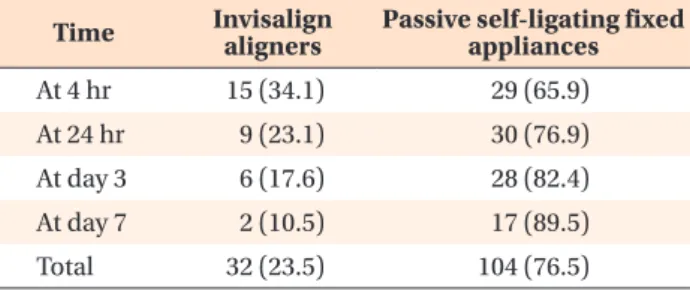
The mean age of the study population was 26 years (standard deviation, ± 7.31). The patients included 22 men (34.4%) and 42 women (65.6%) (Table 1). Table 2 demonstrates the presence of pain between the groups at different intervals in the first week of orthodontic treatment. A lower percentage of patients treated with Invisalign aligners reported pain than did those treated

Table 1. Demographic information of the study participants

Characteristic Total Invisalign aligners Passive self-ligating p-value

Gender 0.60

Male 22 (34.4) 10 (45.5) 12 (54.5)

Female 42 (65.6) 22 (52.4) 20 (47.6)

Age (yr) 26.02 ± 7.31 28.47 ± 8.17 23.56 ± 5.44 0.06

Values are presented as number (%) or mean ± standard deviation.

(4)

with passive self-ligating fixed appliances at 4 hours, 24 hours, day 3, and day 7, and these differences were statistically significant (p = 0.001). Overall, the largest number of participants (n = 44) reported having pain at 4 hours, and the lowest number (n = 19) experienced pain on day 7.

The comparison of pain levels in the two groups at different time intervals is presented in Table 3. Patients treated with Invisalign aligners had significantly lower pain levels (mean VAS scores) than did those treated with passive self-ligating fixed appliances at 4 hours, 24 hours, day 3, and day 7 (p = 0.001). The highest pain levels for both groups of patients were recorded at 24 hours (mean VAS scores of 1.38 and 6 for the Invisalign aligner and passive self-ligating fixed appliance groups, respectively) after the initial placement of orthodontic appliances.

The Kruskal-Wallis test was performed to observe the difference in pain among all patients in both treatment groups (Table 4). The mean VAS scores for all partici- pants at different time intervals during the first week of orthodontic treatment also showed statistically sig- nificant differences (p = 0.001). The highest mean VAS score (3.68) among the study participants was observed at 24 hours.

Table 5 shows the use of analgesics (acetaminophen/

paracetamol) among the study participants. Fewer par- ticipants with Invisalign aligners used analgesics at 4 hours and 24 hours than did those treated with pas- sive self-ligating fixed appliances, and these differences were statistically significant. No participant treated with Invisalign aligners reported taking analgesics on day 7.

The highest number of participants (n = 12) used anal- gesics at 24 hours, and four consumed analgesics at day 7. Compared to 28 patients (84.8%) treated with passive self-ligating fixed appliances, only five (15.1%) treated with Invisalign aligners took analgesics.

DISCUSSION

This study found that a greater proportion of patients treated with passive self-ligating fixed appliances report- ed pain than did patients treated with Invisalign aligners.

Similarly, the intensity of pain recorded using the VAS was higher in the passive self-ligating fixed appliance group than in the Invisalign group. For both groups, the intensity of pain progressively decreased during the first week of fitting the orthodontic appliances. Moreover, Table 2. Presence of pain in the Invisalign and passive

self-ligating fixed appliance groups Time Invisalign

aligners Passive self-ligating fixed appliances

At 4 hr 15 (34.1) 29 (65.9)

At 24 hr 9 (23.1) 30 (76.9)

At day 3 6 (17.6) 28 (82.4)

At day 7 2 (10.5) 17 (89.5)

Total 32 (23.5) 104 (76.5)

Values are presented as number (%).

All p-values are 0.001.

Table 3. Mean VAS scores of the Invisalign and passive self-ligating fixed appliance groups

Pain interval Invisalign

aligners Passive self-ligating fixed appliances At 4 hr 1.22 ± 1.89 (20.9) 5.56 ± 3.25 (44.1) At 24 hr 1.38 ± 2.69 (20.7) 6.0 ± 3.41 (44.3) At day 3 0.66 ± 1.8 (20.5) 4.59 ± 3.32 (44.4) At day 7 0.41 ± 1.6 (25.2) 2.69 ± 3.09 (39.8) Values are presented as mean ± standard deviation a (mean rank).

VAS, Visual analog scale.

All p-values are 0.001.

Table 4. VAS scores during the initial phase of orthodontic treatment

Time VAS score Mean ranks

At 4 hr 3.39 ± 3.43 145.7

At 24 hr 3.68 ± 3.83 144.8

At day 3* 2.62 ± 3.31 125.6

At day 7 1.54 ± 2.7 97.9

Values are presented as mean ± standard deviation and mean ranks.

VAS, Visual analog scale.

*p-value is 0.001.

Table 5. Use of analgesics in the Invisalign and passive self-ligating fixed appliance groups

Time Invisalign aligners

Passive self- ligating fixed

appliances p-value

At 4 hr 2 (18.2) 9 (81.8) 0.043*

At 24 hr 1 (8.3) 11(91.7) 0.003*

At day 3 2 (33.3) 4 (66.7) 0.674

At day 7 0 (0) 4 (100) 0.114

Total 5 (15.1) 28 (84.9) 0.001*

Values are presented as number (%).

Pearson’s chi-square test was performed at 4 hr, 24 hr, and day 7. Fisher’s exact test was performed at day 3 and 7.

*p-value < 0.05.

(5)

the use of analgesics was lesser among patients treated with Invisalign aligners than among those treated with passive self-ligating fixed appliances.

Previous studies have compared the intensity of orth- odontic pain after the insertion of different orthodontic appliances. Bondemark et al.

29

compared the level of pain associated with the use of elastomeric and spring separators and observed the highest degree of pain oc- curring on day 2 and disappearing by day 5. Jones

30

stated that the pain was experienced at 4 hours after the placement of an archwire, reached its peak at 24 hours, and then steadily declined. Jones and Chan

28

reported maximum pain on the morning after archwire insertion and it continued until day 5 or day 6 of the treatment.

A recent study by White et al.

22

found that pain peaked between the first and third days of conventional treat- ment and gradually decreased over the fourth and fifth days. However, some studies have found no significant differences in the prevalence, intensity, frequency, and duration of pain with orthodontic treatment using dif- ferent archwires.

31,32

In the present study, the highest number of patients reported pain at 24 hours after fitting the passive self- ligating fixed appliance, and the largest number of pa- tients treated with Invisalign aligners experienced pain at 4 hours. These findings are inconsistent with the results of Shalish et al.

20

who found that the highest percentage of participants in the Invisalign group reported pain on day 1. These authors described that the application of greater mechanical force in the Invisalign group and the use of a flexible wire and lighter force in the conven- tional buccal group during the first week of treatment could have accounted for the difference in pain.

20

Although the mean VAS scores for both appliances in the present study were highest at 24 hours, a statisti- cally significant difference was observed between the two groups. Fujiyama et al.

21

compared the VAS scores among three groups of patients and found the peak VAS score at 24 hours. Shalish et al.

20

reported the high- est mean pain score on day 1 of treatment with buccal fixed appliances and on day 2 for the Invisalign group.

White et al.

22

observed similar patterns of discomfort that peaked after the first day and decreased over the week in both the conventional appliance and aligner groups. Increased pain or discomfort within the first 24 hours of the placement of orthodontic appliances could result from an acute inflammatory response to the orth- odontic forces.

33

Miller et al.

18

found that patients experienced reduced pain with Invisalign aligners than with fixed appliances during the first week of orthodontic treatment. Later, Shalish et al.

20

compared the pain levels among three groups of patients: the first group received lingual fixed appliances, the second received buccal fixed appliances,

and the third received Invisalign aligners; the most se- vere level of pain was observed with the lingual appli- ance. Fujiyama et al.

21

evaluated the perception of pain among three groups of patients: one group received Invisalign aligners, the second group was treated with conventional fixed orthodontic appliances, and the third group received both Invisalign aligners and fixed ap- pliances. The intensity and duration of pain during the initial stages of treatment were pointedly lower among patients treated with Invisalign aligners than among those treated with an edgewise orthodontic appliance.

Similarly, White et al.

22

also indicated that patients treat- ed with conventional appliances had significantly higher pain than did patients treated with aligners during most of the first week of orthodontic treatment.

In accordance with the findings of previous stud- ies, the findings of this study revealed that patients treated with Invisalign aligners had significantly lower perception of pain than did those treated with passive self-ligating fixed appliances during the first week of treatment. The high acceptance of the Invisalign system could be attributed to the great adaptability of patients to the appliance and high satisfaction with the progress and result of treatment.

34

Moreover, previous studies have shown that Invisalign aligners have lower irregular- ity and complexity indexes than do buccal fixed appli- ances, and this might minimize the patients’ perception of pain with Invisalign aligners.

20

Significantly lower pain in the Invisalign group than in the passive self-li- gating fixed appliance group in the present study, could be because the attachments placement were delayed un- til commencing the insertion of the third set of aligners.

The use of analgesics was related to the intensity of pain in our study, as more patients treated with passive self-ligating fixed appliances used them than did those treated with Invisalign aligners. At 24 hours, more pa- tients treated with passive self-ligating fixed appliances used analgesics than did those treated with Invisalign aligners, and the difference was statistically significant;

moreover, no patient in the Invisalign group took an-

algesics on day 7 of the treatment. A similar pattern of

analgesic use was reported by Shalish et al.,

20

with the

highest intensity of pain being observed on day 1 of

the treatment with fixed orthodontic appliances and no

analgesic consumption being reported until day 6 in

patients treated with Invisalign aligners. Miller et al.

18

also found that 67% of patients treated with fixed ap-

pliances took analgesics as compared to 42% of patients

treated with Invisalign aligners. White et al.

22

reported

that a greater proportion of patients in the conventional

group took pain medication than did patients in the

aligner group. The highest percentage of patients in the

aligner group consumed pain medication on the first

day, while the greatest percentage of patients in the tra-

(6)

ditional group consumed pain medication on the second day.

22

In the present study, appropriate sample size calcula- tions were performed. Both groups had a similar degree of crowding, and patients in both groups were in the first stage of initial alignment. These measures may have helped ensure similar amounts of tooth movement in both groups. The patients in the Invisalign and passive self-ligating fixed appliance groups were matched for age, sex, and degree of crowding. Moreover, patients in both groups received treatment by an experienced orthodontist; hence, their pain perception could not have been influenced by the treatment received from an inexperienced orthodontist or any variable related to variation among orthodontists. Similarly, the asses- sor was blinded during the evaluation of the patients’

responses to reduce the bias in this study. In addition, inclusion and exclusion criteria were applied to recruit the most suitable participants and to obtain valid study results. All the efforts were made to ensure that both groups were similar in all areas other than the different interventions. However, the limitation of the study may be the non-randomization of participants to the inter- ventions. In accordance with previous studies,

15,35

the present study evaluated pain during the first week of orthodontic treatment. Nevertheless, reporting of pain after subsequent monthly appointments could have pro- vided more meaningful data. Further, as the participants were recruited from a private dental clinic, it is likely that more affluent patients were represented in the study. Future studies should include study participants from both private and government dental clinics.

CONCLUSION

The patients treated with Invisalign aligners observed significantly lower pain than did those treated with passive self-ligating fixed appliances. The intensity of pain was the highest at 24 hours and diminished to the lowest levels by day 7 in both groups of patients.

The patients treated with Invisalign aligners reported a lower intensity of pain than did those treated with pas- sive self-ligating fixed appliances during the first week of orthodontic treatment. The use of analgesics also peaked at 24 hours; however, fewer patients treated with Invisalign aligners were found to use medication to relieve their pain.

CONFLICTS OF INTEREST

No potential conflict of interest relevant to this article was reported.

REFERENCES

1. Christensen L, Luther F. Adults seeking orthodontic treatment: expectations, periodontal and TMD is- sues. Br Dent J 2015;218:111-7.

2. Kazancı F, Aydoğan C, Alkan Ö. Patients' and par- ents' concerns and decisions about orthodontic treatment. Korean J Orthod 2016;46:20-6.

3. Oliver RG, Knapman YM. Attitudes to orthodontic treatment. Br J Orthod 1985;12:179-88.

4. Kvam E, Bondevik O, Gjerdet NR. Traumatic ulcers and pain in adults during orthodontic treatment.

Community Dent Oral Epidemiol 1989;17:154-7.

5. Lew KK. Attitudes and perceptions of adults towards orthodontic treatment in an Asian community.

Community Dent Oral Epidemiol 1993;21:31-5.

6. Scheurer PA, Firestone AR, Bürgin WB. Perception of pain as a result of orthodontic treatment with fixed appliances. Eur J Orthod 1996;18:349-57.

7. O'Connor PJ. Patients' perceptions before, dur- ing, and after orthodontic treatment. J Clin Orthod 2000;34:591-2.

8. Ngan P, Kess B, Wilson S. Perception of discomfort by patients undergoing orthodontic treatment. Am J Orthod Dentofacial Orthop 1989;96:47-53.

9. Stewart FN, Kerr WJ, Taylor PJ. Appliance wear: the patient's point of view. Eur J Orthod 1997;19:377- 82.

10. Sergl HG, Klages U, Zentner A. Pain and discomfort during orthodontic treatment: causative factors and effects on compliance. Am J Orthod Dentofacial Or- thop 1998;114:684-91.

11. Miles PG, Weyant RJ, Rustveld L. A clinical trial of Damon 2 vs conventional twin brackets during ini- tial alignment. Angle Orthod 2006;76:480-5.

12. Pringle AM, Petrie A, Cunningham SJ, McKnight M. Prospective randomized clinical trial to com- pare pain levels associated with 2 orthodontic fixed bracket systems. Am J Orthod Dentofacial Orthop 2009;136:160-7.

13. Tecco S, D'Attilio M, Tetè S, Festa F. Prevalence and type of pain during conventional and self-ligating orthodontic treatment. Eur J Orthod 2009;31:380-4.

14. Scott P, Sherriff M, Dibiase AT, Cobourne MT. Per- ception of discomfort during initial orthodontic tooth alignment using a self-ligating or convention- al bracket system: a randomized clinical trial. Eur J Orthod 2008;30:227-32.

15. Fleming PS, Dibiase AT, Sarri G, Lee RT. Pain experi- ence during initial alignment with a self-ligating and a conventional fixed orthodontic appliance system. A randomized controlled clinical trial. Angle Orthod 2009;79:46-50.

16. Rahman S, Spencer RJ, Littlewood SJ, O'Dywer L,

(7)

Barber SK, Russell JS. A multicenter randomized controlled trial to compare a self-ligating bracket with a conventional bracket in a UK population: Part 2:

Pain perception. Angle Orthod 2016;86:149-56.

17. Bertl MH, Onodera K, Čelar AG. A prospective ran- domized split-mouth study on pain experience during chairside archwire manipulation in self- ligating and conventional brackets. Angle Orthod 2013;83:292-7.

18. Miller KB, McGorray SP, Womack R, Quintero JC, Perelmuter M, Gibson J, et al. A comparison of treat- ment impacts between Invisalign aligner and fixed appliance therapy during the first week of treatment.

Am J Orthod Dentofacial Orthop 2007;131:302.e1-9.

19. Boyd RL. Esthetic orthodontic treatment using the invisalign appliance for moderate to complex maloc- clusions. J Dent Educ 2008;72:948-67.

20. Shalish M, Cooper-Kazaz R, Ivgi I, Canetti L, Tsur B, Bachar E, et al. Adult patients' adjustability to orthodontic appliances. Part I: a comparison between Labial, Lingual, and Invisalign™. Eur J Orthod 2012;

34:724-30.

21. Fujiyama K, Honjo T, Suzuki M, Matsuoka S, De- guchi T. Analysis of pain level in cases treated with Invisalign aligner: comparison with fixed edgewise appliance therapy. Prog Orthod 2014;15:64.

22. White DW, Julien KC, Jacob H, Campbell PM, Bus- chang PH. Discomfort associated with Invisalign and traditional brackets: a randomized, prospective trial.

Angle Orthod 2017;87:801-8.

23. Gómez SL, Montoya Y, Garcia NL, Virgen AL, Botero JE. Comparison of frictional resistance among con- ventional, active and passive selfligating brackets with different combinations of arch wires: a finite elements study. Acta Odontol Latinoam 2016;29:

130-6.

24. Noordzij M, Tripepi G, Dekker FW, Zoccali C, Tanck MW, Jager KJ. Sample size calculations: basic prin-

ciples and common pitfalls. Nephrol Dial Transplant 2010;25:1388-93.

25. Bergius M, Kiliaridis S, Berggren U. Pain in ortho- dontics. A review and discussion of the literature. J Orofac Orthop 2000;61:125-37.

26. Krishnan V. Orthodontic pain: from causes to man- agement--a review. Eur J Orthod 2007;29:170-9.

27. Philip BK. Parametric statistics for evaluation of the visual analog scale. Anesth Analg 1990;71:710.

28. Jones M, Chan C. The pain and discomfort expe- rienced during orthodontic treatment: a random- ized controlled clinical trial of two initial align- ing arch wires. Am J Orthod Dentofacial Orthop 1992;102:373-81.

29. Bondemark L, Fredriksson K, Ilros S. Separation ef- fect and perception of pain and discomfort from two types of orthodontic separators. World J Orthod 2004;5:172-6.

30. Jones ML. An investigation into the initial discom- fort caused by placement of an archwire. Eur J Or- thod 1984;6:48-54.

31. Fernandes LM, Ogaard B, Skoglund L. Pain and dis- comfort experienced after placement of a conven- tional or a superelastic NiTi aligning archwire. A ran- domized clinical trial. J Orofac Orthop 1998;59:331- 9.

32. Erdinç AM, Dinçer B. Perception of pain during orthodontic treatment with fixed appliances. Eur J Orthod 2004;26:79-85.

33. Krishnan V, Davidovitch Z. Cellular, molecular, and tissue-level reactions to orthodontic force. Am J Or- thod Dentofacial Orthop 2006;129:469.e1-32.

34. Nedwed V, Miethke RR. Motivation, acceptance and problems of invisalign patients. J Orofac Orthop 2005;66:162-73.

35. Polat O, Karaman AI. Pain control during fixed orth- odontic appliance therapy. Angle Orthod 2005;75:

214-9.

수치

Table 1. Demographic information of the study participants
Table 3. Mean VAS scores of the Invisalign and passive  self-ligating fixed appliance groups

참조

관련 문서