INTRODUCTION
Nonsteroidal anti-inflammatory drugs (NSAIDs) are one of the most commonly used drugs worldwide, as either prescriptions or over-the-counter medications.1 Adverse drug reactions (ADRs) of NSAIDs account for 12% to 29.6% of all ADRs in hospital ad- missions.2 Most ADRs of NSAIDs belong to type A,3 which are dose-dependent and predictable from pharmacological actions of the drugs. Common type A reactions include gastrointestinal bleeding and acute kidney injury.4 Type B reactions, also known as NSAID hypersensitivity reactions, account for 8.4% to 18.3%
of total ADRs of NSAID.5,6 They are idiosyncratic and pharmaco- logically unpredictable. NSAID hypersensitivity reactions pose classification as well as diagnostic and management challeng- es in clinical practice. The aim of this review is to provide the
latest update on the classification of NSAID hypersensitivity and practical approaches to the diagnosis and management of NSAID hypersensitivity, according to the current systematic clas- sification system.
The articles were retrieved via PubMed using the following keywords: nonsteroidal anti-inflammatory agents, hypersensi- tivity reactions, asthma, chronic urticaria, and angioedema. Only studies published in English were evaluated.
PATHOPHYSIOLOGY AND CLASSIFICATION OF NSAID HYPERSENSITIVITY
NSAIDs consist of drugs with diverse chemical structures and anti-inflammatory properties. Most NSAIDs have nonselective inhibitions of COX-1 enzymes. They interfere with arachidonic acid metabolism, leading to blockage of prostaglandin synthe- sis and up-regulation of the leukotriene pathway that contrib- utes to various presentations of NSAID hypersensitivity reac- tions.7 NSAIDs that possess predominant inhibition of COX-1 enzymes, such as indomethacin, naproxen, and diclofenac, have higher rates of hypersensitivity reactions, while weak COX-1 in- hibitors and selective COX-2 inhibitors are often better toler- ated with a lower probability of hypersensitivity reactions.
Hypersensitivity response to paracetamol is also regarded as
Update on the Management of Nonsteroidal Anti-Inflammatory Drug Hypersensitivity
Wan Yin Winnie Yeung1 and Hae Sim Park2
1Division of Rheumatology, Department of Internal Medicine, Pamela Youde Nethersole Eastern Hospital, Hong Kong, China.
2Department of Allergy and Clinical Immunology, Ajou University School of Medicine, Ajou University Medical Center, Suwon, Korea.
The clinical phenotypes of nonsteroidal anti-inflammatory drug (NSAID) hypersensitivity are heterogeneous with various pre- sentations including time of symptom onset, organ involvements, and underlying pathophysiology. Having a correct diagnosis can be challenging. Understanding their respective mechanisms as well as developing a comprehensive classification and diag- nostic algorithm are pivotal for appropriate management strategy. Treatment modalities are based on the subtypes and severity of hypersensitivity reactions. Insights into the phenotypes and endotypes of hypersensitivity reactions enable personalized man- agement in patients with suboptimal control of disease. This review updated the recent evidence of pathophysiology, classifica- tion, diagnostic algorithm, and management of NSAID hypersensitivity reactions.
Key Words: NSAID, asthma, hypersensitivity, urticaria, angioedema, rhinitis
pISSN: 0513-5796 · eISSN: 1976-2437
Received: October 21, 2019 Accepted: November 1, 2019
Corresponding author: Hae-Sim Park, MD, PhD, Department of Allergy and Clini- cal Immunology, Ajou University School of Medicine, Ajou University Medical Cen- ter, 164 World cup-ro, Yeongtong-gu, Suwon 16499, Korea.
Tel: 82-31-219-5150, Fax: 82-31-219-5154, E-mail: [email protected]
•The authors have no potential conflicts of interest to disclose.
© Copyright: Yonsei University College of Medicine 2020
This is an Open Access article distributed under the terms of the Creative Com- mons Attribution Non-Commercial License (https://creativecommons.org/licenses/
by-nc/4.0) which permits unrestricted non-commercial use, distribution, and repro- duction in any medium, provided the original work is properly cited.
Yonsei Med J 2020 Jan;61(1):4-14 https://doi.org/10.3349/ymj.2020.61.1.4
a type of NSAID hypersensitivity reaction, as one-third of the patients with history of NSAID hypersensitivity reactions also suffer from cross-reactions with high-dose paracetamol.8
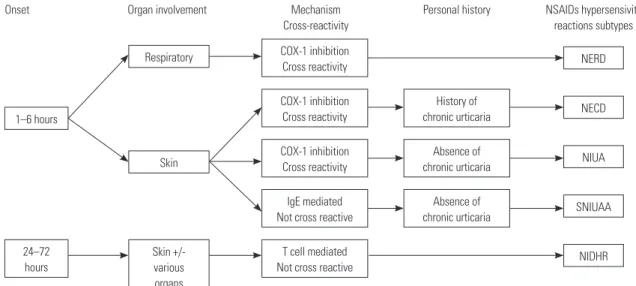
The current classification of NSAID hypersensitivity is based on the time of symptom onset, underlying pathophysiology, clin- ical symptoms, and the presence of cross-reactivity with other NSAIDs, as summarized in Fig. 1.
Acute or immediate hypersensitivity reactions refer to reac- tions with clinical symptoms starting within 1 hour after intake of the culprit drug.9 Both IgE-mediated and non-immunolog- ical hypersensitivity reactions can lead to acute onset of symp- toms. The onset time of delayed hypersensitivity reactions is more variable, ranging from 24 to 72 hours after administration of the drug. Delayed hypersensitivity reactions are usually me- diated by T cells.
According to the European Network of Drug Allergy, NSAID hypersensitivity reactions can be divided into non-immunolog- ically and immunologically mediated subgroups, in which spe- cific IgE or T cells are involved.10
Non-immunologically mediated NSAID hypersensitivity re- actions are caused by disturbance of arachidonic acid metab- olism, dysfunction of 5-lipoxygenase leukotriene C4 synthase (LTC4S), reduction in prostaglandin (PG) E2, and increased pro- duction of cysteinyl leukotrienes (CysLTs), hence triggering systemic inflammation and hypersensitivity symptoms.11 Cross- reactivity is found among NSAIDs with different chemical struc- tures. Major clinical phenotypes of NSAID hypersensitivity re- actions induced by non-immunological mechanisms include NSAID-exacerbated respiratory disease (NERD), NSAID-in- duced urticaria/angioedema (NIUA), and NSAID-exacerbated cutaneous disease (NECD).
In NERD, the role of CysLTs has been illustrated by increased levels of urinary CysLT before and after aspirin challenges com-
pared to aspirin-tolerant asthma.12,13 Decreased levels of PGE2
enhance LTC4S pathway, which accelerates CysLT production.14 Overproduction of CysLT leads to vascular leak, bronchocon- striction, and excess mucus secretion, as well as activation of mast cells and eosinophils. Stimulated mast cells and eosino- phils release chemical mediators and cytokines, which further increase systemic inflammation. Furthermore, aspirin/NSAID can directly promote the activation of eosinophils and mast cells.15 Stimulated innate immune responses with up-regulated IL-33/
thymic stromal lymphopoietin (TSLP) can induce eosinophil activation and facilitate production of cytokines, such as IL-5, IL-9, and IL-13, in patients with NERD.16 Activated eosinophils release extracellular vesicles that promote asthma exacerbation.
They also secret extracellular traps, which contribute to reactive oxygen species production and thereby induce airway inflam- mation.17 Genetic and epigenetic variance in NERD patients and aspirin-tolerant asthmatic patients provide insights into the mechanism of NERD predisposition. Single nucleotide polymor- phisms (SNPs) related to NERD cause dysregulation of CysLTs/
PG production. Epigenetic studies have shown that reduction in PGE production is due to hypomethylation of PGE receptors by SNP, while overproduction of CysLT is caused by hypermeth- ylation of CysLT receptor 1 and 2 by SNP. SNPs on HLA-DPB1 increases susceptibility of NERD. SNPs that regulate the num- ber of CpG sites are less frequently seen in NERD patients com- pared to aspirin-tolerant asthma patients.18 The complex inter- play among SNP, PG, CysLTs, and inflammatory cells makes NERD patients suffer from more severe type 2 airway inflam- mation.
There are two cutaneous phenotypes of NSAID hypersensi- tivity reactions: NECD and NIUA. In NECD, patients have a his- tory of chronic urticaria, which can be exacerbated by aspirin/
NSAID exposure.19 On the other hand, patients with NIUA do
Fig. 1. Classification of NSAID hypersensitivity reactions. NSAID, nonsteroidal anti-inflammatory drug; COX, cyclooxygenase; NERD, NSAID-exacerbated respiratory disease; NECD, NSAID-exacerbated cutaneous disease; NIUA, NSAID-induced urticaria/angioedema; SNIUAA, single NSAID-induced urti- caria, angioedema or anaphylaxis; NIDHR, NSAID-induced delayed hypersensitivity reactions.
Onset Organ involvement Mechanism
Cross-reactivity
Personal history NSAIDs hypersensivity reactions subtypes
1–6 hours
Respiratory NERD
NECD
NIUA
SNIUAA
NIDHR COX-1 inhibition
Cross reactivity
COX-1 inhibition Cross reactivity
History of chronic urticaria
Absence of chronic urticaria
Absence of chronic urticaria COX-1 inhibition
Cross reactivity
IgE mediated Not cross reactive
T cell mediated Not cross reactive Skin
Skin +/- various organs 24–72
hours
not suffer from chronic urticaria but develop urticaria, angio- edema, and/or anaphylaxis only after the exposure to at least two NSAIDs with distinct chemical structures.20 The underlying pathophysiology of NECD and NIUA is not completely recog- nized; however, it is believed to have overlapping features in the defects in arachidonic acid metabolism. This can be illustrated by the increase in urinary CysLT levels and depletion of PGE2
in patients with NECD and NIUA after aspirin challenges.21,22 However, there are some distinctive pathophysiological fea- tures in NECD. Degranulation of basophils is more severe in pa- tients with NECD.23 Genetic polymorphisms of alpha-chain of the high-affinity IgE receptor and HLA allele markers, such as DRB11302 and DQB10609, were more frequently detected in patients with NECD/NIUA,24,25 suggesting that mechanisms re- lated to mast cell activation should be further investigated.
Single NSAID-induced urticaria/angioedema or anaphylaxis (SNIUAA) is the only IgE-mediated type among NSAID hyper- sensitivity reactions. SNIUAA is defined as the presence of ur- ticaria, angioedema, and/or anaphylaxis caused by the produc- tion of IgE antibodies to a single NSAID or NSAIDs with similar chemical structures. Aspirin or NSAID-specific IgE antibodies bind to high-affinity IgE receptors on the surface of mast cells and basophils, hence triggering massive production of chemi- cal mediators (e.g., histamine and platelet activating factors) and causing urticaria, angioedema, and even anaphylaxis. Among different types of NSAID, pyrazolone is the most common cul- prit drug class responsible for IgE-mediated NSAID hypersen- sitivity reactions.26
T cell-mediated NSAID hypersensitivity reactions are the only delayed-type hypersensitivity reactions. Dendritic cells recog- nize NSAID antigens and present them to naïve T cells, leading to the production of activated antigen-specific T cells. Antigen- specific T cells release cytokines and cytotoxins, which further provoke systemic inflammation.27 There is a wide range of clini- cal manifestations including fixed drug eruption, erythema multiforme, and life-threatening conditions, such as drug reac- tion with eosinophilia and systemic symptoms (DRESS), Ste- vens-Johnson syndrome (SJS), and toxic epidermal necrolysis (TEN).28
There are various predisposing factors for NSAID-induced hypersensitivity reactions. They are either related to the chemi- cal structures of NSAID or the characteristics of individual pa- tients. There is a higher risk of anaphylaxis in the propionic acid group of NSAIDs and pyrazolones. Also, patients are more likely to develop delayed hypersensitivity reactions of severe cutane- ous adverse reactions when taking propionic acids.29 On the other hand, selective COX-2 inhibitors have much lower risks of hypersensitivity reactions compared to non-selective COX in- hibitors.30,31 Regarding patient characteristics, female sex, his- tory of autoimmune diseases, and prior history of hypersensi- tivity reactions to other drugs have been shown to be risk factors for NSAID hypersensitivity reactions.5 Patients with history of atopy are also predisposed to NECD or NIUA.32,33
DIAGNOSTIC APPROACH FOR PATIENTS WITH NSAID HYPERSENSITIVITY
Although NSAID hypersensitivity reactions are commonly seen, the correct diagnosis and classification of NSAID hypersensitiv- ity is not straight forward. A comprehensive diagnostic algorithm is necessary for categorizing clinical phenotypes of NSAID hy- persensitivity reaction, so that the management plan and prog- nosis of individual patients can be ascertained and safe alterna- tives can be identified. The diagnostic algorithm should include clinical history, physical examination, and specific provocation tests. Currently, there is no fully validated in vitro testing.34 The diagnostic algorithm is summarized in Fig. 2.
Clinical history and physical examination
A detailed history is extremely important for the identification of clinical phenotype of NSAID hypersensitivity that patients suffer from. It should include the time of symptom onset, de- tails of the symptoms experienced, correlation between symp- toms and ingestion of the culprit drug(s), concomitant medi- cations, personal history of atopy, and the names of tolerated NSAIDs that patients are aware of.
In NERD, patients are commonly middle-aged women who are suffering from both upper (severe recurrent chronic rhino- sinusitis and/or nasal polyps) and lower respiratory symptoms (mainly moderate to severe asthma).35 These symptoms arise within 30 to 120 minutes after exposure to at least two different chemical classes of NSAID. NERD patients may have coexisting ocular, urticaria, and gastrointestinal symptoms, with respiratory symptoms predominant. Lee, et al.36 stratified four sub-pheno- types of NERD, based on the combination of NERD with chronic rhinosinusitis (CRS), atopy, and urticaria. These included sub- type 1 (NERD with CRS and atopy), subtype 2 (NERD with CRS), subtype 3 (only NERD), and subtype 4 (NERD with urticaria).
Patients with subtype 1 suffered from more frequent asthma ex- acerbations, requiring more prevalent use of a combination of medium-to-high-dose of inhaled corticosteroids (ICS)/long- acting beta-agonist (LABA) as well as systemic corticosteroids due to asthma exacerbation. Both subtypes 1 and 2 had higher levels of serum/sputum eosinophilia. Classification of NERD subtypes has enabled better understanding of the pathophys- iology of NERD.
All patients with NECD, NIUA, and SNUIAA suffered from ur- ticaria, angioedema, and/or anaphylaxis. They developed wheals, angioedema, or both within 1 to 6 hours after aspirin and/or NSAID exposures. Anaphylaxis was more commonly observed in patients with SNIUAA.37 NECD patients had a history of chron- ic urticaria, while NIUA patients did not. There was a discrete phenotype of NIUA, with predominant facial angioedema and minimal urticaria. This was associated with hypersensitivity reactions to two house dust mites (Dermatophagoides farinae and Dermatophagoides pteronyssinus).38 Patients with NECD and NIUA had cross-reactivity to NSAIDs with various chemi-
cal structures. Patients with SNIUAA suffered from cutaneous symptoms, only after ingestion of a single NSAID or NSAID shar- ing similar chemical structures.39 In conclusion, a precise his- tory of the types of intolerable NSAIDs is fundamental for an appropriate diagnosis.
Delayed NSAID hypersensitivity reactions were rarely noted, and symptom onset varied from 2 days to 6 weeks after NSAID administration. Diffuse maculopapular eruption, erythroder- ma, and skin desquamation were observed in DRESS, SJS, and TEN, while mucosal erosions were only relevant in TEN and SJS patients. On the other hand, eosinophilia and liver function derangement were typical features of DRESS.40 Physical exami- nation is essential, particularly for cutaneous subtypes of NSAID hypersensitivity reactions. Pattern recognition of skin lesions, evaluation of mucosal involvement, and assessment of the ex- tent of skin involvement facilitate a correct classification, prog- nostic estimation, and appropriate management.
Diagnostic tests
The investigation and management strategy of NSAID hypersen- sitivity reactions is summarized in Fig. 3. Intradermal skin test and skin prick test are only useful for picking up patients with IgE-mediated NSAID hypersensitivity reactions, which is SNI- UAA. Previous studies have documented the reliability of skin tests with pyrazolones, but few have suggested satisfactory cor- relations with other NSAIDs.41 Delayed skin patch test may be useful for delayed NSAID hypersensitivity reactions. The posi- tivity rate of skin tests decreases with time; therefore, it is bet-
ter to perform skin tests once after the resolution of drug rash.
However, standardized protocols for skin tests are lacking, with variable sensitivity and specificities among different centers.
Skin tests are not useful as they are not officially validated for the diagnosis of non-immunological NSAID hypersensitivity reactions.42
Aspirin provocation test is considered to be the gold stan- dard investigation for NSAID hypersensitivity reactions. Aspi- rin can be administered in oral, nasal, bronchial, or intravenous forms; nonetheless, oral and bronchial challenge tests are more commonly performed. Aspirin oral provocation test (OPT) is more sensitive and convenient compared to other aspirin tests.
The sensitivity and specificity of aspirin OPT were reported to be 89% and 93%, respectively.43 Aspirin bronchial challenge has a lower sensitivity, but a similar specificity compared to aspirin OPT. It is considered to be a safer and easier approach for as- sessing patients with suspected NERD. Intranasal provocation with ketorolac had a low sensitivity, and hence was abandoned in the routine evaluation of NERD. In all cases, supervision by an experienced physician, along with a well-equipped resusci- tation trolley, are required to ensure a safe and controlled envi- ronment to avoid NSAID-induced anaphylaxis during provo- cation tests.
The EAACI/GA2LEN (European Academy of Allergy and Clini- cal Immunology/Global Allergy and Asthma European Net- work) 2011 guideline provides the most comprehensive refer- ence for aspirin provocation, and thereby has been the most frequently cited protocol in the literature.44 It recommends a pla- Fig. 2. Diagnostic algorithm of suspected NSAID hypersensitivity. NSAID, nonsteroidal anti-inflammatory drug; NERD, NSAID-exacerbated respiratory disease; NECD, NSAID-exacerbated cutaneous disease; NIUA, NSAID-induced urticaria/angioedema; SNIUAA, single NSAID-induced urticaria, angio- edema or anaphylaxis; NIDHR, NSAID-induced delayed hypersensitivity reactions; SPT, skin prick test; IDT, intradermal skin test; OPT, oral provocation test; PT, provocation test; CU, chronic urticaria; PFT, pulmonary function test; CRS, chronic rhinosinusitis; UAS, Urticaria Assessment Score; AAS, Angio- edema Assessment Score; M-test, airway hyper-responsiveness to methacholine.
1–6 hours
Predominant respiratory symptoms
Predominant cutaneous symptoms
Confirmation of aspirin hypersensitivity:
aspirin OPT/
bronchial PT
Confirmation of aspirin hypersensitivity and
cross-reactivity:
aspirin OPT Severity of urticaria and angioedema by assessment scores:
UAS7, AAS Assessment of concomitant asthma
+/- CRS
Confirmation of culprit NSAID hypersensitivity
SPT/IDT
Confirmation of DHR: NSAID skin patch test/IDT
Aspirin/culprit NSAID OPT if negative
SPT/IDT Assessment of asthma
severity: PFT with bronchodilator response, M-test
Endoscopic and imaging for nasal
polyps and CRS
24–72 hours Clinical history
NIDHR
NERD
NECD NIUA SNIUAA
Presence of CU Absence of CU
cebo on day 1, followed by genuine aspirin provocation on the next day. Baseline pulmonary function test is performed to ex- clude unstable asthma states, which are defined as forced ex- piratory volume in 1 second (FEV1) less than 70% predicted or 1.5 L. A four-step approach to consecutive aspirin administra- tion (71, 117, 312, and 500 mg) is performed every 1.5 to 2 hours.
An ultimately high dose of aspirin challenge (650 mg) can be given to patients who are highly suspected of having multiple NSAID hypersensitivity, but with an unexpectedly negative as- pirin OPT result. FEV1 is measured every 30 minutes after in- take of each aspirin dose. Presence of respiratory symptoms or over 20% decline in FEV1 from baseline are noted as positive responses in aspirin OPT.
For aspirin bronchial challenge test, a mixture of lypophi- lized lysine-aspirin and 0.9% saline (up to 300 mg/mL) is deliv- ered via a nebulizer. The concentration of aspirin obtained is de- termined by the concentration of lysine aspirin mixture and the total number of inhalations. FEV1 is measured as baseline, 10, 20, and 30 minutes after each dose. A decline in over 20% of base- line FEV1 after the administration of lysine aspirin supports the diagnosis of NERD.
Either oral or bronchial aspirin provocation test can be per-
formed in patients with suspected NERD. Aspirin OPT can be repeated when patients show negative results in bronchial as- pirin challenge. However, the time-consuming, long and tedious procedure of EAACI/GA2LEN 2011 protocol restricts its use in clinical practice. Regimens with shorter dosage intervals (1 to 1.5 hours), a larger starting dose of aspirin (40 mg), and a high- er rate of dose escalation have been used for the procedure.
They were shown to have similar safety and tolerance profiles;
therefore, they can be readily applied in clinical settings.45,46 On the other hand, only aspirin OPT can be performed in patients with aspirin/NSAID-induced cutaneous manifestations.
OPT is a key to determining appropriate phenotypes of cu- taneous NSAID hypersensitivity reactions.47 It is considered positive when urticaria and/or angioedema are induced with- in 6 hours of drug exposure.48 If patients suffer from acute and chronic urticaria associated with NSAID hypersensitivity, as- pirin OPT is recommended to confirm the sensitivity. A posi- tive OPT result signifies cross-reactivity of NSAIDs, and a diag- nosis of either NECD or NIUA can be made based on the history of chronic urticaria. On the other hand, OPT negativity equates with single NSAID hypersensitivity cases, and hence confirms SNIUAA.49 If aspirin is the suspected culprit drug, a strong COX-1 Fig. 3. Summary of mechanisms, investigation and management of NSAID hypersensitivity reactions. NSAID, nonsteroidal anti-inflammatory drug; NERD, NSAID-exacerbated respiratory disease; NECD, NSAID-exacerbated cutaneous disease; NIUA, NSAID-induced urticaria/angioedema; SNIUAA, single NSAID-induced urticaria, angioedema or anaphylaxis; NIDHR, NSAID-induced delayed hypersensitivity reactions; SPT, skin prick test; IDT, intradermal skin test; SCAR, severe cutaneous adverse reaction; PFT, pulmonary function test; CRS, chronic rhinosinusitis; UAS, Urticaria Assessment Score; AAS, Angioedema Assessment Score; M-test, airway hyper-responsiveness to methacholine; ICS, inhaled corticosteroids; LABA, long-acting beta-agonists;
LTRA, leukotriene receptor antagonists; INS, intranasal corticosteroids; AH, antihistamines; TSLP, thymic stromal lymphopoietin.
NSAID induced hypersensitivity
NERD
Mepolizumab, dupilumab
Anti-TSLP/IL-33
Surgery
Immediate, non immunological, cross-reactive COX-1 inhibition
Aspirin provocation test
Omalizumab more preferable (NERD with CRS and atopy) All NSAID avoidance +/- aspirin desensitization
Immediate, IgE mediated, no cross-reactivity
Late onset, T-cell mediated, no cross-
reactivity Mechanism
Management
Severe
Experimental Investigations Confirmatory test Assessment of severity
PFT with bronchodilator response, M-test
Endoscopic and imaging for nasal polyps and CRS
Assessment of urticaria/angioedema severity: UAS7, AAS
Assessment of concomitant asthma +/- CRS
Conventional treatment
Asthma: according to GINA guideline; ICS, ICS/LABA, systemic steroid, early introduction of LTRA
CRS: nasal saline lavage and INS
→ systemic steroid and prolonged antibiotics
EAACI/GA2LEN/EDF/WAO 2017 guideline: regular standard dose of AH → 4×AH standard dose
Culprit NSAID avoidance +/- aspirin desensitization Assessment of
comorbities
NECD NIUA SNIUAA
Culprit NSAID SPT/IDT
NIDHR
NSAID skin patch test According to the
SCARs scoring
inhibitor can be chosen for OPT instead. There is no consensus on whether to perform OPT for the culprit NSAID(s), and it is contraindicated in patients with prior anaphylaxis to the of- fending drug. Since there is no standardized protocol for aspi- rin/culprit NSAID OPT for delayed NSAID hypersensitivity re- actions, it is not generally not recommended.50 Aspirin/culprit NSAID OPT may help confirm a diagnosis of fixed drug eruption and maculopapular drug eruption. On the other hand, OPT is contraindicated in patients with prior severe cutaneous ad- verse reactions to aspirin and/or NSAID, as they are potentially life-threatening conditions. If aspirin/culprit NSAID OPT is positive, COX-2 inhibitor and paracetamol OPT should be per- formed to look for safe alternatives. High-dose paracetamol OPT (1000 mg) should be used, as most positive oral challeng- es are seen only in high-dose paracetamol.
In vitro tests have been studied regarding their effectiveness in identifying NSAID hypersensitivity, including basophils ac- tivation test (BAT), serum periostin, surfactant protein D (SPD)/
folliculin concentration, urine leukotriene E4 (LTE4) level, and lymphocyte transformation test (LTT). In BAT, increased expres- sions of CD63 and CD203c markers after in vitro stimulation with allergens were observed by using flow cytometry in patients with allergen-specific hypersensitivity.51 BAT with a combina- tion of aspirin and diclofenac had a sensitivity of 58.3% and a specificity of 93.3%.52 The role of BAT was emphasized when as- pirin provocation test was contraindicated; however, technical and analytical difficulties restrict BAT in clinical use.53 Urine LTE4 level is a potential biomarker for NSAID hypersensitivity reactions, especially in NERD, as it is much higher in NERD pa- tients;54 however, studies concerning the relationship between urinary LTE4 level and NECD or NIUA are scarce, with only one small-scale clinical study suggesting elevation of urinary LTE4 levels in NECD/NIUA patients after aspirin challenge.22 SPD, a lipid and protein complex produced by airway epithelium, is responsible for eosinophil and mast cell suppression as well as phagocytosis induction for pathogen clearance. SPD initiates a protective mechanism against airway epithelial damage. De- creased serum or bronchoalveolar lavage SPD levels are asso- ciated with a higher severity of type 2 inflammation, especially in NERD patients, which was confirmed by an in vitro study.55 However, application of serum SPD in NERD is still prelimi- nary and largely experimental. Folliculin, an intracellular pro- tein expressed by multiple inflammatory cells, disrupts the in- tegrity of airway epithelial cells. Serum folliculin is significantly higher in NERD patients compared to patients with aspirin-tol- erant asthma, but further clinical studies are required to stan- dardize the cut-off value.56 Periostin, an extracellular matrix pro- tein produced by lung fibroblasts and epithelial cells under IL-4 and IL-13 stimulation, has recently been found to be the predictor of type 2 airway inflammation and a key factor for air- way remodeling and permanent airway damage. There are sig- nificantly high periostin concentrations in both serum and ex- haled breath condensate during asthma exacerbations.57 LTT
detects T-cell proliferation after drug exposure in an in vitro set- ting. It is important to confirm causative drugs in patients with delayed NSAID hypersensitivity reactions;58 however, its low sensitivity and technical issues limit the use of these tests in clinical practice. Moreover, validation of potential biomarkers and qualification of in vitro tests help identify phenotypes and endotypes of NERD patients; therefore, precise management decisions can be made with better treatment efficacy.59
TREATMENT
NSAID avoidance
Strict NSAID avoidance is essential for the prevention of acute exacerbation of allergic conditions related to NSAID hypersen- sitivity. Cross-reactivity of NSAID occurs in patients with NERD, NECD, and NIUA; therefore, all COX-1 inhibitors should be avoided. Tolerance tests of COX-2 and paracetamol should be performed due to potential cross-reactivity. For patients with SNIUAA and NSAID-induced delayed hypersensitivity reac- tions (NIDHR), culprit NSAID avoidance is required. Clear drug labeling, use of drug allergy passport, and comprehensive pa- tient-education ensure that both healthcare providers and pa- tients know about NSAID hypersensitivity status and safe alter- natives. The management strategies of NSAID hypersensitivity reactions can be classified according to the sub-phenotypes re- ported.
Pharmacological management of NERD
The treatment goals of NERD include prevention of further trig- gering of NSAID hypersensitivity, satisfactory control of asthma and CRS, and prevention of disease complications, especially recurrence of nasal polyps and lung function decline. The latest EAACI guideline for the management of NERD offers a com- prehensive and precise treatment approach in NERD patients.60 The Global Initiative for Asthma (GINA) guideline 2019 provides insights into disease control and management of acute exac- erbations in asthmatic patients, whether they have NERD or as- pirin-tolerant asthma. Control strategy comprises a stepwise ap- proach, starting from the use of low dose inhaled ICS, followed by a ICS-LABA combination, and then an add-on therapy with low-dose systemic steroids, tiotropium, anti-IgE (omalizumab), three anti-IL5 antibodies (reslizumab, mepolizumab, and ben- ralizumab), or anti-IL4 receptor alpha antagonist (dupilumab) in severe refractory asthma.61 In addition, as the major patho- physiology of NERD is dysregulation of arachidonic acid me- tabolism, early introduction of leukotriene modifiers, includ- ing CysLT receptor 1 antagonists and 5-lipoxygenase inhibitors, is more preferable in patients with NERD to potentially improve their disease outcomes.62,63 However, in a clinical trial, a leukot- riene modifier failed to have advantages in treatment efficacy in NERD patients compared to aspirin-tolerant asthmatics.64
Severe asthma is more prevalent in NERD patients than in
those with aspirin-tolerant asthma, especially in subtype 1/2 of NERD patients, who have higher blood/sputum eosinophilia and require higher doses of ICS and systemic steroids, resulting in more prevalent use of biologics. Omalizumab, a humanized monoclonal antibody, neutralizes IgE by binding to its high-af- finity receptors on the surface of mast cells and basophils. It is approved as an add-on therapy to control patients with severe allergic asthma.65,66 Clinical parameters, including the number of asthma exacerbations and hospitalizations, as well as the molecular markers of urinary LTE4 and blood eosinophils, were reduced after treatment of omalizumab.67 There have been sev- eral reports on the efficacy omalizumab, especially in NERD pa- tients. A reduced use of steroids and short-acting bronchodi- lators was noted after 12 months of omalizumab treatment;68 asthma symptom score, number of asthma exacerbations, hos- pitalization, and urinary LTE4 were significantly reduced.67 A retrospective study of 19 Korean patients with NERD showed reduction in asthma exacerbation, hospitalization, blood eo- sinophil count, and systemic steroid use after omalizumab treat- ment. Therefore, the efficacy of omalizumab could also be re- producible in the Asian population.69 So far, there have been no clinical trials on the efficacy of omalizumab use among differ- ent NERD subtypes; however, there have been a few cases of pa- tients with NERD subtype 1 who had more favorable respons- es to omalizumab, with improvement of asthma and urticaria control.70,71 Omalizumab can increase the success rate of aspi- rin desensitization if regular NSAID use is required in cardio- vascular or rheumatological conditions. Omalizumab is well tolerated with few adverse effects. Most of the dropouts in pre- vious studies were due to medical costs or non-adherence.72 Large-scale, double-blind, and randomized controlled studies are needed in NERD patients.
Mepolizumab, an anti-IL5 monoclonal antibody, provides an add-on option in eosinophilic asthma refractory to a combina- tion of medium-to-high dose ICS and LABA. IL-5 is essential for survival, proliferation, and maturation of eosinophils.73 Neu- tralization of circulating IL-5 by mepolizumab reduces blood and sputum eosinophil counts as well as asthma exacerbation in patients with severe eosinophilic asthma.74 A retrospective study of 14 NERD patients receiving mepolizumab showed a significant reduction in absolute eosinophil count and improved asthma control.75 An in vitro study suggested that reslizumab, another anti-IL5 monoclonal antibody, had a higher binding af- finity to IL-5 and a greater potency to inhibit IL-5-dependent cells proliferation compared to mepolizumab.76 Dupilumab is known to reduce asthma exacerbations in moderate and se- vere cases of eosinophilic asthma, and a small-scale random- ized controlled study showed improvement in FEV1 in NERD patients after 16 weeks of dupilumab use.77 Further clinical ran- domized controlled studies are required to determine the ef- ficacy of other type 2 biologics (reslizumab, benralizumab, and dupilumab) in NERD patients.
With increasing importance of epithelial cells interacting with
immune cells, epithelial cell-targeting biologics, such as anti- TSLP/IL-33 antibodies, are potential agents for the relief of bron- choconstriction and airway inflammation. A small-scale, dou- ble-blind, randomized controlled study illustrated efficacy of anti-TSLP in terms of lung function improvement as well as post-treatment reduction in serum/sputum eosinophil counts,78 although further randomized controlled trials are needed.
To conclude, head-to-head comparisons of treatment effica- cies of different biologics among specific NERD phenotypes and endotypes with applying potential biomarkers are neces- sary in future studies to define the best personalized treatment modality.
Management of NSAID-exacerbated chronic rhinosinusitis and/or nasal polyps
According to the European Position Paper on Rhinosinusitis and Nasal Polyps (EPOS) 2012, CRS is subdivided into CRS without nasal polyposis (CRSsNP) and with nasal polyposis (CRSwNP), based on nasal endoscopic findings.79 Initial treat- ments for both CRSsNP and CRSwNP include regular nasal sa- line lavage and intranasal corticosteroids. Systemic steroids and prolonged antibiotics can be considered in those with moder- ate and severe CRS symptoms. For CRSwNP patients, there is a higher level of evidence to support the use of oral corticoste- roids.80 Surgical options, including polypectomy, ethmoidec- tomy, functional endoscopic sinus surgery, and the endoscop- ic modified Lothrop procedure, are reserved for difficult-to- treat cases. Optimal control of concomitant allergic rhinitis is critical for preventing progression of CRS.81
In NERD patients, occurrence of CRSwNP is attributed to up- regulation of type 2 inflammatory pathway, leading to the pro- liferation and activation of eosinophils and mast cells as well as the release of cytokines, especially IL-5. Eosinophilic inflamma- tion is a common finding in NP tissues of NERD patients; there- fore, NERD patients with CRSwNP tend to be more refractory, with higher probability of NP recurrence.82 NERD patients had higher prevalence of CRSwNP, as illustrated by a higher Lund- Mackay NP score of 3–4 in CT.83 Increase in activated eosinophils and Th2 cytokines was found in the nasal polyp tissue of non- eosinophilic CRSsNP patients after a long duration, suggesting a possible endotype spectrum of CRS from non-eosinophilic CRSsNP to eosinophilic CRSsNP, and then eventually to eosin- ophilic CRSwNP.84 The endoscopic modified Lothrop procedure, together with continual medical treatment for the secondary prevention of NP recurrence, is an optimal treatment for patients with CRSwNP.85,86 Leukotriene modifiers did not show addition- al benefit in the prevention of disease progression in CRSwNP.87 Omalizumab has been shown to be effective in both CRSwNP and CRSsNP patients. There was a significant decrease in dos- ages of regular steroids and antibiotics in CRS patients with and without NP, although this study did not specifically target NERD patients.88 A small-scale randomized controlled study showed a significant reduction in the total endoscopic NP score in NERD
patients who received four injections of omalizumab, and that baseline tissue IgE levels were more correlated with the sever- ity of NP than with serum IgE level in CRSwNP patients.89 Recent data have demonstrated that type 2 biologics, mepolizumab, and dupilumab are useful for secondary prevention of NP, es- pecially in patients with NERD. A meta-analysis illustrated a statistically significant reduction in NP scores of CNSwNP pa- tients using mepolizumab compared to the placebo group.90 However, there are no biomarkers to predict potential respond- ers to mepolizumab before use. Dupilumab reduces both en- doscopic and CT scores of NP as well as symptoms, and im- proved the quality of life in patients with CRSwNP, especially those with concomitant asthma. Serum IgE, thymus, and activa- tion regulated chemokine, and eotaxin-3 were decreased from baseline after dupilumab use; such results imply that they could be potential biomarkers to assess dupilumab response.91 Aspirin desensitization
Aspirin treatment after desensitization (ATAD) is another treat- ment option for patients suffering from moderate to severe asth- ma and CRS. The underlying mechanism for aspirin desensi- tization is not fully understood. Down-regulation of cysteinyl leukotriene receptors, decrease in the production of LTE4, and reduction in airway hyper-responsiveness to LTE4 may be pos- sible pathways,92 while inhibition of IL-4 shows conflicting re- sults and requires further validation.93,94
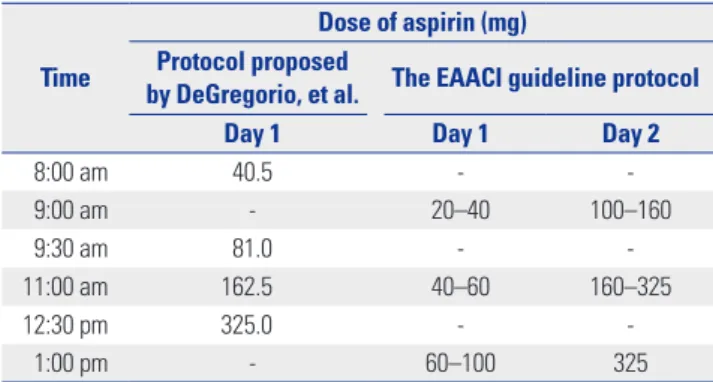
Various protocols for ATAD have been developed, and they are usually the extension of aspirin challenge test.95 Similar to aspirin OPT, expertise and well-equipped tertiary centers are necessary to ensure the safety of ATAD. A modified protocol for aspirin challenge and desensitization was suggested by the EAACI 2019 guideline, consisting of 2 days of ATAD.46 The 1-day ATAD protocol proposed by DeGregorio, et al.45 provides a quick alternative for busy patients. Details and time schedules of the two protocols are shown in Table 1. No matter which protocol has been accomplished, the compliance of aspirin after ATAD is of utmost importance, as aspirin tolerance is lost if aspirin is not taken within 48 hours.
Previous studies have shown convincing results for the effi- cacy of ATAD in controlling symptoms, deterrence of NP relapse,
and reducing the chance of reoperation. According to Berges- Gimeno, et al.,96 87% of NERD patients showed improvement in terms of better symptom control scores, fewer sinusitis, and low- er daily dose of systemic steroid. Walters, et al.97 demonstrated persistent benefits of ATAD beyond 10 years of daily aspirin ther- apy. In clinical practice, however, a significant dropout rate of ATAD has been observed, due to gastrointestinal intolerance or need for elective surgery. Patient education and prescription of proton pump inhibitors may improve drug compliance.
NECD
Patients with NECD suffer from exacerbation of urticaria or an- gioedema, and even anaphylaxis, immediately after NSAID in- gestion. The exacerbation becomes more severe when patients have a suboptimal control of chronic urticaria, or are exposed to high doses of NSAID. As a result, NSAID avoidance, along with optimal control of chronic urticaria, is essential. Chronic urti- caria should be managed according to the EAACI/GA2LEN/
EDF/WAO 2017 guideline,19 which starts with the regular use of standard dose of second generation H1-antihistamines, followed by a top-up of 4-fold dose of antihistamines when the standard dose fails. Omalizumab is reserved for patients who are not responsive to antihistamines. It prevents urticaria exacerbation, and thus leads to a better quality of life in patients with severe uncontrolled chronic urticaria.98 An emergency kit with adren- aline auto-injector should be given to patients with prior ana- phylaxis to NSAID.99
NIUA, SNIUAA, and delayed NSAID hypersensitivity reactions
In NIUA and SNIUAA, patients develop urticaria only after in- take of NSAID. Culprit NSAID avoidance is enough to prevent exacerbation. Acute urticaria exacerbation can be controlled by a short-term use of antihistamines with or without steroids.
In delayed NSAID hypersensitivity reactions, NSAID avoid- ance can prevent the recurrence of skin manifestations. De- sensitization should be considered only when the use of aspi- rin is irreplaceable (e.g., acute myocardial infarction) and the delayed hypersensitivity reaction is mild (e.g., uncomplicated exanthems and fixed drug eruptions).100
CONCLUSION
Advances in diagnostic tests as well as the development of new pharmacological and surgical interventions provide an op- timistic outlook for better management of NSAID hypersensi- tivity reactions. Identification of phenotypes and endotypes of NSAID hypersensitivity allows for management on an individ- ual basis. Further studies are needed to establish the relation- ship between sub-classification of NSAID hypersensitivity re- actions and novel in vitro biomarkers.
Table 1. Comparison of Aspirin Treatment after Desensitization Protocols (EAACI 2019 Protocol46 and Protocol Proposed by DeGregorio, et al.45)
Time
Dose of aspirin (mg) Protocol proposed
by DeGregorio, et al. The EAACI guideline protocol
Day 1 Day 1 Day 2
8:00 am 40.5 - -
9:00 am - 20–40 100–160
9:30 am 81.0 - -
11:00 am 162.5 40–60 160–325
12:30 pm 325.0 - -
1:00 pm - 60–100 325
ACKNOWLEDGEMENTS
This study was supported by a grant of the KHIDI, funded by the Ministry of Health & Welfare, ROK (HI16C0992).
AUTHOR CONTRIBUTIONS
Conceptualization: Wan Yin Winnie Yeung. Investigation: Wan Yin Winnie Yeung. Methodology: Wan Yin Winnie Yeung. Project admin- istration: Wan Yin Winnie Yeung. Resources: Wan Yin Winnie Yeung.
Software: Wan Yin Winnie Yeung. Supervision: Hae Sim Park. Valida- tion: Wan Yin Winnie Yeung. Visualization: Wan Yin Winnie Yeung.
Writing—original draft: Wan Yin Winnie Yeung. Writing—review &
editing: Hae Sim Park.
ORCID iDs
Wan Yin Winnie Yeung https://orcid.org/0000-0002-1785-4921 Hae Sim Park https://orcid.org/0000-0003-2614-0303
REFERENCES
1. McGettigan P, Henry D. Use of non-steroidal anti-inflammatory drugs that elevate cardiovascular risk: an examination of sales and essential medicines lists in low-, middle-, and high-income countries. PLoS Med 2013;10:e1001388.
2. Pirmohamed M, James S, Meakin S, Green C, Scott AK, Walley TJ, et al. Adverse drug reactions as cause of admission to hospital:
prospective analysis of 18 820 patients. BMJ 2004;329:15-9.
3. Iasella CJ, Johnson HJ, Dunn MA. Adverse drug reactions: type A (intrinsic) or type B (idiosyncratic). Clin Liver Dis 2017;21:73-87.
4. Lafrance JP, Miller DR. Selective and non-selective non-steroidal anti-inflammatory drugs and the risk of acute kidney injury. Phar- macoepidemiol Drug Saf 2009;18:923-31.
5. Blumenthal KG, Lai KH, Huang M, Wallace ZS, Wickner PG, Zhou L. Adverse and hypersensitivity reactions to prescription non- steroidal anti-Inflammatory agents in a large health care system.
J Allergy Clin Immunol Pract 2017;5:737-43.
6. Thong BY. Nonsteroidal anti-inflammatory drug hypersensitivity in the Asia-Pacific. Asia Pac Allergy 2018;8:e38.
7. Lee JH, Jung CG, Park HS. An update on the management of as- pirin-exacerbated respiratory disease. Expert Rev Respir Med 2018;12:137-43.
8. Kim YJ, Lim KH, Kim MY, Jo EJ, Lee SY, Lee SE, et al. Cross-reac- tivity to acetaminophen and celecoxib according to the type of nonsteroidal anti-inflammatory drug hypersensitivity. Allergy Asthma Immunol Res 2014;6:156-62.
9. Stone SF, Phillips EJ, Wiese MD, Heddle RJ, Brown SG. Immedi- ate-type hypersensitivity drug reactions. Br J Clin Pharmacol 2014;78:1-13.
10. Kowalski ML, Makowska J. Reply: to PMID 24117484. Allergy 2014;69:815-6.
11. Lee TH, Christie PE. Leukotrienes and aspirin induced asthma.
Thorax 1993;48:1189-90.
12. Divekar R, Hagan J, Rank M, Park M, Volcheck G, O’Brien E, et al. Diagnostic utility of urinary LTE4 in asthma, allergic rhinitis, chronic rhinosinusitis, nasal polyps, and aspirin sensitivity. J Al- lergy Clin Immunol Pract 2016;4:665-70.
13. Gaber F, Daham K, Higashi A, Higashi N, Gülich A, Delin I, et al.
Increased levels of cysteinyl-leukotrienes in saliva, induced spu- tum, urine and blood from patients with aspirin-intolerant asth- ma. Thorax 2008;63:1076-82.
14. Liu T, Laidlaw TM, Katz HR, Boyce JA. Prostaglandin E2 defi- ciency causes a phenotype of aspirin sensitivity that depends on platelets and cysteinyl leukotrienes. Proc Natl Acad Sci U S A 2013;110:16987-92.
15. Steinke JW, Negri J, Liu L, Payne SC, Borish L. Aspirin activation of eosinophils and mast cells: implications in the pathogenesis of aspirin-exacerbated respiratory disease. J Immunol 2014;193:
41-7.
16. Buchheit KM, Cahill KN, Katz HR, Murphy KC, Feng C, Lee-Sar- war K, et al. Thymic stromal lymphopoietin controls prostaglan- din D2 generation in patients with aspirin-exacerbated respira- tory disease. J Allergy Clin Immunol 2016;137:1566-76.
17. Choi Y, Lee Y, Park HS. Which factors associated with activated eosinophils contribute to the pathogenesis of aspirin-exacerbat- ed respiratory disease? Allergy Asthma Immunol Res 2019;11:
320-9.
18. Lee JU, Park JS, Chang HS, Park CS. Complementary participa- tion of genetics and epigenetics in development of NSAID-exac- erbated respiratory disease. Allergy Asthma Immunol Res 2019;
11:779-94.
19. Zuberbier T, Aberer W, Asero R, Abdul Latiff AH, Baker D, Ballmer- Weber B, et al. The EAACI/GA2LEN/EDF/WAO guideline for the definition, classification, diagnosis and management of urticar- ia. Allergy 2018;73:1393-414.
20. Kowalski ML, Stevenson DD. Classification of reactions to non- steroidal antiinflammatory drugs. Immunol Allergy Clin North Am 2013;33:135-45.
21. Szczeklik A, Sanak M. The broken balance in aspirin hypersensi- tivity. Eur J Pharmacol 2006;533:145-55.
22. Doña I, Jurado-Escobar R, Perkins JR, Ayuso P, Plaza-Serón MC, Pérez-Sánchez N, et al. Eicosanoid mediator profiles in different phenotypes of nonsteroidal anti-inflammatory drug-induced ur- ticaria. Allergy 2019;74:1135-44.
23. Hsieh CW, Lee JW, Liao EC, Tsai JJ. A disease marker for aspirin- induced chronic urticaria. Int J Mol Sci 2014;15:12591-603.
24. Bae JS, Kim SH, Ye YM, Yoon HJ, Suh CH, Nahm DH, et al. Signifi- cant association of FcepsilonRIalpha promoter polymorphisms with aspirin-intolerant chronic urticaria. J Allergy Clin Immunol 2007;119:449-56.
25. Kim SH, Sanak M, Park HS. Genetics of hypersensitivity to aspi- rin and nonsteroidal anti-inflammatory drugs. Immunol Allergy Clin North Am 2013;33:177-94.
26. van der Klauw MM, Wilson JH, Stricker BH. Drug-associated anaphylaxis: 20 years of reporting in The Netherlands (1974-1994) and review of the literature. Clin Exp Allergy 1996;26:1355-63.
27. Posadas SJ, Pichler WJ. Delayed drug hypersensitivity reactions - new concepts. Clin Exp Allergy 2007;37:989-99.
28. Mockenhaupt M, Kelly JP, Kaufman D, Stern RS; SCAR Study Group. The risk of Stevens-Johnson syndrome and toxic epider- mal necrolysis associated with nonsteroidal antiinflammatory drugs: a multinational perspective. J Rheumatol 2003;30:2234-40.
29. Lee SY, Nam YH, Koh YI, Kim SH, Kim S, Kang HR, et al. Pheno- types of severe cutaneous adverse reactions caused by nonste- roidal anti-inflammatory drugs. Allergy Asthma Immunol Res 2019;11:212-21.
30. Malskat WS, Knulst AC, Bruijnzeel-Koomen CA, Röckmann H.
Tolerance to alternative cyclooxygenase-2 inhibitors in nonste- roidal anti-inflammatory drug hypersensitive patients. Clin Transl Allergy 2013;3:20.
31. Liccardi G, Salzillo A, Piccolo A, Senna G, Piscitelli E, D’Amato M, et al. Safety of celecoxib in patients with adverse skin reactions to acetaminophen (paracetamol) and nimesulide associated or not with common non-steroidal anti-inflammatory drugs. Eur Ann Allergy Clin Immunol 2005;37:50-3.
32. Sánchez-Borges M, Capriles-Hulett A. Atopy is a risk factor for
non-steroidal anti-inflammatory drug sensitivity. Ann Allergy Asthma Immunol 2000;84:101-6.
33. Asero R. Single NSAID hypersensitivity is associated with atopic status. Eur Ann Allergy Clin Immunol 2015;47:48-53.
34. Demoly P, Adkinson NF, Brockow K, Castells M, Chiriac AM, Greenberger PA, et al. International consensus on drug allergy.
Allergy 2014;69:420-37.
35. Sánchez-Borges M, Caballero-Fonseca F, Capriles-Hulett A. Co- factors and comorbidities in patients with aspirin/NSAID hyper- sensitivity. Allergol Immunopathol (Madr) 2017;45:573-8.
36. Lee HY, Ye YM, Kim SH, Ban GY, Kim SC, Kim JH, et al. Identifi- cation of phenotypic clusters of nonsteroidal anti-inflammatory drugs exacerbated respiratory disease. Allergy 2017;72:616-26.
37. Blanca-Lopez N, J Torres M, Doña I, Campo P, Rondón C, Seo- ane Reula ME, et al. Value of the clinical history in the diagnosis of urticaria/angioedema induced by NSAIDs with cross-intoler- ance. Clin Exp Allergy 2013;43:85-91.
38. Sánchez-Borges M, Fernández-Caldas E, Capriles-Hulett A, Ca- ballero-Fonseca F. Mite-induced inflammation: more than aller- gy. Allergy Rhinol (Providence) 2012;3:e25-9.
39. Kowalski ML, Makowska JS. Seven steps to the diagnosis of NSAIDs hypersensitivity: how to apply a new classification in real practice? Allergy Asthma Immunol Res 2015;7:312-20.
40. Hoetzenecker W, Nägeli M, Mehra ET, Jensen AN, Saulite I, Schmid-Grendelmeier P, et al. Adverse cutaneous drug eruptions:
current understanding. Semin Immunopathol 2016;38:75-86.
41. Himly M, Jahn-Schmid B, Pittertschatscher K, Bohle B, Grub- mayr K, Ferreira F, et al. IgE-mediated immediate-type hyper- sensitivity to the pyrazolone drug propyphenazone. J Allergy Clin Immunol 2003;111:882-8.
42. Brockow K, Garvey LH, Aberer W, Atanaskovic-Markovic M, Barbaud A, Bilo MB, et al. Skin test concentrations for systemi- cally administered drugs -- an ENDA/EAACI Drug Allergy Inter- est Group position paper. Allergy 2013;68:702-12.
43. Kang MG, Sohn KH, Kang DY, Park HK, Yang MS, Lee JY, et al.
Analysis of individual case safety reports of severe cutaneous adverse reactions in Korea. Yonsei Med J 2019;60:208-15.
44. Kowalski ML, Makowska JS, Blanca M, Bavbek S, Bochenek G, Bousquet J, et al. Hypersensitivity to nonsteroidal anti-inflamma- tory drugs (NSAIDs) - classification, diagnosis and management:
review of the EAACI/ENDA and GA2LEN/HANNA. Allergy 2011;
66:818-29.
45. DeGregorio GA, Singer J, Cahill KN, Laidlaw T. A 1-Day, 90-min- ute aspirin challenge and desensitization protocol in aspirin-ex- acerbated respiratory disease. J Allergy Clin Immunol Pract 2019;7:1174-80.
46. Kowalski ML, Agache I, Bavbek S, Bakirtas A, Blanca M, Bo- chenek G, et al. Diagnosis and management of NSAID-Exacer- bated Respiratory Disease (N-ERD)-a EAACI position paper. Al- lergy 2019;74:28-39.
47. Kowalski ML, Woessner K, Sanak M. Approaches to the diagno- sis and management of patients with a history of nonsteroidal anti-inflammatory drug-related urticaria and angioedema. J Al- lergy Clin Immunol 2015;136:245-51.
48. Zisa G, Riccobono F, Bommarito L, D’Antonio C, Calamari AM, Poppa M, et al. Provocation tests with the offending nonsteroi- dal anti-inflammatory drugs in patients with urticaria/angio- edema reactions. Allergy Asthma Proc 2012;33:421-6.
49. Kowalski ML, Asero R, Bavbek S, Blanca M, Blanca-Lopez N, Bo- chenek G, et al. Classification and practical approach to the di- agnosis and management of hypersensitivity to nonsteroidal anti-inflammatory drugs. Allergy 2013;68:1219-32.
50. Aberer W, Bircher A, Romano A, Blanca M, Campi P, Fernandez J, et al. Drug provocation testing in the diagnosis of drug hyper- sensitivity reactions: general considerations. Allergy 2003;58:
854-63.
51. Sanz ML, Sánchez G, Gamboa PM, Vila L, Uasuf C, Chazot M, et al. Allergen-induced basophil activation: CD63 cell expression detected by flow cytometry in patients allergic to Dermatopha- goides pteronyssinus and Lolium perenne. Clin Exp Allergy 2001;31:1007-13.
52. Gamboa P, Sanz ML, Caballero MR, Urrutia I, Antépara I, Esparza R, et al. The flow-cytometric determination of basophil activa- tion induced by aspirin and other non-steroidal anti-inflamma- tory drugs (NSAIDs) is useful for in vitro diagnosis of the NSAID hypersensitivity syndrome. Clin Exp Allergy 2004;34:1448-57.
53. Hemmings O, Kwok M, McKendry R, Santos AF. Basophil activa- tion test: old and new applications in allergy. Curr Allergy Asth- ma Rep 2018;18:77.
54. Hagan JB, Laidlaw TM, Divekar R, O’Brien EK, Kita H, Volcheck GW, et al. Urinary leukotriene E4 to determine aspirin intoler- ance in asthma: a systematic review and meta-analysis. J Allergy Clin Immunol Pract 2017;5:990-7.
55. Choi Y, Lee DH, Trinh HKT, Ban GY, Park HK, Shin YS, et al. Sur- factant protein D alleviates eosinophil-mediated airway inflam- mation and remodeling in patients with aspirin-exacerbated re- spiratory disease. Allergy 2019;74:78-88.
56. Trinh HKT, Pham DL, Choi Y, Kim HM, Kim SH, Park HS. Epi- thelial folliculin enhances airway inflammation in aspirin-exac- erbated respiratory disease. Clin Exp Allergy 2018;48:1464-73.
57. Wardzyn´ska A, Makowska JS, Pawełczyk M, Piechota-Polan´czyk A, Kurowski M, Kowalski ML. Periostin in exhaled breath con- densate and in serum of asthmatic patients: relationship to upper and lower airway disease. Allergy Asthma Immunol Res 2017;9:
126-32.
58. Pichler WJ, Tilch J. The lymphocyte transformation test in the di- agnosis of drug hypersensitivity. Allergy 2004;59:809-20.
59. Agache I, Rogozea L. Asthma biomarkers: do they bring preci- sion medicine closer to the clinic? Allergy Asthma Immunol Res 2017;9:466-76.
60. Wöhrl S. NSAID hypersensitivity - recommendations for diag- nostic work up and patient management. Allergo J Int 2018;27:
114-21.
61. Reddel HK, FitzGerald JM, Bateman ED, Bacharier LB, Becker A, Brusselle G, et al. GINA 2019: a fundamental change in asthma management: treatment of asthma with short-acting broncho- dilators alone is no longer recommended for adults and adoles- cents. Eur Respir J 2019;53:1901046.
62. Marcello C, Carlo L. Asthma phenotypes: the intriguing selective intervention with Montelukast. Asthma Res Pract 2016;2:11.
63. Ta V, White AA. Survey-defined patient experiences with aspirin- exacerbated respiratory disease. J Allergy Clin Immunol Pract 2015;3:711-8.
64. Mastalerz L, Nizankowska E, Sanak M, Mejza F, Pierzchalska M, Bazan-Socha S, et al. Clinical and genetic features underlying the response of patients with bronchial asthma to treatment with a leukotriene receptor antagonist. Eur J Clin Invest 2002;32:949-55.
65. Hanania NA, Alpan O, Hamilos DL, Condemi JJ, Reyes-Rivera I, Zhu J, et al. Omalizumab in severe allergic asthma inadequately controlled with standard therapy: a randomized trial. Ann Intern Med 2011;154:573-82.
66. Bardelas J, Figliomeni M, Kianifard F, Meng X. A 26-week, ran- domized, double-blind, placebo-controlled, multicenter study to evaluate the effect of omalizumab on asthma control in pa- tients with persistent allergic asthma. J Asthma 2012;49:144-52.
67. Hayashi H, Mitsui C, Nakatani E, Fukutomi Y, Kajiwara K, Watai K, et al. Omalizumab reduces cysteinyl leukotriene and 9α,11β- prostaglandin F2 overproduction in aspirin-exacerbated respi- ratory disease. J Allergy Clin Immunol 2016;137:1585-7.
68. Jean T, Eng V, Sheikh J, Kaplan MS, Goldberg B, Jau Yang S, et al.
Effect of omalizumab on outcomes in patients with aspirin-exac- erbated respiratory disease. Allergy Asthma Proc 2019;40:316-20.
69. Lee JH, Lee HY, Jung CG, Ban GY, Shin YS, Ye YM, et al. Therapeu- tic effect of omalizumab in severe asthma: a real-world study in Korea. Allergy Asthma Immunol Res 2018;10:121-30.
70. Porcaro F, Di Marco A, Cutrera R. Omalizumab in patient with aspirin exacerbated respiratory disease and chronic idiopathic urticaria. Pediatr Pulmonol 2017;52:E26-8.
71. Guillén D, Bobolea I, Calderon O, Fiandor A, Cabañas R, Here- dia R, et al. Aspirin desensitization achieved after omalizumab treatment in a patient with aspirin-exacerbated urticaria and re- spiratory disease. J Investig Allergol Clin Immunol 2015;25:133-5.
72. Yorgancıogˇlu A, Öner Erkekol F, Mungan D, Erdinç M, Gemi- ciogˇlu B, Özs¸eker ZF, et al. Long-term omalizumab treatment: a multicenter, real-life, 5-year trial. Int Arch Allergy Immunol 2018;
176:225-33.
73. Varricchi G, Bagnasco D, Borriello F, Heffler E, Canonica GW.
Interleukin-5 pathway inhibition in the treatment of eosinophil- ic respiratory disorders: evidence and unmet needs. Curr Opin Allergy Clin Immunol 2016;16:186-200.
74. Emma R, Morjaria JB, Fuochi V, Polosa R, Caruso M. Mepolizum- ab in the management of severe eosinophilic asthma in adults:
current evidence and practical experience. Ther Adv Respir Dis 2018;12:1753466618808490.
75. Tuttle KL, Buchheit KM, Laidlaw TM, Cahill KN. A retrospective analysis of mepolizumab in subjects with aspirin-exacerbated respiratory disease. J Allergy Clin Immunol Pract 2018;6:1045-7.
76. Liddament M, Husten J, Estephan T, Laine D, Mabon D, Pukac L, et al. Higher binding affinity and in vitro potency of reslizumab for interleukin-5 compared with mepolizumab. Allergy Asthma Immunol Res 2019;11:291-8.
77. Laidlaw TM, Mullol J, Fan C, Zhang D, Amin N, Khan A, et al.
Dupilumab improves nasal polyp burden and asthma control in patients with CRSwNP and AERD. J Allergy Clin Immunol Pract 2019;7:2462-5.
78. Gauvreau GM, O’Byrne PM, Boulet LP, Wang Y, Cockcroft D, Bi- gler J, et al. Effects of an anti-TSLP antibody on allergen-induced asthmatic responses. N Engl J Med 2014;370:2102-10.
79. Fokkens WJ, Lund VJ, Mullol J, Bachert C, Alobid I, Baroody F, et al. EPOS 2012: European position paper on rhinosinusitis and nasal polyps 2012. A summary for otorhinolaryngologists. Rhi- nology 2012;50:1-12.
80. Howard BE, Lal D. Oral steroid therapy in chronic rhinosinusitis with and without nasal polyposis. Curr Allergy Asthma Rep 2013;
13:236-43.
81. Hamilos DL. Chronic rhinosinusitis: epidemiology and medical management. J Allergy Clin Immunol 2011;128:693-707.
82. Mendelsohn D, Jeremic G, Wright ED, Rotenberg BW. Revision rates after endoscopic sinus surgery: a recurrence analysis. Ann Otol Rhinol Laryngol 2011;120:162-6.
83. Stryjewska-Makuch G, Humeniuk-Arasiewicz M, Jura-Szołtys E, Glück J. The effect of antileukotrienes on the results of postoper- ative treatment of paranasal sinuses in patients with non-steroi- dal anti-inflammatory drug-exacerbated respiratory disease. Int Arch Allergy Immunol 2019;179:281-9.
84. Kim DK, Kim DW. Does inflammatory endotype change in pa- tients with chronic rhinosinusitis? Allergy Asthma Immunol Res 2019;11:153-5.
85. Naidoo Y, Bassiouni A, Keen M, Wormald PJ. Long-term out- comes for the endoscopic modified Lothrop/Draf III procedure:
a 10-year review. Laryngoscope 2014;124:43-9.
86. Fandiño M, Macdonald KI, Lee J, Witterick IJ. The use of postop- erative topical corticosteroids in chronic rhinosinusitis with na- sal polyps: a systematic review and meta-analysis. Am J Rhinol
Allergy 2013;27:e146-57.
87. Van Gerven L, Langdon C, Cordero A, Cardelús S, Mullol J, Alo- bid I. Lack of long-term add-on effect by montelukast in postop- erative chronic rhinosinusitis patients with nasal polyps. Laryn- goscope 2018;128:1743-51.
88. Chandra RK, Clavenna M, Samuelson M, Tanner SB, Turner JH.
Impact of omalizumab therapy on medication requirements for chronic rhinosinusitis. Int Forum Allergy Rhinol 2016;6:472-7.
89. Gevaert P, Calus L, Van Zele T, Blomme K, De Ruyck N, Bauters W, et al. Omalizumab is effective in allergic and nonallergic patients with nasal polyps and asthma. J Allergy Clin Immunol 2013;
131:110-6.
90. Rivero A, Liang J. Anti-IgE and anti-IL5 biologic therapy in the treatment of nasal polyposis: a systematic review and meta-anal- ysis. Ann Otol Rhinol Laryngol 2017;126:739-47.
91. Bachert C, Mannent L, Naclerio RM, Mullol J, Ferguson BJ, Ge- vaert P, et al. Effect of subcutaneous dupilumab on nasal polyp burden in patients with chronic sinusitis and nasal polyposis: a randomized clinical trial. JAMA 2016;315:469-79.
92. Hill J, Burnett T, Katial R. Mechanisms of benefit with aspirin therapy in aspirin-exacerbated respiratory disease. Immunol Al- lergy Clin North Am 2016;36:735-47.
93. Perez-G M, Melo M, Keegan AD, Zamorano J. Aspirin and salicy- lates inhibit the IL-4- and IL-13-induced activation of STAT6. J Immunol 2002;168:1428-34.
94. Kong SK, Kim BS, Uhm TG, Chang HS, Park JS, Park SW, et al.
Aspirin induces IL-4 production: augmented IL-4 production in aspirin-exacerbated respiratory disease. Exp Mol Med 2016;
48:e202.
95. White AA, Stevenson DD. Aspirin desensitization: faster proto- cols for busy patients. J Allergy Clin Immunol Pract 2019;7:1181-3.
96. Berges-Gimeno MP, Simon RA, Stevenson DD. Long-term treat- ment with aspirin desensitization in asthmatic patients with as- pirin-exacerbated respiratory disease. J Allergy Clin Immunol 2003;111:180-6.
97. Walters KM, Waldram JD, Woessner KM, White AA. Long-term clinical outcomes of aspirin desensitization with continuous dai- ly aspirin therapy in aspirin-exacerbated respiratory disease. Am J Rhinol Allergy 2018;32:280-6.
98. Maurer M, Sofen H, Ortiz B, Kianifard F, Gabriel S, Bernstein JA.
Positive impact of omalizumab on angioedema and quality of life in patients with refractory chronic idiopathic/spontaneous urticaria: analyses according to the presence or absence of an- gioedema. J Eur Acad Dermatol Venereol 2017;31:1056-63.
99. Ring J, Beyer K, Biedermann T, Bircher A, Duda D, Fischer J, et al. Guideline for acute therapy and management of anaphylaxis:
S2 Guideline of the German Society for Allergology and Clinical Immunology (DGAKI), the Association of German Allergologists (AeDA), the Society of Pediatric Allergy and Environmental Med- icine (GPA), the German Academy of Allergology and Environ- mental Medicine (DAAU), the German Professional Association of Pediatricians (BVKJ), the Austrian Society for Allergology and Immunology (ÖGAI), the Swiss Society for Allergy and Immu- nology (SGAI), the German Society of Anaesthesiology and In- tensive Care Medicine (DGAI), the German Society of Pharma- cology (DGP), the German Society for Psychosomatic Medicine (DGPM), the German Working Group of Anaphylaxis Training and Education (AGATE) and the patient organization German Allergy and Asthma Association (DAAB). Allergo J Int 2014;23:
96-112.
100. Scherer K, Brockow K, Aberer W, Gooi JH, Demoly P, Romano A, et al. Desensitization in delayed drug hypersensitivity reactions -- an EAACI position paper of the Drug Allergy Interest Group.
Allergy 2013;68:844-52.