pISSN 2289-0203ㆍeISSN 2383-7101 https://doi.org/10.15747/jcn.2021.13.1.12
단장증후군으로 장기간 정맥영양공급을 받는 환자에서 비타민 D 결핍
안성효
1, 이상훈
1,2, 김현정
2, 박효정
2, 서정민
1,2성균관대학교 의과대학 삼성서울병원 1외과, 2장재활팀
Vitamin D Deficiency is Prevalent in Short Bowel Syndrome Patients on Long-Term Parenteral Nutrition Support
SungHyo An
1, Sanghoon Lee
1,2, Hyun-Jung Kim
2, Hyo Jung Park
2, Jeong-Meen Seo
1,21Department of Surgery, 2Intestinal Rehabilitation Team, Samsung Medical Center, Sungkyunkwan University School of Medicine, Seoul, Korea
Purpose: Short bowel syndrome (SBS) is the most common etiology for intestinal failure (IF) and these patients are at high risk of developing micronutrient deficiencies. This study aimed at assessing the level of vitamins in adult SBS patients at different stages of their disease before the initiation of multidisciplinary intestinal rehabilitation.
Methods: Patient data from November 2015 to March 2017 were retrospectively reviewed. Adult patients who underwent extensive bowel resection and were classified as SBS-IF were selected. Clinical data including age, sex, etiology of IF, biochemical data, nutritional status, nutrition support, and outcome of intestinal rehabilitation were analyzed.
Results: Nine patients with SBS-IF were included in the analysis. There were 6 male patients and 3 female patients, with a median age of 55.0 years. Vitamin levels were analyzed at 306 days (median) after the development of SBS. At the time of vitamin levels screening, 4 patients were receiving daily intravenous vitamin supplementation. Five patients were not receiving vitamin supplementations, either intravenously or orally. Vitamin B12 was within the normal range in 6 patients and higher than normal in 3 patients. Vitamin D was within the normal range in 3 patients and lower than normal in 6 patients. Vitamin E was within the normal range in 7 patients and higher than normal in 2 patients. Folate was within the normal range in 8 patients (not checked in 1 patient). Ambulatory patients had significantly higher vitamin D levels compared to hospitalized patients (P=0.015).
Conclusion: Vitamin D levels had decreased in 67% of patients with SBS in Korea, while vitamin B12, folate, and vitamin E deficiencies were rarely seen.
Key Words: Short bowel syndrome, Vitamin, Micronutrient, Intestinal rehabilitation
Received June 20, 2021; Accepted June 23, 2021
Correspondence to Sanghoon Lee https://orcid.org/0000-0002-5086-1461 Department of Surgery, Samsung Medical Center, Sungkyunkwan University School of Medicine, 81 Irwon-ro, Gangnam-gu, Seoul 06351, Korea
Tel: +82-2-3410-4025, Fax: +82-2-3410-0040, E-mail: [email protected] Conflict of interest: None.
This is an Open Access article distributed under the terms of the Creative Commons Attribution Non-Commercial License (http://creativecommons.org/licenses/by-nc/4.0) which permits unrestricted non-commercial use, distribution, and reproduction in any medium, provided the original work is properly cited.
INTRODUCTION
Short bowel syndrome (SBS) is a state of malabsorption and malnutrition as a result of extensive bowel resection due to various causes, including volvulus or thrombosis of mes- enteric vessels and recurrent bowel resection for conditions such as Crohn’s disease.1,2 SBS is the most common etiology for intestinal failure in adults and these patients require pa- renteral nutrition (PN) support to sustain adequate body weight and water balance.2,3 Even with sufficient nutrition
Table 2. Initial vitamin analysis results Days from SBS to
vitamin analysis
Vitamin B12 (160∼970 pg/mL)
Vitamin D (10∼150 ng/mL)
Vitamin E (11.6∼46.4 umol/L)
Folate (1.5∼16.9 ng/mL)
INR (0.9∼1.1)
1 721 852.0 1.8 15.1 5.3 NA
2 391 2,925.0 16.0 15.2 5.5 1.01
3 306 1,529.0 1.8 24.7 7.5 1.24
4 2,545 174.0 7.0 28.9 15.0 1.02
5 89 853.0 6.0 52.8 9.5 1.11
6 91 764.0 3.4 36.5 1.5 1.20
7 11 529.0 16.7 36.7 6.6 1.20
8 54 338.0 33.5 32.0 NA 0.99
9 319 4,460.0 2.7 62.4 14.8 1.41
SBS = short bowel syndrome; INR = international normalized ratio; NA = not available.
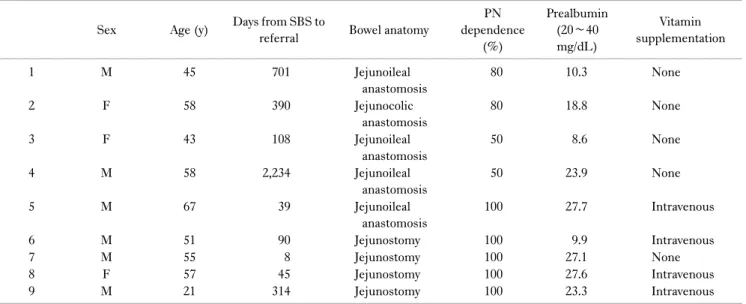
Table 1. Patient demographics
Sex Age (y) Days from SBS to
referral Bowel anatomy
PN dependence
(%)
Prealbumin (20∼40 mg/dL)
Vitamin supplementation
1 M 45 701 Jejunoileal
anastomosis
80 10.3 None
2 F 58 390 Jejunocolic
anastomosis
80 18.8 None
3 F 43 108 Jejunoileal
anastomosis
50 8.6 None
4 M 58 2,234 Jejunoileal
anastomosis
50 23.9 None
5 M 67 39 Jejunoileal
anastomosis
100 27.7 Intravenous
6 M 51 90 Jejunostomy 100 9.9 Intravenous
7 M 55 8 Jejunostomy 100 27.1 None
8 F 57 45 Jejunostomy 100 27.6 Intravenous
9 M 21 314 Jejunostomy 100 23.3 Intravenous
M = male; F = female; SBS = short bowel syndrome; PN = parenteral nutrition.
support including PN, these patients are at high risk of de- veloping micronutrient deficiencies.4
Vitamins are an essential part of nutrition and is profoundly involved in maintaining homeostasis in areas such as bone mineral metabolism and hematopoiesis.5 Deficiencies in spe- cific vitamins deficiencies may lead to osteopenia, muscle weakness, and fractures. SBS patients exhibit suboptimal levels of vitamins and micronutrient at a high rate during in- testinal rehabilitation.6,7 The aim of this study is to assess the level of vitamins in adult SBS patients at different stages of their disease prior to initiation of multidisciplinary intestinal rehabilitation.
MATERIALS AND METHODS
Patient data from the Intestinal Rehabilitation Team (IRT) database at Samsung Medical Center (Seoul, Korea) from November 2015 to March 2017 were retrospectively reviewed.
Adult patients who underwent extensive bowel resection and classified as SBS-intestinal failure (IF) were selected.
Clinical data including age, sex, etiology of IF, biochemical data, nutritional status, nutrition support, and outcome of in- testinal rehabilitation were analyzed.
Management of all patients was done by a multidisciplinary IRT consisting of surgeons, nutritionists, and pharmacists.
When a patient is referred to the IRT, the length and struc- ture of remaining bowel, nutritional status of the patient
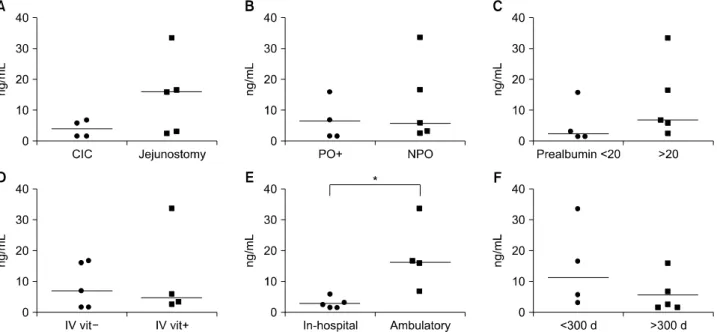
Fig. 1. Comparison of vitamin D levels between patient groups according to clinical and nutritional factors. (A) Remnant bowel anatomy, (B) oral intake, (C) prealbumin level, (D) intravenous vitamin supplementation, (E) ambulatory status, (F) days on parenteral nutrition. CIC = colon-in-continuity; PO+ = oral intake; NPO = nothing by mouth; IV vit = intravenous vitamin. *P<0.05.
Table 3. Composition of intravenous multi-vitamin concentrate (TamipoolⓇ) and daily requirement of vitamins
Unit TamipoolⓇ Daily
requirement
Vitamin A IU 3,300 3,300
Vitamin D IU 200 200
Vitamin E IU 10 10
Vitamin K mcg 0 150
Vitamin C mg 100 200
Thiamine mg 3.4 6
Riboflavin mg 2.8 3.6
Niacin mg 40 40
Pantothenic acid mg 15 15
Pyridoxine mg 4.0 6
Cyanocobalamin mcg 5 5
Biotin mcg 60 60
Folic acid mcg 400 600
were assessed. The composition and volume of macro- nutrients, electrolytes, micronutrients to provide to each pa- tient was determined by assessing the malabsorption status of each patient. Oral or enteral nutrition was encouraged and provided whenever it was feasible. The composition of nu- trition support and dose adjustments were carried out by the multidisciplinary IRT.
Blood samples were analyzed initially following referral to IRT for a thorough screening of deficiencies or complica- tions related to SBS-IF, including electrolyte imbalance, ane- mia, hypoglycemia, vitamin deficiencies (vitamin B12, vita- min D, vitamin E, folate), intestinal failure-associated liver disease, and azotemia. When deficiencies or complications were detected, sequential tests were performed according to protocol.8
RESULTS
Nine patients with SBS-IF were included in the analysis (Table 1). There were 6 male patients and 3 female patients, with median age of 55.0 years. Patients were referred to the IRT after 108.0 days (median value) on PN support for SBS.
Length of remnant small bowel was 85.0 cm (median). Four patients had end jejunostomies, 4 patients had jejunoileal
anastomoses, and 1 patient had a jejunocolic anastomosis.
Five patients were 100% PN dependent, while 2 patients each were receiving 80% and 50% of their calories by PN.
Results of vitamin levels screening are presented in Table 2. Vitamin levels were analyzed at 306 days (median) after development of SBS. At the time of vitamin levels screening, 4 patients were receiving daily intravenous vitamin supple- mentation with a multi-vitamin concentrate (Tamipool;
Celltrion Pharm, Cheongju, Korea). The amount of vitamins
provided by this product is shown in Table 3. Five patients were not receiving vitamin supplementations, either intra- venously or orally. Vitamin B12 was within normal ranges in 6 patients and higher than normal ranges in 3 patients. Vitamin D was within normal ranges in 3 patients and lower than nor- mal ranges in 6 patients. Vitamin E was within normal ranges in 7 patients and higher than normal ranges in 2 patients.
Folate was within normal ranges in 8 patients (not checked in 1 patient). Prothrombin time (international normalized ratio) which is a surrogate marker for vitamin K level was within normal ranges in 3 patients and higher than normal ranges in 6 patients, representing low vitamin K levels in these patients (not checked in 1 patient).
Vitamin D levels were compared between patients grouped according to clinical and nutritional variables (Figure 1).
Patients who are ambulatory had significantly higher vitamin D levels compared to hospitalized patients (P=0.015, Figure 1E). Vitamin D levels were not different in relation with rem- nant bowel anatomy, oral intake, prealbumin levels, intra- venous vitamin supplementation, and duration since develop- ment of SBS.
DISCUSSION
The results of this study illustrate the high prevalence of vitamin D deficiency and relatively sufficient levels of other vitamins in SBS patients. Vitamin D deficiency was con- sistently seen in SBS patients irrespective of remnant bowel anatomy, oral intake, or intravenous vitamin supplemen- tation. These findings are consistent with previous reports evaluating vitamins and micronutrient levels in SBS patients.
In a study by Feng et al.,9 the authors analyzed micronutrient levels in 31 pediatric SBS patients during intestinal rehabilitation. The prevalence of vitamin D deficiency was 93.5%, while vitamin B12 and folate deficiency was not seen in any patients. Risk factor analysis for vitamin D deficiency was done and revealed that remaining bowel length, age, presence of ileocecal valve, duration of PN, and vitamin D supplementation were not significant factors. A study by Ubesie et al.4 included 449 vitamin D measurements in 123 SBS children undergoing intestinal rehabilitation. The prev- alence of vitamin D deficiency was 39.8%. The authors also
presented bone mineral density measurements data which showed 12.5% prevalence of reduced bone mass.
Patients with intestinal failure due to SBS are a diverse population with much variation in the underlying pathology, remnant intestinal anatomy, and degree of malnutrition.
This clinicopathologic diversity leads to a high degree of var- iation in nutritional demand and a one-size-fits-all approach in management is not sufficient in most cases. Patients’ nu- tritional management must be tailored to the demands of each patient and provided by a multidisciplinary team of experts.10,11 The positive effects of this multidisciplinary in- testinal rehabilitation was elucidated in the study by Feng et al.9 that followed patients with serial vitamin D measure- ments during an 8-month span. Vitamin D levels significantly improved through the 8-month period and prevalence of vita- min D deficiency among patients decreased. Intensive in- testinal rehabilitation and nutritional support by an experi- enced team of multidisciplinary specialists is believed to be a major contributing factor in these patients’ improvement in micronutrient status.
One interesting finding in this study is the significantly higher vitamin D levels in ambulatory patients compared to hospitalized patients. This is an expected outcome regarding the importance of exposure to ultraviolet rays in sunlight in the metabolism of vitamin D in humans, but one that has been seldom analyzed as contributing factors in previous reports. Hospitalized patients are apt to spend significantly less time under exposure to direct sunlight and vitamin D synthesis would be hindered. Thus, management of SBS pa- tients should focus on advocating enteral intake and reducing PN, so the patient does not require inpatient care, thus re- ducing the risk of vitamin D deficiency and bone mineral dis- ease that may follow.
This study is the first study to present vitamin measure- ment results in SBS patients in Korea. Vitamin D levels were decreased in 67% of patients while vitamin B12, folate, and vitamin E deficiencies were rarely seen. Future studies should focus on assessing the metabolic effects of vitamin deficiencies in SBS patients and also on the strategies for prevention of vitamin deficiencies in SBS patients.
ORCID
SungHyo An, https://orcid.org/0000-0002-6233-4378 Sanghoon Lee, https://orcid.org/0000-0002-5086-1461 Hyun-Jung Kim, https://orcid.org/0000-0001-9766-8557 Hyo Jung Park, https://orcid.org/0000-0002-3875-0224 Jeong-Meen Seo, https://orcid.org/0000-0002-5527-3976
REFERENCES
1. Thompson JS. Comparison of massive vs. repeated resection leading to short bowel syndrome. J Gastrointest Surg 2000;4(1):
101-4.
2. Pironi L, Arends J, Baxter J, Bozzetti F, Peláez RB, Cuerda C, et al. ESPEN endorsed recommendations. Definition and classifi- cation of intestinal failure in adults. Clin Nutr 2015;34(2):
171-80.
3. Schalamon J, Mayr JM, Höllwarth ME. Mortality and economics in short bowel syndrome. Best Pract Res Clin Gastroenterol 2003;17(6):931-42.
4. Ubesie AC, Kocoshis SA, Mezoff AG, Henderson CJ, Helmrath MA, Cole CR. Multiple micronutrient deficiencies among patients with intestinal failure during and after transition to enteral nutrition. J Pediatr 2013;163(6):1692-6.
5. Wimalawansa SJ. Vitamin D: an essential component for skeletal health. Ann N Y Acad Sci 2011;1240:E1-12.
6. Yang CF, Duro D, Zurakowski D, Lee M, Jaksic T, Duggan C.
High prevalence of multiple micronutrient deficiencies in children with intestinal failure: a longitudinal study. J Pediatr 2011;159(1):39-44.e1.
7. Thomson P, Duerksen DR. Vitamin D deficiency in patients receiving home parenteral nutrition. JPEN J Parenter Enteral Nutr 2011;35(4):499-504.
8. Yoon S, Lee S, Park HJ, Kim HJ, Yoon J, Min JK, et al.
Multidisciplinary intestinal rehabilitation for short bowel syndrome in adults: results in a Korean intestinal rehabilitation team. J Clin Nutr 2018;10(2):45-50.
9. Feng H, Zhang T, Yan W, Lu L, Tao Y, Cai W, et al. Micronutrient deficiencies in pediatric short bowel syndrome: a 10-year review from an intestinal rehabilitation center in China. Pediatr Surg Int 2020;36(12):1481-7.
10. Modi BP, Langer M, Ching YA, Valim C, Waterford SD, Iglesias J, et al. Improved survival in a multidisciplinary short bowel syndrome program. J Pediatr Surg 2008;43(1):20-4.
11. Diamond IR, de Silva N, Pencharz PB, Kim JH, Wales PW.
Neonatal short bowel syndrome outcomes after the establish- ment of the first Canadian multidisciplinary intestinal re- habilitation program: preliminary experience. J Pediatr Surg 2007;42(5):806-11.