Journal of Bacteriology and Virology 2008. Vol. 38, No. 4 p.179 – 188
Epidemiological Prevalence of Avian Pathogenic Escherichia coli Differentiated by Multiplex PCR from Commercial Chickens
and Hatchery in Korea
Soon-Gu Kwon1, Se-Yeoun Cha1, Eun-Ju Choi1, Bokyung Kim2, Hee-Jong Song1 and Hyung-Kwan Jang1*
1Department of Infectious Diseases and Avian Diseases, College of Veterinary Medicine and Bio-Safety Research Institute, Chonbuk National University, Jeonju 561-756, Republic of Korea
2Department of Physiology, College of Medicine and Bio-Food and Drug Research Center, Konkuk University, Chungju 380-701, Republic of Korea *
Received : July 16, 2008 Revised : October 8, 2008 Accepted : October 9, 2008
We examined 216 Escherichia coli (E. coli) isolated from chickens and environmental specimens from hatcheries between 2005 and 2006 in order to evaluate the epidemiological prevalence of avian pathogenic E. coli (APEC) in Korea tentatively by multiplex PCR. The multiplex PCR which was used as tentative criteria of APEC targets 8 virulence-associated genes; enteroaggregative toxin (astA), increased serum survival protein (iss), iron-repressible protein (irp2), P fimbriae (papC), aerobactin (iucD), temperature-sensitive hemagglutinin (tsh), vacuolating autotransporter toxin (vat), and colicin V plasmid operon (cva/cvi) genes. The number of detected genes could be used as a reliable index of their virulence. It was demonstrated that E. coli strains already typed as APEC always harbor 5 to 8 genes, but non-APEC strains harbor less than 4 genes. Assuming the criteria of APEC is a possession of more than 5 virulence- associated genes, we discriminated 24 APEC strains among the 216 E. coli strains. Contamination rates of APEC in the field were 31.3% in layers, 14.0% in broilers, 2.7% in broiler breeders, and 0.0% in environmental specimens from hatcheries. The combinational tendency of APEC examined is a fundamental possession of astA, iss and iucD genes and addition of cva/cvi, tsh, vat, and irp2 genes which have a critical importance for virulent traits of APEC. Compared with intravenous chicken challenge or embryo lethality assay, multiplex PCR method could be useful to discriminate APEC rapidly for convenient diagnosis.
Key Words: Avian pathogenic E. coli, Multiplex PCR
INTRODUCTION
Colibacillosis is pathogenic to mammals and fowls primarily or secondarily as a mixed infection in which
symptoms are complicated. Especially, avian pathogenic E.
coli (APEC) strains are the etiologic agents of colibacillosis in birds and are an important problem for the poultry industry (2,16,21). APEC strains fall under the category of extraintestinal pathogenic E. coli, which are characterized by the possession of virulence factors that enable to live extraintestinal life (3,13,23). These virulent factors have been identified (3,6,13,27). However, no specific virulent factor that contributes entirely to the pathogenicity of APEC has been discovered (20,23). Thus a lack of diagnostic tests 179
*Corresponding author: Hyung-Kwan Jang. Department of Infectious Diseases and Avian Diseases, College of Veterinary Medicine and Bio-Safety Research Institute, Chonbuk National University, Jeonju 561-756, Republic of Korea.
Phone: +82-63-270-3885, Fax: +82-63-270-2135 e-mail: [email protected]
to determine degrees of the virulence which are primary pathogens (highly virulent), secondary pathogens (moder- ately virulent), or nonpathogenic (avirulent) makes it difficult to control the colibacillosis (28). And the lack of diagnostic tests also results in the scarce knowledge about epide- miology of APEC. Especially in Korea, there is no available information of epidemiology of APEC. Take these circum- stances into consideration, we carried out epidemiological study of APEC in chicken farms and hatcheries using multiplex PCR, which could tentatively differentiate APEC from field isolates of E. coli. This multiplex PCR was reported in a previous study (6), and it was proved that virulent strains which are already typed as APEC had 5 to 8 virulence-associated genes but avirulent strains which are already typed as non-APEC strains had at most 4 virulence- associated genes (6).
These genes are enteroaggregative toxin (astA), increased serum survival protein (iss), iron-repressible protein (irp2), P fimbriae (papC), aerobactin (iucD), temperature-sensitive hemagglutinin (tsh), vacuolating autotransporter toxin (vat), and colicin V plasmid operon genes (cva/cvi) (6). AstA gene encodes for EAST1 (enteroaggregative E. coli heat-stable enterotoxin 1), which was first observed in EAEC (entero- aggregative E. coli) strains, which had been recognized as an agent of diarrhea (15). Although the role of EAST1 in pathogenesis was not fully established, presence of this toxin was found in high frequency (17,26,29). Iss gene attributing to increased serum survival, has been described as an important feature of virulent E. coli in chickens (5).
Previous studies reported that iss and the protein which iss encodes were useful targets of colibacillosis (6,19). Location of iss gene tends to exist in both ColV plasmid and bacterial chromosome (13,19,27). Among 8 virulence-associated genes, genes related to iron acquisition system are irp2 and iucD. Irp-fyuA gene cluster encoded for yersiniabactin, were first detected in Yersinia species (10,25). In addition, it also has been found in E. coli isolated from humans and birds (10,24,25). The other gene encodes for iron acquisition system, iucD gene, codes for aerobactin has been described that it is located in both ColV and bacterial chromosome (10,24,25). P fimbriae was first identified in E. coli isolates
pathogenic to human urinary tract (1), and the pathogenesis of this gene in avian strains has not been fully understood.
Several studies have shown the frequent existence of papC in APEC (1,4,6,12). Tsh and vat genes both code for serine protease autotransporter and they have 75% protein homo- logy (18). However, only tsh is on a ColV-type plasmid, and it is located near the colicin V genes in many of APEC strains (3,11). Gene responsible for vacuolating cytotoxin was first detected in septicemic chickens (22), and their location in PAI (pathogenicity island) was first described in avian E. coli that encoded an autotransporter protein (18).
Cva A/B and cvi/cvaC genes are related to ColV plasmid.
Possessing iss, iucD, tsh and cva/cvi, ColV plasmids have been considered to be a defining feature of the APEC strains (13,25).
In this study, we screened 216-field E. coli isolated from the liver of debilitated chickens and environmental speci- mens from hatcheries between 2005 and 2006 in order to evaluate the epidemiological prevalence of APEC in Korea by the multiplex PCR. We temporarily assumed that the criteria of APEC were a possession of 5 to 8 virulence- associated genes, and strains which had less than 4 virulence-associated genes considered to be non-APEC based on the results of previous study (6). According to these criteria, we tentatively differentiated APEC and examined their distribution in Korea. We also obtained detection rates of each virulence-associated genes and combinations of detected genes. Moreover, we could also reevaluate the validity and rapidity of multiplex PCR in terms of appli- cation to field samples.
MATERIALS AND METHODS
1. Bacterial strains
A total of 216 E. coli strains were collected from chickens and hatcheries. All of E. coli strains had been isolated from each liver surface of debilitated chickens submitted to our laboratory from chicken farms for autopsy and environmental specimens from hatcheries. Each swab- bed specimen from liver surface of chickens was smeared on MacConkey agar plate (Difco, Detroit, MI, USA), and
then incubated at 37℃ for approximately 18 h in aerobic conditions. Specimens from hatcheries were collected from the MacConkey agar plates which were left for 10 minutes in the incubation room, hatching room and packing/
dispatching room, and these agar plates were submitted to our laboratory to evaluate the cleanliness level of operation room in hatcheries. Colonies expressing bright pink and surrounded by precipitate in MacConkey agar were selected and tested for screening biochemical traits by using the API 20E (BioMérieux, Marcy l'Etoile, France). The selected E.
coli strains include 129 strains from broilers, 16 strains from layers, 37 strains from broiler breeders, and 34 strains from environmental specimens of hatcheries.
2. DNA preparation
Each of glycerol stock was incubated in Nutrient broth (Difco) and grown overnight in shaking incubator at 37℃.
After that, the enriched medium in a 1.5 ml-effendorf tube was microcentrifuged in 1,500 rpm for 10 min, and the supernatant was discarded. Autoclaved distilled water (DW) or TE buffer (10 mM Tris-HCl, 1 mM EDTA at pH 8.0)
was added to the pellet. This tube was freezed for 10 min at -80℃, and then, incubated (boiled) for 5 min at 95℃. After repeating this procedure 3 to 4 times, the tube was centri- fuged again in 1,500 rpm for 10 min. Amount of DNA in supernatant was evaluated by Nanodrop (ND-1000, Nano- drop Technologies, Wilmington, DE, USA). For adjusting the suitable amount of template DNA, 1 μl, 2.5 μl, 5 μl and 10 μl of each the templates were used for PCR.
3. Multiplex PCR
Test organisms were examined for astA, iss, irp2, papC iucD, tsh, vat, and cva/cvi genes using the following proce- dures. Optimal amount of template decided by Nanodrop was added to the reaction mixture containing 0.4 μl of each primer pair (50 pmol; Bioneer, Daejeon, Korea), 5 μl of dNTP (2 mM; Enzynomics, Daejeon, Korea), 5 μl of 10×
PCR buffer (100 mM Tris-HCl, 15 mM MgCl2, 500 mM KCl; Enzynomics) and 0.5 μl of Taq polymerase (5 U/μl;
Enzynomics). The remainder portion was filled with auto- claved DW up to 50 μl. Amplifications were performed in a 50 μl reaction by using PCR cycler (PTC-220, MJ
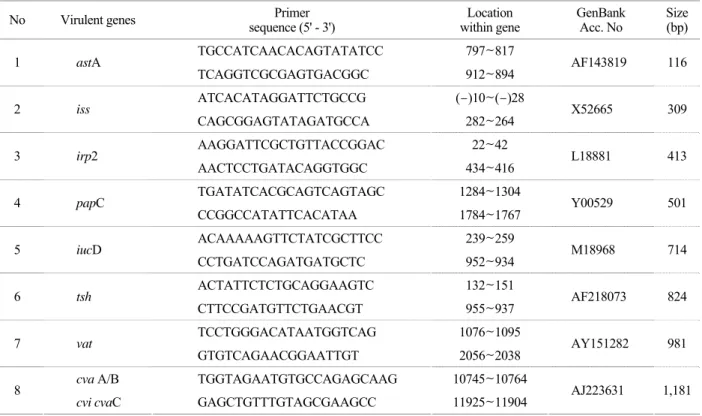
Table 1. Sequence and specificity of PCR primers and their product sizes No Virulent genes Primer
sequence (5' - 3') Location
within gene GenBank
Acc. No Size (bp) TGCCATCAACACAGTATATCC 797~817
1 astA
TCAGGTCGCGAGTGACGGC 912~894 AF143819 116 ATCACATAGGATTCTGCCG (-)10~(-)28
2 iss
CAGCGGAGTATAGATGCCA 282~264 X52665 309 AAGGATTCGCTGTTACCGGAC 22~42
3 irp2
AACTCCTGATACAGGTGGC 434~416 L18881 413 TGATATCACGCAGTCAGTAGC 1284~1304
4 papC
CCGGCCATATTCACATAA 1784~1767 Y00529 501 ACAAAAAGTTCTATCGCTTCC 239~259
5 iucD
CCTGATCCAGATGATGCTC 952~934 M18968 714 ACTATTCTCTGCAGGAAGTC 132~151
6 tsh
CTTCCGATGTTCTGAACGT 955~937 AF218073 824 TCCTGGGACATAATGGTCAG 1076~1095
7 vat
GTGTCAGAACGGAATTGT 2056~2038 AY151282 981
cva A/B TGGTAGAATGTGCCAGAGCAAG 10745~10764
8
cvi cvaC GAGCTGTTTGTAGCGAAGCC 11925~11904 AJ223631 1,181
Research, Wilmington, DE, USA). The cycling conditions were the following: t1, 4 min at 94℃; t3, 30 sec at 58℃; t4, 3 min at 68℃ (t2-t4, repeated 25 times); t5, 10 min at 72℃.
4. Primers
Primers were obtained from Bioneer and the primer sequences used in this study were decided as described previously by Ewers et al. (6). Primers, their position within the target sequences, and size of amplicons are presented in Table 1.
5. Agarose gel electrophoresis
Seven μl samples of reaction mixtures were analyzed by
gel electrophoresis in 0.8% agarose, dissolved in 1× TAE (40 mM Tris-Acetate, 1 mM EDTA at pH 8.3) for 60 min at 90V. After staining with ethidium bromide, the amplicons were photographed by Gel Documentation Analyzer (Vilber Lourmat Trance, Marne-la-Vallée, France).
6. Sequence analysis
The specificity of multiplex PCR was evaluated by direct sequencing of all amplicons from 24 APEC isolates and 16 strains of non-APEC which had dominant combinations of virulence-assiciated genes. The target bands of expected sizes were excised with a blade and purified using Genomed Jetsorb Jet Extraction Kit (Genomed, Inc., St. Louis, MO, A
B
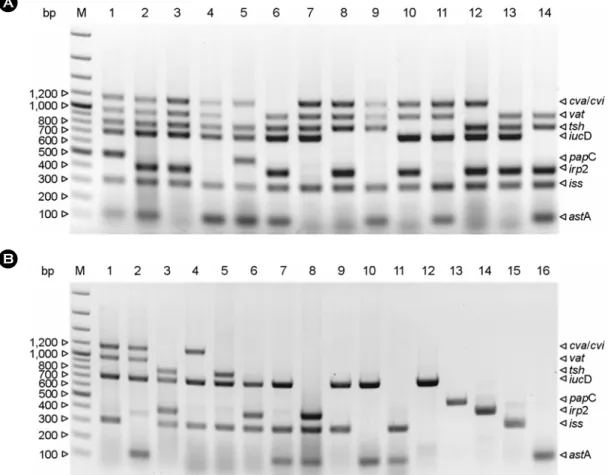
Figure 1. Amplicon patterns of virulence-associated genes by multiplex PCR. (A) Combinations of virulence-associated genes of APEC differentiated by multiplex PCR. There were 14 combinations of virulence-associated genes in 24 APEC strains. M: 100 bp ladder; Lanes 1~2: gene combinations of strains which had 7 virulence-associated genes; Lanes 3~6: gene combinations of strains which had 6 virulence- associated genes; Lanes 7~14: gene combinations of strains which had 5 virulence-associated genes. (B) Combinations of virulence- associated genes of non-APEC differentiated by multiplex PCR. There were 16 combinations of virulence-associated genes which match to more than 2 non-APEC strains. M: 100 bp ladder; Lanes 1~3: main gene combinations of strains which had 4 virulence-associated genes; Lanes 4~8: main gene combinations of strains which had 3 virulence-associated genes; Lanes 9~11: main gene combinations of strains which had 2 virulence-associated genes; Lanes 12~16: main gene combinations of strains which had 1 virulence-associated genes.
USA). Purified DNA products were sequenced in both directions using the Applied Biosystems 3130/3130xl Genetic Analyzer with the Big Dye Terminator V3.1 Cycle Sequencing Kit (Applied Biosystems, Foster City, CA, USA) according to the manufacturers' instructions. Sequences were examined for identity with published sequence data (Table 1) from the National Center for Biotechnology Information (NCBI). Sequence alignment and comparison were per- formed using the GENETYX version 6.1 (Software Development, Tokyo, Japan) with manual adjustment.
RESULTS
1. The criteria of APEC
We tentatively determined that the criteria of APEC were harboring of more than 5 virulence-associated genes as previously reported (6). According to the criteria, we differentiated 24 APEC among 216-field E. coli. The rest of 192 E. coli isolates represented less than 4 virulence- associated genes or none of the targeted genes were detected in these isolates (Fig. 1 and Table 2).
2. Detection rates of APEC according to specimen origins (layers, broiler breeders, broilers and environ- mental objects)
Table 2 shows detection rates of APEC according to the specimen origins. Five APEC (31.3%) were detected in 16 strains from layers, only one APEC (2.7%) was detected in 37 strains from broiler breeders, 18 APEC (14.0%) were discriminated among 129 strains from broilers, and there was no APEC (0.0%) discriminated in 34 strains of environ- mental specimens from hatcheries. Although E. coli isolates
of layers were not enough, it had the highest APEC detection rates among 4 specimen origins. Being in a relatively good environmental condition, strains from broiler breeders had lower APEC detection rates than other origins.
3. Detection rates of virulence-associated genes
There was no strain that contained all 8 of virulence- associated genes. However, there were 3 strains that include
Table 2. Detection rates of APEC from the field isolates of E. coli Origin Total
isolates APEC Detection rates (%) Layer 16 5 31.3 Broiler breeder 37 1 2.7
Broiler 129 18 14.0
Hatchery 34 0 0.0
Total 216 24 11.1
Figure 2. Total detection rates of virulence-associated genes between APEC and non-APEC. (A) Detection rates of virulence- associated genes in APEC. (B) Detection rates of virulence- associated genes in non-APEC. Taken altogether, virulence- associated genes were more frequently appeared in APEC than non-APEC. Detection rates of irp2, tsh, vat and cva/cvi in APEC were relatively higher than detection rates of the corresponding genes in non-APEC, respectively. On the other hand, detection rates of astA, iss and iucD were quite high in non-APEC as well as APEC strains. In addition, detection rate of papC was very low in both APEC and non-APEC.
A
B
7 genes (1.4%), 6 genes detected in 11 strains (5.1%), 5 genes detected in 10 strains (4.6%), 4 genes detected in 15 strains (6.9%), 3 genes detected in 24 strains (11.1%), 2 genes detected in 25 strains (11.6%), 1 gene detected in 68 strains (31.5%) and no virulence-associated genes were detected in 60 E. coli strains (27.7%).
4. Patterns of detection rates of virulence-associated genes
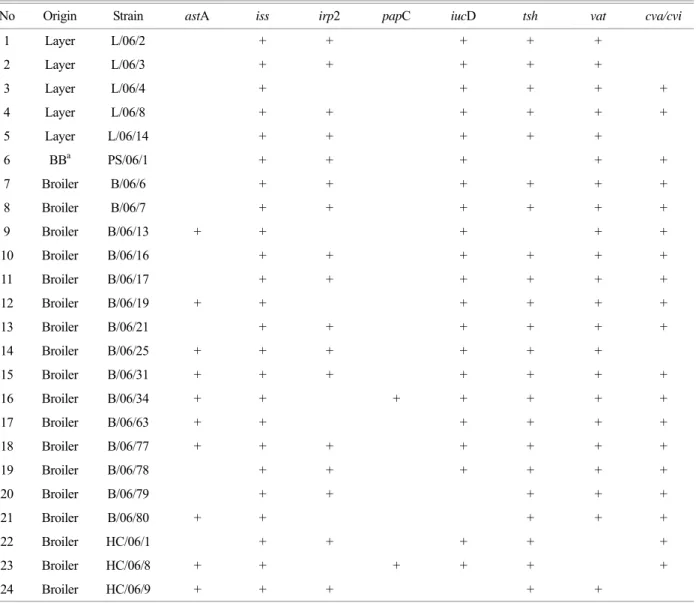
Patterns and combinations of virulence-associated genes for 24 APEC strains isolated in the present study are summarized in Fig. 1 and Table 4. Although the specimen origins of APEC strains were diverse, the existence of virulence-associated genes had similar patterns (Table 3).
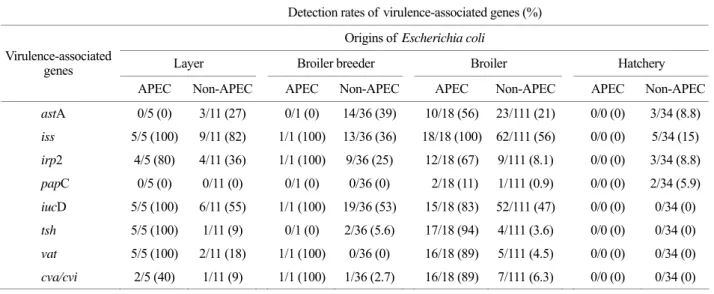
On average, detection rate of astA gene showed that it frequently existed in non-APEC strains as much as APEC strains (Fig. 2). Especially in layer strains, detection rates of astA represented apparently small gap between APEC and non-APEC (Table 3).
The iss was the highest detected gene among the 8 virulence-associated genes (Fig. 2). Furthermore, iss was located on entire 24 APEC strains in the present study.
However, in strains from layers, detection rate of iss in non-APEC was as high as in that of APEC (Table 3). In the similar way, E. coil strains from broiler breeders, broilers, and environmental specimens from hatcheries also presented
that iss gene was more frequently located on non-APEC than other virulence-associated genes (Table 3). In this regard, it was hard to discriminate APEC and non-APEC by iss gene.
Irp2 and iucD, both related to iron acquisition system, demonstrated a different appearance in detection rates between APEC and non-APEC. IucD was detected nearly 90% in APEC, meanwhile, detection rates of irp2 was not as high as iucD (Fig. 2). Our data also indicated that possessing of iucD was not only a characteristic of APEC but also non-APEC strains, because detection rates of iucD represented a small gap between APEC and non-APEC (Fig. 2). Furthermore, these two virulence-associated genes related to iron acquisition system tended to exist on the same strain. Among 24 APEC strains, we differentiated 23 APEC strains contained either or both of two iron acquisition systems (Table 4). Moreover, there are 15 APEC strains that possess both yersiniabactin system and aerobactin system, and 8 APEC strains which have either yersiniabactin system or aerobactin system (Table 4).
PapC was barely detected in both APEC and non-APEC (Fig. 2). E. coli strains from layers and broiler breeders did not possess this gene at all (Table 3). Although E. coli strains from broilers and environmental specimens from hatcheries possessed papC in several cases, this gene itself could not be a clue for differentiating between APEC among
Table 3. Detection rates of virulence-associated genes amomg 216-field isolates of Escherichia coli
Detection rates of virulence-associated genes (%) Origins of Escherichia coli
Layer Broiler breeder Broiler Hatchery Virulence-associated
genes
APEC Non-APEC APEC Non-APEC APEC Non-APEC APEC Non-APEC astA 0/5 (0) 3/11 (27) 0/1 (0) 14/36 (39) 10/18 (56) 23/111 (21) 0/0 (0) 3/34 (8.8) iss 5/5 (100) 9/11 (82) 1/1 (100) 13/36 (36) 18/18 (100) 62/111 (56) 0/0 (0) 5/34 (15) irp2 4/5 (80) 4/11 (36) 1/1 (100) 9/36 (25) 12/18 (67) 9/111 (8.1) 0/0 (0) 3/34 (8.8) papC 0/5 (0) 0/11 (0) 0/1 (0) 0/36 (0) 2/18 (11) 1/111 (0.9) 0/0 (0) 2/34 (5.9) iucD 5/5 (100) 6/11 (55) 1/1 (100) 19/36 (53) 15/18 (83) 52/111 (47) 0/0 (0) 0/34 (0) tsh 5/5 (100) 1/11 (9) 0/1 (0) 2/36 (5.6) 17/18 (94) 4/111 (3.6) 0/0 (0) 0/34 (0) vat 5/5 (100) 2/11 (18) 1/1 (100) 0/36 (0) 16/18 (89) 5/111 (4.5) 0/0 (0) 0/34 (0) cva/cvi 2/5 (40) 1/11 (9) 1/1 (100) 1/36 (2.7) 16/18 (89) 7/111 (6.3) 0/0 (0) 0/34 (0)
non-APEC.
In the total isolates of field E. coli, tsh, vat and cva/cvi were presented as much as iss and iucD. However, tsh, vat and cva/cvi were relatively more limited than other targeted genes in APEC (Fig. 2). In strains from layers and broilers, it was obvious that the gap of detection rates of these genes between APEC and non-APEC was much larger than other virulence-associated genes (Table 3). In strains from broiler breeders and hatcheries, the detection rates of tsh, vat and cva/cvi were apparently low in non-APEC (Table 3), and these results indicated that these genes might be relatively exclusive in APEC strains.
Taken altogether, detection rates of 8 virulence-associated genes in APEC were remarkably higher than non-APEC (Fig. 2). In particular, detection rates of genes iss, iucD, vat, tsh and cva/cvi were nearly 90% in APEC. However, detection rates of genes iss and iucD were relatively high not only in APEC but also in non-APEC.
5. Sequence analysis
Eight amplicons represented expected sequences in accordance with published data (Table 1) from NCBI (data not shown).
Table 4. Combinations of virulence-associated genes in 24 isolates of APEC
No Origin Strain astA iss irp2 papC iucD tsh vat cva/cvi
1 Layer L/06/2 + + + + +
2 Layer L/06/3 + + + + +
3 Layer L/06/4 + + + + +
4 Layer L/06/8 + + + + + +
5 Layer L/06/14 + + + + +
6 BBa PS/06/1 + + + + +
7 Broiler B/06/6 + + + + + +
8 Broiler B/06/7 + + + + + +
9 Broiler B/06/13 + + + + +
10 Broiler B/06/16 + + + + + +
11 Broiler B/06/17 + + + + + +
12 Broiler B/06/19 + + + + + +
13 Broiler B/06/21 + + + + + +
14 Broiler B/06/25 + + + + + +
15 Broiler B/06/31 + + + + + + +
16 Broiler B/06/34 + + + + + + +
17 Broiler B/06/63 + + + + + +
18 Broiler B/06/77 + + + + + + +
19 Broiler B/06/78 + + + + + +
20 Broiler B/06/79 + + + + +
21 Broiler B/06/80 + + + + +
22 Broiler HC/06/1 + + + + +
23 Broiler HC/06/8 + + + + + +
24 Broiler HC/06/9 + + + + +
a Broiler breeder
DISCUSSION
We examined field E. coli by the multiplex PCR which presumably enabled us to investigate the severity of APEC contamination of chicken farms and hatcheries in Korea.
In addition, the rates of virulence-associated genes and the combinational tendency of APEC within targeted 8 virulence-associated genes were also investigated. Although the specimens from four origins were not collected from the same numbers of chickens, the APEC detection rates (31.3%) were the highest in layers (Table 2). The lowest APEC detection rates (0.0%) were observed in environ- mental specimens from hatcheries (Table 2). These results indicated that APEC was widely spread in farms rather than in hatcheries of Korea. Furthermore, being in a relatively good environmental condition, strains from broiler breeders (2.7%) had lower APEC detection rates than strains from broilers (14.0%) (Table 2).
As we expected, there was no genes which exclusively detected in APEC and no exact combination which always apply to APEC. However, by means of this study, we detected the pattern of gene combination and estimated the importance of genes among the 8 virulence-associated genes.
In this study, iss was detected 100% and iucD was detected nearly 90% in APEC strains. However, these strains also detected in non-APEC frequently. This indicates that each of iss and iucD itself might not be a contributor to virulence and these genes merely support other essential virulent traits. In addition, detection rate of papC was low in both APEC and non-APEC. Although P fimbriae promote evasion of the host's defenses, they might be not an essential virulence trait for APEC (25). On the other hand, tsh, vat, and cva/cvi appeared to be essential in APEC strains.
Because their detection rates of tsh, vat and cva/cvi were almost 90% in APEC strains, while these genes existed less than 10% in non-APEC strains.
Gram negative bacteria have several methods for tran- sporting their proteins to the external environment (11,14).
Tsh and vat which are functioning as an autotransporter, and
these system are capable of directing their own secretion across the outer membrane. Tsh coding for temperature sensitive hemmagglutinin has adhesive and proteolytic properties independently (3). Tsh has been treated as an important trait in avian pathogenesis of E. coli in many studies (3,6,25). In our data, significant difference in detection rates between APEC and non-APEC confirmed the importance of tsh in APEC.
Another autotransporter targeted in this study was vat encoding for vacuolating cytotoxin. Vacuolating cytotoxin was first described by Salvadori et al. (22) that cytotoxic substance in supernatant of APEC caused a cytotoxic effect resembling to morphological changes of Helicobacter pylori in target cells. Although a role of vat in pathogenesis for avian E. coli has not been elucidated, our results showed that it might function as an important virulent trait in APEC.
Our data also represented the importance of ColV plas- mid. ColV plasmids were found primarily among virulent enteric bacteria and have been shown to encode several virulence related properties in addition to colicin V (9,13,27).
Possessing iss, iucD, tsh and cva/cvi, ColV plasmids have been considered to be a defining feature of the APEC strains (13,25).
Admittedly, using the multiplex PCR method which is only based on the number of detected genes (6) could not completely differentiated APEC from other E. coli strains in the field. However, in this study, this method was useful to evaluate the contamination of APEC of the chicken farms and hatcheries in Korea. On the basis of Ewers et al. study (6), we differentiated 24 APEC among 216-field E. coli existed in the liver surface of debilitated chickens. Our data showed that 11.1% of APEC was spread in chickens and environment of hatcheries and was primarily or secondarily related to colibacillosis. In the further study, the patho- genicity of APEC isolates would be evaluated by embryo lethality assay (ELA) which was considered to have a correlation with intravenous chicken challenge (7,8,28).
ELA might be useful to reevaluate the pathogenicity of 24 APEC strains isolated in this study.
In consequence, the 'epidemiological prevalence of
APEC differentiated by multiplex PCR from commercial chickens and hatchery in Korea' was a first report to recognize the severity of APEC in Korea. In addition, it was also confirmed that there was no exact combination of virulence-associated genes that could differentiate between APEC and non-APEC. However, we could recognize the frequent combination pattern of APEC and evaluate the significance of virulence-associated genes which had been targeted for discriminating APEC among non-APEC. Tsh, vat and cva/cvi which were relatively exclusive to APEC could be considered as the essential virulence traits of APEC. In contrast, only iss and iucD themselves could not be contributor of APEC. In this respect, addition of irp2, tsh, vat and cva/cvi to the fundamental possession of astA, iss and iucD was a frequent combinational tendency in 24 APEC isolates. Furthermore, finding this combinational tendency would be effective way to discriminate APEC among non-APEC strains in the field.
REFERENCES
1)Amabile de Campos T, Stehling EG, Ferreira A, Pestana de Castro AF, Brocchi M, Dias da Silveira W: Adhesion properties, fimbrial expression and PCR detection of adhesin-related genes of avian Escherichia coli strains. Vet Microbiol 106: 275-285, 2005.
2) Barnes HJ, Nolan LK, Vaillancourt JP: Colibacillosis.
pp. 691-732. In Diseases of Poultry, 12th ed, Saif YM, Fadly AM, Glisson JR, McDougald LR, Nolan LK, Swayne DE (Ed.), Blackwell Pub. Professional, Ames, Iowa, 2008.
3) Dozois CM, Dho-Moulin M, Brée A, Fairbrother JM, Desautels C, Curtiss R 3rd: Relationship between the tsh autotransporter and pathogenicity of avian Escherichia coli and localization and analysis of tsh genetic region. Infect Immun 68: 4145-4154, 2000.
4) Dozois CM, Fairbrother JM, Harel J, Bossé M: pap- and pil-related DNA sequences and other virulence determinants associated with Escherichia coli isolated from septicemic chickens and turkeys. Infect Immun 60: 2648-2656, 1992.
5) Ellis MG, Arp LH, Lamont SJ: Serum resistance and
virulence of Escherichia coli isolated from turkeys. Am J Vet Res 49: 2034-2037, 1988.
6) Ewers C, Janssen T, Kiessling S, Philipp HC, Wieler LH: Rapid detection of virulence-associated genes in avian pathogenic Escherichia coli by multiplex poly- merase chain reaction. Avian Dis 49: 269-273, 2005.
7)Gibbs PS, Maurer JJ, Nolan LK, Wooley RE:
Prediction of chicken embryo lethality with the avian Escherichia coli traits complement resistance, colicin V production, and presence of the increased serum survival gene cluster (iss). Avian Dis 47: 370-379, 2003.
8) Gibbs PS, Wooley RE: Comparison of the intravenous chicken challenge method with the embryo lethality assay for studies in avian colibacillosis. Avian Dis 47:
672-680, 2003.
9)Gilson L, Mahanty HK, Kolter R: Four plasmid genes are required for colicin V synthesis, export, and immunity. J Bacteriol 169: 2466-2470, 1987.
10) Gophna U, Oelschlaeger TA, Hacker J, Ron EZ:
Yersinia HPI in septicemic Escherichia coli strains isolated from diverse hosts. FEMS Microbiol Lett 196:
57-60, 2001.
11)Henderson IR, Navarro-Garcia F, Desvaux M, Fernandez RC, Ala'Aldeen D: Type V protein secretion pathway: the autotransporter story. Microbiol Mol Biol Rev 68: 692-744, 2004.
12) Janben T, Schwarz C, Preikschat P, Voss M, Philipp HC, Wieler LH: Virulence-associated genes in avian pathogenic Escherichia coli (APEC) isolated from internal organs of poultry having died from colibacillosis.
Int J Med Microbiol 291: 371-378, 2001.
13) Johnson TJ, Siek KE, Johnson SJ, Nolan LK: DNA sequence of a ColV plasmid and prevalence of selected plasmid-encoded virulence genes among avian Escheri- chia coli strains. J Bacteriol 188: 745-758, 2006.
14) Kostakioti M, Stathopoulos C: Functional analysis of tsh autotransporter from an avian pathogenic Escherichia coli strain. Infect Immun 72: 5548-5554, 2004.
15) Ménard LP, Dubreuil JD: Enteroaggregative Escheri- chia coli heat-stable enterotoxin 1 (EAST1): a new toxin with an old twist. Crit Rev Microbiol 28: 43-60, 2002.
16) Morris M: Poultry health issue. Poultry Times July 3, 11, 1989.
17)Paiva de Sousa C, Dubreuil JD: Distribution and expression of the astA gene (EAST1 toxin) in Escheri- chia coli and Salmonella. Int J Med Microbiol 291:
15-20, 2001.
18) Parreira VR, Gyles CL: A novel pathogenicity island integrated adjacent to the thrW tRNA gene of avian pathogenic Escherichia coli encodes a vacuolating autotransporter toxin. Infect Immun 71: 5087-5096, 2003.
19)Pfaff-McDonough SJ, Horne SM, Giddings CW, Ebert JO, Doetkott C, Smith MH, Nolan LK:
Complement resistance-related traits among Escherichia coli isolates from apparently healthy birds and birds with colibacillosis. Avian Dis 44: 23-33, 2000.
20)Provence DL, Curtiss R 3rd: Isolation and char- acterization of a gene involved in hemagglutination by an avian pathogenic Escherichia coli strain. Infect Immun 62: 1369-1380, 1994.
21)Rodriguez-Siek KE, Giddings CW, Doetkott C, Johnson TJ, Nolan LK: Characterizing the APEC pathotype. Vet Res 36: 241-256, 2005.
22) Salvadori MR, Yano T, Carvalho HE, Parreira VR, Gyles CL: Vacuolating cytotoxin produced by avian pathogenic Escherichia coli. Avian Dis 45: 43-51, 2001.
23)Tivendale KA, Allen JL, Ginns CA, Crabb BS, Browning GF: Association of iss and iucA, but not tsh, with plasmid-mediated virulence of avian pathogenic
Escherichia coli. Infect Immun 72: 6554-6560, 2004.
24) Valvano MA, Crosa JH: Aerobactin iron transport genes commonly encoded by certain ColV plasmids occur in the chromosome of a human invasive strain of Escherichia coli K1. Infect Immun 46: 159-167, 1984.
25) Vandekerchove D, Vandemaele F, Adriaensen C, Zaleska M, Hernalsteens JP, De Baets L, Butaye P, Van Immerseel F, Wattiau P, Laevens H, Mast J, Goddeeris B, Pasmans F: Virulence-associated traits in avian Escherichia coli: comparison between isolates from colibacillosis-affected and clinically healthy layer flocks. Vet Microbiol 108: 75-87, 2005.
26) Veilleux S, Dubreuil JD: Presence of Escherichia coli carrying the EAST1 toxin gene in farm animals. Vet Res, 37: 3-13, 2006.
27) Waters VL, Crosa JH: Colicin V virulence plasmids.
Microbiol Rev 55: 437-450, 1991.
28)Wooley RE, Gibbs PS, Brown TB, Maurer JJ:
Chicken embryo lethality assay for determining the virulence of avian Escherichia coli isolates. Avian Dis 44: 318-324, 2000.
29) Yamamoto T, Nakazawa M: Detection and sequences of the enteroaggregative Escherichia coli heat-stable enterotoxin 1 gene in enterotoxigenic E. coli strains isolated from piglets and calves with diarrhea. J Clin Microbiol 35: 223-227, 1997.