J Cerebrovasc Endovasc Neurosurg.
2020 December;22(4):216-224
Received: 8 September 2020 Revised: 21 September 2020 Accepted: 23 September 2020
Correspondence to Seung Pil Ban
Department of Neurosurgery,
Seoul National University Bundang Hospital, 82 Gumi-ro 173beon-gil, Bundang-gu, Seongnam 13620, Korea
Tel +82-31-787-7175 Fax +82-31-787-4059
E-mail [email protected] ORCID http://orcid.org/0000-0002-7774-0467
Original Article
Long-term outcomes of drug-eluting stent implantation in patients with symptomatic extra- and intracranial atherosclerotic stenoses
Junhyung Kim, Seung Pil Ban, Young Deok Kim, O-Ki Kwon
Department of Neurosurgery, Seoul National University Bundang Hospital, Seoul National University College of Medicine, Bundang, Korea
Objective: Implantation of drug-eluting stents (DES) for extra- and intracranial ath- erosclerotic stenoses is an emerging topic. It has the potential benefit of preventing recurrent stroke with a reduced rate of in-stent restenosis (ISR).
Methods: Patients who underwent extra- or intracranial stenting using DES in a sin- gle institution were retrospectively reviewed with long-term angiographic and clinical follow-up data.
Results: Twenty-one patients, 9 (42.9%) with extracranial lesions and 12 (57.1%) with intra cranial lesions, were included. The most common symptom was cerebral in- farction (71.4%), followed by vertebrobasilar insufficiency (19.1%) and transient isch- emic attack (9.5%). All patients achieved technical success, with the mean degree of stenosis of 85.9±6.3% before the procedure and 19.5±5.9% after the procedure. All patients showed clinical improvement and no symptomatic recurrence was reported during the mean clinical follow-up period of 45.5±8.9 months. The significant ISR was observed in one patient (4.8%) during the mean radiological follow-up period of 42.8±10.0 months.
Conclusions: Implantation of drug-eluting stents for symptomatic extra- and intra- cranial atherosclerotic stenoses is feasible and has the potential benefit of re ducing the rate of ISR.
Keywords Drug-eluting stent, In-stent restenosis, Percutaneous transluminal angioplasty and stenting , Cerebral ischemic disease, Atherosclerosis
This is an Open Access article distributed under the terms of the Creative Commons Attribution Non-Commercial License (http://creativecommons.org/licenses/
by-nc/3.0/) which permits unrestricted noncommercial use, distribution, and reproduction in any medium, provided the original work is properly cited.
INTRODUCTION
Extra- and intracranial atherosclerotic stenoses are responsible for recurrent ischemic strokes, and the endovascular approach with percutaneous transluminal
angioplasty and stenting (PTAS) has been suggested for the treatment. However, PTAS has not been yet rec- ommended as the first-line treatment for patients with symptomatic extra- and intracranial stenoses, because evidence showing better outcomes from PTAS compared to the aggressive medical treatment without endovascu- lar procedures is lacking from large-scale randomized clinical trials.4)5)21)30) Nevertheless, PTAS has still been considered in a certain group of patients with extra- and intracranial stenoses who present recurrent strokes despite medical therapy, and several studies have shown favorable outcomes.7)20)25)
On the other hand, the development of novel devices and techniques in recent decades contributed to a more effective and safer treatment in endovascular neurosur- gery. One of them is the implantation of drug-eluting stents (DES). It has the potential benefits of reducing in- stent restenosis (ISR). Several reports revealed that DES used for extra- and intracranial stenoses showed lower rate of both ISR and symptomatic recurrence, compared with conventional bare-metal stents.1)3)8)12)16)22-24)26-28)
However, to the best of our knowledge, the long-term efficacy and safety of DES implantation has been rarely discussed. In this study, we present our experience with DES implantation in patients with symptomatic extra- and intracranial atherosclerotic stenoses.
MATERIALS AND METHODS
Patient selectionPatients who underwent DES implantation for extra- and intracranial atherosclerotic stenoses in our institu- tion between July 2014 and November 2016 were retro- spectively reviewed. We performed DES implantation for extra- and intracranial atherosclerotic stenoses if all of the following conditions were met: 1) a symptomatic stenosis with a degree of more than 70%, as measured by digital subtraction angiography (DSA); 2) hypoperfu- sion on the same side of the lesion, confirmed by at least one perfusion imaging study, either computed tomog- raphy perfusion (CTP) or single photon emission com-
puted tomography (SPECT); and 3) recurrent ischemic events despite medical therapy. This study was approved by the institutional review board of our institution, and the requirement for informed consent was waived.
Study procedures
All procedures were performed by board-certified neurosurgeons with a strict, standardized protocol set in place by our institution. The procedure was performed through femoral artery access under general anesthesia.
An 8 Fr introducer sheath was inserted into the right femoral artery. The patient received an intravenous bo- lus of 3,000 IU of heparin shortly after insertion of the femoral sheath. A 6 Fr shuttle sheath (Cook, Blooming- ton, IN, USA) was placed in the distal common carotid artery or near the vertebral artery orifice. An interme- diate catheter, 5.2 Fr Digital Access Catheter (DAC;
Stryker, Kalamazoo, MI, USA) or 5 Fr Soft torqueable catheter Optimized For Intracranial Access (SOFIA; Mi- croVention, Tustin, CA, USA), was positioned through the shuttle sheath as close to the stenosis site as possible.
Through an intermediate catheter, the Orsiro (Biotronik AG, Blüch, Switzerland) DES delivery device was ad- vanced over a 0.014-inch microwire and positioned to the targeted lesion under road map fluoroscopy. The stent diameter was selected to the size that was slightly smaller than the diameter of the adjacent normal artery, and the stent length was selected to cover 2 or 3 mm of the end of both sides of the stenosis. DES implantation was performed by a single balloon inflation with a slow rate of 1 atm per 10 seconds, which never exceeded the nominal pressure of 8 atm. The balloon was also de- flated slowly while the patient’s systolic blood pressure was strictly controlled below 130 mmHg, which is also maintained in one or two post-procedural days until discharge. After the procedure, all patients continued dual antiplatelet medications for at least 12 months.
Clinical and radiological assessments
The clinical outcomes were evaluated using the mod- ified Rankin Scale (mRS) score at admission before the procedure and at the last outpatient visit after discharge.
Any periprocedural complications, such as thromboem- bolism, arterial dissection, or hemorrhage, were evaluat- ed. During the follow-up period, recurrent events, such as cerebral infarction, transient ischemic attack (TIA) or vertebrobasilar insufficiency (VBI) in the territory of the treated artery, were also reviewed.
The degree of stenosis was measured according to the following equation: the diameter at the lesion of the greatest stenosis divided by the diameter of the adjacent normal part of the same artery. Technical success was defined as achievement of less than 30% of residual stenosis of the lesion without periprocedural complica- tions. Follow-up studies with computed tomography an- giography (CTA) or DSA were performed at 6 months, 18 months and yearly thereafter. The significant ISR was defined as more than 50% luminal stenosis within the stent on DSA. In cases with follow-up using CTA, signif- icant ISR was designated to be absent if the stented seg- ment and adjacent parent vessel were clearly observed and patent on CTA scans.
RESULTS
A total of 21 patients were enrolled in this study. The baseline characteristics of patients are summarized in Ta- ble 1. Sixteen patients (76.2%) were male and the mean age was 64.8±10.5 years. The most common symptom was cerebral infarction (71.4%), followed by VBI (19.1%) and TIA (9.5%). Of 21 patients, 9 (42.9%) had extracra- nial lesions and 12 (57.1%) had intracranial lesions.
Most patients had the risk factors of strokes, including hyperlipidemia (90.5%), hypertension (81.0%), a history of smoking (57.1%), diabetes mellitus (47.6%), and cor- onary artery disease (9.5%). All patients received aspirin (100 mg/day) and clopidogrel (75 mg/day) with appro- priate medications for each risk factor (diabetes mellitus, hypertension, and hyperlipidemia). P2Y12 reaction unit (PRU) values, measured by VerifyNow (Accumetrics, San Diego, CA, USA) on the day before the procedure, were available for 15 patients, and patients with clopido- grel resistance, in which the result was greater than 220
PRU, received a modified antiplatelet regimen.15)
Technical success was achieved in all 21 cases. No periprocedural complication was reported. A repre- sentative case is described in Fig. 1. The mean degree of stenosis was 85.9±6.3% before the procedure and 19.5±5.9% after the procedure. The mean clinical fol- low-up duration was 45.5±8.9 months. The mean mRS score was 2.2±0.8 before stenting and 1.3±0.9 after stenting at the last follow-up. All patients demonstrat- ed clinical improvement, and no symptomatic stroke events were observed during the follow-up. Radiological follow-up data was available in all patients. The mean radiological follow-up duration was 42.8±10.0 months.
On the last follow-up, significant ISR was observed in one patient (4.8%) who underwent stenting in the verte- bral artery orifice; however, no lesion-associated symp- toms were observed.
DISCUSSION
Role of stenting in treatment of recurrent strokes Previous large-scale randomized clinical trials, includ- ing the Stenting and Aggressive Medical Management for Preventing Recurrent Stroke in Intracranial Stenosis (SAMMPRIS) and the Vitesse Intracranial Stent Study for Ischemic Stroke Therapy (VISSIT) trials, demon- strated the inferiority of PTAS compared with aggressive medical treatment in patients with symptomatic intra- cranial stenosis, but the risk of recurrent stroke or death at one year was still high despite aggressive medical treatment: 12.6% in the SAMMPRIS trial and 15.1% in the VISSIT trial.4)30) Thereafter, additional endovascular treatments to prevent recurrent stroke have been sug- gested. Several studies revealed that performing PTAS under specific conditions might be helpful for patients with recurrent ischemic symptoms who fail medical therapy, although periprocedural complications and ISR still remain major issues in PTAS, affecting the long- term prognosis.7)20)25)
The poor outcome of PTAS in these previous trials may be attribute to the high rate of periprocedural
Table 1. Baseline demographic and clinical information of the enrolled patients Age (year)/ Sex Clinical presentation Lesion location Initial mRS Pre-stenting stenosis (%) Post-stenting stenosis (%) Clinical follow-up (month) Stroke events during the follow-up Radiological follow-up (month) Last follow-up modality ISR (≥50%)Final mRS
164/MInfarctionParaclinoid ICA372.528.637No37CTANo2
267/FTIAPetrous ICA182.025.038No38CTANo0
355/MInfarctionPetrous ICA289.217.442No42CTANo1
472/MInfarctionPetrous ICA390.020.841No29CTANo2
575/MVBIVAO288.116.041No35CTANo1
667/MInfarctionCervical ICA296.727.447No40CTANo1
772/MInfarctionCervical ICA291.017.544No42CTANo1
869/MTIACervical ICA275.518.547No35CTANo1
972/MInfarctionVAO190.129.047No43DSAYes1
1075/MInfarctionCervical ICA291.620.145No45CTANo2
1155/FInfarctionParaclinoid ICA290.020.041No34DSANo0
1265/FInfarctionParaclinoid ICA487.412.344No44CTANo3
1346/FInfarctionParaclinoid ICA280.018.449No43DSANo0
1467/MInfarctionV4488.522.035No35CTANo3
1535/MInfarctionVAO288.217.455No55CTANo1
1673/MVBIBA290.726.323No23DSANo1
1770/MInfarctionCavernous ICA384.024.560No59CTANo2
1879/MVBIBA182.315.253No53CTANo0
1960/FVBIV4282.011.653No53CTANo1
2057/MInfarctionVAO374.77.049No49DSANo2
2166/MInfarctionVAO289.314.664No64CTANo2
mRS, modified Rankin Scale; ISR, in-stent restenosis; TIA, transient ischemic attack; VBI, vertebrobasilar insufficiency; ICA, internal carotid artery; VAO, vertebral artery orifice; BA, basilar artery; V4, intradural segment of vertebral artery; CTA, computed tomography angiography; DSA, digital subtraction angiography
complications. These studies had several limitations regarding complications that need to be addressed.
First, these studies were limited in patient selection.
Ischemic strokes associated with extra- and intracranial atherosclerotic stenoses can be demonstrated by three mechanisms: 1) thromboembolism from atherosclerotic plaques, 2) hypoperfusion, and 3) direct occlusion of perforators.6) If hypoperfusion is the cause of strokes, improvement of perfusion by PTAS should be helpful in prevention of stroke recurrence; otherwise, strokes that occur by the other two mechanisms might be best treated with medication. In the SAMMPRIS and VISST trials, PTAS was performed without confirmation of ipsilateral hypoperfusion; hence, they might include some cases that unnecessarily underwent PTAS even in situations where medication should have been consid-
ered first, resulting in a high rate of periprocedural com- plications. In our study, PTAS was performed in highly selected patients after detailed analysis of the cerebral vasculature, in which hypoperfusion was confirmed by perfusion images on the same side of symptomatic ste- nosis, with a degree of more than 70%.
Second, according to a study with the subset analysis of periprocedural strokes in the SAMMPRIS trial, per- forator occlusion, rather than stent occlusion or failed perfusion augmentation, was the most common cause of periprocedural strokes.9) Those perforator infarctions frequently occurred in the basilar artery or middle ce- rebral artery. A well-known mechanism of perforator occlusion after PTAS is the displacement or disruption of atheromatous debris, or snow-plowing.17) Therefore, for those high-risk locations, preprocedural and intrap-
A B C
D E F
Fig. 1. A 55-year-old female with symptomatic left paraclinoid internal carotid artery stenosis treated with a 2.25×9 mm Orsiro drug-eluting stent (Patient 11 in Table 1). The diffusion-weighted image shows acute infarction in the left corona radiata (A). Hypoperfusion in the left middle cerebral artery territory was observed in single photon emission computed tomography (SPECT) (B). The degree of stenosis de- creased from 90% (C) to 20% (D) on digital subtraction angiography (DSA). On 34-month follow-up, no significant in-stent restenosis was found in DSA (E), and perfusion was improved in SPECT (F).
rocedural radiological analyses of cerebral vasculature, including precise information of perforators from DSA or vessel wall imaging, is important for the prevention of complications. Our study included only two cases of basilar artery stenting, which might attribute to the fa- vorable outcomes. Nevertheless, these two cases, which we clearly identified perforating arteries around the tar- geted lesion during the procedure, underwent the stent- ing procedure without complications.
Periprocedural complications
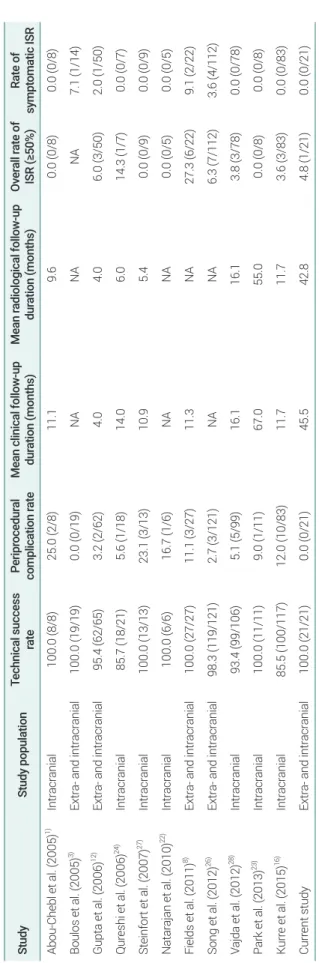
In previous studies with DESs, the periprocedural com- plication rates varied from 0.0% to 25.0%.1)3)8)12)16)22-24)26-28) The differences in rates of procedural complications among studies might be related to the biases in patient selection and the inconsistent procedural processes. In our study, the rates of periprocedural complications and recurrent stroke events were near zero levels. Our theory is that a strictly controlled protocol for PTAS could pre- vent most complications.
There are several tenets for stenting to reduce compli- cations: First, under the optimized antiplatelet prepa- ration, PTAS can be safely performed without throm- boembolic events. In our institution, patients generally receive either standard or modified antiplatelet prepara- tion regimen, based on their clopidogrel responsiveness from PRU test before the procedure.13)15) Second, the shuttle sheath and intermediate catheter provide a stable support during PTAS. Although the DES delivery sys- tem used in our study, Orsiro, is designed to be flexible, it is stiffer than the self-expandable stent system; thus, to overcome the tortuous vascular path and to maintain a stable support during the stent implantation, it is im- portant to place the intermediate catheter as close to the targeted lesion as possible. This approach achieved 100%
technical success and 0% vascular injury in our study.
In addition, there are other several considerations during stent insertion. To reduce the risk of disruption of atherosclerotic plaques or vessel injuries, the diameter of the stent should be selected to the size that is slight- ly smaller than that of the parent artery, and the stent should be deployed in a single try with a very slow bal-
loon inflation, as described above. To reduce the risk of hyperperfusion injury or cerebral hemorrhage by sud- den high-pressure blood flow, the balloon should also be deflated in a slow fashion while the patient’s systolic blood pressure was strictly controlled below 130 mmHg.
Long-term efficacy and in-stent restenosis
ISR after PTAS significantly increases the risk of re- current ischemic events that affect long-term prognosis, which is another major concern for PTAS.14) Incidence of ISR has been reported with a wide range, 0.0-32.3%, which might be due to the various lesion location or type of stents.1)3)5)8)10)12)16)21-24)26-28)30) Although the role of DES in neurovascular intervention has not been estab- lished, several studies using DES, as listed in Table 2, reported promising outcomes in reducing the overall or symptomatic ISR.1)3)8)12)16)22-24)26-28) In a recent meta-anal- ysis report on DES for intracranial atherosclerotic dis- ease, the rate of ISR was 4.1%, and the symptomatic ISR rate was only 0.5%, which is surprisingly lower than those from conventional studies: approximately 29.7% in the Wingspan stent study and up to 26.5% at one year in VISSIT trial.19)29)30) It is similar to our result with the ISR rate of 4.8% without recurrent symptoms.
Although studies using DES for extra- and intracra- nial stenoses have shown good clinical and radiological outcomes, most studies have only shown short- to mid- term results (up to 18 months); otherwise, one study presented an angiographic outcome of 52 months but included only 8 cases.29) Therefore, the long-term ef- fects of reducing the risk of recurrent stroke via DES in patients with extra- and intracranial atherosclerotic stenoses remain unclear. However, in our study, there were no periprocedural complications or recurrent stroke symptoms with a low ISR rate of 4.8% during a mean follow-up period of 45.5 months. This long-term success of DES implantation for symptomatic extra- and intracranial stenoses may be due to the achievement of adequate perfusion augmentation where perfusion is lacking, as well as the maintenance of medical manage- ment, such as antiplatelets, to prevent late stent throm- bosis. These results support the long-term efficacy of
DES implantation for symptomatic extra- and intracra- nial atherosclerotic stenosis.
Safety issues
This study also demonstrates the long-term safety and durability of DES implantation for symptomatic extra- and intracranial atherosclerotic stenoses. The neuro- toxicity of drugs used in DES may be of some concern.
These drugs are known as anticancer drugs or immuno- suppressants. Theoretically, these drugs might be slowly released into the cerebrovascular system, thereby affect- ing the central nervous system.
In our study, Orsiro, the sirolimus-eluting stent with a 60 μm-sized thin stent strut was used, and the dose of sirolimus on this stent was 1.4 μg/mm2. Sirolimus is an immunosuppressant which is often used after organ transplantation, and it is a well-known trigger of revers- ible cerebral vasospasm syndrome or posterior revers- ible encephalopathy syndrome at high doses.2)11) To our knowledge, there have been no studies on the neurotox- icity of sirolimus-eluting stents to the central nervous system in human; however, according to a recent canine experiment, no neurotoxicity was documented after im- plantation of sirolimus-eluting stents during 6-month observations.18) There have been no reports of neurotoxic complications in previous studies with DES and our se- ries.1)3)8)12)16)22-24)26-28) Based on these results, DES are not only effective in reducing the rates of ISR, but also safe and feasible for implantation in extra- and intracranial atherosclerotic stenosis.
CONCLUSIONS
Implantation of DES for symptomatic extra- and intracra- nial atherosclerotic stenoses has the potential benefit of re- ducing the rate of ISR without increasing the risk of peripro- cedural complications. Further randomized prospective studies under a strictly controlled procedural process and the appropriate selection of patients are needed to confirm the long-term efficacy and safety of DES implantation for extra- and intracranial atherosclerotic stenosis.
Table 2. Previous studies using drug-eluting stents in extra- and intracranial stenoses StudyStudy populationTechnical success ratePeriprocedural complication rateMean clinical follow-up duration (months)Mean radiological follow-up duration (months)Overall rate of ISR (≥50%)Rate of symptomatic ISR Abou-Chebl et al. (2005)1)Intracranial100.0 (8/8)25.0 (2/8)11.19.60.0 (0/8)0.0 (0/8) Boulos et al. (2005)3)Extra- and intracranial100.0 (19/19)0.0 (0/19)NANANA7.1 (1/14) Gupta et al. (2006)12)Extra- and intracranial95.4 (62/65)3.2 (2/62)4.04.06.0 (3/50)2.0 (1/50) Qureshi et al. (2006)24)Intracranial85.7 (18/21)5.6 (1/18)14.06.014.3 (1/7)0.0 (0/7) Steinfort et al. (2007)27)Intracranial100.0 (13/13)23.1 (3/13)10.95.40.0 (0/9)0.0 (0/9) Natarajan et al. (2010)22) Intracranial100.0 (6/6)16.7 (1/6)NANA0.0 (0/5)0.0 (0/5) Fields et al. (2011)8) Extra- and intracranial100.0 (27/27)11.1 (3/27)11.3NA27.3 (6/22)9.1 (2/22) Song et al. (2012)26) Extra- and intracranial98.3 (119/121)2.7 (3/121)NANA6.3 (7/112)3.6 (4/112) Vajda et al. (2012)28) Intracranial93.4 (99/106)5.1 (5/99)16.116.13.8 (3/78)0.0 (0/78) Park et al. (2013)23) Intracranial100.0 (11/11)9.0 (1/11)67.055.00.0 (0/8)0.0 (0/8) Kurre et al. (2015)16) Intracranial85.5 (100/117)12.0 (10/83)11.711.73.6 (3/83)0.0 (0/83) Current studyExtra- and intracranial100.0 (21/21)0.0 (0/21)45.542.84.8 (1/21)0.0 (0/21) Values are presented as % (number) unless otherwise indicated.ISR, in-stent. restenosis; NA, not available
Disclosure
The authors report no conflict of interest concerning the materials or methods used in this study or the find- ings specified in this paper.
REFERENCES
1. Abou-Chebl A, Bashir Q, Yadav JS. Drug-eluting stents for the treatment of intracranial atherosclerosis: initial expe- rience and midterm angiographic follow-up. Stroke. 2005 Dec;36(12):e165-8.
2. Ban SP, Hwang G, Kim CH, Kwon OK. Reversible cerebral vasoconstriction syndrome combined with posterior revers- ible encephalopathy syndrome after heart transplantation. J Clin Neurosci. 2017 Aug;42:118-21.
3. Boulos AS, Agner C, Deshaies EM. Preliminary evidence supporting the safety of drug-eluting stents in neurovascular disease. Neurol Res. 2005;27(Suppl 1):S95-102.
4. Chimowitz MI, Lynn MJ, Derdeyn CP, Turan TN, Fiorella D, Lane BF, et al. Stenting versus aggressive medical ther- apy for intracranial arterial stenosis. N Engl J Med. 2011 Sep;365(11):993-1003.
5. Compter A, van der Worp HB, Schonewille WJ, Vos JA, Boiten J, Nederkoorn PJ, et al. Stenting versus medical treat- ment in patients with symptomatic vertebral artery stenosis:
a randomised open-label phase 2 trial. Lancet Neurol. 2015 Jun;14(6):606-14.
6. Derdeyn CP. Mechanisms of ischemic stroke secondary to large artery atherosclerotic disease. Neuroimaging Clin N Am. 2007 Aug;17(3):303-11, vii-viii.
7. Dumont TM, Sonig A, Mokin M, Eller JL, Sorkin GC, Snyder KV, et al. Submaximal angioplasty for symptomatic intracra- nial atherosclerosis: a prospective Phase I study. J Neurosurg.
2016 Oct;125(4):964-71.
8. Fields JD, Petersen BD, Lutsep HL, Nesbit GM, Liu KC, Dogan A, et al. Drug eluting stents for symptomatic intracra- nial and vertebral artery stenosis. Interv Neuroradiol. 2011 Jun;17(2):241-7.
9. Fiorella D, Derdeyn CP, Lynn MJ, Barnwell SL, Hoh BL, Levy EI, et al. Detailed analysis of periprocedural strokes in patients undergoing intracranial stenting in Stenting and Aggressive Medical Management for Preventing Recurrent Stroke in Intracranial Stenosis (SAMMPRIS). Stroke. 2012 Oct;43(10):2682-8.
10. Fiorella DJ, Turk AS, Levy EI, Pride GL Jr, Woo HH, Albu- querque FC, et al. U.S. Wingspan Registry: 12-month fol- low-up results. Stroke. 2011 Jul;42(7):1976-81.
11. Fugate JE, Rabinstein AA. Posterior reversible encephalop- athy syndrome: clinical and radiological manifestations, pathophysiology, and outstanding questions. Lancet Neurol.
2015 Sep;14(9):914-25.
12. Gupta R, Al-Ali F, Thomas AJ, Horowitz MB, Barrow T, Vora NA, et al. Safety, feasibility, and short-term follow-up of drug-eluting stent placement in the intracranial and extracra- nial circulation. Stroke. 2006 Oct;37(10):2562-6.
13. Hwang G, Huh W, Lee JS, Villavicencio JB, Villamor RB Jr, Ahn SY, et al. Standard vs modified antiplatelet preparation for preventing thromboembolic events in patients with high on-treatment platelet reactivity undergoing coil embolization for an unruptured intracranial aneurysm: a randomized clin- ical trial. JAMA Neurol. 2015 Jul;72(7):764-72.
14. Jin M, Fu X, Wei Y, Du B, Xu XT, Jiang WJ. Higher risk of re- current ischemic events in patients with intracranial in-stent restenosis. Stroke. 2013 Nov;44(11):2990-4.
15. Kim CH, Hwang G, Kwon OK, Ban SP, Chinh ND, Tjahjadi M, et al. P2Y12 reaction units threshold for implementing mod- ified antiplatelet preparation in coil embolization of unrup- tured aneurysms: a prospective validation study. Radiology.
2017 Feb;282(2):542-51.
16. Kurre W, Aguilar-Pérez M, Fischer S, Arnold G, Schmid E, Bäzner H, et al. Solving the issue of restenosis after stent- ing of intracranial stenoses: experience with two thin-strut drug-eluting stents (DES)-Taxus Element™ and Resolute In- tegrity™. Cardiovasc Intervent Radiol. 2015 Jun;38(3):583-91.
17. Levy EI, Hanel RA, Boulos AS, Bendok BR, Kim SH, Gibbons KJ, et al. Comparison of periprocedure complications result- ing from direct stent placement compared with those due to conventional and staged stent placement in the basilar artery.
J Neurosurg. 2003 Oct;99(4):653-60.
18. Levy EI, Hanel RA, Tio FO, Garlick DS, Bailey L, Cunning- ham MR, et al. Safety and pharmacokinetics of sirolim- us-eluting stents in the canine cerebral vasculature: 180 day assessment. Neurosurgery. 2006 Oct;59(4):925-33; discussion 933-4.
19. Levy EI, Turk AS, Albuquerque FC, Niemann DB, Aagaard- Kienitz B, Pride L, et al. Wingspan in-stent restenosis and thrombosis: incidence, clinical presentation, and manage- ment. Neurosurgery. 2007 Sep;61(3):644-50; discussion 650-1.
20. Ma N, Zhang Y, Shuai J, Jiang C, Zhu Q, Chen K, et al. Stent- ing for symptomatic intracranial arterial stenosis in China:
1-year outcome of a multicentre registry study. Stroke Vasc
Neurol. 2018 May;3(3):176-84.
21. Markus HS, Larsson SC, Kuker W, Schulz UG, Fird I, Roth- well PM, et al. Stenting for symptomatic vertebral artery ste- nosis: the vertebral artery ischaemia stenting trial. Neurology.
2017 Sep;89(12):1229-36.
22. Natarajan SK, Ogilvy CS, Hopkins LN, Siddiqui AH, Levy EI.
Initial experience with an everolimus-eluting, second-gener- ation drug-eluting stent for treatment of intracranial athero- sclerosis. J Neurointerv Surg. 2010 Jun;2(2):104-9.
23. Park S, Lee DG, Chung WJ, Lee DH, Suh DC. Long-term outcomes of drug-eluting stents in symptomatic intracranial stenosis. Neurointervention. 2013 Feb;8(1):9-14.
24. Qureshi AI, Kirmani JF, Hussein HM, Harris-Lane P, Di- vani AA, Suri MF, et al. Early and intermediate-term out- comes with drug-eluting stents in high-risk patients with symptomatic intracranial stenosis. Neurosurgery. 2006 Nov;59(5):1044-51; discussion 1051.
25. Shao JX, Ling YA, Du HP, Zhai GJ, Xu Y, Cao YJ. Comparison of hemodynamic changes and prognosis between stenting and standardized medical treatment in patients with symp- tomatic moderate to severe vertebral artery origin stenosis.
Medicine (Baltimore). 2019 Mar;98(13):e14899.
26. Song L, Li J, Gu Y, Yu H, Chen B, Guo L, et al. Drug-eluting vs. bare metal stents for symptomatic vertebral artery steno- sis. J Endovas Ther. 2012 Apr;19(2):231-8.
27. Steinfort B, Ng PP, Faulder K, Harrington T, Grinnell V, Sor- by W, et al. Midterm outcomes of paclitaxel-eluting stents for the treatment of intracranial posterior circulation stenoses. J Neurosurg. 2007 Feb;106(2):222-5.
28. Vajda Z, Aguilar M, Göhringer T, Horváth-Rizea D, Bäzner H, Henkes H. Treatment of intracranial atherosclerotic disease with a balloon-expandable paclitaxel eluting stent: procedural safety, efficacy and mid-term patency. Clin Neuroradiol. 2012 Sep;22(3):227-33.
29. Ye G, Yin X, Yang X, Wang J, Qi P, Lu J, et al. Efficacy and safety of drug-eluting stent for the intracranial atherosclerotic disease: A systematic review and meta-analysis. J Clin Neuro- sci. 2019 Jan;59:112-8.
30. Zaidat OO, Fitzsimmons BF, Woodward BK, Wang Z, Killer-Oberpfalzer M, Wakhloo A, et al. Effect of a bal- loon-expandable intracranial stent vs medical therapy on risk of stroke in patients with symptomatic intracranial stenosis: the VISSIT randomized clinical trial. JAMA. 2015 Mar;313(12):1240-8.