INTRODUCTION
Nonalcoholic fatty liver disease (NAFLD) is a clinicopatho- logical syndrome characterized by hepatic steatosis with or without active inflammation (1) in patients with a negligible alcohol intake. There is growing concern about NAFLD, not only because this is a common liver disorder with a world- wide distribution, but also because it is recognized as one of the leading causes of chronic liver disease (2). In addition, a recent study has revealed that patients with nonalcoholic steatohepatitis (NASH) may progress to liver fibrosis, and approximately 8-17% progress to cirrhosis (2, 3). Although NAFLD may occur in non-obese patients (1), most cases of NAFLD are associated with obesity, type 2 diabetes mellitus (4), and hyperlipidemia (5). Weight reduction alone can im- prove liver function in obese patients with fatty liver (6). More- over, insulin resistance underlies most cases of NAFLD, using the homeostasis model assessment-insulin resistance (HOMA- IR) method (7, 8), with a resultant increase in circulating in- sulin levels (9).
Adiponectin is a 30-kDa protein (10). In normal humans, its expression is restricted to adipose tissue (11). Plasma adi-
ponectin levels are negatively correlated with the body mass index (BMI), fasting plasma glucose, fasting insulin, insulin resistance, and triglycerides (12). It is an anti-inflammatory adipocytokine that modulates insulin effects (13). The admin- istration of adiponectin to mice decreased the plasma glucose (10), free fatty acid (FFA) and triglyceride levels (14), and hep- atic glucose production (13). Plasma adiponectin levels are directly correlated with insulin sensitivity and, consequently, with decreases in obese and type 2 diabetic patients (11, 15).
Since adiponectin appears to induce insulin sensitivity, we hypothesized that hypoadiponectinemia is associated with NAFLD. Therefore, we investigated the relationship between NAFLD and plasma adiponectin levels and insulin resistance.
MATERIALS AND METHODS
The study subjects were recruited from participants in rou- tine health examinations at the Department of Family Medi- cine, Korea University Hospital, Seoul, Korea, in February 2004. The study was approved by the ethics committee of Anam Hospital, and was conducted in conformity with the
Dokyoung Yoon, Seung Hwan Lee, Hye Soon Park*, Ji Hoon Lee, Jin Seo Park, Kyung Hwan Cho, Seon Mee Kim
Department of Family Medicine, Korea University College of Medicine, Seoul; Department of Family Medicine*, Asan Medical Center, University of Ulsan College of Medicine, Seoul, Korea
Address for correspondence Seon Mee Kim, M.D.
Department of Family Medicine, Korea University Hospital, 136-1 Anam-5-ga, Seongbuk-gu, Seoul 136-705, Korea
Tel : +82.2-920-5104, Fax : +82.2-928-8083 E-mail : [email protected]
421
Hypoadiponectinemia and Insulin Resistance are Associated with Nonalcoholic Fatty Liver Disease
We investigated the association between nonalcoholic fatty liver disease (NAFLD) and plasma adiponectin levels and insulin resistance. We recruited study subjects among one hundred and eighty one persons who were examined abdominal ultra- sound at routine screening tests. A standard interview (consumption of alcohol and medical history), physical examination (height, weight, waist circumference, and blood pressure), and biochemical study (lipid parameters, aminotransferases, fast- ing plasma glucose, fasting insulin, and plasma adiponectin) were performed. Sub- jects who consumed alcohol more than moderate, evidence of viral hepatitis, toxic hepatitis, and serious cardiac, renal, or hepatic disease were excluded. Thirty-eight NAFLD patients and 53 control subjects diagnosed by ultrasound were finally ana- lyzed. The plasma adiponectin level was significantly correlated with HDL-cholesterol (r=0. 38, p<0.001), triglycerides (r=-0.22, p=0.04), fasting insulin (r=-0.37, p<0.01), and insulin resistance by homeostasis model of assessment-insulin resistance (HOMA- IR) (r=-0.39, p<0.01), after adjusting for age, sex, and adiposity. Multiple logistic regression analysis indicated that HOMA-IR was a significant predictor of having NAFLD (odds ratio [OR]=2.38; 95% confidence interval [CI]: 1.52-5.74), while adipo- nectin had a protective effect against NAFLD (OR=0.22; 95% CI: 0.09-0.55). We demonstrated that hypoadiponectinemia and insulin resistance are associated with NAFLD independent of obesity.
Key Words : Liver Diseases; Fatty Liver; Nonalcoholic Fatty Liver Disease; adiponectin; Insulin Resistance
Received : 17 September 2004 Accepted : 16 December 2004
Helsinki Declaration. Written informed consent was obtained from all the participants before commencing the study.
One hundred and eighty one subjects were screened. After a standard interview (consumption of alcohol, medication, and disease history), forty four subjects who consumed alco- hol more than twice per week, or more than 20 g per week, were excluded. Ten patients who had pathologic findings such as liver cirrhosis on ultrasound were also excluded. Six- teen subjects with evidence of viral hepatitis, toxic hepatitis, and serious cardiac, renal, or hepatic disease were excluded.
Of the remaining subjects, after excluded elderly than seven- ties, 38 subjects with a ‘bright liver’ at ultrasonography were allocated as NAFLD group, while the 53 subjects with a
‘normal liver’ were assessed as control group.
Height (cm) and weight (kg) were measured to calculate body mass index (BMI) as weight (kg)/height (m2). Waist circumference was the minimum circumference between the costal margin and iliac crest. Body fat (%) was measured in a bioimpedance analysis (Inbody 3.0, Biospace, Seoul, Korea).
Blood pressure was measured using a standard mercury sphyg- momanometer, after the subjects were allowed to rest for at least 10 min.
Blood was obtained after a 12-hr overnight fast. A routine biochemical evaluation was performed, including serum aspar- tate aminotransferase (AST), alanine aminotransferase (ALT), total cholesterol, HDL-cholesterol, triglyceride, LDL-choles- terol, fasting plasma glucose, and fasting insulin. Serum was recovered from the supernatant after centrifuging it at 3,000 rpm for 15 min using a clinical centrifuge. The index of insulin resistance was measured using the homeostasis model of assess-
ment (HOMA) method, as HOMA-IR (%)=fasting glucose/
18× insulin/22.5, with insulin expressed in U/mL and fast- ing glucose in mg/dL (16).
The adiponectin protein levels in human plasma were quan- tified using a commercially available enzyme-linked immu- nosorbent assay (ELISA) kit (Quantikine) from R&D Systems (Minneapolis, MN, U.S.A.) after each serum sample was dilut- ed 100-fold, according to the manufacturer’s instructions.
All the subjects were given an ultrasound scan of the liver by an experienced radiologist who was blinded to the labo- ratory values. The diagnosis of fatty liver was based on abnor- mally intense, high-level echoes arising from the hepatic parenchyma, with amplitude similar to that of echoes aris- ing from the diaphragm.
The results are expressed as the mean±SD for Gaussian variables and as median and lower and upper quartiles for non-Gaussian variables. Parameters that did not fulfill nor- mal distribution (i.e., fasting insulin, HOMA-IR, adiponectin) were log-transformed for subsequent analysis. Anthropometric and metabolic characteristics for normally distributed data between control group and NAFLD group were compared by Student t-test and the Wilcoxon two-sample test for data not normally distributed according to sex.
Pearson correlation and partial correlation analyses were used to test the associations between plasma adiponectin levels and anthropometric and metabolic characteristics after adjust- ing for age, sex, and adiposity (BMI, waist circumference, and fat mass).
Multiple logistic regression analysis was used to determine the factors more closely associated with NAFLD, using the
Variables Men
Control NAFLD p value
Women
Control NAFLD p value
Number (%) 15 (58) 11 (42) 38 (58) 27 (42)
Age (yr) 45.3±11.7 51.8±6.5 0.33 49.3±8.4 54.2±8.2 0.19
BMI (kg/m2) 23.7±1.8 24.5±2.1 <0.01 26.0±2.1 27.1±3.5 <0.01
Waist circumference (cm) 85.3±5.7 81.6±6.9 0.02 83.6±12.6 88.6±8.7 0.01
Body fat mass (%) 19.0±3.2 31.5±4.3 <0.01 23.5±4.5 34.4±5.8 0.03
Systolic BP (mmHg) 122.1±21.5 118.5±10.1 0.96 122.5±13.6 124.8±14.8 0.05
Diastolic BP (mmHg) 72.5±14.1 74.5±9.9 0.15 79.6±9.25 79.3±9.1 0.05
Total cholesterol (mg/dL) 199.4±43.3 207.8±42.3 0.62 198.3±35.3 204.6±31.4 0.45
HDL-cholesterol (mg/dL) 46.6±10.4 41.1±6.7 0.12 57.1±17.1 49.4±12.9 0.04
LDL-cholesterol (mg/dL) 124.9±32.8 129.3±39.6 0.76 117.0±28.7 127.3±24.7 0.14
Triglycerides (mg/dL) 137.8±78.7 204.7±46.4 0.01 133.2±70.7 159.8±74.5 0.15
AST (U/L) 19.4±4.8 22.5±4.3 0.10 23.6±18.3 25.9±9.1 0.55
ALT (U/L) 21.6±7.3 28.7±10.1 0.05 23.2±30.5 32.0±19.0 0.15
Fasting blood glucose (mg/dL) 94.3±11.4 93.2±11.8 0.84 89.9±9.1 96.1±16.1 0.05
Fasting insulin ( U/mL) 5.92 (5.20-8.17) 8.19 (7.00-9.43) 0.04 6.81 (5.84-8.83) 9.01 (7.71-13.90) <0.01 HOMA-IR 1.40 (1.17-1.80) 1.99 (1.56-2.40) 0.04 1.56 (1.24-2.01) 2.31 (1.69-3.23) <0.01 Adiponectin ( g/mL) 5.58 (3.92-8.70) 2.50 (2.02-3.84) <0.01 8.38 (5.15-12.11) 6.17 (3.69-9.52) <0.01 Table 1.Anthropometric and metabolic variables of NAFLD and control groups in men and women, respectively
Data are expressed as mean±SD for Gaussian variables and median and lower and higher quartile for non-Gaussian variables.
NAFLD, non-alcoholic fatty liver disease; BMI, body mass index; BP, blood pressure; HDL-cholesterol, high-density lipoprotein cholesterol; LDL-choles- terol, low density lipoprotein cholesterol; AST, aspartate aminotransferase; ALT, alanine aminotransferase; HOMA-IR, homeostasis model of assess- ment-insulin resistance.
presence of NAFLD as the dependent variable, and adiponec- tin, BMI, waist circumference, HOMA-IR, age, and sex as independent variables. The level of statistical significance was set at p<0.05. All statistical analyses were carried out using the SAS computer analysis program (version 8.2; SAS Institute).
RESULTS
Anthropometric and metabolic characteristics of NAFLD and control groups in men and women, respectively, in Table 1. The study subjects were included 26 men and 65 women.
The mean age was 51.3±8.8 yr and the mean BMI was 25.3
±2.9 kg/m2. There was no significant difference in plasma adiponectin levels as well as other clinical parameters between control group and non-participants of this study. NAFLD subjects had significantly higher BMI, waist circumference, fat mass, fasting insulin, and HOMA-IR, and had significantly lower plasma adiponectin than control groups. Log levels of plasma adiponectin were significantly lower in men than in
women (0.50±0.35 and 1.34±0.54, respectively, p<0.001).
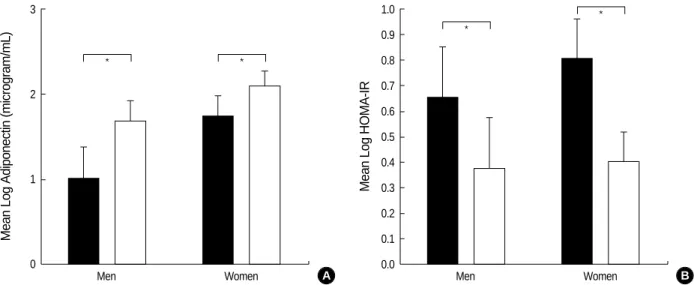
Fig. 1 indicates plasma adiponectin levels and HOMA-IR in the NAFLD and control groups in men and women, respec- tively. Plasma adiponectin levels in NAFLD group were sig- nificantly lower than those in control group in both men and women. HOMA-IR in NAFLD group were significantly higher than those in control group in both men and women.
Fig. 2 graphically depicts the correlations of plasma adipo- nectin levels with HOMA-IR and waist circumference accord- ing to sex. Plasma adiponectin levels were significantly inverse correlated (r=-0.45, p<0.01) with HOMA-IR in women. In the other hands, the associations of plasma adiponectin levels with waist circumference was significantly inverse correlated in both men and women (r=-0.35 p=0.03, r=-0.41 p<0.01, respectively)
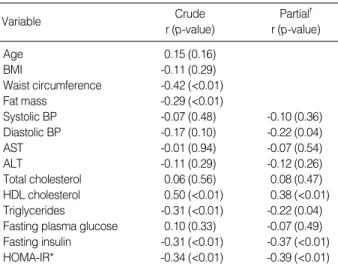
The univariate correlations and partial correlation analyses after adjusting for age, sex, and adiposity (BMI, waist circum- ference, and fat mass) between plasma adiponectin levels and anthropometric and metabolic parameters are shown in Table 2. Adiponectin levels correlated with waist circumference
Mean Log Adiponectin (microgram/mL)
3
2
1
0
Men Women
* *
*
*
Mean Log HOMA-IR
1.0 0.9 0.8 0.7 0.6 0.5 0.4 0.3 0.2 0.1 0.0
Men Women
A B
Fig. 1.Plasma adiponectin levels (A) and HOMA-IR (B) in NAFLD and control groups in men and women, respectively. Closed bars, NAFLD group; Open bars, Control groups.
*p<0.05.
Fig. 2.Correlations of plasma adiponectin levels between HOMA-IR (A) and waist circumference (B) in men (open circle) and women (closed circle), respectively.
Log Adiponectin levles (micrgram/dL) 3
2
1
0
-0.4 -0.2 0.0 0.2 0.4 0.6 0.8 1.0 1.2 1.4 1.6
Log HOMA-IR A
Men r=-0.34, p=0.09 Women r=-0.45, p<0.0
Men r=-0.35, p=0.03 Women r=-0.41, p<0.01
Log Adiponectin levles (micrgram/dL) 3
2
1
0
60 70 80 90 100 110
Waist circumference (cm) B
(r=-0.42, p<0.01), fat mass (r=-0.29, p<0.01), HDL-choles- terol (r=0.50, p<0.01), triglyceride (r=-0.31, p<0.01), and HOMA-IR (r=-0.34, p<0.01) in univariate analyses. Partial correlation analyses showed a significant positive correlation between plasma adiponectin levels and HDL-cholesterol levels (r=0.38, p<0.01). Conversely, negative correlations were ob- served between the plasma adiponectin levels and diastolic blood pressure (r=-0.22, p=0.04), triglycerides (r=-0.22, p=
0.04), fasting insulin (-0.37, p<0.01), and HOMA-IR (r=-0.39, p<0.01).
Table 3 shows the multivariate logistic regression analysis in which the presence of NAFLD was used as the dependent variable, while all variables were designated the independent variables. HOMA-IR indicative of insulin resistance, plasma adiponectin level, BMI, and waist circumference were inde- pendent factors significantly associated with NAFLD. The odds ratios for NAFLD with BMI (odds ratio [OR]=1.45;
95% confidence interval [CI]: 1.19-1.76), waist circumfer- ence (OR=1.13; 95% CI: 1.04-1.22), HOMA-IR (OR=2.38;
95% CI: 1.52-5.74), and plasma adiponectin levels (OR=
0.22; 95% CI: 0.09-0.55) was statistically significant in mul- tiple regression analysis that included all variables.
DISCUSSION
We found that the NAFLD group had a higher insulin resistance than the control group, which is in agreement with previous studies (17, 18). NAFLD is associated with insulin resistance and hyperinsulinemia in even lean subjects with
normal glucose tolerance (18). It was suggested that insulin resistance is the pathognomonic condition responsible for NAFLD. Indeed, NAFLD is considered the hepatic manifes- tation of metabolic syndrome.
Insulin resistance is an essential requirement of NASH, independent of the degree of obesity (12). The insulin-sen- sitizing drugs troglitazone (19) and metformin (20) reduce aminotransferase levels. In the insulin-resistant state, accel- erated lipolysis of adipose tissue results in an increased sup- ply of hepatic free fatty acids (FFAs) and increased lipid oxi- dation, this is accompanied by fat accumulation in hepato- cytes. There is a good correlation between the liver fat con- tent and liver insulin resistance in normal subjects and in type 2 diabetic patients (20).
In this study, insulin resistance was measured using the homeostasis model assessment method, although euglycemic- hyperinsulinemic clamp is the gold standard for defining insulin resistance (7, 8). However, HOMA-IR is easy to per- form, and that method is highly correlated with the euglyce- mic-hyperglycemic clamp (r=0.83, p<0.01) (21). The HOMA method for measuring insulin resistance has been applied extensively in epidemiological investigations (7, 8, 21).
Our study confirms that hypoadiponectinemia occurs in subjects with NAFLD, after controlling for age, sex, and adiposity. Animal models have indicated that adiponectin confers protective effects against alcoholic and nonalcoholic fatty liver disease (22, 23). Recent study reported that hypoad- iponectinemia is a feature of NASH independent of insulin resistance and reduced adiponectin level is associated with more extensive necroinflammation and may contribute to the development of necroinflammatory forms of NAFLD (24).
These data might also support the hypothesis that adiponectin has hepatoprotective effects in humans with NAFLD. The most likely reason for low adiponectin levels in NAFLD may be insulin resistance.
Our study found that HOMA-IR was significantly nega- tively correlated to adiponectin levels which were in accord with a previous report (25). Many investigators (8, 26, 27) suggest that adiponectin regulates hepatocyte metabolism
BMI, body mass index; BP, blood pressure; AST, aspartate aminotrans- ferase; ALT, alanine aminotransferase; HDL-cholesterol, high-density lipoprotein cholesterol; HOMA-IR, homeostasis model of assessment- insulin resistance.
*Log transformation values. �adjusted for age, sex, and adiposity (BMI, waist circumference, fat mass).
Variable Crude
r (p-value)
Partial� r (p-value)
Age 0.15 (0.16)
BMI -0.11 (0.29)
Waist circumference -0.42 (<0.01)
Fat mass -0.29 (<0.01)
Systolic BP -0.07 (0.48) -0.10 (0.36)
Diastolic BP -0.17 (0.10) -0.22 (0.04)
AST -0.01 (0.94) -0.07 (0.54)
ALT -0.11 (0.29) -0.12 (0.26)
Total cholesterol 0.06 (0.56) 0.08 (0.47) HDL cholesterol 0.50 (<0.01) 0.38 (<0.01) Triglycerides -0.31 (<0.01) -0.22 (0.04) Fasting plasma glucose 0.10 (0.33) -0.07 (0.49) Fasting insulin -0.31 (<0.01) -0.37 (<0.01) HOMA-IR* -0.34 (<0.01) -0.39 (<0.01) Table 2.Crude and partial correlation between plasma adipo- nectin levels* and clinical parameters in the study subjects
BMI, body mass index; HOMA-IR, homeostasis model of assessment- insulin resistance.
*Log transformation values.
Variable Regression
coefficient S.E. p- value
Odds
ratio 95% C.I.
Intercept -7.96 2.77 <0.01
BMI 0.40 0.11 <0.01 1.45 1.19-1.76
Waist circumference 0.12 0.04 <0.01 1.13 1.04-1.22
HOMA-IR* 1.52 0.86 <0.01 2.38 1.52-5.74
Adiponectin* -1.53 0.47 <0.01 0.22 0.09-0.55 Table 3.Odds ratio for NAFLD as a dependent variable and anthropometric measurements, insulin resistance and plasma adiponectin levels as independent variables by stepwise multi- variate logistic regression analysis
directly. Long-term administration of adiponectin to diabetic mice improved the indices of insulin sensitivity, and decreased liver, muscle, and plasma triglycerides, and FFAs (22). Injec- tion of recombinant adiponectin in mice increases fatty acid oxidation in muscle, reduces triglyceride content in muscle, and improves muscle sensitivity to insulin (14).
Raised plasma tumor necrosis factor (TNF)- is thought to be another reason for the low adiponectin levels in NAFLD (28). Overproduction of the proinflammatory cytokine TNF- by adipose tissue is involved in insulin resistance in obesity and TNF- is a major cytokine contributing to liver damage in NAFLD (29).
In our study, plasma adiponectin levels were elevated more in women than in men. Similar results have been reported in several studies (29, 30), while others failed to observe a sex difference (31). The higher adiponectin expression in women, as compared to men, might be due to the fact that women tend to have less visceral fat tissue than subcutaneous fat tis- sue. Plasma adiponectin levels were determined predomi- nantly by visceral fat, not by subcutaneous fat (32). There- fore, sexual dimorphism of the body fat distribution might contribute to the difference in plasma adiponectin levels in women and men.
Among the anthropometric index, waist circumference was stronger correlation with plasma adiponectin level, in our study. According to definition for metabolic syndrome sug- gested by the National Cholesterol Education Program Adult Treatment Panel III (33), abdominal obesity is one of the diag- nostic criteria of the metabolic syndrome. Increased adiposity in the abdominal area may result in the development of insulin resistance, so abdominal obesity estimated by waist circum- ference, is inverse correlation with plasma adiponectin levels.
This study has some limitations. One limitation of this study is that the diagnosis of NAFLD was based on ultra- sound examination, but was not confirmed pathologically.
It is difficult to perform extensively in subjects with NAFLD, mainly for ethical reasons (34). Some prospective study com- paring ultrasound scanning with histological examination indicated ultrasound scanning accurately identified steatosis with a sensitivity of 94% and a specificity of 84% (35). Recent study among biopsy proven NASH subjects also reported those patients had lower adiponectin levels and higher HOMA- IR than those with simple steatosis (24). Another limitation is that our study had a cross-sectional design, and there was potential bias in participation, so it cannot elucidate mecha- nisms or determine the direction of causality.
In conclusion, we demonstrated that hypoadiponectinemia and insulin resistance are associated with NAFLD indepen- dent of total heaviness and abdominal fat distribution. Adi- ponectin may be applicable in human disease as a novel agent for treating insulin resistance including NAFLD in the future.
Further research is needed to identify the key determinants of circulating adiponectin and the development of NAFLD.
REFERENCES
1. Sheth SG, Gordon FD, Chopra S. Nonalcoholic steatohepatitis. Ann Intern Med 1997; 126: 137-45.
2. Powell EE, Cooksley WG, Hanson R, Searle J, Halliday JW, Powell LW. The natural history of nonalcoholic steatohepatitis: a follow-up study of forty-two patients for up to 21 years. Hepatology 1990; 11:
74-80.
3. Wanless IR, Lentz JS. Fatty liver hepatitis (steatohepatitis) and obesity:
an autopsy study with analysis of risk factors. Hepatology 1990; 12:
1106-10.
4. Marceau P, Biron S, Hould FS, Marceau S, Simard S, Thung SN, Kral JG. Liver pathology and the metabolic syndrome X in severe obesity. J Clin Endocrinol Metab 1999; 84: 1513-7.
5. Kelley DE, McKolanis TM, Hegazi RA, Kuller LH, Kalhan SC. Fatty liver in type 2 diabetes mellitus: relation to regional adiposity, fatty acids, and insulin resistance. Am J Physiol Endocrinol Metab 2003;
285: E906-16.
6. Park HS, Kim MW, Shin ES. Effect of weight control on hepatic abnormalities in obese patients with fatty liver. J Korean Med Sci 1995; 10: 414-21.
7. Matthews DR, Hosker JP, Rudenski AS, Naylor BA, Treacher DF, Turner RC. Homeostasis model assessment: insulin resistance and beta-cell function from fasting plasma glucose and insulin concen- trations in man. Diabetologia 1985; 28: 412-9.
8. Bonora E, Targher G, Alberiche M, Bonadonna RC, Saggiani F, Zenere MB, Monauni T, Muggeo M. Homeostasis model assessment closely mirrors the glucose clamp technique in the assessment of insulin sensitivity: studies in subjects with various degrees of glucose toler- ance and insulin sensitivity. Diabetes Care 2000; 23: 57-63.
9. Marchesini G, Brizi M, Morselli-Labate AM, Bianchi G, Bugianesi E, McCullough AJ, Forlani G, Melchionda N. Association of nonal- coholic fatty liver disease with insulin resistance. Am J Med 1999;
107: 450-5.
10. Berg AH, Combs TP, Scherer PE. ACRP30/adiponectin: an adipokine regulating glucose and lipid metabolism. Trends Endocrinol Metab 2002; 13: 84-9.
11. Diez JJ, Iglesias P. The role of the novel adipocyte-derived hormone adiponectin in human disease. Eur J Endocrinol 2003; 148: 293-300.
12. Yamamoto Y, Hirose H, Saito I, Tomita M, Taniyama M, Matsubara K, Okazaki Y, Ishii T, Nishikai K, Saruta T. Correlation of the adi- pocyte-derived protein adiponectin with insulin resistance index and serum high-density lipoprotein-cholesterol, independent of body mass index, in the Japanese population. Clin Sci (Lond) 2002; 103: 137-42.
13. Berg AH, Combs TP, Du X, Brownlee M, Scherer PE. The adipocyte- secreted protein Acrp30 enhances hepatic insulin action. Nat Med 2001; 7: 947-53.
14. Fruebis J, Tsao TS, Javorschi S, Ebbets-Reed D, Erickson MR, Yen FT, Bihain BE, Lodish HF. Proteolytic cleavage product of 30-kDa adipocyte complement-related protein increases fatty acid oxidation in muscle and causes weight loss in mice. Proc Natl Acad Sci USA 2001; 98: 2005-10.
15. Kim MJ, Lee Y, Lee BJ, Yoen JH, Shin SY, Shin YG, Chung CH.
Plasma adiponectin Concentration and insulin resistance in Type 2
diabetes. J Korean Diabetes Assoc 2003; 27: 260-71.
16. Haffner SM, Miettinen H, Stern MP. The homeostasis model in the San Antonio Heart Study. Diabetes Care 1997; 20: 1087-92.
17. Chitturi S, Abeygunasekera S, Farrell GC, Holmes-Walker J, Hui JM, Fung C, Karim R, Lin R, Samarasinghe D, Liddle C, Weltman M, George J. NASH and insulin resistance: Insulin hypersecretion and specific association with the insulin resistance syndrome. Hep- atology 2002; 35: 373-9.
18. Seppala-Lindroos A, Vehkavaara S, Hakkinen AM, Goto T, West- erbacka J, Sovijarvi A, Halavaara J, Yki-Jarvinen H. Fat accumula- tion in the liver is associated with defects in insulin suppression of glucose production and serum free fatty acids independent of obesi- ty in normal men. J Clin Endocrinol Metab 2002; 87: 3023-8.
19. Caldwell SH, Hespenheide EE, Redick JA, Iezzoni JC, Battle EH, Sheppard BL. A pilot study of a thiazolidinedione, troglitazone, in nonalcoholic steatohepatitis. Am J Gastroenterol 2001; 96: 519-25.
20. Marchesini G, Brizi M, Bianchi G, Tomassetti S, Zoli M, Melchionda N. Metformin in non-alcoholic steatohepatitis. Lancet 2001; 358:
893-4.
21. Hermans MP, Levy JC, Morris RJ, Turner RC. Comparison of insulin sensitivity tests across a range of glucose tolerance from normal to diabetes. Diabetologia 1999; 42: 678-7.
22. Xu A, Wang Y, Keshaw H, Xu LY, Lam KS, Cooper GJ. The fat- derived hormone adiponectin alleviates alcoholic and nonalcoholic fatty liver diseases in mice. J Clin Invest 2003; 112: 91-100.
23. Hotta K, Funahashi T, Bodkin NL, Ortmeyer HK, Arita Y, Hansen BC, Matsuzawa Y. Circulating concentrations of the adipocyte pro- tein adiponectin are decreased in parallel with reduced insulin sen- sitivity during the progression to type 2 diabetes in rhesus monkeys.
Diabetes 2001; 50: 1126-33.
24. Hui JM, Hodge A, Farrell GC, Kench JG, Kriketos A, George J.
Beyond insulin resistance in NASH: TNF-alpha or adiponectin? Hep- atology 2004; 40: 46-54.
25. Shand BI, Scott RS, Elder PA, George PM. Plasma adiponectin in overweight, nondiabetic individuals with or without insulin resis- tance. Diabetes Obes Metab 2003; 5: 349-53.
26. Combs TP, Berg AH, Obici S, Scherer PE, Rossetti L. Endogenous glucose production is inhibited by the adipose-derived protein Acrp30.
J Clin Invest 2001; 108: 1875-81.
27. Kern PA, Di Gregorio GB, Lu T, Rassouli N, Ranganathan G. Adi- ponectin expression from human adipose tissue: relation to obesity, insulin resistance, and tumor necrosis factor-alpha expression. Dia- betes 2003; 52: 1779-85.
28. Ouchi N, Kihara S, Arita Y, Okamoto Y, Maeda K, Kuriyama H, Hotta K, Nishida M, Takahashi M, Muraguchi M, Ohmoto Y, Naka- mura T, Yamashita S, Funahashi T, Matsuzawa Y. Adiponectin, an adipocyte-derived plasma protein, inhibits endothelial NF-kappaB signaling through a cAMP-dependent pathway. Circulation 2000;
102: 1296-301
29. Cnop M, Havel PJ, Utzschneider KM, Carr DB, Sinha MK, Boyko EJ, Retzlaff BM, Knopp RH, Brunzell JD, Kahn SE. Relationship of adiponectin to body fat distribution, insulin sensitivity and plasma lipoproteins: evidence for independent roles of age and sex. Diabetolo- gia 2003; 46: 459-69.
30. Lindsay RS, Funahashi T, Hanson RL, Matsuzawa Y, Tanaka S, Tataranni PA, Knowler WC, Krakoff J, Snehalatha C, Mukesh B, Simon M, Viswanathan V, Haffner SM, Ramachandran A, Cnop M, Havel PJ, Utzschneider KM, Carr DB, Sinha MK, Boyko EJ, Retzlaff BM, Knopp RH, Brunzell JD, Kahn SE, Weyer C, Funa- hashi T, Tanaka S, Hotta K, Matsuzawa Y, Pratley RE, Tataranni PA.
Adiponectin and development of type 2 diabetes in the Pima Indian population: Plasma adiponectin is an independent predictor of type 2 diabetes in Asian Indians Relationship of adiponectin to body fat distribution, insulin sensitivity and plasma lipoproteins: evidence for independent roles of age and sex hypoadiponectinemia in obesi- ty and type 2 diabetes: close association with insulin resistance and hyperinsulinemia. Lancet 2002; 360: 57-8.
31. Weyer C, Funahashi T, Tanaka S, Hotta K, Matsuzawa Y, Pratley RE, Tataranni PA. Hypoadiponectinemia in obesity and type 2 dia- betes: close association with insulin resistance and hyperinsulinemia.
J Clin Endocrinol Metab 2001; 86: 1930-5.
32. Yatagai T, Nagasaka S, Taniguchi A, Fukushima M, Nakamura T, Kuroe A, Nakai Y, Ishibashi S. Hypoadiponectinemia is associated with visceral fat accumulation and insulin resistance in Japanese men with type 2 diabetes mellitus. Metabolism 2003; 52: 1274-8.
33. World Health Organization Western Pacific Region, International Obesity Task Force.: The Asia-Pacific perspective: redefining obesity and its treatment, Sydney: Health Communications Australia Pty Limited, 2000.
34. Brunt EM, Janney CG, Di Bisceglie AM, Neuschwander-Tetri BA, Bacon BR. Nonalcoholic steatohepatitis: a proposal for grading and staging the histological lesions. Am J Gastroenterol 1999; 94: 2467-74.
35. Saverymuttu SH, Joseph AE, Maxwell JD. Ultrasound scanning in the detection of hepatic fibrosis and steatosis. Br Med J (Clin Res Ed) 1986; 292: 13-5.