© 2011 The Korean Academy of Medical Sciences.
This is an Open Access article distributed under the terms of the Creative Commons Attribution Non-Commercial License (http://creativecommons.org/licenses/by-nc/3.0) which permits unrestricted non-commercial use, distribution, and reproduction in any medium, provided the original work is properly cited.
pISSN 1011-8934 eISSN 1598-6357
Novel Compound Heterozygous Mutations in the Vitamin D Receptor Gene in a Korean Girl with Hereditary Vitamin D Resistant Rickets
Hereditary vitamin D resistant rickets (HVDRR) is a rare genetic disorder caused by a mutation of vitamin D receptor (VDR) gene. A number of cases had been reported in many countries but not in Korea. We examined a three-year old Korean girl who had the typical clinical features of HVDRR including rickets, hypocalcemia, hypophosphatemia, elevated serum calcitriol level and secondary hyperparathyroidism. The girl and her father were both heterozygous for the 719 C-to-T (I146T) mutation in exon 4, whereas she and her mother were both heterozygous for 754 C-to-T (R154C) mutation in exon 5 of the VDR gene. In this familial study, we concluded that the girl had compound heterozygous mutations in her VDR gene which caused HVDRR. This is the first report of a unique mutation in the VDR gene in Korea.
Key Words: Rickets; Vitamin D; Receptor; Mutation Jun Kyu Song1, Kyung Sik Yoon1,
Kye Shik Shim2 and Chong-Woo Bae2 Departments of 1Biochemistry and Molecular Biology and 2Pediatrics, Kyung Hee University School of Medicine, Seoul, Korea
Received: 15 April 2011 Accepted: 21 June 2011 Address for Correspondence:
Kye Shik Shim, MD
Department of Pediatrics, Kyung Hee University Hospital at Gangdong, 892 Dongnam-ro, Gangdong-gu, Seoul 134-727, Korea
Tel: +82.2-440-6131, Fax: +82.2-440-6295 E-mail: [email protected]
This study was supported by the program of the Kyung Hee University for the young medical researcher in 2008 (KHU- 20081250).
DOI: 10.3346/jkms.2011.26.8.1111 • J Korean Med Sci 2011; 26: 1111-1114
CASE REPORT
Pediatrics
INTRODUCTION
The hormonally active form of vitamin D, 1,25-dihydroxyvita- min D3 [1,25(OH)2D3] is an important regulator of bone and min- eral metabolism. Its actions are mediated by the vitamin D re- ceptor (VDR) (1, 2).
The hereditary vitamin D resistant rickets (HVDRR) is a rare genetic disorder inherited in a recessive pattern and caused by heterogeneous mutations of VDR gene. The patients with ho- mozygous or compound heterozygous mutations of gene en- coding VDR develop the disease (2).
The clinical and laboratory features of HVDRR are rickets, hy- pocalcemia, hypophosphatemia and increased serum level of 1,25(OH)2D3 due to resistance to VDR (2).
There were a number of reports in a few countries but not in Korea (3). We discovered a case in a three-year old Korean girl.
This is the first report of a unique mutation in VDR gene in Korea.
CASE DESCRIPTION
The patient was a 3-yr old Korean girl with curved forearms, bow legs and short stature on September 27, 2007. The height stan- dard deviation score of the patient was -0.73 height SDS com-
pared with the normal growth chart of Korean children that was published in 2007 by the Korean Pediatric Society (4). The radio- graphic findings of her wrists and ankles were compatible with rickets but she didn’t have any type of alopecia (Fig. 1).
Her initial (9/27/2007) serum levels of calcium (7.2 mg/dL, normal range, 8.8-10.8), and phosphorus (3.3 mg/dL, normal range, 3.8-6.5) were decreased, the level of 25-hydroxyvitamin D [25(OH)D] (31.5 ng/mL, normal range, 4.8-52.8) was within normal range, but those of alkaline phosphatase, (1,545 IU/L, normal range, 145-420), 1,25(OH)2D3 (165.0 pg/mL, normal range, 25.1-66.1) and parathyroid hormone (1,197.0 pg/mL, nor- mal range, 9-65) were increased.
After a 3-month treatment of supraphysiologic dose of calci- um (100 mg/kg/day) and vitamin D3 (0.2 µg/kg/day), her serum levels of calcium (9.7 mg/dL), phosphorus (5.4 mg/dL) and al- kaline phosphatase (510 IU/L) were normalized and her curved forearms were improved. But the bow legs did not show improve- ment, so she received corrective osteotomies approximately a year later.
Preparation of mRNA and genomic DNA
After obtaining the written informed consent from the patient, her parents and normal children (control group, N = 50) follow-
Song JK, et al. • Hereditary Vitamin D Resistant Rickets
1112 http://jkms.org DOI: 10.3346/jkms.2011.26.8.1111
ing the Kyung Hee University Hospital at Gangdong Institutional Review Board-informed consent approved protocols, the mRNA and genomic DNA were isolated from their blood samples with Invisorb Spin Blood RNA mini kit [Invitek, Berlin, Germany] and QIAamp DNA Blood mini kit [QIAGEN, Berlin, Germany].
Primer design, PCR and DNA sequencing
The primers for PCR and sequencing reactions of cDNA of VDR are as follows, exon 1a-3 F: 5´-CTG CTT GTC AAA AGG CGG CA-3´, exon 1a-3 R: 5´-TTG GGC CGC AGA CTG TCC TT-3´, exon 4-6 F: 5´-CTA TTC ACC TGC CCC TTC AA-3´, exon 4-6 R: 5´-TGC CAC AGG TCC AGG ACA TG-3´, exon 7-9 F: 5´-TGG ACT CGT CCA GCT TCT CCA-3´ and exon 7-9 R: 5´-ACT TCG AGC ACA AGG GGC GT-3´ (Table 1).
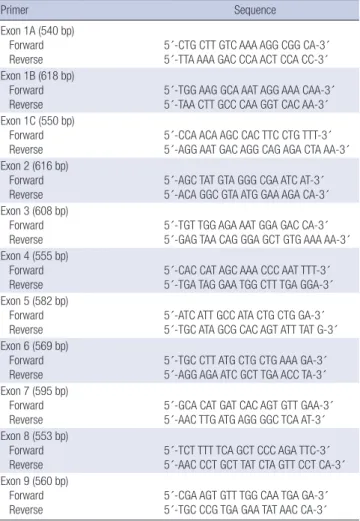
The primers for PCR and sequencing reactions of genomic DNA of VDR are as follows, exon 1a F: 5´-CTG CTT GTC AAA AGG CGG CA-3´, exon 1a R: 5´-TTA AAA GAC CCA ACT CCA CC-3´, exon 1b F: 5´-TGG AAG GCA AAT AGG AAA CAA-3´, exon 1b R: 5´-TAA CTT GCC CAA GGT CAC AA-3´, exon 1c F: 5´-CCA ACA AGC CAC TTC CTG TTT-3´, exon 1c R: 5´-AGG AAT GAC AGG CAG AGA CTA AA-3´, exon 2 F: 5´-AGC TAT GTA GGG CGA ATC AT-3´, exon 2 R: 5´-ACA GGC GTA ATG GAA AGA CA-3´, exon 3 F: 5´-TGT TGG AGA AAT GGA GAC CA-3´, exon 3 R: 5´- GAG TAA CAG GGA GCT GTG AAA AA-3´, exon 4 F: 5´-CAC CAT AGC AAA CCC AAT TTT-3´, exon 4 R: 5´-TGA TAG GAA TGG CTT TGA GGA-3´, exon 5 F: 5´-ATC ATT GCC ATA CTG CTG GA- 3´, exon 5 R: 5´-TGC ATA GCG CAC AGT ATT TAT G-3´, exon 6 F: 5´-TGC CTT ATG CTG CTG AAA GA-3´, exon 6 R: 5´-AGG AGA ATC GCT TGA ACC TA-3´, exon 7 F: 5´-GCA CAT GAT CAC AGT GTT GAA-3´, exon 7 R: 5´-AAC TTG ATG AGG GGC TCA AT-3´,
exon 8 F: 5´-TCT TTT TCA GCT CCC AGA TTC-3´, exon 8 R: 5´- AAC CCT GCT TAT CTA GTT CCT CA-3´, exon 9 F: 5´-CGA AGT GTT TGG CAA TGA GA-3´ and exon 9 R: 5´-TGC CCG TGA GAA TAT AAC CA-3´ (Table 2).
The analysis of the cDNA sequencing was done with 3 primer sets including whole coding regions of cDNA. Their genomic DNA sequencing was done with 11 primer sets including whole coding regions and non-coding regions, including exon/intron splice sites of genomic DNA. Those fragments were sequenced with an ABI 3730XL sequencer (PE Biosystems, Foster city, CA, USA). The sequencing data was analyzed with FinchTV-1.04 se- quence aligner (Geospiza, Seattle, WA, USA) and ClustalX-2.0 sequence aligner (Conway Institute UCD, Dublin, Ireland). We compared their sequences with normal ones of VDR gene.
We found a 719 C-to-T transition (Ile146Thr) in exon 4 of the patient and her father’s VDR genes, and a 754 C-to-T transition (Arg154Cys) in exon 5 of the patient and her mother’s genes (Fig.
2). In this familial study, we concluded that the girl had compound heterozygous mutations in her VDR gene which caused HVDRR.
Fig. 1. (A) The X-ray of lower extremities of the pa- tient shows curved legs. (B) The X-ray of wrist of the patient shows the metaphyseal fraying and cupping of distal radius and ulna.
A B
Table 1. The primers for PCR and sequencing reactions of cDNA of VDR
Primer Sequence
Exon 1A-3 (650 bp) Forward
Reverse 5´-CTG CTT GTC AAA AGG CGG CA-3´
5´-TTG GGC CGC AGA CTG TCC TT-3´
Exon 4-6 (700 bp) Forward
Reverse 5´-CTA TTC ACC TGC CCC TTC AA-3´
5´-TGC CAC AGG TCC AGG ACA TG-3´
Exon 7-9 (673 bp) Forward
Reverse 5´-TGG ACT CGT CCA GCT TCT CCA-3´
5´-ACT TCG AGC ACA AGG GGC GT-3´
Song JK, et al. • Hereditary Vitamin D Resistant Rickets
http://jkms.org 1113
DOI: 10.3346/jkms.2011.26.8.1111
DISCUSSION
1,25-dihydroxyvitamin D3 or calcitriol [1,25(OH)2D3] is an impor- tant regulator of bone and mineral metabolism and its actions are mediated by VDR. The VDR is a member of the nuclear re- ceptor superfamily and belongs to the family of transacting tran- scriptional regulatory factors and shows sequence similarity to the steroid and thyroid hormone receptors (1, 5).
Table 2. The primers for PCR and sequencing reactions of genomic DNA of VDR
Primer Sequence
Exon 1A (540 bp) Forward
Reverse 5´-CTG CTT GTC AAA AGG CGG CA-3´
5´-TTA AAA GAC CCA ACT CCA CC-3´
Exon 1B (618 bp) Forward
Reverse 5´-TGG AAG GCA AAT AGG AAA CAA-3´
5´-TAA CTT GCC CAA GGT CAC AA-3´
Exon 1C (550 bp) Forward
Reverse 5´-CCA ACA AGC CAC TTC CTG TTT-3´
5´-AGG AAT GAC AGG CAG AGA CTA AA-3´
Exon 2 (616 bp) Forward Reverse
5´-AGC TAT GTA GGG CGA ATC AT-3´
5´-ACA GGC GTA ATG GAA AGA CA-3´
Exon 3 (608 bp) Forward Reverse
5´-TGT TGG AGA AAT GGA GAC CA-3´
5´-GAG TAA CAG GGA GCT GTG AAA AA-3´
Exon 4 (555 bp) Forward Reverse
5´-CAC CAT AGC AAA CCC AAT TTT-3´
5´-TGA TAG GAA TGG CTT TGA GGA-3´
Exon 5 (582 bp) Forward Reverse
5´-ATC ATT GCC ATA CTG CTG GA-3´
5´-TGC ATA GCG CAC AGT ATT TAT G-3´
Exon 6 (569 bp) Forward Reverse
5´-TGC CTT ATG CTG CTG AAA GA-3´
5´-AGG AGA ATC GCT TGA ACC TA-3´
Exon 7 (595 bp) Forward Reverse
5´-GCA CAT GAT CAC AGT GTT GAA-3´
5´-AAC TTG ATG AGG GGC TCA AT-3´
Exon 8 (553 bp) Forward Reverse
5´-TCT TTT TCA GCT CCC AGA TTC-3´
5´-AAC CCT GCT TAT CTA GTT CCT CA-3´
Exon 9 (560 bp) Forward
Reverse 5´-CGA AGT GTT TGG CAA TGA GA-3´
5´-TGC CCG TGA GAA TAT AAC CA-3´
A B
VDR Exon 4
719 C-to-T heterozygous mutation in Exon 4 719 C-to-T heterozygous mutation in Exon 5
VDR Exon 5
Proband Proband
Proband Proband
Father Father
Father Mother
Mother Mother
Fig. 2. The analysis of VDR nucle- otide sequences of the patient and her parents. (A) a 719 C-to-T mu- tation (Ile146Thr) in Exon 4 of her and her father’s VDR gene. (B) 754 C-to-T mutation (Arg154Cys) in Exon 5 of her and her mother’s VDR gene.
The heterogeneous mutations of VDR gene cause the heredi- tary Vitamin D resistant rickets (HVDRR), also known as vitamin D dependent rickets type II (VDDR II) that is a rare recessive ge- netic disorder (2).
The clinical features of HVDRR are bow legs, curved forearms and specific changes of long bones similar to nutritional rickets, except alopecia in some patients. Also the laboratory findings of HVDRR are hypocalcemia, hypophosphatemia, elevated serum level of alkaline phosphatase and parathyroid hormone as nutri- tional rickets, except elevated serum 1,25(OH)2D3 level because of end-organ resistance due to mutations in VDR gene (2, 5-7).
The VDR is composed of an N-terminus DNA-binding do- main (DBD) and a C-terminus ligand-binding domain (LBD).
The VDR binds as a heterodimer with the retinoid X receptor (RXR) to specific vitamin D response elements (VDREs) in tar- get genes via a two-zinc finger DBD. Ligand binding causes a conformational change in the VDR that resets the activation func- tion 2 domain in helix H12 and allows for the recruitment and binding of coactivators that modify chromatin and allow tran- scription via RNA polymerase II (9-11).
Mutations in the DBD affect VDR-DNA interactions and they result in total loss of VDR transactivation. But, mutations in the LBD cause defects in ligand binding, RXR heterodimerization, and co-activator interaction, and result in partial or total hor- mone unresponsiveness (9-11).
Alopecia has been associated with mutations that affect DNA binding, RXR heterodimerization and mutations that cause pre- mature stop codons (3, 6, 8, 10, 12-17). But, the cases without alopecia have been usually associated with mutations in ligand binding domain or mutations affecting coactivator protein in- teractions (9, 11, 18, 19).
More than 40 mutations in the VDR gene have been reported.
The types of mutations found in the VDR gene include missense mutations, nonsense mutations, splicing mutations, partial de- letions and compound heterozygous mutations (2, 3, 20).
We discovered a three-year old Korean girl who had the typi- cal clinical features of HVDRR including rickets, hypocalcemia,
Song JK, et al. • Hereditary Vitamin D Resistant Rickets
1114 http://jkms.org DOI: 10.3346/jkms.2011.26.8.1111
hypophosphatemia, elevated serum calcitriol level and second- ary hyperparathyroidism.
The girl and her father were both heterozygous for the 719 C- to-T (I146T) mutation in exon 4, but her father didn’t have any symptoms or signs of rickets. Also, the patient and her mother were both heterozygous for 754 C-to-T (R154C) mutation in exon 5 of the VDR gene, her mother didn’t have either. This is consis- tent with previous reports of heterozygous parents being asymp- tomatic (2).
Because the exon 4 and 5 are in the region of VDR LBD, we think the clinical features of the patient were not as severe and without any type of alopecia, either.
In this familial study, we concluded that each of the patient’s parents had a unique heterozygous mutation of the gene and the girl had compound heterozygous mutations in her VDR gene which caused HVDRR. This is the first report of a mutation in the VDR gene in Korea.
ACKNOWLEDGMENTS
The authors thank Dr. Young Eun Choi for the collection of blood samples and Dr. Yoona Chung for further revision of this manu- script in English.
REFERENCES
1. Haussler MR, Haussler CA, Jurutka PW, Thompson PD, Hsieh JC, Re- mus LS, Selznick SH, Whitfield GK. The vitamin D hormone and its nu- clear receptor: molecular actions and disease states. J Endocrinol 1997;
154(Suppl): S57-73.
2. Malloy PJ, Pike JW, Feldman D. The vitamin D receptor and the syndrome of hereditary 1,25-dihydroxyvitamin D-resistant rickets. Endocr Rev 1999;
20: 156-88.
3. Arita K, Nanda A, Wessagowit V, Akiyama M, Alsaleh QA, McGrath JA.
A novel mutation in the VDR gene in hereditary vitamin D-resistant rick- ets. Br J Dermatol 2008; 158: 168-71.
4. Lee CK, Moon JS, Sohn CS, Lee HJ, Cha SH, Kang HK, Seo JW, Choi JM, Choi BK. Growth standard in children. In: Lee JK, editor. Normal growth chart of Korean children. Seoul: The Korean Pediatric Society, 2007, p2-7.
5. Feldman D, Malloy PJ, Krishnan AV, Balint E. Vitamin D: biology, action, and clinical implications. In: Marcus R, Feldman D, Nelson DA, Rosen CJ, editors. Osteoporosis. vol.1. San Diego: Academic Press, 2007, p317-82.
6. Malloy PJ, Wang J, Srivastava T, Feldman D. Hereditary 1,25-dihydroxyvi- tamin D-resistant rickets with alopecia resulting from a novel missense mutation in the DNA-binding domain of the vitamin D receptor. Mol Genet Metab 2010; 99: 72-9.
7. Hochberg Z. Vitamin-D-dependent rickets type 2. Horm Res 2002; 58:
297-302.
8. Ma NS, Malloy PJ, Pitukcheewanont P, Dreimane D, Geffner ME, Feld-
man D. Hereditary vitamin D resistant rickets: identification of a novel splice site mutation in the vitamin D receptor gene and successful treat- ment with oral calcium therapy. Bone 2009; 45: 743-6.
9. Malloy PJ, Wang J, Peng L, Nayak S, Sisk JM, Thompson CC, Feldman D.
A unique insertion/duplication in the VDR gene that truncates the VDR causing hereditary 1,25-dihydroxyvitamin D-resistant rickets without alopecia. Arch Biochem Biophys 2007; 460: 285-92.
10. Malloy PJ, Xu R, Peng L, Peleg S, Al-Ashwal A, Feldman D. Hereditary 1,25-dihydroxyvitamin D resistant rickets due to a mutation causing mul- tiple defects in vitamin D receptor function. Endocrinology 2004; 145:
5106-14.
11. Malloy PJ, Xu R, Cattani A, Reyes L, Feldman D. A unique insertion/sub- stitution in helix H1 of the vitamin D receptor ligand binding domain in a patient with hereditary 1,25-dihydroxyvitamin D-resistant rickets. J Bone Miner Res 2004; 19: 1018-24.
12. Lin NU, Malloy PJ, Sakati N, Al-Ashwal A, Feldman D. A novel mutation in the deoxyribonucleic acid-binding domain of the vitamin D receptor causes hereditary 1,25-dihydroxyvitamin D-resistant rickets. J Clin En- docrinol Metab 1996; 81: 2564-9.
13. Rut AR, Hewison M, Kristjansson K, Luisi B, Hughes MR, O’Riordan JL.
Two mutations causing vitamin D resistant rickets: modelling on the ba- sis of steroid hormone receptor DNA-binding domain crystal structures.
Clin Endocrinol (Oxf) 1994; 41: 581-90.
14. Yagi H, Ozono K, Miyake H, Nagashima K, Kuroume T, Pike JW. A new point mutation in the deoxyribonucleic acid-binding domain of the vita- min D receptor in a kindred with hereditary 1,25-dihydroxyvitamin D- resistant rickets. J Clin Endocrinol Metab 1993; 76: 509-12.
15. Malloy PJ, Zhu W, Bouillon R, Feldman D. A novel nonsense mutation in the ligand binding domain of the vitamin D receptor causes heredi- tary 1,25-dihydroxyvitamin D-resistant rickets. Mol Genet Metab 2002;
77: 314-8.
16. Mechica JB, Leite MO, Mendonca BB, Frazzatto ES, Borelli A, Latronico AC. A novel nonsense mutation in the first zinc finger of the vitamin D receptor causing hereditary 1,25-dihydroxyvitamin D3-resistant rickets.
J Clin Endocrinol Metab 1997; 82: 3892-4.
17. Cockerill FJ, Hawa NS, Yousaf N, Hewison M, O’Riordan JL, Farrow SM.
Mutations in the vitamin D receptor gene in three kindreds associated with hereditary vitamin D resistant rickets. J Clin Endocrinol Metab 1997;
82: 3156-60.
18. Kristjansson K, Rut AR, Hewison M, O’Riordan JL, Hughes MR. Two mu- tations in the hormone binding domain of the vitamin D receptor cause tissue resistance to 1,25 dihydroxyvitamin D3. J Clin Invest 1993; 92: 12-6.
19. Malloy PJ, Xu R, Peng L, Clark PA, Feldman D. A novel mutation in helix 12 of the vitamin D receptor impairs coactivator interaction and causes hereditary 1,25-dihydroxyvitamin D-resistant rickets without alopecia.
Mol Endocrinol 2002; 16: 2538-46.
20. Zhou Y, Wang J, Malloy PJ, Dolezel Z, Feldman D. Compound heterozy- gous mutations in the vitamin D receptor in a patient with hereditary 1,25-dihydroxyvitamin D-resistant rickets with alopecia. J Bone Miner Res 2009; 24: 643-51.