INTRODUCTION
With the birth of a disabled child, parents were reported to experience complex feelings that includes the feeling of losing someone beloved (1). The reaction to a loss has pat- terns of shock, denial, deal, depression, and acceptance-adjust- ment in adults (2). Guilty feeling, depression, and anxiety were part of this process and it took more than a couple of months to reach the acceptance-adjustment phase in some parents and those developed more severe symptoms than others (3, 4).
Daily care routine, economic problems, receiving appropri- ate help and education are the basic hardships of the parents of a disabled child (3). Diagnostic confusions, behavioral and health problems, and feeling of loneliness in parents also add to these hardships (3, 5, 6). The increase in the severity of the disability results in a more dependent child, more responsi- bility for the parents, and therefore more anxiety in the par- ents (7).
Studies showed that the parents of an autistic child expe- rienced overanxiety due to social relatedness, delay or absence of speech development, stereotypic movements, hyperactiv- ity, and lack of eye contact (8-10). The mothers of autistic
children were reported to be more introverted and neurotic than the normal control group (11) and the parents of chil- dren with autism and Down’s syndrome were reported to be overanxious, oversensitive, stern in manner, and sensitive to be frustrated with criticism (12). Studies of parents with chil- dren with disabilities suggested that 35-53% of mothers of children with disabilities passed cut-off scores for depression (13). The parents of autistic children were also found to have a limited friendship than those of children with Down’s syn- drome (12). It was reported that the mothers of autistic chil- dren were more prone to be distressed than those of children with Down’s syndrome (14, 15).
Most of the previous studies were done more than a decade ago when medical intervention, educational and social sup- port were limited compared with today, included limited sub- jects, used non-standardized assessments, used a normal pop- ulation as control group, and focused on personality rather than psychopathology.
In this study we aimed to evaluate anxiety, depression, alexi- thymia and general psychological symptoms of the mothers of autistic children in comparison with those of the mothers of mentally retarded children.
Sunay Firat, Rasim Somer Diler*, Ayse Avci*, Gulsah Seydaoglu�
Ph.D., *M.D.s at Child and Adolescent Psychiatry, Cukurova University Faculty of Medicine, Balcall, Adana, Turkey; �M.D. at Biostatistics, Cukurova University Faculty of Medicine, Balcall, Adana, Turkey
Address for correspondence Dr. Rasim Somer Diler
Cukurova University Faculty of Medicine Child Psychiatry, Department Adana, Turkey Fax : 90. 322.3386875
E-mail : [email protected]
679
Comparison of Psychopathology in the Mothers of Autistic and Mentally Retarded Children
The aim of this study was to evaluate anxiety, depression, alexithymia, and gen- eral psychological symptoms in the mothers of autistic children in comparison with those in the mothers of mentally retarded children. Forty mothers of autistic chil- dren and 38 mothers of mentally retarded children were included in the study.
After a clinical interview, psychometric tests were performed for depression, anxi- ety, alexithymia, and Symptom Distress Check List (SCL-90) for general psycho- logical symptoms. Non-depression rates was 27.5% in the mothers of autistic children whereas the rate was 55.3% in the mothers of mentally retarded chil- dren. There was no difference regarding anxiety and alexithymia between the two groups. The psychopathology in the mothers of autistic children was more frequent than in those of mentally retarded children in all sub-scales of SCL-90 (somatization obsessive-compulsive, interpersonal sensitivity, depression, anxi- ety, anger-hostility, phobic anxiety, paranoid thought, psychotism, and extra scale).
The mothers of autistic children experienced more psychological distress than those of mentally retarded children. Our findings indicates that the assessment of autistic and mentally retarded children should include psychological assess- ment of their mothers.
Key Words : Mental Retardation; Autistic Wisorder; Anxiety; Depression; Affective Symptoms; Mothers;
Parents
Received : 23 January 2002 Accepted : 4 June 2002
,
MATERIALS AND METHODS Subjects
The study subjects were the mothers whose child aged 3 to 12 yr had visited the Child and Adolescent Psychiatry Department of Cukurova Universty, Faculty of Medicine, between May 1996 and August 1999, and diagnosed at least one year before as autistic disorder (mean age: 4.58±1.85) or moderate or severe mental retardation (mean age: 5.29± 1.55) according to Diagnostical and Statistical Manual for Mental Disorders-IV (DSM-IV) (16). Two physicians and one clinician agreed on the diagnoses of the child after each inter- viewed with the child and the family. In a parallel study by Firat, Diler, and Avci Children Autism Rating Scale (CARS) (17) was administered to 21 of the children diagnosed with autism and the diagnostic accuracy was found to be 100%
between the evaluators and the CARS. CARS scores in autis- tic children ranged between 34 and 52 in the study which reflected moderate to severe autism. CARS is the only autism scale whose validity and reliability have been demonstrated in Turkish autistic children (18, 19). The scale consists of 15 items, each graded from 1 to 4 according to severity (1=none;
2=mild; 3=moderate; 4=severe). The sum of the item scores is a measure of the severity of autistic disorder. The CARS score ranges from 15 to 60. Scores of 30 to 36.6 represent mild to moderate autism, whereas scores of 37 to 60 reflect severe autism. Given that CARS scores were significantly correlated with speech development (r: .88, p<.000) in the parallel study (17), we used speech development along with toilet training to assess the developmental status in autism group and mental retardation group. Porteus Mazes Test (PMT) and Weschler Intelligence Scale for Children-Revised (WISC-R) were used to assess the intellectual disability in children with mental retardation. PMT and WISC-R are wide- ly used to assess IQ in children, and validity and reliability of PMT and WISC-R have been shown in Turkish children (20, 21). In the present study the children with mental retar- dation had IQ scores between 38 and 54 (mean IQ: 43.6).
Forty mothers of autistic children (autism group) and 38 mothers of mentally retarded children (mental retardation group) were included in this study. Mothers of children with a neurologic or genetic disorders, or any other chronic disor- ders were excluded from the study.
Methods
This study was performed in a cross-sectional and descrip- tive manner. Age, education history, and occupation of the mothers and gender, age, speech development (considered positive when using two words in a sentence), presence of special education, day-care, sibling, and toilet training of the children were recorded. Mothers were clinically interviewed and administered with Beck Depression Inventory (BDI),
State-Trait Anxiety Inventory (STAI), Toronto Alexithymia Scale (TAS), and Symptom Distress Check List (SCL-90).
Beck Depression Inventory (BDI) evaluates depression and its emotional, cognitive, and motivational components with 21 items and its validity and reliability were shown in the Turkish population (22). Scores for BDI range from 0 to 63 where 0 to 9 is considered to be normal, 10 to 15 reflects mild depression, 16 to 23 reflects moderate depression, and 24 to 63 reflects severe depression.
State-Trait Anxiety Inventory (STAI) is a self-report scale and evaluates state anxiety (SAI) and trait anxiety separately with 20 questions for each. Validity and reliability of STAI were shown in the Turkish population (23). Scores for each subscale range from 20 to 80 where scores over 60 represent overanxiety.
Toronto Alexithymia Scale (TAS) is a self-report scale that assesses alexithymia (unawareness of cognitive aspect of mo- tional responses) with 26 items. Validity and reliability of TAS were shown in the Turkish population (24). Scores of 11 and over confirm alexithymia whereas scores lower than 11 rule out alexithymia.
Symptom Distress Check List (SCL-90) is a self-report scale which is widely used in normal and distressed population.
Validity and reliability of SCL-90 were shown in the Turkish population (25). Ninety items are divided into 10 subscales that include somatization (SOM), obsessive-compulsive (OC), interpersonal sensitivity (INT), depression (DEP), anxiety (ANX), anger-hostility (HOS), phobic anxiety (PHOB), para- noid thought (PAR), psychotism (PYS), and extra scale (ES).
Scores are defined as general symptom index (GSI), with higher scores representing more problems; and scores from 0 to 0.99 are considered normal, and those over 1 represent psychopathology.
Statistical analysis
SPSS/PC 9.0 was used for statistical analysis. Chi-square test was used for comparison of depressed, anxious, alexithymic, and pathologic (on SCL-90) mothers between the two groups (autistic and mentally retarded children). Student t-test was used to compare the two groups in terms of depression, anxi- ety, alexithymia, and general psychological symptoms (on SCL-90). Mann Whitney U test was used to assess factors that affect psychological tests in both groups. p<0.05 was considered to be statistically significant.
RESULTS
Comparison of psychological test scores between the moth- ers of autistic children and those of mentally retarded children is shown in Table 1. Depression scores (BDI) and state anxi- ety scores (SAI) were significantly higher in the mothers of autistic children than those of mentally retarded children
(p<0.01, t=2.885 and p<0.05, t=2.373, respectively). Gen- eral symptom score on SCL-90 was 0.90±0.64 in the autism group and 0.56±0.32 in the mental retardation group with a statistical significance (p<0.01, t=2.976). All scores in the subscales of SCL-90 (somatization, obsessive-compulsive, in- terpersonal sensitivity, depression, anxiety, anger-hostility, phobic anxiety, paranoid thought, psychotism, and extra scale) were significantly higher in the mothers of autistic children.
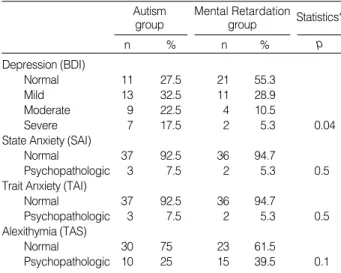
There were more depressed and anxious (state and trait) mothers in the autism group than in mental retardation group (Table 2). There were significantly more pathologic mothers in the autism group than in the mental retardation group in terms of general symptom score, obsessive-compulsive, de- pression, anxiety, anger-hostility, phobic anxiety, paranoid thought, and psychotism according to SCL-90 (Table 3). In the autism group, younger mothers (<30 yr of age) had sig- nificantly higher depression scores and employed mothers had higher state anxiety, trait anxiety, and depression scores (Table 4). The mothers of autistic boys had significantly high- er state anxiety and trait anxity scores than those of autistic girls.
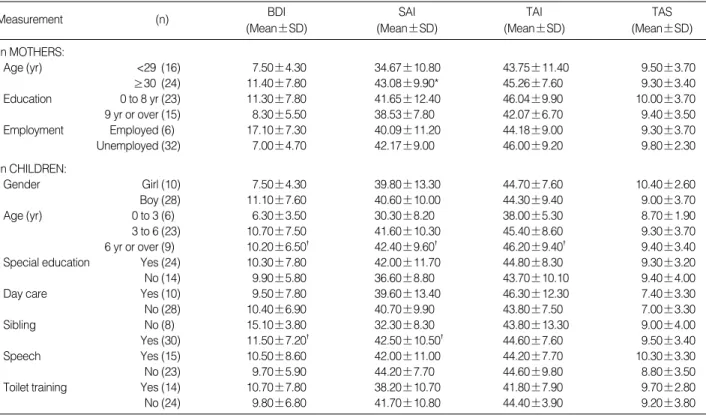
In the mental retardation group, older mothers (>30 yr of age) had statistically significant higher state anxiety scores (Table 5). The mothers in the mental retardation group who had more than one child had significantly higher state anxi- ety and lower depression scores. The remaining factors were found to be insignificant in both groups (age, education his- tory, and occupation of the mothers and gender, age, speech development, presence of special education, day-care, sibling, and toilet training of the children).
BDI 15.50±9.00 10.00±7.00�
SAI 46.00±11.0 40.00±11.0*
TAI 47.00±9.00 44.00±9.00
TAS 8.00±3.00 9.00±3.00
SCL-90 General symptom score 0.90±0.64 0.56±0.32� Somatization (SOM) 1.08±0.99 0.71±0.49*
Obsessive-compulsive (OC) 0.80±0.67 0.50±0.33� Interpersonal sensitivity (INT) 1.08±0.67 0.78±0.48*
Depression (DEP) 1.13±0.74 0.64±0.41�
Anxiety (ANX) 0.96±0.69 0.65±0.49*
Anger-hostility (HOS) 0.56±0.55 0.24±0.24� Phobic anxiety (PHOB) 1.01±0.85 0.46±0.34� Paranoid thought (PAR) 0.87±0.74 0.60±0.50*
Psychotism (PYS) 0.47±0.55 0.22±0.28� Extra scale (ES) 0.82±0.67 0.56±0.47*
Measurements Autism group
Mean±SD Mean±SD Mental retardation
group Table 1.Comparison of depression, state and trait anxiety, alexithymia, and general symptom scores in the mothers of autism group and mental retardation group
Student t-test was used in the analysis.*p<0.05, �p<0.01, �p< 0.001.
BDI: Beck Depression Inventory; SAI: State Anxiety Inventory; TAI: Trait Anxiety Inventory; TAS: Toronto Alexithymia Scale; Symptom Distress Check List: SCL-90.
Depression (BDI)
Normal 11 27.5 21 55.3
Mild 13 32.5 11 28.9
Moderate 9 22.5 4 10.5
Severe 7 17.5 2 5.3 0.04
State Anxiety (SAI)
Normal 37 92.5 36 94.7
Psychopathologic 3 7.5 2 5.3 0.5
Trait Anxiety (TAI)
Normal 37 92.5 36 94.7
Psychopathologic 3 7.5 2 5.3 0.5
Alexithymia (TAS)
Normal 30 75 23 61.5
Psychopathologic 10 25 15 39.5 0.1
n % n % p
Statistics*
Autism group
Mental Retardation group
Table 2.The ratio of depression, anxiety, and alexithymia in the mothers
*Chi-square was used for the statistical analysis. BDI: Beck Depres- sion Inventory; SAI: State Anxiety Inventory; TAI: Trait Anxiety Inventory;
TAS: Toronto Alexithymia Scale.
SCL general score
Normal 24 60.0 35 92.1
Psychopathologic 16 40.0 3 7.9 0.01�
Somatization
Normal 24 60.0 29 76.3
Psychopathologic 16 40.0 9 23.7 0.09
Obsessive compulsive
Normal 25 62.5 34 89.5
Psychopathologic 15 37.5 4 10.5 0.005� Interpersonal sensitivity
Normal 22 45 27 71.1
Psychopathologic 18 45 11 28.9 0.1
Depression
Normal 22 55 33 86.8
Psychopathologic 18 45 5 13.2 0.002�
Anger-hostility
Normal 33 82.5 38 100
Psychopathologic 7 17.5 0 0.0 0.007�
Phobic anxiety
Normal 25 62.5 35 92.1
Psychopathologic 15 37.5 3 7.9 0.002�
Paranoid thought
Normal 26 65 34 89.5
Psychopathologic 14 35 4 10.5 0.01�
Psychotism
Normal 33 82.5 32 97.4
Psychopathologic 7 17.5 1 2.6 0.03�
Extra scale
Normal 26 65 31 91.6
Psychopathologic 14 35 7 18.4 0.08
n % n % p
Statistics*
Autism group
Mental Retardation group
Table 3.The ratio of general symptom score and subscales of SCL-90 in the mothers
*Chi-square was used for the statistical analysis. �Statistically signifi- cant. Symptom Distress Check List: SCL-90.
In MOTHERS:
Age (yr) <29 (16) 17.70±9.60 50.63±12.00 49.50±9.49 9.60±3.10
>30 (24) 14.10±8.90* 43.50±10.00 44.88±8.50 7.30±2.90
Education 0 to 8 yr (8) 18.70±5.70 51.75±11.50 52.13±5.90 10.80±2.10
9 yr or over (32) 14.80±9.80 45.00±11.00 45.38±9.30 8.20±3.20
Employment Employed (12) 17.80±9.00 49.18±11.00 49.00±8.60 8.50±3.50
Unemployed (28) 10.00±7.40� 39.75±9.10� 41.40±8.30� 7.40±2.20
In CHILDREN:
Gender Girl (8) 15.50±10.00 43.35±16.90 45.50±10.40 7.40±2.60
Boy (32) 15.53±9.20 47.09±9.90� 47.03±8.90� 8.30±3.40
Age (yr) 0 to 3 (11) 16.20±8.80 47.10±12.30 48.00±9.80 8.00±3.40
3 to 6 (21) 15.10±9.20 45.10±10.80 46.30±8.90 8.10±2.80
6 yr or over (8) 15.30±8.90 45.80±11.10 46.70±9.10 7.80±3.00
Special education Yes (27) 16.41±2.60 48.63±10.70 48.33±9.40 8.60±2.60
No (13) 7.38±4.20 41.66±11.30 43.38±7.50 7.40±4.20
Day care Yes (29) 14.45±9.40 47.14±11.90 46.27±10.00 8.10±3.70
No (11) 18.36±8.60 44.27±9.40 48.00±6.20 8.50±3.10
Sibling No (10) 14.38±11.50 44.15±12.60 44.30±9.30 7.40±2.20
Yes (30) 16.07±8.10 47.41±10.60 47.89±8.90 8.50±3.60
Speech Yes (24) 17.70±9.70 50.31±10.30 48.12±8.80 8.20±3.10
No (16) 11.60±7.00 46.00±9.40 44.14±9.30 7.90±3.50
Toilet training Yes (25) 16.96±8.49 48.44±10.20 47.92±8.00 8.10±3.20
No (15) 13.13±10.20 42.87±12.40 42.92±12.40 8.30±3.30
TAS (Mean±SD) TAI
(Mean±SD) SAI
(Mean±SD) BDI
(Mean±SD)
Measurement (n)
Table 4.Assessment of variables in the mothers and their autistic children in relation to anxiety, depression, and alexithymia
Mann-Whitney U was used for statistical analysis *p<0.05, �p<0.01, �p<0.001.
BDI: Beck Depression Inventory; SAI: State Anxiety Inventory; TAI: Trait Anxiety Inventory; TAS: Toronto Alexithymia Scale.
In MOTHERS:
Age (yr) <29 (16) 7.50±4.30 34.67±10.80 43.75±11.40 9.50±3.70
≥30 (24) 11.40±7.80 43.08±9.90* 45.26±7.60 9.30±3.40
Education 0 to 8 yr (23) 11.30±7.80 41.65±12.40 46.04±9.90 10.00±3.70
9 yr or over (15) 8.30±5.50 38.53±7.80 42.07±6.70 9.40±3.50
Employment Employed (6) 17.10±7.30 40.09±11.20 44.18±9.00 9.30±3.70
Unemployed (32) 7.00±4.70 42.17±9.00 46.00±9.20 9.80±2.30
In CHILDREN:
Gender Girl (10) 7.50±4.30 39.80±13.30 44.70±7.60 10.40±2.60
Boy (28) 11.10±7.60 40.60±10.00 44.30±9.40 9.00±3.70
Age (yr) 0 to 3 (6) 6.30±3.50 30.30±8.20 38.00±5.30 8.70±1.90
3 to 6 (23) 10.70±7.50 41.60±10.30 45.40±8.60 9.30±3.70
6 yr or over (9) 10.20±6.50� 42.40±9.60� 46.20±9.40� 9.40±3.40
Special education Yes (24) 10.30±7.80 42.00±11.70 44.80±8.30 9.30±3.20
No (14) 9.90±5.80 36.60±8.80 43.70±10.10 9.40±4.00
Day care Yes (10) 9.50±7.80 39.60±13.40 46.30±12.30 7.40±3.30
No (28) 10.40±6.90 40.70±9.90 43.80±7.50 7.00±3.30
Sibling No (8) 15.10±3.80 32.30±8.30 43.80±13.30 9.00±4.00
Yes (30) 11.50±7.20� 42.50±10.50� 44.60±7.60 9.50±3.40
Speech Yes (15) 10.50±8.60 42.00±11.00 44.20±7.70 10.30±3.30
No (23) 9.70±5.90 44.20±7.70 44.60±9.80 8.80±3.50
Toilet training Yes (14) 10.70±7.80 38.20±10.70 41.80±7.90 9.70±2.80
No (24) 9.80±6.80 41.70±10.80 44.40±3.90 9.20±3.80
TAS (Mean±SD) TAI
(Mean±SD) SAI
(Mean±SD) BDI
(Mean±SD)
Measurement (n)
Table 5.Assessment of variables in the mothers and their mentally retarded children in relation to anxiety, depression, and alexithymia
Mann-Whitney U was used for statistical analysis *p<0.05, �p<0.01, �p<0.001.
BDI: Beck Depression Inventory; SAI: State Anxiety Inventory; TAI: Trait Anxiety Inventory; TAS: Toronto Alexithymia Scale.
The mothers in the mental retardation group were less edu- cated and less employed than those in the autism group.
DISCUSSION
In this descriptive, cross-sectional study we found that the mothers of autistic children had significantly higher depres- sion (BDI), state anxiety (SAI), and general symptom scores (SCL-90) and had higher depression, state and trait anxiety rates than those of mentally retarded children. Younger (<30 yr of age), employed mothers of autistic boys had higher psy- chopathology scores.
Before drawing any conclusions, one should take into ac- count the limitations of this study. This was a cross-sectional study and limited to only the mothers of mentally retarded and autistic children and thus may not fully reflect all disabled children or worsening-fluctuating psychopathologies and maladjustment in the families.
Depression scores and state anxiety scores were significant- ly higher in the mothers of autistic children than those of mentally retarded children. There were more depressed and anxious (state and trait) mothers in the autism group than in the mental retardation group. Consistent with pervious studies (15, 26 ), mothers of autism group had significantly higher depression scores and anxiety (state) scores than those of mental retardation group. General score and all sub-scores on SCL-90 including depression and anxiety scores were high in the autism group. A higher depression rate (27, 28), and higher stress and more adjustment problems were reported in the mothers of autistic children than in those of children with Down’s syndrome (15). It was also reported that long- term stress scores were higher in the mothers of autistic chil- dren than those of normal children (12, 29, 30). In a recent study by Olsson and Hwang mothers with children with autism had higher depression scores on BDI than mothers of children with intellectual disability without autism (26).
In our study mothers of autistic children had higher depres- sion scores on BDI (mean=15.0) than the Olsson and Hwang’s study (mean=11.8) (26) whereas mothers of mentally retard- ed children had similar BDI scores in two studies (mean=
10.0 in our study vs. mean=9.2). Fifty percent of mothers with autism and 45% of mothers with intellectual disabili- ty without autism were depressed according to BDI scores in Olsson and Hwang’s study (26) whereas the rates were 72.5% in autism group and 44.7% in mental retardation group in our study. Studies of parents with children with disabilities suggested that 35-53% of mothers of children with disabilities passed cut-off scores for depression (23). In our study depression in the mothers of autistic children was more frequent and severe compared to previous studies which might reflect the relatively inchoate social and medical sup- port for autism in Turkish community in comparison to those for mental retardation which might increase maternal stress.
We need cross-cultural studies for further conclusions.
Families of autistic children were reported to experience long-term distress (31). The ambiguity of the severity and nature of the disability in autistic children make the family and parents find it difficult to make reasonable predictions regarding the potential and capability of the children (31).
The limited social relations and eye contact in autistic chil- dren increased the confusion of the parents and have been shown to increase parental stress (20), and these symptoms are not present in mentally retarded children (30, 31). These factors might contribute to the higher psychopathology in the mothers of autistic children than in those of mentally re- tarded children in our study. Developmental stage was also reported to affect parental stress (32). Of note, speech devel- opment were better in children with autism in our study than those with mental retardation (60% speech positive in autism group vs 40% in mental retardation group). Parents of autis- tic children have long been described as having particular characteristics such as schizoid traits, higher traits of aloof, hypersensitive, anxious, tense, and rigid (33, 34) which in turn contribute to their increased psychological stress. Simi- lar to these studies we found significant increase on anxiety- tense and psychotism related sub-scales of SCL-90 (obsessive- compulsive, depression, anger-hostility, phobic anxiety, para- noid thought, and psychotism sub-scales) in mothers of autism group in comparison to those of mental retardation group.
A correlation between higher depression scores and age of the mothers of the disabled children was reported (5). How- ever, some studies reported no correlation between age and the depression scores of the mothers of the disabled children (31). We found that younger mothers (<30 yr of age) had significantly higher depression scores in the autism group, whereas older mothers (>30 yr of age) had significant high- er state anxiety scores in the mental retardation group. Our findings need to be confirmed in future studies. Although there were no difference in autism group, mothers of younger children (<3 yr of age) had lower depression, state and trait anxiety scores than those of older children (3 to 6 yr and >6 yr of age) in mental retardation group. Turner and Sloper (1996) reported that there were a significant decline with age in the frequency of behaviour problems and disturbed problems in children with Down’s syndrome, but many prob- lems were found to be persistent (32). The few number of young children in autism and mental retardation group made it difficult to draw accurate conclusions regarding the age of the children, but we can conclude that mothers of autistic children had increased psychopathology from the early ages of their children while mothers of mentally retarded children had increased psychopathology at slighty later ages of their children (>3 yr of age). Along with other factors related to autism, it should be taken into account that having a child diagnosed with autism might also be more devastating than with mental retardation due to the dreadful popularity of autism in media.
.
Socio-economic status were reported not to be related to parental depression in families with children with intellec- tual disability (26, 35). In our study employed mothers had significantly higher state anxiety, trait anxiety, and depres- sion scores in the autism group whereas occupation showed no significance in the mental retardation group. Mothers are more involved in the treatment of an autistic child (e.g. learn- ing behavioral techniques) than in the treatment of a men- tally retarded child (2, 36), and staying away from home or from the child may induce feeling of guilty and anxiety in the mothers. Socio-economic factors (e.g. education and em- ployment) might not serve as a buffer against parental stress in the presence of specific stresors related to autistic disorder.
The boys with intellectual disability were reported to have more disturbed behaviour than girls (37), the mothers of dis- abled boys were reported to be more distressed (31), and irri- tability were found to be increased in the relatives of male autistic patients compared to those of boys (33). Similar to these studies we found higher state and trait anxiety scores in the mothers of autistic boys, but the gender showed no significance in the mental retardation group. In mental retar- dation group mothers of more than one child had significant- ly higher state anxiety scores and lower depression scores than those with a single child. Presence of a sibling showed no significance in autistic group and education of the mother, age of the child, presence of a day care, special education, de- velopmental status (speech and toilet training) showed no significance in both groups in terms of anxiety, depression and alexithymia. Further longitudinal research is needed that includes the assessment of anxiety and depression in the child, family functions, and psychological attachment between the child and the family.
In conclusion our study revealed the psychopathology in the mothers of disabled children, especially those with autis- tic children. The clinicians should be aware of the need for the assessment of psychological well-being of the parents and avoid focusing only on the disabled child. The nature of the disability might result in different reactions in parents and these differences should be taken into account. We need lon- gitudinal studies on a large group of samples that will also focus on the fathers’ and siblings’ distress as well as those of mothers. More knowledge about the adaptation process and development of psychopathologies in parents will let us estab- lish more effective preventive strategies which will also in turn help the disabled children.
REFERENCES
1. Quine L, Pahl J. First diagnosis of severe handicap: a study of parental reactions. Dev Med Child Neurol 1987; 29: 232-42.
2. Tomkiewicz S. The Life of parents with handicapped children. Pedi- atrie 1987; 42: 375-82.
3. Kazak AE, Marvin RS. Differences, difficulties and adaptation: stress
and social networks in families with handicapped child. Fam Relat 1984; 33: 67-77.
4. Seligman, M. Handicapped children and their families. J Couns Dev 1985; 64: 274-7.
5. Kazak AE. Families with disabled children: stress and social net- works in three samples. J Abnorm Child Psychol 1987; 15: 137-46.
6. Molsa PK, Ikonen-Molsa SA. The mentally handicapped child and family crisis. J Mental Defic Res 1985; 29: 309-14.
7. Blacher J, Nihira K, Meyers CE. Characteristics of home environ- ment of families with mentally retarded children: comparison across levels of retardation. Am J Ment Defic 1987; 91: 313-20.
8. Bebko JM, Konstantareas M.M, Springer J. Parent and professional evaluations of family stress associated with characteristics of autism.
J Autism Dev Disord 1987; 17: 565-76.
9. Ohta M, Nagai Y, Hara H, Sasaki M. Parental perception of behav- ioral symptoms in Japanese autistic children. J Autism Dev Disord 1987; 17: 549-63.
10. Dor-Shav NK, Horowitz Z. Intelligence and personality variables of parents of autistic children. J Genet Pscyhol 1984; 144: 39-50.
11. Hodapp RM, Dykens EM, Masino LL. Families of children with Prider-Willi syndrome: stress-support and relations to child char- actersitics. J Autism Dev Disord 1997; 27: 11-24.
12. Piven J, Chase G, Landa R, Wrozek M, Gayle J, Cloud D, Folstein S. Psychiatric disorders in the parents of autistic individuals. J Am Acad Child Adolesc Psychiatry 1991; 30: 471-8.
13. Veisson M. Depression symptoms and emotional states in parents of disabled and non-disabled children. J Soc Behav Pers 1999; 27:
87-98.
14. Holroyd J, McArthur D. Mental retardation and stress on the parents:
a contrast between Down’s syndrome and childhood autism. Am J Ment Defic 1976; 80: 431-6.
15. Sanders JL, Morgan SB. Family stress and adjustment as perceived by parents of children with autism and Down’s syndrome: implica- tions for intervention. Child and Family Behaviour Therapy 1997;
19: 15-32.
16. American Psychiatric Association. Diagnostic and Statistical Manu- al of Mental Disorders, Fourth Edition. Washington DC: American Psychiatric Association; 1994.
17. Flrat S, Diler RS, AvclA. Assessment of autistic children with “Child- hood Autism Rating Scale”. In: AvclA, Diler RS, editors. Fulltext Congress Book of 9th National Child and Adolescent Psychiatry Congress, 28-30 April 1999. Adana: Cukurova University Press;
1999: 134-41.
18. Schopler, E, Reichler, RL, Rochen Renner B. The Childhood Autism Rating Scale (CARS), Manual. Los Angeles: Western Psychological Services; 1988.
19. Sucuo lu, B, ktem, F, Akk k, F. A study of assessment tools in children with autism. J Turkish 3P 1996; 4: 116-21.
20. Savasir I, Sahin N. Weschler Cocuklar icin Zeka Olcegi (WISC-R).
Ankara : Turkish Psychologists Association Publication; 1994.
21. Togrol B. Catell Zeka Testinin 2A ve 2B formlari ile Porteus Labirent- leri Zeka Testi’nin (Porteus Mazes Test) 1300 Turk cocuguna uyarlan- masi. Istanbul Universitesi Psikoloji Calismalari 1974; 11: 1-32.
22. Hisli N. Beck depresyon envanterinin ge erli i zerine bir allma.
Psikoloji Dergisi 1988; 6: 118-26.
23. ner N, LeCompte A. Durumluk -S rekli KayglEnvanteri El Kitabl. Istanbul: Bo azi i niversitesi Yaylnlari; 1982.
24. Dereboy IF. Aleksitimi bir gzden ge irme. T rk Psikiyatri Dergis 1990; 1: 155-63.
25. ner N. T rkiyede Kullanllan Psikolojik Testler: Bir Ba vuru Kayna l. Istanbul: Bo azi i niversitesi Yaylnlarl; 1994.
26. Olsson MB, Hwang CP. Depression in mothers and fathers of chil- dren with intellectual disability. J Intellect Disabil Res 2001; 45:
535-43.
27. Ryde-Brandt B. Anxiety and defence strategies in mothers of children with different disabilities. Br J Soc Psychol 1990; 63: 183-92.
28. Wolf LC, Noh S, Fisman SN, Speechley M. Brief Report: psycho- logical effects of parenting stress on parents of autistic children. J Autism Dev Disord 1989; 19: 157-66.
29. G ndo du BF. Otistik ve normal ocu u olan anne-babalarln evlilik uyumlarlnlalgllamalarlve bazlde i kenler baklmlndan karlla - tlrllmasl[dissertation]. Ankara: Ankara niversitesi Sosyal Bilim- ler Enstit s ; 1995.
30. Rosenbaum PL. Prevention of psychosocial problems in children with chronic illness. Can Med Assoc J 1986; 139: 293-5.
31. TunallB, Power TG. Creating satisfaction: a psychological perspec-
tive on stress and coping in families of handicapped children. J Child Psychol Psychiatr 1993; 34: 945-57.
32. Turner S, Sloper P. Behaviour problems among children with Down’s syndrome: prevalance, persistence and parental appraisal. J Appl Res Intellect Disabil 1996; 9: 129-44.
33. Murphy M, Bolton PF, Pickles A, Fombonne E, Piven J, Rutter M.
Personality traits of the relatives of autistic probands. Psychol Med 2000; 30: 1411-24.
34. Piven J, Palmer P, Jacob D, Childress D, Arndt J. Broader autism phenotype; evidence from a family history study of multiple-incidence autism families. Am J Psychiatry 1997; 154: 185-91.
35. Hoare P, Harris M, Kerley S. A community survey of children with severe intellectual disability and their families: psychological adjust- ment, carer distress and the effect of respite care. J Intellect Disabil Res 1998; 42: 218-27.
36. Wing L. Autistic Children. A Guide for Parents. Trowbridge: Red- wood Burn Ltd; 1972.
37. Stores R, Stores G, Fellows B, Buckley S. Daytime behaviour prob- lems and maternal stress in children with Down’s syndrome, their siblings, and non-intellectually diabled and other intellectually dia- bled peers. J Intellect Disabil Res 1998; 42: 228-37.
.