This study aimed to show the effects of Korean medicine treatment (particularly bee-venom pharmacopunture) on a patient with brachial plexus palsy. A 64-year-old woman was diagnosed with brachial plexus palsy on the right upper extremity and was treated with Korean and Western medicine from September 30
thto November 6
th, 2019. Improvement of the patient’s symptoms was evaluated using the Manual Muscle Test, Range of Motion and visual analogue scale. After treatment, the patient’s Manual Muscle Test grade and Range of Motion were improved, and the Visual Analogue Scale score indicated the intensity of her right hand numbness had decreased. These results suggested that improper use of crutches can result in brachial plexus palsy and a Korean-Western medicine treatment regimen primarily focused on bee-venom pharmacopunture, may be effective in reducing the symptoms of brachial plexus palsy.
©2020 Korean Acupuncture & Moxibustion Medicine Society. This is an open access article under the CC BY- NC-ND license (http://creativecommons.org/licenses/by-nc-nd/4.0/).
Article history:
Submitted: June 02, 2020 Revised: July 13, 2020 Accepted: July 23, 2020 Keywords:
acupuncture, bee venom, palsy.
https://doi.org/10.13045/jar.2020.00164 pISSN 2586-288X eISSN 2586-2898
Case Report
Brachial Plexus Palsy whilst on Crutches Treated with Korean Medicine Focused on Bee-Venom Pharmacopunture
Jae Eun Lim
1, Mi Sa Song
2, Hyun Jeong Do
1, Gyu Hui Kim
1, Jung Hyeon Park
1, Hyun Min Yoon
1, Sun Hee Jang
1, Jong Cheol Seo
1, Choon Ho Song
1, Cheol Hong Kim
1,*
1 Department of Acupuncture and Moxibustion Meridian and Acupoint, College of Korean Medicine, Dong-Eui University, Busan, Korea 2 Department of Ophthalmology and Otolaryngology and Dermatology, College of Korean Medicine, Dong-Eui University, Busan, Korea
ABSTRACT
Journal of Acupuncture Research
Journal homepage: http://www.e-jar.org
Introduction
The brachial plexus is a bundle of nerves which extend from the lower 4 cervical nerves and the 1st thoracic nerve root (C5, C6, C7, C8, and T1) to the upper extremities. This plexus consists of both motor and sensory nerves and forms the basis of the nerves in the upper extremities [1].
Damage to the brachial plexus may result in neurological symptoms such as weakness or loss of muscle strength, and sensory loss in upper extremities. The leading cause of the brachial plexus injury is traffic accidents, followed by a fall, knife damages pinch point injury, and injuries during birth [2]. Brachial plexus injury is especially common in males in their 20s and 30s [3], and this injury does not usually occur independently in most cases, but tends to be accompanied with other injuries such as fractures of the clavicle, rib, humerus or scapula, and hemopneumothorax [4].
In Western medicine, nerve conduction studies and
electromyography are primary methods to diagnose brachial plexus palsy, and computerized tomography and magnetic response imaging (MRI) can be used for accurate diagnoses [5]. The treatment of brachial plexus palsy is classified into conservative treatment including medication, physical therapy and rehabilitation, and surgical intervention including exploration, neurolysis, neurorrhaphy, nerve grafting, and neurotization.
In Korean medicine, brachial plexus palsy classified according to the main symptoms or causes. If sensory impairment is a significant symptom then the brachial plexus palsy is classed as Mamok (numbness of the skin) or Mamokbulin (insensitivity of the skin), and if motor impairment is prominent the brachial plexus palsy is called Wi syndrome (wilting disease). In addition, accompanying neuralgia is classified as Kyunbitong (shoulder pain), and if the cause of brachial plexus palsy is due to trauma it is classified as Shangkeun (sinew injury) [6].
Korean medicine treatments for brachial plexus injury include
*
Corresponding author. Cheol Hong KimDepartment of Acupuncture and Moxibustion Meridian and Acupoint,College of Korean Medicine, Dong-Eui University, 62, Yangjeong-ro, Busanjin-gu, Busan 47227,Korea E-mail:[email protected]
ORCID: Jae Eun Lim https://orcid.org/0000-0002-3001-1670, Mi Sa Song https://orcid.org/0000-0002-3392-4563, Hyun Jeong Do https://orcid.org/0000-0002-2466-1044, Gyu Hui Kim https://orcid.org/0000-0002-4521-5334, Jung Hyeon Park https://orcid.org/0000-0002-0550-4115, Hyun Min Yoon https://orcid.org/0000-0003-3645-6109, Sun Hee Jang https://orcid.org/0000-0001-6968-1009, Jong Cheol Seo https://orcid.org/0000-0002-5114-3189, Choon Ho Song https://orcid.org/0000-0003-0030-1391, Cheol Hong Kim https://orcid.org/0000-0003-2058-0762
©2020 Korean Acupuncture & Moxibustion Medicine Society. This is an open access article under the CC BY-NC-ND license (http://creativecommons.org/licenses/by-nc- nd/4.0/).
injury after cervical lymph node biopsy [7], having a fall [8], and traffic accident [4,9]. Research on brachial plexus palsy caused by compressive damage has been much less studied. A case of a patient suffering from postural brachial plexus injury after a long surgical procedure has been reported [10].
The clinical case presented in this retrospective study, presents data from a patient who suffered from brachial plexus palsy which occurred whilst she was on crutches because of a fracture to her right ankle. Korean-Western medicine treatment primarily focused on bee-venom pharmacopunture (BVP) to treat brachial plexus palsy with neurological symptoms (such as weakness in right upper limb muscles, Range of Motion (ROM) limits on right wrist joint and numbness on right hand).
This study is a retrospective chart review approved for exemption from deliberation by the Institutional Review Board of 00 Korean medicine hospital (IRB no.: 2020-02).
Case Report Patient Patient
Um○○, F/64 Chief complaint
Weakness in right upper limb muscles and ROM limits on the right wrist joint.
Onset
September 24
th, 2019.
Past history
The patient was diagnosed with diabetes mellitus and hyperlipidemia in 2017 and receives medication for these conditions.
Present illness
The patient has been on crutches due to a fracture in the right ankle, since August 4
th, 2019. Whilst on crutches, she felt weakness in the right upper arm to the hand on September 24
th, 2019, and it seemed like there was no particular reason for the weakness since she had not suffered a trauma (like a fall). She was admitted to the
□□ hospital, Neurology Department on September 24
thand stayed until the 28
thSeptember, 2019. She received MRI scan of her brain and underwent electromyography, but there were no particular problems arising from the tests. She also took a C-spine MRI where she was diagnosed with a cervical herniated intervertebral disc between C6 and C7, but it was not directly related to the present symptoms. Although □□ hospital recommended her to transfer to a specialist hospital for a more accurate examination, she was admitted to the Department of Acupuncture at ○○ Korean Medicine Clinic on September 30
thfor concentrated Korean medicine treatment.
During her stay, an orthopedic surgeon of ○○ Hospital asked for an X-ray scan on October 1
st, 2019to check the condition of the fracture in her right ankle. Then he strongly recommended the patient to receive treatment at a specialist hospital for accurate diagnosis on paralyzed right wrist. Upon the surgeon’s advice she was discharged on October 1
st, but returned to the ○○ Korean Medicine Clinic on October 2
nd. She said that the muscle strength in the right upper limb had increased after Korean medicine treatment, and wanted to be treated at the ○○ Korean Medicine
Clinic instead of the specialist hospital.
Treatment period and number of treatments
The patient had inpatient treatment from September 30
thuntil October 1
st, 2019, and 10 outpatient sessions from October 2
nduntil November 6
th, 2019.
Symptoms of first-visit
On September 24
th, 2019, she felt weakness in the right upper arm to her hand and her right wrist was paralyzed so the ROM of this joint was limited. In addition, she felt numbness in her right hand that lasted all day; her visual analogue scale (VAS) score was 5.
Physical examination
The patient’s symptoms were evaluated with the Manual Muscle Test (MMT) and ROM. Although the MMT grade for the right upper extremity flexors and right shoulder extensor were Grade 4, and the right elbow extensor was Grade 3, the right wrist extensor was Grade 0. The ROM of the right upper limb joints were normal (excluding the right wrist extension which was measured at 0°).
Radiological findings
The wrist anterior-posterior and lateral (right) X-ray scans (October 1
st, 2019) showed no remarkable findings.
Other symptoms
The patient had suffered from hot flushes and excessive perspiration for several years. In addition, she had frequent urination (approximately 8-9 times during the day and 3 times at night), whilst the amount of water she usually drank was normal.
Her appetite and digestive condition were normal, but she suffered from chronic constipation. She defecated once every 2 or 3 days on average and had to put considerable effort into her defecation.
Treatments Pharmacopuncture
BVP and Juglandis semen pharmacopuncture (JSP) were used and the concentration of BVP was adjusted depending on the severity of symptoms, treatment session, or site of injection. Skin testing was performed on the skin around LI11 prior to the BVP treatment.
During the inpatient treatment period until the 2
ndoutpatient treatment, the patient received 1:10,000 BVP (Extramural Herbal Dispensary of the Busan Korean Medical Association, Busan, Korea) using a 1.0mL disposable insulin syringe (29g× 12.7 mm, Shin Chang Medical Co., Gumi, Korea). The injection points were SI9, GB21, HT1, LI10, LI4, EX-UE9 and EX-UE7, and a total of 1 mL was used across all sites (0.05 to 0.1 mL were distributed to each point). In the 3
rdand 4
thsession, the patient received 1:4,000 BVP (Extramural Herbal Dispensary of the Busan Korean Medical Association, Busan, Korea) at the identical points as the previous sessions. In the 5
thand 6
thsession, a total 1 mL of the 1:2,000 BVP (Extramural Herbal Dispensary of Bee Plus, Chilgok, Korea) was injected into SI9, HT1, LI10, and 0.5 mL of the 1:10,000 BVP (Extramural Herbal Dispensary of Bee Plus, Chilgok, Korea) was injected into EX-UE9 and EX-UE7 in her right hand. From the 7
thto 10
thsessions, 1 mL of the 1:1,000 BVP (Extramural Herbal Dispensary of Bee Plus, Chilgok, Korea) was injected at the identical points as the previous sessions in the upper and lower arm and 0.5 mL of the 1:10,000 BVP (Extramural Herbal Dispensary of Bee Plus, Chilgok, Korea) was also injected into the identical points on the 6
thsession in her right hand.
During every session, 1 mL of the JSP (Extramural Herbal
Dispensary of the Busan Korean Medical Association, Busan, Korea) was injected into GB20, GB21, and other trigger points along the pathway of the brachial and radial nerve in the axillary area or deltoid, biceps brachii and brachialis muscles, using disposable insulin syringes (27 g × 38 mm, Shin Chang Medical Co., Gumi, Korea).
Pharmacopuncture treatment was performed once a day during the inpatient treatment, and once every session during the outpatient treatment. Throughout the whole treatment period, the treatment was performed by a specialist with more than 20 years of clinical experience in the Department of Acupuncture and Moxibustion.
Acupuncture
Acupuncture treatment was performed twice a day during the inpatient treatment period and once every session during the outpatient treatment. Sterilized, disposable needles (0.25 × 40 mm, Dong Bang Acupuncture Inc., Seongnam, Korea) were used for a retaining time of approximately 20 minutes, and a needling depth of 10 mm to 20 mm. Dong-Si acupuncture treatment was applied at Shinkwan, Cheugsamli, Cheughasamli, Yugwan and Samjung on the unaffected side, and Young-gol, SI3 on the affected side. No further treatment was provided after the acupuncture, and this treatment was performed by 2 trainees specializing in acupuncture.
Herbal medicine treatment
She did not take herbal medicine during the short inpatient treatment period. During the period of outpatient treatment from October 2
ndto November 6
th, 2019, she took Hwanggijakyakgyejigoju-Tang 3 times a day. The formula
consisted of Astragali Radix 10g, Paeoniae Radix Alba 6 g, CinnamomiRamulus 6 g and Oryzae Acetum 40 mL.
Western medicine treatment
She took Solondo 5 mg, Mioben 20 mg, Gabatin 100 mg and Hantracet 37.5 mg prescribed by a doctor at the □□ hospital from September 24
thto 30
th, 2019, and she took Solondo 10 mg and Dexilant 30 mg prescribed by the Department of Rehabilitation Medicine at the ○○ Hospital, 3 times a day from October 4
thto 10
th, 2019.
Evaluation methods
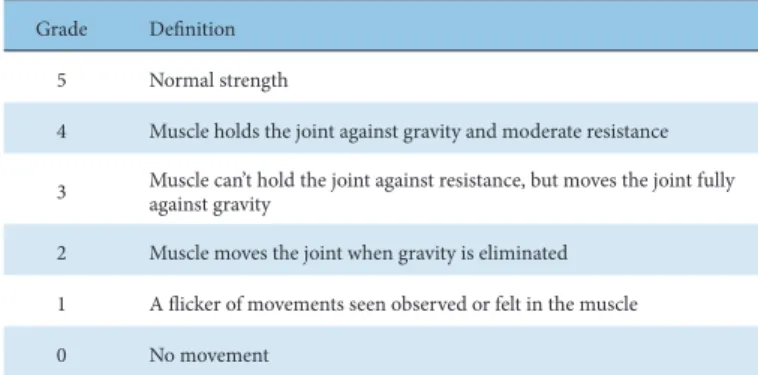
MMT The muscular strength of the upper extremity was evaluated based on the MMT (Table 1). Muscle strength for the unaffected upper extremity was rated as Grade 5, and if the muscle strength of the affected upper extremity is nearly equal to that of the unaffected one, it was rated Grade 4. The right wrist extensor was primarily evaluated as Grade 0 and the right elbow extensor was rated as Grade 3 in the first assessment.
ROM The maximum angle of the right wrist extension was measured 8 times from September 30
thto November 6
th, 2019. The right wrist extension was only subject to ROM evaluation, since that of flexion, adduction, abduction, internal rotation and external rotation showed normal range in the first assessment.
VAS The VAS is a 10cmhorizontal line marked with a scale of 0 to 10.
where 0 indicates “no symptoms at all” and 10 indicates “the worst pain imaginable [11].” The degree of her discomfort of numbness on her right hand was rated.
Treatment progress
The MMT grade of the right upper extremity and ROM of the right wrist increased (Tables 2 and 3) and the discomfort of numbness in her right hand decreased as indicated by the VAS score (Table 4). In addition, the other symptoms such as hot flushes and excessive perspiration improved. After 10days of taking Hwanggijakyakgyejigoju-Tang, symptoms such as hot flushes and excessive perspiration had decreased by 30% on October 11
th, 2019, compared with symptoms on September 30
th, and symptoms had decreased more than 60% on October 21
st, after taking it for 20 days.
Grade Definition 5 Normal strength
4 Muscle holds the joint against gravity and moderate resistance 3 Muscle can’t hold the joint against resistance, but moves the joint fully
against gravity
2 Muscle moves the joint when gravity is eliminated 1 A flicker of movements seen observed or felt in the muscle
0 No movement
Table 1.Manual Muscle Test.
30th
Sept. 2nd
Oct. 7th
Oct. 14th
Oct. 18th
Oct. 21st
Oct. 25th
Oct. 6th
Nov.
Shoulder Flexor 4 4 4 4 4 4 4 4
Extensor 4 4 4 4 4 4 4 4
Elbow Flexor 4 4 4 4 4 4 4 4
Extensor 3 3 3 3 4 4 4 4
Wrist Flexor 4 4 4 4 4 4 4 4
Extensor 0 1 1 1 1 2 2 3
Table2. Muscle Manual Test Before and During the Treatment Period.
Discussion
Brachial plexus is a bundle of nerves with a complicated anatomical structure which varies from person to person.
Therefore, it is difficult to accurately diagnose how severe the symptoms are or where the exact damaged areas are when the plexus is damaged. In addition, the injury has an extremely poor prognosis and may result in serious disability to the patient since there is no specific cure for brachial plexus palsy [12]. In this case, a woman patient on crutches was diagnosed with brachial plexus palsy. Similar to this case, the paralysis caused by continuous pressure on the brachial plexus, axillary nerve, and radial nerve is called “Crutch palsy.” Crutch palsy is a rare compressive neuropathy but it may occur in some people who use crutches improperly, causing prolonged and excessive compression on the axial region. Therefore, education in the proper use of crutches may help prevent this complication [13].
In treating neurological disorders or anti-inflammatory conditions, controlling immune function or hormone secretion, improving blood circulation and relieving pain BVP has been reported to be effective [14]. During the treatment, the concentration of BVP was adjusted every session, and there were marked changes in the symptoms when increasing the concentration of BVP. Especially, in extension ROM on the right wrist which improved after the use of 1:1,000 Bee Venom from 0°
on October 18
thto 30° on October 21
st, 2019.
In addition to the BVP treatment, 1 mL of the JSP was injected into trigger points every session along with the pathway of the brachial and radial nerve in the axial region. It was aimed to moisten the muscular meridian (body) [15] on the upper extremity which caused the pain and had developed whilst on crutches.
The acupuncture treatment was primarily based on Dong- Si acupuncture therapy. Cheugsamli and Cheughasamli of the affected side, which aimed to treat neuralgia with blood-activating, stasis-dispelling, anti-inflammatory and pain relief. Yugwan and Samjung of the affected side, which aimed to treat hemiplegia
with soothing the muscles and activating the collaterals. Shin- kwan of the affected side, which is known to have special effects on shoulder and arm pain. Young-gol and SI3 of the unaffected side as traction points [16].
From October 2
ndto November 6
th, the patient took Hwanggijakyakgyejigoju-Tang3times a day. It aimed to treat excessive perspiration, frequent urination, and hot flushes, based on the content of the Shanghanlun [17], and to treat numbness in the right hand, based on the content of Yakjing which says “Astragali Radix treats Mamokbulin [18].”As a result, herbal medicine treatment improved not only the main symptoms of Mamokbulin (insensitivity of the skin), but also hot flushes, and excessive perspiration, which helped the patient’s overall condition improve.
To evaluate the progress of improvement, the MMT grade in the right upper limb and ROM on the right wrist were measured. In addition, the patient was required to indicate the degree of right- hand numbness using the VAS, and to assess the percent of hot flushes and episodes of excessive perspiration compared with the first evaluation.
After treatment, the MMT grade of the right elbow improved from Grade 3 to Grade 4, and the right wrist improved from Grade 0 to Grade 3. The extension ROM of the right wrist also improved from 0° on September 30
th, to 60° on November 6
th. In addition, the intensity of numbness in the right hand reduced from a VAS score of 5 to a score of 2, and the range numbness became narrower (from the whole hand to the fingertips). The patient was especially satisfied with the Korean medicine treatment because it addressed not only the main symptoms but also the hot flushes and excessive perspiration which were alleviated by 60% compared to before treatment.
After the 10
thoutpatient session (November 6
th, 2019), she discontinued her treatment, since she felt she had fully recovered from her symptoms.
As the number of survivors from traffic or sports accidents increases, the number of brachial plexus injury patients is also increasing. Most of these patients suffer from neuropathy pain and
30th
Sept. 2nd
Oct. 7th
Oct. 14th
Oct. 18th
Oct. 21st
Oct. 25th
Oct. 6th
Nov.
Shoulder Flexion Norm* Norm Norm Norm Norm Norm norm Norm
Extension Norm Norm Norm Norm Norm Norm norm Norm
Elbow Flexion Norm Norm Norm Norm Norm Norm norm Norm
Extension Norm Norm Norm Norm Norm Norm norm Norm
Wrist Flexion Norm Norm Norm Norm Norm Norm norm Norm
Extension 0° 0° 0° 0° 0° 30° 45° 60°
Norm, normal range.
Table3. Range of Motion Before and During the Treatment Period.
30th
Sept. 2nd
Oct. 7th
Oct. 14th
Oct. 18th
Oct. 21st
Oct. 25th
Oct. 6th
Nov.
VAS score 5 4 4 3 3 3 2 2
VAS, visual analogue scale.
Table4. Changes of VAS Score for Numbness on the Right Hand.