• 검색 결과가 없습니다.

Reconstruction of Chest Wall Defects Using a Technique Involving Mesh, Titanium Plates, and a Pedunculated Muscle Flap

N/A
N/A
Protected

Academic year: 2021

Share "Reconstruction of Chest Wall Defects Using a Technique Involving Mesh, Titanium Plates, and a Pedunculated Muscle Flap"

Copied!
4
0
0

로드 중.... (전체 텍스트 보기)

전체 글

(1)

ISSN: 2233-601X (Print) ISSN: 2093-6516 (Online)

− 308 −

Received: June 5, 2018, Revised: August 24, 2018, Accepted: August 27, 2018, Published online: October 5, 2018

Corresponding author: Dave Koole, Department of Thoracic Surgery, Elisabeth-Tweesteden Hospital, 5042 AD Tilburg, The Netherlands (Tel) 31-0621469818 (Fax) 31-013-4677216 (E-mail) [email protected]

© The Korean Society for Thoracic and Cardiovascular Surgery. 2018. All right reserved.

This is an open access article distributed under the terms of the Creative Commons Attribution Non-Commercial License (http://creativecommons.org/

licenses/by-nc/4.0) which permits unrestricted non-commercial use, distribution, and reproduction in any medium, provided the original work is properly cited.

Reconstruction of Chest Wall Defects Using a Technique Involving Mesh, Titanium Plates,

and a Pedunculated Muscle Flap

Dave Koole, M.D., Ph.D. 1 , Michael Bemelman, M.D. 1 , Joost Schijen, M.D. 2 , Marnix de Fijter, M.D. 1 , Joël van der Niet, M.D. 1

Departments of

1

Thoracic Surgery and

2

Pulmonology, Elisabeth-Tweesteden Hospital

We herein present a new surgical reconstruction technique for large chest wall defects after resection of ad- vanced chest wall tumors.

Key words: 1. Chest wall 2. Reconstruction

Introduction

Large chest wall resections are often mandatory in the management of chest wall tumors. Skeletal re- construction is required to prevent respiratory failure due to paradoxical thoracic movement or infection and to protect the lungs, heart, and greater vessels from injury. Furthermore, reconstruction of the thoracic cage aims to maintain functional and cos- metic integrity. The complication rate of large chest wall reconstructions ranges between 46% and 69%, with a respiratory morbidity rate of 27% [1].

Reconstructions with materials such as methyl me- thyacrylate, bone cement, fascia grafts, and silicone implants have been described [2]. These techniques are not optimal for chest wall reconstruction, and in- fection of the prothesis requires complete removal.

We describe an alternative large chest wall re- construction procedure in 4 patients using a combi- nation of a mesh, titanium plates, and a penduncu- lated muscular flap to ensure flexible movements in combination with a reduced infection rate.

Methods

1) Technique

Patients were intubated with a double-lumen tube.

For a right lobectomy, the patient was placed in the left lateral decubitus position, followed by a right posterolateral thoracotomy and mobilization of the latissimus dorsi and intercostal muscles. The involved part of the thoracic wall and involved lobe were re- sected en bloc with a 2-cm macroscopic margin. The bronchial stump was covered by an intercostal mus- cle flap. A ‘sandwich’ technique (mesh, titanium plates, and pedunculated muscle flap) was used to reconstruct the resulting large thoracic wall defect.

The defect in the thoracic wall was covered with the mesh as an inner lining, with a 3-cm overlap inside the thoracic cage, and anchored with Mersilene su- tures through bore holes of the ribs. To reconstruct the rib cage and to bridge the defects, titanium plates secured with at least 3 screws on either side of the ribs were used (matrixRIB system, Synthes). If possible, the screws were alternately placed to ach- ieve a more flexible construction. The plates were at-

Korean J Thorac Cardiovasc Surg 2018;51:308-311 □ CLINICAL RESEARCH □

https://doi.org/10.5090/kjtcs.2018.51.5.308

(2)

Chest Wall Defect Reconstruction: A New Technique

− 309 −

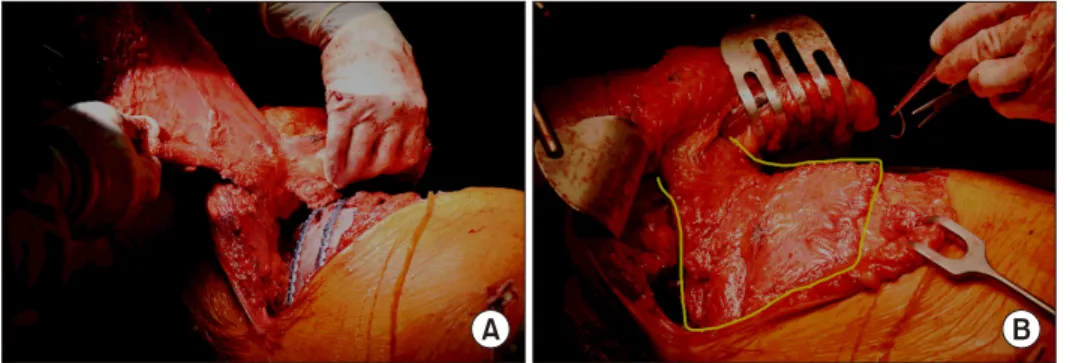
Fig. 2. (A, B) A pedunculated lat- issimus dorsi flap covered both the mesh and the titanium plates.

Fig. 1. A thoracic wall defect covered with a mesh and titanium plates.

Table 1. Pulmonary function tests before and after surgery in case 1

Variable Before surgery After surgery Total lung capacity 8,600 mL (113%) 5,940 mL (82%) Vital capacity 4,360 mL (87%) 3,020 mL (65%)

FEV1 2,000 mL (53%) 1,480 mL (42%)

FVC/FEV1 ratio 47% 49%

FEV1, forced expiratory volume in 1 second; FVC, forced vital capacity.

tached to the mesh with Vicryl sutures, which facili- tate removal of a broken plate (Fig. 1). A peduncu- lated latissimus dorsi flap was tunneled under the scapula (nerves were cut), and covered both the mesh and the titanium plates (Fig. 2). Finally, a chest tube and 2 wound drains were placed to secure drainage. The same technique was used for right and left lobectomies.

Results

1) Case 1

A 58-year-old patient presented with a persistent dry cough, dyspnea, and hemoptysis. Computed to- mography (CT) showed a solid tumor in the right upper lobe with invasion of the chest wall and pathologic lymph nodes in the right hilum. Bron- choalveolar lavage fluid cytology revealed malignant cells (non-small cell lung cancer [NSCLC]). Mediasti- noscopy with lymph node biopsy showed no lym- phatic metastases (stage IIB). A sleeve bilobectomy of

the right upper and middle lobe was performed, with the right lower lobe attached to the main bronchial tree. The resulting chest wall defect was recon- structed with a polypropylene mesh, titanium plates, and a pedunculated latissimus dorsi flap. Pathologic examination revealed a pT3N1M0R0 carcinoma (stage IIIA). He was extubated immediately afterwards, and was discharged 9 days after surgery. The patient re- ceived adjuvant chemotherapy without complications.

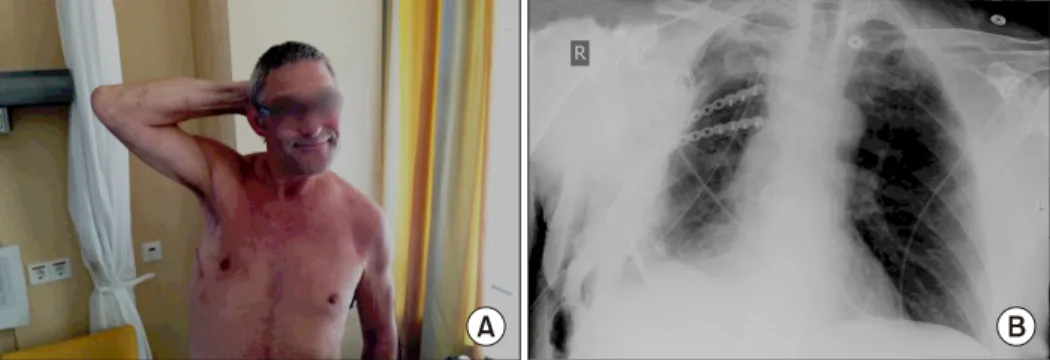
After 10 months, the patient presented with thoracic pain located at the site of the implanted plates. A chest X-ray revealed spontaneous fracture of a tita- nium plate. The plate was surgically removed with- out complications. The patient currently has good pulmonary function without pain or thoracic de- formity (Table 1, Fig. 3).

2) Case 2

A 64-year-old patient presented with thoracic pain,

coughing, and sneezing. CT and positron emission to-

mography (PET) imaging showed a tumor located at

the lingula. CT-guided needle biopsy revealed malig-

nant NSCLC cells (stage IIB). Partial resection of 2

ribs and pericardium and lobectomy of the upper left

lobe were performed. Reconstruction of the chest

wall defect was achieved with a dual mesh, titanium

(3)

Dave Koole, et al

− 310 −

Fig. 3. (A, B) The patient has good pulmonary function without pain or thoracic deformity.

Table 2. Pulmonary function tests before and after surgery in case 4

Variable Before surgery After surgery Total lung capacity 6,970 mL (100%) 5,050 mL (75%) Vital capacity 4,240 mL (103%) 2,760 mL (71%)

FEV1 2,560 mL (85%) 2,090 mL (73%)

FVC/FEV1 ratio 61% 76%

FEV1, forced expiratory volume in 1 second; FVC, forced vital capacity.

plates, and the serratus anterior muscle. Pathological examination revealed a sarcomatoid carcinoma (pT3N0R0). The patient was rapidly extubated and discharged after 8 days. Adjuvant chemotherapy was initiated. After 4 months, a fracture of the humerus was diagnosed as having resulted from osteolytic metastasis. Internal fixation of the fracture was per- formed, followed by adjuvant radiotherapy. The pa- tient currently has good clinical pulmonary function without functional loss or visible deformity of the chest.

3) Case 3

A 74-year-old patient was hospitalized for delirium.

A tumor of the lung was discovered on a chest X-ray.

CT imaging of the chest revealed a Pancoast tumor with invasion of the thoracic wall. PET imaging dem- onstrated increased uptake at the site of the tumor, and in 1 ipsilateral hilar lymph node. Ultrasound needle biopsy demonstrated a low-grade NSCLC (stage IIIA). Cerebral magnetic resonance imaging (MRI) and mediastinoscopy did not detect additional lymph node metastasis. The patient received neo- adjuvant chemoradiation, which resulted in re- gression of the tumor. Resection of the first 4 ribs and lobectomy of the left upper lobe were performed.

A polypropylene mesh, titanium plates, and a pe- dunculated latissimus dorsi muscle flap were used for chest wall reconstruction. Pathologic examination showed malignant tumor cells and peribronchial lymph node metastasis (pT3N1M0R0) Extubation fol- lowed directly, and the patient was discharged 14 days after surgery. The patient died 6 months after surgery due to widespread metastases.

4) Case 4

A 72-year-old presented with chest pain that radi-

ated to the left upper arm. CT imaging showed a tu- mor in the left upper lobe with invasion of the parie- tal pleura. PET revealed increased uptake at the site of the tumor and in 1 ipsilateral hilar lymph node.

Ultrasound-guided needle biopsy revealed malignant NSCLC cells (stage IIIA). Cerebral MRI and media- stinoscopy did not detect additional lymph node metastasis. The patient received neoadjuvant chemo- radiation, which resulted in regression of the tumor.

Partial resection of the first 4 ribs with lobectomy of the left upper lobe was performed. Chest wall re- construction was established with a mesh, titanium plates, and a pedunculated latissimus dorsi muscle flap. Pathologic examination showed fibrosis after chemoradiation (T3N1M0R0). Immediate extubation was performed, and the patient was discharged after 17 days. During 24 months of follow-up no events occurred. The patient has good pulmonary function, and no functional or cosmetic defects of the chest (Table 2).

Discussion

This study describes 3 patients with stage IIIA

NSCLC and 1 patient with a sarcomatoid tumor with

large chest wall defects. Reconstruction was per-

formed using a mesh, titanium plates, and a pedun-

(4)

Chest Wall Defect Reconstruction: A New Technique

− 311 − culated muscle flap. The aim of this reconstruction is to create a flexible fibrous plate resulting from growth of fibroblasts into the mesh, and to prevent recurring infections [3]. Dieterich et al. [3] showed increased proliferation and penetration of myofibro- blasts in meshes using scanning electron microscopy.

Another study demonstrated that the biocompatibility of the mesh combined with titanium plates facilitated adhesion between the mesh and its surroundings [4].

In fibroblasts, titanium upregulates fibronectin, which is deposited in the extracellular matrix and binds col- lagen, proteoglycans, and fibrin. Several reports have shown a lower rate of postoperative infections when titanium was used than for other materials [5]. In addition, using a pedunculated muscle as the outer lining stimulates fibrous outgrowth and protects against infections [3]. The fracture of titanium plates (matrixRIB system) from a direct impact has been reported once in the literature. In our study, 1 pa- tient developed a spontaneous plate fracture. The plate was removed without complications and did not have to be replaced because a fibrous plate had been formed. Moreover, no patients developed com- plications related to adjuvant chemotherapy or radiation.

In conclusion, reconstruction of large chest wall defects with a mesh, titanium plates, and a peduncu-

lated muscle flap is feasible.

Conflict of interest

No potential conflict of interest relevant to this ar- ticle was reported.

References

1. Weyant MJ, Bains MS, Venkatraman E, et el. Results of chest wall resection and reconstruction with and without rigid prosthesis. Ann Thorac Surg 2006;81:279-85.

2. Lardinois D, Muller M, Furrer M, et al. Functional assess- ment of chest wall integrity after methylmethacrylate reconstruction. Ann Thorac Surg 2000;69:919-23.

3. Dieterich M, Stubert J, Gerber B, Reimer T, Richter DU.

Biocompatibility, cell growth and clinical relevance of synthetic meshes and biological matrixes for internal sup- port in implant-based breast reconstruction. Arch Gynecol Obstet 2015;291:1371-9.

4. Berthet JP, Wihlm JM, Canaud L, et al. The combination of polytetrafluoroethylene mesh and titanium rib implants:

an innovative process for reconstructing large full thick- ness chest wall defects. Eur J Cardiothorac Surg 2012;42:

444-53.

5. Berthet JP, Solovei L, Tiffet O, et al. Chest-wall re-

construction in case of infection of the operative site: is

there any interest in titanium rib osteosynthesis? Eur J

Cardiothorac Surg 2013;44:866-74.

수치

Table 1. Pulmonary function tests before and after surgery in  case 1
Fig. 3. (A, B) The patient has good  pulmonary function without pain or  thoracic deformity.

참조

관련 문서

In the efficiency review of the Trombe wall system through the experiment, if the Trombe wall was applied in the building structure, the Trombe wall had the

Salama H, Rose LF, Salama M, Betts NJ : Immediate loading of bilaterally splinted titanium root-form implants in fixed prosthodontics.. A technique reexamined:

Alveolar ridge augmentation with titanium mesh and a combination of autogenous bone and anorganic bovine bone: a 2-year prospective study.. Corinaldesi G, Pieri F, Sapigni

success rates of dental implants placed at the time of or after alveolar ridge augmentation with an autogenous mandibular bone graft and titanium mesh: a 3-to

This study was to do a comparative analysis on kinematic differences and differences in muscle activity between the skilled and the unskilled in windsurfing

The third was combination of levator palpebrae, superior rectus, inferior oblique muscle weakness(n=5) and the fourth was the third group plus medial rectus

The preparation of osseodensification technique should start with a smaller diameter than conventional technique because of the recovery of elastic strain. It

Results: The results demonstrated a significant positive correlation between the muscle atrophy and the tendon tear.(p<0.05) And there was statistically