서 론
우리나라는 65세 이상 노인에서 치매 유병률이 9.2% (95% confi- dence intervals [CIs] 8.2–10.4)로 서구나 다른 아시아 국가보다 높은 수준이다.1) 치매 발생을 줄일 수 있는 것으로 신체활동, 금연, 적절한 음주, 건강한 식이 등이 알려졌다.2,3) 생활습관과 같은 개인적인 요인 외에 사회적 관계도 치매 발생에 영향을 줄 수 있는데, 스웨덴 코호 트연구(75세 이상, 1,203명)에 따르면 홀로 사는 노인은 배우자와 함 께 사는 노인보다 치매가 많이 발생하였다.4) 미국 코호트연구(78세
이상 여성, 2,249명)에서는 가족과 친구로 구성된 사회연결망이 풍성 할수록 치매 발생이 적었고,5) 프랑스에서 15년 동안 추적 관찰한 코 호트연구(65세 이상, 3,777명)에서는 다른 사람과의 관계에 만족하 는 군은 그렇지 않은 군에 비하여 치매 발생이 감소하였다.6)
일상생활을 수행하는 데 장애가 생겨 치매를 진단받기 전에 인지 기능 감소가 먼저 일어난다.7) 그래서 치매의 조기 진단과 예방을 위 해서 인지기능 감소가 있는 사람을 확인하는 것이 중요하다. 미국에 서 수행한 두 가지 코호트연구가 있다. 시카고에 거주하는 65세 이상 6,102명에서 지난 한 달간 보았던 자녀, 친척, 친구들의 수가 많을수
Original Article
형체가 있는 사회적 지지와 노인의 인지기능 감소:
고령화연구패널조사
이원준, 김하경, 김현하, 유승룡, 장수은, 오미경*
울산대학교 의과대학 강릉아산병원 가정의학교실
Tangible Social Support and Cognitive Decline in the Elderly: The Korean Longitudinal Study of Aging
Won Joon Lee, Haa-Gyoung Kim, Hyunha Kim, Seung Ryoung Yoo, Soo Eun Jang, Mi-Kyeong Oh*
Department of Family Medicine, Gangneung Asan Hospital, University of Ulsan College of Medicine, Gangneung, Korea
Background: Low levels of social support are known to be linked to decreased cognitive function and increased dementia risks. This study examined how tangible social support provided by offspring to their parents reduces cognitive decline among the elderly.
Methods: This study used data from the Korean Longitudinal Study of Aging. The study subjects were 1,540 individuals aged 65 years and older population who evidenced no cognitive impairment (Korean-Mini Mental State Examination ≥24). They were interviewed in 2006, and then were followed up with for 2 years. Tangible social support (monetary or other) was categorized as giver (and/or taker), only taker, or neither. A multiple logistic regression analysis was conducted to determine the relationships between tangible social support and cognitive decline.
Results: After adjusting for potential confounders, the neither and only taker groups were likely to undergo cognitive decline compared to those in the monetary give-and-take group (odds ratio [OR], 2.18; 95% confidence interval [CI], 1.36–3.60; OR, 1.67; 95% CI, 1.07–2.68, respectively). Among those of the lowest socioeconomic status, the neither group demonstrated more cognitive decline than did the monetary give-and-take group (OR, 4.78; 95% CI, 1.39–22.36).
Conclusion: Encouraging give-and-take between parents and their offspring may assist in protecting the elderly from cognitive decline.
Keywords: Elderly; Social Support; Cognitive Decline
https://doi.org/10.21215/kjfp.2017.7.3.337 eISSN 2233-9116
Korean J Fam Pract. 2017;7(3):337-341
KJFP
Korean Journal of Family PracticeReceived February 26, 2016 Revised June 27, 2016 Accepted July 7, 2016 Corresponding author Mi-Kyeong Oh
Tel: +82-33-610-3325, Fax: +82-33-641-8130 E-mail: [email protected]
Copyright © 2017 The Korean Academy of Family Medicine
This is an open-access article distributed under the terms of the Creative Commons At- tribution Non-Commercial License (http://creativecommons.org/licenses/by-nc/4.0) which permits unrestricted noncommercial use, distribution, and reproduction in any medium, provided the original work is properly cited.
Won Joon Lee, et al. Tangible Social Support and Cognitive Decline in the Elderly
Korean Journal of Family Practice
KJFP
록 5년 후 인지기능 감소가 적었다.8) 34개 알츠하이머병센터에 방문 한 55세 이상 5,335명에서는 배우자와 같이 사는 사람은 다른 사람 (친척 등)과 같이 사는 사람보다 3년 후 인지기능 감소가 적었지만, 자녀 유무와 인지기능 감소의 관련성은 유의하지 않았다.9)
이전 연구들은 다양한 사회적 관계와 인지기능 감소의 관련성을 보여주었지만, 부모-자식 관계를 사회연결망의 한 부분으로만 다루 거나 자녀의 유무만을 고려하였으므로 구체적으로 어떤 측면이 인
지기능과 관련되는지 알기 어렵다. 이 연구에서는 우리나라에서 부 모와 자식 사이에서 오고 가는 유형의 사회적 지지(금전, 선물이나 여행 및 관광, 건강보조식품, 의료 보조기구 등)가 노인의 인지기능 감소와 관련성이 있는지 살펴보았다.
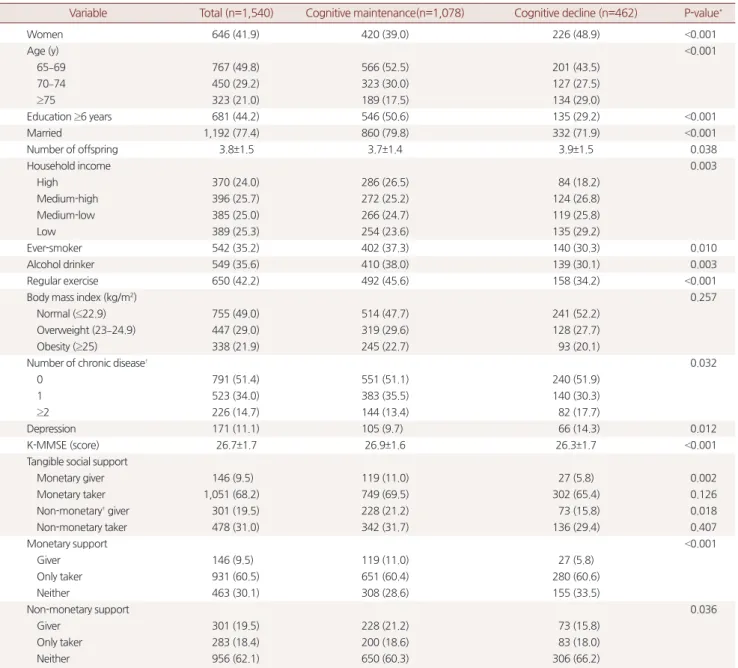
Table 1. Baseline characteristics among study population
Variable Total (n=1,540) Cognitive maintenance(n=1,078) Cognitive decline (n=462) P-value*
Women 646 (41.9) 420 (39.0) 226 (48.9) <0.001
Age (y) <0.001
65–69 767 (49.8) 566 (52.5) 201 (43.5)
70–74 450 (29.2) 323 (30.0) 127 (27.5)
≥75 323 (21.0) 189 (17.5) 134 (29.0)
Education ≥6 years 681 (44.2) 546 (50.6) 135 (29.2) <0.001
Married 1,192 (77.4) 860 (79.8) 332 (71.9) <0.001
Number of offspring 3.8±1.5 3.7±1.4 3.9±1.5 0.038
Household income 0.003
High 370 (24.0) 286 (26.5) 84 (18.2)
Medium-high 396 (25.7) 272 (25.2) 124 (26.8)
Medium-low 385 (25.0) 266 (24.7) 119 (25.8)
Low 389 (25.3) 254 (23.6) 135 (29.2)
Ever-smoker 542 (35.2) 402 (37.3) 140 (30.3) 0.010
Alcohol drinker 549 (35.6) 410 (38.0) 139 (30.1) 0.003
Regular exercise 650 (42.2) 492 (45.6) 158 (34.2) <0.001
Body mass index (kg/m2) 0.257
Normal (≤22.9) 755 (49.0) 514 (47.7) 241 (52.2)
Overweight (23–24.9) 447 (29.0) 319 (29.6) 128 (27.7)
Obesity (≥25) 338 (21.9) 245 (22.7) 93 (20.1)
Number of chronic disease† 0.032
0 791 (51.4) 551 (51.1) 240 (51.9)
1 523 (34.0) 383 (35.5) 140 (30.3)
≥2 226 (14.7) 144 (13.4) 82 (17.7)
Depression 171 (11.1) 105 (9.7) 66 (14.3) 0.012
K-MMSE (score) 26.7±1.7 26.9±1.6 26.3±1.7 <0.001
Tangible social support
Monetary giver 146 (9.5) 119 (11.0) 27 (5.8) 0.002
Monetary taker 1,051 (68.2) 749 (69.5) 302 (65.4) 0.126
Non-monetary‡ giver 301 (19.5) 228 (21.2) 73 (15.8) 0.018
Non-monetary taker 478 (31.0) 342 (31.7) 136 (29.4) 0.407
Monetary support <0.001
Giver 146 (9.5) 119 (11.0) 27 (5.8)
Only taker 931 (60.5) 651 (60.4) 280 (60.6)
Neither 463 (30.1) 308 (28.6) 155 (33.5)
Non-monetary support 0.036
Giver 301 (19.5) 228 (21.2) 73 (15.8)
Only taker 283 (18.4) 200 (18.6) 83 (18.0)
Neither 956 (62.1) 650 (60.3) 306 (66.2)
Values are presented as number (%) or mean±standard deviation.
K-MMSE, Korean-Mini Mental State Examination.
*P-values were calculated by chi-square test or paired t-test. †Chronic diseases included hypertension, diabetes mellitus, heart disease, and cerebrovascular diseases.
‡Non-monetary support included gifts, trips, health supplement foods, medical appliances, and electronics.
이원준 외. 형체가 있는 사회적 지지와 노인의 인지기능 감소 Korean Journal of Family Practice
KJFP
방 법
고령화연구패널조사(Korean Longitudinal Study of Aging, KLoSA) 는 45세 이상 중고령자를 대상으로 하는 패널연구로 다층층화추출 한 10,254명에 대하여 2006년에 기본조사를 하였고, 이 중에 2008년 8,688명(84.7%)을 추적조사 하였다. 기초조사 항목과 연구방법에 대 해서는 이미 다른 연구에서 소개하였다.10) 65세 이상 노인 3,501명 중 에 2006년에 인지기능 저하가 없는(한국형 간이정신상태검사[Kore- an-Mini Mental State Examination, K-MMSE] 24점 이상) 사람이 1,767 명이었다. 이 중에 자녀가 있고, 설문을 완결한 1,540명을 연구대상으 로 하였다. 인지기능은 K-MMSE로 측정하였고 24점 이상을 정상으 로 하고,11,12) 2년 후에 24점 미만으로 감소한 경우를 인지기능 감소로 정의하였다.
사회적 지지는 다른 사람에 의해 제공되는 자원으로 정의하고,13) 정서적, 도구적, 평가적, 정보적 지지 등으로 구분한다.14) 유형의 사회 적 지지(도구적 지지)는 금전적 지원(용돈, 생활비)이나 비금전 물질 적 지원(선물, 여행 및 관광, 건강보조식품, 의료보조기구, 전자제품 등)으로 나누었다. 응답한 시점의 작년 한 해(2005년) 동안에 부모(응 답자)가 자녀에게 금전을 주었는지(혹은 주지 않음, monetary giver or not), 자녀로부터 금전을 받았는지(혹은 받지 않음, monetary taker or not), 자녀에게 비금전적 지원을 주었는지(혹은 주지 않음, non-mon- etary giver or not), 자녀로부터 비금전적 지원을 받았는지(혹은 받지 않음, non-monetary taker or not)를 변수로 만들었다. 또한 금전적 지 원과 비금전적 지원의 각각에 대하여 주고받은 경우와 주기만 한 경 우, 받기만 한 경우, 주지도 받지도 않은 경우의 네 그룹으로 나누려 고 하였지만 주기만 한 경우가 거의 없었다. 주기만 한 경우와 주고받 은 경우를 자녀에게 준 경우(giver)로 분류하여 총 세 그룹으로 나누 어 분석하였다.
인지기능과 연관된 교란변수로는 이전 연구를 참고하여 선택하
였다.4-6,9) 비만도는 통계적 유의성이 없어 제외하였고, 최종적으로 통
계적 모델에 포함한 교란변수는 성별, 나이(65–69세, 70–74세, 75세 이상), 교육수준(초등학교 졸업 이상), 결혼, 자녀 수, 가구소득(상, 중 상, 중하, 하), 생활습관(흡연, 음주, 운동), 만성질환 개수(고혈압, 당뇨 병, 심장질환, 뇌혈관질환), 우울증, 2006년도 인지기능 점수이다.
1. 통계분석
2년 동안 인지기능을 정상으로 유지한 군과 감소한 군으로 나누 어 연속형 변수에서 평균의 차이가 있는지 검정하기 위해 대응표본 t-검정(paired t-test)을 하고, 범주형 변수에서 빈도의 차이가 있는지 알기 위해 카이제곱 검정(chi-square test)을 하였다. 비만도를 제외한
나머지 변수의 영향을 통계적으로 보정하기 위하여 다중 로지스틱 회귀분석(multiple logistic regression analysis)을 사용하였고, 유형의 사회적 지지와 인지기능 감소의 관련성을 알기 위해 교차비(odds ra- tios, ORs)와 95% CIs를 계산하였다. 끝으로 소득수준별로 영향이 다 른지 알기 위해 각각의 소득수준 그룹으로 나누어 다중 로지스틱 회귀분석을 하였다. 모든 통계분석은 프로그램 R ver. 3.1.3 (R Foun- dation for Statistical Computing, Vienna, Austria)을 사용하였다.15) 결 과
65세 이상 노인 1,540명 중에 2년 후 462명(30.0%)에서 인지기능이 감소하였다. 비만도를 제외한 모든 변수에서 인지기능이 유지한 군 과 감소한 군 사이에 유의한 차이가 있었다. 인지기능이 유지한 군은 감소한 군에 비하여 남자가 많고, 젊으며, 교육을 더 받았고, 결혼한 사람이 많으며, 소득이 높았다. 두 군 사이에 자녀로부터 돈이나 다 른 것을 받은 비율은 비슷하였고, 자녀에게 돈이나 다른 것을 준 경 우는 인지기능이 유지한 군에서 많았다(Table 1).
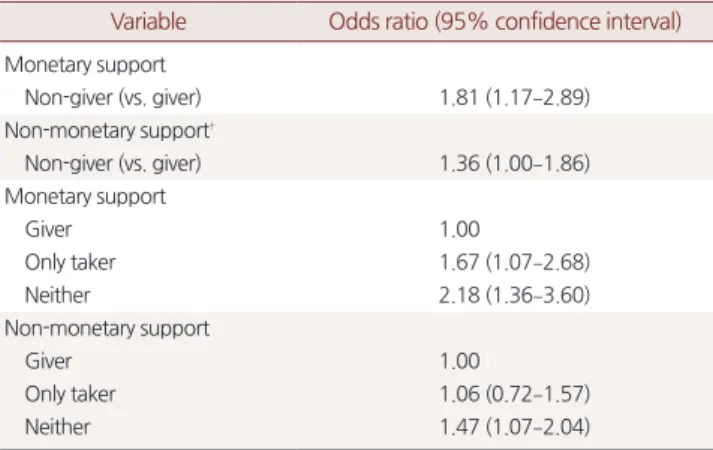
성별, 나이, 교육, 결혼, 자녀 수, 소득과 생활습관(흡연, 음주, 운 동), 만성질환(고혈압, 당뇨병, 심장질환, 뇌혈관질환), 우울증, 인지기 능 점수(2006년)의 영향을 통계적으로 보정하였을 때, 자녀와 돈을 주고받는지는 둘 다 인지기능 감소와 연관성이 있었지만, 비금전적 지원에서는 부모가 자녀에게 주는 경우에만 연관성을 보였다(Table 2).
가구소득을 사분위수 기준으로 네 가지 군으로 나누어 개별적으 로 분석한 결과 소득이 중하인 군에서 자녀에게 돈을 주는 경우에 비하여 서로 주고받지 않은 노인이 인지기능 감소가 더 많이 생겼다
Table 2. Tangible social support and cognitive decline*
Variable Odds ratio (95% confidence interval) Monetary support
Non-giver (vs. giver) 1.81 (1.17–2.89) Non-monetary support†
Non-giver (vs. giver) 1.36 (1.00–1.86) Monetary support
Giver 1.00 (
Only taker 1.67 (1.07–2.68)
Neither 2.18 (1.36–3.60)
Non-monetary support
Giver 1.00 (
Only taker 1.06 (0.72–1.57)
Neither 1.47 (1.07–2.04)
*Logistic regression analysis adjusted for gender, age, education (≥6 years), mari- tal status, number of offspring, household income, tobacco smoking, alcohol drinking, regular exercise, number of chronic disease (hypertension, diabetes mellitus, heart disease and cerebrovascular disease), depression and baseline Ko- rean-Mini Mental State Examination score. †Non-monetary support included gifts, trips, health supplement foods, medical appliances, and electronics.
Won Joon Lee, et al. Tangible Social Support and Cognitive Decline in the Elderly
Korean Journal of Family Practice
KJFP
(OR 3.38, 95% CI 1.29–10.15). 소득이 가장 낮은 군에서는 자녀에게 돈 을 주는 경우에 비하여 자녀로부터 돈을 받기만 하는 노인과 주거나 받지 않은 노인이 모두 유의하게 인지기능 감소가 더 많이 발생하였 다(각각 OR 3.44, 95% CI 1.05–15.65; OR 4.78, 95% CI 1.39–22.36) (Table 3).
고 찰
인지기능이 정상인 65세 이상 노인에서 자녀와 금전적이거나 비 금전적인 지원이 오고 갈 때 그렇지 않은 경우와 비교하여 2년 후 인 지기능 저하가 적었다. 특히, 저소득층 노인에서 유형의 사회적 지지 가 인지기능 저하를 줄이는 데 가장 큰 영향을 주었고, 금전적 지원 이 더욱 의미가 있었다.
이 연구를 통해 새롭게 밝혀낸 것은 네 가지가 있다. 첫째, 우리나 라에서도 사회적 지지와 노인의 인지기능의 관련성이 있는 것을 확 인하였다. 둘째, 사회적 지지를 부모-자식 관계에서 유형의 사회적 지 지로 구체화하였다. 사회 연결망이 풍성할수록 인지기능 감소가 줄 어든다고 했을 때 노인에게 새로운 가족, 친구, 친척을 만드는 것은 어렵고, 관계하고 있는 사람들은 노인의 인지기능 감소를 막기 위해 어떤 일을 해야 하는지 모르게 된다. 하지만 부모-자식 관계에서 유 형의 지지가 오고 가는 것이 인지기능 감소가 줄어든다고 하면 부모 나 자식에게나 노인의 인지기능 감소를 위해서 유형의 지지(금전, 선 물이나 여행 및 관광, 건강보조식품, 의료 보조기구 등)를 주고받아 볼 수 있어 실제 적용이 가능해진다. 셋째, 이전에 사회적 지지는 수 동적인 개념으로 인식하였지만, 자원을 받는 것뿐만 아니라 상대에 게 주는 것도 노인의 인지기능 저하를 막는 데 도움이 될 수 있다. 자 식은 있지만 상호 교류가 없는 경우에 부모가 먼저 유형의 자원을 자 녀에게 제공하는 것으로 사회적 지지를 시작하고 노인의 인지기능 저하를 막는 것을 기대할 수 있다. 넷째, 소득이 낮은 노인은 소득이 높은 노인에 비하여 인지기능 저하가 더 많았지만, 소득이 낮은 노인
일수록 유형의 사회적 지지가 인지기능 감소에 더 큰 영향을 주었다.
취약계층에서 부모-자식 관계의 사회적 지지를 활성화할 수 있다면 소득에 따른 인지기능의 격차를 줄일 수 있을 것이다.
부모-자식 관계에서 유형의 사회적 지지가 노인의 인지기능 감소 에 영향을 미치는 병태생리학 기전으로는 이미 알려진 사회적 지지 와 건강을 연결하는 심혈관계와 신경호르몬계, 면역계가 관여하는 것으로 생각한다.10) 특히, 인지기능과 관련된 연구로 치매가 없는 89 명의 노인을 대상으로 한 코호트연구가 있다. 노인의 사회적 관계가 생전의 인지기능 혹은 사망 후 부검한 뇌의 병리소견에 미치는 영향 을 분석하였는데 인지기능이 떨어질수록 뇌의 병리소견이 심하였지 만, 더 많은 사회 연결망을 가진 군에서는 심한 뇌의 병리소견을 갖 더라도 인지기능이 유지되었다.16) 이는 사회적 지지가 인지기능 감소 를 줄이는 데 대한 완충효과를 나타낸다는 가설을 뒷받침한다.
이 연구는 몇 가지 한계점이 있다. 첫째, 부모-자식 관계의 상호작 용을 살펴보는데 이론적으로 가능한 경우는 네 가지(주고받는 경 우, 주기만 하는 경우, 받기만 하는 경우, 주지도 받지도 않는 경우)이 지만 실제로는 노인이 자녀에게 유형의 자원을 주기만 하는 경우가 거의 없어 세 개군으로 밖에 나누지 못하였다. 주고받는 것과 주기만 하는 것을 주는 경우로 분류하여, 순수하게 주기만 하는 경우와 인 지기능 감소의 관련성을 확인하지 못하였다. 둘째, 유형의 사회적 지 지 외에 감정적(혹은 주관적) 사회적 지지에 대해서 같이 측정하지 못하였다. 감정적 사회적 지지는 ‘그 관계를 만족하는가?’, ‘만족하는 정도는 어떠한가?’와 같은 설문으로 측정하는데 이미 수집된 자료에 는 관련된 설문 문항이 없었다. 셋째, 인지기능이 감소하면 사회적 관 계가 줄어들 수 있다. 이를 극복하기 위해 2006년 인지기능 점수를 통계적으로 보정하였지만 연구 초기에 인지기능감소가 발생한 군 을 가려내지 못해 역인과(reverse causality)의 가능성을 완전히 배제 할 수는 없다. 넷째, 유형의 사회적 지지를 설문조사로 측정하여 과 거의 기억을 잘못 기억하는 회상 비뚤림(recall bias)이나 설문자에게 Table 3. Tangible social support and cognitive decline according to the household income*
Variable High Medium-high Medium-low Low
Monetary support
Giver 1.00 1.00 1.00 1.00
Only taker 1.58 (0.63–4.52) 1.10 (0.51–2.48) 2.08 (0.84–5.95) 3.44 (1.05–15.65)
Neither 2.11 (0.80–6.32) 1.04 (0.45–2.51) 3.38 (1.29–10.15) 4.78 (1.39–22.36)
Non-monetary support†
Giver 1.00 1.00 1.00 1.00
Only taker 1.43 (0.57–3.58) 0.93 (0.44–1.97) 1.72 (0.78–3.87) 0.55 (0.24–1.26)
Neither 1.32 (0.67–2.69) 1.13 (0.63–2.06) 2.28 (1.17–4.66) 1.21 (0.60–2.48)
Values are presented as odds ratio (95% confidence interval).
*Logistic regression analysis adjusted for gender, age, education (≥6 years), marital status, number of offspring, tobacco smoking, alcohol drinking, regular exercise, number of chronic disease (hypertension, diabetes mellitus, heart disease and cerebrovascular disease), depression and baseline Korean-Mini Mental State Examination score. †Non-monetary support included gifts, trips, health supplement foods, medical appliances, and electronics.
이원준 외. 형체가 있는 사회적 지지와 노인의 인지기능 감소 Korean Journal of Family Practice
KJFP
실제보다 더 나은 모습으로 보여지고 싶은 사회적 바람직성 편향(so- cial desirability bias)이 있을 수 있다. 회상 비뚤림은 사회적 지지의 종 류와 상관없이 무작위로 발생하여 연구 결과에 큰 영향을 주지는 않는다. 사회적 바람직성 편향은 유형의 사회적 지지가 실제로는 없 었는데 있다고 응답하는 비율을 높이는 방향으로 작용하였을 것이 고, 이것은 사회적 지지와 인지기능 감소의 연관성을 약화시키는 방 향으로 작용하여 실제 효과크기를 과소평가하게 한다.
향후 연구에서는 유형의 사회적 지지와 감정적 사회적 지지를 함 께 측정하여 인지기능과 관련성 및 이 둘 사이의 교호작용을 확인 하고, 역인과의 가능성을 줄이기 위하여 좀 더 긴 시간의 추적관찰 을 한 후 초기 몇 년간에 인지기능 저하를 제외하고 분석을 하는 것 을 제안한다.
여러 사회관계 중에 부모-자식 관계가 큰 비중을 차지하는 우리 나라에서는 부모와 자녀 사이에 돈이나 물질적 지원을 주고받는 것 은 노인의 인지기능 감소를 줄이는 데 영향을 주는 것으로 나타났다.
요 약
연구배경:
노인에서 사회적 지지가 적은 것은 인지기능을 감소시켜 치매 발생을 높인다. 부모와 자녀 사이에 오가는 유형의 사회적 지지 와 인지기능 감소가 관련성이 있는지 살펴보았다.방법:
고령화연구패널조사 자료를 이용한 코호트 연구로 2006년에 인지기능 저하가 없고(간이정신상태검사 24점 이상), 자녀가 있는 65 세 이상 노인을 대상으로 하였다(1,540명). 유형의 사회적 지지(금전 적 혹은 비금전적 지원)를 자녀에게 준 경우(주고받은 경우와 주기 만한 경우 포함), 자녀로부터 받기만 한 경우, 주지도 받지도 않은 경 우로 분류하였다. 유형의 사회적 지지와 2년 후 인지기능 감소(간이 정신상태검사 24점 미만)의 관련성을 알아보기 위하여 다중 로지스 틱 회귀분석을 하였다.결과:
혼란변수의 영향을 통계적으로 보정하였을 때, 금전을 자녀 와 주지도 받지도 않은 경우와 자녀에게 받기만 한 경우는 자녀에게 주는 경우에 비하여 인지기능 감소가 유의하게 많았다(교차비 2.18, 95% 신뢰구간 1.36–3.60; 교차비 1.67, 95% 신뢰구간 1.07–2.68). 특히 저소득층 노인에서 금전적 지지를 주고받지 않는 경우는 주는 경우 에 비해 인지기능 저하가 많이 발생했다(교차비 4.78, 95% 신뢰구간 1.39–22.36).결론:
부모와 자녀 사이에 유형의 사회적 지지를 주고받는 것은 노 인의 인지기능 감소를 줄이는 데 영향을 준다.중심단어:
노인; 사회적 지지; 인지기능 감소REFERENCES
1. Kim YJ, Han JW, So YS, Seo JY, Kim KY, Kim KW. Prevalence and trends of dementia in Korea: a systematic review and meta-analysis. J Korean Med Sci 2014; 29: 903-12.
2. Di Marco LY, Marzo A, Muñoz-Ruiz M, Ikram MA, Kivipelto M, Ruefe- nacht D, et al. Modifiable lifestyle factors in dementia: a systematic review of longitudinal observational cohort studies. J Alzheimers Dis 2014; 42: 119- 35.
3. Lee Y, Na DL, Cheong HK, Hong CH, Back JH, Kim J, et al. Lifestyle recom- mendations for dementia prevention: PASCAL. J Korean Geriatr Soc 2009;
13: 61-8.
4. Fratiglioni L, Wang HX, Ericsson K, Maytan M, Winblad B. Influence of so- cial network on occurrence of dementia: a community-based longitudinal study. Lancet 2000; 355: 1315-9.
5. Crooks VC, Lubben J, Petitti DB, Little D, Chiu V. Social network, cognitive function, and dementia incidence among elderly women. Am J Public Health 2008; 98: 1221-7.
6. Amieva H, Stoykova R, Matharan F, Helmer C, Antonucci TC, Dartigues JF.
What aspects of social network are protective for dementia? Not the quanti- ty but the quality of social interactions is protective up to 15 years later. Psy- chosom Med 2010; 72: 905-11.
7. Petersen RC. Mild cognitive impairment as a diagnostic entity. J Intern Med 2004; 256: 183-94.
8. Barnes LL, Mendes de Leon CF, Wilson RS, Bienias JL, Evans DA. Social re- sources and cognitive decline in a population of older African Americans and whites. Neurology 2004; 63: 2322-6.
9. Brenowitz WD, Kukull WA, Beresford SA, Monsell SE, Williams EC. Social relationships and risk of incident mild cognitive impairment in U.S. Al- zheimer’s disease centers. Alzheimer Dis Assoc Disord 2014; 28: 253-60.
10. Uchino BN. Social support and health: a review of physiological processes potentially underlying links to disease outcomes. J Behav Med 2006; 29:
377-87.
11. Folstein MF, Folstein SE, McHugh PR. “Mini-mental state”. A practical meth- od for grading the cognitive state of patients for the clinician. J Psychiatr Res 1975; 12: 189-98.
12. Kang Y, Na DL, Hahn S. A validity study on the Korean Mini-Mental State Examination (K-MMSE) in dementia patients. J Korean Neurol Assoc 1997;
15: 300-8.
13. Cohen S, Syme SL. Social support and health. Orlando (FA): Academic Press; 1985.
14. House JS. Work stress and social support. Reading (MA): Addison-Wesley Pub. Co.; 1981.
15. Team RC. R: a language and environment for statistical computing. Vienna:
R Foundation for Statistical Computing; 2015.
16. Bennett DA, Schneider JA, Tang Y, Arnold SE, Wilson RS. The effect of social networks on the relation between Alzheimer’s disease pathology and level of cognitive function in old people: a longitudinal cohort study. Lancet Neurol 2006; 5: 406-12.