ABSTRACT
Purpose: Li-Fraumeni syndrome (LFS) is a rare autosomal cancer syndrome caused by a germline mutation in the TP53 gene. Breast cancer in LFS patients is of various subtypes;
however, limited data are available on the clinicopathological features of these subtypes and their appropriate treatments. This study aimed to review the clinical features and treatments for breast cancer in South Korean patients with germline TP53 mutations.
Methods: Data on the clinicopathological features and treatment of all breast cancer patients with LFS were collected retrospectively from the available database of 4 tertiary hospitals in the Republic of Korea.
Results: Twenty-one breast cancer cases in 12 unrelated women with confirmed germline TP53 mutations were included in the study. The median age at diagnosis was 33.5 years. The histopathological diagnosis included invasive ductal carcinoma (n = 16), ductal carcinoma in situ (n = 3), and malignant phyllodes tumor (n = 2). While 42% and 31% of the cases were positive for estrogen and progesterone receptors, respectively, 52.6% were human epidermal growth factor receptor 2 (HER2) positive, and 21% were triple-negative. The treatments included mastectomy (52%) and breast-conserving surgery (38%). Five patients underwent radiotherapy (RT). The median follow-up period was 87.5 (8–222) months. There were 3 ipsilateral and 4 contralateral breast recurrences during the follow-up, and 8 patients developed new primary cancers. In the post-RT subgroup, there were 2 ipsilateral and 2 contralateral breast recurrences in 1 patient, and 4 patients had a new primary cancer.
Conclusion: As reported in other countries, breast cancer in LFS patients in South Korea had an early onset and were predominantly but not exclusively positive for HER2.
A multidisciplinary approach with adherence to the treatment guidelines, considering mastectomy, and avoiding RT is encouraged to prevent RT-associated sequelae in LFS patients.
Keywords: Breast neoplasms; Genes, erbB-2; Li-Fraumeni syndrome; Genes, p53
Original Article
Received: Sep 21, 2020 Revised: Dec 26, 2020 Accepted: Feb 16, 2021 Correspondence to Woo-Chan Park
Division of Breast Surgery, Department of Surgery, Seoul St. Mary's Hospital, College of Medicine, The Catholic University of Korea, 222 Banpo-daero, Seocho-gu, Seoul 06591, Korea.
E-mail: [email protected]
© 2021 Korean Breast Cancer Society This is an Open Access article distributed under the terms of the Creative Commons Attribution Non-Commercial License (https://
creativecommons.org/licenses/by-nc/4.0/) which permits unrestricted non-commercial use, distribution, and reproduction in any medium, provided the original work is properly cited.
ORCID iDs Hassan Alyami
https://orcid.org/0000-0002-7824-6583 Tae-Kyung Yoo
https://orcid.org/0000-0002-5790-353X Jong-Ho Cheun
https://orcid.org/0000-0001-9986-5597 Han-Byoel Lee
https://orcid.org/0000-0003-0152-575X Sung Mi Jung
https://orcid.org/0000-0003-2820-8797
Hassan Alyami 1,2, Tae-Kyung Yoo 1, Jong-Ho Cheun 3, Han-Byoel Lee 3,4,5, Sung Mi Jung 6, Jai Min Ryu 6, Soong June Bae 7, Joon Jeong 7,
Chang Ik Yoon 1, Juneyoung Ahn 1, Pill Sun Paik 1, Min Kyung Cho 1, Woo-Chan Park 1
1 Division of Breast Surgery, Department of Surgery, Seoul St. Mary's Hospital, College of Medicine, The Catholic University of Korea, Seoul, Korea
2Department of Surgery, King Fahd Military Medical Complex, Dhahran, Saudi Arabia
3Department of Surgery, Seoul National University College of Medicine, Seoul, Korea
4Biomedical Research Institute, Seoul National University Hospital, Seoul, Korea
5Cancer Research Institute, Seoul National University, Seoul, Korea
6 Division of Breast Surgery, Department of Surgery, Samsung Medical Center, Sungkyunkwan University School of Medicine, Seoul, Korea
7Department of Surgery, Gangnam Severance Hospital, Yonsei University College of Medicine, Seoul, Korea
Clinical Features of Breast Cancer in
South Korean Patients with Germline
TP53 Gene Mutations
Jai Min Ryu
https://orcid.org/0000-0001-5405-7385 Soong June Bae
https://orcid.org/0000-0002-0012-9694 Joon Jeong
https://orcid.org/0000-0003-0397-0005 Chang Ik Yoon
https://orcid.org/0000-0002-7273-8886 Juneyoung Ahn
https://orcid.org/0000-0002-6840-4496 Pill Sun Paik
https://orcid.org/0000-0001-8480-5567 Min Kyung Cho
https://orcid.org/0000-0002-3445-1921 Woo-Chan Park
https://orcid.org/0000-0002-1265-1981 Conflict of Interest
The authors declare that they have no competing interests. Han-Byoel Lee is a member of the board of directors of, and has stock and ownership interests at DCGen, Co., Ltd., outside the submitted work.
Author Contributions
Data curation: Alyami H, Cheun JH, Lee HB, Jung SM, Ryu JM, Bae SJ, Jeong J, Ahn J, Paik PS, Cho MK; Formal analysis: Alyami H;
Supervision: Park WC, Yoo TK; Validation: Yoo TK, Yoon CI, Ahn J, Park WC; Writing - original draft: Alyami H; Writing - review & editing:
Yoo TK.
INTRODUCTION
Of all breast cancers, 5%–10% are hereditary. BRCA1/BRCA2 mutations are the most common mutations identified in families with a high risk of breast cancer [1]. Other genes associated with hereditary susceptibility to breast cancer and varying penetrance levels include CDH1, CHEK2, PALB2, ATM, PTEN, and TP53 [2-5]. Li-Fraumeni syndrome (LFS) is a rare autosomal dominant familial cancer syndrome caused by a germline mutation in the TP53 gene and is involved in about 1% of hereditary breast cancers [6]. TP53 is a tumor suppressor gene that plays a vital role in cell cycle control, apoptosis, and DNA repair. Germline TP53 mutation is associated with a broad spectrum of tumors, including soft tissue sarcoma, breast, brain, lung, and adrenocortical cancers. Early onset breast cancer is the most common feature in patients with LFS, with a lifetime risk greater than 60% [7].
In the last two decades, with the increasing availability of genetic testing, hereditary breast cancers have become more common. However, there is limited data on the clinical features and treatment for some types of breast cancers, such as those in patients with germline TP53 gene mutations. Approaching such patients requires a multidisciplinary team with up-to- date knowledge of the disease features and proper treatments.
A few reports have stated that LFS-associated breast cancers are most commonly of a high histological grade and are positive for estrogen receptor (ER) and human epidermal growth factor receptor 2 (HER2) [8]. We retrospectively gathered data from tertiary hospitals in the Republic of Korea to describe the clinicopathological features and breast cancer treatment in patients with LFS.
METHODS
This study was approved by the Institutional Review Boards of the participating hospitals.
We retrospectively collected data from 4 tertiary hospitals in the Republic of Korea (Seoul St.
Mary's Hospital KC20RIDI0311, Gangnam Severance Hospital 3-2020-0234, Seoul National University Hospital 1507-132-689, and Samsung Medical Center 2020-06-077) on all patients diagnosed with breast cancer between January 2005 and December 2019. The requirement for informed consent was waived due to the retrospective nature of the study. The included patients had a confirmed germline TP53 mutation based on the classic or Chompret criteria for LFS (Supplementary Table 1) [9] or had a personal history of breast cancer at a younger age and did not have an identifiable mutation in BRCA1/2 genes. Germline TP53 mutations were confirmed by Sanger or next-generation sequencing (NGS). The reading criteria for the pathology results were hospital-based.
Clinical information including the patient's age at diagnosis, personal and family history of cancer, mutation status, histopathological features including histological grade, hormonal receptors, HER2 status, type of surgical treatment, chemotherapy, radiotherapy (RT), and hormonal therapy was collected from the available medical records and analyzed.
RESULTS
The clinicopathological features, treatments, and follow-up data of the study participants are summarized in Table 1.
Table 1. Clinicopathological features, treatment, and follow-up data of breast cancer patients with germline TP53 mutations CaseAge at diagnosis (yr) SideBreast cancer type GradeERPRHER2SurgeryChemotherapyRTHRTAnti-HER2 therapyTP53 mutationFollow- up (mon)*
Other cancersFamily history 131RightIDCHighNegNegPosMastectomyYesNoYesYesMissense9NoneFather: lung cancer LeftDCISHighPosPosNegMastectomyBrother: osteosarcoma 225RightIDCIntermediateNegNegPosBCSYesNoNoYesMissense9Skin cancerMother: leukemia Grandmother: breast cancer 347RightIDCIntermediateNegNegNegBCSYesYesNoNoMissense96NoneFather: esophageal cancer Brother: lung cancer 4†28–30LeftIDCHighNegNegPosMastectomyYesNANANAFrameshift222- Nasal cavity squamous cancerDaughter: ovarian cancer37–39RightIDCIntermediatePosPosPosMastectomyYesNoYesYes- Lung cancer 5†19–21LeftMalignant phyllodesIntermediateNANANAWide excisionNANANANAMissense79- Thyroid cancerFather: cancer unknown site 28–30RightIDCIntermediatePosPosNegMastectomyNoNoYesNo- Chondrosarcoma nasal cavity - Marginal zone B-cell lymphoma, conjunctiva - MALToma, extranodal, Rt maxillary 6†46–48LeftIDCHighNegNegPosMastectomyYesNANANAMissense120- Colon cancerBrother: stomach cancer55–57RightIDCHighNegNegNegMastectomyYesNoNoNo- Lung cancer - Stomach cancer 741RightIDCHighNegNegPosMastectomyYesNoNoYesMissense144Lung cancerUnknown 848RightIDCIntermediatePosPosPosBCSYesYesYesNoMissense124Pre-B ALLFather: liver cancer 9‡34LeftIDCIntermediatePosNegPosMastectomyYesNoYesNoMissense8Bone metastasisNone 1052LeftIDCIntermediatePosPosNegBCSYesYesYesNoMissense40Thyroid cancer2 Sisters: breast cancer 1 Sister: ovarian cancer 1120LeftMalignant phyllodesUnknownNANANAWide excisionNANANANAMissense156Lung cancerNone LeftIDCUnknownNegNegPosBCSYesYesNoNo 28LeftIDCIntermediateNegNegNegBCSYesNoYesNo RightDCISHighNegNegPosBCSNoYesNoNo 29RightDCISHighPosPosNegBCSNoNoYesNo 32LeftIDCHighNegNegNegMastectomyYesNoNoNo 1233LeftIDCUnknownPosNegNegMastectomyYesYesYesNoSynonymous31ThymomaNone IDC, invasive ductal carcinoma; DCIS, ductal carcinoma in situ; ER, estrogen receptor; PR, progesterone receptor; HER2, human epidermal growth factor receptor; BCS, breast-conserving surgery; NA, not applicable; ALL, acute lymphoblastic lymphoma; RT, radiotherapy; HRT, hormone therapy; Pos, positive; Neg, negative. *Follow-up started after the first breast cancer diagnosis; †Age range was recommended by the hospital Ethics Committee for more privacy; ‡Patient expired.
Demographic data
Twelve unrelated women with confirmed germline TP53 mutations were diagnosed with 21 breast cancers. The median age at initial diagnosis was 33.5 (20–52) years. Five women had bilateral breast cancer, 4 had metachronous contralateral breast cancer, and 1 patient had synchronous breast cancer.
Histopathological data
The histopathological diagnosis included invasive ductal carcinoma (IDC) (n = 16), ductal carcinoma in situ (DCIS) (n = 3), and malignant phyllodes tumor (n = 2). Of the cases with IDC and DCIS, 50% had high or intermediate histological grades. Additionally, 8 (42%) and 6 (31%) cases were positive for ER and progesterone receptor (PR), respectively. While 10 (52.6%) cases were HER2 positive (immunohistochemistry 3+ or fluorescence in situ hybridization amplified), 4 (21%) were triple-negative. Malignant phyllodes tumors were the initial presentation in 2 patients, and both developed IDC later.
Treatment
Of all cases, 52% and 38% were treated with mastectomy and breast-conserving surgery (BCS), respectively, and 10% had only wide excision of the malignant phyllodes tumor. Chemotherapy was administered to 11 patients, 3 of whom were treated twice or more for recurrence in the ipsilateral or contralateral breast. Five patients received RT to treat 6 breast cancers following BCS in 5 cases and mastectomy in 1 case. All patients with hormone receptor-positive cancers were treated with tamoxifen, and 57% of the HER2-positive patients received targeted therapy, mainly trastuzumab. The median follow-up period was 87.5 (8–222) months from the first breast cancer diagnosis. There were 3 cases of ipsilateral and 4 cases of contralateral breast cancer recurrences during the follow-up period, and 8 patients developed new primary cancers. The left breast cancer in patient 11 (Table 1) was treated with BCS and RT. Subsequently, she developed bilateral recurrence, which was treated with bilateral BCS and right-side RT. She also had right breast recurrence, which was treated with BCS, and finally had left breast recurrence, for which she underwent mastectomy. Only 1 patient had a distant metastasis and died 8 months after diagnosis of breast cancer (case 9, bone metastasis). In the follow-up data of the post-RT subgroup, there were 2 ipsilateral and 2 contralateral breast cancer recurrences in 1 patient who had bilateral breast RT. The other 4 patients who underwent adjuvant RT had no locoregional recurrence for a median follow-up duration of 68 months (range, 31–124 months). Four patients developed new primary cancers, including acute lymphoblastic lymphoma, lung cancer, thyroid cancer, and thymoma.
Li-Fraumeni syndrome and TP53 mutation type
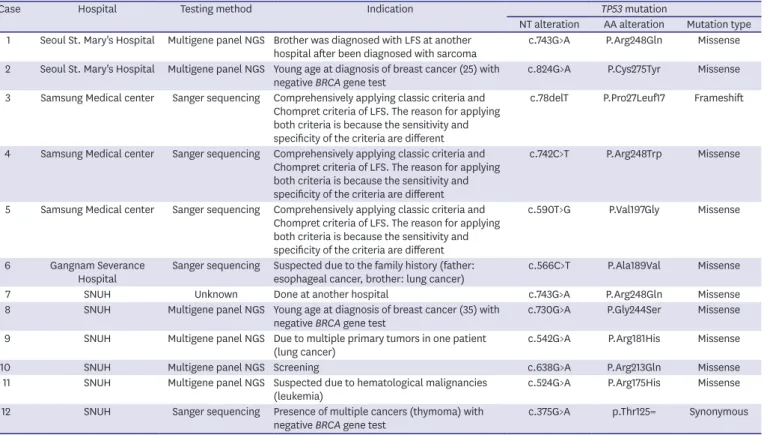
The TP53 mutation types, testing methods, and indications are shown in Table 2. Testing for TP53 mutation was based on suspected personal and/or family history as per the classic or Chompret criteria for LFS. Two patients diagnosed with breast cancer at a younger age with no identifiable BRCA1/2 gene mutations were subsequently tested for TP53 mutation by using a multigene panel NGS. Ten patients had a missense variant, one had a frameshift, and the other had a synonymous mutation.
Nine (75%) patients had a personal history of one or more additional primary malignancies (lymphoma/MALToma, n = 3; lung cancer, n = 4; thyroid cancer, n = 2; chondrosarcoma, n = 1; nasal squamous carcinoma, n = 1; skin cancer, n = 1; colon cancer, n = 1; stomach cancer, n = 1; pancreatic cancer, n = 1; and thymoma, n = 1), which are considered core components or high-risk associated cancers of LFS. Two patients had childhood malignancies before breast cancer. Eight (67%) patients reported a family history (mostly a first-degree relative) of different types of cancer, including (breast
cancer, n = 3; lung cancer, n = 2; ovarian cancer, n = 2; osteosarcoma, n = 1; leukemia, n = 1; stomach cancer, n = 1; pancreatic cancer, n = 1; liver cancer, n = 1; and esophageal cancer, n = 1).
DISCUSSION
In women with LFS, breast cancer is the most common malignancy (79%), followed by soft tissue sarcoma (27%) [10]. The cumulative breast cancer incidence in LFS patients is approximately 85%
by the age of 60, a risk level comparable to that seen in patients with BRCA1 and BRCA 2 germline mutations. The annual hazard rate of breast cancer in these patients increases in the late teens (age 18–20 years) and peaks at about age 40 [11]. In our study, the median age of LFS patients with breast cancer was 33.5 (20–52) years, which is considered as early onset when compared to the age of onset in the general Korean population (40–49 years) [12].
In hereditary breast cancer, the subtypes differ based on hereditary predisposing syndrome.
While breast cancers in individuals with BRCA1 mutations are predominantly triple negative breast cancer, 80% of them in BRCA2 mutation carriers are ER positive and HER2 negative.
Women with CDH1 mutations have invasive lobular breast tumors [13]. Breast cancers in individuals with germline TP53 mutations (LFS) are predominantly ER and/or HER2 positive [8].
In our review of 21 tumors in 12 women with TP53 mutations, 52.6% (10 out of 19) of the tumors were HER2 positive, and 42% were ER or PR positive. Generally, in invasive breast cancer, the HER2 gene is amplified in 15%–25% of cases [14]. Our results confirm that breast cancers in LFS patients are predominantly HER2 positive.
Table 2. TP53 gene mutation types, testing methods, and indications in patients with breast cancer in South Korea
Case Hospital Testing method Indication TP53 mutation
NT alteration AA alteration Mutation type 1 Seoul St. Mary's Hospital Multigene panel NGS Brother was diagnosed with LFS at another
hospital after been diagnosed with sarcoma c.743G>A P.Arg248Gln Missense 2 Seoul St. Mary's Hospital Multigene panel NGS Young age at diagnosis of breast cancer (25) with
negative BRCA gene test c.824G>A P.Cys275Tyr Missense
3 Samsung Medical center Sanger sequencing Comprehensively applying classic criteria and Chompret criteria of LFS. The reason for applying both criteria is because the sensitivity and specificity of the criteria are different
c.78delT P.Pro27Leuf17 Frameshift
4 Samsung Medical center Sanger sequencing Comprehensively applying classic criteria and Chompret criteria of LFS. The reason for applying both criteria is because the sensitivity and specificity of the criteria are different
c.742C>T P.Arg248Trp Missense
5 Samsung Medical center Sanger sequencing Comprehensively applying classic criteria and Chompret criteria of LFS. The reason for applying both criteria is because the sensitivity and specificity of the criteria are different
c.590T>G P.Val197Gly Missense
6 Gangnam Severance
Hospital Sanger sequencing Suspected due to the family history (father:
esophageal cancer, brother: lung cancer) c.566C>T P.Ala189Val Missense
7 SNUH Unknown Done at another hospital c.743G>A P.Arg248Gln Missense
8 SNUH Multigene panel NGS Young age at diagnosis of breast cancer (35) with
negative BRCA gene test c.730G>A P.Gly244Ser Missense
9 SNUH Multigene panel NGS Due to multiple primary tumors in one patient
(lung cancer) c.542G>A P.Arg181His Missense
10 SNUH Multigene panel NGS Screening c.638G>A P.Arg213Gln Missense
11 SNUH Multigene panel NGS Suspected due to hematological malignancies
(leukemia) c.524G>A P.Arg175His Missense
12 SNUH Sanger sequencing Presence of multiple cancers (thymoma) with
negative BRCA gene test c.375G>A p.Thr125= Synonymous
SNUH, Seoul National University Hospital; NGS, next-generation sequencing; LFS, Li-Fraumeni syndrome; NT, nucleotide; AA, amino acid.
A few studies have described the histopathological features of breast cancer in patients with LFS. In a study of early onset breast cancer, Wilson et al. [15] found that HER2 was amplified in 83% of LFS patients compared to 16% in the control group. A retrospective study from the MD Anderson Cancer Center including 30 breast cancers in women with TP53 mutations confirmed these findings with HER2 overexpression in 67% and ER positivity in 70% of the tumors compared to 25% HER2 positivity and 68% ER positivity in the control group of TP53 mutation-negative patients [16]. In a larger study of 39 LFS patients who had 43 breast cancers (32 invasive and 11 DCIS), Masciari et al. [8] found HER2 amplification in 63% of invasive and 73% of DCIS cancers.
Two patients in our study initially presented with malignant phyllodes tumors. The incidence of adrenocortical cancer and malignant phyllodes showed the greatest increase in patients with TP53 mutations relative to the general population [17]. In a study conducted to determine the incidence of germline genetic mutations in 550 patients with phyllodes tumors, almost 10% of the patients who tested positive for a germline cancer predisposition gene (BRCA1/2, TP53) carried a deleterious mutation. The authors suggested including phyllodes tumors in the criteria for genetic counseling and testing for known heritable cancer syndromes since they may have been the presenting tumors in these young women. Additionally, they may represent a de novo mutation, which cannot be predicted based on their family history alone [18]. These tumors are currently not included in the National Comprehensive Cancer Network practice guidelines as criteria for genetic counseling or testing for any known heritable cancer syndromes. Further studies with large samples are needed to confirm the relationship between these mutations and phyllodes tumors before changing the current recommendation.
An analysis of the TP53 database by the International Agency for Research on Cancer showed that of all cancers caused by TP53 mutations, missense mutations account for more than 70%
of the cases, followed by nonsense and splice mutations [19]. In our study, the most common mutation was a missense mutation. HER2 amplification was observed in all mutation types.
The treatment of breast cancer in patients with LFS follows the same principles as in sporadic cancer, except for RT, which is contraindicated in these patients to avoid radiation- associated sequelae. The recently published American Society of Clinical Oncology guidelines for the management of hereditary breast cancers state that irradiation of intact breasts is contraindicated in women carrying a germline TP53 mutation. In these cases, mastectomy is the recommended therapeutic option, and post-mastectomy RT should only be considered in patients with a significant risk of locoregional recurrence [20]. It is expected that the carriers of a TP53 mutation would be unable to repair tissue damage from DNA-damaging RT, thereby significantly increasing the risk for RT-associated sequelae [21].
The follow-up data of the 5 patients who underwent adjuvant RT in our study showed 4 patients with a new primary cancer (acute lymphoblastic lymphoma, lung cancer, thyroid cancer, and thymoma) that were not regarded to be related to RT. Only 1 patient had 2 ipsilateral and 2 contralateral breast cancer recurrences after breast RT. These recurrences and primaries are probably the net effect of genetic predisposition on both the risk of new primaries and RT-associated cancers. A single case series by Heymann et al. [22] studied the clinical outcomes in 6 patients with germline TP53 mutations who had received RT after breast cancer surgery. There were 3 contralateral breast cancer recurrences, 3 ipsilateral breast cancer recurrences, 2 RT-induced cancers, and 3 new primary cancers. Based on these observations, mastectomy of the breast bearing the cancer and a contralateral prophylactic
mastectomy were advised. However, other studies have suggested that RT does not always result in additional malignancies in LFS patients [23]. Le et al. [24] found that only 2 patients had radiation-induced malignancies (thyroid and sarcoma), and only 1 had a locoregional recurrence among the 18 LFS patients with breast cancer who were treated with RT. These findings showed that LFS does not have to be an absolute contraindication for RT in breast cancer. However, future studies with longer follow-up periods and larger sample sizes are needed before making changes to the current recommendations.
The limitations of our study are its retrospective nature and small sample size. However, to the best of our knowledge, by reviewing the published data so far, this is the only study describing the histopathological features and management of breast cancer patients with TP53 mutations in an Asian population.
In conclusion, breast cancer in LFS patients in South Korea had an early onset and were predominantly but not exclusively HER2 positive. A multidisciplinary approach with adherence to the treatment guidelines, considering mastectomy, and avoiding RT is encouraged to prevent RT-associated sequelae in LFS patients.
SUPPLEMENTARY MATERIAL
Supplementary Table 1
The classical and Chompret criteria for the diagnosis of LFS [9]
Click here to view
REFERENCES
1. de Bruin MA, Ford JM, Kurian AW. A young woman with bilateral breast cancer: identifying a genetic cause and implications for management. J Natl Compr Canc Netw 2013;11:512-7.
PUBMED | CROSSREF
2. Narod SA. BRCA mutations in the management of breast cancer: the state of the art. Nat Rev Clin Oncol 2010;7:702-7.
PUBMED | CROSSREF
3. Cybulski C, Górski B, Huzarski T, Masojć B, Mierzejewski M, Dȩbniak T, et al. CHEK2 is a multiorgan cancer susceptibility gene. Am J Hum Genet 2004;75:1131-5.
PUBMED | CROSSREF
4. Antoniou AC, Casadei S, Heikkinen T, Barrowdale D, Pylkäs K, Roberts J, et al. Breast-cancer risk in families with mutations in PALB2. N Engl J Med 2014;371:497-506.
PUBMED | CROSSREF
5. Goldgar DE, Healey S, Dowty JG, Da Silva L, Chen X, Spurdle AB, et al. Rare variants in the ATM gene and risk of breast cancer. Breast Cancer Res 2011;13:R73.
PUBMED | CROSSREF
6. Sidransky D, Tokino T, Helzlsouer K, Zehnbauer B, Rausch G, Shelton B, et al. Inherited p53 gene mutations in breast cancer. Cancer Res 1992;52:2984-6.
PUBMED
7. Hwang SJ, Lozano G, Amos CI, Strong LC. Germline p53 mutations in a cohort with childhood sarcoma:
sex differences in cancer risk. Am J Hum Genet 2003;72:975-83.
PUBMED | CROSSREF
8. Masciari S, Dillon DA, Rath M, Robson M, Weitzel JN, Balmana J, et al. Breast cancer phenotype in women with TP53 germline mutations: a Li-Fraumeni syndrome consortium effort. Breast Cancer Res Treat 2012;133:1125-30.
PUBMED | CROSSREF
9. Criteria for LFS | Li-Fraumeni Syndrome Association. Li-Fraumeni Syndrome Association. https://www.
lfsassociation.org/what-is-lfs/lfs-critieria/. Accessed November 18th, 2020.
10. Bougeard G, Renaux-Petel M, Flaman JM, Charbonnier C, Fermey P, Belotti M, et al. Revisiting Li- Fraumeni syndrome from TP53 mutation carriers. J Clin Oncol 2015;33:2345-52.
PUBMED | CROSSREF
11. Mai PL, Best AF, Peters JA, DeCastro RM, Khincha PP, Loud JT, et al. Risks of first and subsequent cancers among TP53 mutation carriers in the National Cancer Institute Li-Fraumeni syndrome cohort. Cancer 2016;122:3673-81.
PUBMED | CROSSREF
12. Kang SY, Kim YS, Kim Z, Kim HY, Kim HJ, Park S, et al. Breast cancer statistics in Korea in 2017: data from a breast cancer registry. J Breast Cancer 2020;23:115-28.
PUBMED | CROSSREF
13. Manié E, Vincent-Salomon A, Lehmann-Che J, Pierron G, Turpin E, Warcoin M, et al. High frequency of TP53 mutation in BRCA1 and sporadic basal-like carcinomas but not in BRCA1 luminal breast tumors.
Cancer Res 2009;69:663-71.
PUBMED | CROSSREF
14. Sjögren S, Inganäs M, Lindgren A, Holmberg L, Bergh J. Prognostic and predictive value of c-erbB-2 overexpression in primary breast cancer, alone and in combination with other prognostic markers. J Clin Oncol 1998;16:462-9.
PUBMED | CROSSREF
15. Wilson JRF, Bateman AC, Hanson H, An Q, Evans G, Rahman N, et al. A novel HER2-positive breast cancer phenotype arising from germline TP53 mutations. J Med Genet 2010;47:771-4.
PUBMED | CROSSREF
16. Melhem-Bertrandt A, Bojadzieva J, Ready KJ, Obeid E, Liu DD, Gutierrez-Barrera AM, et al. Early onset HER2-positive breast cancer is associated with germline TP53 mutations. Cancer 2012;118:908-13.
PUBMED | CROSSREF
17. Birch JM, Alston RD, McNally RJ, Evans DG, Kelsey AM, Harris M, et al. Relative frequency and morphology of cancers in carriers of germline TP53 mutations. Oncogene 2001;20:4621-8.
PUBMED | CROSSREF
18. Rosenberger LH, Thomas SM, Nimbkar SN, Hieken TJ, Ludwig KK, Jacobs LK, et al. Germline genetic mutations in a multi-center contemporary cohort of 550 phyllodes tumors: an opportunity for expanded multi-gene panel testing. Ann Surg Oncol 2020;27:3633-40.
PUBMED | CROSSREF
19. Petitjean A, Mathe E, Kato S, Ishioka C, Tavtigian SV, Hainaut P, et al. Impact of mutant p53 functional properties on TP53 mutation patterns and tumor phenotype: lessons from recent developments in the IARC TP53 database. Hum Mutat 2007;28:622-9.
PUBMED | CROSSREF
20. Tung NM, Boughey JC, Pierce LJ, Robson ME, Bedrosian I, Dietz JR, et al. Management of hereditary breast cancer: American Society of Clinical Oncology, American Society for Radiation Oncology, and Society of Surgical Oncology guideline. J Clin Oncol 2020;38:2080-106.
21. Delia D, Goi K, Mizutani S, Yamada T, Aiello A, Fontanella E, et al. Dissociation between cell cycle arrest and apoptosis can occur in Li-Fraumeni cells heterozygous for p53 gene mutations. Oncogene 1997;14:2137-47.
PUBMED | CROSSREF
22. Heymann S, Delaloge S, Rahal A, Caron O, Frebourg T, Barreau L, et al. Radio-induced malignancies after breast cancer postoperative radiotherapy in patients with Li-Fraumeni syndrome. Radiat Oncol 2010;5:104.
PUBMED | CROSSREF
23. Hendrickson PG, Luo Y, Kohlmann W, Schiffman J, Maese L, Bishop AJ, et al. Radiation therapy and secondary malignancy in Li-Fraumeni syndrome: a hereditary cancer registry study. Cancer Med 2020;9:7954-63.
PUBMED | CROSSREF
24. Le AN, Harton J, Desai H, Powers J, Zelley K, Bradbury AR, et al. Frequency of radiation-induced malignancies post-adjuvant radiotherapy for breast cancer in patients with Li-Fraumeni syndrome. Breast Cancer Res Treat 2020;181:181-8.
PUBMED | CROSSREF