INTRODUCTION
Benign prostatic hyperplasia (BPH) is one of the most frequently occurring urologic diseases in men older than 50. BPH induces lower urinary tract symptoms (LUTS).
The bladder outlet obstruction causes a variety of urinary
Community-based research on the benign
prostatic hyperplasia prevalence rate in Korean rural area
Hyeok Jun Goh, Shin Ah Kim1, Ji Won Nam1, Bo Youl Choi1, Hong Sang Moon
Departments of Urology and 1Preventive Medicine, Hanyang University College of Medicine, Seoul, Korea
Purpose: We investigated the prevalence rate of benign prostatic hyperplasia (BPH) among Korean males in a rural area through a cross-sectional, community-based epidemiologic survey and analyzed the correlation with epidemiologic factors.
Materials and Methods: A total of 779 males who lived in Yangpyeong County participated in a prostate examination campaign.
Targeting these men, we collected the International Prostate Symptom Score (IPSS), medical history, demographic information, serum prostate-specific antigen, and prostate volume as measured by transrectal ultrasonography. The data for 599 participants were analyzed, excluding 180 men who had a possibility of prostate cancer. BPH was defined as an IPSS of 8 points or higher and a prostate volume of 25 mL or more.
Results: The prevalence rate of BPH was 20.0%. The prevalence rate increased with age. There were 2 subjects (4.4%) in the age group of 40–49 years, 18 subjects (10.9%) in the age group of 50–59 years, 44 subjects (22%) in the age group of 60–69 years, and 56 subjects (26.6%) in the age group of over 70 years; this increase with age was statistically significant (p<0.001). In the BPH group, the average IPSS was 14.67±5.95, the average prostate volume was 37.04±11.71 g, and the average prostate-specific an- tigen value was 1.56±0.88 ng/mL. In the analysis of correlations between the epidemiologic factors and the risk of BPH, smoking was the only statistically significant factor.
Conclusions: The total prevalence rate of BPH in this study was 20.0%, which was a little lower than the rate reported in other cit- ies or rural areas.
Keywords: Prevalence; Prostatic hyperplasia
Korean J Urol 2015;56:68-75.
http://dx.doi.org/10.4111/kju.2015.56.1.68 pISSN 2005-6737 • eISSN 2005-6745
Received: 4 August, 2014 • Accepted: 21 October, 2014 Corresponding Author: Hong Sang Moon
Department of Urology, Hanyang University Guri Hospital, 153 Gyeongchun-ro, Guri 471-701, Korea TEL: +82-31-560-2374, Fax: +82-31-560-2372, E-mail: [email protected]
ⓒ The Korean Urological Association, 2015
symptoms including nocturia, incomplete voiding, urgency, and hesitancy and comes to the fore as a significant health problem interrupting the quality of life of men over middle age. The prevalence rate of BPH increases with age; BPH occurs in 40% to 70% of men aged 60 to 70 years [1,2]. The current Korean population is aging very
This is an Open Access article distributed under the terms of the Creative Commons Attribution Non-Commercial License (http://creativecommons.org/licenses/by-nc/3.0) which permits unrestricted non-commercial use, distribution, and reproduction in any medium, provided the original work is properly cited.
www.kjurology.org
rapidly compared with other countries; with this, interest in health after middle age is increasing throughout society. However, owing to a lack of recognition about BPH, the time until visiting the hospital is often delayed, and this tendency is truer in rural areas than in urban areas. In this situation, it is necessary to understand the prevalence rate of BPH, but few systematic epidemiologic investigations have been carried out about BPH in Korea.
Also, there are limitations in the epidemiologic research conducted so far because the previous data were not collected by use of standardized diagnostic criteria or a specific clinical definition. Therefore, in this study, the prevalence rate of BPH was estimated among males living in the rural Korean area of Yangpyeong Country. Also, we investigated the correlation between epidemiologic factors and BPH.
MATERIALS AND METHODS
1. Research participants
This study was conducted to investigate the prevalence rate of BPH and its related factors on the basis of an epidemiologic investigation among males in one rural community in Korea. The Department of Preventive Medicine and the Department of Urology in Hanyang University Guri Hospital planned the cohort research by targeting Yangpyeong County. We recruited subjects through a prostate health screening campaign.
The participants of this study were males aged 40 and above in Yangpyeong County, Gyeonggi-do. The
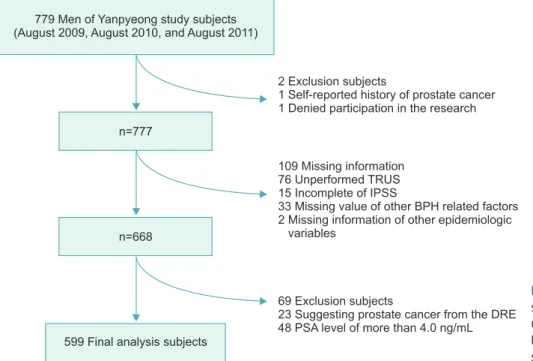
participants were recruited over August to September 2009, August 2010, and August 2011. Trained investigators collected the International Prostate Symptom Score (IPSS), individual medical history, and demographic information for each participant. We excluded those already diagnosed with BPH who were receiving treatment and taking health food supplements. Prostate disease was assessed by measuring serum prostate-specific antigen (PSA), a doctor’s medical examination by interview, a digital rectal examination, and prostate volume by transrectal ultrasound (SA6000II, Medison Inc., Seoul, Korea). A total of 799 males responded to all of the survey questions and underwent examinations. Among them, 668 subjects remained for study after the exclusion of 1 person who did not consent to participate in the study, 1 person who had a prostate cancer history, and 109 subjects who were missing the digital rectal examination, transrectal ultrasonography, or other epidemiologic inf ormation. Among these subjects, data were analyzed from the 599 subjects finally participating in this study after the exclusion of subjects in whom a nodule was perceived or who had a serum PSA score of 4.0 or higher and thus who might have prostate cancer (Fig. 1) The severity of LUTS was evaluated by the IPSS and quality of life and the participants were divided into four groups by age (40–49, 50–59, 60–69, and 70 years and above). This study was approved by the Institutional Review Board (IRB) of Hanyang University College of Medicine. The IRB numbers were HYUH IRB 2010-R-38 and 2011-07-005.
Fig. 1. Flow chart of the selection of subjects for the study. TRUS, transrectal ultrasonography; IPSS, International Prostate Symptom Score; PSA, prostate- specific antigen.
779
A Men of Yanpyeong study subjects (August 2009, August 2010, and ugust 2011)
n=777
n=668
599 Final analysis subjects
2 Exclusion subjects
1 Self-reported history of prostate cancer 1 Denied participation in the research
109 Missing information Unperformed TRUS Incomplete of IPSS
Missing value of other BPH related factors 2 Missing information of other epidemiologic
variables 76 15 33
69 Exclusion subjects
Suggesting prostate cancer from the DRE 48 PSA level of more than 4.0 ng/mL 23
2. Criteria of epidemiologic investigation
In this study, BPH was defined as a score of 8 or higher on the IPSS and a prostate volume of 25 mL or above by transrectal ultrasonography, according to the criteria of the fourth edition of the textbook of urology published by the Korean Urological Association. The prevalence rate of BPH was compared by classifying the groups by age: 40–49, 50–59, 60–69, and 70 years and above. In addition, the prevalence rate of each LUTS was checked by classifying the total IPSS in each group into a mild symptom group (score of 1–7), a moderate symptom group (score of 8–19), and a severe symptom group (score of 20–35) [3].
Additionally, the analysis was conducted on the correlations between the epidemiologic factors (age, marital status, education level, smoking status, alcohol consumption status, regular exercise, body mass index [BMI]), comorbidities (hypertension, diabetes), and serum PSA and BPH.
3. Statistical analysis
SAS ver. 9.2 (SAS Institute Inc., Cary, NC, USA) was used for the statistical analysis; we also used the chi- square test, independent t-test, analysis of variance, and logistic regression analysis. The results of the statistical analysis were considered to be significant when the p-value was less than 0.05.
RESULTS
1. Prevalence rate of BPH
A total of 599 subjects participated in this study. The
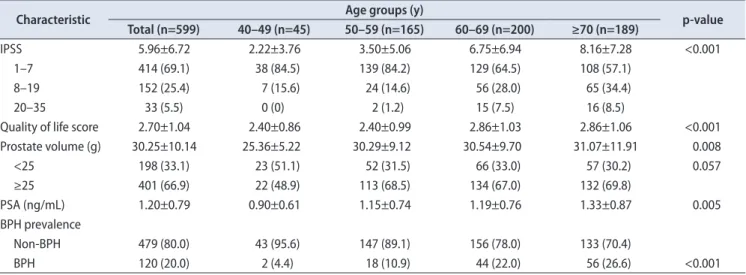
participants’ average age was 63.72±9.40 years. There were 45 subjects (7.5%) in the aged 40–49 years group, 165 subjects (27.5%) in the aged 50–59 years group, 200 subjects (33.4%) in the aged 60–69 years group, and 189 subjects (31.5%) in the aged 70 years and above group. The prostate volume of the entire group of participants was 30.25±10.14 g, and the average PSA level was 1.20±0.79 ng/
mL. The IPSS and the quality of life score were 5.96±6.72 and 2.70±1.04, respectively. In the age groups, the IPSS was 2.22±3.76 in men aged 40–49 years, 3.50±5.06 in those aged 50–59, 6.75±6.94 in those aged 60–69, and 8.16±7.28 in men aged 70 or more. These changes with age were statistically significant (p<0.001). Also, prostate volume was 25.36±5.22 g in men aged 40–49 years, 30.29±9.12 g in men aged 50–59 years, 30.54±9.7 g in men aged 60–69 years, and 31.07±11.91 g in men aged 70 years and above, and these age-related increases were statistically significant (p=0.008).
A total of 120 subjects (20.0%) in the entire group of participants met the standard of BPH as defined in this study. When we examined the prevalence rate according to age, we found that the prevalence rate increased with age. There were 2 subjects (4.4%) with BPH in the and aged 40–49 years group, 18 subjects (10.9%) in the aged 50–
59 years group, 44 subjects (22%) in the aged 60–69 years group, and 56 subjects (26.6%) in the aged 70 years and above group, and this increase with age was statistically significant (p<0.001) (Table 1).
2. Distribution of factors associated With BPH A total of 120 participants (20%) met the definition
Table 1. Basic characteristics of the study subjects
Characteristic Age groups (y)
p-value Total (n=599) 40–49 (n=45) 50–59 (n=165) 60–69 (n=200) ≥70 (n=189)
IPSS 5.96±6.72 2.22±3.76 3.50±5.06 6.75±6.94 8.16±7.28 <0.001
1–7 414 (69.1) 38 (84.5) 139 (84.2) 129 (64.5) 108 (57.1)
8–19 152 (25.4) 7 (15.6) 24 (14.6) 56 (28.0) 65 (34.4)
20–35 33 (5.5) 0 (0) 2 (1.2) 15 (7.5) 16 (8.5)
Quality of life score 2.70±1.04 2.40±0.86 2.40±0.99 2.86±1.03 2.86±1.06 <0.001
Prostate volume (g) 30.25±10.14 25.36±5.22 30.29±9.12 30.54±9.70 31.07±11.91 0.008
<25 198 (33.1) 23 (51.1) 52 (31.5) 66 (33.0) 57 (30.2) 0.057
≥25 401 (66.9) 22 (48.9) 113 (68.5) 134 (67.0) 132 (69.8)
PSA (ng/mL) 1.20±0.79 0.90±0.61 1.15±0.74 1.19±0.76 1.33±0.87 0.005
BPH prevalence
Non-BPH 479 (80.0) 43 (95.6) 147 (89.1) 156 (78.0) 133 (70.4)
BPH 120 (20.0) 2 (4.4) 18 (10.9) 44 (22.0) 56 (26.6) <0.001
Values are presented as mean±standard deviation or number (%).
IPSS, International Prostate Symptom Score; PSA, prostate-specific antigen; BPH, benign prostatic hyperplasia.
The p-values were calculated using one-way analysis of variance for continuous variable and chi-square test for categorical variables. Significant at p<0.05.
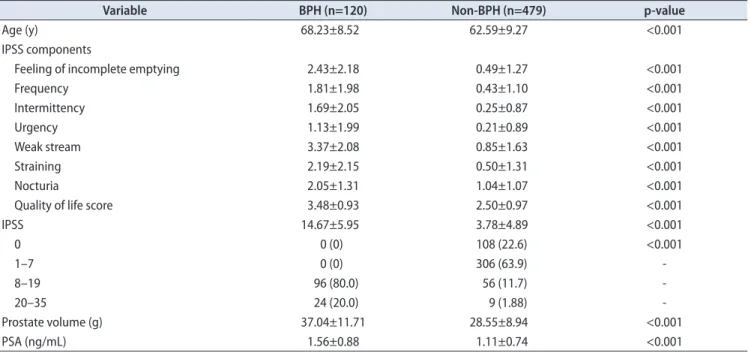
of BPH in this study. The average age of the BPH group was 68.23±8.52 years, the average IPSS was 14.67±5.95, the average prostate volume was 37.04±11.71 g, and the average PSA level was 1.56±0.88 ng/mL (Table 2). In the subscores of the IPSS, the score for weak urinary stream was highest (3.37±2.08); the scores for incomplete emptying (2.43±2.18), hesitancy (2.19±2.15), and nocturia (2.05±1.31) were also high. In the survey questions about quality of life, the overall inconvenience of the patients due to their current urinary symptoms was used for the score; the scores were divided from 0 as very satisfied to 6 as very dissatisfied. The quality of life score was significantly higher in the BPH group (3.48±0.93) than in the non-BPH group (2.50±0.91).
3. Analysis of the factors influencing BPH
In this study, we conducted a correlation analysis to determine whether epidemiologic factors (marital status, education level, smoking status, alcohol consumption status, BMI, and regular exercise) and comorbidities (hypertension and diabetes) influenced the risk of BPH.
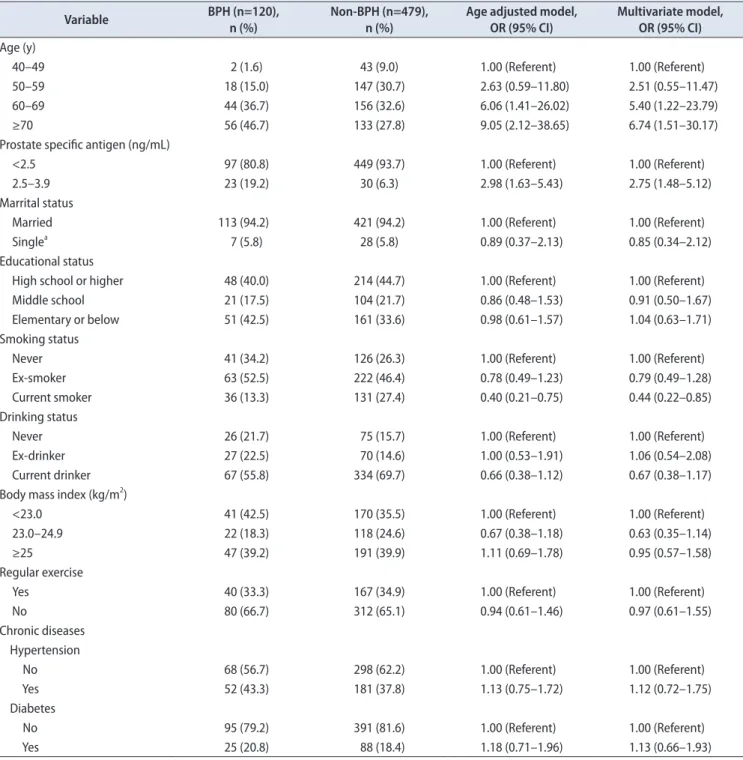
A statistically significant factor was smoking status. The non-BPH group had a higher proportion of smokers than did the BPH group (Table 3). The reason the epidemiologic factors including lifestyle did not show a significant correlation may be that this study was based on a cross- sectional design that did not clearly show a sequential
relationship by time. In the case of the BPH group, the patients’ uncomfortable urinary status could have already influenced changes in health behavior.
DISCUSSION
BPH generally occurs in males in their 50s; 80% of males in their 70s suffer from the LUTS related to BPH [1].
Because in current Korean society the population is aging, the older population is rapidly increasing. Additionally, the incidence of metabolic syndrome, which is a risk factor for BPH, and the number of patients with obesity are also annually increasing owing to westernized eating habits.
BPH and LUTS could lead to social problems caused by the increase in annual medical expenses related to serious complications such as falls, depression, and reduced quality of life, particularly in the elderly [4-6]. In this situation, it is necessary to conduct systematic epidemiologic investigations of the prevalence rate of BPH in Korea.
To investigate the prevalence rate of BPH, it is first necessary to clarify the diagnostic criteria of BPH. Although methods exists for the diagnosis of BPH, including taking the patient’s medical history and recording urinary symptoms, prostate volume measurement by digital rectal examination and trans- rectal ultrasonography, peak urinary flow rate (Qmax), and residual urine measurement, accurate diagnostic
Table 2. Comparisons of factors between subjects with and without BPH
Variable BPH (n=120) Non-BPH (n=479) p-value
Age (y) 68.23±8.52 62.59±9.27 <0.001
IPSS components
Feeling of incomplete emptying 2.43±2.18 0.49±1.27 <0.001
Frequency 1.81±1.98 0.43±1.10 <0.001
Intermittency 1.69±2.05 0.25±0.87 <0.001
Urgency 1.13±1.99 0.21±0.89 <0.001
Weak stream 3.37±2.08 0.85±1.63 <0.001
Straining 2.19±2.15 0.50±1.31 <0.001
Nocturia 2.05±1.31 1.04±1.07 <0.001
Quality of life score 3.48±0.93 2.50±0.97 <0.001
IPSS 14.67±5.95 3.78±4.89 <0.001
0 0 (0) 108 (22.6) <0.001
1–7 0 (0) 306 (63.9) -
8–19 96 (80.0) 56 (11.7) -
20–35 24 (20.0) 9 (1.88) -
Prostate volume (g) 37.04±11.71 28.55±8.94 <0.001
PSA (ng/mL) 1.56±0.88 1.11±0.74 <0.001
Values are presented as mean±standard deviation or number (%).
BPH, benign prostatic hyperplasia; IPSS, International Prostate Symptom Score; PSA, prostate-specific antigen.
The p-values were calculated using independent t-test for continuous variable and chi-square test for categorical variables. Significant at p<0.05.
criteria have not been established. Currently, BPH is mainly defined clinically on the basis of the IPSS, prostate volume, and Qmax. Garraway et al. [2] defined BPH as urinary symptoms, prostate volume of 20 mL or more as measured by transrectal ultrasonography, and Qmax of 15 mL/s or less. In their study, they reported that the prevalence rate of BPH was 14% in males in their 40s and 40% in males in their 70s. Bosch et al. [7] defined
BPH as a prostate volume of 30 mL or more and IPSS of 8 points or higher and reported a BPH prevalence rate of 19%. In a study targeting males aged 40 years and older in Spain. In studies defining BPH in Korea, Rhew et al.
[8] defined BPH as an IPSS of 8 points or higher and a Qmax of 10 mL/s or less [8]. Chung et al. [9] defined it as an IPSS of 8 points or higher, prostate volume by digital rectal examination of 30 mL or more, and Qmax of 15 mL/
Table 3. Age-adjusted and multivariate OR (95% CI) of BPH risk according to selected factors
Variable BPH (n=120),
n (%) Non-BPH (n=479),
n (%) Age adjusted model,
OR (95% CI) Multivariate model, OR (95% CI) Age (y)
40–49 2 (1.6) 43 (9.0) 1.00 (Referent) 1.00 (Referent)
50–59 18 (15.0) 147 (30.7) 2.63 (0.59–11.80) 2.51 (0.55–11.47)
60–69 44 (36.7) 156 (32.6) 6.06 (1.41–26.02) 5.40 (1.22–23.79)
≥70 56 (46.7) 133 (27.8) 9.05 (2.12–38.65) 6.74 (1.51–30.17)
Prostate specific antigen (ng/mL)
<2.5 97 (80.8) 449 (93.7) 1.00 (Referent) 1.00 (Referent)
2.5–3.9 23 (19.2) 30 (6.3) 2.98 (1.63–5.43) 2.75 (1.48–5.12)
Marrital status
Married 113 (94.2) 421 (94.2) 1.00 (Referent) 1.00 (Referent)
Singlea 7 (5.8) 28 (5.8) 0.89 (0.37–2.13) 0.85 (0.34–2.12)
Educational status
High school or higher 48 (40.0) 214 (44.7) 1.00 (Referent) 1.00 (Referent)
Middle school 21 (17.5) 104 (21.7) 0.86 (0.48–1.53) 0.91 (0.50–1.67)
Elementary or below 51 (42.5) 161 (33.6) 0.98 (0.61–1.57) 1.04 (0.63–1.71)
Smoking status
Never 41 (34.2) 126 (26.3) 1.00 (Referent) 1.00 (Referent)
Ex-smoker 63 (52.5) 222 (46.4) 0.78 (0.49–1.23) 0.79 (0.49–1.28)
Current smoker 36 (13.3) 131 (27.4) 0.40 (0.21–0.75) 0.44 (0.22–0.85)
Drinking status
Never 26 (21.7) 75 (15.7) 1.00 (Referent) 1.00 (Referent)
Ex-drinker 27 (22.5) 70 (14.6) 1.00 (0.53–1.91) 1.06 (0.54–2.08)
Current drinker 67 (55.8) 334 (69.7) 0.66 (0.38–1.12) 0.67 (0.38–1.17)
Body mass index (kg/m2)
<23.0 41 (42.5) 170 (35.5) 1.00 (Referent) 1.00 (Referent)
23.0–24.9 22 (18.3) 118 (24.6) 0.67 (0.38–1.18) 0.63 (0.35–1.14)
≥25 47 (39.2) 191 (39.9) 1.11 (0.69–1.78) 0.95 (0.57–1.58)
Regular exercise
Yes 40 (33.3) 167 (34.9) 1.00 (Referent) 1.00 (Referent)
No 80 (66.7) 312 (65.1) 0.94 (0.61–1.46) 0.97 (0.61–1.55)
Chronic diseases Hypertension
No 68 (56.7) 298 (62.2) 1.00 (Referent) 1.00 (Referent)
Yes 52 (43.3) 181 (37.8) 1.13 (0.75–1.72) 1.12 (0.72–1.75)
Diabetes
No 95 (79.2) 391 (81.6) 1.00 (Referent) 1.00 (Referent)
Yes 25 (20.8) 88 (18.4) 1.18 (0.71–1.96) 1.13 (0.66–1.93)
OR, odds ratio; CI, confidence interval; BPH, benign prostatic hyperplasia.
a:Single including widowed, divorced or separated, and never married.
s or less. In studies investigating the prevalence rate in Seongnam City and Jeju Island, BPH was defined as an IPSS of 8 points or higher and prostate volume measured by transrectal ultrasonography of 30 mL or more [10,11].
In this study, BPH diagnosis was based on the symptom score and the prostate volume, and urof lowmetry examination was excluded. The reason the uroflowmetry examination was excluded was as follows. First, Blanker et al. [12] reported that the BPH prevalence rate defined by two variables including symptom score and prostate volume and the BPH prevalence rate defined by three variables including symptom score, prostate volume, and Qmax were 12% and 10%, respectively, and that there was no statistically significant difference between the two rates [10]. Second, it was thought that there could be many errors when determining BPH based on 10 mL/
s or less or 15 mL/s or less in epidemiologic examinations because uroflowmetry can vary depending on the amount of urination [11]. Jakobsen et al. [13] measured prostate volume through transrectal ultrasonography by targeting 175 males whose ages were between 27 and 70 years;
the average prostate volume of adenoma prostate was significantly higher than that of nonadenoma prostate:
28.0 mL (range, 14.5–62.1 mL) vs. 23.0 mL (range, 11.3–39.1 mL) [13]. Therefore, those authors proposed criteria for BPH as an IPSS of 8 points or higher and a prostate volume by transrectal ultrasonography of 25 mL or more.
The BPH prevalence rate was 20% (120/599 subjects) in the present study and lower than the rate in other reports in Korea. The reason for this could be that 210 of 599 males (35%) were in their 40s to 50s and were thus relatively younger than the groups in the other studies in Korea. BPH prevalence rates reported in Korea were 40% in the urban area of Seongnam and 25.5% in Busan [8,11]. In addition, the prevalence rates were 23.2% in the rural area of Yeoncheon, Gyeonggi- do, and 27.7% in the inland area of Chungcheongbuk-do [14,15]. The reasons for the differences in the prevalence rate are as follows. First, there were variables in the epidemiologic investigation, such as the selection of the target group and regional differences in the population.
Second, the diagnostic criteria for BPH differed in each investigation. The prevalence rate in Seongnam was much higher than in other regions because the study was an epidemiologic investigation targeting the elderly population (65 years old and above). Although Lee et al.
[14] conducted an epidemiologic investigation for the first time in Yeoncheon area in 1995, they only conducted a survey of the IPSS and then estimated the prevalence rate
of BPH. Chung et al. [9] reported that the BPH prevalence rate as assessed by LUTS, digital rectal examination, and uroflowmetry examination was 11%; here, the question about the accuracy of measuring prostate size could be raised because the prostate volume was measured by digital rectal examination. In this study, the survey and the epidemiologic investigation were performed by interviewers who were sufficiently trained; unlike other authors’ measurement of the prostate volume by digital rectal examination, it could be thought that the reliability would be high because the prostate volume was accurately measured by transrectal ultrasonography.
Epidemiologic research on BPH has greatly evolved over the past several years, and many epidemiologic data have been accumulated. Even though age and genetics play an important role as causes of BPH, it is notable that lifestyle factors such as metabolic syndrome or cardiovascular disease, which can be corrected, have a considerable impact on the natural progression of BPH [16].
One cohort study showed that LUTS prevalence increased by 80% in the group diagnosed with at least three components of the metabolic syndrome compared with the group without diagnosed components of the metabolic syndrome. Additionally, other studies have shown that the risk of BPH and LUTS is significantly increased in people with heart disease [17-19].
In other previous studies, a correlation was observed in which the more the amount of fat increased, the more the prostate volume increased. In several research studies, weight, BMI, and waistline all showed a significant correlation with prostate volume [20-22]. In this study, there was no significant difference in BMI between the BPH group and the non-BPH group. The reason for this may be that the cross-sectional design of this study did not clearly show the sequential relationship of time.
The study criteria were also vague because there are few studies related to BMI and prostate volume in Asia, including Korea. In the Longitudinal Study of Aging cohort in Baltimore, Maryland (USA), each 1-kg/m2 increase in BMI corresponded to a 0.41-mL prostate volume increase. Compared with nonobese participants (BMI<25 kg/m2), the obese participants (BMI≥35 kg/m2) showed a 3.5-time higher BPH risk [20]. In addition, whereas some studies reported that there was a reverse protective effect of smoking on BPH and LUTS, other studies reported that the risk level increased or showed no change [21].
Therefore, it is necessary to conduct more studies on the correlation between smoking and BPH.
There were several limitations to the current study.
First, the subjects were not a random sample of the population because we recruited subjects through a prostate health screening campaign. Second, we did not consider the difference in the population distribution by age in Yangpyeong County and the study group. Third, although prevalence was the number of cases of the condition at a particular point in time, the participants of this study were recruited over 3 years (August–September 2009, August 2010, and August 2011) in an effort to collect more participants.
Consequently, the results of this epidemiologic research investigating the BPH prevalence rate in a rural Korean area showed a lower value than in other countries.
One reason for this may be that the ratio of relatively younger males in their 40s to 50s was somewhat higher in this epidemiologic investigation than in other studies.
Second, there may have been an influence of diet, with a focus on vegetables in the rural area compared with the westernized diet of high meat consumption in urban areas. Although our study did not survey the eating habits of the individuals, in a study performed to evaluate food intake of the elderly residing in different regions of Korea, the intake of meats was significantly higher in urban elderly than in rural elderly [23]. Third, the different diagnostic criteria of BPH applied in each study could be a cause of the differences in prevalence rates.
CONCLUSIONS
In this study, the prevalence rate of BPH was estima- ted by targeting males aged 40 years and older in a rural Korean area. The results showed that the prevalence rate of BPH in males aged 40 years and older in Yangpyeong County was 20.0%. When classifying the men according to age, the prevalence rate of BPH increased with age. The IPSS also increased with age. None of the epidemiologic factors studied including lifestyle showed a statistically significant correlation with BPH, except for smoking. This study showed a lower prevalence rate of BPH in a rural area than reported in other studies in Korea. Unlike other studies conducted in rural areas, however, the reliability of this study can be considered to be high because prostate volume was measured by use of a more objective method.
CONFLICTS OF INTEREST
The authors have nothing to disclose.
REFERENCES
1. Berry SJ, Coffey DS, Walsh PC, Ewing LL. The development of human benign prostatic hyperplasia with age. J Urol 1984;132:
474-9.
2. Garraway WM, Collins GN, Lee RJ. High prevalence of benign prostatic hypertrophy in the community. Lancet 1991;338:469- 71.
3. Barry MJ, Fowler FJ Jr, O'Leary MP, Bruskewitz RC, Holtgrewe HL, Mebust WK, et al. The American Urological Association symptom index for benign prostatic hyperplasia. The Measure- ment Committee of the American Urological Association. J Urol 1992;148:1549-57.
4. Taylor BC, Wilt TJ, Fink HA, Lambert LC, Marshall LM, Hoff- man AR, et al. Prevalence, severity, and health correlates of lower urinary tract symptoms among older men: the MrOS study. Urology 2006;68:804-9.
5. Parsons JK, Mougey J, Lambert L, Wilt TJ, Fink HA, Garzotto M, et al. Lower urinary tract symptoms increase the risk of falls in older men. BJU Int 2009;104:63-8.
6. Engstrom G, Henningsohn L, Walker-Engstrom ML, Leppert J.
Impact on quality of life of different lower urinary tract symp- toms in men measured by means of the SF 36 questionnaire.
Scand J Urol Nephrol 2006;40:485-94.
7. Bosch JL, Hop WC, Kirkels WJ, Schroder FH. Natural history of benign prostatic hyperplasia: appropriate case definition and estimation of its prevalence in the community. Urology 1995;46(3 Suppl A):34-40.
8. Rhew HY, Koo JH, Cho SS, Kang JS, Lee CK, Kim JC, et al. The prevalence of BPH in Busan city over age 40. Korean J Urol 2001;42:223-7.
9. Chung TG, Chung J, Lee MS, Ahn H. Prevalence of benign prostatic hyperplasia in Jeong-Eup area: community-based study. Korean J Urol 1999;40:52-8.
10. Huh JS, Kim YJ, Kim SD. Prevalence of benign prostatic hyper- plasia on Jeju Island: analysis from a cross-sectional communi- ty-based survey. World J Mens Health 2012;30:131-7.
11. Park HK, Park H, Cho SY, Bae J, Jeong SJ, Hong SK, et al. The prevalence of benign prostatic hyperplasia in elderly men in Korea: a community-based study. Korean J Urol 2009;50:843-7.
12. Blanker MH, Groeneveld FP, Prins A, Bernsen RM, Bohnen AM, Bosch JL. Strong effects of definition and nonresponse bias on prevalence rates of clinical benign prostatic hyperpla- sia: the Krimpen study of male urogenital tract problems and general health status. BJU Int 2000;85:665-71.
13. Jakobsen H, Torp-Pedersen S, Juul N. Ultrasonic evaluation of age-related human prostatic growth and development of be- nign prostatic hyperplasia. Scand J Urol Nephrol Suppl 1988;
107:26-31.
14. Lee ES, Lee C, Kim Y, Shin Y. Estimation of benign prostatic hyperplasia prevalence in Korea: an epidemiological survey us- ing International Prostatic Symptom Score (IPSS) in Yonchon county. Korean J Urol 1995;36:1345-52.
15. Lee HL, Seo JW, Kim WJ. The prevalence of benign prostatic hyperplasia: community-based study in Chungbuk province.
Korean J Urol 1999;40:1500-5.
16. Parsons JK. Benign prostatic hyperplasia and male lower urinary tract symptoms: epidemiology and risk factors. Curr Bladder Dysfunct Rep 2010;5:212-8.
17. Meigs JB, Mohr B, Barry MJ, Collins MM, McKinlay JB. Risk factors for clinical benign prostatic hyperplasia in a commu- nity-based population of healthy aging men. J Clin Epidemiol 2001;54:935-44.
18. Rohrmann S, Smit E, Giovannucci E, Platz EA. Association between markers of the metabolic syndrome and lower urinary tract symptoms in the Third National Health and Nutrition Ex- amination Survey (NHANES III). Int J Obes (Lond) 2005;29:
310-6.
19. Joseph MA, Harlow SD, Wei JT, Sarma AV, Dunn RL, Taylor JM, et al. Risk factors for lower urinary tract symptoms in a population-based sample of African-American men. Am J Epi- demiol 2003;157:906-14.
20. Parsons JK, Carter HB, Partin AW, Windham BG, Metter EJ, Ferrucci L, et al. Metabolic factors associated with benign prostatic hyperplasia. J Clin Endocrinol Metab 2006;91:2562-8.
21. Parsons JK. Modifiable risk factors for benign prostatic hyper- plasia and lower urinary tract symptoms: new approaches to old problems. J Urol 2007;178:395-401.
22. Parsons JK, Sarma AV, McVary K, Wei JT. Obesity and benign prostatic hyperplasia: clinical connections, emerging etiologi- cal paradigms and future directions. J Urol 2009;182(6 Suppl):
S27-31.
23. Kim Y, Seo S, Kwon O, Cho MS. Comparisons of dietary behavior, food intake, and satisfaction with food-related life between the elderly living in urban and rural areas. Korean J Nutr 2012;45:252-63.