D I A B E T E S & M E T A B O L I S M J O U R N A L
This is an Open Access article distributed under the terms of the Creative Commons Attribution Non-Commercial License (http://creativecommons.org/licenses/by-nc/3.0/) which permits unrestricted non-commercial use, distribution, and reproduction in any medium, provided the original work is properly cited.
Sarcopenia, Frailty, and Diabetes in Older Adults
Hak Chul Jang
Department of Internal Medicine, Seoul National University Bundang Hospital, Seoul National University College of Medicine, Seongnam, Korea
Populations are aging and the prevalence of diabetes mellitus is increasing tremendously. The number of older people with dia- betes is increasing unexpectedly. Aging and diabetes are both risk factors for functional disability. Thus, increasing numbers of frail or disabled older patients with diabetes will increase both direct and indirect health-related costs. Diabetes has been report- ed as an important risk factor of developing physical disability in older adults. Older people with diabetes have lower muscle mass and weaker muscle strength. In addition, muscle quality is poorer in diabetic patients. Sarcopenia and frailty have a com- mon soil and may share a similar pathway for multiple pathologic processes in older people. Sarcopenia is thought to be an in- termediate step in the development of frailty in patients with diabetes. Thus, early detection of sarcopenia and frailty in older adults with diabetes should be routine clinical practice to prevent frailty or to intervene earlier in frail patients.
Keywords: Diabetes; Disability; Frailty; Sarcopenia
Corresponding author: Hak Chul Jang http://orcid.org/0000-0002-4188-6536 Department of Internal Medicine, Seoul National University Bundang Hospital, Seoul National University College of Medicine, 82 Gumi-ro 173beon-gil, Bundang-gu, Seongnam 13620, Korea
The Sulwon Award for Scientific Achievement is the Korean Diabetes Association’s highest scientific award and honors an individual who has excellently contributed to the progress in the field of diabetes and metabolism. Sulwon Award is named after an emeritus professor Eung Jin Kim, who founded Korean Diabetes Association. Prof. Hak Chul Jang received the seventh Sulwon Award at 2015 International Conference on Diabetes and Metabolism, October 15-17, 2015 at Jejudo Island, Korea.
INTRODUCTION
Increased life expectancy and declining fertility has brought dramatic shifts in the age structure worldwide [1]. Large pop- ulations are aging and this has become a global social and health burden. A progressive decline in muscle mass and strength, termed sarcopenia, develops as a consequence of ag- ing [2]. The prevalence of sarcopenia reported varies widely depending on the definition and methods of assessment; it ranges from 8% to 40% of people aged over 60 years [3,4]. Sar- copenia results in frailty, loss of independence, physical dis-
ability, and increased mortality in older adults [5,6].
Diabetes mellitus is a prevalent chronic disease, especially in older adults, that is associated with microvascular and car- diovascular complications [7]. More than 25% of Korean peo- ple over age 60 years have diabetes mellitus [8,9]. Diabetes has been associated with an increased risk of developing physical disability in older adults [10,11]. Chronic conditions such as visual disturbances, diabetic complications, comorbidities, and depression are associated with physical disability in pa- tients with diabetes; however, these account for only some of the impairments [12]. It was also reported that men and women with diabetes diagnosed at age 60 have estimated re- ductions in life expectancy of 7.3 and 9.5 years and good qual- ity of life of 11.1 and 13.8 years, respectively [13]
Physical and cognitive function becomes of great impor- tance in the care of older people with diabetes. A key strategy is to prevent the functional decline instead of attempting to recover lost function. In this review, the relationship between sarcopenia, frailty, and physical disability in older adults with diabetes will be discussed.
http://dx.doi.org/10.4093/dmj.2016.40.3.182 pISSN 2233-6079 · eISSN 2233-6087
SARCOPENIA AND DIABETES
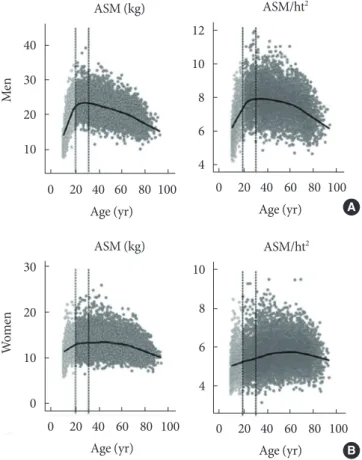
A progressive decrease in muscle mass, especially of the lower extremities and an increase in fat mass, especially of visceral and intermuscular fat are common body compositional changes associated with aging [14,15]. After 30 years of age, muscle mass is reported to decline at an annual rate of ap- proximately 1% to 2%, and that accelerates to as much as 1.5%
to 3% per year after age 60 years, becoming ever faster after age 75 years (Fig. 1) [4,15].
Baumgartner et al. [16] first proposed that the appendicu- lar skeletal muscle mass (ASM) divided by height squared (ASM/ht2) was as a representative muscle index. Clinically, sarcopenia was defined as relative ASM index less than 2 stan- dard deviations below the mean values of healthy young adults or the lowest quintile of study populations [16,17].
However, recent studies have indicated that decline in muscle
strength may be more important in the health outcomes relat- ed to sarcopenia [18]. Based on this, the European Working Group for Sarcopenia in Older People proposed reduced mus- cle mass with either muscle weakness or poor physical perfor- mance as the criteria for sarcopenia [2]. These criteria demon- strated better associations with various outcomes compared with the definitions driven only by muscle mass [19,20].
Meanwhile, the Foundation for the National Institutes of Health (FNIH) Sarcopenia Project has suggested a new crite- ria for sarcopenia categorized by muscle mass, muscle strength, and physical performance [21]. They proposed a new muscle mass index of ASM divided by body mass index. However, data about the clinical implications of the new FNIH criteria remain sparse.
Muscles play various important roles in the human body;
thus, loss of muscle mass and strength can cause a diverse range of functional disability and metabolic derangements in older adults. Sarcopenia has been closely related to many clin- ical consequences, including functional disability, metabolic impairment, increased cardiovascular risk, and mortality, in the older Korean adults [6,22-25].
However, studies of sarcopenia in older adults with diabetes are few. The Health, Aging, and Body Composition (Health ABC) Study showed that older adults with type 2 diabetes lost their knee extensor strength more rapidly than nondiabetic subjects did [26]. In that study, diabetic patients had greater declines in muscle mass and leg muscle strength, and muscle quality was poorer in diabetic patients over 3 years. In addi- tion, thigh muscle cross-sectional area also declined twice as fast in older women with diabetes than in nondiabetic sub- jects over 6 years [27]. Further, the Hertfordshire study dem- onstrated that older men newly diagnosed with diabetes have significantly weaker muscle strength and higher odds of im- paired physical function than those without diabetes do [28].
Leenders et al. [29] also showed that leg lean mass and appen- dicular skeletal mass were significantly lower in older men with diabetes. Further, leg-extension strength in patients with diabetes was weaker than in nondiabetic subjects, and func- tional performance was impaired in older diabetic men. Oth- er studies also have demonstrated that leg muscle strength and gait speed is reduced in older peoples with diabetes [30,31]
Kim et al. [32] reported that in Korean men and women aged ≥65 years, ASM was lower in diabetic patients compared with nondiabetic subjects but relative muscle index (ASM/
40 30 20 10
Men
0 20 40 60 80 100 Age (yr)
ASM (kg)
30 20 10 0
Women
0 20 40 60 80 100 Age (yr)
ASM (kg)
12 10 8 6 4
0 20 40 60 80 100 Age (yr)
ASM/ht2
10 8 6 4
0 20 40 60 80 100 Age (yr)
ASM/ht2 A
B
Fig. 1. Changes of appendicular skeletal muscle mass (ASM), and ASM indices according to age trends in Korean (A) men and (B) women using data from Korea National Health and Nutrition Examination Study 2008 to 2010. ht2, height squared (m). Modified from Kim et al. [4].
height2) was lower only in older men with diabetes. The Kore- an Sarcopenic Obesity Study showed that sarcopenia (skeletal muscle mass/weight×100 <2 SD below the mean of the young reference) was present in 15.7% in subjects with diabe- tes and 6.9% in the control subjects [33]. Yoon et al. [34] dem- onstrated that muscle mass and strength in older diabetic pa- tients were not different compared with nondiabetic subjects, but muscle quality was poorer and physical performance was impaired in diabetic subjects with poor glycemic control.
PATHOPHYSIOLOGY OF SARCOPENIA IN DIABETES
Multiple factors are associated with decreased muscle mass and/or strength in older adults [2,17]. The major causes or mechanisms related to sarcopenia include inadequate nutri- tion, physical inactivity or disuse, age-related hormonal chang- es including sex hormone and growth hormone, loss of motor neurons, atherosclerosis, obesity, insulin resistance, and in- flammatory cytokines (Table 1).
Additionally, diabetes mellitus will accelerate the reduction of muscle mass and strength because hyperglycemia, diabetic complications, obesity, insulin resistance, inflammatory cyto- kines, and endocrine changes associated with diabetes have adverse effects on muscle [35].
The mechanism of hyperglycemia that is associated with accelerated reduction of muscle mass and strength is still un- clear. Weight loss associated with hyperglycemia may result in the loss of muscle mass and strength [36]. It is also reported
that amino acid metabolism decreases in type 2 diabetes [37].
Insulin resistance inhibits the mammalian target of the ra- pamycin pathway that leads to protein synthesis and decreases protein degradation [38]. Insulin resistance also increases ac- tivation of the ubiquitin-proteasome pathway, resulting in degradation of muscle protein [37].
Chronic hyperglycemia increases advanced glycation end products (AGEs). AGEs accumulate in skeletal muscle and cartilage and increase the stiffness in patients with diabetes. It was reported that elevated AGEs were associated with poor grip strength in older women with moderate to severe disabili- ty and slow walking speed in older community-dwelling adults [39,40]. Higher skin autofluorescence, a noninvasive measure- ment of tissue AGEs, has been associated with lower grip strength and leg-extension power in Japanese men [41].
Another major cause of sarcopenia in diabetes is a decrease in motor neurons [42]. Diabetic neuropathy is a common complication of diabetes, especially in older adults, and it leads to muscle wasting and weakness of distal skeletal muscles [31].
Electrophysiological studies have shown that muscle strength of the ankle and knee extensors in patients with diabetes are correlated with fiber density and the amplitude of the macro motor unit potential [43], suggesting the loss of muscle strength because of incomplete reinnervation after axonal loss. A longi- tudinal follow-up study for diabetic polyneuropathy has shown that 8.3% of the patients had electrophysiological ab- normalities at baseline; 16.7% had such abnormalities at 5 years; and 41.9% at 10 years [44]. Interestingly, diabetic pa- tients with peripheral neuropathy had higher calf intermuscu- lar adipose tissue volume, and higher adipose tissue volume was associated with poor muscle strength and physical func- tion [45].
Diabetes is associated with an increase in inflammatory cyto- kines. It has been reported that systemic inflammatory cyto- kines such as tumor necrosis factor and interleukin 6 have detrimental effects on muscle mass, strength, and physical performance in older adults [46,47].
Testosterone increases satellite cell numbers and protein synthesis in muscle [48]. Serum testosterone levels decline gradually and progressively with aging in men. The men with diabetes and/or obesity have lower serum testosterone levels.
Therefore, testosterone deficiency is another cause of sarcope- nia in patients with diabetes.
Table 1. Major causes or mechanisms of sarcopenia in older adults
Primary Age related: sex hormones, muscle apoptosis, mitochondrial dysfunction
Secondary Activity related: physical inactivity, disuse, decon ditioning, zero gravity
Nutrition related: inadequate dietary intake, malabsorption, gastrointestinal disorders or medications that cause anorexia
Endocrine disorder related: obesity, insulin resistance, inflammatory cytokine, steroid treatment, abnormal thyroid function
Neurodegenerative disorder related: stroke, parkinsonism, diabetic neuropathy
Chronic disease related: malignancy, advanced organ failure
FRAILTY AND DIABETES
Frailty is a common geriatric syndrome in older adults that carries an increased risk for poor health outcomes including falls, incident disability, hospitalization, and mortality because of decreased physical reserves [49]. Although agreement be- tween a theoretical concept and an operational definition is lacking [50], Fried et al. [49] defined a clinical phenotype of frailty, which was identified by the presence of three or more of the five components (Table 2). An individual with one or two of the five components was considered prefrail. Frailty seems to be a dynamic process and also potentially reversible.
Therefore, early detection of frailty and prevention or early in- terventions should be key issues in the care of older adults.
Fried et al. [51] also proposed the cycle of frailty, in which sarcopenia was one of the main potential causes of frailty. Ac- tually, sarcopenia and frailty have a commonality and may share the similar pathway for multiple pathologic processes in older people. Thus, sarcopenia may be an intermediate step in the development of frailty in patients with diabetes.
Several studies have shown that diabetic patients aged 65 years or older were more likely to be frail than nondiabetic older adults were [52-54]. These studies also reported that frail patients with diabetes had a higher mortality than non- frail patients, and the presence of frailty was an independent risk factor for mortality. The German ESTHER (Epidemiolo- gische Studie zu Chancen der Verhütung, Früherkennung und optimierten Therapie chronischer Erkrankungen in der älteren BevÖlkerung) study and the Whitehall II Prospective Study demonstrated that the prevalence of frailty was 3- to 5-fold higher in patients with diabetes older than 65 years than that
seen in the general population [55,56].
MANAGEMENT OF FRAILTY IN DIABETES
Morley et al. [35] suggested that the management of frailty in patients with diabetes initially should focus on the prevention of sarcopenia. Several consensus reports recommended the measurement of gait speed as a screening method on clinical practice [2,17]. Until now, no pharmacologic agent to prevent or treat sarcopenia has proven to be as efficacious as exercise (mainly resistance training) is in combination with nutritional intervention (adequate protein and energy intake) [57]. This approach is currently the key strategy for the management of sarcopenia and frailty.
Larger muscles in the body move in a rhythmic manner for a prolonged period during aerobic exercise, whereas resis- tance exercise involves muscles working hard against an ap- plied force or weight such as in weight lifting. Both aerobic and resistance exercise training have been shown to prevent the decline in muscle mass and strength with age [58]. Al- though aerobic exercise is less likely to contribute to muscle hypertrophy, it has been linked to improvements in cardiovas- cular fitness and endurance capacity. Aerobic exercise can also reduce body fat including intra- and intermuscular fat, which in turn improves the functional role of muscle relative to body weight [59,60]. In contrast, resistance exercise training ap- pears to have a larger effect on augmenting muscle mass and strength, and it attenuates the development of sarcopenia [61,62]. Improvements in muscle strength can be achieved with as little as one resistance exercise training session per week [63].
Many older people do not consume sufficient amounts of dietary intake and protein, which leads to a reduction in lean body mass and increased functional disability [64]. The cur- rent recommended dietary allowance (RDA) of dietary pro- tein is 0.8 g/kg/day, but 40% of people aged over 70 years did not meet this RDA [65]. Older women taking a low protein diet below the RDA had a significant decline in muscle mass and strength [66]. Further, older people who took the protein of RDA had a negative nitrogen balance and might require a higher protein content than the RDA to maintain their skele- tal muscle [67]. Although older adults who exercise may have additional protein requirements, studies investigating wheth- er nutritional supplementation in combination with resistance exercise can augment muscle strength and mass have yielded Table 2. Clinical phenotype of frailty proposed by Fried et al.
Weight loss Unintentional loss of ≥4.5 kg in the past year Weakness Hand-grip strength in the lowest 20% quintile
adjusted for sex and body mass index
Exhaustion Poor endurance and energy, self-reported from the Center for Epidemiologic Studies Depression Scale
Slowness Walking speed under the lowest quintile adjusted for sex and height
Low physical
activity level Lowest quintile of kilocalories of physical activity during the past week, measured by the Minnesota Leisure Activity Scale
Modified from Fried et al., with permission from Oxford University Press [49].
inconsistent results [68]. Nutritional supplementation may re- sult in an overall decrease in voluntary food intake and adher- ence to the supplements can be a problem [69].
Additionally, three treatable causes should be managed for the treatment of frailty [35]: (1) treatable causes of fatigue: vi- tamin B12 deficiency, adrenal inefficiency, hypothyroidism, anemia, sleep apnea, hypotension, syncope, and depression;
(2) polypharmacy: anticholinergic medication, overtreatment of blood pressure, hypoglycemia; (3) and unintentional weight loss: depression, medications, dysphagia, dental problems, and nosocomial infections.
CONCLUSIONS
As larger populations are now aging, there is a tremendous in- crease of older adults with diabetes. Aging and diabetes are both risk factors for functional impairment. A recent system- atic review article showed that diabetes is associated with a strong increase in the risk of physical disability in older adults [11]. This will increase both direct and indirect health-related costs. I believe that early detection of sarcopenia and frailty in older adults with diabetes should be routine clinical practice to facilitate early multimodal interventions.
CONFLICTS OF INTEREST
No potential conflict of interest relevant to this article was re- ported.
ACKNOWLEDGMENTS
This work was supported by the National Research Founda- tion Grant (No. 2006-2005410) of the Ministry of Education, Science, and Technology and a grant of the Korea Health Technology R&D Project through the Korea Health Industry Development Institute (KHIDI), funded by the Ministry of Health and Welfare, Republic of Korea (grant number: HI15 C3207). I thank Professors Hyung-Joon Yoo and Ki-Up Lee for the scientific leadership in the field of elderly diabetes.
REFERENCES
1. The Population Reference Bureau: 2014 World population data sheet. Available from: http://www.prb.org/pdf14/2014- world-population-data-sheet_eng.pdf (cited 2016 Feb 27).
2. Cruz-Jentoft AJ, Baeyens JP, Bauer JM, Boirie Y, Cederholm T, Landi F, Martin FC, Michel JP, Rolland Y, Schneider SM, Topinkova E, Vandewoude M, Zamboni M; European Work- ing Group on Sarcopenia in Older People. Sarcopenia: Euro- pean consensus on definition and diagnosis. Report of the Eu- ropean Working Group on Sarcopenia in Older People. Age Ageing 2010;39:412-23.
3. Abellan van Kan G. Epidemiology and consequences of sarco- penia. J Nutr Health Aging 2009;13:708-12.
4. Kim KM, Lim S, Choi KM, Kim JH, Yu SH, Kim TN, Song W, Lim JY, Won CW, Yoo HJ, Jang HC; Sarcopenia Study Group of Korean Geriatrics Society. Sarcopenia in Korea: prevalence and clinical aspects. J Korean Geriatr Soc 2015;19:1-8.
5. Fried LP, Guralnik JM. Disability in older adults: evidence re- garding significance, etiology, and risk. J Am Geriatr Soc 1997;45:92-100.
6. Kim JH, Lim S, Choi SH, Kim KM, Yoon JW, Kim KW, Lim JY, Park KS, Jang HC. Sarcopenia: an independent predictor of mortality in community-dwelling older Korean men. J Geron- tol A Biol Sci Med Sci 2014;69:1244-52.
7. Resnick HE, Harris MI, Brock DB, Harris TB. American Dia- betes Association diabetes diagnostic criteria, advancing age, and cardiovascular disease risk profiles: results from the Third National Health and Nutrition Examination Survey. Diabetes Care 2000;23:176-80.
8. Kim DJ. The epidemiology of diabetes in Korea. Diabetes Metab J 2011;35:303-8.
9. Lee YJ, Jang HC, Kim EH, Kim HJ, Lee SB, Choi SH, Lim S, Park KU, Park YJ, Kim KW. Association between apolipopro- tein E polymorphism and type 2 diabetes in subjects aged 65 or over. Korean Diabetes J 2008;32:30-7.
10. De Rekeneire N, Resnick HE, Schwartz AV, Shorr RI, Kuller LH, Simonsick EM, Vellas B, Harris TB; Health, Aging, and Body Composition study. Diabetes is associated with subclini- cal functional limitation in nondisabled older individuals: the Health, Aging, and Body Composition study. Diabetes Care 2003;26:3257-63.
11. Wong E, Backholer K, Gearon E, Harding J, Freak-Poli R, Ste- venson C, Peeters A. Diabetes and risk of physical disability in adults: a systematic review and meta-analysis. Lancet Diabetes Endocrinol 2013;1:106-14.
12. Caruso LB, Silliman RA, Demissie S, Greenfield S, Wagner EH. What can we do to improve physical function in older persons with type 2 diabetes? J Gerontol A Biol Sci Med Sci 2000;55:M372-7.
13. Narayan KM, Boyle JP, Thompson TJ, Sorensen SW, William- son DF. Lifetime risk for diabetes mellitus in the United States.
JAMA 2003;290:1884-90.
14. Newman AB, Lee JS, Visser M, Goodpaster BH, Kritchevsky SB, Tylavsky FA, Nevitt M, Harris TB. Weight change and the conservation of lean mass in old age: the Health, Aging and Body Composition Study. Am J Clin Nutr 2005;82:872-8.
15. Hughes VA, Frontera WR, Roubenoff R, Evans WJ, Singh MA. Longitudinal changes in body composition in older men and women: role of body weight change and physical activity.
Am J Clin Nutr 2002;76:473-81.
16. Baumgartner RN, Koehler KM, Gallagher D, Romero L, Heymsfield SB, Ross RR, Garry PJ, Lindeman RD. Epidemiol- ogy of sarcopenia among the elderly in New Mexico. Am J Ep- idemiol 1998;147:755-63.
17. Fielding RA, Vellas B, Evans WJ, Bhasin S, Morley JE, Newman AB, Abellan van Kan G, Andrieu S, Bauer J, Breuille D, Ceder- holm T, Chandler J, De Meynard C, Donini L, Harris T, Kannt A, Keime Guibert F, Onder G, Papanicolaou D, Rolland Y, Rooks D, Sieber C, Souhami E, Verlaan S, Zamboni M. Sarco- penia: an undiagnosed condition in older adults. Current con- sensus definition: prevalence, etiology, and consequences. In- ternational working group on sarcopenia. J Am Med Dir Assoc 2011;12:249-56.
18. Newman AB, Kupelian V, Visser M, Simonsick EM, Goodpas- ter BH, Kritchevsky SB, Tylavsky FA, Rubin SM, Harris TB.
Strength, but not muscle mass, is associated with mortality in the health, aging and body composition study cohort. J Gerontol A Biol Sci Med Sci 2006;61:72-7.
19. Landi F, Liperoti R, Russo A, Giovannini S, Tosato M, Capolu- ongo E, Bernabei R, Onder G. Sarcopenia as a risk factor for falls in elderly individuals: results from the ilSIRENTE study.
Clin Nutr 2012;31:652-8.
20. Woo J, Leung J, Sham A, Kwok T. Defining sarcopenia in terms of risk of physical limitations: a 5-year follow-up study of 3,153 Chinese men and women. J Am Geriatr Soc 2009;57:
2224-31.
21. Studenski SA, Peters KW, Alley DE, Cawthon PM, McLean RR, Harris TB, Ferrucci L, Guralnik JM, Fragala MS, Kenny AM, Kiel DP, Kritchevsky SB, Shardell MD, Dam TT, Vassile- va MT. The FNIH sarcopenia project: rationale, study descrip- tion, conference recommendations, and final estimates. J Gerontol A Biol Sci Med Sci 2014;69:547-58.
22. Kim JH, Choi SH, Lim S, Yoon JW, Kang SM, Kim KW, Lim JY, Cho NH, Jang HC. Sarcopenia and obesity: gender-differ-
ent relationship with functional limitation in older persons. J Korean Med Sci 2013;28:1041-7.
23. Kim KE, Jang SN, Lim S, Park YJ, Paik NJ, Kim KW, Jang HC, Lim JY. Relationship between muscle mass and physical per- formance: is it the same in older adults with weak muscle strength? Age Ageing 2012;41:799-803.
24. Lim S, Kim JH, Yoon JW, Kang SM, Choi SH, Park YJ, Kim KW, Lim JY, Park KS, Jang HC. Sarcopenic obesity: prevalence and association with metabolic syndrome in the Korean Lon- gitudinal Study on Health and Aging (KLoSHA). Diabetes Care 2010;33:1652-4.
25. Kim KM, Lim S, Choi SH, Kim JH, Shin CS, Park KS, Jang HC.
Cardiometabolic implication of sarcopenia: the Korea National Health and Nutrition Examination Study (KNHANES) 2008- 2010. IJC Metab Endocr 2014;4:63-9.
26. Park SW, Goodpaster BH, Strotmeyer ES, Kuller LH, Broudeau R, Kammerer C, de Rekeneire N, Harris TB, Schwartz AV, Tylavsky FA, Cho YW, Newman AB; Health, Aging, and Body Composition Study. Accelerated loss of skel- etal muscle strength in older adults with type 2 diabetes: the health, aging, and body composition study. Diabetes Care 2007;30:1507-12.
27. Park SW, Goodpaster BH, Lee JS, Kuller LH, Boudreau R, de Rekeneire N, Harris TB, Kritchevsky S, Tylavsky FA, Nevitt M, Cho YW, Newman AB; Health, Aging, and Body Composi- tion Study. Excessive loss of skeletal muscle mass in older adults with type 2 diabetes. Diabetes Care 2009;32:1993-7.
28. Sayer AA, Dennison EM, Syddall HE, Gilbody HJ, Phillips DI, Cooper C. Type 2 diabetes, muscle strength, and impaired physical function: the tip of the iceberg? Diabetes Care 2005;
28:2541-2.
29. Leenders M, Verdijk LB, van der Hoeven L, Adam JJ, van Kranenburg J, Nilwik R, van Loon LJ. Patients with type 2 dia- betes show a greater decline in muscle mass, muscle strength, and functional capacity with aging. J Am Med Dir Assoc 2013;
14:585-92.
30. Volpato S, Bianchi L, Lauretani F, Lauretani F, Bandinelli S, Guralnik JM, Zuliani G, Ferrucci L. Role of muscle mass and muscle quality in the association between diabetes and gait speed. Diabetes Care 2012;35:1672-9.
31. Kalyani RR, Tra Y, Yeh HC, Egan JM, Ferrucci L, Brancati FL.
Quadriceps strength, quadriceps power, and gait speed in old- er U.S. adults with diabetes mellitus: results from the National Health and Nutrition Examination Survey, 1999-2002. J Am Geriatr Soc 2013;61:769-75.
32. Kim KS, Park KS, Kim MJ, Kim SK, Cho YW, Park SW. Type 2 diabetes is associated with low muscle mass in older adults.
Geriatr Gerontol Int 2014;14 Suppl 1:115-21.
33. Kim TN, Park MS, Yang SJ, Yoo HJ, Kang HJ, Song W, Seo JA, Kim SG, Kim NH, Baik SH, Choi DS, Choi KM. Prevalence and determinant factors of sarcopenia in patients with type 2 diabetes: the Korean Sarcopenic Obesity Study (KSOS). Dia- betes Care 2010;33:1497-9.
34. Yoon JW, Ha YC, Kim KM, Moon JH, Choi SH, Lim S, Park YJ, Lim JY, Kim KW, Park KS, Jang HC. Hyperglycemia is as- sociated with impaired muscle quality in older men with dia- betes: the Korean Longitudinal Study on Health and Aging.
Diabetes Metab J 2016;40:140-6.
35. Morley JE, Malmstrom TK, Rodriguez-Manas L, Sinclair AJ.
Frailty, sarcopenia and diabetes. J Am Med Dir Assoc 2014;
15:853-9.
36. von Haehling S, Morley JE, Anker SD. From muscle wasting to sarcopenia and myopenia: update 2012. J Cachexia Sarco- penia Muscle 2012;3:213-7.
37. Wang X, Hu Z, Hu J, Du J, Mitch WE. Insulin resistance accel- erates muscle protein degradation: activation of the ubiquitin- proteasome pathway by defects in muscle cell signaling. En- docrinology 2006;147:4160-8.
38. Lawrence JC Jr. mTOR-dependent control of skeletal muscle protein synthesis. Int J Sport Nutr Exerc Metab 2001;11 Suppl:
S177-85.
39. Dalal M, Ferrucci L, Sun K, Beck J, Fried LP, Semba RD. Ele- vated serum advanced glycation end products and poor grip strength in older community-dwelling women. J Gerontol A Biol Sci Med Sci 2009;64:132-7.
40. Semba RD, Bandinelli S, Sun K, Guralnik JM, Ferrucci L. Re- lationship of an advanced glycation end product, plasma car- boxymethyl-lysine, with slow walking speed in older adults:
the InCHIANTI study. Eur J Appl Physiol 2010;108:191-5.
41. Momma H, Niu K, Kobayashi Y, Guan L, Sato M, Guo H, Chujo M, Otomo A, Yufei C, Tadaura H, Saito T, Mori T, Mi- yata T, Nagatomi R. Skin advanced glycation end product ac- cumulation and muscle strength among adult men. Eur J Appl Physiol 2011;111:1545-52.
42. Andreassen CS, Jakobsen J, Andersen H. Muscle weakness: a progressive late complication in diabetic distal symmetric polyneuropathy. Diabetes 2006;55:806-12.
43. Andersen H, Stalberg E, Gjerstad MD, Jakobsen J. Association of muscle strength and electrophysiological measures of rein- nervation in diabetic neuropathy. Muscle Nerve 1998;21:
1647-54.
44. Partanen J, Niskanen L, Lehtinen J, Mervaala E, Siitonen O, Uusitupa M. Natural history of peripheral neuropathy in pa- tients with non-insulin-dependent diabetes mellitus. N Engl J Med 1995;333:89-94.
45. Tuttle LJ, Sinacore DR, Cade WT, Mueller MJ. Lower physical activity is associated with higher intermuscular adipose tissue in people with type 2 diabetes and peripheral neuropathy.
Phys Ther 2011;91:923-30.
46. Visser M, Pahor M, Taaffe DR, Goodpaster BH, Simonsick EM, Newman AB, Nevitt M, Harris TB. Relationship of inter- leukin-6 and tumor necrosis factor-alpha with muscle mass and muscle strength in elderly men and women: the Health ABC Study. J Gerontol A Biol Sci Med Sci 2002;57:M326-32.
47. Cesari M, Penninx BW, Pahor M, Lauretani F, Corsi AM, Rhys Williams G, Guralnik JM, Ferrucci L. Inflammatory markers and physical performance in older persons: the InCHIANTI study. J Gerontol A Biol Sci Med Sci 2004;59:242-8.
48. Sinha-Hikim I, Cornford M, Gaytan H, Lee ML, Bhasin S. Ef- fects of testosterone supplementation on skeletal muscle fiber hypertrophy and satellite cells in community-dwelling older men. J Clin Endocrinol Metab 2006;91:3024-33.
49. Fried LP, Tangen CM, Walston J, Newman AB, Hirsch C, Gottdiener J, Seeman T, Tracy R, Kop WJ, Burke G, McBurnie MA; Cardiovascular Health Study Collaborative Research Group. Frailty in older adults: evidence for a phenotype. J Gerontol A Biol Sci Med Sci 2001;56:M146-56.
50. Rodriguez-Manas L, Feart C, Mann G, Vina J, Chatterji S, Chodzko-Zajko W, Gonzalez-Colaco Harmand M, Bergman H, Carcaillon L, Nicholson C, Scuteri A, Sinclair A, Pelaez M, Van der Cammen T, Beland F, Bickenbach J, Delamarche P, Ferrucci L, Fried LP, Gutierrez-Robledo LM, Rockwood K, Rodriguez Artalejo F, Serviddio G, Vega E; FOD-CC group (Appendix 1). Searching for an operational definition of frail- ty: a Delphi method based consensus statement: the frailty operative definition-consensus conference project. J Gerontol A Biol Sci Med Sci 2013;68:62-7.
51. Fried LP, Walston J. Principles of geriatric medicine and ger- ontology. 5th ed. New York: McGraw Hill; 2003. Chapter 116, Frailty and failure to thrive; p1487-502.
52. Ottenbacher KJ, Graham JE, Al Snih S, Raji M, Samper-Tern- ent R, Ostir GV, Markides KS. Mexican Americans and frailty:
findings from the Hispanic established populations epidemio- logic studies of the elderly. Am J Public Health 2009;99:673-9.
53. Hubbard RE, Andrew MK, Fallah N, Rockwood K. Compari-
son of the prognostic importance of diagnosed diabetes, co- morbidity and frailty in older people. Diabet Med 2010;27:603- 6.
54. Cacciatore F, Testa G, Galizia G, Della-Morte D, Mazzella F, Langellotto A, Pirozzi G, Ferro G, Gargiulo G, Ferrara N, Rengo F, Abete P. Clinical frailty and long-term mortality in elderly subjects with diabetes. Acta Diabetol 2013;50:251-60.
55. Saum KU, Dieffenbach AK, Muller H, Holleczek B, Hauer K, Brenner H. Frailty prevalence and 10-year survival in com- munity-dwelling older adults: results from the ESTHER co- hort study. Eur J Epidemiol 2014;29:171-9.
56. Bouillon K, Kivimaki M, Hamer M, Shipley MJ, Akbaraly TN, Tabak A, Singh-Manoux A, Batty GD. Diabetes risk factors, diabetes risk algorithms, and the prediction of future frailty:
the Whitehall II prospective cohort study. J Am Med Dir As- soc 2013;14:851.e1-6.
57. Rolland Y, Onder G, Morley JE, Gillette-Guyonet S, Abellan van Kan G, Vellas B. Current and future pharmacologic treat- ment of sarcopenia. Clin Geriatr Med 2011;27:423-47.
58. Frankel JE, Bean JF, Frontera WR. Exercise in the elderly: re- search and clinical practice. Clin Geriatr Med 2006;22:239-56;
vii.
59. Short KR, Vittone JL, Bigelow ML, Proctor DN, Nair KS. Age and aerobic exercise training effects on whole body and mus- cle protein metabolism. Am J Physiol Endocrinol Metab 2004;286:E92-101.
60. Misic MM, Rosengren KS, Woods JA, Evans EM. Muscle quality, aerobic fitness and fat mass predict lower-extremity physical function in community-dwelling older adults. Ger- ontology 2007;53:260-6.
61. Sipila S, Suominen H. Effects of strength and endurance train- ing on thigh and leg muscle mass and composition in elderly women. J Appl Physiol (1985) 1995;78:334-40.
62. Frontera WR, Meredith CN, O’Reilly KP, Knuttgen HG, Evans
WJ. Strength conditioning in older men: skeletal muscle hy- pertrophy and improved function. J Appl Physiol (1985) 1988;
64:1038-44.
63. Taaffe DR, Duret C, Wheeler S, Marcus R. Once-weekly resis- tance exercise improves muscle strength and neuromuscular performance in older adults. J Am Geriatr Soc 1999;47:1208- 14.
64. Bartali B, Frongillo EA, Bandinelli S, Lauretani F, Semba RD, Fried LP, Ferrucci L. Low nutrient intake is an essential com- ponent of frailty in older persons. J Gerontol A Biol Sci Med Sci 2006;61:589-93.
65. Houston DK, Nicklas BJ, Ding J, Harris TB, Tylavsky FA, Newman AB, Lee JS, Sahyoun NR, Visser M, Kritchevsky SB;
Health ABC Study. Dietary protein intake is associated with lean mass change in older, community-dwelling adults: the Health, Aging, and Body Composition (Health ABC) Study.
Am J Clin Nutr 2008;87:150-5.
66. Castaneda C, Charnley JM, Evans WJ, Crim MC. Elderly women accommodate to a low-protein diet with losses of body cell mass, muscle function, and immune response. Am J Clin Nutr 1995;62:30-9.
67. Campbell WW, Trappe TA, Wolfe RR, Evans WJ. The recom- mended dietary allowance for protein may not be adequate for older people to maintain skeletal muscle. J Gerontol A Biol Sci Med Sci 2001;56:M373-80.
68. Bonnefoy M, Cornu C, Normand S, Boutitie F, Bugnard F, Rahmani A, Lacour JR, Laville M. The effects of exercise and protein-energy supplements on body composition and muscle function in frail elderly individuals: a long-term controlled randomised study. Br J Nutr 2003;89:731-9.
69. Milne AC, Potter J, Vivanti A, Avenell A. Protein and energy supplementation in elderly people at risk from malnutrition.
Cochrane Database Syst Rev 2009;(2):CD003288.