Ann Clin Microbiol Vol. 17, No. 2, June, 2014 http://dx.doi.org/10.5145/ACM.2014.17.2.65 pISSN 2288-0585⋅eISSN 2288-6850
A Study of Efflux Pump Genes in Mycobacterium tuberculosis Clinical Isolates
Sun Young Cho
1, You Sun Nam
2, Hyung-Seok Yang
1, Yun Soo Soh
3, Min Jin Kim
4, Hee Joo Lee
11
Department of Laboratory Medicine, School of Medicine, Kyung Hee University,
2Department of Biomedical Science,
3
Department of Medicine, Kyung Hee University Graduate School,
4Seegene Medical Foundation, Seoul, Korea
The efflux pump system has been suggested as an important mechanism in the drug resistance of Mycobacterium tuberculosis (MTB). In this study, mo- lecular analysis of five genes in the efflux pump sys- tem of MTB isolates from Korean patients was per- formed in order to identify appropriate molecular targets. In this study, 35 culture-positive specimens were included. PCR was performed for five efflux genes, mmpL7, efpA, mmr, p55 and tap-like gene. In the 35 clinical isolates, molecular analysis of five
kinds of efflux pump genes was performed. Only one clinical isolate showed negative PCR results for all five efflux pump genes. All the rest 34 isolates pre- sented concurrent positive results for the five efflux pump genes. In the near future, gene expression study with quantitative PCR should be performed us- ing these genes. (Ann Clin Microbiol 2014;17:65-68) Key Words: Multidrug efflux pump genes, Mycobacterium
tuberculosis, Drug resistance
65
Received 12 November, 2013, Revised 17 April, 2014, Accepted 13 May, 2014
Correspondence: Hee Joo Lee, Department of Laboratory Medicine, School of Medicine, Kyung Hee University, 1 Hoegi-dong, Dongdaemoon-gu, Seoul 130-702, Korea. (Tel) 82-2-958-8672, (Fax) 82-2-958-8609, (E-mail) [email protected]
ⓒ The Korean Society of Clinical Microbiology.
This is an Open Access article distributed under the terms of the Creative Commons Attribution Non-Commercial License (http://creativecommons.org/licenses/by-nc/3.0) which permits unrestricted non-commercial use, distribution, and reproduction in any medium, provided the original work is properly cited.
It has been reported that decreased drug permeability contrib- utes to phenotypic drug resistance of Mycobacterium tuber- culosis (MTB) [1,2]. The efflux pump system has been sug- gested as one of other mechanisms involving drug resistance in MTB [3-6]. A high prevalence of mycobacterial infection to make a special concern in the public health problem in Korea was reported [7]. Nevertheless, there is no epidemiologic study for efflux pump genes in Korean clinical isolate of MTB. In this study, we plan to investigate efflux pump genes of clinical iso- lates of MTB from Korean patients and to suggest the appro- priate target selection for the study about efflux pump genes of MTB.
This study was conducted at Kyung Hee University Hospital, Seoul, Korea, from October 2011 to June 2012. During these periods, 35 specimens showing culture positive results in solid media, and stored in incubator were finally enrolled in this study.
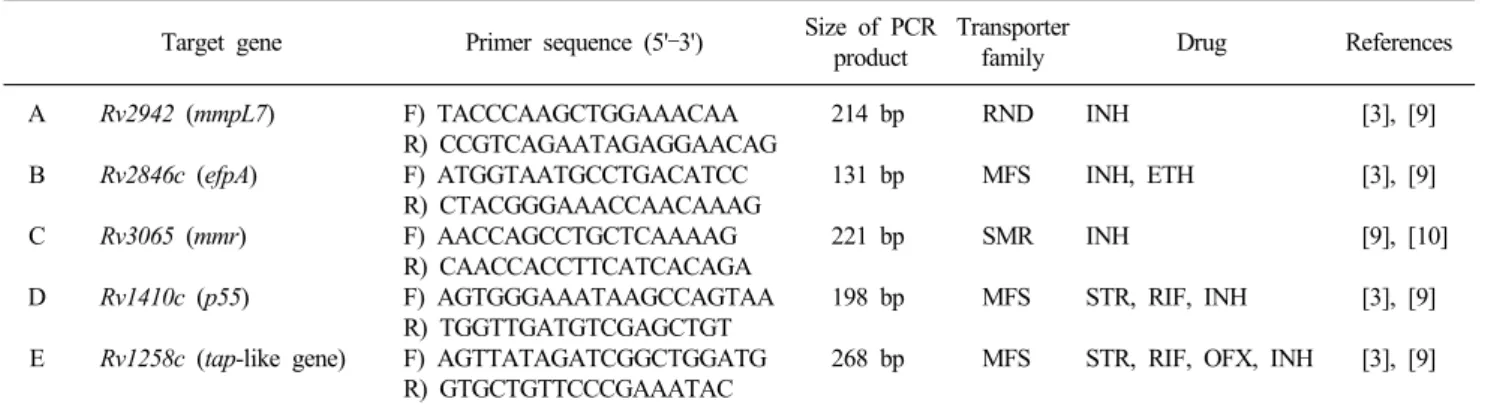
The primer sequences for 5 efflux genes, mmpL7, efpA, mmr, p55 and tap-like gene, have previously been described by Rodrigues et al. and DNA preparation for PCR reaction of ef-
flux genes was done according to our previous study (Table 1) [8,9]. Final 2 μL of template DNA was taken for the PCR re- action with Maxime PCR PreMix (i-Taq) (iNtRON Biotechnology, Sungnam, Korea). PCR was done in LifePro Thermal Cycler (Bioer Technology Co., Ltd, Hangzhou, China). Thermal cy- cling conditions were as follows: initial denaturation step at 95oC for 5 min, 40 cycles of denaturation at 95oC for 1 min, annealing at 60oC for 1 min and extension at 72oC for 1 min;
and a final extension step at 72oC for 5 min.
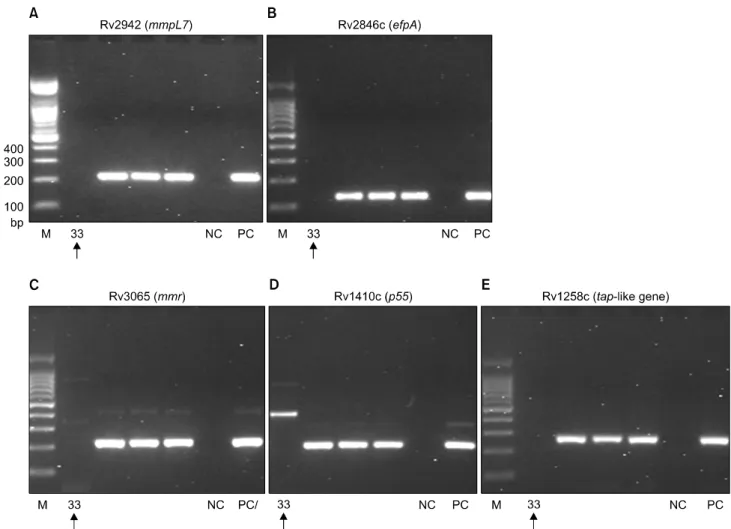
Molecular analysis of 5 kinds of efflux pump genes was per- formed in total 35 clinical isolates. Laboratory characteristics of these isolates were presented in Table 2. Only one clinical iso- late (specimen serial number 33) showed negative results in all of 5 kinds of efflux pump gene PCR (Fig. 1). All the rest 34 isolates presented concurrent positive results in 5 efflux pump genes.
In this study, with molecular analysis of 5 genes in efflux pump system, we investigated efflux pump genes of MTB iso- lates from Korean patients, to choose and suggest appropriate molecular targets. Almost all isolates (34/35), only except one
66
Ann Clin Microbiol 2014;17(2):65-68Table 2. Characteristics of 35 clinical isolates in this study
No. Specimen Sex/Age AFB smear Culture (L) Culture (S) Drug susceptibility test*
1 2 3 4 5 6 7 8 9 10 11 12 13 14 15 16 17 18 19 20 21 22 23 24 25 26 27 28 29 30 31 32 33 34 35
Sputum Sputum Urine, clean Sputum Urine, clean Sputum Sputum Sputum Pleural mass Pleural fluid Sputum Sputum Sputum Sputum Sputum Sputum Sputum Sputum Sputum Sputum
Bronchial washing Sputum
Sputum
Bronchial washing Sputum
Sputum Mediastinum Bronchial washing Bronchial washing Sputum
Sputum Sputum Sputum Sputum Sputum
M/37 M/27 F/69 M/26 F/73 M/43 M/52 F/25 F/81 F/46 F/46 M/15 F/25 F/79 F/80 F/79 M/71 F/72 M/32 F/54 F/54 M/81 M/51 F/69 M/64 M/54 F/37 M/17 M/39 M/72 F/72 F/80 F/81 F/81 F/27
1+
1+
Negative Negative Negative 2+
Negative 3+
Negative Negative 1+
Negative Negative Negative Negative Negative 1+
Negative Negative Negative Negative 2+
1+
Negative Negative 1+
Negative Negative Negative Negative Negative Negative Negative 1+
1+
Negative MTB MTB Negative NA Negative NA NA MTB MTB MTB MTB MTB MTB Negative MTB MTB MTB MTB MTB MTB MTB Negative MTB MTB MTB MTB MTB MTB Negative MTB MTB MTB MTB NA
1+
1+
2+
1+
1+
2+
1+
2+
1+
1+
2+
1+
1+
1+
1+
1+
1+
1+
1+
2+
1+
1+
2+
1+
1+
1+
1+
1+
1+
1+
1+
1+
1+
1+
1+
Susceptible for all agents tested Susceptible for all agents tested Susceptible for all agents tested Susceptible for all agents tested NA
Susceptible for all agents tested Susceptible for all agents tested Susceptible for all agents tested Susceptible for all agents tested Susceptible for all agents tested Susceptible for all agents tested Susceptible for all agents tested NA
NA NA
Susceptible for all agents tested Susceptible for all agents tested Susceptible for all agents tested Susceptible for all agents tested Susceptible for all agents tested Susceptible for all agents tested Resistant for INH, RIF, and EMB Susceptible for all agents tested Susceptible for all agents tested Susceptible for all agents tested Susceptible for all agents tested NA
Resistant for SM, RIF, and RFB Susceptible for all agents tested Susceptible for all agents tested Susceptible for all agents tested Susceptible for all agents tested Resistant for INH
Resistant for INH
Susceptible for all agents tested Abbreviations: L, liquid; S, solid; F, female; M, male; NA, non-available; MTB, Mycobacterium tuberculosis; INH, isoniazid; RIF, rifampicin;
EMB, ethambutol; SM, streptomycin; RFB, rifabutin.
*Tested anti-TB agents for the drug susceptibility test include amikacin, capreomycin, cycloserin, ethambutol, isoniazid, kanamycin, levofloxacin, moxifloxacin, ofloxacin, P-aminosalicylic acid, prothionamide, pyrazinamide, rifampicin and streptomycin.
Table 1. Primers for molecular analysis in 5 efflux pump genes
Target gene Primer sequence (5'–3') Size of PCR product
Transporter
family Drug References
A B C D E
Rv2942 (mmpL7) Rv2846c (efpA) Rv3065 (mmr) Rv1410c (p55) Rv1258c (tap-like gene)
F) TACCCAAGCTGGAAACAA R) CCGTCAGAATAGAGGAACAG F) ATGGTAATGCCTGACATCC R) CTACGGGAAACCAACAAAG F) AACCAGCCTGCTCAAAAG R) CAACCACCTTCATCACAGA F) AGTGGGAAATAAGCCAGTAA R) TGGTTGATGTCGAGCTGT F) AGTTATAGATCGGCTGGATG R) GTGCTGTTCCCGAAATAC
214 bp 131 bp 221 bp 198 bp 268 bp
RND MFS SMR MFS MFS
INH INH, ETH INH
STR, RIF, INH STR, RIF, OFX, INH
[3], [9]
[3], [9]
[9], [10]
[3], [9]
[3], [9]
Abbreviations: F, forward; R, reverse; bp, base pairs; RND, resistance nodulation division; MFS, major facilitator super-family; SMR, small multidrug resistance family; INH, isoniazid; RIF, rifampicin; OFX, ofloxacin.
Sun Young Cho, et al. : A Study of Efflux Pump Genes in MTB
67
Fig. 1. Molecular analysis of efflux pump genes in clinical specimens of Korean patients. In total 35 specimens showing the positivity for M.
tuberculosis, only one clinical strain shows negative results in all of 5 kinds of efflux pump gene PCR (specimen serial number 33, arrows).
The rest of strains present positive results in 5 efflux pump genes, simultaneously. M, size marker; NC, negative control; PC, positive control.
case, presented positive results in PCR tests of 5 kinds of efflux pump genes. Because the efflux pump induction is an important step in the evolution of mycobacterial drug resistance, gene ex- pression study should be followed in these genes, with a large number of clinical isolates [6]. Comparisons of gene expression levels according to treatment courses and drug exposure can al- so provide information to understand the role of efflux pump genes of MTB.
ACKNOWLEDGMENTS
This study was supported by a grant from Korean Society of Clinical Microbiology.
REFERENCES
1. Soto SM. Role of efflux pumps in the antibiotic resistance of
bacteria embedded in a biofilm. Virulence 2013;4:223-9.
2. Sarathy J, Dartois V, Dick T, Gengenbacher M. Reduced drug uptake in phenotypically resistant nutrient-starved nonreplicating Mycobacterium tuberculosis. Antimicrob Agents Chemother 2013;
57:1648-53.
3. da Silva PE, Von Groll A, Martin A, Palomino JC. Efflux as a mechanism for drug resistance in Mycobacterium tuberculosis.
FEMS Immunol Med Microbiol 2011;63:1-9.
4. Balganesh M, Dinesh N, Sharma S, Kuruppath S, Nair AV, Sharma U. Efflux pumps of Mycobacterium tuberculosis play a significant role in antituberculosis activity of potential drug candidates. Antimicrob Agents Chemother 2012;56:2643-51.
5. Escribano I, Rodríguez JC, Llorca B, García-Pachon E, Ruiz M, Royo G. Importance of the efflux pump systems in the resistance of Mycobacterium tuberculosis to fluoroquinolones and linezolid.
Chemotherapy 2007;53:397-401.
6. Schmalstieg AM, Srivastava S, Belkaya S, Deshpande D, Meek C, Leff R, et al. The antibiotic resistance arrow of time: efflux pump induction is a general first step in the evolution of mycobacterial drug resistance. Antimicrob Agents Chemother 2012;56:4806-15.
7. Kim HJ. Current Status of Tuberculosis in Korea. Korean J Med 2012;82:257-62.
8. Rodrigues L, Machado D, Couto I, Amaral L, Viveiros M.
68
Ann Clin Microbiol 2014;17(2):65-68Contribution of efflux activity to isoniazid resistance in the Mycobacterium tuberculosis complex. Infect Genet Evol 2012;
12:695-700.
9. Cho SY, Kim MJ, Suh JT, Lee HJ. Comparison of diagnostic performance of three real-time PCR kits for detecting Myco- bacterium species. Yonsei Med J 2011;52:301-6.
=국문초록=
임상 분리된 결핵균에서의 Efflux Pump Gene에 대한 선행연구
1경희대학교 의과대학 진단검사의학교실, 경희대학교 대학원 2기초의과학과, 3의학과, 4씨젠의료재단 조선영1, 남유선2, 양형석1, 소윤수3, 김민진4, 이희주1
Efflux pump system은 약제 내성 결핵균의 중요한 기전 중 하나로 제안되고 있다. 이 연구는 efflux pump system의 5가지 유전자에 대한 분석을 통해, 한국 환자들로부터 분리된 결핵균의 적절한 표적을 선택하고 제안하기 위해 시행되었다.
이 연구에서는 양성 동정결과를 보이는 35 검체가 분석되었다. mmpL7, efpA, mmr, p55, 그리고 tap-like gene 등 5종류의 efflux gene에 대해 PCR을 시행하여 35개의 분리된 결핵 균주를 분자적 방법으로 분석하였다. 그 결과 오직 하나의 분리 균주에서 5종류의 efflux pump gene PCR에 대해 음성 결과를 보였다. 나머지 34개의 분리 균주에서는 5종류의 efflux pump gene에 대해 동시 양성 결과가 나왔다. 앞으로 이 유전자들에 대한 PCR 정량 검사를 통해 유전자 발현 조사가 진행되어야 할 것이다. [Ann Clin Microbiol 2014;17:65-68]
교신저자 : 이희주, 130-702, 서울시 동대문구 회기동 1번지 경희의료원 진단검사의학과
Tel: 02-958-8672, Fax: 02-958-8609 E-mail: [email protected]