Received: June 29, 2018 Revised: September 16, 2018 Accepted: October 2, 2018
Address for Correspondence: Winnie Lai-Sheung Cheng, School of Nursing, Tung Wah College, 31 Wylie Road, Homantin, Kowloon, Hong Kong
Tel: +852-91794786, Fax: +852-27821566, E-mail: [email protected]
Original Article
pISSN: 2288-6478, eISSN: 2288-6761 https://doi.org/10.6118/jmm.2018.24.3.188 Journal of Menopausal Medicine 2018;24:188-195
J MM
Introduction
The world’s population is ageing. More people are living lon- ger than ever before - aged 60 years and over are expected to increase from 11% to 22% by 2050.1 Many women are expected to live beyond the age after post-menopause.
Women in menopausal and post-menopausal stage experi- ence an increased level of stress due to its normal physiological changes and increased health risks.2,3 Health disorders such as cardiovascular diseases, osteoporosis, and breast cancer are commonly found in these women.4,5 In particular, breast can- cer is the common cause of cancer death in midlife women.6,7
International evidences have demonstrated that breast cancer screening to be effective in reducing breast cancer mortality among midlife.8~11 However, breast cancer screening practice was low in Asian countries,12~15 it deserves further study to in- vestigate the factors.
Menopause is a normal physiological process among wom- en who often experience vasomotor, psychosocial, physical and sexual symptoms around age 50.16,17 The menopause- related symptoms may start from perimenopause through menopause and last beyond post-menopause.18 For some women, these symptoms significantly affect their perceived quality of life (QOL)16,19,20 and constitute distress and distur-
The Roles of Menopausal-specific Quality of Life on Breast Cancer Screening Beliefs in Menopausal and Postmenopausal Women
Winnie Lai-Sheung Cheng, Florence MF Wong
School of Nursing, Tung Wah College, Kowloon, Hong Kong
Objectives: This study investigated the association between menopausal-specific quality of life (MENQOL) and breast cancer screening beliefs among Hong Kong Chinese menopausal and postmenopausal women.
Methods: A cross-sectional study was employed to collect data. The questionnaire was distributed to a convenience sample of 218 women aged above 45. The outcome variables were breast cancer screening beliefs and breast examination. Multiple regression analyses were conducted to test the effect of 4 domains in MENQOL (vasomotor, psycho-social, physical, and sexual symptom) and the health behaviors on the 2 outcome variables.
Results: This study found that the overall MENQOL scores (in particular psycho-social, and physical aspects) were significantly associated with positive attitudes toward health check-ups and better knowledge and perceptions in breast cancer. Regular exercise was also significantly related to breast examination.
Conclusions: MENQOL (especially psycho-social and physical domain) and regular exercise are important factors associated with breast cancer screening beliefs. The results of this study illuminate health care professionals to develop primary health care strategies to improve the quality of life of mid-life women. (J Menopausal Med 2018;24:188-195)
Key Words: Breast neoplasms · Mammography · Menopause · Postmenopause · Quality of life
Winnie Lai-Sheung Cheng. Menopausal-specific Quality of Life and Breast Cancer Screening
bances that can disrupt their daily activities.21,22
Perceived health is a concept that measures self-perceptions of health related QOL - an indicator to predict the use of health service and screening practice.23,24 In midlife women, perceived health status is greatly affected by the menopausal specific symptoms, which may in turn determine their use of screen- ing practice. Therefore, it is worthwhile to identify menopausal- specific QOL (MENQOL) of midlife women, and investigate its association with breast screening beliefs and practice.
A previous study has reported that women (age, 50-74 years) with better QOL in general health status and physical health were more likely to receive breast cancer screening.25 Few studies have reported that women with poor perceived health were less likely to be participative in breast screening practice but the results were inconsistent.26~28 In general, people tend to use health service more frequently if they perceived ill health.23 However, little is known about the association between adherence of breast cancer screening practice and MENQOL among menopausal and postmenopausal women.
No study has investigated the effects of MENQOL on breast cancer screening beliefs and practice. Therefore, this pres- ent study aimed to explore the influence of the 4 domains of MENQOL (vasomotor, physical, psychosocial, and sexual) on the breast cancer screening beliefs and practice among the menopausal and postmenopausal women living in Hong Kong.
We hypothesized that women reporting better MENQOL would have positive attitudes towards breast cancer screening prac- tice and thus more likely to participate in breast screening prac- tice. The findings of this present study add knowledge on the factors that can contribute to the adherence with breast cancer screening.
Materials and Methods
1. Design and sampling
A cross-sectional descriptive survey using self-reported questionnaires was conducted involving 218 women. Using Epi-Info version 7 (Centers for Disease Control and Pre- vention, Atlanta, GA, USA) for calculation, the sample size achieved 80% confidence level with 5% marginal error based on the total population of women aged over 45 in Hong Kong, which was 1,647,710.29 Convenience sample was used
to recruit the participants for the study. The inclusion crite- ria were women aged at or above 45, with ability to respond clearly; exclusion criteria were those women who had been receiving hormonal therapy and history of cancer. Data were collected from the participants who participated in a com- munity health project conducted in Hung Home district in Hong Kong (Special Administrative Region of China).
(1) Outcome variables
The outcome variables used in this study were breast screening practice, knowledge and perceptions about breast cancer, barriers to mammographic screening and attitude to- ward general health check-ups. The breast screening practice was assessed with self-reported breast examination by doc- tor in the previous one year. The knowledge and perceptions about breast cancer, barriers to mammographic screening and attitude toward general health check-ups were assessed with a modified Chinese Breast Cancer Screening Beliefs Ques- tionnaire (CBCSB) developed by Fong and his colleagues.30 The modified CBCSB is an 11-item scale which consists of 3 subscales: attitudes toward general health check-ups (4 items), knowledge and perceptions about breast cancer (4 items), and barriers to mammographic screening (3 items). The response was assessed with a 5-point Likert scale ranging from “strongly agree” (1) to “strongly disagree” (5), the higher the score, the more positive in attitudes, more accurate in knowledge, and least perceived barriers to having mammograms. For analysis, the mean response within a subscale was converted to a range between 0 and 100. If all items within a subscale for a partici- pant were scored as 5, the final score is 100, and if a partici- pant scored all items as 1, the final score is then 0. A formula is given: (total score - minimum total)/(maximum total - minimum total). For example, the score of a subscale of 4 items = (total score - 4)/(20-4). A score of 65 or higher in each subscale indicates better attitude, more knowledge or lower barrier.30
(2) Independent variables
The MENQOL questionnaire31 was used in this study. The MENQOL consists of 29 items in 4 domains: vasomotor (3 items), psycho-social (7 items), physical (16 items), and sexual (3 items). The vasomotor domain evaluates the presence of hot flushes, night sweats, and sweating. The psychosocial domain assesses the psychosocial aspects of woman regarding per-
Journal of Menopausal Medicine 2018;24:188-195
J MM
sonal satisfaction, anxiousness, memory, and depression. The physical domain includes items such as flatulence, bloating, pain, tiredness, sleeping, physical strength, and weight gain.
The sexual domain assesses changes in sexual desire, vaginal dryness, and intimacy. Participants should indicate if a symp- tom is present or not-present. If not-present, the participants continued with next symptom. If present, the participant should indicate the level of bothersome with a 7-point likert scale through 0; not all bothered, to 6; extremely bothered. For cal- culation of score, 1 was assigned for “not-present”, and 2 for
“present” with “not at all bothered” through to 8 for “extremely bothered”. The mean of each domain was measured from 1 to 8. The average of the 4 domains means represented the overall score.31 As the MENQOL was originally developed in English, the Chinese version used in this present study was translated from the English version using forward and backward translation by the researchers. The internal consistency of the translated version was tested with Cronbach alpha, which was 0.865.
(3) Other covariates
Socio-demographic characteristics which included age, level of education, family income, occupation, and marital status, and health behaviors that may confound the asso- ciation of MENQOL with breast cancer practice and percep- tions were taken into account in this study.
2. Data analysis
Data were analyzed by the SPSS version 23 (SPSS Inc., Chicago, IL, USA). Descriptive statistics were reported for socio-demographic and menopausal symptoms, and breast cancer screening practices. Categorical data were presented as count and proportions. Continuous data are presented as mean and standard deviation. The mean differences of MENQOL and breast cancer screening beliefs among differ- ent socio-demographic characteristics were assessed using analysis of variance (ANOVA) and independent t-test. The relationship between demographic characteristics and meno- pausal symptoms with breast screening practice and beliefs was assessed by Pearson correlation or Pearson χ2 tests. The potential predictors were fitted separately in the multiple re- gression models to predict the attitudes to health check-ups and breast cancer knowledge and perceptions. In all statis- tical analyses, a P-value of less than 0.05 was considered
as statistical significant.
3. Ethical considerations
This study was approved by the Human Research Ethics Committee of the study institution. Data were collected after obtaining verbal consent from the participants.
Results
This study included 223 women who responded and com- pleted the questionnaire out of a total of 304 invited women.
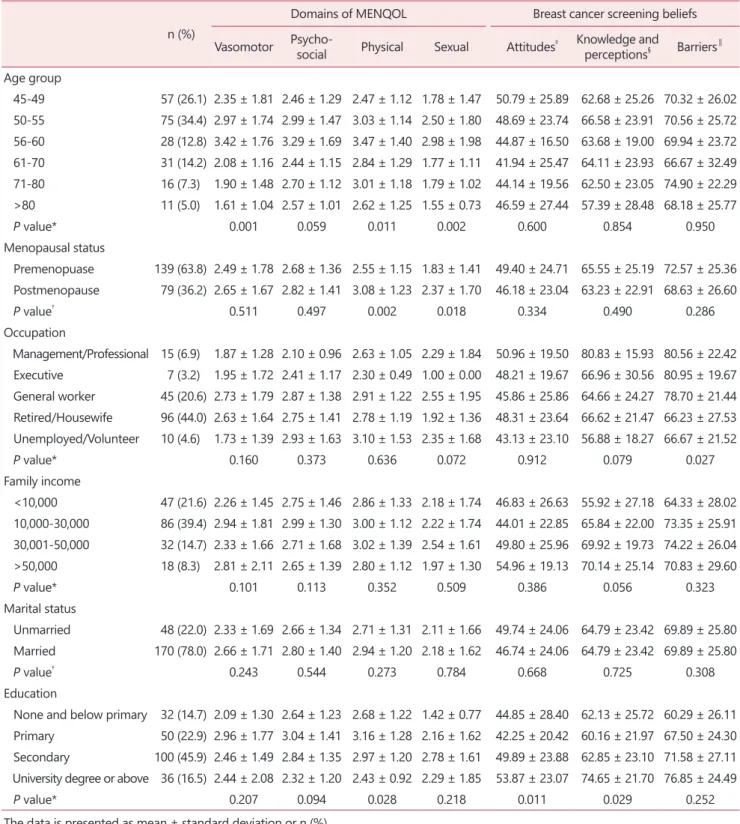
Refusal to participation in the study was mainly due to un- availability. After removal of incomplete questionnaires, 218 valid questionnaires were recovered for analysis. Of these, 161 women aged over 50 (73.9%), and most were from 50 to 55 years old (34.4%). The majority were married (78.0%) and retired or housewives (44%). Sixty-two point four percent of them had secondary or above education. The majority of women (36.2%) had passed menopause (postmenopause), and 63.8% (premenopause) of them were in the transitional period. All pre-menopause women aged below 61. Women aged between from 56 to 60 reported statistically significant high scores in vasomotor, physical and sexual domains of the MENQOL. Women with better education level reported a lower score in physical domain. No significant differences were re- ported in occupation, family income, and marital status. Table 1 shows the details of demographic characteristics, the MENQOL and breast cancer screening beliefs scores. For breast cancer screening beliefs, there were no significant differences among women with many of the socio-economic characteristics, ex- cept that there were statistically significant high scores, meaning less barrier to mammographic screening among women work- ing at managerial and executive level, and low scores in at- titudes toward health check-ups, and breast cancer knowledge and perceptions among less educated women. About half of the women did not have their breast examined by doctor in the previous year (n = 131, 60%), expose to sunlight regularly (n = 117, 53.7%), take oral calcium supplement (n = 135, 61.9%), and perform regular physical exercise (n = 95, 43%). Table 2 shows the participation of menopausal related health behaviors.
The relationship between MENQOL and the breast cancer screening beliefs and practice were also computed. Statisti-
Winnie Lai-Sheung Cheng. Menopausal-specific Quality of Life and Breast Cancer Screening
Table 1. Mean scores per domain of Menopause-specific Quality of Life Questionnaire according to socio-demographic characteristics (n = 218) n (%)
Domains of MENQOL Breast cancer screening beliefs Vasomotor Psycho-social Physical Sexual Attitudes‡ Knowledge and
perceptions§ Barriers∥ Age group
45-49 57 (26.1) 2.35 ± 1.81 2.46 ± 1.29 2.47 ± 1.12 1.78 ± 1.47 50.79 ± 25.89 62.68 ± 25.26 70.32 ± 26.02 50-55 75 (34.4) 2.97 ± 1.74 2.99 ± 1.47 3.03 ± 1.14 2.50 ± 1.80 48.69 ± 23.74 66.58 ± 23.91 70.56 ± 25.72 56-60 28 (12.8) 3.42 ± 1.76 3.29 ± 1.69 3.47 ± 1.40 2.98 ± 1.98 44.87 ± 16.50 63.68 ± 19.00 69.94 ± 23.72 61-70 31 (14.2) 2.08 ± 1.16 2.44 ± 1.15 2.84 ± 1.29 1.77 ± 1.11 41.94 ± 25.47 64.11 ± 23.93 66.67 ± 32.49 71-80 16 (7.3) 1.90 ± 1.48 2.70 ± 1.12 3.01 ± 1.18 1.79 ± 1.02 44.14 ± 19.56 62.50 ± 23.05 74.90 ± 22.29 >80 11 (5.0) 1.61 ± 1.04 2.57 ± 1.01 2.62 ± 1.25 1.55 ± 0.73 46.59 ± 27.44 57.39 ± 28.48 68.18 ± 25.77
P value* 0.001 0.059 0.011 0.002 0.600 0.854 0.950
Menopausal status
Premenopuase 139 (63.8) 2.49 ± 1.78 2.68 ± 1.36 2.55 ± 1.15 1.83 ± 1.41 49.40 ± 24.71 65.55 ± 25.19 72.57 ± 25.36 Postmenopause 79 (36.2) 2.65 ± 1.67 2.82 ± 1.41 3.08 ± 1.23 2.37 ± 1.70 46.18 ± 23.04 63.23 ± 22.91 68.63 ± 26.60
P value† 0.511 0.497 0.002 0.018 0.334 0.490 0.286
Occupation
Management/Professional 15 (6.9) 1.87 ± 1.28 2.10 ± 0.96 2.63 ± 1.05 2.29 ± 1.84 50.96 ± 19.50 80.83 ± 15.93 80.56 ± 22.42 Executive 7 (3.2) 1.95 ± 1.72 2.41 ± 1.17 2.30 ± 0.49 1.00 ± 0.00 48.21 ± 19.67 66.96 ± 30.56 80.95 ± 19.67 General worker 45 (20.6) 2.73 ± 1.79 2.87 ± 1.38 2.91 ± 1.22 2.55 ± 1.95 45.86 ± 25.86 64.66 ± 24.27 78.70 ± 21.44 Retired/Housewife 96 (44.0) 2.63 ± 1.64 2.75 ± 1.41 2.78 ± 1.19 1.92 ± 1.36 48.31 ± 23.64 66.62 ± 21.47 66.23 ± 27.53 Unemployed/Volunteer 10 (4.6) 1.73 ± 1.39 2.93 ± 1.63 3.10 ± 1.53 2.35 ± 1.68 43.13 ± 23.10 56.88 ± 18.27 66.67 ± 21.52
P value* 0.160 0.373 0.636 0.072 0.912 0.079 0.027
Family income
<10,000 47 (21.6) 2.26 ± 1.45 2.75 ± 1.46 2.86 ± 1.33 2.18 ± 1.74 46.83 ± 26.63 55.92 ± 27.18 64.33 ± 28.02 10,000-30,000 86 (39.4) 2.94 ± 1.81 2.99 ± 1.30 3.00 ± 1.12 2.22 ± 1.74 44.01 ± 22.85 65.84 ± 22.00 73.35 ± 25.91 30,001-50,000 32 (14.7) 2.33 ± 1.66 2.71 ± 1.68 3.02 ± 1.39 2.54 ± 1.61 49.80 ± 25.96 69.92 ± 19.73 74.22 ± 26.04 >50,000 18 (8.3) 2.81 ± 2.11 2.65 ± 1.39 2.80 ± 1.12 1.97 ± 1.30 54.96 ± 19.13 70.14 ± 25.14 70.83 ± 29.60
P value* 0.101 0.113 0.352 0.509 0.386 0.056 0.323
Marital status
Unmarried 48 (22.0) 2.33 ± 1.69 2.66 ± 1.34 2.71 ± 1.31 2.11 ± 1.66 49.74 ± 24.06 64.79 ± 23.42 69.89 ± 25.80 Married 170 (78.0) 2.66 ± 1.71 2.80 ± 1.40 2.94 ± 1.20 2.18 ± 1.62 46.74 ± 24.06 64.79 ± 23.42 69.89 ± 25.80
P value† 0.243 0.544 0.273 0.784 0.668 0.725 0.308
Education
None and below primary 32 (14.7) 2.09 ± 1.30 2.64 ± 1.23 2.68 ± 1.22 1.42 ± 0.77 44.85 ± 28.40 62.13 ± 25.72 60.29 ± 26.11 Primary 50 (22.9) 2.96 ± 1.77 3.04 ± 1.41 3.16 ± 1.28 2.16 ± 1.62 42.25 ± 20.42 60.16 ± 21.97 67.50 ± 24.30 Secondary 100 (45.9) 2.46 ± 1.49 2.84 ± 1.35 2.97 ± 1.20 2.78 ± 1.61 49.89 ± 23.88 62.85 ± 23.10 71.58 ± 27.11 University degree or above 36 (16.5) 2.44 ± 2.08 2.32 ± 1.20 2.43 ± 0.92 2.29 ± 1.85 53.87 ± 23.07 74.65 ± 21.70 76.85 ± 24.49
P value* 0.207 0.094 0.028 0.218 0.011 0.029 0.252
The data is presented as mean ± standard deviation or n (%)
*P values calculated using analysis of variance
†P values calculated using independent t-test
‡Attitudes to health check-ups
§Breast cancer knowledge and perceptions
∥Barriers to mammographic screening
MENQOL: Menopause-specific Quality of Life Questionnaire
Journal of Menopausal Medicine 2018;24:188-195
J MM
cally significant association was reported between attitude toward health check-ups with psycho-social (r = -0.198;
P < 0.001), and physical domains (r = -0.168; P < 0.05) of the MENQOL. Breast cancer knowledge and perceptions was also significantly associated with psycho-social (r = -0.276;
P < 0.001) and physical domains (r = -0.198; P < 0.001) of the MENQOL. For demographic characteristics, the educa- tion level was associated with the barriers to mammographic screening (χ2 = 57.63; P < 0.05). Regular exercise was as- sociated with breast examination (χ2 = 7.64; P < 0.05) and attitudes toward health check-ups (χ2 = 31.86; P < 0.05).
Multiple regression analyses were conducted separately to examine the relationship between various potential predic- tors and breast cancer attitudes and knowledge (Table 3). The multiple regression model with predictors for attitudes to health check-ups produced R2 = 0.059, F (4, 213) = 4.386, P < 0.001. As can be seen in Table 3, after controlling for the other variables, only regular exercise contributes to the multiple re- gression models. Regular exercise (coded as yes = 1, no = 2) is negatively and significantly correlated with the attitudes toward health check-ups, indicating that women performed regular exercise tend to have better attitudes. The multiple regression model with predictors for breast cancer knowledge and percep- tions produced R2 = 0.064, F (3, 214) = 5.906, P < 0.001. After controlling for the other variables, only psycho-social domain contributes to the multiple regression models. Psycho-social domain is negatively and significantly correlated with the breast cancer knowledge and perceptions, indicating that women who
Table 2. Number (%) of health behavior (n = 218)
Health behaviors n (%)
Breast examination done by doctor in the previous year
Yes 87 (40.0%)
No 131 (60.1%)
Non-drinkers
Yes 145 (66.5%)
No 73 (33.5%)
Non-smokers
Yes 206 (94.5%)
No 12 (5.5%)
Regular sunlight exposure
Yes 101 (46.3%)
No 117 (53.7%)
Always take oral calcium supplement
Yes 83 (38.1%)
No 135 (61.9%)
Regular physical exercise
Yes 123 (56.4%)
No 95 (43.6%)
The data is presented as n (%)
Table 3. Regression analysis for the factors influencing breast cancer beliefs
Variable Attitudes to health check-ups Breast cancer knowledge and perceptions
B SE B β B SE B β
Regular exercise -8.775 3.180 -0.184*
Psycho-social symptoms -3.574 1.937 -0.210 -4.974 1.938 -0.292*
Physical symptoms -2.287 2.503 -0.119 0.345 2.504 0.018
Overall MENQOL 3.162 3.002 0.155 0.053 20992 0.003
Adjusted R2 0.059 0.064
F 4.386† 5.906†
*P < 0.05
†P < 0.001
MENQOL: Menopause-specific Quality of Life Questionnaire, B: unstandardized beta, SE B: standard error for the unstandardized beta, β:
standardized beta
Winnie Lai-Sheung Cheng. Menopausal-specific Quality of Life and Breast Cancer Screening
were less bothered by the psycho-social symptoms tend to have better breast cancer knowledge and perceptions.
Discussion
The present study aimed to investigate the association of MENQOL using MENQOL with breast cancer screening prac- tice and beliefs among menopausal and postmenopausal women. To our knowledge, this is the first study to assess the role of MENQOL on breast cancer screening practice and be- liefs among menopausal and postmenopausal women. Posi- tive breast cancer screening practice and beliefs are crucial to prevent breast cancer - the common cause of cancer death in midlife women.6,7 The better we know about the MENQOL and its relationship between breast cancer screening practice and beliefs in menopausal and postmenopausal women, the better we can devise primary health care strategies to improve their health outcomes.
Previous studies reported that older and well educated women are resulted in better QOL on many of the MENQOL domains.20,32,33 The current study confirmed the findings.
These results illuminate the needs for health care profes- sionals to devise primary health care strategies targeting the specific groups to improve women’s menopausal health.
Previous studies have shown that better general QOL is relat- ed to the use of breast cancer screening.25,28 People with lower self-rated health were less likely to participate in health screen- ing behavior.34 This present study fills the gap by examining the roles of MENQOL on the breast cancer screening practice and beliefs in menopausal and postmenopausal women. Evidence suggests that women with positive attitude toward menopause tend to live a happier life35 and people with better self-rated health tend to report better life-satisfaction.36 Women with better health status may have a positive attitude toward menopause and may be more motivated in engaging preventive health be- haviors. The present study confirmed the findings. We found that menopausal and postmenopausal women who reported a better MENQOL, in particular psycho-social and physical aspects had more positive attitudes towards health check-ups and better breast cancer knowledge and perceptions.
Previous studies have shown that socioeconomic factors such as age, marital status, income level, education, and
health behavior significantly influence breast cancer screen-
ing.37~39 The menopausal and postmenopausal women in
this study reported a positive relationship between engag- ing in regular exercise and breast examination and attitudes toward health check-up. Multiple regression models show that regular exercise predicted the positive attitudes to- ward health check-up in menopausal and postmenopausal women. This finding is consistent with Lin’s study37 that women who engaged in exercise were found to be more likely to undergo breast cancer screening. Evidence suggests that strong exercise beliefs foster motivation to perform ex- ercise.40 People who spend time in performing exercise on regular basis might have a strong belief in exercise that it can promote health. In fact, exercise improves health of in- dividuals.41,42 The positive effect of exercise on health might foster the positive attitude of regular health check-up.
This study adds new information for health care profes- sionals that regular exercise and MENQOL, in particular the psycho-social and physical aspects among menopausal and postmenopausal women predicts their attitudes towards health check-ups and better breast cancer knowledge and percep- tions respectively. Public health strategies should be devised to promote regular exercise and enhance psycho-social sup- port and physical health to menopausal and postmenopausal women. The effects of such strategies not only promote the menopausal health in midlife women but also help promoting positive attitude toward health check-ups and breast cancer screening.
Like other studies, limitations need to be considered when interpreting the results. First, this is a cross-sectional study which only assessed the health condition in a specific period of time makes it difficult to assess the causal relationship between MENQOL and breast cancer screening beliefs. Menopausal and postmenopausal women may have a better QOL because they had a positive attitude to cope with the physio-psycho- social effects of menopause. Therefore, more evidence for the factors on menopausal and postmenopausal women’s breast cancer screening beliefs is required from a prospective cohort studies. Second, the women were asked about their feelings and experience in a month ago from which information may be lost. Third, the women in this study were recruited from a single district; the results could not necessarily represent the general picture of Hong Kong population as a whole and therefore
Journal of Menopausal Medicine 2018;24:188-195
J MM
lacking of generalizability. Finally, the past history of breast can- cer of the women was not assessed, the results of this study warrant consideration when interpreting some of the reported symptoms which might be affected by the comorbid diseases.
In summary, the present study confirms that psycho- social domain of the MENQOL and regular exercise are important factors associated with the breast cancer screen- ing beliefs, in particular attitudes toward health check-up and breast cancer knowledge and perceptions. Our findings indicated that menopausal and postmenopausal women with better MENQOL, especially in psycho-social and physi- cal domain, were more likely to embrace the positive breast cancer screening beliefs. We also found that menopausal and postmenopausal women reporting more regular exercise were more likely to receive breast examination by doctor.
Further research on prospective cohort studies is suggested to explore the potential factors to explain the association between different domains of MENQOL and breast screening beliefs in menopausal and postmenopausal women.
Acknowledgement
The authors acknowledge the financial support from Takeda Pharmaceuticals (Hong Kong) Limited and col- leagues who helped data collection.
Conflict of Interest
No potential conflict of interest relevant to this article was reported.
References
1. World Health Organization. World health day 2012: Ageing and health. Geneva, CH: World Health Organization, 2012.
[Cited by 2017 Jul 5]. Available from: http://apps.who.int/iris/
bitstream/10665/70840/1/WHO_DCO_WHD_2012.1_eng.pdf.
2. Poomalar GK, Arounassalame B. The quality of life dur- ing and after menopause among rural women. J Clin Diagn Res 2013; 7: 135-9.
3. Caglayan EK, Caglayan K, Alkis I, Arslan E, Okur A, Banli O, et al. Factors associated with mammographic density in
postmenopausal women. J Menopausal Med 2015; 21: 82- 8.
4. Yi SS, Hwang E, Baek HK, Kim TH, Lee HH, Jun HS, et al. Application of bioactive natural materials-based prod- ucts on five women’s diseases. J Menopausal Med 2015; 21:
121-5.
5. Hwang SY, Kim TH, Lee HH. Neutral sphingomyelinase and breast cancer research. J Menopausal Med 2015; 21:
24-7.
6. Ferlay J, Shin HR, Bray F, Forman D, Mathers C, Par- kin DM. Estimates of worldwide burden of cancer in 2008:
GLOBOCAN 2008. Int J Cancer 2010; 127: 2893-917.
7. Wong IO, Schooling CM, Cowling BJ, Leung GM. Breast cancer incidence and mortality in a transitioning Chinese population: current and future trends. Br J Cancer 2015;
112: 167-70.
8. International Agency for Research on Cancer. IARC hand- books on cancer prevention, Volume 7: Breast screening.
Lyon, FR: IARC Press; 2002.
9. Njor S, Nyström L, Moss S, Paci E, Broeders M, Segnan N, et al. Breast cancer mortality in mammographic screening in Europe: a review of incidence-based mortality studies. J Med Screen 2012; 19 Suppl 1: 33-41.
10. Broeders M, Moss S, Nyström L, Njor S, Jonsson H, Paap E, et al. The impact of mammographic screening on breast cancer mortality in Europe: a review of observational stud- ies. J Med Screen 2012; 19 Suppl 1: 14-25.
11. Otto SJ, Fracheboud J, Verbeek AL, Boer R, Reijerink- Verheij JC, Otten JD, et al. Mammography screening and risk of breast cancer death: a population-based case- control study. Cancer Epidemiol Biomarkers Prev 2012; 21:
66-73.
12. Kwok C, Fong DY. Breast cancer screening practices among Hong Kong Chinese women. Cancer Nurs 2014; 37: 59-65.
13. Parsa P, Kandiah M, Mohd Nasir MT, Hejar AR, Nor Afiah MZ. Reliability and validity of Champion’s Health Belief Model Scale for breast cancer screening among Malaysian women. Singapore Med J 2008; 49: 897-903.
14. Wang WL, Hsu SD, Wang JH, Huang LC, Hsu WL. Sur- vey of breast cancer mammography screening behaviors in Eastern Taiwan based on a health belief model. Kaohsiung J Med Sci 2014; 30: 422-7.
15. McCracken M, Olsen M, Chen MS, Jr., Jemal A, Thun M, Cokkinides V, et al. Cancer incidence, mortality, and as- sociated risk factors among Asian Americans of Chinese, Filipino, Vietnamese, Korean, and Japanese ethnicities. CA Cancer J Clin 2007; 57: 190-205.
16. Ahmed K, Jahan P, Nadia I, Ahmed F, Abdullah Al E. As- sessment of menopausal symptoms among early and late
Winnie Lai-Sheung Cheng. Menopausal-specific Quality of Life and Breast Cancer Screening
menopausal midlife Bangladeshi women and their impact on the quality of life. J Menopausal Med 2016; 22: 39-46.
17. Ayers B, Hunter MS. Health-related quality of life of women with menopausal hot flushes and night sweats. Cli- macteric 2013; 16: 235-9.
18. Lock M, Nguyen VK. An anthropology of biomedicine. Ox- ford, UK: Wiley-Blackwell; 2010.
19. Parsa P, Tabesh RA, Soltani F, Karami M. Effect of group counseling on quality of life among postmenopausal women in Hamadan, Iran. J Menopausal Med 2017; 23: 49-55.
20. Mirhaghjou SN, Niknami M, Moridi M, Pakseresht S, Ka- zemnejad E. Quality of life and its determinants in post- menopausal women: a population-based study. Appl Nurs Res 2016; 30: 252-6.
21. Masood A, Rashid S, Musarrat R, Mazahir S. Depression, anxiety, psychological distress and quality of life of women in menopausal phase. Pak J Womens Stud 2016; 23: 77-89.
22. Shyu YK, Pan CH, Liu WM, Hsueh JY, Hsu CS, Tsai PS.
Health-related quality of life and healthcare resource utili- zation in Taiwanese women with menopausal symptoms: a nation-wide survey. J Nurs Res 2012; 20: 208-18.
23. Krakau I. Perception of health and use of health care ser- vices in a Swedish primary care district. A ten year’s per- spective. Scand J Prim Health Care 1991; 9: 103-8.
24. Fleishman JA, Zuvekas SH. Global self-rated mental health: associations with other mental health measures and with role functioning. Med Care 2007; 45: 602-9.
25. Gandhi PK, Gentry WM, Kibert JL, 2nd, Lee EY, Jordan W, Bottorff MB, et al. The relationship between four health- related quality-of-life indicators and use of mammography and Pap test screening in US women. Qual Life Res 2015;
24: 2113-28.
26. Blackwell DL, Martinez ME, Gentleman JF. Women’s com- pliance with public health guidelines for mammograms and pap tests in Canada and the United States: an analysis of data from the Joint Canada/United States Survey Of Health. Womens Health Issues 2008; 18: 85-99.
27. Deshpande AD, McQueen A, Coups EJ. Different effects of multiple health status indicators on breast and colorectal cancer screening in a nationally representative US sample.
Cancer Epidemiol 2012; 36: 270-5.
28. Courtney-Long E, Armour B, Frammartino B, Miller J.
Factors associated with self-reported mammography use for women with and women without a disability. J Womens Health (Larchmt) 2011; 20: 1279-86.
29. Census and Statistics Department. Census results. Wan Chai, HK: The Government of the Hong Kong Special Ad- minstrative Region, 2011. [Cited by 2017 Aug 10]. Available from: https://www.census2011.gov.hk/en/census-result.
html.
30. Fong DY, Kwok C, White K. Psychometric properties of the Chinese Breast Cancer Screening Beliefs questionnaire. Eur J Oncol Nurs 2012; 16: 505-11.
31. Hilditch JR, Lewis J, Peter A, van Maris B, Ross A, Frans- sen E, et al. A menopause-specific quality of life question- naire: development and psychometric properties. Maturitas 1996; 24: 161-75.
32. Williams RE, Levine KB, Kalilani L, Lewis J, Clark RV.
Menopause-specific questionnaire assessment in US population-based study shows negative impact on health- related quality of life. Maturitas 2009; 62: 153-9.
33. Fallahzadeh H. Quality of life after the menopause in Iran:
a population study. Qual Life Res 2010; 19: 813-9.
34. Kruger JS, Sizuki R. Health literacy, self rated health, and health screening behaviors of older adults. Health Educ Monogr Ser 2016; 33: 6-10.
35. Li S, Ho SC, Sham A. Relationship between menopause status, attitude toward menopause, and quality of life in Chinese midlife women in Hong Kong. Menopause 2016;
23: 67-73.
36. Pickard AS, Jalundhwala YJ, Bewsher H, Sharp LK, Walton SM, Schumock GT, et al. Lifestyle-related attitudes: do they explain self-rated health and life-satisfaction? Qual Life Res 2018; 27: 1227-35.
37. Lin SJ. Factors influencing the uptake of screening services for breast and cervical cancer in Taiwan. J R Soc Promot Health 2008; 128: 327-34.
38. Park MJ, Park EC, Choi KS, Jun JK, Lee HY. Sociodemo- graphic gradients in breast and cervical cancer screening in Korea: the Korean National Cancer Screening Survey (KNCSS) 2005-2009. BMC Cancer 2011; 11: 257.
39. Akinyemiju TF. Socio-economic and health access deter- minants of breast and cervical cancer screening in low- income countries: analysis of the World Health Survey. PLoS One 2012; 7: e48834.
40. Ntoumanis N, Stenling A, Thogersen-Ntoumani C, Vlacho- poulos S, Lindwall M, Gucciardi DF, et al. Longitudinal as- sociations between exercise identity and exercise motivation:
A multilevel growth curve model approach. Scand J Med Sci Sports 2018; 28: 746-53.
41. Dalleck LC, Borresen EC, Wallenta JT, Zahler KL, Boyd EK.
A moderate-intensity exercise program fulfilling the American College of Sports Medicine net energy expenditure recom- mendation improves health outcomes in premenopausal women. J Strength Cond Res 2008; 22: 256-62.
42. Chung C, Lee S, Hwang S, Park E. Systematic review of exer- cise effects on health outcomes in women with breast cancer.
Asian Nurs Res (Korean Soc Nurs Sci) 2013; 7: 149-59.