2008, Vol. 52, No. 2
Printed in the Republic of Korea
단 신
글리신의 마그네슘이온 친화도에 대한 DFT연구
권혁재·이갑용*
대구가톨릭대학교 생명화학과 (2008. 2. 21 접수)
A DFT Study on Magnesium Ion Affinity of Glycine
Hyuk-Jae Kwon and Gab-Yong Lee*
Department of Life Chemistry, Catholic University of Daegu, Gyeongsan 712-702, Korea (Received 21 February 2008)
주제어: DFT, Mg2+착화합물, 결합에너지, 글리신
Keywords: DFT, Mg2+ Complex, Binding Energy, Glycine
The simplest and smallest amino acid, glycine is of special interest as a model compound for the experimental and theoretical studies on structure and reactivity of amino acids and peptides.1 The metalation of amino acids plays a significant role in biological phenomena.2-3 An important factor that influences the location of metal ions in the hydro- phobic interior of a protein is the relative intrinsic bond strength between the ionized metals and the various possible metal binding sites. Information on this important thermochemical property can be obtained by studying the metal-ligand complexes in the gas phase in which the solvent effects are absent.
On the other hand, a number of theoretical stud- ies have been reported on the interaction between metal cations and glycine in the gas phase.4-13 The density functional theory (DFT) methods have been shown to be very efficient in predicting the funda- mental thermochemical properties such as gas- phase basicity14,15 and metal ion affinity.16 Hoyau and Ohanessian17 have studied the interaction between the Cu+ ion and glycine by using the HF and B3LYP/6-31G(d) methods in order to obtain Cu+ affinity. Bertran et al.18 have reported a B3LYP study on the bonding in the Cu+-glycine system.
Remko and Rode have investigated the effect of
various metal ions and water coordination on the structure of glycine and zwitterionic glycine employ- ing the B3LYP/6-311+G(d,p) method.19
Thus far, no studies on the structure and magne- sium ion affinity of the Mg2+-glycine complexes have been reported. In this paper, we report a den- sity functional theory investigation on the interac- tion between the magnesium ion and glycine. In this study, we have focused our attention on the binding sites of the magnesium cation, geometrical structure of complexes, and Mg2+ affinity of glycine.
The DFT calculations were performed at the B3LYP level20,21 with 6-311++G(d,p) using the Gaussian03 program.22 The equilibrium geometries for all the structures were fully optimized without any restric- tions on symmetries. The metal binding sites for the Mg2+-glycine complexes were obtained from the geometries for the Li+ binding sites of glycine had been previously calculated by Jensen.23 In addition, the MP2/6-311++G(d,p)//B3LYP/6-311++G(d,p) calcu- lations were also performed for the comparison pur- pose.
Mg2+ ion affinity is calculated as the difference between the optimized energy of the Mg2+-glycine complex[E(Mg2+-Gly)], and the sum of the ener- gies of the Mg2+[E(Mg2+)] and free glycine[E(Gly)]
for the reaction.
RESULTS AND DISCUSSION
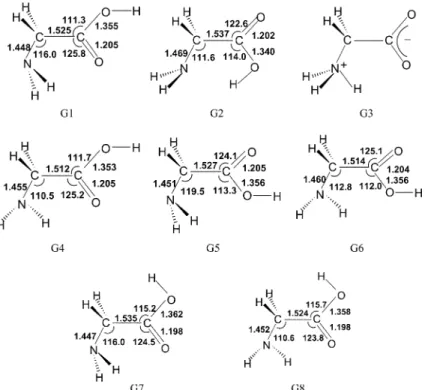
Prior to the calculations for the Mg2+-glycine complexes, the geometry optimization for various glycine conformers was performed starting from the 13 possible structures that had been reported by Csaszar.24 Our DFT calculations at the 6-311++G (d,p) level revealed a total of 7 stable conformers among them. A zwitterionic form, along with these 7 optimized glycines was also considered as an additional trial structure in this study. The opti- mized 7 glycine isomers and the zwitterionic form are shown in Fig. 1.
It should be noted that the zwitterionic form is not optimized in the gaseous state. That is, the zwit- terionic form, structure G3, degenerates into struc- ture G2 when G3 is optimized in the gaseous state.
This implies that glycine exists as a zwitterion in the crystalline state and in solution due to strong electrostatic and polarization interactions with its
cine also exists in a neutral form in the gas phase.
The studies have also demonstrated that the zwitte- rionic form of glycine can be stabilized by the pres- ence of metal ions, thereby forming a bridging complex.28
The ground state glycine(G1) is compared to a previously studied conformer and the structural parameters are found to be in good agreement with the results of the theoretical24 and experimental29 method. On the basis of this result, we have chosen to use the B3LYP functional couples with the 6- 311++G(d,p) basis sets to determine the geometri- cal structures of the Mg2+-glycine complexes and the Mg2+ affinity of glycine.
The lowest energy form of neutral glycine in the gas phase, as determined experimentally29 and theo- retically,30-31 is the G1 conformer with a planar heavy-atom structure and two equal N-H...O H- bonds. Further, the relative energies for the 7 opti- mized glycines at the B3LYP level in this study are close to those of the MP2 results.24
Fig. 1. B3LPY optimized neutral glycines including ground state glycine, G1, and zwitterionic conformer, G3.
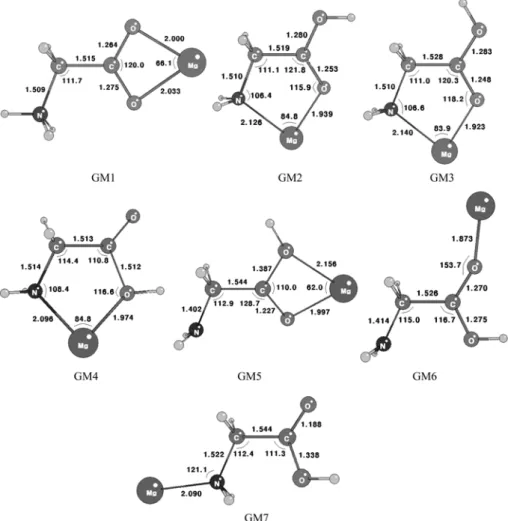
The geometry was optimized to one structure, GM2, for the G1- and G4-Mg2+ complexes even though they were started from the two glycine con- formers, G1 and G4. The optimized geometries of the Mg2+-glycine complexes associated with the coordination sites of the glycine conformers are shown in Fig. 2.
As shown in Fig. 2, the mode of Mg2+ coordina- tion with glycine can be classified into four differ- ent groups.The first structure is GM1, in which Mg2+ is coordinated to two oxygens, i.e., complex- ation to the zwitterionic form of glycine. The sec- ond group consists of structures GM2, GM3, and GM4 each having a five-membered ring along with Mg2+ coordinated to both amino nitrogen and oxy-
gen. The ring in GM4 complex is slightly envel- oped-shaped, similar to cyclopentane. All the other structures with the five-membered ring have Cs symmetric geometry. The third structure is GM5 that represents a structure corresponding to the coordination with two carboxylic oxygens. The fourth group consists of structures GM6 and GM7, in which Mg2+ is coordinated only to the carbonyl oxygen and amino nitrogen, respectively.
It should be noted that the amino hydrogens in the glycines rotate to reduce the repulsion for the Mg2+ with complexation in bidentate complexes.
The relative and binding energies of the optimized Mg2+-glycine complexes, including the MP2 results, are presented in Table 1.
Fig. 2. Optimized structures at B3LYP/6-311++G(d,p) level of theory of Mg2+-glycine complexes.
As given in Table 1, the MP2 energies are simi- lar to the B3LYP energies. The most stable Mg2+- glycine complex is GM1, in which Mg2+ is bound to both the oxygens at the ends of the zwitterionic glycine in both the methods. The next stable iso- mer is GM2, in which Mg2+ is coordinated to the amino nitrogen and carbonyl oxygen. This com- plex has been found to be less stable than the zwit- terionic complex by 6.4 kcal/mol at the B3LYP level. The third stable isomer for the Mg2+-glycine complex is GM3 that is computed to be 12.1 kcal/
mol less stable than GM1. The important structural difference between GM2 and GM3 is in the orien- tation of the hydroxyl hydrogen, which is anti to that of the carbonyl oxygen in GM3 and results in 5.7(6.0 in MP2) kcal/mol higher than GM2. The next stable complex is GM4, in which Mg2+ is bound to the amino nitrogen and hydroxyl oxygen.
GM4 is different from above the most stable three Cs-symmetric isomers, it is a drastically distorted structure, in which Mg2+ is coordinated to the amino nitrogen with 24.4o above the NCC plane.
The last three complexes are GM5, GM6, and GM7 which is 44.8, 48.9, and 60.8 kcal/mol above GM1, respectively. In GM5, similar to GM1, Mg2+
is bound to the two carboxylic oxygens. In GM6 and GM7, Mg2+ is bound only to the carboxylic oxygen (at distance 1.873Å) and amino nitrogen (at distance 2.090Å), respectively.
On the other hand, the binding energies between glycine and Mg2+ at the B3LYP/6-31++G (d,p) level are also presented in Table 1. As has been intro- duced above, the binding energy is obtained from the difference between the energy of the Mg2+-coor- dinated glycine complex, and the sum of the energy of corresponding free glycine and the magnesium cation. As given Table 1, the zwitterionic form, GM1, has the greatest binding energy with 164.3 kcal/mol due to its more electrostatic and polarity and smaller metal-ligand repulsion than the other complexes.7, 11, 15 The binding energies of GM2 and GM3 are almost the same (157.9 and 156.6kcal/mol in GM2 and 157.5 kcal/mol in GM3) due to the similarity of the glycine structure and Mg2+ coordi- nated site.
In conclusion, structure GM1, in which Mg2+ ion coordinates with two oxygens in the carboxylic moiety of the zwitter ionic glycine, exhibited the largest binding energy.
REFERENCES
1. Voet, D.; Voet, J. G. Biochemistry, 2nd ed.; J. Wiley &
Sons New York, 1995.
2. Lippard, S. A.; Berg, J. M. Principles of Bioinorganic Chemistry, University Science Books, Mill Valley, CA 1994.
3. Cerda, B. A.; Wesdemiotis. C. J. Am. Chem. Soc. 1996, 118, 11884.
Complex Total energy (a.u.) Relative energy(kcal/mol) Binding energy(kcal/mol)
B3LYP MP2 B3LYP MP2
GM1 -483.953202 0.0 0.0 164.3 160.3
GM2 -483.942995 6.4 8.3 157.9c 151.3c
156.6d 152.7d
GM3 -483.933944 12.1 14.3 157.5 152.5
GM4 -483.911517 26.2 26.1 139.1 135.9
GM5 -483.881886 44.8 51.0 124.2 114.4
GM6 -483.875251 48.9 57.8 116.4 103.5
GM7 -483.856272 60.8 63.4 104.3 97.9
aMP2 results are on B3LYP/6-311++G(d,p) optimized geometries.
bB3LYP binding energies are included BSSE correction.
cBetween glycine G4 and Mg2+.
dBetween glycine G1 and Mg2+.
4. Jockusch, R. A.; Lemoff, A.: Williams, E. R. J. Am.
Chem. Soc. 2001, 123, 12255.
5. Kim, H. T. Bull. Korean Chem. Soc. 2005, 26, 679.
6. Rogalewicz, F.; Ohanesian, G.; Gresh, H. J. Comput.
Chem. 2000, 21, 963.
7. Marino, T.; Russo, M.; Toscano, M. J. Inorg. Biochem.
2000, 79, 179.
8. Remko, M.; Rode, B. M. Chem Phys. Lett. 2000, 316, 489.
9. Ai, H.; Bu, Y.; Chen, Z. J. Chem Phys. 2003, 118, 1761.
10. Ai, H.; Bu, Y.; Chen, Z. J. Chem Phys. 2003, 118, 10973.
11. Remko, M.; Rode, B. M. Struct. Chem. 2004, 15, 223.
12. Liu, H.; Sun, J. Yang, S. J. Phys. Chem. A 2003, 107, 5681.
13. Li, P.; Bu, Y.; Ai, H. J. Phys. Chem. A 2003, 107, 6419.
14. Hwang, S. G.; Jang, Y. H.; Chung, D. S. Bull. Korean Chem. Soc. 2005, 26, 585.
15. Topol, LA.; Burt, S. K.; Toscano, M.; Russo, N. J. Mol.
Struc.(THEOCHEM) 1998, 430, 41.
16. Marino, T.; Russo, M.; Sicilia, E.; Toscano, M.; Mineva, T. Adv. Quantum Chem. 2000, 36, 93.
17. Hoyau , S.; Ohanesian, G. J. Am. Chem. Soc. 1997, 119, 2016.
18. Bertran, J.; Rodriguez-Santiago, L.; Sodupe, M. J. Phys.
Chem. B 1999, 103, 2310.
19. Remko, M.; Rode, B. M. J. Phys. Chem. A 2006, 110, 1960.
20. Becke, A. D. J. Chem. Phys. 1993, 98, 5648.
21. Lee, C.; Yang, W.; Parr, R. G. Phys. Rev. B 1988, 37, 785.
22. Frisch, M. J.; Trucks, G. W.; Schlegel, H. B.; Scuseria, G. E.; Robb, M. A.; Cheeseman, J. R.; Montgomery, J.
A.; Vreven. Jr. T.; Kudin. K. N.;. Burant, J. C.; Millam, J, M.; Iyengar. S. S.; Tomasi, J.; Barone, V.; Mennucci.
B.; Cossi, M.; Scalmani. G.; Rega. N.; Peterson, G. A.;
Nakatsuji. H.; Hada, M.; Ehara. M.; Toyota. K.;
Fukuda. R.; Hasegawa. J.; Ishida. M.; Nakajima. T.;
Honda. Y.; Kitao. O.; Nakai. H.; Klene. M.; Li. X.;
Knox. J. E.; Hratchian. H. P.; Cross. J. B.; Adamo. C.;
Jaramillo. J.; Gomperts. R.; Stratmann. R. E.; Yazyev.
O.; Austin. A. J.; Cammi. R.; Pomelli. C.; Ochterski. J.
W.; Ayala. P. Y.; Morokuma, K.; Voth. G. A.; Salvador.
P.; Dennenberg. J. J.; Zakrzewski. V. G.; Dapprich. S.;
Daniels. A. D.; Strain. M. C.; Farkas. O.; Malick. D.
K.; Rabuck. A. D.; Raghavachari, K.; Foresman, J. B.;
Ortiz, J. V.; Cui. Q.; Baboul. A. G.; Clifford. S.;
Cioslowski, J.; Stefanov. B. B.; Liu, G.; Liashenko, A.
Piskorz, P.; Komaromi, I.; Martin. R. L.; Fox, D. J.;
Keith, T.; Al-Laham, M. A.; Peng, C. Y.; Nanayakkara, A.; Challacombe, M.; Gill, P. M. W.; Johnson, B.;
Chen, W.; Wong, M. W.; Gonzalez, C.; and Pople, J. A.
Gaussian 03, Revision A.1; Gaussian, Inc.; Pittsburgh PA. 2003.
23. Jensen, F. J. Am. Chem. Soc. 1992, 114, 9533.
24. Csaszar. G. J. Am. Chem. Soc. 1992, 114, 9568.
25. Godfrey, P. D.; Brown, R. D. J. Am. Chem. Soc. 1995, 117, 2019.
26. Chapo, C. J,; Paul, J. B.; Provencal, R. A.; Roth, K.;
Saykally, I. J. J. Am. Chem. Soc. 1998, 120, 12956.
27. Stepanian, S. J.; Reva, I. D.; Radchenko, E. D.;
Rosado, M. T. S.; Duarte, M. L. T. S; Fausto, R.;
Adamowicz, L. J. Phys. Chem. A 1995, 102, 1041.
28. Jockusch, R. A.; Price. W. D.; Williams, E. R. J. Phys.
Chem. A 1999, 103, 9266.
29. Iijima, K.; Tanaka, K.; Onuma, S. J. Mol. Spectrosc.
1991, 246, 257.
30. Frey, R. F.; Coffin, J.; Newton, S. Q.; Ramek, M.; Cheng, V. K. W.; Momany, F. A.; Schafer, L. J. Am. Chem.
Soc. 1992, 114, 5369.
31. Ramek, M.; Cheng, V. K. W.; Frey, R. F.; Newton, S.
Q.; Schafer, L. J. Mol. Struc. (THEOCHEM) 1991, 235, 1.