19
Copyright © 2019 The Korean Society of Fisheries and Aquatic Science pISSN:0374-8111, eISSN:2287-8815
서 론
세계적으로 수산물 소비량은 매년 증가하고 있는 상황이 며, 해양수산부에서 food and agriculture organization of the united nations (FAO)와 the state of world fisheries and aqua- culture (SOFIA)의통계를인용하여밝힌보고에따르면 1인당 수산물연간평균소비량은 1960년대에는 9.9 kg에불과했지만 2013년부터 2015년까지 3년간평균소비량은 20.2 kg을기록 하는등 2배이상증가했다. 이는지난 50년동안연평균 3.2%
씩증가해온것이며, 2025년에는 21.8 kg에이를것으로조사 되는등수산물소비량은계속해증가할것으로예측되고있다. 특히우리나라는 2013-2015년기준 1인당연간수산물소비량 이 58.4 kg으로주요국중 1위에해당한다(MOF, 2017). 노르 웨이수산물위원회(Norwegian Seafood Council, NSC)에따
르면한국소비자들의 75%가소고기, 돼지고기, 닭고기와같은 육류보다수산물을더욱중요한단백질식품군으로생각한다고 답했다(NSC, 2017). 2014년기준우리나라국민 1인당연간수 산물(어패류와해조류) 소비량은 58.9 kg으로육류(소, 돼지, 닭 등) 소비량이 51.8 kg임을감안할때높은수치이다.
해양수산부는지난 4일 OECD (경제협력개발기구)와 FAO ( 유엔식량농업기구)의농업전망보고서 2017-2026 통계(OECD/
FAO, 2017)를인용해앞으로 10년간전세계의수산물생산· 소비·교역량이지속적으로증가할것으로전망된다고밝혔다. 이보고서에따르면오는 2026년전세계수산물생산량은 1억 9390만톤을기록해 2014-2016년평균생산량인 1억 6830만톤 보다 15.2% (2560만톤) 증가할것으로예상된다.
수산물가공품은통조림, 한천, 연제품, 조미가공품등의고차 가공수산물과냉동품, 건제품, 염신품, 염장품등의단순가공
시판 어류 단순가공품의 세균학적 및 화학적 위해요소 분석
김현정·이동수·김일회·김영목1·신일식*
강릉원주대학교 해양식품공학과, 1부경대학교 식품공학과
Bacteriological and Chemical Hazard Analysis in Commercial Fish Products Minimally Processed
Hyun-Jung Kim, Dong-Soo Lee, Il-Hoe Kim, Young-Mog Kim1 and Il-Shik Shin*
Department of Marine Food Science and Technology, Gangneung-Wonju National University, Gangneung 25457, Korea
1Department of Food Science and Technology, Pukyong National University, Busan 48513, Korea
The objective of this study was to analyze bacteriological and chemical hazards in minimally processed commercial fish products, including Hwangtae (freeze-dried pollock), dried anchovy, fermented anchovy sauce, and salted and dried yellow croaker. Escherichia coli counts from all samples were below the regulation limits of the Korean Minis- try of Food and Drug Safety Standards on Quality of Seafood and Seafood Products (Food Code). However, the food poisoning bacterium Staphylococcus aureus was detected at levels above 1.0×10² colony forming units (CFU)/g in Hwangtae, dried anchovy, and salted and dried yellow croaker, which are commonly ingested without heating and pose bacteriological hazards. The detection of S. aureus, an organism indicative of poor personal hygiene, which can be introduced by employees and multiply during distribution, indicates the necessity of improving the sanitary con- trol of minimally processed commercial fish products. Histamine was not detected from dried anchovy or salted and dried yellow croaker, but was detected at some of the highest levels in fermented anchovy sauces. This result suggests that efforts to reduce the amount of histamine in fermented anchovy sauces are required.
Key words: Fish product minimally processed, Food safety, Bacteriological hazards, Histamine, Sanitary control
*Corresponding author: Tel: +82. 33. 640. 2346 Fax: +82. 33. 640. 2340 E-mail address: [email protected]
This is an Open Access article distributed under the terms of the Creative Commons Attribution Non-Commercial Licens (http://creativecommons.org/licenses/by-nc/3.0/) which permits unrestricted non-commercial use, distribution, and reproduction in any medium, provided the original work is properly cited.
Received 21 December 2018; Revised 6 January 2019; Accepted 30 January 2019 저자 직위: 김현정(대학원생), 이동수(대학원생), 김일회(대학원생), 김영목 (교수), 신일식(교수)
https://doi.org/10.5657/KFAS.2019.0019
Korean J Fish Aquat Sci 52(1), 19-26, February 2019
수산물로분류할수있으며, 단순가공수산물은국민이일상적 으로다소비하고있는대표적인수산식품으로전체의약 76%
를차지하고있다(Statistics Korea, 2017). 그러나단순가공수 산물의경우, 공장의규모가영세할뿐만아니라식품제조가공 업등록(신고) 없이제조하거나재래시장등에서비포장상태로 유통되는등위생관리사각지대에있으며, 그위해관리가미흡 한실정이다. 식중독발생통계자료가작성된 2010-2011년 5월 까지식중독원인식품을확인, 추정할수있는 211건중어패류 및그가공품이전체 51%를차지하고있으며발생건수로는 1 위(25건/270건), 환자수로는 2위(405명/7,253명)에달할정도 로높다(Statistics Korea, 2017). 또한 Bahk (2009)의연구에서 도수산물가공품과수산물건조품이위해순위에서각각 2위와 11위로높은순위를나타내었다.
한편단순가공어류의위생학적안전성에관한연구로는생 멸치와시판마른멸치의이화학적및미생물학적특성(Yoon et al., 2017), 마른멸치작업장의식품안전관리인증기준(Hazard analysis and critical control point, HACCP) 모델개발(Yoon et al., 2016), 원료의선도가멸치액젓의품질및위생안전성에미 치는영향(Cho et al., 2015), 시판마른청어(Clupea pallasi) 및 마른멸치(Engraulis japonicus)의위생특성비교및품질기준 제시(Kang et al., 2015), 크기및저장온도에따른건조멸치의 이화학적및미생물학적특성(Kim, 2014a), 마른멸치제조작 업장의 HACCP system model 개발(Kim, 2014b) 등주로멸치 에관한논문만다소있을뿐, 단순가공어류의종류별유통제 품에대한위생학적안전성에관한연구는거의없는실정이다. 이에본연구에서는시중에유통되고있는단순가공어류제품 에대한위생학적안전성확보를위해황태, 마른멸치, 멸치액 젓, 염장굴비등을대상으로세균학적및화학적위해요소조사 를통해단순가공수산물의안전관리를위한기초자료로활용 하고자한다.
재료 및 방법
시료
실험에사용한시료는단순가공어류제품중매출량이많으 며, 소비자들이쉽게접할수있는제품, 그리고건조, 발효, 염 장등다양한가공형태의어류제품을선정하였다. 시료는황태
[Hwangtae, 명태(Theragra chalcogramma)], 마른멸치(Dried anchovy, Engraulis japonicus), 멸치액젓[Fermented anchovy sauce, 멸치(Engraulis japonicas)], 염장굴비[Salted and dried yellow croaker fish, 참조기(Larimichthys polyactis)]로(Table 1), 2017년 1월부터 10월사이에 on-line market과강릉시소재 의마트에서구입하였으며, on-line market에서구입한어류제 품은도착즉시실험에제공하였으며, 마트에서구입한어류제 품은실험당일구입하여 ice box (5℃)로실험실로운반, 12시 간이내에실험을진행하였다.
일반세균수, 대장균군 및 대장균
일반세균수, 대장균군및대장균의분석은식품공전(MFDS,
2016)의일반실험법중미생물시험법에준하는방법으로진
행하였다. 곰팡이수측정을위하여황태 25 g에멸균인산완충
용액(PBS, pH 7.2) 225 mL를가하여 Stomacher 440 (Seward Medical, London, UK)으로 230 rpm에서 1분간균질화한후, 균질액 11 mL에멸균인산완충용액(PBS, pH 7.2) 99 mL를가 하여단계적으로연속희석하여시료액을제조하였다. 일반세 균수는각단계시료액을 plate count agar (PCA; Difco Labo- ratories, Detroit, MI, USA)에접종하고 35±1℃에서 48±2시 간동안배양한후생성된집락수를측정하였다. 대장균군및대 장균은최확수(Most probable number, MPN)법으로분석하였 다. 추정시험의경우 lauryl sulfate tryptose (LST) broth (Difco Laboratories), 확정시험의 경우 brilliant green lactose bile (BGLB) 2% broth (Difco Laboratories)를사용하여 37±1℃, 24-48시간배양하였다. 대장균은 EC broth (Difco Laborato- ries)를사용하여 44.5±1℃, 24시간배양하였으며, 대장균군과
대장균분석에사용된 BGLB, EC 배지가혼탁해지거나발효관
(durham tube)에가스가발생한것을양성으로판정하고, 이를 최확수(MPN/100 g)로나타내었다.
식중독 세균
수산식품의 주요 식중독 세균인 Staphylococcus aureus와 Clostridium botulinum 2종에대하여분석하였으며식품공전 (MFDS, 2016)의시험법에준하여 S. aureus는정량실험을하 였고 Cl. botulinum은정성실험을하였다.
곰팡이
Table 1. The number of companies and samples on minimally processed fish products purchased from Korean fish retail outlets
Sample No. of company No. of samples Sample type and package (No. of samples)
Hwangtae 18 23 Slice (8)1, Shreds (10), Powder (3), Original form (2)
Dried anchovy 20 20 Small (6), Medium (12), Large (2)
Fermented anchovy sauce 17 17 Plastic container package (17)
Salted and dried yellow croaker 9 9 Wrap package (3), Vacuum package (6)
Total 64 69
1Number in parenthesis is number of samples.
곰팡이수측정을위하여황태 25 g에멸균인산완충용액(PBS, pH 7.2) 225 mL를가하여 Stomacher 440 (Seward Medical, London, UK)으로 230 rpm에서 1분간 균질화한 후, 균질액 11 mL에 멸균인산완충용액(PBS, pH 7.2) 99 mL를 가하여 단계적으로연속희석하여 시료액을제조하였다. 곰팡이수는 Cho et al. (2005)의방법에준하여건조필름법으로실시하였 는데, 3M사(Minnesota Mining and Manufacturing Company, USA)의사용설명서에따라 PYM (Petrifilm™ Yeast and mold count plate)에시료를접종및배양(23±2℃에서 3-5일)한다 음다양한색상과큰공간을차지하고가장자리부분이명확히 구분되지않는것을곰팡이로계수하였다.
히스타민 분석
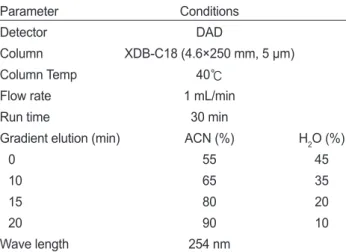
히스타민의함량분석은시료중마른멸치, 멸치액젓, 염장 굴비에대하여실시하였으며, Kim et al. (2011)의방법에준하 여수행하였다. 즉시료 5 g에 0.1 N 염산 25 mL을가하여균질 화하고이것을원심분리(4,000 g, 4℃, 15분)한후여과하여취 하는조작을 2회반복하여얻은상층액에염산을가하여시료액 으로사용하였다. 그후표준용액및시료액 1 mL를각각시험 관에취한후, 내부표준물질(1,7-diaminoheptane 표준품을정 밀히달아 0.1 N 염산에녹여 5 mg/mL로한원액에 0.1 N 염 산으로 100 μg/mL로한것) 10 μL, 포화탄산나트륨용액 0.5 mL, 1% 염화단실아세톤용액 0.8 mL를가하여혼합한후, 마 개를하여 45℃에서 1시간유도체화하고, 10% 프롤린용액 0.5 mL 및에테르 5 mL를가하여 10분간진탕하고상층액을취하 여질소농축한뒤, 아세토니트릴(Acetonitrile, ACN) 1 mL를 가하여여과한것을 high performance liquid chromatograph (HPLC, Agilent 1100, Agilent, Santa Clara, USA)로분석하였 다. 분석조건은 Table 2와같으며, Histamin 표준품의 retention time은 14.195분이었다(Fig. 1)
결과 및 고찰
황태
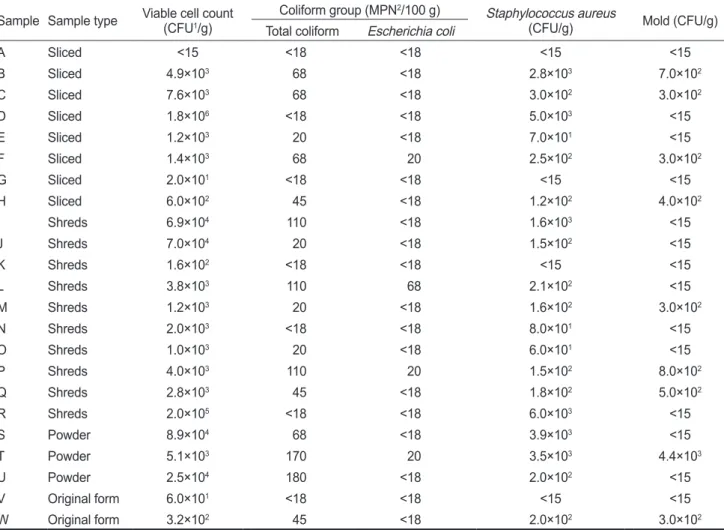
18개사에서제조하여시중에유통중인황태 23개를구입하여
세균학적오염도를조사한결과는 Table 3과같다. 상온유통되 는황태의일반세균수검출범위는 <15-1.8×10⁶ colony form- ing unit (CFU)/g, 대장균군검출범위는 <18-180 MPN/100 g, 대장균 검출범위는 <18-68 MPN/100 g으로 나타났다. 따라 서, 현행식품공전상건포류의대장균허용기준치인 n=5, c=2, m=0, M=10 (MFDS, 2017) 이하로분석되어위생학적문제 는없는것으로사료된다. 그러나식중독세균인 S. aureus가 23개제품중 16개제품에서 1.2×10²-6.0×10³ CFU/g이검출 되었다. 황태제품을원형, 포, 채, 분말형태로구분하였을때, 이에대한차이는발견하지못하였다. 현행식품공전상건포류 의황색포도상구균허용기준치가없어적부판정을할수없으 나, 비슷한조미건어포류허용기준치(조미건어포류에한하여, S. aureus의경우 n=5, c=1, m=10, M=100)와비교하였을때, 향후안전관리가필요한것으로사료된다. 황태는일반적으로 가열하여섭취할뿐만아니라, 식중독을일으킬수있는농도(1 μg)의장독소를생성하기위한황색포도상구균의최소균수는
105 CFU/g으로보고되고있어위생학적으로는문제가없는것
으로사료된다(Ward et al., 1997; Doan and Davidson, 1999, Fox et al., 2000, Leggett et al., 2012).
곰팡이의경우검출범위는 <15-4.4×10³ CFU/g이었고 23개 제품중 2개제품에서국내기준규격[수산물과수산특산물의 품질인증 세부기준(MOF, 2014) 및 KS규격(KATS, 2011)의 경우모두 1.0×10³ CFU/g]을초과하는것으로나타났다. 황태 의경우, 대부분의공장이영세하고, 손으로작업하는과정이많
아식중독세균인 S. aureus가많이검출되는것으로판단되며
Table 2. The HPLC conditions for histamine analysis
Parameter Conditions
Detector DAD
Column XDB-C18 (4.6×250 mm, 5 μm)
Column Temp 40℃
Flow rate 1 mL/min
Run time 30 min
Gradient elution (min) ACN (%) H2O (%)
0 55 45
10 65 35
15 80 20
20 90 10
Wave length 254 nm
DAD, Diode array detectors; ACN, Acetonitrile.
Retention time (min) 0
mAU350 300250 200150 10050 -500
-100 2
1.920 2.612 3.569 7.034 12.451 14.195 - Histamine 15.774 - IS 17.468
4 6 8 10 12 14 16 18 min
Fig. 1. Chromatogram of standard histamine by HPLC. IS, Internal standard.
RT (min) Compound Peak area (%) Amount (ppm)
14.195 Histamine 1440.43311 20.53026
15.774 IS 1642.56482 193.39718
종사자위생교육및가공공정의관리를철저히한다면미생물 오염도가낮은황태를생산할수있을것으로사료된다. 마른 멸치
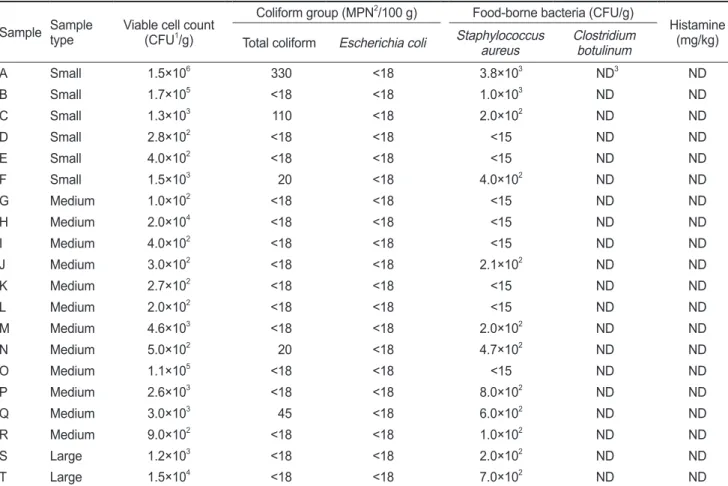
20개사에서 제조하여 유통 중인마른 멸치를 20개 구입하
여세균학적오염도및히스타민함량을조사한결과는 Table
4와 같다. 상온 유통되는 마른 멸치의 일반세균수 검출범위 는 1.0×10²-1.5×10⁶ CFU/g, 대장균군 검출범위는 <18- 330 MPN/100 g이었다. 한편 대장균은 검출되지 않아(<18
MPN/100 g) 현행식품공전상건포류의대장균허용기준치인
n=5, c=2, m=0, M=10 (MFDS, 2017)을만족하는것으로나타 나위생학적문제는없는것으로판단되었다. 그러나식중독세 균중 Cl. botulinum은검출되지않았으나 S. aureus가 20개제 품중 11개제품에서 2.0×10²-3.8×10³ CFU/g이검출되었다. 마른멸치제품을크기별(소멸, 중멸, 대멸)로구분하였을때, 이에대한차이는발견하지못하였다. 현행식품공전상건포류 의황색포도상구균허용기준치가없어적부판정을할수없으
나, 비슷한조미건어포류허용기준치(조미건어포류에한하여, S. aureus의경우 n=5, c=1, m=10, M=100)와비교하였을때, 향후안전관리가필요한것으로사료된다. Kim et al. (2014a)은 멸치의어획직후부터최종제품인마른멸치생산까지의각공 정에서마른멸치의식중독균(S. aureus, Salmonella spp., Vib- rio parahaemolyticus 및 Cl. botulinum)에대하여조사한결과, 식중독세균의종류에관계없이모든제조공정에서검출되지 않았다고보고한바있는데, 본연구의유통제품에서 S. aureus 가허용기준치이상으로검출된것은선별과정에서종사자의 손으로공정이이루어지며건조후박스포장되어유통된후다 시소포장되는경우가많기때문이라판단되며, 이는종사자위 생교육및유통중의위생안전관리강화가필요한것으로사 료된다. 한편히스타민의경우, 20개제품모두검출되지않아, 현행식품공전상수산물에대한허용기준치(200 mg/kg 이하) 를만족하는것으로나타나이화학적문제는없는것으로판단 되었다. Yoon et al. (2017)은시판마른멸치를대멸, 중멸, 소 멸로분류하여히스타민을측정한결과, 대멸 0.27-1.47 mg/kg
Table 3. Bacterial and mold count in Hwangtae purchased from Korean fish retail outlets Sample Sample type Viable cell count
(CFU1/g) Coliform group (MPN2/100 g) Staphylococcus aureus
(CFU/g) Mold (CFU/g)
Total coliform Escherichia coli
A Sliced <15 <18 <18 <15 <15
B Sliced 4.9×10³ 68 <18 2.8×10³ 7.0×10²
C Sliced 7.6×10³ 68 <18 3.0×10² 3.0×10²
D Sliced 1.8×10⁶ <18 <18 5.0×10³ <15
E Sliced 1.2×10³ 20 <18 7.0×101 <15
F Sliced 1.4×10³ 68 20 2.5×10² 3.0×10²
G Sliced 2.0×101 <18 <18 <15 <15
H Sliced 6.0×10² 45 <18 1.2×10² 4.0×10²
I Shreds 6.9×10⁴ 110 <18 1.6×10³ <15
J Shreds 7.0×10⁴ 20 <18 1.5×10² <15
K Shreds 1.6×10² <18 <18 <15 <15
L Shreds 3.8×10³ 110 68 2.1×10² <15
M Shreds 1.2×10³ 20 <18 1.6×10² 3.0×10²
N Shreds 2.0×10³ <18 <18 8.0×101 <15
O Shreds 1.0×10³ 20 <18 6.0×101 <15
P Shreds 4.0×10³ 110 20 1.5×10² 8.0×10²
Q Shreds 2.8×10³ 45 <18 1.8×10² 5.0×10²
R Shreds 2.0×10⁵ <18 <18 6.0×10³ <15
S Powder 8.9×10⁴ 68 <18 3.9×10³ <15
T Powder 5.1×10³ 170 20 3.5×10³ 4.4×10³
U Powder 2.5×10⁴ 180 <18 2.0×10² <15
V Original form 6.0×101 <18 <18 <15 <15
W Original form 3.2×10² 45 <18 2.0×10² 3.0×10²
1CFU, Colony forming unit; 2MPN, Most probable number.
(평균 0.72±0.31), 중멸 0.04-1.64 mg/kg (평균 0.66±0.35), 소멸 0.24-1.23 mg/kg (평균 0.67±0.27)으로 FDA 규격인 50 mg/kg 이하, 국제식품규격위원회(CODEX) 규격인 100 mg/
kg 이하, 우리나라식품공전상수산물에 대한허용기준치인
200 mg/kg 이하의범위내에있었다고보고한바있는데본실
험의결과도이와유사한경향을나타내었다. 멸치 액젓
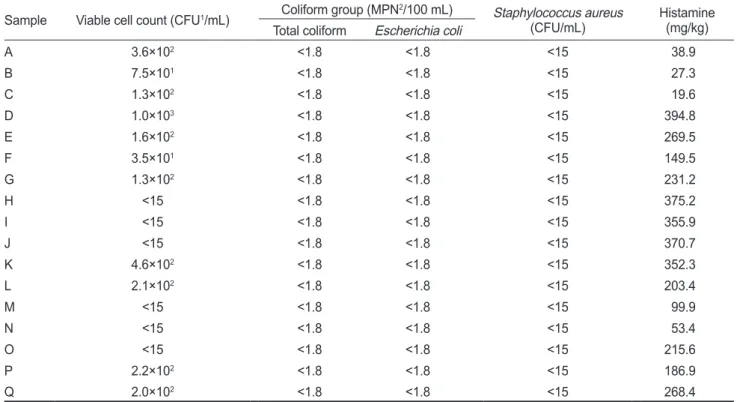
17개사에서제조하여유통중인멸치액젓을 17개구입하여
세균학적오염도및히스타민함량을조사한결과는 Table 5와
같다. 상온유통되는멸치액젓의일반세균수검출범위는 <15- 1.0×10³ CFU/mL이었으며, 대장균군, 대장균, S. aureus는검 출되지않았다. 현행식품공전상액젓의대장균허용기준치가 없어적부판정을할수없으나, 젓갈류의대장균허용기준치( 액젓, 조미액젓은제외, n=5, c=1, m=0, M=10, MFDS, 2017) 와비교하였을때, 위생학적으로문제가없는것으로사료된다.
히스타민의경우, 17개제품모두현행 CODEX 액젓의히스 타민허용기준치인 400 mg/kg 이하를만족하는것으로나타
나(CODEX, 2003) 이화학적문제는없는것으로판단되었지
만다소높은수치로나타났다. 미국, EU, 호주및뉴질랜드등 일부국가에서는어육가공품에도히스타민의허용기준치를설 정하여생성을억제하려는노력을하고있으며, CODEX도액 젓류의히스타민허용기준치를설정하고있다. 반면, 우리나라 는일반수산물의히스타민기준·규격[냉동어류, 염장어류, 통 조림, 건조또는절단등단순처리한것(어육, 필렛, 건멸치등) : 200 mg/kg 이하(고등어, 다랑어류, 연어, 꽁치, 청어, 멸치, 삼 치, 정어리, 몽치다래, 물치다래, 방어에한한다); MFDS, 2017]
이있으나액젓을포함한발효식품에는허용기준치를정해두 지않고있다. 최근외국으로수출된멸치액젓이 EU연합에히
스타민함량기준초과로부적합판정을받은바있다(KITA,
2009). 이는국민건강영양조사 5-7기자료(KNHANES, 2018) 에따르면멸치액젓섭취에대한통계는매우소량으로보고 되고있어큰문제는없는것으로판단되나, 섭취량에주의를 기울일필요가있을것으로사료되며우리나라액젓의선진화 및세계화를위해서우수한품질확보는물론이며위생안전성
을확보하기위한 histamine 저감화에대한노력이지속되어야
할것이다.
Table 4. Bacterial count and histamine level in dried anchovy purchased from Korean fish retail outlets Sample Sample type Viable cell count
(CFU1/g)
Coliform group (MPN2/100 g) Food-borne bacteria (CFU/g)
Histamine (mg/kg) Total coliform Escherichia coli Staphylococcus
aureus Clostridium botulinum
A Small 1.5×10⁶ 330 <18 3.8×10³ ND3 ND
B Small 1.7×10⁵ <18 <18 1.0×10³ ND ND
C Small 1.3×10³ 110 <18 2.0×10² ND ND
D Small 2.8×10² <18 <18 <15 ND ND
E Small 4.0×10² <18 <18 <15 ND ND
F Small 1.5×10³ 20 <18 4.0×10² ND ND
G Medium 1.0×10² <18 <18 <15 ND ND
H Medium 2.0×10⁴ <18 <18 <15 ND ND
I Medium 4.0×10² <18 <18 <15 ND ND
J Medium 3.0×10² <18 <18 2.1×10² ND ND
K Medium 2.7×10² <18 <18 <15 ND ND
L Medium 2.0×10² <18 <18 <15 ND ND
M Medium 4.6×10³ <18 <18 2.0×10² ND ND
N Medium 5.0×10² 20 <18 4.7×10² ND ND
O Medium 1.1×10⁵ <18 <18 <15 ND ND
P Medium 2.6×10³ <18 <18 8.0×10² ND ND
Q Medium 3.0×10³ 45 <18 6.0×10² ND ND
R Medium 9.0×10² <18 <18 1.0×10² ND ND
S Large 1.2×10³ <18 <18 2.0×10² ND ND
T Large 1.5×10⁴ <18 <18 7.0×10² ND ND
1CFU, Colony forming unit; 2MPN, Most probable number; 3ND,Not detected.
염장 굴비
9개사에서 제조하여 유통 중인 염장 굴비를 9개 구입하여
세균학적오염도및히스타민함량을조사한결과는 Table 6
과같다. 냉동유통되는염장굴비의일반세균수검출범위는 2.8×10³-3.2×10⁴ CFU/g이었고, 대장균군과 대장균은 검출 되지않았다. 현행식품공전상염장굴비에관한기준치가없어 비슷한기준치인건포류의대장균허용기준치 n=5, c=2, m=0,
M=10 (MFDS, 2017)를비교하여보면위생학적으로문제가
없는것으로사료된다. 그러나식중독세균인 S. aureus가 9개
제품중 2개제품에서 1.0×10² CFU/g을초과하였다. 염장굴 비제품을진공포장여부로구분하였을때, 이에대한차이는발 견하지못하였다.
현행식품공전상허용기준치중염장굴비기준치가없어적 부판정을할수없으나, 비슷한조미건어포류허용기준치(n=5, c=1, m=10, M=100)와비교하였을때기준치를초과하여위생 학적으로문제가있는것으로나타났다. 염장굴비역시가공 공정중염장, 엮기, 포장공정등종사자의수작업으로이루어 지는공정이많기때문에종사자의철저한위생교육및관리가
Table 5. Bacterial count and histamine level in fermented anchovy sauce purchased from Korean fish retail outlets Sample Viable cell count (CFU1/mL) Coliform group (MPN2/100 mL) Staphylococcus aureus
(CFU/mL) Histamine
(mg/kg) Total coliform Escherichia coli
A 3.6×10² <1.8 <1.8 <15 38.9
B 7.5×101 <1.8 <1.8 <15 27.3
C 1.3×10² <1.8 <1.8 <15 19.6
D 1.0×10³ <1.8 <1.8 <15 394.8
E 1.6×10² <1.8 <1.8 <15 269.5
F 3.5×101 <1.8 <1.8 <15 149.5
G 1.3×10² <1.8 <1.8 <15 231.2
H <15 <1.8 <1.8 <15 375.2
I <15 <1.8 <1.8 <15 355.9
J <15 <1.8 <1.8 <15 370.7
K 4.6×10² <1.8 <1.8 <15 352.3
L 2.1×10² <1.8 <1.8 <15 203.4
M <15 <1.8 <1.8 <15 99.9
N <15 <1.8 <1.8 <15 53.4
O <15 <1.8 <1.8 <15 215.6
P 2.2×10² <1.8 <1.8 <15 186.9
Q 2.0×10² <1.8 <1.8 <15 268.4
1CFU, Colony forming unit; 2MPN, Most probable number.
Table 6. Bacterial count and histamine level in salted and dried yellow croaker purchased from Korean fish retail outlets Sample Package Viable cell count
(CFU1/g) Coliform group (MPN2/100 g) Staphylococcus aureus
(CFU/g) Histamine
(mg/kg) Total coliform Escherichia coli
A Wrap 2.7×10⁴ <18 <18 <15 ND3
B Wrap 3.1×10⁴ <18 <18 <15 ND
C Wrap 1.6×10⁴ <18 <18 9.0×10³ ND
D Vacuum 3.0×10⁴ <18 <18 8.0×10² ND
E Vacuum 2.8×10³ <18 <18 <15 ND
F Vacuum 3.6×10³ <18 <18 <15 ND
G Vacuum 3.2×10⁴ <18 <18 <15 ND
H Vacuum 8.0×10³ <18 <18 <15 ND
I Vacuum 8.8×10³ <18 <18 <15 ND
1CFU, Colony forming unit; 2MPN, Most probable number; 3ND, Not detected.
필요할것으로사료된다. 한편히스타민은 9개제품모두에서 불검출되어, 현행식품공전상수산물에대한허용기준치(200
mg/kg 이하)를만족하는것으로나타나이화학적문제는없는
것으로판단되었다.
이상의결과를요약하면 세균학적오염도는 제품별로 차이 가있는것으로분석되었으며, 황태, 마른멸치, 염장굴비제 품에서식중독균인 S. aureus가다소높은빈도로검출되었다. 특히황태제품에서 S. aureus가 23개제품중 16개제품에서 1.2×10²-6.0×10³ CFU/g이검출되어분석한어류제품들중 가장높은검출율을보였다. 이는황태의채를찢는공정등이 종사자의손으로이루어질수있으며, 마른멸치의경우선별과 정및건조후유통된제품을다시소포장할가능성이있고, 염 장굴비의경우끈으로엮는공정이종사자의손으로이루어질 가능성이있어, 피부상재균인 S. aureus가높은빈도로검출되 는것으로판단되며, 유통중온도관리미비등에의한세균증 식가능성도있을것으로사료된다. 멸치액젓의경우히스타민 이기준치이하로검출되었지만다소높은수치로분석되었다. 히스타민생성균은대부분중온성세균으로이를억제하는방
법으로는숙성할때저온으로관리하는방법이있다. Ko et al.
(2017)의연구에따르면멸치젓갈의경우숙성온도가낮은경
우히스타민의함량이낮게나타나숙성온도가히스타민발현 에크게영향을미치는인자임을확인하였다고밝혔다. 따라서 이와같은어류단순가공품의미생물학적및이화학적위해요 소를줄이기위해서는보다체계적인종사자의위생교육, 멸치 액젓의섭취주의문구표기및숙성온도관리그리고유통중 의온도관리가필요하다고판단된다.
사 사
이논문은 2017년도식품의약품안전처에서시행한용역연구
개발과제 (16162수산물601)의연구개발비지원에의해수행되 었으며이에감사드립니다.
References
Bahk GJ. 2009. Determining of risk ranking for processed foods in Korea. J Fd Hyg Saf 24, 200-203.
Cho MH, Bae EK, Ha SD, Park YS, Mok CK, Hong KP, Kim SP and Park J. 2005. Evaluation of dry rehydratable film method for enumeration of microorganisms in meat, dairy and fishery products. Korean J Food Sci Technol 37, 294- Cho YJ, Jung MH, Kim BK, Jung WY, Gye HJ and Jung HJ. 300.
2015. Effect of raw material freshness on quality and safety of anchovy fish sauce. JFMSE 27, 1194-1201.
CODEX International Food Standards. 2003. Standard for Boiled Dried Salted Anchovies. Retrieved from http://www.
codexalimentarius.org/standards/list-of standards/en/?provi
de=standards&orderField=fullReference&sort=asc&num1
=CODEX on Aug 2, 2018.
Doan CH and Davidson PM. 1999. Growth and production of enterotoxin A by Staphylococcus aureus on “home-style”
French fries. J Food Sci 64, 913-917.
FDA (Food and Drug Administration). 2011. Fish and fisheries products hazards and controls guidance 4th. Retrieved from http://www.FDA.gov/downloads/Food/GuidanceRegula- tion/UCM251970.pdf on Aug 2, 2018.
Fox PF, Guinee TP, Cogan TM and McSweeney PLH. 2000.
Fundamentals of cheese science. Aspen Publisher, Gaithers- burg, MD, U.S.A., 222.
Kang SI, Lee SG, Kim YJ, Kim MJ, Park SY, Heu MS and Kim JS. 2015. Sanitary characterization of commercial boiled-dried pacific herring Clupea pallasi and boiled-dried anchovy Engraulis japonicus and proposal of quality stan- dards. Korean J FIsh Aquat Sci 48, 604-613. https://doi.
org/10.5657/KFAS.2015.0604.
Kim BK, Kim YH, Lee HH, Cho YJ, Kim DS, Oh SM and Shim KB. 2011. Comparison of the chemical compositions and biogenic amine contents of salt-fermented fish sauces pro- duced in Korea to evaluate the quality characteristics. J Fish Mar Sci Edu 23, 607-614.
Kim JH. 2014a. Physicochemical and microbiological char- acteristics of dried anchovies in the different sizes during storage at different temperatures. MS. Thesis, University of Chonnam, Gwangju, Korea.
Kim SH. 2014b. Development of a HACCP system model for boiled-dried anchovy processing workplace. MS. Thesis, University of Gyeongsang, Jinju, Korea.
Ko YA, Kim SH and Song HS. 2017. Effect of salt concentra- tion and fermentation temperature on changes in quality Index of salted and fermented anchovy during fermenta- tion. J Food Hyg Saf 32, 27-34. https://doi.org/10.13103/
JFHS.2017.32.1.27.
KNHANES (Korea National Health and Nutrition Examination Survey). 2018. Retrieved from https://knhanes.cdc.go.kr/
knhanes/sub04/sub04_03.do?class Type=7 on Jan 4, 2018.
KITA (Korea International Trade Association). 2009. EU Union Exported Food (Anchovy sauce). Retrieved from http://www.kita.net/info/notice/index.jsp?sCmd=VIEW
&nPostIndex=162792 on Feb 13, 2018.
KATS (Korean Agency for Technology and Standards). 2011.
Korean industrial standards KSH 6026. MOTIE (Ministry of Trade, Industry and Energy), Eumseong, Korea.
Leggett HC, Cornwallis CK and West SA. 2012. Mechanisms of pathogenesis, infective dose and virulence in human par- asites. PLoS Pathog 8, 1-5. https://doi.org/10.1371/journal.
ppat.1002512.
MOF (Ministry of Oceans and Fisheries). 2014. Standards on Quality Certification of Seafood and Indigenous Seafood.
Sejong, Korea. Retrieved from http://www.nfqs.go.kr/2013/