[논 문] 한국재료학회지 http://dx.doi.org/10.3740/MRSK.2016.26.4.212 Korean J. Mater. Res.
Vol. 26, No. 4 (2016)
212
Photoluminescence Property of Lu
2Si
2O
7:Ce
3+Powder for Scintillator
Kyung-Nam Kim
1†and Guozhong Cao
21Department of Advanced Materials Engineering, Kangwon National University Kangwon Samcheok 25913, Republic of Korea
2Department of Materials Science and Engineering, University of Washington, Seattle, WA 98195, USA
(Received January 18, 2016 : Revised January 18, 2016 : Accepted March 17, 2016)
Abstract
In this paper, cerium doped lutetium pyrosilicate (LPS) powders with cerium content (0.05 and 0.07 mol%) were prepared by sol-gel process. The formation of lutetium pyrosilicate (LPS) phase was confirmed by XRD analysis for the powders heated at 1,200oC; in these powders, a single phase of Lu2Si2O7 (LPS) was observed. Cerium doped lutetium pyrosilicate (LPS) powder was agglomerated and constituted of small spherical particles with diameters of about 300 nm. The photoluminescence spectra of the Lu2Si2O7:Ce3+ powders showed the characteristic of excitation and there was an emission spectrum for Ce3+ in the host of Lu2Si2O7. The emission spectrum shows a broad band in the range of 350-525 nm; the broad wavelength on the right side of the spectra should be ascribed to the same 5d-4f transitions of Ce3+, as in the case of cerium doped Lu2Si2O7 single crystals.Key words
LPS, scintillator, sol-gel, photoluminescence, cerium.1. Introduction
The scintillator is essentially a luminescence material that absorbs the high energy photons and then emits visible light. The cerium ion was studied as a fast luminescence center in many hosts. The cerium doped silicate based scintillators, such as LSO(Lu
2SiO
5),
1)LPS (Lu
2Si
2O
7),
2)LYSO(Lu
2Y
2SiO
5),
3)and GSO(Gd
2SiO
5),
4)have been developed. These material are used for gamma- ray detection in positron emission tomography(PET), astrophysics, nuclear medical diagnostic instruments, and high energy and nuclear physical experiments. Therefore, the investigation on the growth and scintillation prop- erties of ceramic scintillator materials has become an attractive and interesting field in the past decade. Lutetium based crystals are grown by Czochralski method,
3,5-7)of which the cost is very high, and the maximum reachable concentration of rare earth ion is quite low. The advan- tages of the sol-gel process are the possibility to prepare easily thin films (or powder) from solution and it is very attractive.
8-12)Lutetium-based materials have been of concern for the last few years, in which cerium(Ce) doped of Lu
2SiO
5(LSO),
1,9,12)Lu
3Al
5O
12(LuAG),
13)LuBO
314)and LYSO
15)have become the most competitive candidates to replace Bi
4Ge
3O
12(BGO) in positron emission tomography(PET).
Due to its high density of lutetium oxide, lutetium-based materials have been considered as a promising host matrix of rare earth ions to produce phosphors and scintillators.
In particular, cerium doped lutetium silicate(LSO and LPS) are the most stable compounds, and seem to be very efficient scintillator. However, the ion radius of cerium (1.034 Å) is much larger than that of lutetium(0.86 Å), it is expected to be difficult to incoporate a large amount of cerium into the lattice of lutetium based material. Yan et.
al suggested that the solubility of serium ion in the LPS host lattice is higher than in the LSO lattice.
5)We have been preparing LSO:Ce
3+and LPS:Ce
3+powders through a sol-gel process, properties of sol-gel derived LSO:Ce
3+powders have been reported recently.
12)However, Lu
2Si
2O
7: Ce
3+materials have been synthesized rarely using sol-gel method, and the scientillator characteristics are not fully understood.
In this paper, Lu
2Si
2O
7:Ce
3+powders were synthesized by the sol-gel method. The morphology, crystal structure, photoluminescence characteristics of sol-gel derived
†Corresponding author
E-Mail : [email protected] (K.-N. Kim, Kangwon Nat'l Univ.)
©Materials Research Society of Korea, All rights reserved.
This is an Open-Access article distributed under the terms of the Creative Commons Attribution Non-Commercial License (http://creative- commons.org/licenses/by-nc/3.0) which permits unrestricted non-commercial use, distribution, and reproduction in any medium, provided the original work is properly cited.
Photoluminescence Property of Lu2Si2O7:Ce3+ Powder for Scintillator 213
Lu
2Si
2O
7:Ce
3+powders were investigated.
2. Experimental Procedure
Cerium doped Lu
2Si
2O
7powder was synthesized by sol-gel process at room temperature. Lutetium nitrate hy- drate(Lu(NO
3)
3· nH
2O), tetraethyl orthosilicate(Si(OC
2H
5)
4), cerium nitrate hydrate(Ce(NO
3)
2·xH
2O) and i-C
3H
7OH (Showa chemical Co. Ltd., Japan) were used as the starting materials. At first, Si(OC
2H
5)
4(TEOS) was hydro- lyzed, vigorously stirring at 40
oC for 1hr after dissolving it into the 10 ml of i-C
3H
7OH solution. Lutetium nitrate hydrate(Lu(NO
3)
3·6H
2O) and cerium nitrate hydrate(Ce (NO
3)
2·xH
2O) were dissolved separately in 10 ml of i- C
3H
7OH, and then two solutions were mixed together.
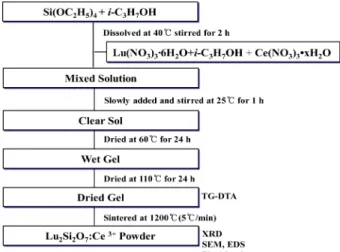
The mixed solution was vigorously stirred at 25
oC for 1hr, and a clear precursor sol was obtained by completely mixing the reactants. The transparent solution was allowed to form a gel at 60
oC and the gel was dried at 110
oC for 24h. A gel was formed after a few days, of which color was turned into light yellow and transparent.
This gel was then calcined at 1,200
oC for 2h in order to obtain Lu
2Si
2O
7:Ce
3+crystalline powder. During heating, the temperature was held at 300
oC for 2h to remove the residual organic compounds. The preparation process of the Lu
2Si
2O
7:Ce
3+powders is shown in Fig. 1 and were prepared according to our previous work.
12)The crystal structure of the powder was examined, using X-ray diffractometer(XRD, D/Max-220, Rigaku, Japan) with Cu Ka radiation operated at 40 kV and 30 mA. The thermal behavior of the dried gel was investigated, using TG-DTA(STA 409, Netzsch, Germany), and carried out at up to 1,200
oC in air at a constant heating rate of 5
o/ min, using Al
2O
3as a reference material. The surface mor- phology was observed, using scanning electron microscope (SEM, Hitachi, S-4300, Japan) and EDS(Horiba EMAX
2770). Emission spectra were measured, using fluorescence spectrophotometer(Perkin-Elmer, LS-55B, USA).
3. Results and Discussion
The crystallization of cerium doped Lu
2Si
2O
7powder was studied by thermal analysis, which is shown in Fig.
2. A sharp exothermic peak is observed at 1,051
oC and corresponds to the crystallization of Lu
2Si
2O
7phase. It shows that the phase transformation in the cerium doped Lu
2Si
2O
7phase is lower than in the cerium doped Lu
2SiO
5phase (at 1,073
oC).
12)Because the Lu
2Si
2O
7phase shows a more open lattice in the Lu
2SiO
5phase,
5)the phase transition is a similar to cerium doped Lu
2SiO
5powder. Total weight loss is approximately 40 %. It is important to note that this crystallization temperature is well below temperatures required by the Czochralski method (about 1900
oC) and in comparing with the solid state reaction temperature (about 1400
oC). The cost of starting materials is lower and the melting point is lower in LPS crystal (about 1900
oC) than in LSO crystal (about 2100
oC ).
5)The cerium doped Lu
2Si
2O
7powders were calcined at an interval of 200
oC in range of 800
oC to 1,200
oC, and the crystallization phase composition was identified with XRD, which is shown in Fig. 3. The gel powder re- mained amorphous up to 800
oC. It was seen that Lu
2O
3phase appeared at 800
oC. The crystallinity was increased as the heating temperature was increased. At 1,000
oC the all characteristics peaks of Lu
2Si
2O
7phase appeared, and any other phases were not formed. When the calcination temperature reaches 1,200
oC, continued refinement of peak shapes and intensities were observed, indicating crystallite growth of the Lu
2Si
2O
7phase with the calcined temperature increasing. The formation of Lu
2Si
2O
7phase was confirmed by XRD analysis for the powder heated at
Fig. 1. Experimental procedure of the Lu2Si2O7:Ce3+ powders.
Fig. 2. TG-DTA analysis of the Lu2Si2O7:Ce3+ powders synthesized by sol-gel process.
214 Kyung-Nam Kim and Guozhong Cao
1,200
oC. The Lu
2Si
2O
7powder is in agreement with the Lu
2Si
2O
7crystal reported(JCPDS card No. 35-0326).
5,6)Fig. 4 shows the morphology and EDS of cerium doped Lu
2Si
2O
7powders which were synthesized by sol- gel process and calcined at 1,200
oC for 2h. Cerium doped Lu
2Si
2O
7powders are slightly agglomerated because of crystallite growth at high calcined temperature. Cerium doped lutetium pyrosilicate(LPS) powder was homo- geneous and constituted of small spherical particles of about 500 nm. Fig. 4(right) shows that the surface of gel powders was doped efficiently with cerum ion.
Fig. 5 shows the excitation and emission spectrum of Lu
2Si
2O
7:Ce
3+powders with the cerium ion contents (0.05 mol% and 0.07 mol%). It is clear that the excitation spectrum is essentially identical to the absorption spectrum.
The excitation spectrum of Lu
2Si
2O
7: Ce
3+powders taken at emission of 405 nm show two bands which have peaks at 306 and 351 nm, which are assigned to the Ce
3+ion transiting from the 5d level to the 4f ground states. The emission spectrum of Lu
2Si
2O
7:Ce
3+powders excited at 351 nm are shown in Fig. 5. The emission intensity
increases at a cerium doping of 0.05 mol%, but decreases at 0.07 mol%. The emission spectrum shows a broad band in range of 350-525 nm, and the broad wavelength band on the right side of the spectra should be ascribed to the same 5d-4f transitions of Ce
3+as the case of Ce doped Lu
2Si
2O
7:Ce
3+single crystal.
5,7)4. Conclusion
Cerium doped lutetium pyrosilicate(LPS) powders were prepared by sol-gel process with different cerium con- tents (0.05 mol% and 0.07 mol%). The formation of lutetium pyrosilicate(LPS) phase was confirmed by XRD analysis for the powders heated at 1,200
oC, in which single phases of Lu
2Si
2O
7was observed. Lutetium pyro- silicate(LPS) powder was homogeneous and constituted of small spherical particles of about 300 nm. The excita- tion spectrum of Lu
2Si
2O
7:Ce
3+powders taken at emission of 405 nm shows two bands peaking at 306 and 351 nm, which are assigned to the Ce
3+ion transiting from the 5d level to the 4f ground states. The emission intensity increases at a cerium doping of 0.05 mol%, but decreases at 0.07 mol%. The emission spectrum shows a broad band in range of 350-525 nm, and the broad wavelength band on the right side of the spectra should be ascribed
Fig. 5. The excitation and emission spectra for Lu2Si2O7:Ce3+ powder calcined at 1,200oC. Left: excitation spectra, Right: emission spectra.Fig. 3. X-ray diffraction patterns of the Lu2Si2O7:Ce3+ powder calcined at various temperatures for 2h.
Fig. 4. SEM/EDS micrographes of the Lu2Si2O7:Ce3+ powders calcined at 1,200oC for 2h.
Photoluminescence Property of Lu2Si2O7:Ce3+ Powder for Scintillator 215
to the same 5d-4f transitions of Ce
3+as the case of Ce doped Lu
2Si
2O
7:Ce
3+single crystal.
Acknowledgements
This study was supported by 2014 Research Grant from Kangwon National University(No.220140065).
References
1. C. L. Melcher and J. S. Schweitzer, IEEE Trans. Nucl.
Sci., 39, 502 (1992).
2. D. Pauwels, N. Le Masson, B. Viana, A. Kahn Harari, E.
V. D. van Loef, P. Dorenbos and C.W.E. van Eijk, IEEE Trans. Nucl. Sci., 47, 1787 (2000).
3. L. Pidol, B. Viana, A. Bessiere, A. Galtayries, P. Dorenbos and B. Ferrand, Mater. Sci. Forum, 555, 371 (2007).
4. K. Takagi and T. Fukazawa, Appl. Phys. Lett., 42, 43 (1983).
5. C. Yan, G. Zhao, Y. Hang, L. Zhang and J. Xu, J. Cryst.
Growth, 281, 411 (2005).
6. C. Yan, G. Zhao, Y. Hang, L. Zhang and J. Xu, Mater.
Lett., 60, 1960 (2006).
7. H. Feng, D. Ding, H. Li, S. Lu, S. Pan, X. Chen and G.
Ren, J. Alloy. Compd., 509, 3855 (2011).
8. C. Mansuy, R. Mahiou and J. M. Nedelec, Chem. Mater., 15, 3242 (2003).
9. C. Mansuy, C. Dujardin, R. Mahiou and J .M. Nedelec, Opt. Mater., 31, 1334 (2009).
10. D. Boyer, G Bertrand-Chadeyron, R. Mahiou, L. Lou, A.
Brioude and J. Mugnier, Opt. Mater., 16, 21 (2001).
11. J. Sokolnicki and M. Guzik, Opt. Mater., 31, 826 (2009).
12. D. Y. Shin, G. Cao and K. N. Kim, Curr. Appl. Phys., 11, S309 (2011).
13. H. L. Li, X. J. Liu, R. J. Xie, Y. Zeng and L. P. Hung, J. Am. Ceram. Soc., 87, 2536 (2006).
14. C. Mansuy, J. M Nedelec, C. Dujardin and R. Mahiou, J. Sol-Gel Sci. Technol., 32, 253 (2004).
15. Z. Zhu, B. Liu, C. Cheng, Y. Yi, H. Chen and M. Gu, Appl. Phys. Lett., 102, 071909 (2013).