서 론
세계적으로 부영양화가 심화된 수계에서 남조류 대발 생 및 조류독소의 생성은 수서생태계 교란 및 사람의 건 강을 위협하기 때문에
21
세기 환경문제의 새로운 화두로 등장하였다.
이와 관련된 조류로는Microcystis aerugi- nosa (Carmichael, 1992; Park and Watanabe, 1996),
Microcystis viridis (Watanabe et al., 1986), Anabaena flos-aquae (Krishnamurthy et al., 1986), Oscillatoria agardhii (Meriluoto et al., 1989), Nostoc sp. (Sivonen, 1990), Aphanocapsa cumulus (Domingos et al., 1999), Oscillatoria tenuis (Brittain et al., 2000)
등이며,
많은 나 라에서 새,
가축,
야생동물 및 사람에게 미치는 독성피해 가 보고되었다(Francis, 1878; Codd, 1995; Jochimsen et al., 1998).
남조류가 생성하는 독소는microcystin, nodu-
─
─ 313 ─ ─
용존성 독소
microcystin-LR
이 식물플랑크톤 군집에 미치는 영향김 백 호*∙서 미 연1∙한 명 수 (한양대학교 생명과학과, 1서울시 보건환경연구원)
Effects of Dissolved Microcystin- -LR on the Different Phytoplankton Communities in a Microcosm Scale. Kim, Baik - - H o*, Mi - - Yeon Suh
1and Myung - - Soo Han (Department of Environmental Science, Hanyang University, Seoul 133- -791, Korea;
1Seoul Metropolitan Government, Research Institute of Public Health and Environment, Seoul 137
--130, Korea)
Based on the result that biological control agent (BCA) increased the dissolved microcystin- -LR in a field experiment to control the cyanobacterial bloom (Kim et al., 2005), a laboratory experiment was used to evaluate the effects of dissolved microcystin- -LR (MCLR) with different concentrations on abundance, dominance, diversity of phytoplankton community, concentration of chlorophyll a and microcystin concentration in replicated microcosms. The treatments in this laboratory experiment comprised different concentrations of T1 (natural MCLR concentration), T10 (ten times to natural MCLR concentration), and T100 (one hundred times to natural MCLR concentration). MCLR treatment of exclusively Stephanodiscus hantzschii- -dominated community in Chonho bridge hardly chang- ed in algal species, but abundance. In Kildong pond, Aulacoseira and Dinobryon- - rich community was replaced by green algae Scenedesmus- - rich community especially in T100 experiment. However, in Yangsoori- -Ryukgakji pond having the highest concentration of initial MCLR, Microcystis aeruginosa was decreased in abundance. Therefore, the treatment of BCA to control M. aeruginosa severely changed the phytoplankton community in term of algal species, abundance (chlorophyll a) and dissolved microcystin- -LR via a high release of MCLR.
Keywords : microcosm, microcystin- - LR, Microcystis aeruginosa, phytoplankton community
* Corresponding author: Tel: 02) 2220-0909, Fax: 02) 2296-1741, E-mail: [email protected]
larin, anatoxin-a, anatoxin-a (s), aphantoxins
등으로 독 소가 작용하는 대상기관은 간이나 신경계이며,
냄새나 육 안으로 거부감을 느낄 수 있어 직접 섭취할 가능성은 매 우 낮지만 생물학적 농축과정이나 정수과정 동안 제거되 지 않을 경우 언제든지 심각한 영향을 줄 가능성은 배제 할 수 없다.
국내수계에서microcystin-LR (MCLR)
에 의 한 피해현상은 아직까진 알려진 바 없으나(
박 등, 1996;
김 등
, 1998),
최근 수자원 이용 및 친수공간에 대한 관심 도가 증가하고 있어 이에 대한 적극적인 대책이 필요하 다 하겠다.
조류독소
Microcystin
은 현재64
종의 유도체가 알려져 있으며 이중MCLR
은 가장 강한 독성을 갖고 있다(Chorus and Bartram, 1999; Brittain et al., 2000). MCLR
은 다른 유도체들과 마찬가지로5
가지 공통된 아미노산D-alanine, D-erythro- β -methylaspartic acid, Adda, D-glutamic acid, N-methyldehydroalalnine
등을 가지 며, 2, 4
번이L-leucine
과L-arginine
으로 되어 있다(
최 등, 1997; Brittain et al., 2000).
이들은pH,
온도,
효소 등 에 매우 강하기 때문에6N HCl, TFA (trifluoroacetic acid)
등과 같은 강산으로나 제어가 가능하다(Harada et al., 1991). MCLR
의 독성은protein phosphatases 1, 2A
를 억 제함으로서okadaic acid
와 유사하게 쥐 간세포의 종양 을 유발하며(Runnegar et al., 1995),
피해생물의 종류나 대상기관에 따라 독성영향도 매우 다양하다(Runnegar et al., 1987; Rodger et al., 1994; Fujiki et al., 1999).
이처럼 지금까지 독소microcystin
에 대한 연구는 주로 독소의 종류,
구조,
독성작용,
분해 및 제어 등에 집중되어 있으며(Harada et al., 1991),
남조류 대발생이나 이로 인한 독소 발생이 수중생태계에 미치는 영향에 대한 연구는 극히 빈약하다.
뿐만 아니라 살조세균과 같은 생물제재를 이용 한 남조류 제어(Choi et al., 2005)
및 적용이후 수중 용존 성 독소의 증가(
김 등, 2005)
와 같이 수중내 노출된 독소 가 식물플랑크톤 및 수환경에 미치는 영향을 파악하는 연구는 상수원 공급을 위한 수자원 관리에 매우 중요하 다 하겠다.
본 연구는 남조대발생수역에서 용존성 조류독소가 수 서생태계의 식물플랑크톤 군집의 종 조성 및 현존량
,
그 리고 수중 용존독소량 등에 어떠한 영향을 주는 지를 파 악하고자,
성격이 서로 다른 현장수에 용존성 독소MCLR
를 농도별로 투여하고 각 처리군의 식물플랑크톤,
환경요인,
독소량의 변화를 조사하였다.
재료 및 방법
1.
대상수역의 선정시료채집을 위한 장소의 선정은 현장의 물리적 특성 및 조류독소의 분포가 차이를 나타내는 장소로서
,
선행연 구(
서 등, 2005)
에서 밝혀진 독소Microcystin-LR (MCLR)
의 농도에 따라 양수리 육각지,
천호대교,
길동생 태공원 등3
개 지점을 선정하였다(Table 1).
채수당시 수 온은 대부분10
�C
미만이었으며,
현장수를 채수하여 실내 로 이동하는 시간 동안 냉암 보관하였고 이 시간 동안의 남조류 성장이나 독소량 변동은 무시하였다.
2.
실험 디자인실험은
3
개 현장수의 표층수(⁄50 cm)
를Van-dorn
채 수기를 이용하여10 L PE bottles
에 채수한 후 냉암 보관 하여 실험실로 이동하였다.
실험기간은3
월7
일부터3
월21
일까지14
일간 실시하였으며,
대조군(T1)
과 처리군1 (T10), 2 (T100)
에 대하여3
배수 실험으로1 L
유리배양 용기에mesozooplankton
등을 제거하기 위하여 현장수 를60 µ m mesh
로 각각 여과한 후1 L
유리 배양용기에 넣어 수행하였다(Table 1).
독소처리는 현장수의 독소농 도를 대조군으로(T1),
각 채수지점에서 분석된MCLR
농 도의10
배(T10), 100
배(T100)
가MCLR standard
를 각 각 처리하였고,
조사는 격일간으로 총8
회의 생물시료 및 환경요인 측정을 실시하였다.
환경요인은 수온, pH,
용존 산소,
질산염,
인산염을 측정하였고, chlorophyll a
는 대조 군과 처리군의 실험규모를 고려하여 실험종료까지 총2
회를 측정하였다.
실험은Microcystis aeruginosa
대발생 시 현장 수온과 유사한25~30
�C,
광은 자연광 그리고 미속 교반 하에서 실시하였다.
Table 1. MCLR concentrations of natural freshwater at each sampling station and inoculated concen- tration in each treatment (unit: µ g L
-1)
Sampling site T1 T10 T100
CH bridge 0.03 0.30 3.00
YS pond 0.49 4.90 49.00
KD pond 0.01 0.10 1.00
CH bridge: Chonho bridge, YS pond: Yangsoori Ryukgakji, arti-
ficial pond, KD pond: Kildong ecological park pond. T1: natural
MCLR concentration at that sampling time as control, T10: ten
times treatment of T1 MCLR concentration, T100: 100 times trea-
tment of T1 MCLR concentration.
3.
환경요인분석수온
, pH,
용존산소는Portable multi-parameter (YSI 610-D, USA)
를 이용하여microcosm
내에서 직접 측정 하였고,
질산성질소,
인산염 인 분석을 위한 시료는 각 실 험군을 균일하게 섞은 후10 mL
를 취해Ion chromatog- raphy (Advanced I.C, Metrohm AG) IC Net 2.3
을 이용하 여APHA (1995)
방법에 따라 정량하였다. Chlorophyll a
는 현장수500 mL
를GF/C filter (Whatman 1.2 µm poro- sity, England)
로 여과한 후, 90% acetone 10 mL
를 주입 한 시험관에 넣고 마쇄하여 하룻밤 냉암소에 보관 후, UV/Visible Spectrophotometer (DU800, Beckman Coulter, Inc.)
를 사용하여multiple wavelengths
에서 측 정하였다.
4.
식물플랑크톤 군집 분석식물플랑크톤의 동정과 계수를 위해 대조군과 실험군 을 격일에 걸쳐
10 mL
씩을 취해Lugol
용액으로(최종농First reaction
50
µL well-1with sample and standard 50
µL well-1with first antibody solution Plate sealing and shaking at room temperature for 1 min
Stay at 4� C, 16~24 hr Remove the plate sealing 3 times washing with 250
µL well-1Second reaction
100
µL well-1with peroxide conjugate solution Plate sealing and shaking for 1 min
Room temperature for 2 hr Remove the plate sealing 3 times washing with washing solution
Colorimetric measurements 100 µL well
-1with colorimetric solution
Shaking for 1 min 100 µL well
-1with stop solution
Detection at 450 nm
Fig. 1. Schematic steps of microcystin-LR analysis.
5 10 15 20 25 30
4 6 8 10 12
8.0 8.5 9.0 9.5 10.0
3/7 3/9 3/11 3/13 3/15 3/17 3/19 3/21 0.0
0.5 1.0 1.5 2.0 2.5
YS pond
5 10 15 20 25 30
4 6 8 10 12
8.0 8.5 9.0 9.5 10.0
3/7 3/9 3/11 3/13 3/15 3/17 3/19 3/21 0.0
0.5 1.0 1.5 2.0 2.5
KD pond
T1 T10 T100
5 10 15 20 25 30
4 6 8 10 12
8.0 8.5 9.0 9.5 10.0
3/7 3/9 3/11 3/13 3/15 3/17 3/19 3/21 0.0
0.5 1.0 1.5 2.0 2.5
CH bridge
NO3-N (mg L-1)pHDO (mg L-1)WT (�C)
Date
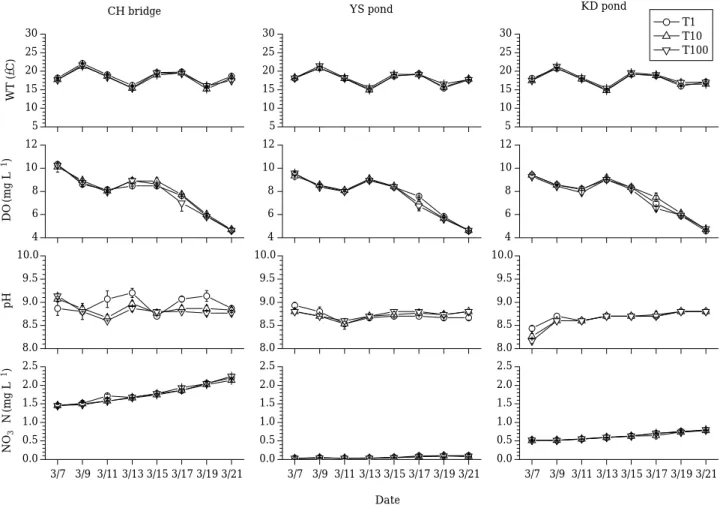
Fig. 2. Variations of water environments after treatment of microcystin-LR in three different waters. CH bridge: Chonho
bridge, YS pond: Yangsoori Ryukgakji pond, KD pond: Kildong ecological park pond.
도
1%)
고정 후 시료의 광산화에 대한 손상을 최소화하 기 위해 알루미늄 호일로 빛을 차단시켰다.
농축한 시료 는 잘 혼합한 후Sedgwick-Rafter Counting Chamber
에 시료2 mL
을 골고루 옮긴 후10
분 이상 침전시킨 다음 광학현미경 (Nikon eclipse 600, JAPAN) 200
배하에서 세 포수를 계수하였다.
식물플랑크톤 군집을 분석하기 위하 여 출현종수와 개체수를 근간으로 하는 군집의 우점도지 수(McNaughton, 1967),
다양성지수(Shannon-Weaver, 1963)
를 각각 산출하였다.
5.
조류독소Microcystin- -LR (MCLR)
측정독소는
Microcystin-LR standard (C
49H
74N
10O
12, Wako, Japan)
를 이용하여methanol 1 mL
에 용해 후 현 장수 대비 단계별로 증류수로 희석하여 사용하였다.
총MCLR
양은1)
조체성 (C-MCLR), 2)
용존성(D-MCLR)
으 로 구분하여 독소처리 전과 실험종료일에 각각ELISA
법(enzyme-linked immunosorbent assay)
으로 분석하였다.
분석은 실험초기와 종료일에2
회에 걸쳐 실시하였으며,
실험초기는 채수 당일에 곧바로 측정하였으며,
실험종료 일에 처리군 배양기에 남아있는 시료 중400 mL
를GF/C
여과지에 여과시킨 후,
여과된 조체성 시료를 시험 관에 넣고methanol 10 mL
를 가하고 동결 보관하였다.
보관된 시료를 해동하여10 µL
를 취하고 증류수990 µL
를micro centrifuge tube
에 넣은 후ELISA
분석에 사용 하였다.
용존성 독소는 해동하여 전과 동일하게ELISA
분석에 사용하였다(Fig. 1).
결 과
1.
이화학적 환경요인MCLR
처리이후 수온 및 용존산소는 크게 변동되지CH bridgeYS pond
0 10 20 30 40 50
0 10 20 30 40 50
Chl a (mg m
-3)
T1 T10 T100
0 10 20 30 40 50
0.00 0.01 0.02 0.03 0.04 0.05
START END
C-MCLR (µg L
-1)
0.00 0.10 0.20 0.30 0.40 0.50
T1 T10 T100
0.00 0.01 0.02 0.03 0.04 0.05
0.0 1.0 2.0 3.0
4.0 D-MCLR (µg L
-1)
0 10 20 30 40 50
T1 T10 T100
0.0 1.0 2.0 3.0 4.0
KD pond
Concentration
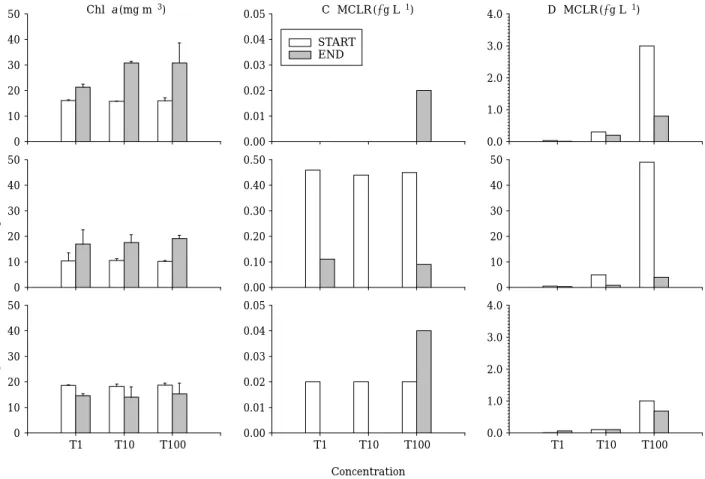
Fig. 3. Variations of chlorophyll a concentration and cellular MCLR and dissolved MCLR after the treatment of
microcystin-LR with three different concentrations. CH bridge: Cheonho bridge, YS pond: Yangsoori Ryukgakji
pond, KD pond: Kildong ecological park pond. T1: natural MCLR concentration at that sampling time as control,
T10: ten times treatment of T1 MCLR concentration, T100: 100 times treatment of T1 MCLR concentration.
않았다
.
수온은3
개의 시료군(
천호대교,
양수리 육각지,
길동생태공원)
에서14.8~22.1
�C
범위였으며,
용존산소는 실험1
일째9.3~10.3 mg L
-1,
실험20
일째4.5~4.6 mg L
-1 로서 전체적으로 시간에 따라 감소하였다. pH
는 전체적 으로8.2~9.2
범위로서 모두 약 알칼리성 상태를 나타냈 다.
양수리 육각지와 길동생태공원은 모든 실험군(T1, T10, T100)
에서 큰 차이를 보이지 않았으나 천호대교는T1
에 비해T10, T100
에서 점차 감소하였다.
질산성질소(NO
3-N)
의3
개 현장수 농도는 서로 크게 차이를 보였으 나 모든 실험군에서 시간에 따라 점차적으로 증가하였 다.
천호대교의 경우1.450~2.248 mg L
-1,
양수리 육각지0.030~0.102 mg L
-1,
길동생태공원0.508~0.808 mg L
-1 로 조사되었다.
실험기간 동안 모든 실험군에서 인산염 인(PO
4-P)
은 검량한계0.02 µg L
-1이하로 나타났다.
엽록 소a
는 처리된MCLR
량에 따라3
개 지점이 각각 서로변화를 나타냈다
.
천호대교에서는 처리농도에 따라 증가 하였는데, T100
에서15.8 mg m
-3→30.8 mg m
-3로 가장 크게 증가하였다.
양수리 육각지에서는 모든 실험군에서 처리전보다 다소(17.5
→19.1 mg m
-3)
증가한 반면,
길동 생태공원에서는 처리전보다 약간(18.7
→15.3 mg m
-3)
감 소하였다. MCLR
처리에 따른 독소변동(
용존성)
은 실험 군에 따라 차이를 나타냈다.
천호대교의 경우, MCLR
처 리이후T10, T100
에서 각각 처리농도의70%, 30%
가 검 출되었다.
양수리 육각지에서는MCLR
처리이후T10, T100
에서 각각 처리농도의10%, 5%
정도만 검출되었다.
길동생태공원에서는MCLR
처리이후T10
에서는 변화가 없었으나T100
에서는 처리농도의 약70%
정도가 검출되 었다. MCLR
처리에 따른 조체성 독소의 변동은 천호대 교와 길동생태공원에서 뚜렷하였고,
남조Microcystis
aeruginosa
가 대발생하는 양수리 육각지에서는 크게 감0 20 40 60 80 100
YS pond CH bridge KD pond
Aulacoseira Dinobryon Scenedesmus Nitzschia Navicula
0 20 40 60 80 100
Stephanodiscus Oscillatoria Aulacoseira Asterionella Nitzschia
3/7 3/9 3/11
3/13 1/3 3/17 3/19 3/21 3/7 3/9 3/11
3/13 1/3 3/17 3/19 3/21 3/7 3/9 3/11
3/13 1/3 3/17 3/19 3/21
0
20 40 60 80 100
T1 T10 T100
Aphanocapsa Scendesmus Microcystis Scenedesmus Lyngbya
Date
Cell mL-1
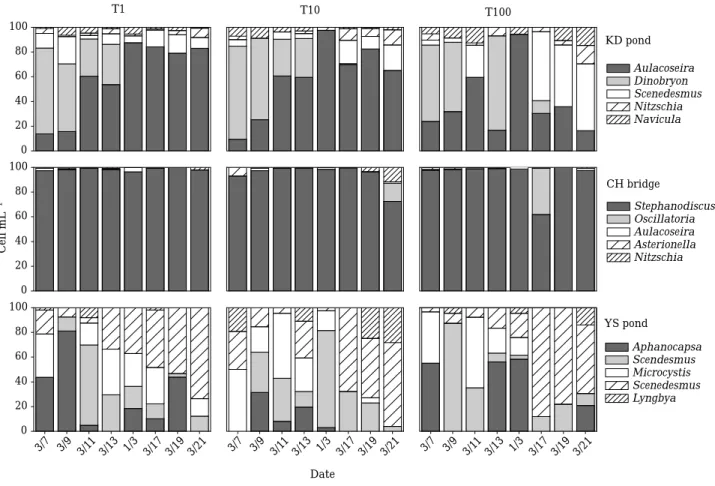
Fig. 4. Variations of standing crops of phytoplankton (cells mL
-1), dominance indices and diversity indices of phyto-
plankton community after the treatment of microcystin-LR with three different concentrations. CH bridge: Chonho
bridge, YS pond: Yangsoori Ryukgakji pond, KD pond: Kildong ecological park pond. T1: natural MCLR concen-
tration at that sampling time as control, T10: ten times treatment of T1 MCLR concentration, T100: 100 times
treatment of T1 MCLR concentration.
소하였다
.
2.
식물플랑크톤 군집 변화1)
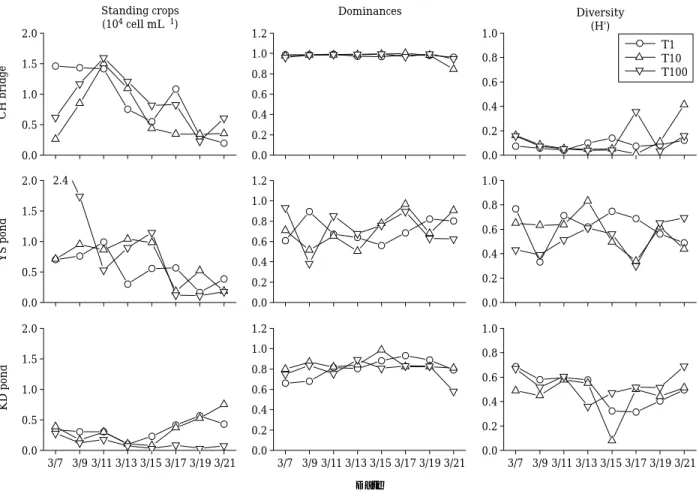
현존량MCLR
처리에 따른 각 실험군의 식물플랑크톤 현존량 은 현장수에 따라 다소 차이를 나타냈다.
천호대교(
초기 밀도= 14.58\10
3cells mL
-1)
와 양수리 육각지(
초기밀 도= 7.02\10
3cells mL
-1)
의 경우 시간의 경과에 따라T1, T10, T100
모두 점차적으로 감소하였다.
이에 반해 길동생태공원 (초기밀도= 0.4\10
3cells mL
-1)
의 경우, T1, T10
에서는1
주일간 서서히 감소하다가3/15
일 이후 다시 점차적으로 증가하였다.
이에 반해T100
에서는 계 속하여 낮은 밀도를(⁄0.1\10
3cells mL
-1)
유지하였다.
2)
종 조성 및 우점종MCLR
처리에 따른 각 실험군에서의 식물플랑크톤 종조성 및 우점종 변화는 현장수에 따라 뚜렷한 차이를 나 타냈다
.
천호대교의 경우,
모든 실험군에서Stephano- discus hantzschii
가 전체 현존량의95%
이상(14.58\10
3cells mL
-1)
을 차지하였으나,
실험기간에 따라T10, T100
에서Oscillatoria sp. (500, 3,000 cells mL
-1)
가 다소 출현 하였다.
결국 조류독소는 규조가 우점하는 군집에서 새로 운 남조Oscillatoria
의 성장을 유도하였다.
양수리 육각 지는 다른2
개 지점보다 실험기간 동안 다양한 종들이 출현하였다. T1
에서는 실험초기에Aphanocapsa, Scene- desmus, Microcystis
가 우점한 반면,
실험후기로 갈수록 녹조Scendesmus,
남조Lyngbya
등이 새롭게 증가하였 으나 남조Aphanocapsa, Microcystis
등이 점차 감소하 였다.
이러한 경향은T10, T100
에서도 유사하게 나타났 다.
결국 조류독소는 새로운 남조Lyngbya
의 성장을 유 도하였으나 시간의 경과에 따라 영양물질의 고갈로 인한microcosm
내 식물플랑크톤 쇠퇴현상이 일어났다.
길동생0.0 0.2 0.4 0.6 0.8 1.0
0.0 0.2 0.4 0.6 0.8 1.0 1.2
0.0 0.5 1.0 1.5 2.0
0.0 0.2 0.4 0.6 0.8 1.0
0.0 0.2 0.4 0.6 0.8 1.0 1.2
0.0 0.5 1.0 1.5 2.0
3/7 3/9 3/11 3/13 3/15 3/17 3/19 3/21 0.0
0.2 0.4 0.6 0.8 1.0
3/7 3/9 3/11 3/13 3/15 3/17 3/19 3/21 0.0
0.2 0.4 0.6 0.8 1.0 1.2
3/7 3/9 3/11 3/13 3/15 3/17 3/19 3/21 0.0
0.5 1.0 1.5 2.0
T1 T10 T100
2.4
Diversity (H') Dominances
Standing crops (10
4cell mL
-1)
KD pondCH bridgeYS pond
Date
Fig. 5. Variations of standing crops of 1
stand 2
nddominant phytoplankton species after the treatment of microcystin-LR with three different concentrations. CH bridge: Chonho bridge, YS pond: Yangsoori Ryukgakji pond, KD pond:
Kildong ecological park pond. T1: natural MCLR concentration at that sampling time as control, T10: ten times
treatment of T1 MCLR concentration, T100: 100 times treatment of T1 MCLR concentration.
태공원은 규조
Aulacoseira granulata
와 황색편모조Dinobryon
이 우점하는 군집으로서T100
에서 뚜렷하게 감소한 반면,
녹조Scenedesmus
가 증가하였다.
결국MCLR
이 규조가 우점하였던 군집에서 녹조중심 군집으 로 변화시켰으나,
종 조성면에서는 그다지 큰 영향을 주 지 않았다.
우점도 및 다양성 지수
:
독소처리에 의한3
개 식물플랑 크톤 군집의 우점도 및 다양도 지수의 유의한 변동은 관 찰되지 않았다(p¤0.5).
천호대교의 식물플랑크톤 군집은 규조Stephanodiscus hantzschii
의 높은 우점으로 인하 여 높은 우점도지수(0.844~1.000)
와 다른2
개 지점에 비해 낮은 다양도 지수(0.283~0.450)
를 나타냈으며,
양 수리 육각지에서는 남조류와 녹조류가 우점하였으며,
천 호대교보다 다소 낮은 우점도지수( 0.383~0.933)
와 높 은 다양도지수 (0.330~0.933)
를 나타냈다.
길동생태공원 은 규조류,
황색편모조,
녹조류 등이 고르게 분포하였으 며,
천호대교와 양수리 육각지의 중간정도 우점도 지수(0.581~0.988)
와 다양도 지수(0.050~0.784)
를 나타냈다.
고 찰
Microcystin-LR (MCLR)
처리는 뚜렷한 식물플랑크톤 천이를 유도하였는데,
규조Stephanodiscus hantzschii
가 압도적으로 우점하였던 천호대교에서는 종 조성의 큰 변 화를 나타내지 않았으며 소량의 남조Oscillatoria
가 발 달하였고,
다양한 종이 관찰되었던 길동생태공원에서는 오히려 규조Aulacoseira granulata,
황색편모조Dinobr- yon
이 감소하고 녹조Scenedesmus
가 증가하였다.
한편,
남조류가 우점하였던 육각지(Aphanocapsa, Microcystis, Scendesmus)
에서는 흥미롭게도M. aeruginosa
는 억제되 었으나 다른 조류는 큰 영향을 받지 않았다.
이러한 결과 는 결국1)
독소MCLR
처리가 남조M. aeruginosa
를 사 멸시키면서 유리된 조류의 독소가 남조류 사멸속도를 증 가시키고(Kotak et al., 1993, 1995),
다른 남조의 발달을 유도하며, 2)
규조나 녹조와 같은 다른 조류에 대해서는 종 특이적으로 작용하는 특징을 보여준다.
결국 남조류 사멸에 의한 수중 용존성 독소의 증가는 동시에 다른 조 류의 발달을 가져오는 식물플랑크톤 군집의 천이를 유도 할 것으로 판단해 볼 수 있다.
부영양수역에서 용존성
MCLR
농도는Microcystis aeruginosa
를 포함한 수중 남조류 현존량에 크게 의존되 어 있으나(Kotak et al., 1993, 1995),
조체성 독소가 동물 플랑크톤(Jungmann and Benndorf, 1994),
어류(Rabergh
et al., 1991; Sugaya et al., 1990),
패류(Chen et al., 1993),
수서곤충(Andersen et al., 1993)
등의 섭식자를 통해 농 축되는 반면,
조류세포 사멸과 함께 수중으로 유출된 용 존성 독소는 대부분 희석,
흡착,
온도, pH
등에 의한 열분 해,
광분해,
생물적 분해 등을 통하여 소멸된다(Harada and Tsuji, 1998).
본 연구에서 투여된MCLR
은 실험종료 후 분석결과 실험군에 따라5~70%
까지 큰 차이를 보였 다.
특히,
규조류가 우점하였던 천호대교와 길동생태공원 에서는 독소량이 크게 변하지 않은 반면,
남조류Apha- nocapsa, Microcystis
가 우점하였던 육각지에서는5%
만 이 검출되었다.
이처럼 육각지에서 소량의 독소가 검출된 원인은 추후 상세한 연구가 필요하나1
차적으로 성격이 다른 군집-
식물플랑크톤 종 조성과 영양염의 특성으로 판단되어지며,
미생물이나 다른 소비자에 의한 분해(Kotak et al., 1996)
또는 여수로 배수관으로부터 유리된Fe
에 의해 용존성MCLR
이 분해(Yuan et al., 2002;
Bandala et al., 2004)
등의 가능성도 배제할 수 없다고 사료된다.
남조
Mircrocystis aeruginosa
를 제어하기 위한 다양한 친환경적 제어방법이 개발되고 있으며(Daft et al., 1975;
Sigee et al., 1999; Fukushima et al., 2000; Bettarel et al., 2003),
특히 살조세균을 이용한 제어연구가 활발하게 진행중이다(Yamamoto et al., 1998; Manage et al., 2001;
Choi et al., 2005).
그러나 이들 대부분의 연구는 배양M.
aeruginosa
세포에 대해 살조능을 보인 살조세균의 분리 및 관련 물질의 탐색으로서 이러한 생물 또는 생물유래 물질을 현장생태계에 직접 적용한 사례는 아직 없다.
최 근 남조M. aeruginosa
가 대발생하는 현장수를 이용한mesocosm
실험에서 김 등(2005)
은 살조세균Xanthoba-
cter autotrophycus
투여가 처리전 수중내 용존성MCLR
농도보다4
배 이상 증가시킨다고 보고하였으며,
살조세 균 활성을 위해 배지의 첨가가 필요하다고 하였다.
두 연 구의 공통으로 사용된 육각지의 현장수 실험에서 생물제 재처리는 남조M. aeruginosa
및 식물플랑크톤 총현존량 감소,
용존성MCLR
및 영양염 증가를 보인 반면, MCLR
처리는 독소량은 오히려 감소하고 영양염은 큰 변동를 보이지 않았으나 뚜렷한 종 천이를 유도하였다.
결국,
생 물제재를 처리할 경우 수중의 남조M. aeruginosa
를 포 함한 식물플랑크톤 총현존량은 물론 조류독소에 의해 새 로운 조류의 발달이 유도됨을 시사해 준다.
다만 새로운 종의 발달이 남조류 사멸에 대한 단순한 종 천이과정 인 지,
독소에 상관없이 영양염의 공급에 따른 먹이경쟁의 결과에 의한 종 천이인지를 규명하기 위한 추후 연구가 필요하다.
적 요
남조 대발생을 제어하기 위한 생물제재의 처리가 수중 생태계에 미치는 영향을 파악하는 연구의 일환으로
,
살조 세균 처리이후 증가된 용존성microcystin-LR (MCLR)
이 식물플랑크톤 군집의 종조성 및 현존량,
그리고 조류 독소 분포에 어떠한 영향을 주는 지를 파악하기 위하여, MCLR standard
를 성격이 다른3
가지 현장수를 넣은 시 험관에 대조군,
현장 농도의10
배, 100
배 씩 처리하고 식 물플랑크톤 생물량,
엽록소a,
환경요인,
독소량 등의 변 화를 각각 조사하였다.
규조Stephanodiscus hantzschii
가 압도적으로 우점하였던 천호대교에서는 독소처리이후 현존량은 점차 감소하였으며 종조성은 크게 변하지 않았 으며,
규조Aluacoseira
와 황색편모조Dinobryon
이 우점 한 길동생태공원에서는 현존량이 크게 감소한 반면,
고농 도 처리에서는 녹조Scenedesmus
가 크게 발달하였다.
남 조류와 용존성MCLR
농도가 가장 높았던 양수리 육각 지에서는 남조M. aeruginosa
감소 및 총 현존량의 감소 가 일어났다.
이상의 결과는 생물제재 처리이후 남조M.
aeruginosa
사멸에 따른 용존성 독소의 증가가 수중내식물플랑크톤 군집의 종조성 및 현존량 변화를 더욱 심 화시키는 것으로 밝혀졌다
.
감사의 말씀
이 논문은
2004
년 한국학술진흥재단의 지원에 의하여 연구되었으며(KRF-2004-050-C00018),
실험에 도움을 주신 김보라, 정승원군께 깊은 감사를 드립니다.
인 용 문 헌