404
Copyright © 2018 The Korean Society of Fisheries and Aquatic Science pISSN:0374-8111, eISSN:2287-8815
서 론
근연관계에있는종들은자연상태에서드물게교잡현상이일 어나고
,
이로인하여새로운계통의진화가초래되기도 한다(Grant and Grant, 1992; Lee et al., 2009).
그러나자연상태에 서이들의교잡유무를정확히파악하기란쉽지않으며,
따라서 최근에는DNA
에의한교잡유무추정연구가수행되고 있다(Brykov and Podlesnykh, 2001; Lee et al., 2009; Yun et al., 2009; Kwun and Kim, 2010).
참복과
(Tetraodontidae)
어류는19
속121
종이알려져있으며(Nelson, 2006),
국내에는본과에10
속33
종이기재되어있다(Kim and Lee, 1990; Lee , 1993; Han, 1995; Han and Kim, 1998a, 1998b, Han et al., 2017).
복어류는구형의특이한형태 를가지고,
외부형태가유사한종들이많아종동정에어려움이 많다(Baek, 2017).
우리나라는수입
(
식용)
가능한복어21
종을법규로정하고있 지만,
이것은일본의수산법규를그대로가져와사용한것으로우리나라와맞지않는점이있다
(Baek, 2017).
그리고복어류 는테트로도톡신(Tetrodotoxin)
이라는치명적인독을가진어 류로서,
잘못판단하여식용할경우중독을일으킬염려가있 어,
형태적으로명확한종의분류가필요하다(Han et al., 2017).
현재참복속
(Takifugu)
어류중별종이지만형태적으로유사 한복어류는흰점복(T. poecilonotus)
과황해흰점복(T. albop- lumbeus),
매리복(T. snyderi)
과국매리복(T. vermicularis),
황 복(T. obscurus)
과황점복(T. flavidus),
밀복속(Lagocephalus)
어류등이있다(Baek, 2017).
또한,
동아시아연안에서식하는 종으로,
등,
뒷,
가슴지느러미의줄기수와척추골의수가같은 범위안에있는계수형질상매우유사한종인자주복과참복이 있다(Reza et al., 2008).
본 연구는 최근에 자주복
(Takifugu rubripes)
이나 참복(Takifugu chinensis)
과매우유사한개체가출현하여분류에 어려움을야기하고있다.
따라서형태적으로유사한자주복,
참 복,
흰점참복(Takifugu pseudommus)
과미동정1
종에대하여 형태및유전학적비교를실시하여유연관계를확인하고자하참복속(genus Takifugu) 어류 3종과 미동정 1종의 형태 및 유전학적 비교
백정익*·한경호 1 ·이성훈 1 ·김진구 2
국립수산과학원 수산자원연구센터, 1전남대학교 해양기술학부, 2부경대학교 자원생물학과
Morphological and Molecular Comparison among Three Species and One Unidentified Takifugu Species
Jeong-Ik Baek*, Kyeong-Ho Han
1
, Seong-Hoon Lee1
and Jin-Koo Kim2
Fisheries Resources Research Center, National Institute of Fisheries Science, Tongyeong 56034, Korea
1Department of Marine Technology, Chonnam National University, Yeosu 59626, Korea
2Department of Marine Biology, Pukyong National University, Busan 48513, Korea
Takifugu rubripes , T. chinensis , T. pseudommus and an unidentified species were morphologically and genetically studied. Morphology was compared using external morphology and the genetic analysis was conducted using mi- tochondrial DNA cytochrome oxidase I (COI) and cytochrome b (Cyt b). The morphological characteristics of T.
rubripes , T. chinensis and T. pseudommus were confirmed, as reported previously. The unidentified species was confirmed to have the characteristics of T. rubripes and T. chinensis . The COI sequences of the four species were 99-100% similar; genetic distance was d =0.0000 and Cyt b genetic distance was d =0.0000-0.00834. Species in the phylogenetic tree belonging to the same group could not be classified genetically. In conclusion, the unidentified spe- cies was considered to be a hybrid between T. rubripes and T. chinensis .
Key words: Takifugu , Unidentified species, Comparison study, Morphology, Genetics
This is an Open Access article distributed under the terms of the Creative Commons Attribution Non-Commercial Licens (http://creativecommons.org/licenses/by-nc/3.0/) which permits unrestricted non-commercial use, distribution, and reproduction in any medium, provided the original work is properly cited.
https://doi.org/10.5657/KFAS.2018.0404 Korean J Fish Aquat Sci 51(4) 404-410, August 2018
Received 17 April 2018; Revised 15 May 2018; Accepted 2 August 2018
*Corresponding author: Tel: +82. 55. 650. 2243 Fax: +82. 61. 659. 7169
E-mail address: [email protected]
참복속 어류 4종의 형태 및 유전 비교 연구
405
였다
,
재료 및 방법
이연구에서사용된표본은
2015
년12
월부터2016
년12
월까 지자주복(Takifugu rubripes) 3
개체는통영,
참복(T. chinensis) 9
개체와흰점참복(T. pseudommus) 6
개체는목포,
미동정어류(Takifugu sp.) 1
종은여수에서채집하여외부형태에대하여비 교를하였다.
유전분석을위해부경대학교해양어류자원기탁 등록보존기관(MFRBK, marine fish resource bank of Korea)
에서미동정어류6
개체의근육샘플을추가로분양받았다.
표 본의형질을조사하기위하여어체의등쪽,
배쪽과옆쪽을사 진촬영하였고,
체형과체색및피부극의외부형태특징을관 찰하였다.
구입한 종의 동정및 학명은
Masuda et al. (1984)
과Han (1995)
을따랐으며,
분류체계는Nelson (2006)
을따랐다.
표본 의계수형질로는등,
가슴,
뒷지느러미및꼬리지느러미줄기수 이고,
계측형질은Abe and Tabeta (1984)
와Han (1995)
에따라18
개부위를1/10mm vernier caliper
를사용하여측정하였다.
어류의분자분석을위하여
DNA
를추출하였고,
추출한DNA
는cytochrome oxidase I (COI)
와Cytochrome b (Cyt b)
유전 자영역을증폭하였으며,
염기서열정보는NCBI (national cen- ter for biotechnology information) GenBank
에등록하였다.
염기서열을 비교하기 위해
COI
영역의 자주복(T. rubripes;
CNU16007; KY514072),
참복(T. chinensis; CNU 16006;
KY514073),
흰점참복(T. pseudommus; CNU16009; KY 514075),
미동정어류(Takifugu sp.; CNU 17001-17008; MH 172368-172375)
에서얻은염기서열과NCBI
에등록된자주 복(T. rubripes; KP641572, JQ738474),
참복(T. chinensis; KP 641550, KP641557),
흰점참복(T. pseudommus; KP641558)
의Database
를이용하였다.
외집단으로는 참복과
(Tetraodontidae)
꺼끌복속(Arothron)
의 흑점꺼끌복(Arothron nigropunctatus; CNU 16012; KY 514078),
밀복속(Lagocephalus)
의은밀복(Lagocephalus wheeleri;
CNU 16014; KY514080)
과첼로복속(Chelonodon)
의첼로복(Chelonodon patoca; KY553284)
을 함께 비교하였다. Cytb
영역은자주복(T. rubripes; CNU17011; MH477884),
참복(T.
chinensis; CNU 17012; MH477885),
흰점참복(T. pseudom-
(A)
(B)
(C)
(D)
Fig. 1. Lateral (left), dorsal (middle) and ventral (right) views of Takifugu spp. A, Takifugu rubripes; B, Takifugu chinensis; C, Takifugu pseudommus; D, Takifugu sp.
mus; CNU17013; MH477886),
미동정 어류(Takifugu sp.;
CNU 17014-17021; MH477887-477894)
의염기서열을비교 하였다.
염기서열간유전거리는
mega6 (Tamura et al., 2013)
의pair- wise distance
를Kimura-2-parameter (Kimura, 1980)
로계산 하였고,
계통수는Neighbor-Joinging tree
방법을이용하여작 성하였다. Mega6
를이용하여NJ tree
는Kimura-2-parameter
로분석하였으며, bootstrap
은1,000
번수행하였다.
결과 및 고찰
이연구에이용된
4
종모두등쪽은검은색이고,
배쪽은흰색을 띠며,
등과꼬리지느러미는검은색을띤다.
피부극의분포위 치는몸의등쪽과배쪽에있어같았으며,
지느러미의모양도같 았다.
그러나자주복은참복,
흰점참복과는달리몸의옆쪽에불 규칙하게둥근모양의검은색반점과흰색무늬가꼬리지느러미 앞까지이어져있었고,
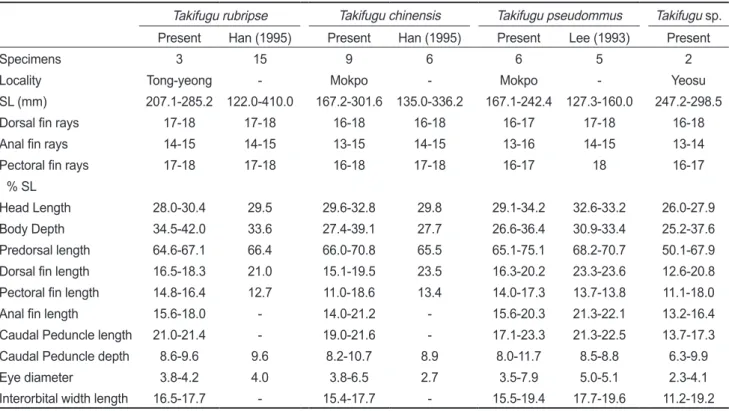
참복과흰점참복은가슴지느러미뒤쪽Table 1. Comparison of counts and measurements among Takifugu spp.
Takifugu rubripse Takifugu chinensis Takifugu pseudommus Takifugu sp.
Present Han (1995) Present Han (1995) Present Lee (1993) Present
Specimens 3 15 9 6 6 5 2
Locality Tong-yeong - Mokpo - Mokpo - Yeosu
SL (mm) 207.1-285.2 122.0-410.0 167.2-301.6 135.0-336.2 167.1-242.4 127.3-160.0 247.2-298.5
Dorsal fin rays 17-18 17-18 16-18 16-18 16-17 17-18 16-18
Anal fin rays 14-15 14-15 13-15 14-15 13-16 14-15 13-14
Pectoral fin rays 17-18 17-18 16-18 17-18 16-17 18 16-17
% SL
Head Length 28.0-30.4 29.5 29.6-32.8 29.8 29.1-34.2 32.6-33.2 26.0-27.9
Body Depth 34.5-42.0 33.6 27.4-39.1 27.7 26.6-36.4 30.9-33.4 25.2-37.6
Predorsal length 64.6-67.1 66.4 66.0-70.8 65.5 65.1-75.1 68.2-70.7 50.1-67.9
Dorsal fin length 16.5-18.3 21.0 15.1-19.5 23.5 16.3-20.2 23.3-23.6 12.6-20.8
Pectoral fin length 14.8-16.4 12.7 11.0-18.6 13.4 14.0-17.3 13.7-13.8 11.1-18.0
Anal fin length 15.6-18.0 - 14.0-21.2 - 15.6-20.3 21.3-22.1 13.2-16.4
Caudal Peduncle length 21.0-21.4 - 19.0-21.6 - 17.1-23.3 21.3-22.5 13.7-17.3
Caudal Peduncle depth 8.6-9.6 9.6 8.2-10.7 8.9 8.0-11.7 8.5-8.8 6.3-9.9
Eye diameter 3.8-4.2 4.0 3.8-6.5 2.7 3.5-7.9 5.0-5.1 2.3-4.1
Interorbital width length 16.5-17.7 - 15.4-17.7 - 15.5-19.4 17.7-19.6 11.2-19.2 SL, Standard length.
Table 2. Genetic distances (COI) among Takifugu spp.
1 2 3 4 5 6 7 8 9 10
Takifugu chinensis
Takifugu rubripes 0.0000
Takifugu pseudommus 0.0000 0.0000
Takifugu sp. 1 0.0000 0.0000 0.0000
Takifugu sp. 2 0.0000 0.0000 0.0000 0.0000
Takifugu sp. 3 0.0000 0.0000 0.0000 0.0000 0.0000
Takifugu sp. 4 0.0000 0.0000 0.0000 0.0000 0.0000 0.0000
Takifugu sp. 5 0.0000 0.0000 0.0000 0.0000 0.0000 0.0000 0.0000
Takifugu sp. 6 0.0000 0.0000 0.0000 0.0000 0.0000 0.0000 0.0000 0.0000
Takifugu sp. 7 0.0000 0.0000 0.0000 0.0000 0.0000 0.0000 0.0000 0.0000 0.0000
Takifugu sp. 8 0.0000 0.0000 0.0000 0.0000 0.0000 0.0000 0.0000 0.0000 0.0000 0.0000
참복속 어류 4종의 형태 및 유전 비교 연구
407
에검은색큰반점
1
개가흰색으로둘러싸여있지만이어서다 른어떠한무늬도없었다(Fig. 1).
흰점참복은자주복
,
참복과는다르게몸의등쪽과옆쪽에검 은색바탕에둥근모양의희미한흰색반점이흩어져있고,
자 주복은뒷지느러미가흰색이고,
참복은검은색이며,
흰점참복 은흰색또는검은색이다.
또,
자주복과참복의중간형태를가 진종으로추정되는미동정어류는자주복의특징인몸의옆쪽 에불규칙하게둥근모양의검은색반점과흰색무늬가꼬리지 느러미앞까지이어지고있지만,
뒷지느러미는참복의특징인 검은색을띠고있어외부형태적으로는자주복과참복의잡종 으로보인다(Fig. 1).
참복속
4
종의계수,
계측형질은Table 1
과같았고,
미동정어 류를제외한3
종의결과는Lee (1993)
및Han (1995)
와도유사하였으며
,
계수형질은4
종이큰차이를나타내지않았다.
계 측형질에서는4
종이같은분류군으로서의특징을나타냈고,
미 동정어류는체장에대한등지느러미길이가12.6-20.8%
로참 복속어류3
종과차이를나타냈지만,
전체적으로큰차이를나 타내지않았다.
미동정어류는Lee (1993)
과Han (1995)
의연 구결과와도차이를나타내지않아계수,
계측형질로서종을구 분하기에는어려움이있었다(Table 1).
이러한결과는Song et
al. (2001)
의연구결과인자주복과참복의근연종은형태적으로항상자주복의특징을보인다고하는결과에대해서는미동 정어류의경우자주복과참복의형태적특징을고루갖추고있 어다른결과를나타냈다
(Song et al., 2001).
미토콘드리아
DNA cytochrome oxidase I (COI)
영역을이 용한 분자분석에서는 자주복,
참복,
흰점참복의 염기서열이 Fig. 2. Phylogenetic tree based on cytochrome oxidase I showing the relationships among Tetraodontid fishes. The Neighbor-Joinging tree is constructed using the Kimura-2-parameter model (Kimura, 1980). 1,000 replication of bootstrap. Bar indicates genetic distance of 0.02Takifugu pseudommus
Takifugu sp. 2
Takifugu chinensis
Takifugu sp. 1
Takifugu sp. 5
Takifugu sp. 6
Takifugu rubripes
Takifugu sp. 3
Takifugu sp. 4
Takifugu sp. 7
Takifugu sp. 8 0.0028
0.0009
0.0009
0.0009
0.0042
0.0005
0.0009 0.0014
0.0000 0.0009
Takifugu chinensis (KP641550.1) Takifugu pseudommus (KP641558.1) Takifugu chinensis (KP641557.1) Takifugu rubripes (JQ738474.1) Takifugu rubripes (KP641572.1) Takifugu sp.8
Takifugu sp.7 Takifugu sp.6 Takifugu sp.5 Takifugu sp.4 Takifugu sp.3 Takifugu sp.2 Takifugu sp.1 Takifugu pseudommus Takifugu chinensis Takifugu rubripes
Sphoeroides pachygaster Chelonodon patoca Arothron nigropunctatus
97
100
0.02
백정익
ㆍ
한경호ㆍ
이성훈ㆍ
김진구408
Fig. 3. Phylogenetic tree based on cytochrome b showing the relationships among Takifugu fishes. The Neighbor-Joinging tree is construct- ed using the Kimura-2-parameter model (Kimura, 1980). 1,000 replication of bootstrap. Bar indicates genetic distance of 0.0005
Takifugu pseudommus
Takifugu sp. 2
Takifugu chinensis
Takifugu sp. 1
Takifugu sp. 5
Takifugu sp. 6
Takifugu rubripes
Takifugu sp. 3
Takifugu sp. 4
Takifugu sp. 7
Takifugu sp. 8 0.0028
0.0009
0.0009
0.0009
0.0042
0.0005
0.0009 0.0014
0.0000 0.0009
Takifugu chinensis (KP641557.1) Takifugu rubripes (JQ738474.1) Takifugu rubripes (KP641572.1) Takifugu sp.8
Takifugu sp.7 Takifugu sp.6 Takifugu sp.5 Takifugu sp.4 Takifugu sp.3 Takifugu sp.2 Takifugu sp.1 Takifugu pseudommus Takifugu chinensis Takifugu rubripes
Sphoeroides pachygaster Chelonodon patoca Arothron nigropunctatus
97
100
0.02
Table 3. Genetic distance (Cyt b) among Takifugu spp.
1 2 3 4 5 6 7 8 9 10
Takifugu chinensis
Takifugu rubripes 0.0037
Takifugu pseudommus 0.0037 0.0000
Takifugu sp. 1 0.0037 0.0000 0.0000
Takifugu sp. 2 0.0046 0.0009 0.0009 0.0009
Takifugu sp. 3 0.0037 0.0018 0.0018 0.0018 0.0028
Takifugu sp. 4 0.0046 0.0028 0.0028 0.0028 0.0037 0.0009
Takifugu sp. 5 0.0037 0.0000 0.0000 0.0000 0.0009 0.0018 0.0028
Takifugu sp. 6 0.0037 0.0000 0.0000 0.0000 0.0009 0.0018 0.0028 0.0000
Takifugu sp. 7 0.0037 0.0018 0.0018 0.0018 0.0028 0.0018 0.0028 0.0018 0.0018
Takifugu sp. 8 0.0083 0.0065 0.0065 0.0065 0.0074 0.0065 0.0074 0.0065 0.0065 0.0065
참복속 어류 4종의 형태 및 유전 비교 연구
409
99-100%
유사했고,
유전 거리는d=0.0000
이었다(Table 2).
Neighbor-Joinging tree
에서는4
종이같은그룹에속하였고,
근 연종의경우도자주복,
참복,
흰점참복과100% bootstrap
일치 하는유연관계를나타내어,
유전적으로4
종을구분할수없었 다(Fig. 2).
외집단으로설정한첼로복(Chelonodon patoca)
과4
종사이의유전거리는d=0.2182,
불룩복(Sphoeroides pachy- gaster)
은d=0.2104,
흑점꺼끌복(Arothron nigropuntatus)
은d=0.1850
으로나타났고,
첼로복과불룩복사이의유전거리는d=0.2420,
첼로복과흑점꺼끌복은d=0.1667,
불룩복과흑점꺼 끌복은d=0.2451
로나타났다.
Cyt b
영역의결과는유전거리는4
종이d=0.0000-0.0083
으 로약간의차이는있었지만종을구분하기에는무리가있는결 과를나타내었고,
자주복과흰점참복은d=0.0000
으로COI
와 같은결과를나타내어,
유전적으로는자주복과흰점참복은같 은종이지만형태적으로는다른표현형을가진종으로보인다.
참복과미동정어류와의유전거리는d=0.0037-0.0083
인데반 해,
자주복과미동정어류의유전거리는d=0.0000-0.0065
로참 복보다는자주복과가까운것으로나타났으나유의한차이는 아니라고판단된다(Table 3). Cyt b
영역의NJ tree
에서자주복 은다른종들과는약간의거리를두고있었고,
참복과흰점참복 은미동정어류와같은그룹을이루고있었다.
하지만참복속어 류4
종이크게는같은그룹에속하며작은차이를가지고있어 유전적으로종을구분하기에는어려움이있으며미동정어류는 자주복과참복의잡종(Hybrid)
으로추정된다(Fig. 3)
분자분석의결과
,
자주복,
참복,
미동정어류는DNA
염기서 열에서낮은단계의변화가관찰되어,
종내에서이루어질수있 는분기라고하였고,
종간의유전거리가다른종과의거리보다 는작아자주복,
참복,
근연종을다른표현형을가진종이라고 하였다.
결론적으로자주복과참복은같은종이지만각각흰색 과검은색의뒷지느러미를가진복어의학명이라는결과를뒷 받침한다고볼수있다는Song et al. (2001)
의연구결과를지지 하여준다.
그리고Reza et al. (2008)
의연구결과인자주복과참 복이자연상태에서어느정도의유전물질을교환하고,
그결과 근연종이출현한다고하였다.
따라서이논문의미동정어류와같은자주복과참복의잡종
(Hybrid)
이출현한것과같은결과를뒷받침하고있다
.
그리고자주복과참복에대한관련성정도 를추정하는연구가더필요하다는연구결과도지지하여준다.
그러나이연구에서는참복속미동정어류2
개체가형태비교 를위하여사용되었기때문에,
추후더많은표본을대상으로한 분류학적연구가필요하다고생각되며, Song et al. (2001)
과Reza et al. (2008)
의연구결과로볼때자주복,
참복,
흰점참복 의산란특성에대한연구와잡종이출현하여그F2
와F3
의출 현유무에대한연구도필요하다고판단된다.
사 사
이논문은
2018
년도국립수산과학원수산시험연구사업과제명
(R2018023)
의지원으로수행된연구입니다.
References
Abe T and Tabeta O. 1984. Pufferfishes Available in Japan. An illustrated guide to their identification Central law publica- tion, Tokyo, Japan, 85.
Baek. 2017. Taxonomy and Molecular Phylogeny of the Te- traodontoidei (Teleostei:Tetraodontiformes). Ph. D Thesis, Chonnam National University, Yeosu, Korea.
Brykov VlA and Podlesnykh AV. 2001. Comparative study of mitochondrial DNA in two greening species (Hexagrammi- dae: Pisces) and their hybrids from Peter the Great Bay (Sea of Japan). Anim Genet 12, 1663-1666.
Grant PR and Grant BR. 1992. Hybridization of bird species.
Science 256, 193-197.
Han KH. 1995. Morphology, osteology and phylogeny of the fishes of the Family Tetraodontidae (Teleostei; Tetraodon- tiformes). Ph. D Thesis, National Fisheries University of Busan, Busan, Korea, 205.
Han KH, Baek JI, Shin LS, Kim HJ, Yoon BI, Hwang JH and Lee SH. 2017. Morphological Description of Three Species of Pufferfishes (Tetraodontidae) from India. Ko- rean J Fish Aquat Sci 50, 77-84. http://dx.doi.org/10.5657/
KFAS.2017.0077.
Han KH and Kim YU. 1998a. Taxonomic Revision of the Ge- nus Takifugu (Teleostei; Tetraodontidae) from Korea. Bull Yosu Nat’l Univ 12, 563-589.
Han KH and Kim YU. 1998b. Taxonomic Revision of the Gen- era Logocephalus and Pleurancanthus (Teleostei; Tetra- odontidae) from Korea. Bull Yosu Nat’l Univ 12, 591-604.
Kim IS and Lee WO. 1990. Synopsis of the Suborder Tetra- odontoidei (Pisces; Tetraodontiformes) from Korea. Korea J Ichthyol 2, 1-27.
Kimura M. 1980. A simple method for estimating evolutionary rates of base substitutions through comparative studies of nucleotide sequences. J Mol Evol 16, 111-120.
Kwun HJ and Kin JK. 2010. Occurrence of Natural Hybrid between Oplegnathus fasciatus and Oplegnathus punctatus from the South Sea of Korea. Korea J Ichthyol 22, 201-205.
Lee IR, Yang H, Kim JH, Kim KY and Bang IC. 2009. Identi- fication of a natural hybrid between the striped spine loach
Cobitis tetralineata and the king spine loach Iksookimia longicorpa by analyzing mitochondrial COI and Nuclear
RAG1 sequences. Korea J Ichthyol 21, 287-290.Lee WO. 1993. A Systematic study of the family Tetraodonti- dae (Pisces: Tetraodontiformes) from Korea. Ph.D. Thesis, Chonbuk National University, Jeongju, Korea.
Masuda H, Amaoka K, Araga C, Uyeno T and Yoshino T. 1984.
The fishes of the Japanese archipelago. Tokai University, Tokyo, Japan, 437.
Nelson JS. 2006. Fishes of the world (4th ed.). John Wiley and
Sons, New York, NY, U.S.A., 601.
Reza MS, Furukawa S, Mochizuki T, Matsumura H and Watabe S. 2008. Genetic comparison between torafugu Takifugu
rubripes and its closely related species karasu Takifugu chinensis. J Soc Fisheries Science 17, 743-754. https://doi.
org/10.1111/j.1444-2906. 2008. 01585.X.
Song L, Liu B, Xiang J and Qian PY. 2001. Molecular Phylog- eny and Species Identification of Pufferfish of the Genus
Takifugu (Tetraodontiformes, Tetraodontidae). Mar Biotech-
nol 3, 398-406. https://doi.org/10.1007/S10126-001-0006-5.Tamura K, Dudley J, Nei M and Kumar S. 2013. MEGA4: Mo- lecular Evolutionary GeneticsAnalysis (MEGA) software version 6.0. Mol Biol Evol 24, 1596-1599.
Yun YE, Lee IR, Park SY, Kang EJ, Kim EO, Yang SK, Nam YK and Bang IC. 2009. Genetic identification of hybrids be- tween Rhodeus uyekii and R. notatus by sequence analysis of RAG-1 gene. J Aquaculture 22, 79-82.