- 903 -
효소적 가수분해에 따른 두유와 전두유의 단백질 변화
장세영․신경아․박난영․방광웅1․정용진†
계명대학교 식품가공학과, 1경북전문대학 식품가공조리과
Protein Changes in Soymilk and Whole Soymilk due to Enzymatic Hydrolysis
Se-Young Jang, Kyung-A Sin, Nan-Young Park, Kwang-Woong Bang1 and Yong-Jin Jeong†
Department of Food Science and Technology, Keimyung University, Daegu 704-701, Korea
1
Department of Food Technology and Cooking, Kyungbuk College, Youngju 750-712, Korea
Abstract
This study investigated protein changes in soymilk and whole soymilk due to enzymatic hydrolysis. The total free amino acid contents of low molecular weight soymilk (LSM) and low molecular weight whole soymilk (LWSM) were higher than soymilk (SM) and whole soymilk (WSM). The essential amino acid content was similar in SM and LSM, but was higher in LWSM than WSM. In SDS-PAGE performed to tendency of becoming low molecules, the soy protein molecular weights were 3372 kDa for SM and WSM, but 17 kDa or less for LSM and LWSM.
Also, high molecular weight protein spots were evident in 2-D electrophoresis of SM and LSM, but only low molecular weight protein spots of various sizes were evident in WSM and LWSM. This suggests that the high molecular weight protein in SM and WSM is changed to low molecular weight protein by enzymatic hydrolysis.
Further investigations of the separation and qualities of these proteins are required.
Key words:soymilk, whole soymilk, low molecule protein, proteome, 2-DE
서 론
1)
대두는 양질의 단백질을 함유하고 있으며, 높은 불포화 지방산 비율과 식이섬유소 등 영양학적으로 우수한 식량자 원이다(1). 대두의 항영양성 인자들이 항암성 및 여러 생리 적 기능이 있다는 점이 밝혀지면서 대두의 가치는 더욱 커지고 있다(2-4). 대두가공품 중 두유는 콜레스테롤이 거 의 없으며 만성질환 예방에 효과가 높은 식이섬유, 올리고 당, 이소플라본, 피틴산, 단백질 분해효소 억제제, 사포닌, 대두 단백질과 그 가수분해물, 식물성 스테롤과 페놀 화합 물 등 기능성 성분이 함유되어 있어 식물성 건강음료로의 인식이 확대되어 가고 있으며(5-7), 두유의 품질 및 기능성 을 향상시키기 위한 연구가 많이 진행되고 있다. Choung
†Corresponding author. E-mail:[email protected], Phone:82-53-580-5557, Fax:82-53-580-6477
등(8)은 미생물 복합 처리한 두유박 단백질 제조 및 대두단 백질 특성, Pyun과 Hwang(9)은 Bacillus polymyxa에서 분리 한 protease를 처리한 대두단백질의 기능성에 대해 보고한 바 있다. 최근 Jeong 등(10)은 효소제 종류에 따른 가수분해 물의 특성에 관해 보고하였으며, Jang 등(11, 12)은 전두유 액의 효소적 가수분해 최적화 조건과 두유와 전두유 가수분 해물의 기능성에 관해 보고한 바 있다. 단백질의 기능특성 을 개선하는 방법 중 가수분해 효소 처리를 통해 변형대두 단백질을 제조하는 것이 현실적으로 가장 적용 가능성이 크다(13). 또한 대두단백질의 효소분해물이 단순히 아미노 산 집합체만으로는 설명할 수 없는 기능을 가지고 있는 것이 알려지면서(14) 질병예방 및 기능적 효능을 갖춘 새로 운 식품소재로서 재평가 받고 있다(15).
프로테오믹스(proteomics)는 단백질체의 기능 이상과 구 조변형 등을 가려내는 분석기술을 뜻하는 것으로 한꺼번에 수천 개 단백질의 발현 정도, 특정 단백질의 발현 양상의
변화, 단백질 합성 후 변형(post-translational modification), 다른 단백질간의 상호작용과 단백질 전체 수준에서의 구성 및 기능 등을 연구하여 세포내 변형과정과 네트웍 형성을 질병의 진행과정과 연계시켜 종합적으로 정보를 대량으로 얻을 수 있다(16-18). 특히, 특정 조건에 따른 단백질의 발현 량의 변화 분석은 크게 이차원 전기영동 방법(Two- dimensional gel electrophoresis, 2-DE)과 Non 2-DE의 두 가지 기술이 사용되며, 전자는 전기영동 방식을 사용하여 임의의 조직 내에 존재하는 단백질을 분리할 수 있다(19).
후자는 주로 ICAT(isotopecoded affinity tag)이나 MCAT (mass-coded abundance tag)와 같은 특정의 친화 태그를 붙 이는 방법과 LC-MS(liquid chromatography-mass spectrometry) 를 사용한다. Non 2-DE 기술이 보다 정확한 결과를 제공하 지만, 여전히 2-DE 기술이 가격 효율성 등으로 인해 단백질 의 발현 패턴 분석이 주로 이용된다(20,21).
따라서 본 연구는 유리아미노산, SDS-PAGE 전기영동과 2-DE 방법을 이용하여 효소적 가수분해에 따른 두유와 전 두유의 단백질의 특성 변화를 조사하였다.
재료 및 방법
재 료
본 실험에 사용한 대두는 2007년도 경북 상주지방에서 재배한 메주콩을 구입하여 사용하였으며, 저분자화 효소제 (KMF-G, 70,000 PU/g)는 (주)계명푸덱스(KMFoodex. Co., Ltd. Korea)에서 제공 받아 사용하였다.
시료 제조
대두 100 g을 Jang 등(11)의 방법에 준하여 3회 수세한 후 수돗물에 7~8시간 침지하였다. 침지한 대두를 100℃의 끓는 물에 20분간 가열한 후 탈피하여 건조 대두 중량의 7배량의 물을 넣고 homogenizer(HF-93, SMT company, Japan)로 15,000 rpm에서 10분간 마쇄하였다. 대두 마쇄액 의 가용성 고형분 함량을 10%(w/v)로 조정한 것을 전두유 (Whole soymilk, WSM)로 사용하였고, 전두유를 부직포로 여과하여 비지를 제거한 것을 두유(Soymilk, SM)로 사용하 였다. 제조한 두유와 전두유에 KMF-G 0.2%(w/w)를 각각 첨가하여 50℃에서 1시간동안 가수분해한 후 100℃에서 10분간 효소를 불활성화하여 저분자 두유(Low molecule soymilk, LSM)와 저분자 전두유(Low molecule whole soymilk, LWSM)을 제조하였다. 제조한 모든 시료는 동결 건조(SFD SM24L, Samwon, Korea)한 후 100 mesh 이상으 로 분쇄하여 사용하였다.
유리 아미노산
시료 10 g에 75% ethanol 100 mL을 가한 후 80℃ 수욕조
에서 1시간 환류 냉각시켜 유리 아미노산을 추출하였다.
추출액을 여과지(Whatman No. 1, England)로 여과하여 감 압 농축시킨 후 증류수로 100 mL이 되게 정용하였다. 정용 한 시료 50 mL에 25% TCA 용액 50 mL 가하여 1시간 동안 냉장 보관 후 3,000 rpm으로 20분간 원심분리 하였다.
상등액에 diethyl ether 100 mL을 가한 후 3회 반복 추출하여 지질, 색소 및 지용성 물질을 제거하였다. 수용액층을 40℃
에서 감압농축 시켜 0.2 N lithium citrate buffer(pH 2.2) 10 mL로 용해하고 membrane filter(pore size 0.2 μm, Advantec MFS, Japan)로 여과한 후 아미노산 자동분석기(Biochem 20, Pharmacia Biotech. Ltd., England)로 분석하였다.
SDS-PAGE 전기영동
동결건조 전 액체시료를 원심분리한 후 상등액에 sample buffer를 동량 첨가하고 100℃의 물에 5분간 방치하여 단백 질의 완전한 변성을 유도한 후 전기영동을 하였다. 전기영 동용 완충용액은 0.1%(w/v) SDS를 포함하는 0.025 M Tris base, 0.192 M glycine 용액(pH 8.3)을 사용하였다. Gel의 염색은 Coomasie blue R-250로 상온에서 30분간 교반하면 서 염색하였고, 탈색시약(100 mL methanol, 100 mL glacial acetic acid, 800 mL H2O)으로 gel을 18시간 이상 탈색시켜 가용성 단백질의 전기영동 패턴을 조사하였다.
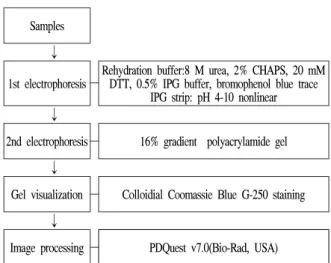
2차원 전기영동(2-dimensional gel electrophoresis, 2-DE) 2-DE는 Kim 등(22)의 방법으로 실시하였다. 시료에 rehydration buffer(8 M urea, 2% CHAPS, 20 mM DTT, 0.5%
IPG buffer, bromophenol blue trace)을 섞은 후, IPG (Immobilized pH gradients) holder에서 로딩하였다. 24 cm linear gradient pH 4-10 nonlinear strip를 사용해 focusing하 였으며, focusing은 IPG phore strip(Genomine drystripTM)를 사용하였다. IEF(First-dimension Isoelectric focusing)가 끝 난 IPG strip을 equilibration buffer I [6 M urea, 30%(w/v)
Samples
↓
1st electrophoresis Rehydration buffer:8 M urea, 2% CHAPS, 20 mM DTT, 0.5% IPG buffer, bromophenol blue trace
IPG strip: pH 4-10 nonlinear
↓
2nd electrophoresis 16% gradient polyacrylamide gel
↓
Gel visualization Colloidial Coomassie Blue G-250 staining
↓
Image processing PDQuest v7.0(Bio-Rad, USA)
Fig. 1. Schematic illustration of two-dimensional electrophoresis of sample proteome.
glycerol, 2%(w/v) SDS, 0.05 M tris-HCl buffer, bromophenol blue trace, 1% DTT]과 equilibration buffer II(equilibration buffer I + 2.5% iodoacetamide)에 평형화 시킨 후 16%
gradient polyacrylamide gel을 사용해 second dimension을 실시하였다(Fig. 1).
염색 및 이미지 분석
2-DE를 한 후 2% phosphoric acid, 10% ammonium
Table 1. Comparison of free amino acid content on the SM, LSM, WSM, LWSM
(unit: mg%)
Free amino acids Samples
SM1) LSM2) WSM3) LWSM4)
Hydroxy-L-proline ND5) 11.24 ND ND
Serine 1.58 ND ND 1.67
Glutamic acid ND 6.88 6.44 ND
α-Aminoadipic Acid 3.10 ND 2.54 4.16
Proline 1.63 ND 2.19 2.25
Glycine 1.27 2.22 1.26 0.95
Alanine 2.13 2.39 2.14 2.45
α-Amino-n-butyric acid ND ND 0.48 0.82
Valine 6.59 6.71 6.78 8.40
Methionine 0.83 0.86 1.34 1.60
Cystathionine ND ND 3.73 2.65
Isoleucine 1.11 0.99 1.33 1.80
Leucine 1.43 1.94 5.08 11.58
Tyrosine 1.36 2.97 2.39 2.83
β-Alanine 0.87 ND 4.63 3.99
Phenylalanine 2.48 3.36 6.17 10.99
γ-Amino-n-butyric Acid 8.64 10.33 9.53 9.46
Ethanolamine 0.88 1.75 1.02 0.99
Hydroxylysine ND ND 0.84 1.77
Ornithine ND ND ND 0.32
Lysine 1.77 2.07 2.98 2.65
1-Methyl-L-histidine ND ND 0.58 ND
Histidine 1.34 2.40 1.72 2.39
Tryptophan 2.65 ND 3.79 4.10
Arginine 12.81 12.98 13.09 21.04
EA6) 16.87 15.93 27.47 41.11
TA7) 52.47 69.09 80.07 98.87
1)SM: Soymilk.
2)LSM: Low molecule soymilk.
3)WSM: Whole soymilk.
4)LWSM: Low molecule whole soymilk.
5)ND : Not detected.
6)EA : Essential amino acid(Thr+Val+Met+Ile+Leu+Phe+Lys+Trp).
7)TA : Total free amino acid.
sulphate와 20% methanol을 포함한 0.1% Colloidial Coomassie Briliant Blue G-250(Bio-Rad, USA)을 이용하여 spot을 염색 하였다. Staining이 끝난 각 polyacrylamide gel들은 Densitometer 로 scanning하여 PDQuest v7.0(Bio-Rad, USA)로 이미지를 분석하였다(Fig 1).
결과 및 고찰
유리아미노산의 함량 및 조성 변화
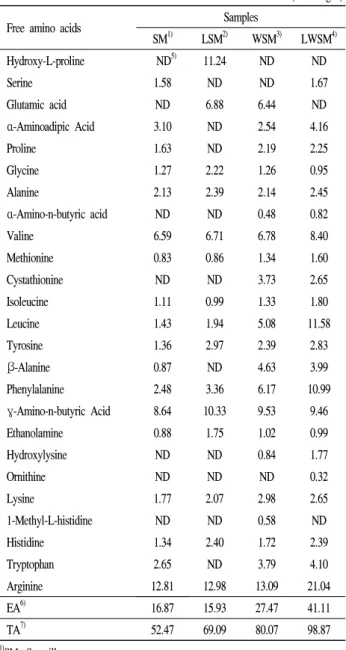
두유(SM), 저분자 두유(LSM), 전두유(WSM), 저분자 전 두유(LWSM)의 유리아미노산 함량과 조성을 분석한 결과 를 Table 1에 나타내었다. LSM의 총 유리아미노산 함량은 69.09 mg%로 SM의 52.47 mg%보다 높았으나 필수 아미노 산의 함량은 비슷하게 나타났다. LWSM의 경우 총 유리아 미노산은 98.87 mg%, 필수아미노산은 41.11 mg%로, 총 유리아미노산 80.07 mg%, 필수아미노산 27.47 mg%인 WSM에 비해서 높게 나타나 대두단백질이 가수분해 되면 서 유리아미노산의 함량이 증가된 것으로 생각된다. SM과 LSM에 비해 WSM와 LWSM에서 필수아미노산과 총 유리 아미노산 함량은 높게 나타났으며, 이것은 WSM과 LWSM 제조과정에서 비지를 제거하지 않아 유리아미노산이 높게 나타난 것으로 생각된다. 이러한 결과는 Jang 등(11)과 Gu 등(23)이 대두단백질과 녹두 단백질이 효소적 가수분해를 통해 유리아미노산이 증가되며, Shin(24)이 분리대두단백 이 효소처리에 의해 유리아미노산의 함량이 증가된다고 보고한 것과 비슷한 결과를 나타내었다. 유리아미노산의 조성을 조사한 결과 모든 시료에서 valine, leucine, phenylalanine, γ-aminobytyric acid(GABA), arginine의 함량 이 높은 것으로 나타났다. Valine, leucine, phenylalanine, arginine은 저분자화 시킨 LSM, LWSM에서 함량이 더 높게 나타났으나 기타 아미노산의 함량은 큰 변화가 없었다.
SDS-PAGE 전기영동 패턴
효소적 가수분해에 따른 시료들의 단백질 분자량 변화를 조사하기 위해서 SDS-PAGE 전기 영동한 결과를 Fig. 2에 나타내었다. SM의 단백질의 분자량은 33, 40 및 72 kDa의 고분자와 12 kDa 이하의 저분자로 나타났으며, WSM의 경우 분자량 40~70 kDa 사이의 고분자 단백질이 분포하는 것으로 나타내었다. An 등(25)은 삶은 대두의 수용성 단백 질의 주된 분자량은 66 kDa이라고 보고한 바 있어 WSM의 단백질 분자량과 비슷하였으며, SM은 비지 제거로 인하여 수용성 단백질이 대부분 빠져나가서 간 것으로 생각된다.
LSM와 LWSM에서는 주로 11 kDa이하의 저분자 단백질이 넓은 분포대를 나타내어 효소적 가수분해로 인해 단백질이 저분자화 되는 것을 알 수 있었다. Gu 등(23)은 녹두 단백질 의 분자량은 50 kDa 이상이지만 열처리와 효소처리에 의해
17 kDa 이하로 분해된다고 보고한 것과 비슷한 경향을 나타 내었다.
Fig. 2. SDS-polyacrylamide gel electrophoresis profile of the SM, LSM, WSM, LWSM. SM : Soymilk, LSM : Low molecule soymilk, WSM : Whole soymilk, LWSM : Low molecule whole soymilk.
Fig. 3. Two-dimensional proteome profiles of total protein from the SM, LSM, WSM, and LWSM.
SM : Soymilk, LSM : Low molecule soymilk, WSM : Whole soymilk, LWSM : Low molecule whole soymilk and proteins were analyzed using pH 4~10 N nonlinear IPG gel strip and 10~16% SDS-PAGE gel(24 cm x 20 cm x 1 mm).
Two-dimensional electrophoresis(2-DE)
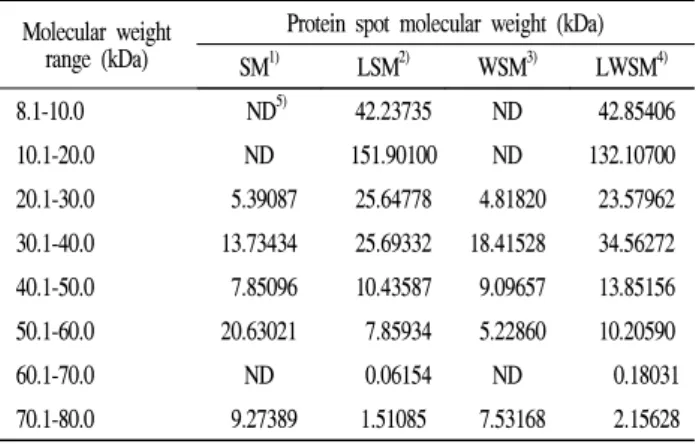
이차원 전기영동으로 효소가수분해에 따른 단백질 spot 을 비교한 결과를 Fig 3과 Table 2에 나타내었다. Fig. 3과 같이 SM과 WSM의 gel image에서 평균적으로 약 480개의 단백질 spot이 검출되었다. 이들 단백질 spot은 pH 4~6에서 주요 분자량이 약 34, 54 및 86 kDa이며 pH 7~10에서는 주 분자량은 약 20 kDa으로 두 시료의 가공방법이 다르지만 유사한 경향을 나타내었다. LSM과 LWSM의 경우 약 400개 의 단백질 spot이 검출되었다. pH 4~7.2 범위의 SM과 WSM의 고분자 단백질 spot은 효소적 가수분해에 의해 저 분자화 되어 LSM과 LWSM에서는 단백질 spot이 감소하는 것으로 gel image에 나타났다. Table 2와 같이 단백질 spot의 분자량의 합계를 보면 분자량 8.1~20 kDa 범위의 단백질은 SM과 WSM에서 나타나지 않았으나 LSM과 LWSM에서 나타났다. 이것은 SM과 WSM의 고분자 단백질 spot들이 가수분해 되어 LSM과 LWSM에서는 다양한 크기로 전환이 되어 단백질 spot을 형성한 것으로 효소적 가수분해에 의해
단백질이 저분자화 되는 것으로 나타났으며, 향후 단백질 표준지도 작성, peptide 분리 및 기능성과 같은 연구가 수반 되어야 할 것으로 생각된다.
Table 2. Protein spot molecular weight of the SM, LSM, WSM, and LWSM on the PDQuest
Molecular weight range (kDa)
Protein spot molecular weight (kDa)
SM1) LSM2) WSM3) LWSM4)
8.1-10.0 ND5) 42.23735 ND 42.85406
10.1-20.0 ND 151.90100 ND 132.10700
20.1-30.0 5.39087 25.64778 4.81820 23.57962 30.1-40.0 13.73434 25.69332 18.41528 34.56272 40.1-50.0 7.85096 10.43587 9.09657 13.85156 50.1-60.0 20.63021 7.85934 5.22860 10.20590
60.1-70.0 ND 0.06154 ND 0.18031
70.1-80.0 9.27389 1.51085 7.53168 2.15628
1)SM: Soymilk.
2)LSM: Low molecule soymilk.
3)WSM: Whole soymilk.
4)LWSM: Low molecule whole soymilk.
5)ND : Not detected.
요 약
본 연구는 두유와 전두유의 효소적 가수분해에 따른 단 백질의 변화를 조사하였다. 총 유리아미노산 함량을 조사 한 결과 두유(SM)과 전두유(WSM)에 비해서 저분자 두유 (LSM)와 저분자 전두유(LWSM)에서 높게 나타났다. 필수 아미노산 함량은 SM과 LSM에서 비슷하였으나 LWSM은 WSM보다 높게 나타났다. SDS-PAGE 전기영동 패턴 분석 결과 SM과 WSM에서는 33~72 kDa의 고분자가 존재하였 으나 LSM와 LWSM에서는 17 kDa 이하의 저분자 단백질만 나타났다. 또한 이차원 전기영동한 결과 SM과 LSM에서의 고분자 단백질 spot이 WSM와 LWSM에서는 다양한 크기 의 저분자 단백질 spot으로 변환되어 효소가수분해에 의해 고분자 단백질이 저분자화 되는 것으로 나타났으며, 향후 단백질 spot의 분리 및 특성에 관한 연구가 필요하다.
참고문헌
1. Hendrich, S., Lee, K.W., Xu, X., Wang, H.J. and Murphy, P.A. (1994) Defining food components as new nutrient.
J. Nutr., 124, 1789-1792
2. Choi, M.S. and Rhee, K.C. (2006) Production and processing of soybeans and nutrition and safety of
isoflavone and other soy products for human health. J.
Med. Food, 9, 1-10
3. Mazur, W.M., Dule, J.A., Wahala, K., Rasku, S. and Adlerecreutz, H. (1998) Isoflavonoids and ligmans in legumes: Nutritional and health aspects in human. J. Nutr.
Biochem., 9, 193-200
4. Messina, M. (1995) Modern applications for an ancient bean: Soybeans and the prevention and treatment of chromic disease. J. Nutr., 125, 567-569
5. Kim, J.S. (1996) Current research trends on bioactive function of soybean. Korea Soybean Digest, 13, 17-24 6. Kim, C.H., Park, J.S., Shon, H.S. and Chung, C.W. (2002)
Determination of isoflavone, total saponin, dietary fiber, soy oligosaccharides and lecithins from commercial soy products based on the one serving size-some bioactive compounds from commercialized soy products. Korean J. Food Sci. Technol., 34, 96-102
7. Shon, H.S., Lee, Y.S., Shin, H.C. and Chung, H.K. (2000) Does soybean isoflavone have adverse effects on human.
Korean Soybean Digest, 17, 9-19
8. Choung, N.H., Shin, Y.S., Kim, S.H. and Yim, M.H.
(2003) Characteristics of soy protein hydrolysates with enzymes produced by microorganisms isolated from traditional Meju. Korean J. Food Preserv., 10, 80-88 9. Pyun, J.W. and Hwang, I.K. (1995) Effects of protease
treatment on functional properties of soymilk protein.
Korean J. Soc. Food Sci., 11, 26-32
10. Jeong, K.H., Seo, J.H. and Jeong, Y.J. (2005) Characteristics of soybean hydrolysates prepared with various protease. Korean J. Food Preserv., 12, 460-464 11. Jang, S.Y., Gu, Y.A., Park, N.Y., Kim, I.S. and Jeong,
Y.J. (2007) Physicochemical property changes of whole soymilk dependent on hydrolysis conditions. Kor. J. Food Preserv., 14, 394-399
12. Jang, S.Y., Sin, K.A., Park, N.Y., Bang, K.W., Kim, J.H. and Jeong, Y.J. (2008) Functional properties of hydrolysate soy milk and whole soy milk. Kor. J. Food Preserv., 15, 361-366
13. Lee, C.H., Kim, C.S. and Lee, S.P. (1984) Studies on the enzymatic partial hydrolysis of soybean protein isolates. Korean J. Food Sci. Technol., 16, 228-234 14. Kennedy, A. (1995) Cancer prevention by soy products.
J. Nutr., 125, 733-741
15. Yoon, J.Y., Cho, H.K. and Lee, S.R. (1993) Effect of phytate on the digestibility and electrophoretic pattern of soy protein isolate. Korean J. Food Sci. Technol., 25, 360-365
16. Seol, J.W., Hwang, I.H., Chae, J.S., Kang, H.S., Ryu, K.S., Kang, C.S. and Park, S.Y. (2005) Proteome analysis of chickens fed with tissue culture medium waste after harvest of Korean wild ginseng. Korean J. Vet. Res., 45, 155-161
17. Blackstock, W.P. and Weir, M.P. (1999) Proteomics:
quantitative and physical mapping of cellular proteins.
Trends Biotechnol., 17, 121-127
18. Wilkins, M.R., Pasquali, C., Appel, R.D., Ou, K., Golaz, O., Sanchez, J.C., Yan, J.X., Gooley, A.A., Hughes, G., Hunphrey-Smith, I., Williams, K.L. and Hochstrasser, D.F. (1996) From proteins to proteomes: Large-scale protein identification by two-dimensional electrophoresis and amino acid analysis. Biotechnology, 14, 61-65 19. Shim, J.E. and Lee, W.S. (2005) Automated method of
landmark extraction of protein 2DE images based on multi-dimensional clustering. Korea Infor. Pro. Soc.
Review, 12, 719-728
20. Gygi, S.P., Rist, B., Gerber, S.A., Turecek, F., Gelb, M.H.
and Aebersold, R. (1999) Quantitative analysis of complex protein mixtures using isotope-coded affinity
tags. Nat. Biotechnol., 17, 994-999
21. Cagney, G. and Emili, A. (2002) De novo peptide sequencing and quantitative profiling of complex protein mixtures using mass-coded abundance tagging, Nat.
Biotechnol., 20, 163-170
22. Kim, S.I., Kim, S.J., Nam, M.H., Seo, J.B., Kim, S.H., Kwon, K.H., Kim, Y.H., Choi, J.S., Yoo, J.S., Yang, D.C., Choi, K.T. and Park, Y.M. (2001) Purification of crude protein mixture from Panax ginseng and hairy root for proteome analysis. Korean J. Plant Tissue Culture, 28, 347-351
23. Gu, Y.A., Jang, S.Y., Park, N.Y., Mun, C.R., Kim, O.M.
and Jeong, Y.J. (2006) Property changes of mung bean depending on hydrolysis conditions. Kor. J. Food Preserv., 13, 563-568
24. Shin, J.H. (1986) Effect of ISP(Isolated soy protein) treated with enzyme on fermented soy milk. Ph. D.
Thesis, Kyung Hee University, Seoul, Korea
25. An, B.J., Son, G.M. and Choi, C. (1986) Changes in protein and amino acid composition of native meju during fermentation. J. Korean Soc. Food Sci. Nutr., 15, 152-157
(접수 2008년 7월 25일, 채택 2008년 11월 14일)