• 검색 결과가 없습니다.

자동차용 팰트로부터 방출되는 휘발성 유기화합물의 저감 연구

N/A
N/A
Protected

Academic year: 2021

Share "자동차용 팰트로부터 방출되는 휘발성 유기화합물의 저감 연구"

Copied!
4
0
0

로드 중.... (전체 텍스트 보기)

전체 글

(1)

Appl. Chem. Eng., Vol. 21, No. 6, December 2010, 680-683

680

자동차용 팰트로부터 방출되는 휘발성 유기화합물의 저감 연구

박승규⋅김헌창

호서대학교 화학공학과

(2010년 10월 26일 접수, 2010년 11월 8일 채택)

-

Reduction of Volatile Organic Compounds Emitted from Automobile Felt by Activated Carbon and Hollow Core/Mesoporous Shell Carbon Ball

Seung Kyu Park and Heon Chang Kim

Department of Chemical Engineering, Hoseo University, Choongnam 336-795, Korea (Received October 26, 2010; Accepted November 8, 2010)

나노카본볼과 활성탄을 혼합하여 자동차용 팰트에서 발생하는 휘발성유기화합물의 흡착성능을 시험하였다. 자동차에 서 발생하는 휘발성유기화합물의 양을 측정하는 최적의 분석방법으로 고성능 액체크로마토그래피와 가스크로마토그 래피를 활용하였다. 새로 생산된 팰트에서는 포름알데히드가 0.3∼6.0 ppm 존재하였으나 상온에서 14일 동안 숙성시 키면 0.2∼0.5 ppm으로 감소하였고, 아세트알데히드도 0.2∼3.0 ppm에서 0.2∼0.4 ppm으로 감소하였다. 새로 생산된 팰트에서 발생되는 총 휘발성유기화합물은 8.49 µg/TP로 일본자동차협회의 허용치에 비하여 약 26배나 높게 관측되었 으나, 나노카본볼과 활성탄 혼합물 0.2 wt%를 팰트에 첨가시키면 0.32 µg/TP 이하로 저감할 수 있었다.

Nano carbon balls (NCBs), activated carbons (ACs) and their mixture (new carbon mixtures, NCMs) were used to reduce volatile organic compounds (VOCs) emitted from the automobile felt. The optimum analytical method to measure the trace amount of the VOCs, including formaldehyde and acetaldehyde, has been established by utilizing high performance liquid chromatography (HPLC) and gas chromatography (GC). The levels of formaldehyde and acetaldehyde released from newly produced felt were in the ranges of 0.3 ∼6.0 ppm and 0.2∼3.0 ppm, respectively. After 14 days of aging at the room temper- ature, however, their levels were still in the ranges of 0.2 ∼0.5 ppm and 0.2∼0.4 ppm, respectively. By applying NCMs of 2 wt% to the automobile felt, the amount of the total volatile organic compounds (TVOCs) was reduced under the chronic inhalation minimum risk level of 0.32 µg/TP.

Keywords: nano carbon balls, activated carbons, automobile felt, VOCs, adsorbent

1. Introduction

1)

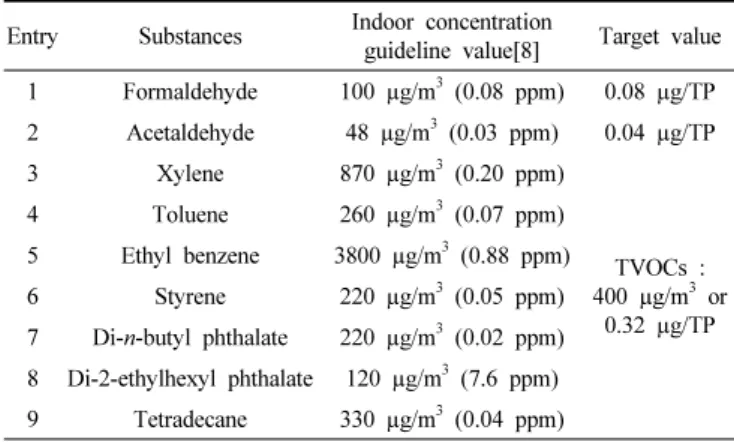
Emissions of volatile organic compounds (VOCs), extensively used as solvents, refrigerants, aerosol propellants and raw materials, are one of the most delicate environmental problems currently faced by chem- ical industries. VOCs are known as pollutants that contribute to smog generation, greenhouse effect and ozone layer depletion, and some are even considered toxic and hazardous to human health. VOCs including formaldehyde and acetaldehyde released from the automobile felts can irritate human respiratory system and evoke many physical symptoms such as headaches, nausea, dizziness and allergies[1-4]. The potential health risk exists due to the toxic nature of such compounds. Although the threshold concentration of formaldehyde recognized by passengers in the vehicle is 0.83 ppm[5], the minimum risk level (MRL) of the

† 교신저자 (e-mail: [email protected])

chronic inhalation is 0.03 ppm[6]. In consequence, passengers exposed to sub-ppm levels of such VOCs may get sick without any odor per- ception[5-7]. Since the symptoms can be more seriously recognized by the passenger in the new automobile, minimization of VOCs released from the new automobile felt is of major interest to contemporary society.

Japan automobile manufacturers association (JAMA) and automobile

companies established the indoor concentration level guideline of VOCs

in the automobile cabin (Table 1), promoted a voluntary approach to

reduce VOC levels in vehicle cabins, and announced to apply it to the

new commercial vehicles from the year 2008[8]. Generally, big auto-

mobile companies strictly limit VOCs emission from automobile parts

such as dashboard, fabric and felt etc. Despite of many efforts to re-

duce VOCs emission from the felt, non-woven cloth, used for damper

or shock absorbent in the automobile, only a few studies regarding the

indoor air quality of automobile were carried out for practical applica-

tion[9-11]. Several studies to eliminate VOCs in atmosphere by adsorb-

(2)

자동차용 팰트로부터 방출되는 휘발성 유기화합물의 저감 연구 681

Appl. Chem. Eng., Vol. 21, No. 6, 2010 Table 1. VOCs Indoor Concentration Level Guideline by Automobile

Manufacturer

Entry Substances Indoor concentration

guideline value[8] Target value 1 Formaldehyde 100 µg/m 3 (0.08 ppm) 0.08 µg/TP 2 Acetaldehyde 48 µg/m 3 (0.03 ppm) 0.04 µg/TP 3 Xylene 870 µg/m 3 (0.20 ppm)

TVOCs : 400 µg/m 3 or

0.32 µg/TP 4 Toluene 260 µg/m 3 (0.07 ppm)

5 Ethyl benzene 3800 µg/m 3 (0.88 ppm) 6 Styrene 220 µg/m 3 (0.05 ppm) 7 Di- n-butyl phthalate 220 µg/m 3 (0.02 ppm) 8 Di-2-ethylhexyl phthalate 120 µg/m 3 (7.6 ppm) 9 Tetradecane 330 µg/m 3 (0.04 ppm)

Figure 1. (a) SEM Image of NCBs, (b) TEM Image of NCBs, (c) SEM Image of ACs, and (d) SEM Image of pores in ACs.

Table 2. Composites and Physico-chemical Data of NCBs, ACs and NCMs Mixtures

Materials Material composition BET surface area (m 2 /g)

Pore size (nm) NCBs Carbon/Silica/H 2 O = 57.1/41/1.9 1230 2 ∼4 ACs Coconut activated carbon 1275 0.5 ∼500 NCMs Mixture of NCBs and ACs (1 : 9) 1255 0.5 ∼500 ents such as activated carbons[12-15], carbon fibers[1,16,17], and mes-

oporous silica materials[2,18-20] were also reported.

This study aims at the effective reduction of VOCs released from the automobile felt and the accurate analysis of the trace amount of VOCs. To reduce VOCs emission, nano carbon balls (NCBs), activated carbons (ACs) and their mixture (new carbon mixtures, NCMs) were applied into the felt. Adsorption of VOCs released from the felt was analyzed by using high performance liquid chromatography (HPLC) and gas chromatography (GC). The amount of the total volatile organic compounds (TVOCs) was calculated by summing the amount of in- dividual volatile organic compounds.

2. Experiment

2.1. Preparation of Test Pieces for the Analysis of Aldehyde Gases In the analysis of typical aldehyde gases, the automobile felt (Feltech Co., Japan) was first kept at the room temperature for 14 days. Then the test pieces (TPs) of 8 cm × 10 cm × 1 cm were prepared.

5 TPs (4 g each) were analyzed by the following procedure 1) silicon chip (Aldrich, USA) and clamp was connected to the tedlar bag (SKC Inc., USA) of 5 L, 2) the bag was washed out twice with pure nitrogen gas (99.9%), 3) TPs were placed inside the bag, 4) the bag was filled with pure nitrogen gas of 4 L and was kept at 65 ℃ in dry oven, 5) after thermal treatment for 2 h, the bag was connected to 2,4-dini- trophenyl-hydrazine (DNPH) cartridge (Aldrich, USA), 6) the total gas was pumped out at 100 mL/min from the bag to the cartridge by ADPEC pump, 7) and acetaldehyde and formaldehyde eluted with ace- tonitrile (Aldrich, USA) of 10 mL were analyzed by HPLC (Waters 600, USA) using C 18 column (250 × 4.6 mm, 5 µm particles) and UV photodiode array detector.

2.2. Preparation of Test Pieces for the Analysis of TVOCs For the measurement of TVOCs, the 5 test piece was also prepared from the automobile felt. The size and weight of each TP were 8 cm

× 10 cm × 1 cm and 4 g, respectively. Two-way glass chamber and stainless chamber in same size were constructed for the analysis. Pure nitrogen (99.9%) was supplied with a mass flow controller into the first glass chamber, and the outlet of the second stainless chamber was

connected to Tenax-TA column (Alltech Associates Inc., USA). A 5 L tedlar bag, containing TPs, was placed in the glass chamber. The nitro- gen gas was introduced into the glass chamber along with the heat treatment at 65 ℃ for 2 h in a dry oven. Subsequently, all the gases adsorbed into Tenax-TA column were analyzed by GC (Hewlett Packard 5890 series-II, USA) with the optimized analysis condition (UV photo- diode array detector, UV-A column, temp: 40 to 250 ℃, rate 15 ℃/min).

2.3. Removal of VOCs and Aldehyde Gases from the TPs The starting materials inserted into the felt were commercially avail- able coconut ACs and NCBs. Figure 1 represents the SEM and TEM images of NCBs and ACs used for the adsorption study. The surface area of NCBs was 1230 m 2 /g, slightly smaller than that of ACs, and the molar composition of NCBs were carbon/silica/H 2 O = 57.1/41/1.9 as shown in Table 2. The manufacturing process to produce NCBs can be found elsewhere in the literature[21-24]. NCBs and ACs were first separately used as adsorbing materials for the removal of VOCs re- leased from the automobile felt. Then the mixture of NCBs and ACs, designated as new carbon mixtures (NCMs), was also utilized for the adsorption study. Based on the precedent abatement experiment for various gases, the optimum ratio of NCBs to ACs was 1 : 9 by weight.

Once the NCMs was scattered uniformly into the TPs, the TPs were

kept in zipper storage bag for the experiment.

(3)

682 박승규⋅김헌창

공업화학, 제 21 권 제 6 호, 2010

Figure 2. Reduction of formaldehyde released from the felt after introduction of adsorbents.

Figure 3. Reduction of acetaldehyde released from the felt after introduction of adsorbents.

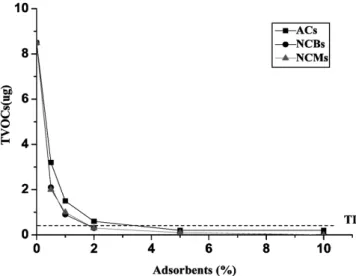
Figure 4. Reduction of TVOCs released from the felt after introduction of adsorbents.

3. Results and Discussion

From the morphology analysis, NCBs were almost mono-dispersed spherical particles with core-shell structure, as shown in Figure 1, and micro pores were found to be well developed in ACs. Figure 2 shows the reduction of formaldehyde after introduction of adsorbents, ACs, NCBs and NCMs, into the felt at the room temperature (25 ℃). After 14 days of aging at the room temperature, the level of formaldehyde released from the incipient felt was 0.35 ppm (or 0.35 µg/TP) without the application of any absorbent. When NCBs of 0.5 wt% were applied into the felt, the formaldehyde release decreased to 0.1 ppm. With the same amount of ACs, the formaldehyde release decreased to 0.07 ppm.

It should be noted that the application of 0.5 wt% NCMs, a mixture of NCBs and ACs, showed somewhat enhancement in the reduction of the formaldehyde release. This synergetic effect can be more clearly seen when the amount of NCMs applied to the felt increased to 1 wt%, resulting in about 93% reduction of the formaldehyde release.

Figure 3 shows the reduction of acetaldehyde after introduction of adsorbents at the room temperature. Without any absorbent, after 14 days aging at the room temperature, the level of acetaldehyde released from the original felt was observed to be 0.23 ppm. Although de- creased to 0.09 ppm with 0.5 wt% NCBs and to 0.06 ppm with 0.5 wt% ACs respectively, the levels of the acetaldehyde release were still much higher than the target. However the application of 0.5 wt%

NCMs into the felt dramatically reduced the acetaldehyde release down to 0.02 ppm, satisfying the allowable level of the acetaldehyde release.

The addition of more NCMs nearly affected the reduction capacity of the acetaldehyde release.

Figure 4 shows the reduction of TVOCs in the glass chamber system after introduction of adsorbents at the room temperature. When the ted- lar bag was employed instead of two-way glass chamber or stainless chamber, the initial level of TVOCs after baking at 65 ℃ for 2 h was somewhat higher. Nonetheless, without any absorbent, the level of TVOCs released from the original felt was 8.49 ppm, about 26 times

higher than the target level of 0.32 ppm. NCBs and NCMs showed similar performance, while ACs were less effective, in the reduction of the TVOCs release. It was observed that the level of the TVOCs re- lease could be lower down under the target level by either NCBs or NCMs of 2 wt%.

4. Conclusions

To reduce emissions of volatile organic compounds from new auto- mobile felts, new test methods to measure the extremely low concen- trations of VOCs released from the felt were established. The concen- trations of VOCs released from the original felt were varied. After 14 days of aging at the room temperature, the levels of acetaldehyde and formaldehyde were 0.2 ∼0.5 ppm and 0.2∼0.4 ppm, respectively. To reduce VOCs levels, NCBs, ACs and NCMs were applied into the felt.

With the application of 0.5 wt% NCMs, the levels of formaldehyde

(4)

자동차용 팰트로부터 방출되는 휘발성 유기화합물의 저감 연구 683

Appl. Chem. Eng., Vol. 21, No. 6, 2010 and acetaldehyde decreased by more than 80%. With the application

of 2 wt% NCMs, the level of TVOCs released from the felt decreased under the target level of 0.32 µg/TP.

Acknowledgments

This work was financially supported by Hoseo University.

References

1. K. L. Foster, R. G. Fuerman, J. Economy, S. M. Larson, and M.

J. Rood, Chem. Mater., 4, 1068 (1992).

2. R. S. Guerrero and A. Sayari, Environ. Sci. Technol., 41, 4761 (2007).

3. M. E. Davis, A. P. Blicharz, J. E. Hart, F. Laden, E. Garshick, and T. J. Smith, Environ. Sci. Technol., 41, 7152 (2007).

4. T. Schupp, H. M. Bolt, and J. G. Hengstler, Toxicology, 206, 461 (2005).

5. J. E. Amoore and E. Hautala, J. Appl. Toxicol., 3, 272 (1983).

6. M. Krzyzanowski, J. J. Quackenboss, and M. D. Lebowitz, Environ.

Res., 52, 117 (1990).

7. B. N. Tam and C. M. Neumann, J. Environ. Manage., 73, 131 (2004).

8. JAMA Press Releases (http://www.jama-english.jp), March 31 (2006).

9. T. Hayashi, M. Kumita, and Y. Otani, J. Chem. Eng., Jpn., 32, 72 (2006).

10. T. Hayashi, M. Kumita, and Y. Otani, Environ. Sci. Technol., 39,

5436 (2005).

11. M. Sugiura and K. Fukumoto, J. Mater. Sci., 29, 682 (1994).

12. L. Jing, L. Zhong, L. Bing, X. Qibin, and X. Hongxia, Chin. J.

Chem. Eng., 16, 871 (2008).

13. N. Ozturk and T. M. Bektas, J. Hazard. Mater. B, 12, 1555 (2004).

14. X. S. Zhao, Q. Ma, and G. Q. Lu, Energy Fuels, 12, 1051 (1998).

15. S. Carlos-Cuellar, P. Li, A. P. Christensen, B. J. Krueger, C.

Burrichter, and V. H. Grassian, J. Phys. Chem. A, 107, 2350 (2003).

16. M. P. Cal, M. J. Rood, and S. M. Larson, Energy Fuels, 11, 311 (1997).

17. A. Stein, Z. Wang, and M. A. Fierke, Adv. Mater., 20, 1 (2008).

18. K. Kosuge, S. kubo, N. Kikukawa, and M. Takemori, Langmuir, 23, 3095 (2007).

19. J. Yang, T. T. Zhuang, F. Wei, Y. Zhou, Y. Cao, Z. Y. Wu, Z.

J. H. Zhu, and C. Liu, J. Hazard. Mater., 162, 866 (2009).

20. S. O. Lee, S. J. Kitchin, K. D. M. Harris, G. Sankar, M. Dugal, and J. M. Thomas, J. Phys. Chem. B, 106, 1322 (2002).

21. S. B. Yoon, K. N. Sohn, J. Y. Kim, C. H. Shin, J. S. Yu, and T. H. Hyeon, Adv. Mater., 14, 19 (2002).

22. S. B. Yoon, J. Y. Kim, J. H. Kim, Y. J. Park, K. R. Yoon, S. K.

Park, and J. S. Yu, J. Mater. Chem., 17, 1758 (2007).

23. Y. Kim, S. B. Yoon, and J. S. Yu, Chem. Commun., 21, 790 (2003).

24. J. K. Lee, S. Y. Han, S. K. Park, Y. K. Park, and C. W. Lee,

Korean J. Chem. Eng., 22, 42 (2005).

수치

Table 2. Composites and Physico-chemical Data of NCBs, ACs and  NCMs Mixtures
Figure 4. Reduction of TVOCs released from the felt after introduction  of adsorbents.

참조

관련 문서

K., "Hydrogen production by catalytic decomposition of methane over activated carbons: kinetic study", International Journal of Hydrogen Energy, Vol...

In SDE extraction, a total of 117, 115 and 120 volatile compounds were detected in Aster yomena, Aster tataricus and Chrysanthemum zawadskii, individually, whereas their total

Just as the industry, the government, and the civil societies gathered in to save the automobile industry of Incheon from each crisis of automobile industry in the past,

In an effort to develop a new method to remove nitrogen, this study examined the effects of C/N ratio, carbon source and nitrogen concentration on

-another type of stereoisomer when Compound having carbon (chiral carbon) with 4 different groups attached carbon (chiral carbon) with 4 different groups

Yanga, “Mesoporous activated carbon fiber as electrode material for high-performance electrochemical double layer capacitors with ionic liquid electrolyte”, J...

Vapors emitted from tankers to recovery machine is used as fuel in the ships that helps cut down the significant portion of the shipping costs needed for the fuel..

If two or more longest chains of the same length, the parent is the chain with the greatest number of subs..