Article https://doi.org/10.14478/ace.2019.1029
1. Introduction 1)
Globally, approximately 50 million people have dementia, and nearly 10 million people develop dementia with age every year[1]. Dementia refers to a decline in cognitive function, which interferes with daily living by affecting memory, thinking, judgment, behavior, and so forth.
Types of dementia include Alzheimer’s disease (AD), Parkinson’s dis- ease, dementia with Lewy bodies, and frontotemporal dementia[2-8].
The most common type of dementia is AD, a neurodegenerative dementia. Amyloid beta 42 (Aβ42), total tau, and phosphorylated tau in the cerebrospinal fluid (CSF) are the most widely known biomarkers of AD[3]. Among these markers, interest in Aβ42 is increasing since it was reported that using an AD mouse model, the Aβ42 level in CSF is directly correlated with that in plasma[9]. However, further inves- tigations into quantification of the Aβ42 levels in the blood are re- quired to diagnose AD[9,10]. Aβ42 is produced by cleavage of the amyloid precursor protein. The peptide precipitates in the form of pla- que in the brain and regresses the nerves responsible for memory and cognition. The deposition of Aβ42 is known to begin 10 years before the onset of Alzheimer’s symptoms[4,5]. Since Aβ42 accumulates in the brain, Alzheimer’s patients have less than 500 pg/mL of Aβ42 in their CSF[3]. A method of curing AD has not been found to date.
Therefore, early diagnosis of AD would open the window for the de- velopment of medicine as well as a cure. Enzyme-linked immunosorbent
† Corresponding Author: Daegu Catholic University,
Department of Biomedical Engineering, Gyeongsan-si, Gyeongbuk 38430,
Republic of Korea
Tel: +82-53-850-2513 e-mail: [email protected]
pISSN: 1225-0112eISSN: 2288-4505 @ 2019 The Korean Society of Industrial and
Engineering Chemistry. All rights reserved.
assays have been widely used as a technique to detect Aβ[9,11,12].
However, interesting research efforts have been made to develop la- bel-free detection techniques based on electrical and optical meth- ods[13-16].
Recently, much attention has been paid to surface plasmon resonance (SPR) sensors, which can monitor biomolecular interactions with high- ly sensitive, label-free, and real-time detection[17-19]. Four different SPR detection modes, namely, angular interrogation, phase interrogation, intensity measurement, and wavelength measurement are available[20].
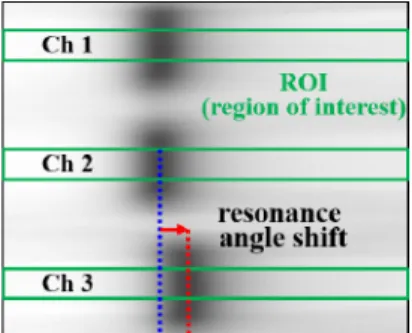
Angular interrogation and intensity measurement modes utilize the SPR reflectance curve, a graph of the intensity of the reflected light with respect to the incident angle. The reflectance curve relies on the optical properties of the SPR sensor components and system. The angle at which the reflected light is minimum on the reflectance curve is called the resonance angle. Changes in the refractive index of the medium causes a shift in the reflectance curve. Measurements in the angular in- terrogation mode monitor the resonance angle according to changes in the refractive index of the medium, whereas the intensity measurement mode monitors the reflectance at a fixed angle at the maximum tangen- tial slope point on the reflectance curve[21,22]. To enhance the reso- lution in the angular interrogation mode, the optical path should be lengthened. This requirement may limit the compactness of an SPR sensor system with high resolution. Modifying the SPR sensor chip and applying another detection mode is an alternative approach to en- hance the resolution of the sensor system. The material conventionally used for SPR chips is gold (Au) due to biocompatibility. However, it limits the detection of trace-level concentration of biomolecules[23].
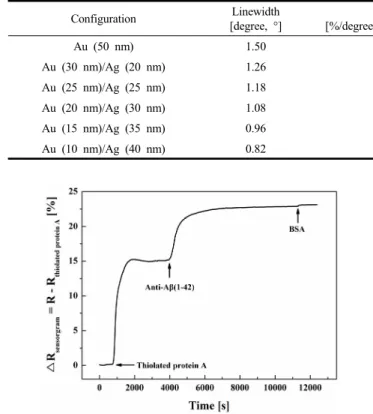
Silver (Ag) is also a good candidate for SPR chips, and its reflectance curve has a narrower linewidth and sharper dip, leading to a higher
Thiolated Protein A-functionalized Bimetallic Surface Plasmon Resonance Chip for Enhanced Determination of Amyloid Beta 42
Hyung Jin Kim, Chang-Duk Kim * , and Young-Soo Sohn
†
Department of Biomedical Engineering, Daegu Catholic University, Gyeongsan-si, Gyeongbuk 38430, Republic of Korea
* Department of Physics, Kyungpook National University, Daegu 41566, Republic of Korea (Received April 22, 2019; Revised May 8, 2019; Accepted May 16, 2019)
Abstract
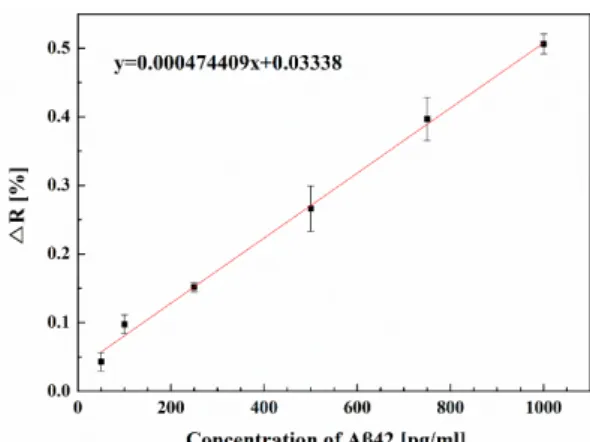
The capability of detecting amyloid beta 42 (Aβ42), a biomarker of Alzheimer’s disease, using a thiolated protein A-function- alized bimetallic surface plasmon resonance (SPR) chip was investigated. An optimized configuration of a bimetallic chip con- taining gold and silver was obtained through calculations in the intensity measurement mode. The surface of the SPR bi- metallic chip was functionalized with thiolated protein A for the immobilization of Aβ42 antibody. The response of the thio- lated protein A-functionalized bimetallic chip to Aβ42 in the concentration range of 50 to 1,000 pg/mL was linear. Compared to protein A without thiolation, the thiolated protein A resulted in greater sensitivity. Therefore, the thiolated protein A-func- tionalized bimetallic SPR chip can be used to detect very low concentrations of the biomarker for Alzheimer’s disease.
Keywords: Surface plasmon resonance, Amyloid beta 42, Alzheimer’s disease, Intensity measurement