Analysis of the cancer genome atlas data to determine the correlation between PROX1 and TERT in hepatocellular carcinoma
Jae-Ho Lee
Department of Anatomy, Keimyung University School of Medicine, Daegu, Republic of Korea
Dear Editor,
We read with great interest the article by Kimet al.1regarding the role of prospero homeobox protein 1 (PROX1) and telo- merase reverse transcriptase (TERT) in hepatocellular
carcinoma (HCC); their study reported that PROX1 expres- sion mediated TERT activity differently in accordance with the status of viral infection in HCC. Interestingly, TERT and PROX1 mRNA expression were positively correlated in non-B
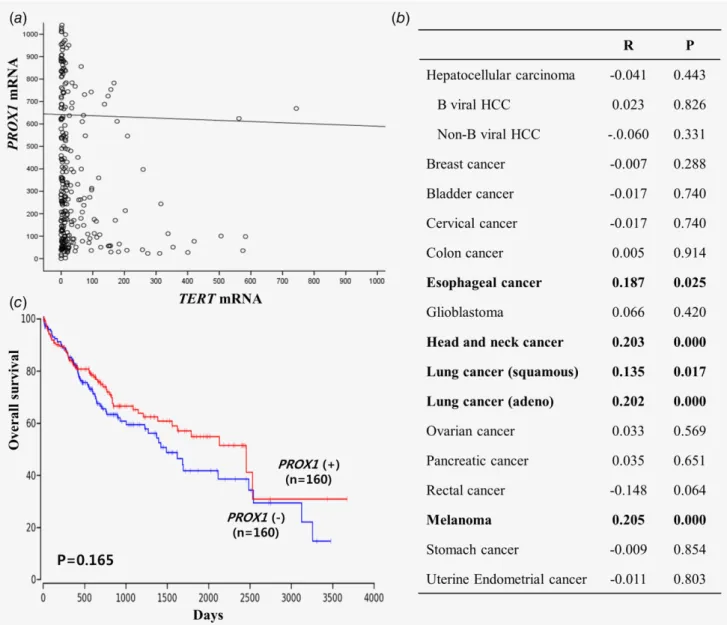
Figure1.No correlation betweenTERT and PROX1 mRNA expression in hepatocellular carcinoma (HCC) (a). Association between TERT and PROX1 expression in various cancers based on The Cancer Genome Atlas data (b). Survival analysis of PROX1 expression in HCC (c). [Color figure can be viewed at wileyonlinelibrary.com]
International Journal of Cancer
IJC
Int. J. Cancer: 144, 1752–1753 (2019) © 2018 UICC
LettertotheEditor
viral HCCs; however, this correlation was not observed in B viral HCCs. Using same approach, we analyzed the correlation betweenTERT and PROX1 mRNA expression in various can- cers including HCC, based on The Cancer Genome Atlas (TCGA) data from OncoLnc and cBioPortal.
Expression data were downloaded from TCGA’s data por- tal (https://tcga-data.nci.nih.gov/tcga/) on July, 2018.2 TCGA data indicated that TERT mRNA expression levels did not correlate with those ofPROX1 mRNA (r = -0.041, p = 0.443, Fig. 1a). When stratified by B viral status, there was no association between TERT and PROX1 expression (Fig. 1b).
Interestingly, the median values of TERT andPROX1 expres- sion in HCCs were high exclusively in TCGA data. Therefore, we investigated this association in other cancers presented on TCGA portal. Unexpectedly, TERT and PROX1 mRNA expression levels were correlated in several cancer types, including melanoma, esophageal, head and neck, and lung cancers (Fig. 1b). Although this association was not observed previously in HCC,1PROX1 may be an important activator of TERT in some cancers. Regarding studies on TERT promoter mutation, a common single nucleotide polymorphism, rs2853669, and hepatitis B virus X were not included in HCC analysis of TCGA data, thereby necessitating further compre- hensive analyses.
Furthermore, the prognostic value of PROX1 mRNA expression was analyzed in various cancers on the basis of TCGA data. In most cancers including HCC,PROX1 did not have a prognostic value (Fig. 1c). However, PROX1 downregu- lation indicated a poorer prognosis exclusively in melanoma (p = 0.048). The TERT promoter is one of the most frequent mutation sites in HCC and may be an essential modulator of TERT expression in cancers.3Moreover,TERT expression is a
robust prognostic marker; however, the detailed mechanism underlying TERT regulation yet remains controversial.4 As observed in the current and in previous studies, a positive correlation between TERT and PROX1 expression in certain cancers suggested that PROX1 probably regulates TERT in an activity-dependent manner with other genetic changes.1 The biological functions of PROX1- and TERT-associated gene alterations are of great interest for further studies in cancer.
Yours sincerely,
References
1. Kim YJ, Yoo JE, Jeon Y, et al. Suppression of PROX1-mediated TERT expression in hepatitis B viral hepatocellularcarcinoma.Int J Cancer 2018 (In press) 2. Anaya J. OncoLnc: linking TCGA survival data to mRNAs, miRNAs, and
lncRNAs.Peer J Comp Sci 2016;2:e67.
3. Nault JC, Mallet M, Pilati C, et al. High frequency of telomerase reverse- transcriptase promoter somatic mutations in hepatocellular carcinoma and pre- neoplastic lesions.Nat Commun 2013;4:2218.
4. Fujimoto A, Furuta M, Totoki Y, et al. Whole-genome mutational landscape and characterization of noncoding and structural mutations in liver cancer.Nat Genet 2016;48:500–9.
Conflict of interest:The authors have no conflict of interest to declare.
Grant sponsor:National Research Foundation of Korea;Grant numbers:2014R1A6A3A04058057
DOI:10.1002/ijc.31888
History: Received 27 Jul 2018; Accepted 12 Sep 2018; Online 24 Sep 2018
Correspondence to:Jae-Ho Lee, Department of Anatomy, Keimyung University School of Medicine, Daegu, Republic of Korea,
E-mail: [email protected]; Tel: +82-53-580-3833; Fax:
+82-53-580-3835
Letter to the Editor 1753
Int. J. Cancer: 144, 1752–1753 (2019) © 2018 UICC
LettertotheEditor