※ This research was supported by the MKE(Ministry of Knowledge Economy), Korea, under the ITRC(Information Technology Research Center) support program supervised by the IITA(Institute of Information Technology Assessment) (IITA-2009-C1090-0902-0019)
* INHA university telecommunication lab([email protected], [email protected])
** Icube networkteam ([email protected]), *** INHA university ([email protected])
논문번호:KICS2009-10-473, 접수일자:2009년 10월 20일, 최종논문접수일자:2009년 12월 1일
Channel Estimation for Mobile OFDM systems by LS Estimator based Kalman Filtering Algorithm
Sangjun Bae*, Yoonho Jang*, Sangkyun Nam** Associate Members, Kyung Sup Kwak*** Lifelong Member
ABSTRACT
In OFDM systems, mobile channel degrades the system performance seriously. Therefore, channel estimation technique is required to compensate for the degradation from the channel effects. However, conventional channel estimations in frequency domain induce ICI which is induced from Doppler frequency. In addition, a linear interpolation method causes inaccurate channel estimation. In order to minimize the effect of the interference and interpolation error, the proposed method combines LS method and Kalman filtering algorithm. Channel impulse response is adaptively tracked by Kalman filtering based on the information from LS estimator. Simulation results are presented to verify the performance of the proposed channel estimation over mobile channel environment. Simulation results show that the proposed method can effectively compensate for channel degradation.
Key Words : OFDM, Channel Estimation, LS estimator, Kalman Filter
Ⅰ. Introduction
Many wireless communication systems adopt OFDM (Orthogonal Frequency Division Multiplexing) due to high data transmission rate, high bandwidth efficiency and reliability against multi-path fading channel. It has been applied in DAB (Digital Audio Broadcasting) systems, DVB (Digital Video Broadcasting) systems, wireless LAN standards such as IEEE 802.11a and wireless broadband access standard such as IEEE 802.16e
[1].
In OFDM system, the entire channel is divided into many narrow sub-channels that are transmitted in parallel. If bandwidth of each subcarrier is much less than the channel coherence bandwidth, a frequency flat channel model can be assumed for subcarriers. Moreover, if the length of the guard interval is greater than the delay spread of the
channel, ISI (Inter Symbol Interference) free channel can be assumed by inserting a CP (Cyclic Prefix) into the OFDM symbol. Although OFDM is robust to the multipath fading channel, the system performance is degraded by mobile channel. The othogonality among different subcarriers is destroyed by Doppler spread. This causes ICI(Inter Carrier Interference), and leads to severe system performance degradation
[2]. Therefore, dynamic channel estimation is necessary for mobile OFDM systems.
Channel estimation schemes are categorized into
the non-data aided and the data-aided algorithm. For
the non-data-aided algorithm, which is also known
as blind channel estimation, complex matrix
operations with several iterations are usually
required during the estimation. However, blind
channel estimation is well motivated for the spectral
Fig. 1. Block diagram of OFDM System
efficiency
[3]-[5].
Despite the efficiency of blind method, utilization of pilot tones is inevitable for high quality channel estimation in mobile channel environment. Various pilot assisted channel estimation techniques have been studied for coherent modulation and demodulation. Among them the MMSE (minimum mean square error) estimator is the most effective.
However, it requires high computational complexity for inverse computation. Thus, due to its simplicity, LS estimator is used as practical channel estimation.
In this paper, the proposed method combines LS estimator with Kalman filter to track the channel values. Initial coarse channel values are obtained by LS estimator in frequency domain. After interpolation procedure, Kalman filtering scheme adaptively tracks channel impulse response in time domain.
This paper is organized as follows. A baseband signal model for the OFDM system which is shown in Fig. 1 introduced in Section Ⅱ. The overall channel estimation is described in Section Ⅲ where the Kalman filtering scheme is provided to track the channel coefficients. Simulation results are presented in section Ⅳ to demonstrate the effectiveness of the proposed algorithm. Finally, the conclusion is drawn in section Ⅴ.
Ⅱ. System Model
A block diagram for a baseband OFDM system is in Fig.1. The binary information data is generated and modulated. The pilot tones are uniformly inserted to every OFDM symbol. The pilot arrangement in OFDM symbol is based on the same
periodic for reducing the noise enhancement from interpolation
[6]. The modulated data on the n-th subcarrier is
(1)
When d=0, the pilot tone is located in the subcarrier and rest of subcarriers in subgroup transmit the information data. Through paper,
∈
denotes the index of frequency domain, ∈
is the index of time domain and subscript l is OFDM symbol order. The subgroup number in OFDM symbol is denoted by integer ∈
. In subgroup, subcarriers are divided into a pilot subcarrier and information data subcarriers by notation ∈
. Therefore, OFDM symbol is constructed with K=N/S pilot subcarriers and N-K information data subcarriers.
After pilot insertion,the data in the frequency domain take N-point IDFT to transform into the time domain with following equation
(2)
After IDFT, the CP which is larger than the expected delay spreads is inserted. As a result, CP contained ODFM symbol is expressed as
(3)
where
is the length of the CP. Then, OFDM symbols are transmitted through the channels. The received signal can be represented by
(4)
where R is the total number of propagation path,
is channel impulse response of r-th tap and
is the AWGN (Additive White Gaussian Noise). It is known that dynamics of a WSSUS (Wide Sense Stationary Uncorrelated Scattering) channel are accurately modeled by AR (autoregressive) process
[7]. For simplicity, modeling a first order autoregressive (AR) process for channel impulse response is
∙
(5)
where a is the AR coefficient and
is the process noise. The coefficient of the AR, a, is determined by
(6)
where
∙ is zero-th order Bessel function of the first kind,
is the maximum Doppler frequency,
is the symbol duration. The WSS assumption implies
[8]
(7)
where
is subcarrier correlation.
After removing the CP, the received signals in time domain take N-point DFT to transform into the frequency domain
[9]
(8)
where
(9)
≠
≠
∙
(10)
are channel frequency response and ICI, respectively, and
is the DFT of
. Here,
and
denote sample period and the r-th path delay normalized by sampling time. The received signal in Eq. (8) is assumed that CP effectively prevents the ISI but ICI is still remained in the signal.
Ⅲ. Proposed Channel Estimation
3.1 Coarse Channel Estimation in Frequency Domain
In the pilot subcarrier, coarse channel frequency response can be obtained by following LS estimator
(11)
After estimation at the pilot subcarriers, channel frequency response at data subcarriers are estimated by linear interpolation which is expressed as
(12)
As a result, the signal after the interpolation includes ICI and errors from the interpolation.
3.2 Precise Channel Estimation
Mobile speed introduces ICI effect to channel
frequency response in Eq. (8)–(10). Furthermore,
error which is caused by the interpolation can
(a)
(b)
Fig. 2. (a) Block diagram of proposed channel estimator (b)Block diagram of Kalman filter
degrade the system performance as well.
To mitigate the effect of ICI and interpolation error, Kalman filtering algorithm utilizes to track the channel coefficients based on the estimated channel in frequency domain, the received signals are demodulated by following zero forcing method
(13)
where
denotes the demodulated signal at
n-th subcarrier. For utilizing Kalman algorithm intime domain, the demodulated signal by zero forcing method is required to transform into the time domain with following equation
(14)
where
,
are the demodulated OFDM symbol in frequency domain and time domain, respectively. For adapting channel to the Kalman filtering algorithm, a second order AR process is introduced as
(15)
where
is the augmented form of channel impulse response.
is AR coefficient matrix with coefficient value
∙
which is determined by eq. (6) and
is a process noise vector with r-th tap process noise,
. To adapt the augmented channel into the system, received signal can be expressed as
(16)
where
and R is assumed
number of effective channel tap.
Through adaptive procedure of Kalman filtering which is described in the Fig. 2-(a) and 2-(b), the predicted channel
can be obtained by following recursive computation
[10]
(17)
(18)
(19)
(20)
where
is the Kalman gain vector at instant l,
is the channel estimation at instant l+1,
and
are the covariance matrices of
and
respectively,
is the covariance matrix of estimation error. The initial channel state vector and covariance matrix of prediction error are as follows
(21)
(22)
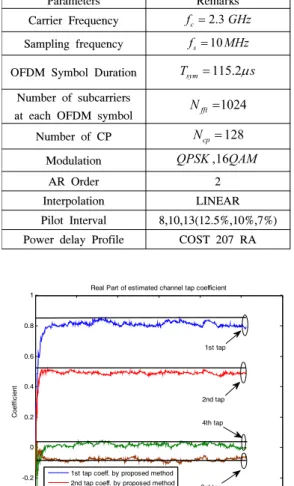
Parameters Remarks Carrier Frequency fc=2.3GHz Sampling frequency fs=10MHz OFDM Symbol Duration Tsym
= 115.2
μsNumber of subcarriers
at each OFDM symbol Nfft
= 1024
Number of CP Ncp
= 128
Modulation QPSK
,16
QAMAR Order 2
Interpolation LINEAR
Pilot Interval 8,10,13(12.5%,10%,7%) Power delay Profile COST 207 RA Table 1. System Parameters
0 200 400 600 800 1000 1200
-0.4 -0.2 0 0.2 0.4 0.6 0.8 1
subcarrier number
Coefficient
Real Part of estimated channel tap coefficient
1st tap coeff. by proposed method 2nd tap coeff. by proposed method 3rd tap coeff. by proposed method 4th tap coeff. by proposed method
1st tap
2nd tap 4th tap
3rd tap
Fig. 3. Convergences of each taps value in real part (QPSK modulation , fd=149Hz, Eb/N0=20dB)
0 200 400 600 800 1000 1200
-0.2 -0.1 0 0.1 0.2 0.3 0.4 0.5 0.6 0.7 0.8
Subcarrier number
Coefficient
Image part of estimated channel tap coefficient
1st tap coeff. by porposed method 2nd tap coeff. by porposed method 3rd tap coeff. by porposed method 4th tap coeff. by porposed method
2nd tap
1st tap
4th tap
3rd tap
Fig. 4. Convergences of each taps value in imaginary part (QPSK modulation , fd=149Hz, Eb/N0=20dB).
5 10 15 20 25 30 35
10-4 10-3 10-2 10-1
Eb/N0(dB)
BER
QPSK modulation
proposed, fd=6.4 LS, fd=6.4 channel known, fd=6.4 proposed, fd=64 LS, fd=64 channel known, fd=64 proposed, fd=149 LS, fd=149 channel known, fd=149 proposed, fd=212 LS, fd=212 channel known, fd=212
fd=64
fd=6.4 fd=149 fd=212
Fig. 5. BER performance with QPSK modulation.
5 10 15 20 25 30 35
10-4 10-3 10-2 10-1
Eb/N0(dB)
BER
16 QAM
proposed, fd=6.4 LS, fd=6.4 known channel. fd=6.4 proposed, fd=64 LS, fd=64 known channel, fd=64 proposed, fd=149 LS, fd=149 known channel, fd=149 proposed, fd=212 LS, fd=212 known channel, fd=212
fd=6.4 fd=64 fd=149
fd=212
Fig. 6. BER performance with 16QAM.
Finally, channel coefficient of each taps obtained after filtering and prediction procedure by Kalman algorithm based on information form the LS estimator. The proposed channel estimation mitigates ICI and interpolation error and this is demonstrated in the next section.
Ⅳ. Simulation Results
The parameters of the system
[11]are presented in the Table 1. At the receiver, perfect timing and frequency synchronization are assumed. The convergence of each tap is shown in Fig 3 and Fig.
4. Fig. 3 shows the real part and Fig. 4 is imaginary
part of each tap and dashed lines represent the true
coefficients of channel impulse responses. Each line
5 10 15 20 25 10-3
10-2 10-1
Eb/N0
BER
BER compare different amount of pilot
proposed, pilot=12.5%
LS, pilot=12.5%
known channel, pilot=12.5%
proposed, pilot=10%
LS, pilot=10%
known channel, pilot=10%
proposed, pilot=7.7%
LS, pilot=7.7%
known channel, pilot=7.7%
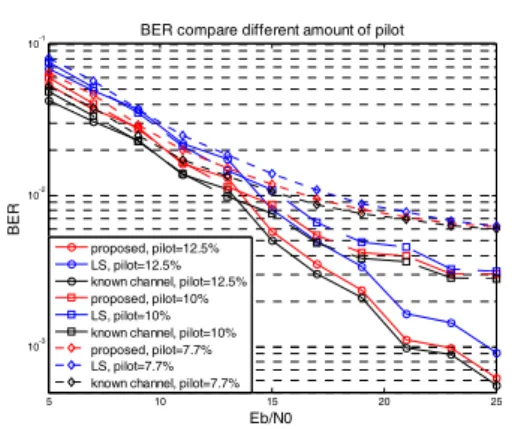
Fig. 7. BER performance under various amounts of pilot tones(fd=6.4 , QPSK modulation)
converged to true coefficients is the estimated coefficients by proposed scheme. After first 100 subcarriers, approximately, the estimated coefficients of each tap are converged to the true channel coefficients. In other words, the proposed channel estimation scheme adaptively tracks the ideal channel coefficient.
Fig.5 and Fig.6 present BER performance by the proposed method with QPSK modulation and 16QAM. The performance of the proposed scheme is evaluated under various Doppler frequencies. The Doppler frequencies in the simulation are set as 6.4 Hz, 64 Hz, 149 Hz and 212 Hz which corresponding to the mobile speeds as 3 km/h, 30 km/h, 70 km/h and 100 km/h, respectively. The proposed method is fairly comparable with LS estimator and known channel at every Doppler speed. The performance degradation from ICI and interpolation is increased when mobile station speed is high but these effects are mitigated by the proposed scheme. The QPSK modulation case in Fig. 5, proposed method improves the system performance 3dB when Doppler frequency is 6.4 Hz and target BER is 10
-3. The 16QAM case in Fig. 6, proposed method has 2dB improvement of the system performance with same conditions. Even though the Doppler frequency is increase, the system performance is improved by the proposed method. However, when the doppler speed is over 212Hz, the system has slight or less improvement than LS estimator at both modulation.
Another approach of proposed scheme is amountof pilot tone. Without loss of generality, the small number of pilot tones induces more errors than high number of pilot tones due to inaccurate estimation by interpolation. In Fig. 7, the bit error rate performance is evaluated by proposed scheme with 7.7%, 10% and 12.5% pilot tones allocation with Doppler frequency is 6.4Hz. When the OFDM symbol possesses 12.5% of pilot tones, the proposed scheme generates 3dB improvement when the bit error rate is 10
-3. Furthermore, the accuracy of channel estimation with proposed scheme is similar with known channel case than only the LS estimator. When the pilot tones are allocated with 7.7% and 10%, proposed scheme enhance the
system performance but the amount of pilot tone is important parameter for accurate channel estimation.
Ⅴ. Conclusion
In this paper, proposed channel estimation utilizes a Kalman filtering algorithm based on the LS estimator. Based on the information from the LS estimator, the Kalman filtering algorithm tracks the channel impulse responses in each tap to mitigate the ICI and interpolation error. In the simulation, performance of the proposed scheme is evaluated under various Doppler frequencies and different number of pilot tones in terms of BER. Simulation results show that even system has mobility, performance is compensated by the proposed scheme but the enhancement of the performance is better in the low Doppler frequency than high Doppler frequency. Finding a converging time in Kalman algorithm will be valuable further research for reducing the complexity of overall system.
References
[1] Al-Naffouri, Tareq Y., “An em-based forward-backward Kalman filter for the estimation of time-variant channels in OFDM,”
IEEE Trans on Sig., Vol.55, No.7, pp.3924-
3930, Jul, 2007.
[2] Y. S. Choi, Voltz. P.J., Cassara. F.A, “On
channel estimation and detection for
multicarrier signals in fast and selective Rayleigh fading channel,” IEEE trans. comm., Vol.49, No.10, pp.1375-1387, Aug. 2001.
[3] MORELLI Michele, MENGALI Umberto, “A comparison of pilot-aided channel estimation methods for OFDM systems,”
IEEE transactions on sig., Vol.49, No.12, pp.3065-3073, Dec, 2001.
[4] B.W. Seo, H.G. Chung, “Improved precoding-assisted blind channel estimation scheme for OFDM systems,” in Proc. IEEE
66th VTC’07, pp.1260-1264, Sept. 2007.[5] Lin, R., Petropulu, A.P., “Linear precoding assisted blind channel estimation for OFDM systems,” IEEE Trans. Vehicular Technology, Vol.54, No.3, pp.983-995, May 2005.
[6] Negi, R., Cioffi, J., “Pilot tone selection for channel estimation in a mobile OFDM system,”
IEEE Trans. Cons., Vol.44, No.3, pp.1122-
1128, Aug. 1998.
[7] M.K. Tsatsanis, G.B. Giannakis, G. Zhou,
“Estimation and equalization of fading channels with random coefficients,” IEEE Signal
Processing, Vol.53, pp.211-299, Sept.1996.[8] Zhenlan Cheng, Dahlhaus, D., “Time versus frequency domain channel tracking using Kalman filters for OFDM systems with antenna arrays,” in Proc. IEEE 57th VTC’03, Vol.1, pp.651- 655, Apr.2003.
[9] Coleri, S., Ergen, M.; Puri, A., Bahai, A.,
“Channel estimation techniques based on pilot arrangement in OFDM systems,” IEEE Trans.
Broad., Vol.48, No.3, pp.223- 229, Sep.2002.
[10] S. Haykin, Adatptive filter theory, 4th ed., Pearson Education, 2002
[11] IEEE Std 802.16e-2005, IEEE standard for Local and metropolitan area networks, “Part
16: Air interface for fixed and mobile broadband wireless access systems,” Feb.2006.[12] Bulumulla, S.B., Kassam, S.A., Venkatesh, S.S., “A systematic approach to detecting OFDM signals in a fading channel,” IEEE
Trans. Comm., Vol.48, No.5, pp.725-728, May2000.
[13] M. Patzold, Mobile Fading channels, Wiley
international USA, 2002.
[14] Meng-Han Hsieh, Che-Ho Wei, “Channel estimation for OFDM systems based on comb-type pilot arrangement in frequency selective fading channels,” IEEE Trans. Cons., Vol.44, No.1, pp.217-225, Feb. 1998.
[15] Gupta, P., Mehra, D.K., “Kalman filter based channel estimation and ICI suppression for high mobility OFDM systems,” in Proc. IEEE ICIT’
06, pp.612 – 615, Dec. 2006.
[16] Stamoulis, A., Diggavi, S.N., Al-Dhahir, N.,
“Intercarrier interference in MIMO OFDM,”
IEEE Trans. Sig. Proc. ,Vol.50,No.10, pp.2451-
2464, Oct. 2002.
[17] W.C. Jakes, Microwave Mobile Communication, Wiley, 1974.
[18] Davis, L.M., Collings, I.B., Evans, R.J.,
“Identification of time-varying linear channels,”
in Proc. IEEE ICASSP’97, Vol.5, pp.3921- 3924, Apr. 1997.
[19] Yuping Zhao, Aiping Huang, “A novel channel estimation method for OFDM mobile communication systems based on pilot signals and transform-domain processing,” in Proc.
IEEE VTC’97, Vol.3, pp.2089-2093 May 1997.
[20] K.Y. Han, S.W. Lee, J.S. Lim, K.M. Sung,
“Channel estimation for OFDM with fast fading channels by modified Kalman filter,” IEEE
Trans. Cons., Vol.50, No.2, pp.443-449, May2004.
[21] Sternad, M., Aronsson, D., “Channel estimation and prediction for adaptive OFDM downlinks,”
in Proc. IEEE VTC’03, Vol.2, pp.1283- 1287, Oct. 2003.
[22] C.K. Min, N.S. Chang, J. S. Cha, Joonhyuk
Kang, “MIMO-OFDM downlink channel
prediction for IEEE802.16e systems using
Kalman filter,” in Proc. IEEE WCNC’07,
pp.942-946, Mar. 2007.
배 상 준
(Sangjun Bae) 준회원 2008년 2월 인하대학교 전자과
(공학사)
2008년 3월~현재 인하대학교 정보통신대학원(석사과정)
<관심 분야> MIMO-OFDM 시스템, UWB, Cognitive Radio
장 윤 호
(Yoonho Jang) 준회원
2008년 2월 인하대학교 전자과 (공학사)
2008년 3월~현재 인하대학교 정보공학과 (석사과정)
<관심 분야> MIMO-OFDM 시스템, UWB, Cognitive Radio
남 상 균
(Sangkyun Nam) 준회원
2007년 2월 인하대학교 컴퓨터 공학과(공학사)
2009년 8월 인하대학교 정보공 학과 석사
2009년 9월~현재 (주)아이큐 브 네트워크팀 연구원
<관심 분야> 유비쿼터스 컴퓨팅, 무선 네트워크, 홈 네트워크
곽 경 섭
![Fig. 1. Block diagram of OFDM System efficiency [3]-[5] .](https://thumb-ap.123doks.com/thumbv2/123dokinfo/5289495.374194/2.799.90.715.85.257/fig-block-diagram-ofdm-efficiency.webp)