지역별 오미자의 리그난 함량 및 분석법 검증
황병순․김기창․박영희․황인국 국립농업과학원 농식품자원부
Method Validation and Quantification of Lignans in the Fruits of Korean Omija (Schisandra chinensis) by Cultivation Region
Byung Soon Hwang, Gi-Chang Kim, Young Hee Park, and In Guk Hwang Department of Agrofood Resources, National Institute of Agricultural Sciences,
Rural Development Administration
ABSTRACT This study examined the lignans (schizandrin, schizandrin A, gomisin A, gomisin G, gomisin H, gomisin J, and gomisin N) contents in the fruit of Omija (Schisandra chinensis) according to the cultivation region. The methods for determining lignans were validated by measuring the specificity, linearity, limit of detection (LOD), limit of quantifi- cation (LOQ), precision, and accuracy using HPLC analysis. Among the lignans, schizandrin was the most abundant (3.85∼6.60 mg/g) followed by gomisin N (2.69∼4.38 mg/g). Schizandrin A and gomisin A were approximately 0.60∼
2.04 and 0.86∼1.63 mg/g, respectively, and gomisin G, gomisin H, and gomisin J were less than 0.50 mg/g. The contents of seven lignans of Omija were 9.04∼14.90 mg/g. Omija showed different contents of lignans according to the cultivation region, but there was no significant difference in the total contents. These results will provide valuable basic data for the standardization of Korean Omija.
Key words: Schisandra chinensis, lignan, HPLC
Received 23 July 2019; Accepted 1 October 2019
Corresponding author: In Guk Hwang, Department of Agrofood Resources, National Institute of Agricultural Sciences, Rural Devel- opment Administration, Wanju, Jeongbuk 55365, Korea E-mail: [email protected], Phone: +82-63-238-3672
서 론
오미자는 오미자과(Schisandraceae)의 오미자속(Schi- sandra)에 속하는 Schisandra chinensis(Trucz.) Baill의 열매덩굴성 식물로써 한국, 중국동북부, 일본 등에 분포한 다. 과실이 단맛, 신맛, 쓴맛, 떫은맛, 짠맛 5가지 맛이 난다 는 의미로 오미자라 하며 약용한다(Lee와 Yoon, 2002;
Rural Development Administration, 2018).
동의보감 내경 편에서 오미자는 사람의 형기를 양생하며 정액, 기의 변조, 신경정신에 작용하는 증후를 다스리며 체 내의 비생리적 작용을 조절하는 역할을 하고 특히 심장, 간 장, 기, 혈이 허약한 자가 복용하면 좋다고 한다(Lee, 1995).
오미자의 생리활성은 항산화 효과(Choi 등, 2011), 알츠 하이머(Mocan 등, 2016; Wei 등, 2019), 항당뇨(Qu 등, 2015) 등의 활성이 있다고 보고되어 있다. 또한 리그난 화합 물은 간세포 보호 및 간 기능 회복작용(Han 등, 2014;
Sowndhararajan 등, 2018; Yun과 Jung, 2017; Yuan 등, 2018; Zhu 등, 2019), 미백(Lee 등, 2017), 항균(Lee 등,
2001), 항염증(Kang 등, 2014; Choi 등, 2013; Szopa 등, 2018), 항암 효과(Kim 등, 2018; Dai 등, 2018; Suh 등, 2014)가 있는 것으로 보고하였다. 현재 오미자는 추출물로 서 근력개선, 갱년기 여성건강의 도움을 주는 건강기능식품 기능성 원료로 인정되어 있으며(Shin 등, 2016), 리그난 성 분 schizandrin, gomisin A, gomisin N의 합을 지표(기능) 성분으로 활용하고 있다(Ministry of Food and Drug Saf- ety, 2019).
오미자의 주성분은 향기성분, 페놀화합물, 다당류, 안토 시아닌 및 리그난계 화합물이 대표적 성분이다. 주로 리그난 계 물질 schizandrin, schizandrin A, gomisin A-H 등이 있다(Gao 등, 2019; Liu 등, 2019; Liu 등 2017).
우리나라 오미자 자생지 환경특성은 주로 해발 500~700 m 준고냉지 산록의 계곡 구릉지로 습도가 높고 잔자갈이 위 층에 있으며, 부엽토가 쌓여 배수가 잘되는 지역이다. 국내 에서 오미자는 내한성이 강하고 고온에 약하여 여름철 고온 을 피할 수 있는 경북 문경, 전북 장수, 진안, 무주와 강원도 의 인제 등이 재배지역이다(Rural Development Adminis- tration, 2018). 오미자 재배 생산은 백두대간 산간지대를 따라 재배 벨트를 형성하면서 인근 지역으로 늘어나고 있고, 전국적으로 2017년에는 6,502 농가가 2,556 ha를 재배하여, 9,893톤(M/T)을 생산하고 있다(Ministry of Agriculture, Food and Rural Affairs, 2017).
오미자에 함유된 리그난 성분들의 정량 분석방법에 관하 여도 많은 연구가 진행되어 왔다(Kim 등, 2013; Koo 등, 2011; Lu와 Chen, 2009). 오미자 리그난 성분 분석에 대한 연구와 한국, 태국 및 일본산을 비교하여 차이가 있다는 연 구(Nakajima 등, 1983)는 있지만 국내에서 재배되는 지역 별 오미자 리그난 함량에 대한 연구는 부족한 상태이다.
본 연구에서는 오미자의 주요 성분으로 알려진 리그난 7 종(gomisin A, gomisin G, gomisin H, gomisin J, gomisin N, schizandrin, schizandrin A)에 대한 동시분석방법을 확 립하며 그에 대한 분석법 검증과 주생산지 지역을 포함한 지역별 오미자 리그난 화합물 7종에 대한 정량분석을 실시 하였다. 재배지역별 오미자 정량 정보를 제공할 수 있고, 재 현성이 증진된 최적의 HPLC 분석조건을 검토하여 국내에 서 재배되는 오미자의 품질평가 및 이용성 증진 연구의 기초 자료를 제공하고자 하였다.
재료 및 방법
실험재료
실험재료는 경기도(GG), 강원도(GW), 충청북도(CB), 경 상북도(GB), 경상남도(GN), 전라북도(JB)의 재배농가로부 터 직접 오미자를 구매하였고, 오미자를 분쇄(SMX-6500 JS, Shinil Co., Ltd., Seoul, Korea) 및 30 mesh체를 통과시 킨 후 균질화하여, -4°C에서 저장하여 시료로 사용하였다.
시약 및 기기
실험에 사용된 지표성분 gomisin A, gomisin G, gomisin H, gomisin J, gomisin N, schizandrin, schizandrin A는 Sigma-Aldrich Co.(St. Louis, MO, USA) 제품을 사용하였 다. 분석에 사용한 시약들은 HPLC grade acetonitrile과 ethanol, analytical grade 및 그 밖의 시약은 특급을 사용하 였다. 정량분석에 사용된 HPLC는 Nexera X2(Shimadzu Co., Kyoto, Japan)를 이용하였으며, column은 Mightysil RP-18(Kanto, Tokyo, Japan)을 사용하였다.
추출 방법
본 실험에서는 오미자 리그난 성분 분석을 위한 추출조건 을 최적화하였다. 오미자 시료 1.00 g, 추출은 초음파 추출 로 고정하였고, 추출용매는 0, 25, 50, 75, 95%(v/v)의 범위 에서 에탄올로 추출하였다. 오미자의 리그난 화합물의 합이 가장 높은 95% 용매 비율을 선정하였다. 추출방법 선정은 이전단계에서 선택된 최상의 용매조성물 95% 에탄올을 사 용하여 추출하였고, 초음파, 진탕, 교반추출을 하여 최적의 추출방법을 선정하였다. 추출방법은 초음파 추출로 선정, 추 출시간은 10분에서 30분까지 변화를 주었고, 추출반복횟수 는 1~3번에 걸쳐 반복실험을 하였다. 추출액은 4°C에서 10 분간 3,000 rpm으로 원심분리 및 여과하여 최종 50 mL로 정용하고 0.20 μm syringe filter(PVDF, Whatman, Cli-
fton, NJ, USA)로 여과한 후 HPLC 분석용 시료로 사용하였 다.
HPLC 분석
전처리하여 추출한 오미자의 리그난 7종 정량분석은 문 헌(Kim 등, 2013; Koo 등, 2011; Lu와 Chen, 2009)을 참고 하여 이동상 구배 조건을 변형하여 사용하였다. 오미자 추출 물에 함유되어 있는 리그난 표준품 7종을 HPLC로 분석한 머무름 시간과 시료를 표준품과 동일한 조건으로 분석한 결 과와 비교하여 동정하였고, 시료 용액에 일정량의 표준품을 첨가하여 동시에 HPLC로 분석한 후 검출된 피크의 모양과 검출시간을 측정하여 확인하였다. 실험은 3번 반복 측정하 였고, 표준시료의 peak 면적에 의해 산출된 값을 기준으로 평균과 표준편차로 나타내었다. 분석컬럼은 Mightysil RP- 18(4.6×250 mm, 5 µm) column을 사용하였고 이동상 용매 는 water(용매 A), acetonitrile(용매 B)을 사용하여 리그난 성분들을 동시에 분석하였다. 이동상 농도 구배 조건은 용매 A : B를 0분(55:45), 12분(48:52), 15분(47:53), 16분(42:
58), 24분(36:64), 26분(36:64), 40분(24:76), 41분(0:100), 55분(0:100), 57분(55:45), 65분(55:45)으로 하였으며, 용 출 속도는 0.8 mL/min, column의 온도는 35°C로 유지하였 고, injection volume은 10 μL, 검출기는 PDA(photo-di- ode array detector), 검출 파장은 254 nm에서 측정하였 다.
분석법 검증
오미자의 리그난 분석을 위해 분석법에 대한 직선성(lin- earity), 검출한계(limit of detection, LOD), 정량한계(limit of quantification, LOQ) 및 정확성(accuracy)을 검증하였 다. 직선성은 표준물질을 100, 75, 50, 25, 10, 5, 2.5 μg/
mL로 희석한 후 HPLC로 6회 반복 분석하여 표준용액의 피크 면적과 농도를 변수로 작성한 검량선의 상관계수(R2) 값을 이용하여 직선성을 확인하였다.
각 성분에 대한 검출한계와 정량한계는 표준용액의 크로 마토그램을 사용하였고, 검출한계 3.3×σ/s(σ: 반응의 표준 편차, s: 표준검량선의 기울기), 정량한계 10×σ/s(σ: 반응의 표준편차, s: 표준검량선의 기울기) 식을 이용하여 계산하였 다. 정확성은 회수율(recovery) 시험을 통하여 확인하였고, 표준용액은 0.5, 0.75, 1 mg/mL의 농도로 준비하여 사용하 였다. 각각의 표준용액 1 mL를 추출 전 시료에 첨가하고, 리그난 추출 과정에 따라 추출한 후 HPLC 분석을 통하여 얻은 각각의 농도의 비를 이용하여 아래의 공식으로 회수율 을 계산하였다.
Recovery (%)= Cspiked sample-Csample Cadd ×100
Cspiked sample: Concentration of test sample added Csample: Concentration of test sample
Cadd: Concentration of standard solution
A
B
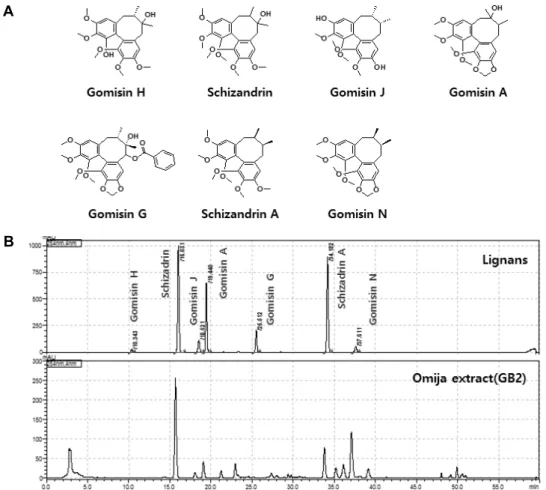
Fig. 1. Chemical structures of major lignan compounds (A) and HPLC chromatograms of lignan standards and Omija extract (B).
통계처리
통계분석은 SPSS 통계프로그램(Statistical Package for the Social Science, Ver. 12.0, SPSS Inc., Chicago, IL, USA)을 이용하여 각 측정군의 평균과 표준편차를 산출하 고, 재배지역별 간의 차이 유무를 one-way ANOVA(anal- ysis of variance)로 분석한 후 신뢰구간 P<0.05에서 Dun- can’s multiple range test를 실시하였다
결과 및 고찰
분석조건 설정
리그난 화합물 7종의 동시분석법을 확립하고자 다양한 용매조성 및 파장에 대하여 분석조건을 검토한 결과 새로운 분석조건을 확립하였다. 총 분석시간은 65분이며, 표준품을 분석하였을 때 피크의 머무름 시간은 gomisin H 10.34분, schizandrin 16.03분, gomisin J 18.52분, gomisin A 19.44 분, gomisin G 25.51분, schizandrin A 34.18분, gomisin N 37.61분이었다(Fig. 1). 본 연구의 분석조건에서 표준물 질의 분리 상태는 양호하였으며, 전처리한 오미자의 크로마 토그램을 비교하여 각각의 리그난 표준품 7종의 피크가 분 리되는지를 확인한 결과 Fig. 1과 같이 각 성분들이 다른 피크와 간섭 없이 분리되었으며 표준용액의 피크유지시간과
오미자의 피크유지시간이 일치하는 것을 확인할 수 있었다.
분석법 검증
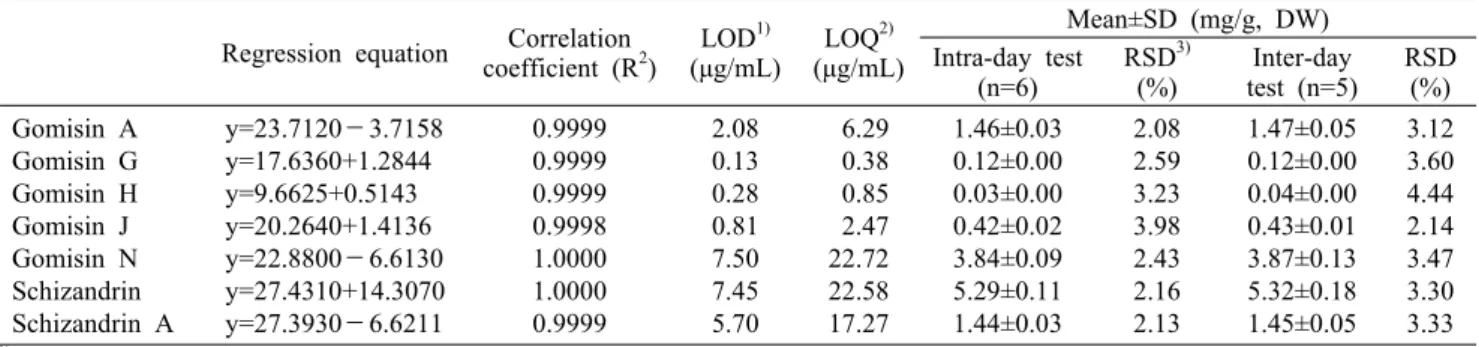
시험법의 유효성 검증을 위해서 리그난 화합물 7종의 직 선성, LOD, LOQ, 회수율(%) 실험을 하였다. 직선성을 평가 하기 위하여 6단계 농도의 표준품을 분석하였고 얻어진 크 로마토그램에서의 peak 면적과 농도 간의 상관관계를 회귀 분석을 통해 결정하였다. 그 결과 R2값이 0.9998~1.0000으 로 높은 직선성을 나타내었다. 직선성을 나타내는 범위 내에 서 지표성분들의 LOD값은 0.13~7.50 μg/mL이며, LOQ 값 은 0.38~22.58 μg/mL였다. LOD와 LOQ를 계산하는 데 이 용되는 신호대잡음비는 baseline에 대한 noise와 peak의 상대비로 그 값이 낮을수록 해당 표준물질이 주어진 조건에 서 잘 검출된다는 의미를 나타낸다(He 등, 2015). HPLC를 이용한 분석법의 검증 결과 지표성분들의 일내 상대표준편 차(RSD)값 2.08~3.98%였고, 일간 상대표준편차(RSD)값 2.14~4.44%(Table 1), 회수율을 구해본 결과 95.01~99.22
%였다(Table 2). 이러한 연구 결과 본 연구에서 사용한 분 석방법은 정량분석이 가능한 재현성(reproducibility)을 가 지고 있고, 유효성 검증을 통하여 동시 분석할 수 있는 충분 한 감도와 직선성 및 정밀도와 정확도를 갖고 있음을 확인할 수 있었다.
Table 1. Validation parameters of the developed HPLC analysis for lignan compounds Regression equation Correlation
coefficient (R2) LOD1)
(μg/mL) LOQ2) (μg/mL)
Mean±SD (mg/g, DW) Intra-day test
(n=6) RSD3)
(%) Inter-day test (n=5) RSD
(%) Gomisin A
Gomisin G Gomisin H Gomisin J Gomisin N Schizandrin Schizandrin A
y=23.7120-3.7158 y=17.6360+1.2844 y=9.6625+0.5143 y=20.2640+1.4136 y=22.8800-6.6130 y=27.4310+14.3070 y=27.3930-6.6211
0.9999 0.9999 0.9999 0.9998 1.0000 1.0000 0.9999
2.08 0.13 0.28 0.81 7.50 7.45 5.70
6.29 0.38 0.85 2.47 22.72 22.58 17.27
1.46±0.03 0.12±0.00 0.03±0.00 0.42±0.02 3.84±0.09 5.29±0.11 1.44±0.03
2.08 2.59 3.23 3.98 2.43 2.16 2.13
1.47±0.05 0.12±0.00 0.04±0.00 0.43±0.01 3.87±0.13 5.32±0.18 1.45±0.05
3.12 3.60 4.44 2.14 3.47 3.30 3.33
1)Limit of detection.
2)Limit of quantification.
3)Relative standard deviation.
Table 2. Recovery of lignan compounds for the validation of analytical method
Original (mg/0.5 g) Added (mg) Found (mg/0.5 g) Recovery (%) RSD1) (%) Gomisin A 1.46±0.03
0.500 1.000 1.500
1.94±0.01 2.42±0.02 2.88±0.03
96.48±1.60 96.19±2.34 96.30±0.30
1.66 2.44 0.31 Gomisin G 0.12±0.00
0.125 0.250 0.500
0.24±0.00 0.36±0.01 0.59±0.02
95.46±2.33 95.50±2.34 96.07±2.93
2.44 2.46 3.05 Gomisin H 0.03±0.00
0.125 0.250 0.500
0.15±0.00 0.28±0.01 2.10±2.73
95.79±1.97 99.22±2.15 96.99±1.93
2.05 2.17 1.99 Gomisin J 0.42±0.02
0.125 0.250 0.500
0.55±0.00 0.66±.0.00 0.89±0.02
96.83±2.47 95.20±0.48 95.90±1.33
2.55 0.50 1.38 Gomisin N 3.84±0.09
0.500 1.000 1.500
4.33±0.02 4.79±0.02 5.28±0.04
97.39±3.47 95.44±2.04 96.60±1.79
3.56 2.14 1.86 Schizandrin 5.29±0.11
0.500 1.000 1.500
5.76±0.02 6.24±0.04 6.71±0.04
95.31±3.49 95.01±3.92 95.71±1.29
3.66 4.13 1.35 Schizandrin A 1.44±0.03
0.500 1.000 1.500
1.93±0.01 2.42±0.02 2.89±0.01
98.32±3.49 97.89±1.88 96.87±0.43
3.66 1.92 0.44
1)Relative standard deviation.
본 연구에서 개발된 HPLC 분석방법은 높은 감도를 가지 며, 유효성 검증을 통하여 지역별 오미자 중 리그난 화합물 7종에 대한 동시분석이 가능함을 보여주었다.
HPLC 분석-리그난 함량 측정
오미자에서 리그난 화합물을 추출하기 위해 추출방법은 시료 1.00 g에 초음파 추출 20분으로 고정하고 0, 25, 50, 75, 95% 에탄올 추출용매에 따른 HPLC 분석 결과, 리그난 화합물 7종의 합이 95%> 75%> 50%> 25%> 0% 에탄올 순으로 높았다. 전처리 추출방법으로는 초음파 추출, 추출시 간 20분, 추출용매 95% 에탄올 용매로 2번 반복 추출 시 가장 높은 리그난 화합물의 양을 보여 최종 전처리 방법으로 선정하여 분석하였다(Fig. 2).
재배 지역별 오미자에 따른 개별 리그난 성분을 확인하기 위하여 HPLC 분석을 하여 각각의 함량을 Table 3에 제시하 였다. 분석 결과는 각 성분의 peak를 적분하여 넓이를 측정 하였고 넓이는 calibration curve의 식을 이용하여 농도로 환산하였으며 mg/g의 단위로 나타내었다. 오미자의 재배지 역별 schizandrin, gomisin N, gomisin A, schizandrin A의 함량은 각각 3.85~6.60, 2.69~4.38, 0.52~1.63, 0.60~
2.04 mg/g 범위로 존재하였다. 리그난 화합물 중에서 가장 많은 함량을 보인 것은 schizandrin과 gomisin N이었으며, 총 리그난 함량은 경상북도(GB) 12.01 mg/g, 강원도(GW) 11.31 mg/g, 경기도(GG) 11.23 mg/g, 전라북도(JB) 10.96 mg/g, 충청북도(CB) 10.87 mg/g, 경상남도(GN) 10.25 mg/g 순으로 양이 존재하였고 지역별 리그난 성분 함량 차
0 3 6 9 12 15
Schisandrin Gomisin J
Gom isin A
Schisand rin A
Gomisin N Total
Contents (mg/g, d.b) .
0% EtOH 25% EtOH 50% EtOH 75% EtOH 95% EtOH
A
0 3 6 9 12 15
Schisandrin Gom
isin J Gomisin A
Schisandrin A Gomisin N
Total
Contents (mg/g, d.b) .
Ultrasonic Waterbath Shaker
B
0 3 6 9 12 15
Schisandr in
Gomisin J Gomisin A
Schisandrin A Gomisin N
Total
Contents (mg/g, d.b) .
10 min 20 min 30 min
C
0 3 6 9 12 15
Schisandrin Gom
isin J Gomisin A
Schisandrin A Gomisin N
Total
Contents (mg/g, d.b) .
1st 2nd 3rd
D
Fig. 2. Total lignan contents of Schisandra chinensis by extraction condition. Material to solvent ratio (A), extraction method (B), ultrasonification time (C), and the number of repeat (D).
Table 3. Contents of lignans in Omija fruit extract depending on cultivation region (Unit: mg/g) Region Gomisin A Gomisin G Gomisin H Gomisin J Gomisin N Schizandrin Schizandrin A Total
GG1 GG2 GW1 GW2 CB1 CB2 CB3 GB1 GB2 GB3 GB4 GB5 GB6 GB7 GB8 GN1 GN2 JB1 JB2 JB3 JB4 JB5 JB6 JB7 JB8 JB9
1.27±0.02f1) 0.90±0.01lmn 1.57±0.06bc 0.86±0.01n 1.17±0.02hi 1.28±0.01f 0.89±0.02mn 0.95±0.06l 1.23±0.03g 1.04±0.04k 1.14±0.02ij 1.14±0.01ij 1.11±0.01j 0.93±0.01lm 1.34±0.02e 1.34±0.01e 1.01±0.01k 1.56±0.05cd 1.29±0.04f 1.55±0.03cd 1.61±0.03ab 1.20±0.02gh 1.63±0.03a 1.14±0.02ij 1.22±0.01g 1.52±0.02d
0.07±0.00fghi 0.15±0.05a 0.06±0.00hi 0.07±0.00ghi 0.10±0.05bcdefg 0.06±0.00hi 0.09±0.01defgh 0.09±0.01defgh 0.11±0.00bcde 0.10±0.00bcdefgh 0.08±0.00efghi 0.08±0.01efghi 0.09±0.00bcdefgh 0.12±0.01ab 0.08±0.00efghi 0.05±0.00i 0.08±0.01fghi 0.12±0.00abc 0.07±0.01fghi 0.10±0.01bcdef 0.09±0.01bcdefgh 0.09±0.01cdefgh 0.14±0.03a 0.10±0.00bcdefgh 0.09±0.01bcdefgh 0.12±0.01abcd
0.04±0.00bcd 0.04±0.00cde 0.03±0.00def 0.03±0.00def 0.03±0.00def 0.02±0.00f 0.02±0.00ef 0.03±0.03def 0.04±0.00bcd 0.03±0.00def 0.03±0.00ef 0.04±0.00bcd 0.03±0.00def 0.03±0.00def 0.04±0.00bcd 0.04±0.00bcd 0.03±0.00ef 0.03±0.00cde 0.03±0.00def 0.06±0.01a 0.05±0.00bc 0.03±0.00def 0.05±0.00ab 0.05±0.00ab 0.03±0.00cde 0.05±0.00ab
0.36±0.01hi 0.42±0.00c 0.38±0.01gh 0.38±0.01efg 0.35±0.01i 0.33±0.00j 0.38±0.01gh 0.38±0.02gh 0.51±0.01a 0.35±0.02i 0.36±0.00i 0.38±0.001fg 0.41±0.00cd 0.44±0.00b 0.36±0.00i 0.29±0.00k 0.40±0.00cde 0.41±0.01cd 0.30±0.01k 0.39±0.02def 0.38±0.01efg 0.39±0.00defg 0.39±0.01defg 0.34±0.01ij 0.36±0.00i 0.39±0.01defg
3.41±0.05ef 2.97±0.03k 3.36±0.12efgh 3.37±0.04efgh 3.22±0.09hi 3.24±0.02ghi 3.15±0.12ij 3.31±0.25fgh 4.38±0.10a 2.95±0.11kl 3.13±0.06ij 3.70±0.04d 3.89±0.05c 3.51±0.02e 3.38±0.04efg 2.82±0.02lm 3.48±0.03e 4.06±0.09b 3.02±0.06jk 3.44±0.07ef 3.85±0.06c 3.46±0.09ef 3.41±0.08ef 2.69±0.02m 2.96±0.06kl 3.37±0.04efgh
5.30±0.10de 5.08±0.06fg 5.38±0.18cd 4.52±0.06hi 4.96±0.10fg 5.47±0.02bcd 4.67±0.10h 5.00±0.35fg 6.60±0.14a 4.40±0.17ij 5.37±0.07cd 5.66±0.05b 5.55±0.04bc 5.37±0.03cd 5.55±0.05bc 3.85±0.04l 4.87±0.04g 5.62±0.12b 4.53±0.17hi 4.30±0.09jk 4.98±0.09fg 4.88±0.04g 5.45±0.10bcd 4.13±0.05k 4.41±0.07ij 5.14±0.07ef
0.86±0.01k 1.58±0.02d 0.88±0.03k 1.73±0.02c 0.86±0.02k 1.06±0.01hi 1.26±0.03g 1.07±0.07h 2.04±0.05a 1.31±0.05g 1.25±0.01g 1.41±0.01f 1.46±0.01f 1.82±0.01b 0.96±0.01j 0.65±0.00no 1.60±0.02d 1.52±0.03e 0.73±0.03m 0.64±0.01no 1.00±0.02ij 0.95±0.01j 0.66±0.01n 0.60±0.11o 0.80±0.01l 0.65±0.01no
11.32±0.19fghi 11.13±0.13hijk 11.65±0.40efg 10.97±0.15ijk 10.69±0.29kl 11.47±0.06fgh 10.45±0.27lm 10.83±0.78jkl 14.90±0.34a 10.18±0.39mn 11.35±0.16fghi 12.40±0.12cd 12.53±0.09c 12.20±0.07cd 11.71±0.12efg 9.04±0.09o 11.46±0.10fgh 13.32±0.22b 9.96±0.32n 10.48±0.21lm 11.96±0.19de 11.00±0.12hijk 11.73±0.26ef 9.05±0.11o 9.87±0.14n 11.24±0.14ghij Mean±SD 1.23±0.24 0.09±0.02 0.04±0.01 0.38±0.04 3.37±0.38 5.04±0.59 1.13±0.41 11.27±1.25
RSD 19.51 22.22 25.00 10.53 11.28 11.71 36.28 11.09
1)Mean±SD in triplicate (n=3).
2)Any means in the same column followed by the same letter are not significantly (P<0.05) different by Duncan’s multiple range test.
0 2 4 6 8 10
7~8 8~9 9~10 10~11 11~13
Contents of three major lignans (mg/g)
Number of Omija fruit extracts. ..
Fig. 3. Contents of three major lignans (schizandrin, gomisin N, gomisin A) extracted from Schisandra chinensis by culti- vation region.
이는 적은 것으로 확인하였다(Table 3). 오미자의 리그난 성분 중 schizandrin과 gomisin N 함량이 높은 것은 이미 많은 문헌에 보고되어 있다(Kim 등, 2002; Koo 등, 2011).
대한약전에서 오미자는 정량할 때 schizandrin, gomisin A, gomisin N의 합 0.7% 이상을 기준으로(Ministry of Food and Drug Safety, 2019) 제시하고 있으며, 본 연구에서 분 석된 국내 26개 지역 오미자는 schizandrin, gomisin A, gomisin N의 합이 7.97~12.20 mg/g(0.8~1.2%), 0.7% 이 상으로 확인되었다(Fig. 3). 재배지역 26중 12개 지역(GG2, GW2, CB3, GB1, GB2, GB3, GB4, GB5, GB6, GB7, GN2, JB9)은 오미자의 리그난 성분에서 schizandrin A가 gomi- sin A보다 함량이 높았다(Table 3). 오미자는 품종에 따른 항산화 활성과 성분(Han 등, 2019), 수확시기(Choi, 2011) 에 따라 성분 차이가 있는 것으로 보고된 바가 있다. 지역별 온도와 고도의 차이에 대한 영향으로 오미자 내 리그난 성분 들의 함량과 다른 물질로의 전환에서 차이가 발생하는 것으 로 판단된다. 추후 품종, 수확시기, 재배조건 등 환경에 따른 오미자의 리그난 함량에 대한 연구가 필요할 것으로 생각된 다.
본 연구는 지역별 오미자의 리그난 7종의 성분을 동시에 분석할 수 있고, 재현성 및 검출감도가 증진된 최적의 HPLC 분석법을 확립하였다. 품질관리를 위한 객관적이고 과학적 인 근거를 제시하여 국내에서 재배되는 오미자의 품질평가 에 대한 하나의 기준이 될 것으로 기대된다.
요 약
본 연구는 재배지역별 오미자의 리그난 함량을 조사하기 위 해 수행되었다. HPLC를 사용하여 특이성, 직선성, 검출한계 (LOD), 정량한계(LOQ) 및 정확도를 결정함으로써 리그난 의 분석법이 검증되었다. 리그난 중에는 schizandrin이 3.85~6.60 mg/g으로 가장 풍부했고 그다음 gomisin N이 2.69~4.38 mg/g으로 많았다. Schizandrin A와 gomisin A 는 0.60~2.04, 0.86~1.63 mg/g이었고, gomisin G, gomi-
sin H, gomisin J는 0.5 mg/g 미만이었다. 오미자의 리그난 화합물 7종 함량은 9.04~14.90 mg/g이었다. 재배지역별 오미자는 각 리그난의 함량은 다르지만 전체 함량에는 큰 차이가 없다. 오미자 표준화를 위한 기초자료로 유용할 것으 로 기대된다.
감사의 글
본 연구는 2019년도 농촌진흥청 연구사업(과제번호: PJ 012641022019) 및 국립농업과학원 전문연구원 과정 지원 사업(과제번호: PJ012641012019)에 의해 이루어진 것임.
REFERENCES
Choi HJ, Choi YW, Baek SY, Kim BS, Ahn SC, Rhee MS, et al. Activity-guided screening of anti-inflammatory com- pounds from the hexane extracts of Schisandra chinensis fruit. J Life Sci. 2013. 23:311-318.
Choi SR, Kim CS, Kim JY, You DH, Kim JM, Kim YS, et al. Changes of antioxidant activity and lignan contents in Schisandra chinensis by harvesting times. Korean J Med Crop Sci. 2011. 19:414-420.
Dai X, Yin C, Guo G, Zhang Y, Zhao C, Qian J, et al. Schisan- drin B exhibits potent anticancer activity in triple negative breast cancer by inhibiting STAT3. Toxicol Appl Pharmacol.
2018. 358:110-119.
Gao Y, Wu S, Cong R, Xiao J, Ma F. Characterization of lignans in Schisandra chinensis oil with a single analysis process by UPLC-Q/TOF-MS. Chem Phys Lipids. 2019. 218:158-167.
Han CK, Seong KS, Lee KW, Park SS, Jeong JY, Kim SS.
Effects of Omija (Schizandra chinensis Baillon) concentrate on blood alcohol clearance and hepatoprotective function in rats induced by acute ethanol intoxication and chronic ethanol treatment. J Korean Soc Food Sci Nutr. 2014. 43:1139-1147.
Han SH, Jang JK, Ma KH, Kim YJ, Kim SM, Lee HJ, et al.
Selection of superior resources through analysis of growth characteristics and physiological activity of Schisandra chi- nensis collection. Korean J Med Crop Sci. 2019. 27:8-16.
He X, Li J, Zhao W, Liu R, Zhang L, Kong X. Chemical finger- print analysis for quality control and identification of Ziyang green tea by HPLC. Food Chem. 2015. 171:405-411.
Kang S, Lee KP, Park SJ, Noh DY, Kim JM, Moon HR, et al.
Identification of a novel anti-inflammatory compound, α-cu- bebenoate from Schisandra chinensis. J Ethnopharmacol. 2014.
153:242-249.
Kim HJ, Seo YM, Lee EJ, Chung C, Sung HJ, Sohn HY, et al. Anti-proliferative and pro-apoptotic activities by pomace of Schisandra chinensis (Turcz.) Baill. and schizandrin. J Life Sci. 2018. 28:415-420.
Kim KS, Kang SS, Ryu SN. Quantitative analysis of lignans from fruits of Schizandra chinensis. Kor J Pharmacogn. 2002.
33:272-276.
Kim Y, Ha N, Han SH, Jeon JY, Hwang M, Im JY, et al. Confir- mation of schizandrin as a marker compound in Jangsu Omija powder. J Korean Soc Food Sci Nutr. 2013. 42:244-248.
Koo DC, Suh WS, Baek SY, Shim SH. Quantitative determi- nation of lignans from Schizandra chinensis by HPLC. Kor J Pharmacogn. 2011. 42:233-239.
Lee J, Ryu HS, Kim JM, Jung TH, Park SM, Lee YM. Anti-mel- anogenic effect of gomisin N from Schisandra chinensis
(Turcz.) Baillon (Schisandraceae) in melanoma cells. Arch Pharm Res. 2017. 40:807-817.
Lee JS, Yoon PS. Wild Botany. Daesun, Seoul, Korea. 2002.
p 496-497.
Lee JS. Literature review on the Omija activities in the Dongeui- bogam. J East Asian Soc Diet Life. 1995. 5:1-6.
Lee JY, Min YK, Kim HY. Isolation of antimicrobial substance from Schizandra chinensis Baillon and antimicrobial effect.
Korean J Food Sci Technol. 2001. 33:389-394.
Liu K, Song Y, Liu Y, Peng M, Li H, Li X, et al. An integrated strategy using UPLC.QTOF-MSE and UPLC.QTOF-MRM (enhanced target) for pharmacokinetics study of wine proc- essed Schisandra Chinensis fructus in rats. J Pharm Biomed Anal. 2017. 139:165-178.
Liu Y, Guo JT, Wang ZB, Li ZY, Zheng GX, Xia YG, et al.
Aromatic monoterpenoid glycosides from rattan stems of Schisandra chinensis and their neuroprotective activities. Fito- terapia. 2019. 134:108-112.
Lu Y, Chen DF. Analysis of Schisandra chinensis and Schisan- dra sphenanthera. J Chromatogr A. 2009. 1216:1980-1990.
Ministry of Agriculture, Food and Rural affairs. Special crops production performance. Ministry of Agriculture, Food and Rural Affairs, Sejong, Korea. 2017. p 7.
Ministry of Food and Drug Safety. The Korean Pharmacopoeia.
Ministry of Food and Drug Safety, Chungju, Korea. 2019.
p 75.
Mocan A, Zengin G, Crişan G, Mollica A. Enzymatic assays and molecular modeling studies of Schisandra chinensis li- gnans and phenolics from fruit and leaf extracts. J Enzyme Inhib Med Chem. 2016. 31:200-210.
Nakajima K, Taguchi H, Ikeya Y, Endo T, Yosioka I. Constitu- ents of Schizandra chinensis Baill. ⅩⅢ. Quantitative analy- sis of lignans in the fruits of Schizandra chinensis BAILL. by high performance liquid chromatography. Yakugaku Zasshi.
1983. 103:743-749.
Qu Y, Chan JY, Wong CW, Cheng L, Xu C, Leung AW, et
al. Antidiabetic effect of Schisandrae chinensis Fructus in- volves inhibition of the sodium glucose cotransporter. Drug Dev Res. 2015. 76:1-8.
Rural Development Administration. Five flavor magnolia vine- agricultural technology guide. Rural Development Adminis- tration, Jeonju, Korea. 2018.
Shin D, Hong SB, Geum JH, MA JY, Chung HS. Effects of Schisandrae Fructus on menopause symptoms in ovariectom- ized mice. J Korean Med. 2016. 37:39-46.
Sowndhararajan K, Deepa P, Kim M, Park SJ, Kim S. An over- view of neuroprotective and cognitive enhancement properties of lignans from Schisandra chinensis. Biomed Pharmacother.
2018. 97:958-968.
Suh WS, Park SY, Min BS, Kim SH, Song JH, Shim SH. The antiproliferative effects of compounds isolated from Schisan- dra chinensis. Korean J Food Sci Technol. 2014. 46:665-670.
Szopa A, Dziurka M, Warzecha A, Kubica P, Klimek-Szczyku- towicz M, Ekiert H. Targeted lignan profiling and anti-in- flammatory properties of Schisandra rubriflora and Schisan- dra chinensis extracts. Molecules. 2018. 23:3103.
Wei M, Liu Y, Pi Z, Li S, Hu M, He Y, et al. Systematically characterize the anti-Alzheimer’s disease mechanism of li- gnans from S. chinensis based on in-vivo ingredient analysis and target-network pharmacology strategy by UHPLC-Q- TOF-MS. Molecules. 2019. 24:1203.
Yuan R, Tao X, Liang S, Pan Y, He L, Sun J, et al. Protective effect of acidic polysaccharide from Schisandra chinensis on acute ethanol-induced liver injury through reducing CYP2E1- dependent oxidative stress. Biomed Pharmacother. 2018. 99:
537-542.
Yun YR, Jung MH. Gomisin A ameliorates endoplasmic retic- ulum stress-induced hepatic steatosis. J Life Sci. 2017. 27:
233-240.
Zhu P, Li J, Fu X, Yu Z. Schisandra fruits for the management of drug-induced liver injury in China: A review. Phytomedi- cine. 2019. 59:152760.