51 This is an Open-Access article distributed under the terms of the Creative Commons Attribution Non-Commercial License (http://
creativecommons.org/licenses/by-nc/3.0) which permits unrestricted non-commercial use, distribution, and reproduction in any medium, provided the original work is properly cited.
J. Mushrooms 2016 June, 14(2):51-58 http://dx.doi.org/10.14480/JM.2016.14.2.51 Print ISSN 1738-0294, Online ISSN 2288-8853
© The Korean Society of Mushroom Science
*Corresponding author E-mail : [email protected]
Tel : +82-31-670-5420, Fax : +82-31-676-2602 Received May 25, 2016
Revised June 17, 2016 Accepted June 27, 2016
담자균류 목질섬유소 분해효소의 특성과 산업적 이용
임선화1· 강희완1,2,*
1한경대학교 미래융합기술대학원
2한경대학교 유전공학연구소
Industrial applications and characteristics of lignocellulolytic enzymes in Basidiomycetous fungi
Sun-Hwa Lim1 and Hee-Wan Kang1,2,*
1Graduate School of Future Convergence Technology, Hankyong National University, Ansung 456-749, Korea
2Institute of Genetic Engineering, Hankyong National University, Ansung 456-749, Korea
ABSTRACT: Basidiomycetous fungi are one of the most potent biodegraders because many of its species grow on dead wood or litter, in environments rich in lignocellulose. For the degradation of lignocellulose, basidiomycetes utilize their lignocellulytic enzymes, which typically include laccase (EC 1.10.3.2), lignin peroxidase (EC 1.11.1.14), xylanase (EC 3.2.1.8), and cellulase (EC 3.2.1.4). In recent years, the practical applications of basidiomycetes have ranged from the textile to the pulp and paper industries, and from food applications to bioremediation processes and industrial enzymatic saccharification of biomass. Recently, spent mushroom substrates of edible mushrooms have been used as sources of bulk enzymes to decolorize synthetic dyes in textile wastewater. In this review, the occurrence, mode of action, general properties, and production of lignocellulytic enzymes from mushroom species will be discussed. We will also discuss the potential applications of these enzymes
KEYWORDS: Industrial applications, lignocellulytic enzymes, Mushroom, Basidiomycetes
서 론
전 세계에서 가장 많이 재배되고 있는 버섯 종으로 양 송이(Agaricus bisporus) ,표고버섯(Lentinus edodes), 느 타리버섯(Pleurotus spp.) 목이버섯(Auricula auricula), 팽 이버섯(Flamulina velutipes) 풀버섯 (Volvariella volvacea) 을 들 수 있으며 한국은 표고버섯, 느타리버섯, 큰느타리 버섯, 팽이버섯이 버섯 총생산량의 95% 이상을 차지한
다. 식용버섯 인공재배 시에 사용되는 콘코브, 톱밥, 면 실박 등의 배지성분은 목질섬유소를 구성하며 xylanase, cellulase, lignin 분해효소 등 목질분해효소를 다량 분비하 여 고 분자량의 목질섬유소를 수용성 저분자량의 당으로 분해하여 균사체의 영양 흡수과정을 거처 생체 내에서 생 명 유지에 필요한 에너지원으로 이용 한다(Baldrian, 2011; Scarse, 1995). 대부분의 목질섬유소 70% 이상이 cellulose와 hemicellulose 등의 섬유소로 구성되어 있으 며 약 20~30% 정도가 lignin으로 섬유소와 견고하게 결 합되어 있다. 기질의 특성에 따라 균사체는 cellulase, hemicellulase 외에도 lignin 분해효소를 분비하여 수목을 부패시키는데 갈색으로 변색시키는 것을 갈색부후균 (Brown rot fungi), 백색으로 변색시키는 것을 백색부후균 (White rot fungi)로 부른다(Pandey and Pitman, 2003).
갈색변색은 lignin을 적게 분해함으로 갈색형태로 남아 있 게 되고 백색변색은 lignin 분해효소를 다량 생산하여 백 색으로 변색하는 것으로 생각 되고 있다. 식용버섯인 느 타리버섯, 큰느타리버섯, 팽이버섯 등은 백색부후균으로 알려져 있다.
버섯은 기질에 따라 다양한 목질분해효소를 분비한다.
목재나 톱밥처럼 lignin 성분을 많이 포함하는 기질에서 자 라는 표고버섯은 lignin을 분해하는 manganase peroxidase 그리고 laccase를 다른 버섯에 비해 많이 분비를 한다 (Baldrian and Valášová, 2008; Bushwell, 1998). lignin 양이 적고 섬유소양이 많은 기질에서 자라는 풀버섯은 endo-1,4-β-glucanase (EC3.2.1.4), cellobio-hydrolase (EC 3.2.1.91), β-glucosidase (EC 3.2.1.21)와 같은 다양 한 섬유소분해효소를 분비하지만 lignin 분해 효소는 소량 분비한다 (Cai et al., 1994). 반면 여름느타리버섯은 섬유 소분해효소와 목질분해효소를 생산 lignin을 다량 포함하는 수목을 분해하여 영양을 섭취한다.(Bushwell et al., 1998)
균류의 목질섬유소분해는 cellulases, hemicellulases, ligninases 등의 복합적 효소 반응에 의해서 발생한다 (Bayer et al, 1998; Ljungdahl, 2008; Sanchez, 2009;
Weng, et al., 2008). Cellulases와 대부분의 hemicellulase 는 glycoside hydrolases 그룹의 효소로 알려져 있으며 최 근에는 2,500개 이상의 glycoside hydrolases가 115 families로 분류 보고되고 있다. Lignin 분해효소는 laccase, manganese peroxidises (Mp), lignin peroxidises (Lp)가 알려져 있다. Table 1에서는 곰팡이가 생산하는 목 질분해효소 활성과 기질특이성을 보여주고있다.
본 고에서는 담자균류가 생산하는 cellulase, hemicellulase, lignin 분해효소를 포함하는 목질섬유분해효소의 특성, 작
용기구 및 산업적 이용에 관하여 총괄적으로 기술 하고자 한다.
Cellulase
Cellulase는 cellulose를 가수분해하는 효소로서 Endo- cellulase (Endo-1,4-β-D-glucanase, EC 3.2.1.4), Exo- cellulase(1,4-β-glucan cellobiohydrolase, EC 3.2.1.91) 그 리고 β-glucosidase (β-D-glucosid glucohydrolase, EC 3.2.1.21)가 있다(Dashtban et al., 2009; Whitaker, 1971).
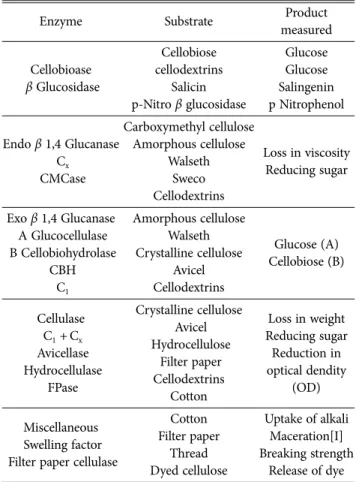
Endo-cellulase는 비결정지역의 cellulose 쇄상분자에 무 작위적으로(주로 비환원성말단기) 작용하여 glucose, cellubiose, oligomer를 생성하는 효소작용을 한다 (Table 2). Exo-cellulase는 섬유소의 쇄상고분자의 비환원성 말 단부위에서부터 작용하여 연속적으로 이당류의 단위 (cellubiose)를 생성하며 사상균의 복합효소 중에서 가장 많이 분포한다(Almin et al, 1975). 흥미롭게도 목재의 cellulose를 주로 분해하는 갈색부후를 일으키는 담자균류 는 exo-ß-glucanase가 없는 것으로 보고되고 있다(Pandey and Pitman, 2003). ß-glucosidase (EC 3.2.1.21)는 ß 1-2, 1-3, 1-4, 1-6 결합을 지닌 2당류를 분해한다. 또한 cellulase계 효소에서 주역할은 Endo, Exo-cellulase를 억 제하는 cellubiose를 분해하는 것이다.
Cellulose는 키틴과 같이 β-1,4 결합으로 glucose가 연결 Table 1. Examples of different fungi producing different lignocellulolytic enzymes and their substrates
Group Fungal strain Enzymes Substrate
Aerobic fungi (Extracellular lignocellulolytic enzymes)
Ascomycetes
T. reesei Cellulases (CMCase, CBH, BGL),
Hemicellulase (xylanase) Wheat straw T. harzianum Cellulases (CMCase, CBH),
β-1,3-glucanases Wheat bran, wheat straw
A. niger Cellulases, Xylanases Sugar cane bagasse
Pestalotiopsis sp. Cellulases (CMCase, CBH), Laccase Forest litter of Quercus variabilis
Basidiomycetes P. chrysosporium Cellulases (CMCase, CBH, BGL), CDH, LiP, MnP, Hemicellulase (xylanases)
Red oak, grape seeds, barley bran, woodchips F. palustris Cellulases (CMCase, CBH, BGL) Microcrystalline cellulose
Anaerobic rumen fungi (Chytridiomycetes) (Cell-wall associated lignocellulolytic enzymes,
“cellulosome”)
Anaeromyces Anaeromyces mucronatus 543
Cellulase (CMCase),
Hemicellulase (xylanase) Orchard grass hay Caecomyces Caecomyces communisCellulases, Hemicellulases
(xylanase, β-D-xylosidase) Maize stem Cyllamyces Cyllamyces aberensis Cellulases, Xylanases Grass silage Neocallimastix Neocallimastix frontalisCellulases, Hemicellulase
(xylanase, β-galactosidase) Cotton fiber, wheat straw Orpinomyces Orpinomyces sp. Cellulase (CMCase, CBH, β-glucosidase),
Hemicellulases (xylanase, mannanases) Wheat straw Piromyces Piromyces sp. Cellulases (CMCase, CBH, β-glucosidase)
Hemicellulases (xylanase, mannanases) Maize stem
CMCase: Carboxymethylcellulases (endoglucanase), CBH: Cellobiohydrolases, BGL: β-glucosidases, CDH: Cellobiose dehydrogenase, MnP:
Manganese peroxidises, LiP: Lignin peroxidises. (Dashtban et al. 2009)
된 선형의 다당류이다. 일반적인 cellulose는 15-10,000개의 glucose가 수소결합으로 연결된anhydroglucose chains을 형 성하며, 불용성 섬유질이다. Cellulose는 xylan이나 lignin 과 같은 다른 다당류와 복합적으로 식물체에 존재하고 세포벽의 40% 이상을 구성한다(Bayer et al., 1998).
Cellulose를 효율적으로 이용하기 위해서는 glucose로 얼 마나 잘 분해하느냐에 따라 다르다. 물리적 또는 화학적 인 방법인 고온이나 강산으로 cellulose를 분해하면 순수 한 glucose 외에 다른 불순물이 포함되는데, 생체 촉매인 celluase를 이용하면 순수한 glucose를 얻을 수 있는 하나 의 방법이 될 수 있다.
Cellulases는 균류에서 주로 많이 생산된다. Chrysosporium lignorum는 5개의 endo-β-1,4 glucanases (Almin et al., 1975; Eriksson and Pettersson, 1975)가 보고되었고, Penicillim notatum에서도 cellulase의 기질 특이성이 규명 되었으며 (Pettersson, 1969), 균류가 분비하는 cellulase는 다양하며 기질에 따라 작용하는 효소가 다르고, 생산물도 다르게 만들어 진다(Table 2)
cellulase 의 효소활성기구는 적어도 2단계를 거치는 것 으로 추측하고 있다 (Reese et al., 1950). 첫 번째로 Cl cellulase (EC 3.2.1.91, cellulose 1,4-beta-cellobiosidase) 이라는 효소가 관여하여 anhydroglucose chains을 무작위
로 분해한다. C1 계열의 cellualse는 면섬유나 결정형의 cellulose는 잘 분해하나 carboxymethyl cellulose (CMC) 와 같은 수용성 cellulose의 분해 효과가 없다(Pettersson, 1969). 그러나 Spano et al. (1975)에 따르면 C1과 다르게 exo와 endo β-1,4 glucanases로 구성된 crosslinked cellulase (Cc) 계열의 cellulase는 산이나 염으로 팽윤되어 지거나 수용성인 셀룰로오스를 분해한다고 하였다.
Xylanase
Xylan은 Hemicelluloses의 주성분으로 galactose, mannose, xylose, arabinose 등 다양한 당의 중합체로 세포벽을 유 지하고, 식물의 구성 성분 중 2번째로 많은 성분으로 식 물의 건물 중량에서 20-30% 이상을 차지하고 있다 (Haltrich et al., 1996). Hemicelluloses는 당 잔기구성에 따라 D-galactan, D-mannan, D-xylan, C-arabinon 등으 로 나누게 된다. Xylan은 다양한 당이 결합 되어 있는 복잡한 구조물로서 분해를 위해서 다양한 효소가 복합적 으로 작용 하게 된다(Fig. 2). Xylanase 는 Xylan에 있는 1, 4–β- D- xylosidic linkage를 분해하는 glycosidase (endo 1, 4-xylanases)로 분해산물은 다양한길이의 xylo- oligosaccharides가 되며 이는 β-xylosidase에의해서 단당 류인 xylose로 분해된다. 다양한 치환기가 1, 4, β- linked xylose의 backbone에 결합하는데 α-L-arabinofuranosidase, D-glucuronidases, acetyl xylan esterase, ferulic acid esterases, pcoumairic acid esterases에 의해서 분해된다.
Xylan을 분해하는 효소는 다양한 생물 종에서 발견되는 데, 호기성 미생물과 혐기성 미생물뿐만 아니라 균류, 조 류, 원생동물 등 다양한 생물이 가지고 있는 효소이다 (Collins et al., 2005; Polizeli et al,. 2005; Prade, 1995;
Sunna and Antranikian, 1997). 이들 대부분은 식물을 분 해하여 자일로오스를 얻어 생장에 필요한 탄소원을 얻는 부생균들이나, 식물의 병원균으로 식물 세포에 침입하기 위해 헤미셀룰로오스를 분해한다. 일반적으로 xylan을 분 해하는 곰팡이로서 Trichoderma와 Aspergillus 종에서 많 이 연구 된 바 있다. (Fujita et al., 2002; Gawande and
Fig. 1. Structure of xylan and the sites of attack by xylanolytic enzymes (Pastor et al. 2007)
Table 2. Characterization of cellulase
Enzyme Substrate Product
measured
Cellobioase β Glucosidase
Cellobiose cellodextrins
Salicin p-Nitro β glucosidase
Glucose Glucose Salingenin p Nitrophenol
Endo β 1,4 Glucanase Cx CMCase
Carboxymethyl cellulose Amorphous cellulose
Walseth Sweco Cellodextrins
Loss in viscosity Reducing sugar
Exo β 1,4 Glucanase A Glucocellulase B Cellobiohydrolase
CBH C1
Amorphous cellulose Walseth Crystalline cellulose
Avicel Cellodextrins
Glucose (A) Cellobiose (B)
Cellulase C1 +Cx
Avicellase Hydrocellulase
FPase
Crystalline cellulose Avicel Hydrocellulose
Filter paper Cellodextrins
Cotton
Loss in weight Reducing sugar Reduction in optical dendity
(OD)
Miscellaneous Swelling factor Filter paper cellulase
Cotton Filter paper
Thread Dyed cellulose
Uptake of alkali Maceration[I]
Breaking strength Release of dye CMC = carboxymethyl cellulose; FP = filter paper.
Kamat, 1999; He et al., 2009). 버섯류에서는 표고버섯에 서 35kDa의 Xylanase를 정제한 바 있으며 Aspergillus terreus의 Xylanase family 10과 높은 상동성이 있는 것 으로 나타났다(Lee et al, 2007). 또한 큰느타리버섯 (Pleurotus eryngii)과 Termitomyces clypeatus로부터 xylanase가 분리되어 효소학적 특성이 연구 된 바 있다 (Altaf et al., 2010; Mukherjeem and Senguptaa, 1985) 최근, 버섯 수확 후 배지 (spent mushroom substrate, SMS)추출물에서 목질섬유소분해효소활성을 조사한 바 있다. 팽이버섯 SMS추출물은 다른 식용버섯SMS보다 2- 10배이상의 Xylanase활성이 있었다(Lim et al., 2012;
aLim et al., 2013). Xylanase는 주요 분해효소로서 최적 반응온도는 40-60℃이며 pH는 4.5-8인 것으로 보고 되고 있다 (Hazlewood and Gilbert, 1993).
lignin 분해효소
Lignin은 분지된 phenylpropane의 3차원적 중합체로 바 이오매스의 20-30%의 섬유소를 포함 하고 있으며 최량의 섬유소를 확보하기 위하여 lignin 분해는 필수적인 과정이 다. Lignin의 복잡한 화학구조와 견고한 화학적 결합 때 문에 목질섬유소 중에서 가장 분해하기 어려운 성분이다.
담자균류의 lignin 분해양식은 산소분자를 이용하여 산화 하는 laccase와 hydrogen peroxide를 요구하는 peroxidase 로 나눌 수 있다(Call and Gerday, 1997). Peroxidase는 Lignin peroxidase (EC 1.11.1.14)와 manganese peroxidase (MnP; EC 1.11.1.13)로 나눌 수 있다. Lignin peroxidase 는 aryl alcohol oxidase와 glyoxal oxidase의 형태로 효소 적인 역할을 하나 목질섬유소기질에 잘 검출되지 않는 특 성이 있지만 glyoxal oxidase는 낙엽분해 담자균류에서 검출되기도 한다(Baldrian, 2011). Mn-peroxidase는 낙엽 분해 담자균에서 주로 발견되고 있으며 토양 등에 많이 분포하는 부식질(humic성분)을 분해하는데 중요한 역할 을 한다(Baldrian, 2011).
Laccase는 (p-diphenol:oxygen oxidoreductase, EC1.10.3.2) p-디페놀 산화효소라고 하며, 4개의 구리이온을 포함하는 산화환원 효소로 과산화수소를 만들지 않고 물의 산소분 자의 환원을 촉매하며 페놀 잔기를 퀴논으로 산화함으로 써 리그닌을 분해한다(Kunamneni et al., 2007). Laccase 생산은 백색부후균이나 호지성기생균, 병원성 곰팡이뿐만 아니라 식용버섯인 양송이버섯(Perry et al., 1993), 느타 리버섯(Giardina et al., 1999; Palmieri et al., 1997;
Palmieri et al., 2003), 표고버섯 등에도 알려져 있다. 느 타리버섯은 8개의 다른 laccase isozymes이 알려졌다 (Gianfreda et al., 1999; Palmieri et al., 1997; Palmieri et al., 2003). 가장 많은 isoform인 POXC는 59 kDa의 단 백질로 pI 값은 2.9이고, 다른 3가지 isozymes (POXA2, POXB1, POXB2)은 분자량이 67 kDa이고 pI 값이 4.1인 것 2개와 pI 값이 2.9인 것 하나로 이뤄져 있다. 다른 2개
의 isoforms (POXA1b and POXA1w)은 61 kDa과 pI 6.7-6.9,이고, 나머지2개의 isoforms (POXA3a and POXA3b)은 heterodimers로 pI값은 4.1-4.3, 61 kDa과 16 또는 18 kDa의 분자량을 가지고 있다.
Laccase의 반응 경로는 크게 2가지로 나눌 수 있는데, 페놀 화합물을 직접 분해하는 과정과 비페놀 화합물을 분 해하는 과정이다(Fig. 2). 페놀 화합물은 laccase가 산화되 어 물을 생산하고 산화된 laccase와 기질인 페놀 화합물이 만나 페놀 화합물을 산화시키고 laccase는 원상태로 복구 되는 촉매 작용을 한다. 하지만 비페놀 화합물은 laccase 가 직접 작용을 하는 것이 아니라 mediator가 있어야 하 는데, laccase가 mediator를 산화 시키고 산화된 mediator 가 비페놀 화합물을 산화하여 반응하는 과정이다 (Brijwani et al., 2010; Kunamneni et al., 2007).
목질섬유분해효소의 산업적 이용
cellulase는 산업적으로 다양하게 이용 되는데, 바이오 에너지 생산에 있어서 바이오매스를 당화시키는데 중요 한 효소이다. (Weng et al., 2018). 또한 펄프산업에서는 불순물을 제거하거나 폐지의 재활용에도 적용된다 (Kibbelwhite and Clark, 1996). 세계 바이오에탄올산업 시장규모는 현재 총 845억$로 년간 20%이상 급성장하고 있다(Oscar et al., 2014). 글로벌 연료 에탄올 효소 산업 은 세계 산업용 효소 시장의 12%를 형성하고 시장은 지 난 몇 년 동안 15%-20%의 연간 성장 속도로 증가 하고 있다. 바이오매스를 분해하여 당화하는 단계에서 당화효 소가 주도적 역할을 하고 있으며 선진 각국에서는, 유용 효소의 산업화를 위한 다양한 종류의 숙주균과 발현계를 개발하고 특허화 하여 많은 기술들을 독점적으로 보호하 고 있다. Trichoderma reesei 배양액을 농축한 산업용효 소로 개발한 celluclast 1.5L 와 Xylanase활성의 β-D- glucosidase를 강화한 Novozyme 188 (Novo Co., Denmark)를 개발하여 바이오 에너지 생산 효소로 이용되 고 있으며 Novozymes (47%) ,Genencor 및 DSM NV 글로벌회사가 87%를 점유 하고 있다. 당화를 위해서는 cellobiohydrase, endoglucanase, beta-glycosidase 등의 Fig. 2. Mechanism of action of laccase on non-phenolics compound and phenolics compound
효소의 복합체 적용이 매우 유용하다(Oscar et al., 2014).
이에 Novozyme 사는 Cellic CTec2효소복합체 개발 하여 제 2 목질분해효소로서 연구개발 하였다.
버섯 배지원재료는 면실박, 비트펄프, 콘코브, 톱밥 등 주로 이용 되고 있으며 cellulose, hemicellulose, lignin등 목질섬유소로 구성 되어 있다. 버섯생산은 영양단계인 균 사생장과정과 생식단계인 자실체 생성을 거치면서 cellulase, xylanase 및 lignin 분해효소 등의 목질분해효소 를 세포외로 분비하여 배지를 분해한 산물을 영양원으로 흡수한다. 버섯 수확 후 배지 (spent mushroom substrate, SMS)내에는 다량의 목질섬유분해효소가 잔존해 있으며 버섯종에 따라 특징적인 목질섬유소 분해효소를 생산한다 (Ayala et al., 2011; Ball and Jacson, 1995; Ko et al., 2005; Matcham and Wood, 1992; Singh et al., 2003). 국 내 주요생산버섯인 느타리버섯, 큰느타리버섯, 팽이버섯 과 노루궁텡이버섯, 느티만가닥버섯, 노랑느타리버섯, 잣 버섯, 버들송이버섯의 SMS내의 목질섬유분해효소의 활 성을 조사 한 바 있으며(bLim et al, 2013) 큰느타리버섯 은 가장 높은 laccase (8.1 U/g)활성을 보였으며 팽이버섯 SMS는 가장 높은 xylanase (160 U/g)활성을, 버들송이는 amylase (3.6 U/g)과 cellulase (3.15 U/g) 활성이 가장 높 게 검출 되었다 (Fig. 3). 향 후 효소추출을 위한 공정시스 템이 확립 된 다면 버려지는 버섯 폐 자원의 저가 원재료 로 고 부가가치의 유용한 목질섬유분해효소를 대량 생산 할 수 있을 것으로 기대 된다.
미생물 중에서 담자균류는 가장 강력한 lignin 분해효소 를 생성 하는 것으로 알려져 있으나 대량생산기술이 아직 미흡하며 다른 숙주계를 이용한 발현시험이 진행 되고 있 다(Brijwani et al., 2010). Fig 4에서 보여주는 것 같이
Laccases는 섬유, 제지, 화장품 산업과 하수의 탈색과 독 소를 제거를 통한 정화, 바이오센서, 바이오연료에 이르기 까지 광범위하게 적용되고 있다 (Bolobova et al., 2002;
Call et al., 1997; Couto et al., 2006; Gianfreda et al., 1999; Mayer and Staples, 2002; Minussi et al., 2007;
Yaropolov et al., 1994). 또한 음료수의 품질을 증가시키 거나 식물 오일에 포함된 산소를 제거함으로써 보존성을 증대시키는 등 식품산업에도 응용될 수 있는 유용한 효 소이다(Brijwani et al., 2010; Couto et al., 2006; Duran et al., 2002; Mayer and Staples, 2002; Minussi et al., 2002; Minussi et al., 2007). laccase는 목질분해 뿐만 아니 라 페놀계 염료의 탈색에 매우 유용하게 이용되고 있다. 세 계적으로 연간 700,000 톤 이상의 염료가 생산되고 있으며 (Moosvi et al., 2007), 합성염료인 azo, anthraquinone, triphenylmethane과 phthalocyanine 계통의 염료는 섬유산 업에서 사용량이 지속적으로 증가하고 있다. 염료의 종류 에 따라 2-50%의 염료가 섬유와 결합하지 않고 주변의 Fig. 3. Productivity of enzymes in spent mushroom composts (SMCs) of different mushroom species. a, Pleurotus cornucopiae b, Pleurotus ostreatus c, Pleurotus eryngii d, Hericium erinaceum e, Lyophyllum ulmarium f, Agrocybe cylindracea g, Lentinus lepideus h, Flammulina velvtipes. The results are mean (±S.D.) of three replicate samples. (bLim et al., 2013)
Fig. 4. Possible applications of laccases in biotechnology.
토양이나 바다에 폐수로 유실되어 환경오염의 원인이 된 다(Ganesh et al., 1994; O’ Neill et al., 1999). 버섯류의 lignin 분해효소를 이용한 탈색효과 연구에서 느타리버섯 의 배양여액에서 추출한 lignin peroxidase가 Remazol Brilliant Blue R(RBBR)의 탈색에 유효하다고 보고 된 바 있다(Shin et al., 1997). 수확 후 배지(SMS)추출물을 이용한 염료탈색연구는 Lentinus polychrous SMS에서 분리된 laccase에 의한 RBBR 탈색효과가 보고 된 바 있으며(Saranyu and Rakrudee, 2007), 느타리버섯의 SMS 추출물의 탈색이용도 보고 된 바 있다(Papinutti and Forchiassin, 2010). 최근, 큰느타리 SMS를 이용한 탈색효과가 조사 된 바 있는데 안티퀴논계 염료 RBBR 와 아조계 염료 congo rad의 탈색효과가 다른 식용버섯 SMS추출물 보다 매우 우수한 것으로 나타났다(aLim et al., 2013). SMS는 독성성분인 polycyclic aromatic hydrocarbons (PAHs)를 제거하는데 유용하게 이용된 바 있다(Gasecka et al., 2012). laccase는 광범위한 산업분야 에서 사용되며, 특히 오염된 수질 및 토양환경을 재생, 복 원하는 bioremediation 산업과 리그닌 제거, 섬유소 표백 등의 펄프산업 등에서 연구가치가 매우 높다(Couto et al., 2006; Kunamneni et al., 2007).
결론적으로 목질섬유소 분해효소는 펄프, 제지 산업이 외에도 세제공업, 농산물 가공, 섬유 등 다양한 산업 분야 에 잠재적인 시장을 갖고 있다. 바이오에너지 생산과정 에 사용되는 당화효소는 세계 산업용 효소 시장의 약 12% 를 점하고 있어 목질섬유소분해효소의 가치가 새롭 게 대두 되고 있으며 유전자의 재조합과 미생물개량과 배 양기술로 효소생산을 극대화하고 있다(Gianluca et al., 2008; Guo et al., 2005). 최근 담자균류의 유전체 연구가 수행 되어 목질섬유소 분해효소연관 유전자가 대량 발굴 되고 있으며(Ohm et al., 2010; Park et al., 2014) 담자균 류에서 강한활성을 나타내는 lignin분해효소 유전자이용 과 버섯 수확 후배지를 이용한 목질섬유소분해 효소의 대 량생산 등 산업적 이용이 기대 된다.
감사의 글
본 연구는 농촌진흥청 공동연구사업(과제번호 PJ009969) 연구지원에 의해 수행된 결과입니다.
References
Almin K., Eriksson K, Pettersson B. 1975. Extracellular Enzyme system utilized by the fungus Sporotrichum pulverulentum (Chrysosporium lignorum) for the Breakdown of cellulose. 2.
activities of the five endo-1,4,β-glucanases towards carboxymethyl-cellulose. Eur J Biochem. 51: 207-211.
Altaf SA, Umar DM, Muhammad MS. 2010. Production of xylanase enzyme by Pleurotus eryngii and Flamulina velutipes
grown on different carbon sources under submerged fermentation. World Appl Sci J. 8: 47-49
Ayala M, Gonzalez-Munoz SS. Pinos-Rodriguez JM. Vazquez C, Meneses, M. Loera O. Mendoza GD. 2011) Fibrolytic potential of spent compost of Agaicus birsporus to degrade forages for ruminants. African J Microbiol Res. 5:643-650.
Baldrian P. 2011. production of lignocellulytic enzymes by mushrooms. Proceedings of the 7th International Conference on Mushroom Biology and Mushroom Products (ICMBMP7) Baldrian P, Valášová V. 2008. Degradation of cellulose by
basidiomycetous fungi. FEMS Microbiol. Rev. 32: 501-521.
Ball AS, Jacson AM. 1995. The recovery of lignocelluloseo- degrading enzymes from spent mushroom compost. Bioroes.
Technol. 54:311-314.
Banci L, Ciofi-Baffoni S, Tien M. 1999. Lignin and Mn peroxidase-catalyzed oxidation of phenolic lignin oligomers.
Biochemistry 38: 3205-3210.
Bayer EA, Chanzy H, Lamed R, Shoham Y. 1998. Cellulose, cellulases and cellulosomes. Curr Opin Struct Biol. 8:548–557.
Bolobova AV, Askadskii AA, Kondrashchenko VI, Rabinovich ML. 2002. Theoretical principles of technology of wood composites. Book II. Enzymes, Models, Processes [in Russian], Nauka, Moscow
Brijwani K, Rigdon A, Vadlani PV. 2010. Fungal laccases:
production, function, and applications in food processing.
Enzyme Res. 2010: 1-10
Bushwell JA. 1998. Production of lignocellulolytic enzymes by edible mushrooms and their role in substrate utilization.
Paper presented at Icro Unesco University Malaya, Kuala Lumpur, Malaysia, pp. 1-5
Cai YJ. Buswell JA, Chang ST. 1994. Cellulase and hemicellulase of Volvalriella volvacea and the effect of Tween 80 on enzyme productoin. Mycol Res. 98:440-446
Call HP, Mucke I. 1997. History, overview and applications of mediated lignolytic systems, especially laccase-mediator- systems. J Biotechnol. 53:163-202.
Collins T, Gerday C, Feller G. 2005. Xylanases, xylanases families and extremophilic xylanases, FEMS Microbiol Rev 29:3-23.
Couto SR, Toca Herrera JL .2006. Industrial and biotechnological applications of laccases: a review. Biotech Adv. 24: 500-513.
Dashtban M, Schraft H, Wensheng QW. 2009 Fungal bioconversion of lignocellulosic residues; opportunities &
perspectives. Internl J Biol Sci. 2009; 5:578-595
Duran N, Rosa MA. D’Annibale A, Gianfreda L. 2002.
Applications of laccases and tyrosinases (phenoloxidases) immobilized on different supports: review, Enzyme Microbiol Technol. 31: 907-931.
Eriksson K, Pettersson B. 1975. Extracellular enzyme system utilized by the fungus Sporotrichum pulverulentum (Chrysosporium lignorum) for the Breakdown of cellulose. 1.
Separation, Purification and Physico-Chemical Characterization of Five Endo,1,4-glucanases. Eur J Biochem. 51: 193-218.
Fujita Y, Katahira S, Ueda M, Tanaka A, Okada H, Morikawa Y, Fukuda H, Kondo A. 2002. Construction of whole-cell biocatalyst for xylan degradation through cell-surface xylanase display in Saccharomyces cerevisiae. J Mol Catal B Enzym. 17:189-195.
Ganesh R, Boardman GD, Michelson D. 1994. Fate of azo dyes in sludges. Water Res. 28:1367-1376.
Gasecka M, Drzewiecka K, Stachowiak J, Siwulski M, Golin'ski P,
Sobieralski K, Golak I. 2012. Degradation of polycyclic aromatic hydrocarbons (PAHs) by spent mushroom substrates of Agaricus bisporus and Lentinula edodes. Acta Scientiarum Polonorum- Hortorum Cultus. 11:39-46.
Gawande PV, Kamat MY. 1999. Production of Aspergillus xylanase by lignocellulosic waste fermentation and its application. J Appl Microbiol. 87:511-519.
Gianfreda L, Xu F, Bollag JM. 1999. Laccases: a useful group of oxidoreductive enzymes. Bioremed J. 3:1-25.
Gianluca B, Chiara L, Giovanni M, Patrizia R, Carla, P, Luciano V, Francesco G. 2008. Molecular cloning and heterologous expression of a laccase gene from Pleurotus eryngii in free and immobilized Saccharomyces cerevisiae cells. Appl Microbiol Biotechnol. 79:731-741.
Giardina P, Palmieri G, Scaloni A, Fontanella B, Faraco V, Cennamo G, Sannia G. 1999. Protein and gene structure of a blue laccase from Pleurotus ostreatus. Biochem J. 341:655-663.
Guo M, Lu F, Pu J, Bai D, Du L. 2005. Molecular cloning of the DNA encoding laccase from Trametes versicolor and heterologous expression in Pichia methanolica. Appl Microbiol Biotechnol. 69:178-183.
Haltrich D, Nidetzky B, Kulbe KD, Steiner W, Zupancic S. 1996.
Production of fungal xylanases. Biores Technol 58: 137-161.
Hazlewood GP, Gilbert HJ. 1993. Molecular biology of hemicellulases. In: Coughlan, M. P and Hazlewood G.
P(eds.), Hemicelluloses and Hemicellulases. Portland Press, London, UK.
He J, Zhang K, Ding X, Chen D. 2009. Expression of endo-1, 4- beta-xylanase from Trichoderma reesei in Pichia pastoris and functional characterization of the produced enzyme. BMC Biotechnol. 9:56-66.
Kibbelwhite PR, Clark TA. 1996. Enzymatic modification of radiata pine kraft fiber and handsheet properties. Appia J.
49:390–396.
Ko HK, Park SH, Kim SH, Park HG, Park WM. 2005. Detection and recovery of hydrolytic enzymes from spent compost of four mushroom species. Folia Microbiol. 50:103-106.
Kunamneni A. Ballesteros A, Plou FJ Alcade M. 2007. Fungal laccases—a versatile enzyme for biotechnological applications, pp. 233–244, in Communicating Current Research and Educational Topics and Trends in Applied Microbiology, A. Mendez-Vilas(ed), Formatex, Badajoz, Spain.
Lee JW, Gwak KS, Kim SI, Kim MY, Choi DH, Choi IG. 2007.
Characterization of xylanase from Lentinus edodes M290 cultured on waste mushroom logs. Microbiol Biotechnol.17:
1811-1817
Lim SH, Kim JK, Lee YH, Kang HW. 2012. Production of lignocellulytic enzymes from spent mushroom compost of Pleurotus eryngii. Kor J Mycol. 40:152-158. (in Korean)
aLim SH, Lee YH, Kang HW. 2013. Efficient recovery of lignocellulolytic enzymes of spent mushroom compost from oyster mushrooms, Pleurotus spp., and potential use in dye decolorization. Mycobiology 41:214-220.
bLim SH, Lee YH, Kang HW. 2013. Optimal extraction and characteristics of lignocellulytic enzymes from various spent mushroom composts. Kor J Mycol. 41:160-166(in Korean).
Ljungdahl LG. 2008. The cellulase/hemicellulase system of the anaerobic fungus Orpinomyces PC-2 and aspects of its applied use, Ann N Y Acad Sci, 1125:308-321.
Matcham SE, Wood DA. 1992. Purification of Agaricus bisporus extracellular laccase from mushroom compost. Biotechnol.
Lett. 14:297-300.
Mayer AM, Staples RC. 2002. Laccase: new functions for an old enzyme. Phytochemistry 60:551-565.
Minussi, RC, Rossi M, Bologna L, Rotilio D, Pastore GM, Duran N .2007. Phenols removal in musts: strategy for wine stabilization by laccase, J. Mol. Catal. B: Enzymes 45: 102-107.
Minussi R, Pastore G. M, Duran N. 2002. Potential applications of laccase in the food industry. Trends Food Sci Technol.
13:205-216.
Moosvi S, Kher X, Madamwar D. 2007. Isolation, characterization and decolorization of textile dyes by a mixed bacterial consortium JW-2. Dyes and Pigments. 74: 723-729.
Mukherjeem M, Senguptaa S. 1985. Inducible Xylanase of the Mushroom Termitomyces clypeatus Differing from the Xylanase/Amylase Produced in dextrin Medium. J General Microbiol. 131: 1881-1885.
Ohm RA, de Jong JF, Lugones LG, Aerts A, Kothe E, et al. 2010 Genome sequence of the model mushroom Schizophyllum commune. Nat Biotechnol. 28: 957-963.
O’Neill C, Hawkes FR, Hawkes DL, Lourenco ND, Pinheiro HM, Delee W. 1999. Color in textile effluents sources, measurement, discharge consents and simulation: a review. J Chem Technol Biotechnol 74:1009-1018.
Oscar R-C, Trajano HL, Sheldon J.B. Duff SJB. 2014. Stability of commercial glucanase and β-glucosidase preparations under hydrolysis conditions. Peer J: e 402.
Pandey KK, Pitman AJ 2003. FTIR studies of the changes in wood chemistry following decay by brown-rot and white-rot fungi. Internl Biodet Biodeg. 52:151-160.
Palmieri G, Cennamo G, Faraco V, Amoresano A, Sannia G, Giardina P. 2003.Atypical laccase isoenzymes from copper supplemented Pleurotus ostreatus cultures. Enzyme Microb.
Technol. 33:135-325.
Palmieri G, Giardina P, Bianco C, Scaloni A, Capasso A, Sannia G. 1997. A novel white laccase from Pleurotus ostreatus. J Biol Chem. 272:31301-31307.
Papinutti L, Forchiassin F. 2010. Adsorption and decolorization of dyes using solid residues from Pleurotus ostreatus mushroom production. Biotech Biop Engin. 15:1102-1109.
Park YJ, Baek JH, Lee SW et al. 2014. Whole genome and global gene expression analyses of the model mushroom Flammulina velutipes reveal a high capacity for lignocellulose degradation. Plos One 9: e93560
Perry CR, Matcham SE, Wood DA, hurston CF. 1993. The structure of laccase protein and its synthesis by the commercial mushroom Agaricus bisporus. J Gen Microbiol.
139:171-178.
Pastor FI, Gallardo JÓ, Sanz-Aparicio J, Díaz P. 2007. Xylanases:
Molecular Properties and Applications, pp. 65-85 In: Polaina, J and MacCabe A. P (Eds). Industrial Enzymes: Structure, Function and Applications. Springer. Dordrecht, The Netherlands.
Pettersson G. 1969 Studies on celluloytic enzymes. VI. specificity and mode of action on different substrates of a cellulase from Penicillium notatum. Arch Biochem Biophys. 130-286.
Polizeli ML, Rizzatti AC, Monti R. Terenzi HF, Jorge JA, Amorim DS. 2005. Xylanases from fungi: Properties and industrial applications. Appl Microbiol Biotechnol. 67:577-591.
Prade RA. 1995. Xylanases, from biology to biotechnology.
Biotechnol Genet Eng Rev 13:101-131.
Reese E, Siu R, Levinson H. 1950. The biological degradation of soluble cellulose derivatives and Its relationship to the mechanism of cellulose hydrolysis. J Appl Bacteriol. 59:485- 497.
Sanchez C. 2009. Lignocellulosic residues: biodegradation and bioconversion by fungi. Biotechnol Adv. 27:185-194.
Saranyu K, Rakrudee S. 2007. Laccase from spent mushroom compost of Lentinus polychrous Lev. and its potential for remazol brilliant blue R decolourisation. Biotechnology 6: 408- 413.
Scarse R. 1995. Cultivating mushrooms—the potential, Mycologist 9:18-19.
Shin KS, Oh IK, Kim CJ. 1997. Production and purification of remazol brilliant blue R. decolorizing peroxidase from the culture filtrate of Pleurotus ostreatus. Appl Environ Microbiol.
63: 1744-1748.
Singh AD, Abdullah N, Vikineswary S. 2003. Optimization of extraction of bulk enzymes from spent mushroom compost. J Chem Technol Biotechnol. 78:743-752.
Spano L, Medeiros J, Mandels M. 1975 Enzymatic Hydrolysis of Cellulosic Waste to Glucose. Resour Recov Conserv. 1:279-294.
Sunna A, Antranikian G. 1997. Xylanolytic enzymes from fungi and bacteria. Crit Rev Biotechnol 17:39-67.
Weng JK, Li X, Bonawitz ND, Chapple C. 2008. Emerging strategies of lignin engineering and degradation for cellulosic biofuel production. Curr Opin Biotechnol. 19:166-172.
Whitaker DR. 1971. Enzymes 3rd Ed. 5, 274-275.
Xu, F. 1997. Effect of redox potential and hydroxyde inhibition on the pH activity profile of fungal laccase. J Biol Chem.
272:924-928.
Yaropolov AI, Skorobogat’ko OV, Vartanov SS, Varfolomeev SD.
1994. Laccase, Properties, catalytic mechanism, and applicability. Appl Biochem Biotechnol. 49:257-280.