• 검색 결과가 없습니다.

Formwork System Selection Model for Tall Building Construction Using the Adaboost Algorithm

N/A
N/A
Protected

Academic year: 2021

Share "Formwork System Selection Model for Tall Building Construction Using the Adaboost Algorithm"

Copied!
7
0
0

로드 중.... (전체 텍스트 보기)

전체 글

(1)

Journal of the Korea Institute of Building Construction, Vol. 11, No. 5

http://dx.doi.org/10.5345/JKIBC.2011.11.5.523 www.jkibc.org

Formwork System Selection Model for

Tall Building Construction Using the Adaboost Algorithm 1)

Shin, Yoonseok *

Department of Architectural Engineering, Gyeongnam National University of Science and Technology, 150 Chilam-dong, Jinju, Gyeongnam 660-7, Korea

Abstract

In a tall building construction with reinforced concrete structures, the selection of an appropriate formwork system is a crucial factor for the success of the project. Thus, selecting an appropriate formwork system affects the entire construction duration and cost, as well as subsequent construction activities. However, in practice, the selection of an appropriate formwork system has depended mainly on the intuitive and subjective opinion of working‐level employees with restricted experience. Therefore, in this study, a formwork system selection model using the Adaboost algorithm is proposed to support the selection of a formwork system that is suitable for the construction site conditions. To validate the applicability of the proposed model, the selection models Adaboost and ANN were both applied to actual case data of tall building construction in Korea. The Adaboost model showed slightly better accuracy than that of the ANN model. The Adaboost model can assist engineers to determine the appropriate formwork system at the inception of future projects.

Keywords : formwork system, adaboost, tall building construction

1. Introduction

1.1 Purpose

During the last half‐century, both the number and the height of the tall buildings have increased continuously. According to a report by one of the world’s high‐rise building associations, the average height of the world’s top 10 highest buildings has increased to 420 m in 2009 from 150 m in 1960[1]. In particular, the recent trend is a conspicuous increase in the use of economical reinforced concrete structures rather than that of steel and steel‐reinforced concrete structures due to the development of structure technology and construction materials in Korea[2].

In the tall building construction projects with

Received : August 26, 2011

Revision received : September 2, 2011 Accepted : September 2, 2011

* Corresponding author : Shin, Yoonseok

[Tel: 82-55-751-3673, E-mail: [email protected]]

ⓒ2011 The Korea Institute of Building Construction, All rights reserved.

reinforced concrete structures, the selection of a formwork system suitable for field conditions is essential for the success of a project. That is, formwork represents 40∼60 % of structure work in terms of cost and about 10 % of total construction cost, showing high percentage as a single work[3].

In addition, the formwork is an important factor that determines the cycle per floor of tall building construction. As a result, the selection of suitable formwork system affects the construction cost and duration of the project as well as subsequent processes such as electrical installation, machine equipment work and finishing works[4]. Decision‐

making on the selection of a formwork system, however, still depends on the experience and intuition of some working‐level employees. In this regard, it is necessary to obtain tools that can scientifically and systematically support decision‐

making, given the current situation in which more and more building construction projects have become larger and taller.

Since the early 1990s, attempts have been made

to use an artificial intelligence method that allows

(2)

Formwork System Selection Model for Tall Building Construction Using the Adaboost Algorithm

working‐level staff to select a formwork system suitable for site conditions. Examples include a study in which a professional system was used to select a formwork system by considering various conditions[5] as well as a study using an artificial neural system[6,7]. While professional systems have been frequently used in the study of decision‐

making related to construction, they are weak in the area of self‐learning and take a lot of time due to the complicated process of obtaining the rules required for system construction[8]. In addition, while an artificial neural network method is known to have good performance in terms of prediction, classification, optimization and problem‐solving, there is a limit to such an approach, in that the optimal parameter should be selected through a repetitive trial and error process[8].

Recently, with regard to such study theory, the Adaboost algorithm (adaptive boosting algorithm;

“Adaboost algorithm” hereinafter) introduced by Freund & Schapire in 1999, has attracted much attention in the area of machine learning and prediction research. The Adaboost algorithm is known to be an effective learning algorithm with excellent generalization ability[9,10]. In particular, for classification problems like selection of method, this algorithm is fast and simple, easy‐to‐program and has the advantage of requiring setting only for one parameter[11]. For this reason, there are many studies currently conducted on the Adaboost algorithm in other areas, but there has still been no study in the construction area; in particular, on the selection of a formwork system.

In this regard, this study proposed a formwork system selection model using the Adaboost algorithm and aimed to check the applicability of this new algorithm in the selection of a construction method. It is expected to contribute to the successful execution of tall building projects by enabling systematic and scientific decision‐making.

1.2 Method and Scope

This study restricted the target of data collection to reinforced concrete residential building projects in Korea over 30 stories in height. 101 cases were collected from 75 tall building projects of 15 major construction companies, focusing on large cities such as Seoul and Busan, from May 2007 to Mar 2011. In particular, among the collected data

related to formwork system of each site, only the horizontal formwork system was applied with the model proposed by this study.

This study implemented the Adaboost algorithm model using Microsoft’s 'Visual C++ 2005.'

The overall progress of the study can be summarized in Figure 1.

Figure1. Research procedures

2. Consideration of Formwork System in

Tall Building Construction in Korea

By investigating the present status of the

application of a floor plate formwork system in 75

tall building projects in Korea and collecting 101

cases, application status can be identified as

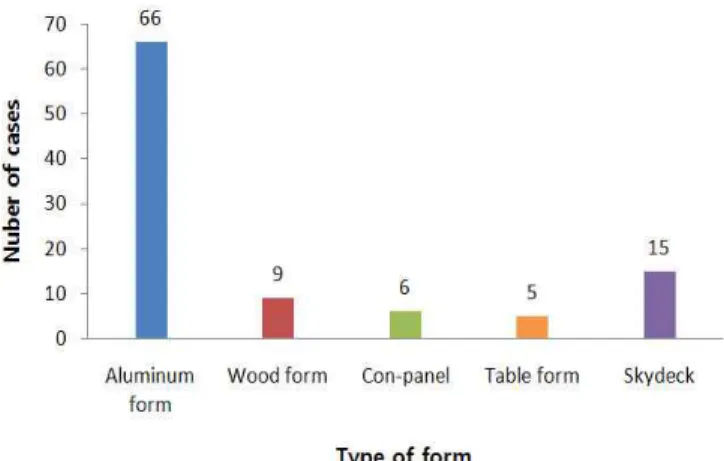
shown in Figure 2. That is, horizontal formwork

systems can be classified into wood form,

aluminum form, corn panel, sky‐deck and table

form. Of these, aluminum formwork was applied at

66 places, and was found to be applied the most

frequently. This is because aluminum formwork

requires low material cost and is not greatly

restricted by the building structure compared to

system form such as sky‐deck and table form. On

(3)

formwork still has a high dependence on the workforce.

At present, the actual site of tall building construction depends on the experience and intuition of working‐level staff in the selection of formwork in many parts. However, as tall building projects become larger and taller, it will become more difficult to select a formwork system suitable for field situations that become bigger and bigger.

Figure 2. The state of horizontal formwork systems

Thus far, studies have been conducted using artificial intelligence methods to support the decision‐making of working‐level staff for the selection of construction methods. While the Adaboost algorithm has been in the spotlight in various areas such as face recognition[12,13], recognition of city structures[14], prediction of bankruptcy[15], and credit assessment[16], there has been almost no application of the Adaboost algorithm to the area of construction. Accordingly, this study will apply the Adaboost algorithm to the selection of a formwork system and examine its applicability in the area of construction based on this.

3. Construction of Model using Adaboost Algorithm

3.1 Overview of Adaboost Algorithm

In general, when a program developer plans to develop a computer program that can predict the solution to a certain problem, he or she first collects information on a rule that can be obtained

collected rule is a rule‐of‐thumb, rough and inaccurate, it must be better than random selection. The boosting method has been proven to be able to create very accurate predictions by combining rule‐of‐thumb methods that can be rough and in accurate in this way[11].

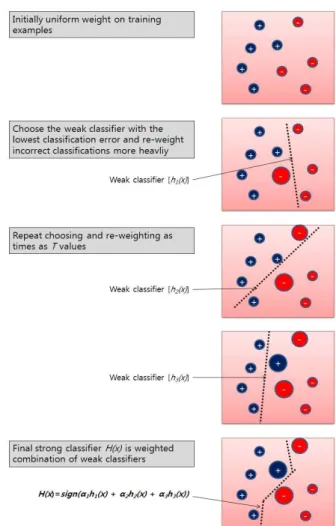
Proposed by Freund & Schapire in 1995 based on this concept, the Adaboost algorithm is a methodology that maximizes the usability of one classifier by its accuracy. That is, the Adaboost algorithm is a simple study algorithm that constructs one strong classifier using a set of influential weak classifiers, as shown in Figure 3.

As a result, this algorithm selects the weak classifiers for which classification can be largely increased when they are combined, and constructs a strong classifier using this so as to predict the classification result when new data is given.

The adaboost algorithm in this study used algorithm[12] improved by Viola & Jones in 2001.

The study process of this Adaboost algorithm can be summarized as follows:

1) Prepare ' ' study data '

', where ' ' for positive and negative values, respectively.

2) Initialize the weight ' ' for ' ' , respectively, where ' ' and ' 'are the numbers for positive and negative value, respectively.

3) For ' ',

① Normalize the weight.

② For each feature point, ' ', learn classifier, ' '. Each error is calculated as '

'.

③ Select the classifier that has the lowest error values, ' '.

④ Update the weight to w t + 1, i = w t i , b t 1 - e

i

. If ' ' is classified accurately, ' ', if not, '

'. And ' '.

4) The strong classifier to finally be determined

is as shown below:

(4)

Formwork System Selection Model for Tall Building Construction Using the Adaboost Algorithm

Figure 3. Simple example showing that Adaboost can construct a strong classifier from a set of weak classifiers

1 1

1 ( ) 0.5

( )

0

T T

t t t

t h x t

h x

otherwise

a a

= ³ ´ =

= í ì î

å å

where, ' '.

3.2 Construction of Formwork System Selection Model using Adaboost Algorithm

1) Multiple Classification using Adaboost Algorithm The Adaboost algorithm was originally developed for dual classification, such as positive or negative. Accordingly, some adjustment is required in the application of the Adaboost algorithm to separate more than 2 classes, as shown in this study. This study applied OVR (one‐versus‐rest) type[8] and this dual classification algorithm to the problem of multiple classification. That is, this study constructed a strong classifier for each formwork system, and applied the type

recommended as a category value of classifier that obtains the highest score ( H(x) ) value among them.

2) Construct Formwork System Selection Model using Adaboost Algorithm

The following is the detailed application process to select the formwork system using the Adaboost algorithm. First, learn the strong classifier for each system formwork using the study data. For study data of each study course, site conditions per case are allocated to and the formwork system is allocated with , which has the value of ‘0’ or ‘1.’ For example, if a strong classifier for one data is properly classified, becomes ‘1,’ and if not, it becomes the value of ‘0’. Second, when the study of a strong classifier for each formwork system is over, calculate the classification score (sum of value of positive / sum of total value) for each strong classifier.

If this value is big, it means that this case is classified more effectively than in the other strong classifier. Third, separate this new case into the category of formwork systems that have the highest classification value. These processes can be schematized and summarized as shown in Figure 4.

Figure 4. Process of formwork system selection model in this study

4. Case Study

4.1 Overview of Experiment

This chapter verified the applicability of the Adaboost model for the selection of a formwork system using 101 collected pieces of data.

Variables were selected through interviews with 10

(5)

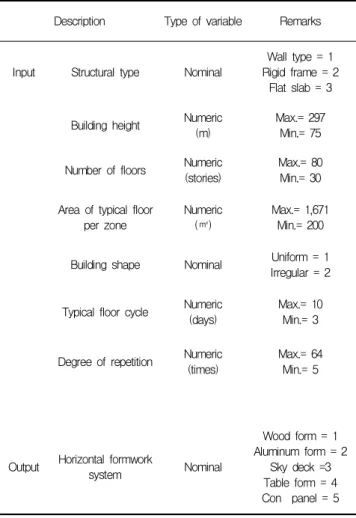
hands‐on experience in the structure work of tall building construction projects and by referring to existing studies[5,17,18]. As a result, Table 1 shows the features of maximum value and minimum value as well as the type of variables applied for model construction. As mentioned in the above chapter, in the Adaboost algorithm, input variables above 7 are allocated to for one data, and the value of ‘0’ or ‘1’ are allocated to value depending on whether it agrees with output variable (result value). From 101 data, 91 data and 20 data were extracted and applied randomly as training data for experiment and data for test.

Table 1. Variables in the formwork system selection Description Type of variable Remarks

Input Structural type Nominal Wall type = 1 Rigid frame = 2

Flat slab = 3

Building height Numeric

(m) Max.= 297

Min.= 75

Number of floors Numeric

(stories) Max.= 80

Min.= 30 Area of typical floor

per zone Numeric

(㎡) Max.= 1,671

Min.= 200

Building shape Nominal Uniform = 1

Irregular = 2

Typical floor cycle Numeric

(days) Max.= 10

Min.= 3

Degree of repetition Numeric

(times) Max.= 64

Min.= 5

Output Horizontal formwork

system Nominal

Wood form = 1 Aluminum form = 2

Sky deck =3 Table form = 4 Con‐panel = 5

In addition, to evaluate the applicability of the proposed model, this study constructed the model using the artificial neural networks, which have been frequently used for classification problems like this study, applied the same data and

artificial neural network model, ‘NeuroShell 2 Release 4.0' of ‘Ward Systems Group Inc.'was used. And, parameters such as hidden layer, momentum and learning rate required for modeling were applied by finding the optimal value as shown in Table 2 through repeated experiments. In addition, given the fact that there are few formwork application cases is few, fivefold cross‐

validation was performed for comparison with performance of 2 models.

Table 2. optimal parameters for ANN

Parameter Number

Hidden layer 1

Hidden neurons 3

Coefficient of the momentum 0.7

Learning rate 0.8

Setting for parameter is required to apply the Adaboost algorithm, like other machine learning algorithm. This algorithm has the 'T' value required for the creation of a weak classifier as a single parameter. According to a previous study [11, 19], the case in which 'T' value is ‘10’

generally has high accuracy and there is no big difference in accuracy when the value increases over this. Since there was no difference in the accuracy of classification depending on an increase in 'T' value based on '10' as a result of experiment, this study set 'T' value to ‘10’ and performed the experiment.

4.2 Case Application and Results

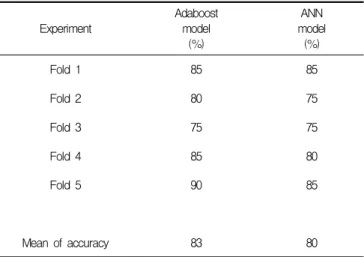
Table 3 shows the results of applying 20 test

data to the Adaboost model proposed by this study

and the artificial neural network model,

respectively. With regard to the average accuracy

of the two models, the Adaboost model recorded an

accuracy of 83 % and artificial neural network

model an accuracy of 80 %, showing that Adaboost

model has slightly higher accuracy. Since the gap

of the result of two models is slight, it is difficult

to determine that the Adaboost model is superior

to the artificial neural network model in terms of

accuracy of prediction.

(6)

Formwork System Selection Model for Tall Building Construction Using the Adaboost Algorithm

Table 3. Comparison of Accuracy of Adaboost and ANN

Experiment Adaboost

model (%)

ANN model (%)

Fold 1 85 85

Fold 2 80 75

Fold 3 75 75

Fold 4 85 80

Fold 5 90 85

Mean of accuracy 83 80

However, it is easier and simpler to construct the Adaboost model than the artificial neural network, which requires a complex process of parameter setting, since the Adaboost model requires the setting of only one parameter. In addition, unlike an artificial neural network model that presents only one result, the Adaboost model did not stop at presenting one alternative as a result, but provided a classification score for each alternative. This feature is considered a useful reference that can be utilized by the working‐level staff for the selection of a tall building formwork system.

These results show that the Adaboost algorithm, which is being newly introduced in the area of construction, has potential applicability to classification problems such as the selection of methods. In particular, it is expected that this algorithm can be applied in areas of classification problems where an artificial intelligence method was applied, such as bidding strategy, risk management, and conceptual cost estimation assessment.

5. Conclusion

Recently, an increase in economical reinforced concrete (reinforced concrete) structures has been conspicuous in Korea due to the development of structure technology and construction materials. In the tall building construction project with reinforced concrete structures, formwork represents a high percentage of construction cost and

construction duration, and affects the subsequent processes, and thus the selection of a formwork system that is suitable for field conditions is an essential factor for project success. Decision‐making on the selection of a formwork system, however, still depends on the experience and intuition of some working‐level employees. In this regard, it is necessary to obtain tools that can scientifically and systematically support decision‐making, given that more and more building construction projects have become bigger and taller. In this regard, this study proposed a formwork selection model using the Adaboost algorithm, which has recently attracted attention in the area of machine learning and prediction models, and verified the applicability of the new algorithm in the area of new construction method selection through comparison with the artificial neural network model in the application of cases. As a result, it was found that the Adaboost algorithm showed rather excellent performance compared to the artificial neural network model in terms of prediction accuracy. In addition, it was simpler and easier to construct a model by setting a simple parameter, and showed the advantage of providing additional information that could be utilized in the decision‐making process, which was a classification score for each alternative along with optimal alternatives. As a result, this study verified that the Adaboost algorithm had potential applicability to classification problems such as the selection of a method in the area of construction.

This study focused on a review of the applicability of Adaboost algorithm for the selection of formwork systems in tall building construction. However, an in‐depth analysis of each variable is required to construct a model that can be applied in the actual site. In addition, further examination is required for the case of formwork system application, much more than the application for model construction.

Finally, while a simple dual classifier was applied

as a weak classifier, the Adaboost algorithm can

use the existing artificial intelligence method such

as an artificial neural network and support vector

machine as a weak classifier. In this regard,

additional study should be conducted to select and

utilize weak classifiers suitable for various cases.

(7)

This work was supported by Gyeongnam National University of Science and Technology Grant.

References

1. Oldfield P, Wood A. 2008 A Bumper Year for Skyscrapers, Although the Future Remains Uncertain [Internet]. Chicago:

Council on Tall Bulidings and Urban Habitat; 2009 January [cited 2011 Aug 30]. 1 p. Available from: http://www. ctbuh.

org/TallBuildings/HeightStatistics/AnnualBuilding Review/2008BuildingsCompleted/2008ABumperYearforSkyscra pers/tabid/785/language/en‐GB/Default.aspx.

2. Kim TH. Optimization of the Formwork Selection Process in Tall Buildings [Master's thesis]. Seoul (Korea): Korea University; 2007. 66 p.

3. Hanna AS. Concrete Formwork Systems. 2nd ed. New York:

Marcel Dekker Inc.; 2005. 262 p.

4. Tam CM, Tong TKL, Lau TCT & Chan KK. Selection of vertical formwork system by probabilistic neural networks models. Construction Management and Economics. 2005 March;23(3):245‐54.

5. Hanna AS, Willenbrock JH, Sanvido VE. Knowledge acquisition and development for formwork selection system.

Journal of Construction Engineering and Management. 1992 March;118(1):179‐98.

6. Kamarthi SV, Sanvido VE, Kumara SRT. NEUROFORM―

Neural network system for vertical formwork selection.

Journal of Computing in Civil Engineering. 1992 April;6(2):178‐99.

7. Kumar PR, Ravi V. Bankruptcy prediction in banks and firms via statistical and intelligent techniques – A review. European Journal of Operational Research. 2007 August;180:1‐28.

8. An SH, Park UY, Kang KI, Cho MY, Cho HH. Application of Support Vector Machines in assessing conceptual cost estimates. Journal of Computing in Civil Engineering. 2007 July/August;21(4):259‐64.

9. Papageorgiou C, Oren M, Poggio T. A General Framework for Object Detection. Proceedings of International Conference on Computer Vision; 1998 January 4‐7; Bombay. India: IEEE Computer Society Press; 1998. p. 555‐62.

10. Schapire RE, Freund Y, Bartlett P, Lee WS. Boosting the margin: a new explanation for the effectiveness of voting methods. Annals of Statistics. 1998 May;26(5):1651‐86.

Journal of Japanese Society for Artificial Intelligence. 1999 September;14(5):771‐80.

12. Viola P, Jones M. Rapid object detection using a boosted cascade of simple features. Proceedings of IEEE International Conference on Computer Vision and Pattern Recognition;

2001 December 8‐14; Hawaii. USA: .IEEE Computer Society Press; 2001. p. 511‐18.

13. Jung SU, Kim DH, An KH, Chung MJ. Efficient rectangle feature extraction for real‐time facial expression recognition based on AdaBoost. Proceeding of IEEE/RSJ International Conference on Intelligent Robots and Systems; 2005 August 2‐6; Edmonton. Canada: IEEE Operations Center; 2005. p.

1941‐46.

14. Steiniger S, Lange T, Burghardt D, Weibel R. An approach for the classification of urban building structures based on discriminant analysis techniques. Transactions in GIS. 2008 March;12(1):31‐59.

15. Cortes EA, Rubio NG, Martinez MG, Elizondo D. Bankruptcy forecasting: an empirical comparison of AdaBoost and neural networks. Decision Support Systems. 2007 April;45(1):110‐22.

16. Park EJ. A comparison of SVM and boosting methods and their application for credit scoring [Master's thesis]. Seoul (Korea): Seoul National University; 2005. 33 p.

17. Proverb DG, Holt GD, Olomolaiye PO. Factors in formwork selection: a comparative investigation. Building Research and Information. 1999 March;27(2):109‐19.

18. Shin Y, Kim DY, Yang SW, Cho HH, Kang KI. Decision support model using the adaboost algorithm to select formwork systems in high‐rise building construction.

Proceeding of the 25th International Symposium on Automation and Robotics in Construction; 2008 June 26‐29;

Vilnius. Lithuania: Institute of Internet and Intelligent Technologies; 2008. p. 644‐9.

19. Arditi D, Pulket P. Predicting the outcome of construction

litigation using boosted decision trees. Journal of

Computing in Civil Engineering. 2005 October;19(4):387‐93.

수치

Figure 2. The state of horizontal formwork systems
Figure 3. Simple example showing that Adaboost can construct a strong classifier from a set of weak classifiers
Table 2. optimal parameters for ANN
Table 3. Comparison of Accuracy of Adaboost and ANN

참조

관련 문서