*Corresponding Author : Kim Hyun Ju (Kyeongnam National University of Science and Technology Educare Teacher's Education Center) Tel: +82-10-5573-3575 email: [email protected]
Received July 25, 2016 Accepted August 11, 2016
Revised August 10, 2016 Published August 31, 2016
어린이집 영아반 및 유아반 교사의
제3차 어린이집 표준보육과정에 대한 인식과 편성·운영 실태
김현주
경남과학기술대학교 보육교사교육원
Recognition, Organization and Management of the Third Standard Childcare Curriculum of Teachers of 0 to 2-year-olds and 3 to
5-year-olds In Child Care Centrer
Kim Hyun Ju
Kyeongnam National University of Science and Technology Educare Teacher's Education Center
요 약 본 연구는 「제3차 어린이집 표준보육과정」에 대한 영아반 및 유아반 교사들의 인식 및 편성·운영 실태를 분석하여 어린이집 표준보육과정 적용과 운영의 실제 변화를 위한 기초 자료를 제공하여 보육의 질적 향상에 기여하고자 하는데 그 목적이 있다. 이를 위해 제3차 어린이집 표준보육과정에 대한 영아반 및 유아반 교사들의 인식, 편성·운영 실태는 어떠한지 와 영역별 실행정도는 어떠한지를 연구문제로 설정하였다. 연구방법은 제3차 어린이집 표준보육과정에 대한 인식 및 편성․
운영 실태에 관한 질문지를 구성하고 경상남도의 보육교사들을 연구대상으로 총 300부의 질문지를 배부하여 267부를 선정 하여 분석하였다. 수집된 연구자료는 t 검증 및 일원변량분석을 실시하였다. 연구결과 첫째, 어린이집 영아반 및 유아반 교사 들은 대체로 제3차 어린이집 표준보육과정을 인식하고 있었다. 둘째, 어린이집 영아반 및 유아반 교사들은 대체로 제3차 어린이집 표준보육과정을 적절히 편성 및 운영하고 있었다. 셋째, 영아반 교사와 유아반 모두 제3차 어린이집 표준보육과정 을 영역별로 실행하고 있었지만 영역별 실행도는 차이가 있었다.
Abstract This article aims to help improve day care qualitatively to offer base data for applying the standard childcare curriculum and improve the management, by analyzing the teacher's recognition, organization and management on the 3rd standard childcare curriculum. For this, we examined teacher's recognition, organization and management on the 3rd standard childcare curriculum and determined how much a teacher of an infant class and a teacher of a young children class conduct for every sector. A questionnaire was prepared to study the recognition, organization and management on the 3rd standard childcare curriculum and the selected study subjects were educare teachers in G-do. T-test and one-way analysis of variance were conducted with the collected research data. The study results are as follows. First, the educare teachers mostly recognized the 3rd standard childcare curriculum. Second, they were properly organizing and managing the 3rd standard childcare curriculum. Third, all the teachers of an infant class and a young children class were conducting the 3rd standard childcare curriculum for every sector.
Keywords : the 3rd standard childcare curriculum, teacher’s recognition, organization and management
1. 서론 1. 연구의 목적 및 필요성
한 국가의 보육과정은 그 나라 보육의 방향을 규정하 고, 미래의 국가경쟁력인 능력 있는 민주시민 양성의 초 석이 되기 때문에 선진국들은 국가수준의 보육과정 개발
과 개선에 꾸준한 노력을 기울여 오고 있다[15]. 이에 우 리나라에서도 2007년에 「영유아보육법 시행규칙」 제 30조와 관련하여 표준보육과정을 개발, 고시한 바 있으 며 2013년 1월 21일에는 「제3차 어린이집 표준보육과 정」이 고시되었다. 특히 「제3차 어린이집 표준보육과 정」은 유치원과 어린이집의 공통과정인 누리과정의 연 령확대로 인해 영유아의 전인적 발달과 우리 문화에 적 합한 내용을 일관성 있고 연계적으로 실천하며, 궁극적 으로 사회에서 추구하는 인간상을 구현하고 전국 어린이 집의 질적 수준을 높이는 데 기여하고자 고시되었다 [13].
우리나라 어린이집 표준보육과정은 0∼5세 영유아를 대상으로 한 어린이집에서 운영해야 할 보편적 보육내용 을 문서로 제시한 것으로, 영유아의 연령 및 발달수준에 적합한 보육서비스를 제공하여 어린이집 영유아의 보육 목적과 목표를 달성하기 위한 국가수준의 보육과정이다.
따라서 어린이집에서는 국가수준의 보육과정에 의거하 여 각 어린이집의 실정, 영유아의 실태, 영유아의 환경, 보육교직원의 실태 등을 감안하여 어린이집 보육과정을 편성․운영할 필요가 있으며, 교사는 각 어린이집의 보 육과정에 기초하여 교사 수준의 보육과정을 편성․운영 하여야 한다. 그러므로 어린이집 보육과정 운영에 있어 서 교사의 역할은 매우 중요하며, 교사의 보육계획 및 운 영은 보육의 질을 결정하는 핵심요인이 된다. 즉, 교사는 보육과정을 최종적으로 그리고 가장 영유아 가까이 실천 하는 사람으로서 보육의 질을 결정하는 중요한 역할을 하기 때문에[20, 26, 재인용] 국가수준의 보육과정의 문 서상 이해정도가 실제 보육과정 편성․운영에 많은 영향 을 미칠 수 있는 것이다. 이에 [6]는 국가수준의 보육과 정이 현장에 적용되기 위해서는 보육과정 실행의 주체자 인 교사들이 문서상의 보육과정을 이해하고 해석해서 보 육 실천에 옮기는 것이 무엇보다 중요하며 어린이집 보 육과정이 교실 수업에 실제 적용 시 교사들이 어떻게 활 용하느냐에 따라 보육과정의 결과는 달라질 수 있는 것 이다[7 재인용]. 또한 [18]은 교육과정 실행 주체로서 교 사의 역할을 강조한 바 있으며, 이에 필요한 전문성을 갖 추기 위해서는 다각적인 노력이 필요하다고 하였다. 결 국 교사는 국가수준의 보육과정을 실행하는 가장 중추적 요인으로서 이들의 국가수준 보육과정의 이해 및 인식여 부에 따라 보육과정 편성·운영이 좌우된다고 해도 과언 이 아니다. 더욱이 「제3차 어린이집 표준보육과정」은
누리과정의 대상연령 확대 등으로 짧은 기간 내에 개정 이 이루어졌으므로 0∼2세를 담당하는 영아반 교사와 3
∼5세 누리과정을 담당하는 유아반 교사들의 정확한 인 식과 편성·운영실태를 파악하여 어린이집 표준보육과정 개선과 운영을 위한 기초 자료를 모색할 필요가 있다.
한편, 표준보육과정 관련 선행연구들을 살펴보면, 표 준보육과정에 기초한 보육프로그램에 관한 연구[4, 5, 11, 25, 33], 표준보육과정에 기초한 관찰척도 개발에 관 한 연구[1], 표준보육과정에 따른 영아보육과정 편성에 관한 연구[8], 표준보육과정과 유치원교육과정과의 비교 연구[2, 23], 표준보육과정에 대한 교사의 인식 및 운영 실태에 관한 연구[9, 10, 12, 17, 19, 22, 24, 27, 28, 29, 31, 32, 33, 34] 등으로 2007년도 표준보육과정 고시를 기준으로 활발히 이루어져 왔으나 이들 연구들은 제1차 와 제2차 표준보육과정에 초점을 둔 것으로 최근 고시된
「제3차 어린이집 표준보육과정」에 대한 교사들의 인 식 및 운영실태에 관한 연구로는 [12]의 연구, [31]의 연 구, [3]의 연구로 단 3편 뿐이다. 이들 연구는 담당학급 의 연령에 관계없이 보육교사 및 원장을 대상으로 수행 되어지거나 영아반 교사만을 대상으로 수행되어 졌다.
더욱이 변인으로써 담당학급연령을 0-2세 영아반과 3-5 세 유아반 교사로 나누어 비교 분석한 연구는 한 편도 찾아볼 수 없는 실정이다. 현재 실시되고 있는 「제3차 어린이집 표준보육과정」은 「제2차 표준보육과정」과 달리 3-5세 보육과정인 누리과정을 포함하고 있다. 또한 현장에서는 교사들을 대상으로 표준보육과정과 누리과 정 연수를 따로 실시하고 있는 점을 미루어 볼 때 연수 참여정도에 따른 영아반과 유아반 교사의 인식 및 편성·
운영실태를 살펴보는 것은 매우 필요하고 중요하다고 하 겠다.
따라서 본 연구에서는 어린이집 영아반과 유아반 교 사의 「제3차 어린이집 표준보육과정」에 대한 인식 및 편성·운영실태를 알아보고, 교사의 변인(경력, 학력, 교 육참여유무)에 따른 차이를 알아보는데 그 목적을 둔다.
이와 같은 목적을 위해 다음과 같은 연구문제를 설정 하였다.
첫째, 어린이집 영아반 및 유아반 교사의「제3차 어 린이집 표준보육과정」에 대한 인식은 어떠하며, 변인 (경력, 학력, 교육참여유무)에 따라 차이가 있는가?
둘째, 어린이집 영아반 및 유아반 교사의「제3차 어 린이집 표준보육과정」에 대한 편성·운영 실태는 어떠하
며, 변인(경력, 학력, 교육참여유무)에 따라 차이가 있는가?
셋째, 어린이집 영아반 및 유아반 교사의 「제3차 어 린이집 표준보육과정」에 대한 영역별 실행정도는 어떠 한가?
2. 연구방법
2.1 연구대상
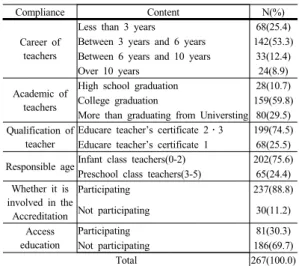
어린이집 교사의 제3차 어린이집 표준보육과정에 대 한 인식 및 편성·운영실태를 파악하기 위한 본 연구의 대 상은 경남지역의 어린이집에 근무하는 267명의 교사들 이다. 경남지역 어린이집 교사들을 대상으로 한 하계 보 육교직원 보수교육 강의를 시작하기 전에 총 300부의 질문지를 배부하였으며, 이중에서 유효한 응답인 총 285 부를 회수하였다. 그러나 중복 표기로 인해서 연구 자료 로 활용할 수 없는 질문지 28부를 제외하여서 실제 분석 에서 최종자료로 활용한 질문지는 총 267부이다. 연구대 상의 일반적인 배경은 다음 Table 1 과 같다.
Compliance Content N(%)
Career of teachers
Less than 3 years 68(25.4)
Between 3 years and 6 years 142(53.3) Between 6 years and 10 years 33(12.4)
Over 10 years 24(8.9)
Academic of teachers
High school graduation 28(10.7)
College graduation 159(59.8)
More than graduating from Universting 80(29.5) Qualification of
teacher
Educare teacher’s certificate 2․3 199(74.5) Educare teacher’s certificate 1 68(25.5) Responsible ageInfant class teachers(0-2) 202(75.6) Preschool class teachers(3-5) 65(24.4) Whether it is
involved in the Accreditation
Participating 237(88.8)
Not participating 30(11.2)
Access education
Participating 81(30.3)
Not participating 186(69.7)
Total 267(100.0)
Table 1. General characteristics
2.2 연구도구
본 연구에서 사용된 연구도구는 제3차 어린이집표준 보육과정에 대한 교사들의 인식 및 편성·운영실태를 알 아보기 위한 질문지로서 연구목적에 따라 크게 ‘교사의 일반적인 배경’, ‘제3차 어린이집 표준보육과정에 대한 보육교사의 인식’, ‘제3차 어린이집 표준보육과정의 편 성 및 운영실태’로 구성되어 있다. 질문지의 문항 내용은
2013년 1월 보건복지부가 고시한 「제3차 어린이집 표 준보육과정의 총론」, 「2015년도 보육사업안내」를 기 초로 하였으며, 제3차 어린이집 표준보육과정에 대한 보 육교사의 인식에 관한 연구는 [19]의 연구도구를 참고로 하여 두 차례의 예비조사와 내용 타당도 검증을 거쳐 본 연구자가 질문지를 구성하였다. 질문지 문항은 다지 선 다형, 배열형, 개방형으로 구성하였다. 질문지의 구성은 총 58문항으로 이 중 6문항은 교사의 배경을 알아보기 위한 것이고, 16문항은 제3차 어린이집 표준보육과정에 대한 인식을 알아보기 위한 것이며, 나머지 36문항은 교 사의 제3차 어린이집 표준보육과정의 편성 및 운영실태 를 알아보기 위한 것이다. 질문지 내용은 다음 Table 2 와 같다.
Subcategory Contents(Item Number) Item Number
Distributed background
․Career of teachers(1)
․Academic of teachers(1)
․Qualification of teacher(1)
․Responsible age(1)
․Whether it is involved in the Accreditation(1)
․Access education(1)
6
Recognition of the Third Standard
Childcare Curriculum
․Preliminary experience(6)
․Interest and understanding(10) 16
Organization and management of the
Third Standard Childcare Curriculum
․Organization and management(30)
․Practice degree of area(5-6) 36
Total 58
Table 2. The contents of the survey by category
2.3 자료 분석
본 연구의 자료는 SPSS Window용(ver. 18.0)을 사용 하고 t검증과 일원변량분석(ANOVA)을 실시하였으며, Scheffe 사후검정을 추가적으로 실시하였다.
3. 연구결과
3.1 어린이집 영아반 및 유아반 교사의「제3차 어린이집 표준보육과정」에 대한 인식 3.1.1 제3차 어린이집 표준보육과정에 대한 사전
경험정도
Content Infant class teachers Preschool class teachers
N M SD t/F(p) N M SD t/F(p)
Career of teachers
Less than 3 years 52 2.807 .778
1.256(.291)
16 3.104 .666
.945(.425)
Between 3 years and 6 years 108 2.757 .719 34 3.044 .688
Between 6 years and 10 years 27 2.963 .710 6 3.277 1.020
Over 10 years 15 3.077 .552 9 2.722 .311
Total 202 2.821 .725 65 3.035 .679
Academic of teachers
High school graduation 26 2.596 .826
1.839(.162)
2 2.833 .000
3.697*(.030)
College graduation 119 2.822 .652 40 2.875 .668
More than graduating from Uviversting 57 2.924 .807 23 3.333 .639
Total 202 2.821 .725 65 3.035 .679
Access education
Participating 132 3.064 .626
-7.336*(.00 0)
54 3.243 .522
-7.420*(.000
Not participating 70 2.364 .679 11 2.015 .360 )
Total 202 2.714 .652 65 2.629 .441
*p<.05
Table 4. Teachers according to the variables of the Third Standard Childcare Curriculum
N M SD t(p)
Infant class
teachers 202 2.822 .725
-2.101* (.037) Preschool class
teachers 65 3.035 .680
*p<.05
Table 3. Preliminary experience of the Third Standard Childcare Curriculum
제3차 어린이집 표준보육과정에 대한 사전경험에 대 한 교사들의 인식을 살펴본 결과, 위의 Table 3 에서 제 시한 바와 같이 연구대상 영아반 및 유아반 교사들의 인 식은 통계적으로 유의한 차이가 있는 것으로 나타났다 (t=-2.101, p<.05). 제3차 어린이집 표준보육과정에 대한 사전경험정도에 있어 영아반 교사는 평균 2.822인 반면 유아반 교사는 평균 3.035로 유아반 교사가 사전경험정 도가 좀 더 높은 것으로 나타났다.
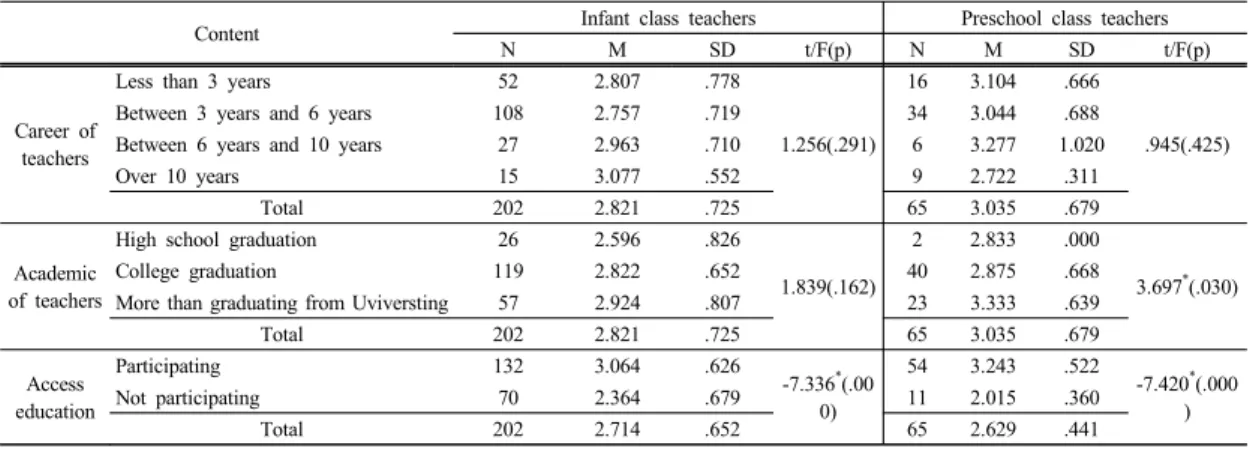
교사변인에 따른 제3차 어린이집 표준보육과정에 대 한 사전경험에 대한 교사들의 인식을 살펴본 결과, 위의 Table 4 에서 제시한 바와 같이 영아반 교사경력, 교사 학력에 따라서는 통계적으로 유의한 차이가 없으나 교육 참여유무에 따라서는 통계적으로 유의한 차이가 있는 것 으로 나타났다(p<.05). 즉, 교육참여를 한 영아반 교사의 사전경험정도가 교육참여를 하지 않은 영아반 교사보다 사전경험정도가 좀 더 높았다.
한편, 유아반 교사학력과 교육참여유무에 따라서는 통계적으로 유의한 차이가 있는 것으로 나타났다 (p<.05). 즉, 유아반 교사학력에 있어서는 4년제 대학교 이상 졸업교사가 평균 3.113으로 가장 높은 사전경험정
도를 보였다. 사후분석결과에서도 전문대학 졸업교사와 4년제 대학교 이상 졸업교사의 평균의 차이가 통계적으 로 유의한 것으로 나타났다(p<.05). 또한 유아반 교사 교육참여유무에 있어서도 통계적으로 유의한 차이가 있 는 것으로 나타났다(p<.05).
3.1.2 제3차 어린이집 표준보육과정에 대한 관심과 이해정도
제3차 어린이집 표준보육과정에 대한 관심과 이해정 도에 대한 교사들의 인식을 살펴본 결과, 위의 Table 5 에서 제시한 바와 같이 연구대상 영아반 및 유아반 교사 들의 인식은 통계적으로 유의한 차이가 있는 것으로 나 타났다(t=-2.180, p<.05). 제3차 어린이집 표준보육과정 에 대한 관심과 이해정도에 있어 영아반 교사는 평균 2.978인 반면 유아반 교사는 평균 3.086으로 유아반 교 사가 관심과 이해정도가 근소하지만 좀 더 높은 것으로 나타났다.
N M SD t(p)
Infant class
teachers 202 2.978 .492
-2.180* (.030) Preschool class
teachers 65 3.086 .282
*p<.05
Table 5. Interest and understanding of the Third Standard Childcare Curriculum
교사변인에 따른 제3차 어린이집 표준보육과정에 대 한 관심과 이해정도에 대한 교사들의 인식을 살펴본 결
Content Infant class teachers Preschool class teachers
N M SD t/F(p) N M SD t/F(p)
Career of teachers
Less than 3 years 52 2.807 .778
1.256(.291)
16 3.104 .666
.945(.425)
Between 3 years and 6 years 108 2.757 .719 34 3.044 .688
Between 6 years and 10 years 27 2.963 .710 6 3.277 1.020
Over 10 years 15 3.077 .552 9 2.722 .311
Total 202 2.821 .725 65 3.035 .679
Academic of teachers
High school graduation 26 2.596 .826
1.839(.162)
2 2.833 .000
3.697*(.030)
College graduation 119 2.822 .652 40 2.875 .668
More than graduating from Uviversting 57 2.924 .807 23 3.333 .639
Total 202 2.821 .725 65 3.035 .679
Access education
Participating 132 3.064 .626
-7.336*(.000)
54 3.243 .522
-7.420*(.000)
Not participating 70 2.364 .679 11 2.015 .360
Total 202 2.714 .652 65 2.629 .441
*p<.05
Table 6. Teachers according to the variables of Interest and understanding of the Third Standard Childcare Curriculum
Content Infant class teachers Preschool class teachers
N M SD t/F(p) N M SD t/F(p)
Career of teachers
Less than 3 years 52 3.089 .572
.314(.815)
16 3.299 .528
1.168(.329)
Between 3 years and 6 years 108 3.090 .507 34 3.205 .318
Between 6 years and 10 years 27 3.064 .572 6 3.419 .303
Over 10 years 15 3.220 .447 9 3.053 .543
Total 202 3.096 .527 65 3.226 .412
Academic of teachers
High school graduation 26 2.872 .708
2.957(.054)
2 3.060 .262
7.282*(.001)
College graduation 119 3.151 .509 40 3.100 .359
More than graduating from Uviversting 57 3.070 .456 23 3.469 .415
Total 202 3.096 .527 65 3.226 .412
Access education
Participating 132 3.117 .511
-.787(.432)
54 3.257 .422
-1.351(.181)
Not participating 70 3.055 .559 11 3.074 .335
Total 202 2.946 .488 65 2.990 .328
*p<.05
Table 8. Teachers according to the variables of Organization and management of the Third Standard Childcare Curriclum 과, 위의 Table 6에서 제시한 바와 같이 영아반과 유아
반 교사 모두 교사경력, 교사학력에 따라서는 통계적으 로 유의한 차이가 없으나 교육참여유무에 따라서는 통계 적으로 유의한 차이가 있는 것으로 나타났다(p<.05).
즉, 교육참여유무에 따라서는 영아반과 유아반 교사 모두 교육참여경험이 있는 교사들이 높은 관심과 이해정 도를 보였고, 교육참여경험이 있는 영아반 교사 평균 3.046, 유아반 교사 3.135로 유아반 교사가 근소하지만 좀 더 높은 관심과 이해정도를 보임을 알 수 있으며 통 계적으로도 유의한 차이를 보였다(p<.05).
3.2 어린이집 영아반 및 유아반 교사의「제3차 어린이집 표준보육과정」에 대한 편성·
운영 실태
3.2.1 제3차 어린이집 표준보육과정에 대한 편성·
운영 실태
제3차 어린이집 표준보육과정에 대한 편성·운영 실태 를 살펴본 결과, 위의 Table 7에서 제시한 바와 같이 연 구대상 영아반 및 유아반 교사들의 편성·운영 실태는 통 계적으로 유의한 차이가 있는 것으로 나타났다(t=-2.080, p<.05). 제3차 어린이집 표준보육과정에 대한 편성·운영 실태에 있어 영아반 교사는 평균 3.096인 반면 유아반 교사는 평균 3.226으로 유아반 교사의 편성·운영 실태가 높게 나타났다.
N M SD t(p)
Infant class
teachers 202 3.096 .527
-2.080* (.039) Preschool class
teachers 65 3.226 .412
*p<.05
Table 7. Organization and management of the Third Standard Childcare Curriculum
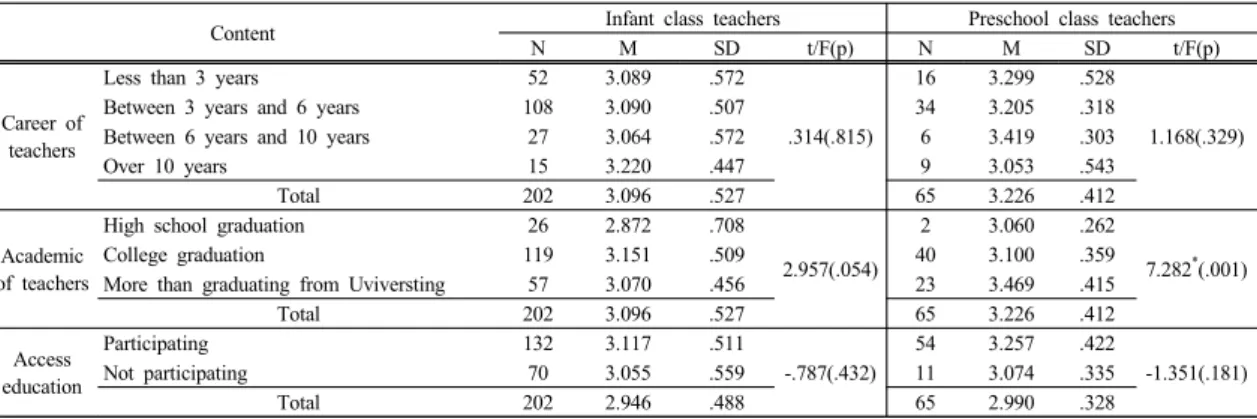
교사변인에 따른 제3차 어린이집 표준보육과정에 대 한 편성·운영 실태를 살펴본 결과, 위의 Table 8에서 제 시한 바와 같이 영아반 교사는 교사경력, 교사학력, 교육 참여유무에 따라서는 통계적으로 유의한 차이가 없는 것 으로 나타났다.
반면 유아반 교사는 교사경력과 교육참여유무에 따라 서는 통계적으로 유의한 차이가 없으나 교사학력에 따라 서는 통계적으로 유의한 차이가 있는 것으로 나타났다 (p<.05). 교사학력에 대한 유아반 교사의 사후분석결과 전문대학 졸업교사와 4년제 대학교 이상 졸업교사에 대 해서 통계적으로 유의한 차이를 보였다(p<.05).
3.3 어린이집 영아반 및 유아반 교사의「제3차 어린이집 표준보육과정」에 대한 영역별 실행정도
3.3.1 제3차 어린이집 표준보육과정에 대한 영아반 교사의 영역별 실행정도
영아반 교사의 제3차 어린이집 표준보육과정의 영역 별 실행정도를 분석한 결과, 위의 Table 9에서 제시한 바와 같이 실행정도는 평균 3.37으로 대체로 높게 나타 났다. 영역별로 살펴보면, 기본생활영역의 경우는 평균 3.53으로 가장 높게 나타났으며, 신체활동영역은 평균 3.48, 의사소통영역은 평균 3.40 순으로 높게 나타났다.
자연탐구영역의 경우는 3.20으로 상대적으로 낮게 나타 났다.
area M SD
Basic life 3.53 .54
Physical exercise 3.48 .61
Social relations 3.38 .64
Communication 3.40 .59
Natural research 3.20 .68
Art experience 3.24 .60
Practice degree 3.37 .52
Table 9. Practice degree of area of the Third Standard Childcare Curriculum of Infant class teachers
유아반 교사의 제3차 어린이집 표준보육과정의 영역 별 실행정도를 분석한 결과, 위의 Table 10에서 제시한 바와 같이 교사들의 영역별 실행정도는 의사소통영역의 경우는 평균 3.48로 가장 높게 나타났으며, 신체운동․
건강영역은 평균 3.36, 사회관계영역은 평균 3.35 순으 로 나타났다. 자연탐구영역의 경우에는 평균 3.21로 상 대적으로 낮게 나타났다.
area M SD
Physical exercise․health 3.36 .56
Social relations 3.35 .52
Communication 3.48 .50
Natural research 3.21 .54
Art experience 3.32 .55
Practice degree 3.34 .42
Table 10. Practice degree of area of the Third Standard Childcare Curriculum of preshool class teachers
4. 논의 및 제언
본 연구는 경남지역 어린이집 영아반과 유아반 교사 의 「제3차 어린이집 표준보육과정」에 대한 인식 및 편 성·운영실태를 알아보고, 교사의 변인(경력, 학력, 교육 참여유무)에 따른 차이를 알아보는데 그 목적이 있다. 본 연구의 결과를 연구문제를 중심으로 논의하면 다음과 같다.
첫째, 어린이집 영아반 및 유아반 교사는 제3차 어린 이집 표준보육과정에 대해 대체로 인식하고 있는 것으로 나타났으며 이는 [31], [3]의 연구결과와도 일치한다. 제 3차 어린이집 표준보육과정에 대한 사전경험정도에 있 어서는 영아반 및 유아반 교사들이 제3차 표준보육과정 에 대해 들어 본 적은 있으나 교육참여정도는 낮은 것으 로 나타났다. 이러한 결과는 표준보육과정에 대한 교 육․연수가 제대로 시행되지 않고 있다고 발표한 [24]의 연구 결과와도 일치하는 것으로 국가수준의 보육과정의 교육 및 연수의 확대 실시와 전 교사가 참여할 수 있는 방안 마련이 시급한 것을 시사한다. 특히, 교사의 국가수 준 보육과정 인식은 어린이집 보육과정 편성 및 운영에 많은 영향을 미치므로 이를 주지할 필요가 있다. 이는 국 가에서 추구하는 인간상 구현과도 직결되는 것으로 교사 의 보육과정 인식 결과가 자라나는 영유아에게 영향을 미치고 나아가 국가의 인재양성 초석에도 영향을 미치게 되므로 국가수준 보육과정 연수를 위한 정책적인 해결방 안 모색과 지원이 필요하다고 하겠다.
둘째, 어린이집 영아반 및 유아반 교사의 제3차 어린 이집 표준보육과정에 대한 편성·운영 실태는 적절히 편 성·운영되고 있는 것으로 나타났으며 이는 [3], [14], [21]의 연구결과와도 일치한다. 영아반과 유아반 교사의 편성·운영 실태를 비교해 보았을 때는 영아반 교사에 비 해 유아반 교사가 제3차 어린이집 표준보육과정의 편성·
운영 실태 정도가 높게 나타났다. 이와 같은 결과는 유아 반 교사 못지않게 영아반 교사는 제3차 어린이집 표준보 육과정을 연령집단별로 수준별로 적용하게 되어있는 점 을 미루어 볼 때 영아반 교사의 역할 및 전문성을 재고 하게 한다. 그러므로 [19]의 연구에서 제안한 바와 같이 교육과정 실행 주체로서 필요한 영아반 교사의 전문성을 갖추기 위한 다각적인 노력이 필요하다고 하겠다.
또한 교사변인(경력, 학력, 교육참여유무)에 따라서는 영아반 교사는 경력, 학력, 교육참여유무에 따른 차이가 나타나지 않았는데 이는 [3]의 연구결과와도 일치한다.
반면 유아반 교사는 경력, 교육참여유무에 따라서는 통 계적으로 유의한 차이가 없었으나 학력에 따라서는 통계 적으로 유의한 차이가 있는 것으로 나타났다. 즉 학력에 따른 차이에서 ‘4년제 대학교 이상’에서 높은 편성·운영 실태를 보였다. 이는 [14]의 연구에서 유아반 교사의 경 력과 학력에 따라 표준보육과정 편성·운영 실태가 차이 가 있는 것으로 밝힌 연구결과와는 다소 다른 결과로서 유아반 교사의 경력보다는 학력이 표준보육과정 편성·운 영에 영향을 미치는 교사의 변인이 됨을 알 수 있다.
셋째, 영아반 교사와 유아반 교사의 제3차 어린이집 표준보육과정의 영역별 실행정도는 두 집단 모두 대체로 높게 나타났으나 영역별 실행도는 차이가 있었다. 영아 반 교사는 기본생활영역 실행도가 매우 높았고, 자연탐 구영역의 실행도는 상대적으로 낮았다. 반면, 유아반 교 사는 의사소통영역의 실행도가 높았고, 자연탐구영역의 실행도는 낮았다. 이러한 결과들을 미루어볼 때 영아반 교사와 유아반 교사의 각 영역에 대한 충분한 인지와 실 행으로 한 영역에 치우치지 않는 통합보육이 절실함을 암시하는 것으로도 볼 수 있다.
본 연구의 제한점을 바탕으로 후속연구를 위한 제언 을 하면 다음과 같다.
첫째, 본 연구는 표준보육과정을 운영하고 있는 보육 교사들을 대상으로 설문조사를 하였으므로 현장관찰 등 질적 연구를 통한 다양한 접근의 후속연구가 필요하다.
둘째, 본 연구는 제3차 어린이집 표준보육과정의 영 역별 실행정도에 있어서 연령별 하위내용범주를 다루지 못하였다. 따라서 표준보육과정 각 연령집단별 하위내용 범주에 따른 교사들의 인식 및 운영실태에 관한 연구가 필요하다.
셋째, 본 연구는 경상남도의 한정된 지역만을 대상으 로 하였으므로 제3차 어린이집 표준보육과정 인식 및 편
성․운영실태에 관한 전체 실태에 일반적으로 적용하기 가 어렵다. 따라서 전국 어린이집을 대상으로 한 후속연 구가 필요하다.
Reference
[1] Kang, Hyun Mi, & Hwang, Hae Ik, “A Preliminary Study into the Infant Observation Scale Based on the National Curriculum for Childcare Centers”, Korea Journal of child studies, vol. 32, no. 5, pp. 167-183, 2011.
DOI: http://dx.doi.org/10.5723/KJCS.2011.32.5.167 [2] Kim, Sun Kyung, “A Comparative Study on the
Standard Edu-care Course and the New(7th) Kindergarten Curriculum”, Master’s thesis Department of social welfar graduate school of Myongji University, 2009.
[3] Kim, Su Yeon, “The 3rd Standard Childcare Curriculum amended in 2013 has reflected on the site and to look into childcare teachers' interests, understanding level, its operation condition, participation rates of the related education or training and their requirements”, Master’s thesis Department of early childhood education graduate school of Gunsan University, 2014.
[4] Kim, Suk Ja, & Kim, Hee Kyung, “Analysis of Economic Concepts Presented in the Childcare program”, Journal of early childhood education research
& review, vol. 13, no 6, pp. 367-389, 2009.
[5] Kim, Suk Ja, & Kim, Yun Yi, “Analysis of the Contents of Multicultural Education in the Childcare Program”, Journal of early childhood education research & review, 15(3), 441-457, 2011.
[6] Kim, Suk Hee, “A Qualitative Study on the Field Operation and Teacher's Understanding of "The 6th Kindergarten Curriculum" : Focused on the Free Play”, Master’s thesis Department of early childhood education graduate school of Young nam University, 2002.
[7] Kim, Woo Yong, “(A)Study of Teacher's Recognition and Application on the Revision of the Kindergarten Curriculum in 2007”, Master’s thesis Department of early childhood education graduate school of Chonam University, 2010.
[8] Park, So Young, “Organization and Management States of the Early Childhood Curriculum at Levels of Child Care Centers according to National Standardized Child Care Curriculum”, Journal of Child Education, vol. 19, no. 2, pp. 71-85, 2010.
[9] Park, Jong Mi, “A study on the practice level and barriers of the infant under 2 years child care teachers for 『Standard Childcare course』”, Master’s thesis Department of early childhood education graduate school of Chungang University, 2011.
[10] Park, Ji Hyun, “A Study on Teachers’ Recognition and Management”, Master’s thesis Department of chid welfare graduate school of Gyengnam National University, 2011.
[11] Byun, Sun Ju, Kim, Suk Ja, Kim, Hyun Jung, & Jung, Mi Hyun, “Analysis of Child"s Character Education Presented in Child –Care Program”, Journal of early childhood education research & review, vol. 17, no. 2, pp. 471-494, 2013.
[12] Park, Hye Yong, “Nursery Teacher’s Understanding and Use of the 3rd Standard Chuldcare Curriculum”, Master’s thesis Department of education graduate school of Kumoh National Institute Technology, 2014.
[13] Ministry of health & weltare, Standard child care curriculum, 2013.
[14] Son, Ji Yeon, “A survey on Nuri Curriculum operating state for 3-5 year old children in childcare center”, Master’s thesis Department of early childhood education graduate school of Korea National University, 2014.
[15] Ministry of Gender Equality and Family, Standard child care curriculum, Seoul, 2005-26.
[16] Ministry of Gender Equality and Family, Standard child care curriculum of education program, Seoul, 2007.
[17] Yun, Jong Hee, “necessary on-site day care environment and the professional commitment of day care teachers”, Master’s thesis Department of early childhood education graduate school of Gkmin University, 2011.
[18] Yeom, Ji Sook. “Kindergarten Teacher as an Initiator of Curriculum Implementation”, Journal of early childhood education research & review, vol, 15. no. 6, pp.295-31, 2011.
[19] Lee, Dong Ryul, “Child care teachers’ perception and management of Standard child care curriculum”, Master’s thesis Department of social welfare graduate school of Kyungwoon National University, 2009.
[20] Lee, Soon Ja, “The study of Public kindergarten teachers` perceptions on field problems occurring during managing curriculum”, Journal of Korea open association for early childhood education, vol. 17, no. 4, pp. 1-21, 2003.
[21] Lee, Jung Wuk, & Park, Jin Lee, “An investigation of the current state of the Korean National Curriculum ,NURI, for ages 3-5 in child care centers in the Seoul metropolitan area”, Journal of early childhood education, vol. 33, no. 6, pp. 339-365, 2013.
DOI: http://dx.doi.org/10.18023/kjece.2013.33.6.015 [22] Lee, Han Eun, “The relation between perception of the
Standard Childcare curriculum for the childcare teacher and the performance degree”, Master’s thesis Department of education graduate school of Sookmyung Woomen’s University, 2008.
[23] Lee, Hyun Ju, “Comparison Study of Kindergarten Curriculum and Child care center Standard Childcare cours”, Master’s thesis Department of early childhood education graduate school of Kangwon University, 2012.
[24] Lee, Hoon Hi, “Ouklook of daycare teachers on the National Curriculum for childcare centers and the state of curriculum management”, Master’s thesis Department of early childhood education graduate school of Ewha Womans University, 2008.
[25] Lee, Eun Sil, “An effect on young children’s bias, self-concept and prosocial behaviors of a multi-cultural childcare program”, Master’s thesis Department of early childhood education graduate school of science and
technology, Kyungpook Natinal University, 2011.
[26] Lee, Hee Kyung, & Lee, Kun Hee, “Teachers`
Perception and Requests for Kindergarten Curriculum Management in Gyeonggi Province”, Journal of early childhood education research & review, vol. 17, no. 1, pp. 195-224, 2013.
[27] Lim, Seon Mi, “The Actual State of the Use of the National Standard Educare Curriculum by Child Care Teachers in the Gyeongnam Area and their Requests for Support”, Master’s thesis Department of early childhood education graduate school of Gyeongnam University, 2010.
[28] Jung, Su Mi, “Perception and operation status of the Standard Childcare Curriculum Focusing on the child care teachers for 3-5 year-olds”, Master’s thesis Department of early childhood education graduate school of Gyeongwon University, 2009.
[29] Jung, Ul Soon, “Perception and operation status of the Standard Childcare Curriculum Focusing on the child care teachers”, Master’s thesis Department of early childhood education graduate school of Aju University, 2009.
[30] Jo, Hee Ja, “Childcare Teachers' Recognition and Application on the Standard Chidcare Curriculum”, Master’s thesis Department of early childhood education graduate school of Gwangju University, 2011.
[31] Ju, Hyun Mi, “A Study on Teachers' Recognition and Actual Conditions adout the Third Standard Child Care Center Curriculum”, Master’s thesis Department of early childhood education graduate school of Gongju University, 2014.
[32] Han, Su Yean, “Development of a multi-cultural childcare program based on the standard childcare curriculum and test of its effects”, Master’s thesis Department of education graduate school of Uiduk University, 2011.
[33] Ham, Hyun, “An analysis of child-care teachers’
understanding & practices of the national chil-care curriculum”, Master’s thesis Department of education graduate school of Konkuk University, 2009.
[34] Hwang, Hye Kyung, “A research on the understanding and practice of the standard childcare course by childcare teachers”, Master’s thesis Department of child welfare graduate school of Science and Technology Kyungpook University, 2010.
김 현 주(Kim Hyun Ju) [정회원]
•2000년 2월 : 경남대학교 교육대학 원 유아교육전공 졸업(교육학석사)
•2010년 2월 : 전남대학교 대학원 유아교육과 졸업(교육학박사)
•2003년 9월 ~ 현재 : 경남과학기 술대학교 보육교사교육원 전임교수
<관심분야>
보육과정, 놀이지도