A Study on the Determinants of Acceptance of Beacon as an O2O Marketing Media: Focusing on the Difference between Beacon
Accepter and Non-accepter
Min-Wook Choi
Professor, Dept. of Advertising & Public Relations, Namseoul University
O2O 마케팅 수단으로서 비콘의 수용에 영향을 미치는 요인에 관한 연구: 비콘 수용자와 비수용자의 차이를
중심으로
남서울대학교 광고홍보학과 교수
최민욱
Abstract This study tries to grasp the factor that affects the acceptance of beacon as an O2O marketing tool. This study examined whether there is a difference between beacon accepter as a means of marketing communication and non-accepter in terms of related variables. As a result, there were significant differences between beacon perceiver and non-perceiver in 'smartphone usage' and 'brand consciousness'. In order to understand the predictive variables influencing beacon acceptance as a means of marketing communication, this study used 'perceiving beacon as a marketing communication media' as a dependent variable to perform logistic regression analysis. As a result of the analysis, it was found that 'smartphone usage' and 'brand consciousness' were the predictive variables affecting beacon perceiving. This study tried to analysis the results in the viewpoint of perceived usefulness and ease-of-use which were insisted by TAM.
Key Words : Beacon, Use-Diffusion model, Acceptance, O2O marketing, IoT
요 약 본 연구에서는 O2O 마케팅 수단으로서 비콘의 수용에 영향을 미치는 요인의 파악을 시도하였다. 구체적으로 관련 변인들에서 마케팅 커뮤니캐이션 수단으로서 비콘의 수용자와 비수용자 사이에 차이가 있는지 검증하였다. 연구 결과 ‘스마트폰 이용량’과 ‘브랜드 인식’에서 인지자와 비인지자 사이에 유의미한 차이가 발견되었다. 또한 마케팅 커뮤 니케이션 수단으로서 비콘의 수용 예측 변인을 파악하기 위하여 ‘마케팅 커뮤니케이션 수단으로서 비콘의 수용’을 종속 변인으로 로지스틱 회귀분석을 실시하였다. 연구결과 ‘스마트폰 이용량’과 ‘브랜드 인식’ 모두 마케팅 커뮤니케이션 수 단으로서 비콘의 수용에 영향을 미치는 예측변인임이 검증되었다. 본 연구 결과를 TAM에서 주장되는 지각된 유용성과 지각된 사용 용이성 관점에서 분석하였다.
주제어 : 비콘, 사용-확산 모델, 수용, O2O 마케팅, 사물인터넷
*Funding for this paper was provided by Namseoul university
*Corresponding Author : Min-Wook Choi([email protected]) Received February 13, 2019
Accepted May 20, 2019 Revised April 28, 2019
Published May 28, 2019
1. Introduction
This study tries to grasp the factor that affects the acceptance of beacon as an O2O marketing tool by applying the use diffusion model.
Recently with the spread of O2O marketing and Internet of Things(IoT), beacon is used widely in various sectors of society. Walking down the street, you get to see on your smartphone the message with free coupons and discount messages from nearby restaurants and cafes.
When you get into the stores, you are introduced about events and provided help with your shopping through your smart phone. After finishing order and payment using beacon, you can get your coffee right away without the need to wait in line. Like this, beacon helps receiving information and services automatically in various places such as cafes, department stores, exhibition halls, and stadiums, providing smarter consumption and life.
Beacon is a Wireless local area network technology based on bluetooth low-electricity technology and beacon service is a kind of smart phone local area communication technology and a location-based service that makes it possible to find the location of a user within short range and makes mobile payment available threats[1]. Beacon realizes not only finding location, but other functions such as marketing, location information, automation, and automatic payment[2].
Especially, beacon is a kind of O2O(Online to Offline) platform that connects online and offline, and it is used as a means of marketing that starts promotion when a user of a smart phone with beacon app installed on it walks into a store that is registered for the service. In the relevant industry, beacon is considered to become the core of O2O marketing based on the organic combination of smart phone and finding location and it is expected to be the motive power in the growth of O2O platform in the future.
Beacon is a new technology and service that is spreading to society today. Especially, O2O marketing and IoT that bring innovation in various fields of society and lead a new paradigm have great growth potential. Therefore, understanding the acceptance and diffusion processes of beacon as new technologies and services is of great significance both academically and practically.
Recently, as the convergence and diffusion of IT convergence technology rapidly develops in new media environment, many researches on the diffusion and adoption of new technologies and services are under way. In addition, there are an increasing number of studies on the diffusion of new products and services among social system members. The diffusion studies have been mainly based on Rogers' Innovation Theory[3] and Acceptance-Diffusion, which is represented by the Technology Acceptance Model (TAM).
In recent years, researchers have pointed out the limitations of this acceptance-diffusion model and point out that the use-diffusion process, which explains the diffusion process more clearly, is needed to complete the diffusion process[4,5,6]. In other words, in order to grasp the essence of acceptance and diffusion, it is necessary to study in depth the use process of the audience. In the past, research on the diffusion of innovation has overlooked the importance of the use-diffusion part. In recent technological products with rapid technological change, the use-diffusion of existing technology products of consumer is likely to have an impact on the market. In the papers, they propose that the amount of use and the diversity of the use of the products or services currently used by the users lead to the adoption and diffusion of new products or services;
Beacon is a convergence technology that can
identify the location of smartphones using
Bluetooth 4.0, which consumes less power due to
the Internet core technology. Therefore, it is
necessary to apply the use-diffusion model to understand the acceptance and diffusion process of beacon, which is a new service that utilizes smart phones based on the Internet of things.
From the perspective of innovation diffusion, the key to the acceptance and diffusion of beacons is to find factors that influence the acceptance and diffusion of beacons. Especially, beacon service using smartphone is a core technology of IoT which is expected to give a big change to future life, and it plays an important role in O2O marketing which is growing fast.
Therefore, It can be said that the finding and analysis of these have great significance academically and practically.
This study was conducted on 123 consumers in their twenties. The reason for choosing 20 ages for the questionnaire was considered to be that these age groups are likely to accept new ICT technology at an early stage. This study attempted a two - step approach to data analysis. The first step was a t-test to test the difference between beacon acceptance experiencer and non-experiencer on beacon acceptance predictors for marketing communication. In the second step, This study conducted a logistic regression analysis to examine whether the beacon acceptance variables that were found to be different were actually predictive of beacon acceptance and the relative importance of each predictor variable.
2. Research Problems
The purpose of this study is to identify the characteristics of early adopters of beacon services in terms of new advertising and marketing forms that are spreading in the present society and to identify the factors influencing such initial acceptance. Specifically, the variables related to innovation diffusion (smartphone usage, diversity of smartphone use, individual innovation), O2O marketing variables
(on-line shopping ratio),the variables related to the identity of beacon as marketing communication means (attitudes toward advertising, brand consciousness, value seeking tendencies) and privacy variables (privacy concerns) will be analyzed to know the difference between the experiencers of beacon service adoption and non-experiencer of beacon service adoption. This study also examine whether these factors are significant variables that can predict actual beacon service initial acceptance behavior.
According to the use-diffusion model, the diversity of use and usage of the products currently used by users indicates the adoption and diffusion of new services. When we apply these contents to beacon, which is a new service using smartphone, it can be expected that the degree of smartphone usage and diversity of usage affects beacon service acceptance behavior positively.
According to related studies, the innovativeness of individual plays important role in adopting new products or new services[7].
Beacon service is a new advertising and marketing type that is spreading to society at present. Considering the characteristics of the beacon service, it is expected that the higher the innovativeness, the more active the acceptance of the initial beacon service.
O2O marketing is a combination of online and
offline consumption channels. It is a method to
induce consumption to offline channels through
online service on the Internet, or to provide
information to customers in an offline store and
finally to purchase online[6]. Here, consumers
who use the beacon service, which is part of the
O2O platform connecting on-line and off-line,
are questioned whether they are consumers who
mainly use online shopping channels or
consumers who mainly use offline shopping
channels. In this context, this study seeks to
understand the influence of the proportion of
online and offline shopping on beacon service acceptance behavior. Even though O2O service has a characteristic of convergence of online shopping channels and offline shopping channels, beacon service is initialized with smartphone. So it is expected that the larger the proportion of online shopping is, the more active the acceptance of the initial beacon service will be.
As a result of analyzing related studies and data, beacon as a means of marketing communication is more likely to have a function as a promotional service that offers price discount functions such as coupons or events rather than functions as an advertising to build and enhance brand image. Therefore, it is assumed that advertising-related variables have a negative effect on beacon acceptance behavior, and promotional-related variables have a positive effect on beacon acceptance behavior.
The attitude toward advertising, which means overall attitude toward the advertising, is a factor affecting the positive behavior related to the advertisement. According to related studies, the consumer who has positive attitude toward advertising has a tendency to accept each advertisement and the consumer who has negative attitude toward advertising has a tendency to avoid advertisement[8,9]. This study prospect that the more favorable to advertising, the less possible to accept beacon service, because beacon service has more characteristics as promotional means centering on price discount than image-based advertising.
Brand consciousness is a individual characteristic which think brand importantly and has a tendency to purchase famous brand[10,11].
Sproles and Kendall have dealt with the concept of brand consciousness in a paper analyzing consumer decision making process[12].
Consumers with high brand consciousness prefer products which advertise actively. Considering these research results, it is expected that
consumers with higher brand consciousness will be more likely to be favorable to advertising and thus less likely to accept beacon service.
Value seeker means the tendency to consider price-related factors as the most important factor in purchasing activities[13]. The attitude toward coupons or price discounts is positive in that people with a tendency to values pursue the most economic benefits when they form an attitude toward a particular object. This variable is important because a large portion of the beacon messages are price related messages such as coupons or discount events. Considering these facts, it is expected that consumers who are highly inclined toward value seek will be more favorable to promotions and therefore be more likely to accept beacon services.
The concern about privacy means the concern about the infringement of privacy due to the provision of personal information[14]. Privacy Concern is considered to be the biggest threat to the commercialization of beacon-enabled apps due to the feature that beacons provide location-based personal information and provide services. In addition to providing the user's real-time location information, the fact that the beacon app records the visit time, purchase history, and preferred products through a specific store may also cause concern about personal information disclosure. Considering the characteristics of this beacon service, it is expected that consumers who are concerned about privacy will be passive in accepting beacon services[15].
3. Results and Discussion
Survey conducted to 123 consumers. They are
all in their twenties. 56 males and 67 females
responded to questionnaire. The average age of
respondents is 21.7. This study examined
whether there is a difference between beacon
perceiver as a means of marketing communication and non-perceiver in terms of
‘smartphone usage’, ‘use diversity of smartphone’,
‘innovativeness’, ‘shopping behavior’,’ ‘attitude toward advertising’, ‘brand consciousness’, ‘value seek’ and ‘concern about privacy’. As a result, there were significant differences between beacon perceiver and non-perceiver in 'smartphone usage' and 'brand consciousness' as seen in Table 1.
Variable Perceiver M
perceiver Non-
M t sig.
(1-tailed) Smartphone
Usage 5.74 7.42 -2.718 p < .01
Use Diversity of
Smartphone 9.91 9.86 .083 n.s
Innovativeness 4.66 4.64 .082 n.s
Shopping
Behavior 3.60 3.68 -.322 n.s
Attitude toward
Advertising 5.01 5.00 .076 n.s
Brand
Consciousness 5.42 4.95 1.942 p < .05
Value seek 5.30 5.32 -.096 n.s
Concern about
privacy 4.97 4.85 .428 n.s
N 35 88 - -
Table 1. Difference between perceiver and non-perceiver on beacon as marketing communication media
But unlike hypothesis, it was found that beacon non-perceiver use smartphone more than beacon perceiver. This result implies that smartphone is no longer innovative products. In other words, in Korea, smartphones are popularized and not used by innovative consumers any more. On the contrary, when we see the data which the smartphone average using time per day of non-perceiver exceeds 7 hours, we can guess that consumers who have a lot of smartphone usage use it for entertainment purpose such as watching video, webtoon, playing game and chatting in SNS. Therefore, it can be expected that the efforts to grasp and understand new trends of society through news or information search are weak, and that they
are lack of awareness and acceptance of new technologies and services such as beacons.
Beacon perceiver scored higher 'brand consciousness' than non-perceiver. The result which beacon perceiver thinks brand more importantly than non-perceiver means that beacons are related to building brand power.
This study tried to find if there is a difference in ‘smartphone usage’, ‘use diversity of smartphone’,
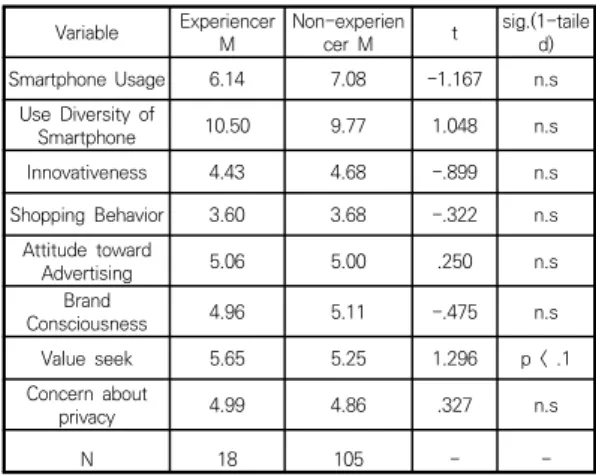
‘innovativeness’, ‘shopping behavior’,’ attitude toward advertising’, brand consciousness’, ‘value seek’ and ‘concern about privacy’ between people who have experience of downloading beacon app and those who have not. As a result of the analysis, there was a significant difference with p <.1 between experiencer and non-experiencer as seen in Table 2. In other words, the person who has downloaded the beacon app has higher value orientation than the person who does not have experience. This is a result of reflecting the characteristics of beacons including coupons or price discounts. However, the number of experienced beacon apps is small, so it needs to pay a closer attention to be interpreted.
Variable Experiencer
M Non-experien
cer M t sig.(1-taile d)
Smartphone Usage 6.14 7.08 -1.167 n.s
Use Diversity of
Smartphone 10.50 9.77 1.048 n.s
Innovativeness 4.43 4.68 -.899 n.s
Shopping Behavior 3.60 3.68 -.322 n.s
Attitude toward
Advertising 5.06 5.00 .250 n.s
Brand
Consciousness 4.96 5.11 -.475 n.s
Value seek 5.65 5.25 1.296 p < .1 Concern about
privacy 4.99 4.86 .327 n.s
N 18 105 - -
Table 2. Difference between beacon app down experiencer and non-experiencer
In order to understand the predictive variables
influencing beacon acceptance as a means of
marketing communication, this study used
'perceiving beacon as a marketing
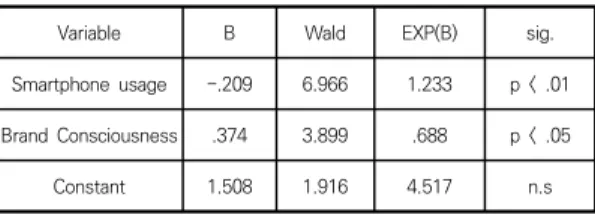
communication means' as a dependent variable and used 'smartphone usage', 'brand consciousness' as independent variables to perform logistic regression analysis. As a result of the analysis, it was found that 'smartphone usage' and 'brand consciousness' were the predictive variables affecting beacon perceiving as seen in Table 3. In other words, the less smartphone usage, and the more important the brand is, the more likely it is to recognize that beacons are used as marketing communication means.
Variable B Wald EXP(B) sig.
Smartphone usage -.209 6.966 1.233 p < .01 Brand Consciousness .374 3.899 .688 p < .05
Constant 1.508 1.916 4.517 n.s
Table 3. Logistic analysis on perceiving beacon as marketing communication media
4. Conclusion
According to result, use–diffusion related variables were not positive significant factors to influence beacon acceptance. This result implies that smartphone is no longer innovative products. In other words, in Korea, smartphones are popularized and not used by innovative consumers any more. Based on survey, beacon has not been widely accepted as a marketing communication media in society. It could be explained by TAM(Technology Acceptance Model. The major factors which affect the acceptance of new technology are perceived usefulness and ease-of-use according to TAM.
Considering that beacon has not been widely accepted as a marketing communication media, beacon seemed to not give strong benefit which differentiated from traditional marketing communication media to consumer. And consumer seemed to regard installing using beacon app as a bother.
To promote the acceptance of beacon as marketing communication media, these points must be considered. Practically the merit and benefit of beacon should be communicated actively to consumer by marketing communication including advertising. and the way to install beacon app should be informed to consumer easily.
REFERENCES
[1] J. A. Lee, & S. I. Kim,(2016). Beacon`s User Analysis and Proposal Guidelines on IoT Environment. Journal of Communication Design, 54, 212-223.
[2] G. Burdick. (2015). In-Store Beacons Mature, Make Shopping Personal. Economist, May 2015, 6-9.
[3] E. M. Rogers. (1995), Diffusion of Innovation. NY: The Free Press.
[4] R. L. Anderson & D. J. Ortinau. (1988). Exploring Consumers' Postadoption Attitudes and Use Behaviors in Monitoring the Diffusion of a Technological-based Discontinuous Innovation.
Journal of Business Research,17(3), 283-298.
[5] C. F. Shih & A. Venkatesh. (2004) Beyond Adoption : Development and Application of Use-Diffusion Model.
Journal of Marketing. 68, 59-72.
[6] S. J. You & J. I. Shon. (2009). A study on the adoption-diffusion and use-diffusion of the digital convergence product: Focusing on the camera phone.
Journal of the Korea Iindustrial Information Systems Society,14(4), 101-115.
[7] E. A. Park. (2008). A Study on the Determinants of Early Adoption of New Media: Focused on Innovativeness, Conspicuous Consumption, Perception of New Media Characteristics.. Journal of Consumer Studies. 19(1), 93-113.
[8] J. D. Kim & N. G. Kim. (2015). The Possibility of O2O Innovation Which Connect On-line and Off-line Is Opened. LG Business Insight, Weekly Focus, 16.
[9] S. Lee & R. Lumpkin. (1988) More Than Just Talk on the Move: Uses and Gratifications of the Cellular Phone. Journal of Business Research. 17(3), 283-298.
[10] P. S. Speck & M. T. Elliott. (1997) Predictors of Advertising Avoidance in Print and Broadcast Media.
Journal of Advertising. 26(3), 61-76.
[11] S. Shim & K. C. Gehrt. (1996) Hispanic and Native American Adolescence: An Exploratory Study of Their Approach to Shopping. Journal of Retailing. 72(3), 302-324.
[12] G. B. Sproles & E. L. Kendall. (1986) A Methodology for Profiling Consumer's Decision-making Styles.
Journal of Consumer Affair. 20(2), 267-279.
[13] A. Dickinger & M. Kleijnen. (2008) Coupons Going Wireless: Determinants of Consumer Intentions to Redeem Mobile Coupons. Journal of Interactive marketing. 22(3), 23-29.
[14] T. Zhou, Y. Lu. & B. wang. (2010) Integrating TTF and UTAUT to Explain Mobile Banking User Adoption.
Computers in Human Behavior. 26(4), 760-767.
[15] L. Barkhuus & A. K. Dey. (2003) Location-based Services for Mobile Telephony: A Study of Users' Privacy Concerns. Interact. 3, 702-712.
최 민 욱(Choi, Min Wook) [정회원]
․ 1989년 2월 : 한양대학교 (신문방송 학, 학사)
․ 2000년 8월 : 한양대학교 (광고홍보 학, 석사)
․ 2005년 8월 : 한양대학교 (광고홍보 학, 박사)
․ 2006년 9월 ~ 현재 : 남서울대학교 광 고홍보학과 교수
․ 관심분야 : 뉴미디어 광고 및 홍보
․ E-Mail : [email protected].