Print ISSN: 2288-4637 / Online ISSN 2288-4645 doi:10.13106/jafeb.2021.vol8.no1.375
Service Recovery Process: The Effects of Distributive and Informational Justice on Satisfaction over Complaint Handling*
Badawi BADAWI 1 , Wiwi HARTATI 2 , Istyakara MUSLICHAH 3
Received: September 30, 2020 Revised: November 22, 2020 Accepted: December 05, 2020
Abstract
The justice issue in the service recovery process has become an interesting topic especially in rural banks in Indonesia. There are two types of justice issues in handling the complaint process; distributive and informational. This study aims to analyze the effect of distributive and informational justice on complaint handling satisfaction. This study also examines the mediating role of positive and negative emotions on the effect of justice in post-merger rural banks. This research employs a survey by distributing a questionnaire to 238 customers who have complained to one of the post-merger rural banks in West Java and Yogyakarta. This study uses the structural equation modelling (SEM) method by WarpPLS software. The results reveal that distributive and informational justice have a positive effect on positive and negative emotions, while informational justice does not affect positive and negative emotions. Distributive and informational justice directly affect satisfaction over complaint handling. On the other hand, positive and negative emotions affect satisfaction over complaint handling. The findings of this study suggest that positive emotion also mediates the distributive justice effect on satisfaction over complaint. Lastly, positive and negative emotions do not mediate the informational justice effect on satisfaction over complaint handling at post-merger rural banks in West Java and Yogyakarta, Indonesia.
Keywords: Distributive Justice, Informational Justice, Customer Emotions, Satisfaction, Complaint Handling, Rural Banks JEL Classification Code: A11, E02, E24, E60
the banking efficiency system is important to promote sustainable growth in a healthy bank, so the regulator is needed to evaluate the bank’s health system (Kumar et al., 2020). The success of handling complaints is the main key to maintaining and increasing profit and growth in the banking industry, especially in Rural Banks (Badawi et al., 2020). A customer complaint is not a threat but should be viewed as a key to enhancing service delivery (Badawi, 2012). The company’s timely response is also a key strategy for successfully handling complaints, avoiding negative impressions, and covering up failed service performance (even small complaints). A small complaint has the potential to develop into a bigger issue, if the company does not respond and attend to it quickly (Badawi, 2012).
The justice issue when handling complaints is a concern for researchers and business practitioners in the financial services industry. There are some previous studies that discuss it such as Badawi (2012); McColl-Kennedy (2013); DeWitt et al., (2008); Gelbrich and Roschk (2011).
Perceived justice refers to how individual consumers evaluate fairness in the complaint handling process which is generally divided into four categories, namely: distributive,
*Acknowledgements:
1
The researchers would like to thank BRIN Ristekdikti, Indonesia, who have provided funding support for the Basic Research scheme 2019/2020 (2
ndYear).
1
First Author and Corresponding Author. Senior Lecturer.
Management Department, Faculty of Economics, Universitas Muhammadiyah Cirebon, Indonesia [Postal Address: Jl. Tuparev 70, Cirebon, West Java, 45153, Indonesia]
Email: [email protected]
2
Senior Lecturer. Management Department, Faculty of Economics, Universitas Muhammadiyah Cirebon, Indonesia
3
Senior Lecturer. Management Department, Faculty of Business and Economics, Universitas Islam Indonesia, Indonesia
© Copyright: The Author(s)
This is an Open Access article distributed under the terms of the Creative Commons Attribution Non-Commercial License (https://creativecommons.org/licenses/by-nc/4.0/) which permits unrestricted non-commercial use, distribution, and reproduction in any medium, provided the original work is properly cited.
1. Introduction
Business competition in the banking industry, draws
the attention of managers to realize that handling customer
complaints effectively plays a crucial role in maintaining
and increasing the number of customers. The success of
procedural, interactional, and informational justice (Badawi, 2012). Previous studies support the direct effect of perceived justice on satisfaction after service recovery (Badawi, 2012; Ha and Jang (2009); Kau and Loh (2006);
Schoefer (2008); Wirtz and Mattila (2004) and perceived mediating role of justice between service recovery activities and post-recovery satisfaction (Gelbrich & Roschk, 2011;
Homburg & Fürst, 2005).
According to organizational behavior literature, distributive justice is fairness in reward given to customers in the complaint handling process. The basic principle of distributive justice starts with equity theory (Goodwin &
Ross, 1992); equality theory (Greenberg, 1990), and need theory (Deutsch, 1985). The distributive equity model has been extensively tested in marketing research and consumer behavior (Greenberg, 1990; Badawi, 2012).
Distributive justice is usually used to explain justice or fairness (Badawi, 2012). Distributive justice is measured by giving rewards and compensation (Kelley et al., 1993), giving discounts and coupons (Mattila, 2001; Sparks &
McColl-Kennedy, 2001).
Besides distributive justice, fair information in the service recovery process also becomes very important for customers (Badawi et al., 2020). Informational Justice is an explanation and endorsement that focuses on procedures that explain the procedural provisions on justice perception (Bies & Shapiro, 1988; Badawi, 2012). A description of the process provides information needed to evaluate the structural aspects of the service recovery process (Colquitt et al., 2001) that is relevant, and logical (Shapiro & Buttner, 1988).
Skarlicki et al. (2008) state that informational justice mediates the effect of justice on the interaction integration.
In addition, Badawi (2012) finds that the four justices (distributive, procedural, interactional, and informational) have an undesirable effect on negative customer emotion.
While Ambrose et al. (2007) state that distributive, procedural, interactional, and informational justice affect customer satisfaction. This result is also supported by Colquitt et al.
(2001) who found that the four justices namely distributive, procedural, interactional, and informational justice have an effect on evaluation authority (e.g. management evaluation).
Greenberg (1994) finds that informational justice offers a social exchange picture which provides an explanation of events in a negative reaction to performance.
Earlier studies and literature explain that emotion is a variable to create satisfaction for service failures (Badawi, 2012; Badawi et al., 2020). A number of studies have revealed that there is a relationship between personality and emotion (Gountas & Gountas, 2007; Badawi et al., 2020). Customer satisfaction depends on several things such as acceptance of service quality (Rezaei et al., 2011), anger, frustration, and regret have an effect on complaints, negative word-of-mouth (WOM), and switching intention (Hoang, 2020). Although the service provided is good, the customers still expect to
receive better service (Choi, Qiao, & Wang, 2020; Le, Nguyen, & Pham, 2020; Tran, Tran, & Pham, 2020).
However, previous studies about the microfinance services industry have not yet discussed much distributive and informational justice in creating satisfaction over complaint handling through the role of mediating positive and negative emotions in the complaint handling process. Therefore, this study examines the effect of distributive and informational justice on satisfaction with complaint handling. This study also examines the mediating role of positive and negative emotions on satisfaction over complaint handling.
2. Literature Review 2.1. Distributive Justice
Justice performance literature can be used as a basis for increasing complaint handling satisfaction and raising post-service quality standards. Equity theory (Bowen &
Johnston, 1999; Smith et al., 1999) and social exchange theory (Deutsch, 1999) are some theories that explain the comparison between what has been sacrificed and what has been accepted. The comparison is measured by real performance against perceived expectation. Some researchers believe those theories about justice in service improvement context (Maxham et al., 2002; Andreassen, 2000).
Viewed from the context of service, distributive justice refers to the extent to which customers feel they have been treated fairly for service performance. According to Bowen, Gilliland, and Folger (1999), there are three principles of distributive justice, namely: cost, number of services, and excellence. Kreitner and Kinicki (2007) state that structural justice is defined as justice which illustrates how reward e.g., compensation is distributed based on complaint. Distributive justice is also related to the problem of the value received by customers in accordance with the expectations promised.
Distributive justice explains how the consumer responds to the amount and form of compensation he receives (Badawi et al., 2020). Distributive justice has an effect on satisfaction.
Badawi (2012) found that distributive justice reduces negative emotion and increases satisfaction on service recovery.
H1: Distributive justice has an effect on a customer’s positive emotion
H2: Distributive justice reduces a customer’s negative emotion
H3: Distributive justice directly affects a customer’s satisfaction over complaint handling
2.2. Informational Justice
According to social exchange theory, a follow-up of
this theory development is the company’s responsibility
to respond to customer complaints properly (Blau, 1964).
Trust in responding to customer complaints has a cycle, namely trust will result in trust (Butler, 1995). Trust given to customers will be followed by customers’ satisfaction on perceived service recovery. Good trust in the company’s response to customer complaints is a way to measure informational justice. Informational justice can be interpreted as communicating relevant reasons about procedures that are used in the assessment and rational distribution in the service recovery process to the customers (Greenberg, 1993).
Informational justice has a strong role in the emotional ties of the customer and company (Hassan & Hashim, 2011). Informational justice focuses on explanation and endorsement which explains the procedural provisions on justice perception (Greenberg, 1990; Martono et al., 2020).
A description of procedure provides the information needed to evaluate the structural aspects of the service recovery process (Colquitt et al., 2001), logic and relevant information (Shapiro & Buttner, 1988) and correctly determined without power factor (Folger et al., 1983)
Several studies show that informational justice explains the settlement of problem groups (conflicts), and directly affects negative reactions (Greenberg, 1994). Informational justice has a constructive effect on dealing with complaints (Badawi, 2012). It also provides an adequate explanation of the decision-making process (Greenberg, 1994). Informational justice refers to the extent to which consumers receive an explanation of decision procedures made by the organization such as adequate, clear, reasonable, and precisely detailed and timely explanation of justice perception (Bies & Moag, 1986). Providing an explanation increases justice perception (Brockner et al., 1994) and mitigates negative reaction victims (Shaw, Wild, & Colquitt, 2003).
H4: Informational Justice has an effect on positive emotion
H5: Informational Justice has negative effect on customer’s negative emotion
H6: Informational Justice directly affects customer satisfaction over complaint handling
2.3. Mediation Role Of Customer Emotion
Emotion is an important factor in responding to marketing stimulation and consumer behavior in general. Some previous studies about emotional response focus on customer complaints (Badawi, 2012; Badawi et al., 2020; Huang et al., 2019), the satisfaction rating formation (Westbrook
& Oliver, 1991), consumer decision-making process (Luce et al., 1999). According to Richins (1997), emotional theory is widely recognized in consumer behavior study, as a systematic investigation into emotional determinants and their influence on consumer responses about their complaint (Bagozzi, Gopinath, & Nyer, 1999)
Emotion is motives related to individual feelings such as the expression of love, pride, comfort, health, safety, and practicality. These motives are subjective, so it is difficult to determine the relationship between the service purchase motive and the product purchased. Emotion is a complex and patterned reaction of individuals about what they do to survive in achieving what they want. Kritner et al., (2007) state that emotion is a complex individual reaction about their personal failure which they feel and express. Emotion affects several aspects of satisfaction such as service recovery satisfaction (Rio et al., 2009; Pelaez et al., 2014), satisfaction over complaint service (Choraria, 2013; Jerger
& Wirtz, 2017), and marketing (Bagozzi et al. 1999).
H7: Positive emotion has an effect on customer satisfaction over complaint handling
H8: Negative emotion has negative effect on customer satisfaction over complaint handling
H9: Positive and negative emotions mediate distributive and informational justice on customer satisfaction over complaint handling
2.4. Service Recovery Satisfaction
Generally, the studies about complaint handling satisfaction have a good quality compared to the studies about products (Johnson et al., 2001). Researchers argue that a product has a higher level of satisfaction than service because the convenience provided by the company to customers has a consistent quality level. A successful company is a company that responds quickly to customer complaints. A break down of service implementation is the main problem faced by the company. A customer complaint is therefore a useful moment to develop a positive relationship with customers (Badawi, 2012). The company’s timely intervention to customer complaints can change the situation from a negative to a positive one so that it enhances customer confidence and increases the company’s commitment to establish long- term, meaningful relationships (Tax et al., 1998; Hwan et al., 2020).
3. Method
The study uses causality research as an approach to analyze whether there is a mutual relationship between the variables of distributive justice, informational justice, and negative and positive customers’ emotion to satisfaction over complaint handling. This study is conducted on the post- merger Rural Bank in West Java and Yogyakarta, Indonesia.
The sampling technique uses accidental (random)
sampling due to the field’s condition. Each Rural Bank
cannot provide data on customers who have complained
and the customers are difficult to identify. The methods for
distributing and withdrawing the questionnaire are:
1) Going directly to the Rural Bank in each region 2) Speaking directly to the customer who has made the complaint
This approach has been used in previous studies (Jang
& Namkung, 2009; Río-Lanza et al., 2009). The number of samples is 238 taken from West Java and Yogyakarta. The number of samples fulfills the minimum requirements of a survey study which is 100 respondents (Hair et al., 2010).
All variables are measured using a one to six Likert scale, where 1 = strongly disagree to 6 = strongly agree.
The development of the variables are (1) distributive justice (DJ) with four indicators from Blodgett et al. (1997); Smith et al. (1999); Badawi (2012), (2) informational justice (IFJ) from Ambrose (2002) and Badawi (2012). Emotion customer (EC) developed from Walsh and Beatty (2007) which is measured with five dimensions. While satisfaction over complaint handling (SR) was adopted from Badawi (2012). The hypothesis is tested by using WarpPLS software (Solimun et al. (2019).
3.1. Data Analysis Results 3.1.1. Respondent Characteristic
The respondents’ characteristics in this study are gender, age, occupation, education, income, number of complaints, and service type. The results of data processing show that there are 113 men (47%) and 125 women (53%). The age of the respondents ranges from 19-30 years (31%), 31-40 years (50%), and 41-55 years (19%). There are two respondents who have indicated occupation as student (3.3%), 103 as an entrepreneurs (44.1%), 36 as a private employees (15.1%), and 89 as civil servants (37.3%). The majority of the respondents are senior high school graduates (43%). The respondents who have an income of > 1 million are 41 (17.23%), 1 million-5 million are 106 (44.53%), and <5 million are 91 (38.24%).
The number of respondents making complaints between 1-2 times is 167 (71.1%), and between 3-5 times is 71 (29.8).
Service categories that are being complained about are credit (41.5%), deposit (37.5%), and others (21%).
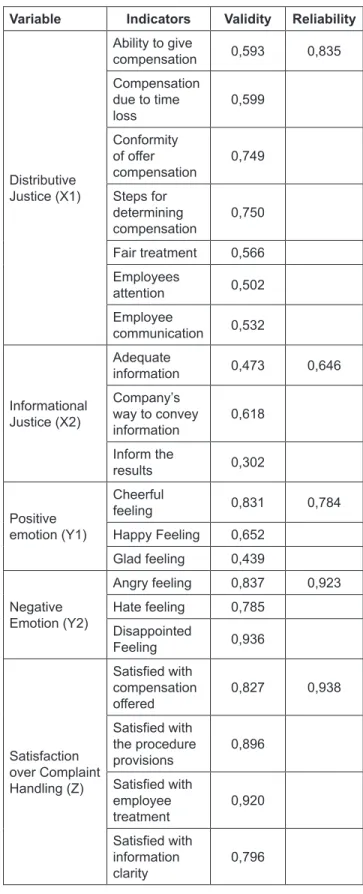
This study uses research instruments with six scales for two exogenous variables, one endogenous variable, and two mediating variables. Each of the variables needs to be tested for validity and reliability. The validity test is important to know the accuracy of research instruments, while the reliability test is important to know the consistency of research instruments. The results of the validity and reliability test with SPSS can be summarized in Table 1.
Table 1 shows that all indicators have a correlation value above 0.3. It can be concluded that all indicators are valid.
Furthermore, the reliability test result shows that all variables have Alpha-Cronbach coefficient values above 0.6. It can be concluded that all variables are reliable.
Table 1: Validity and Reliability Test Result
Variable Indicators Validity Reliability
Distributive Justice (X1)
Ability to give
compensation 0,593 0,835
Compensation due to time
loss 0,599
Conformity of offer
compensation 0,749 Steps for
determining
compensation 0,750 Fair treatment 0,566 Employees
attention 0,502
Employee
communication 0,532
Informational Justice (X2)
Adequate
information 0,473 0,646
Company’s way to convey
information 0,618 Inform the
results 0,302
Positive emotion (Y1)
Cheerful
feeling 0,831 0,784
Happy Feeling 0,652 Glad feeling 0,439
Negative Emotion (Y2)
Angry feeling 0,837 0,923
Hate feeling 0,785 Disappointed
Feeling 0,936
Satisfaction over Complaint Handling (Z)
Satisfied with compensation
offered 0,827 0,938
Satisfied with the procedure
provisions 0,896 Satisfied with
employee
treatment 0,920
Satisfied with information
clarity 0,796
3.1.2. Hypothesis Testing
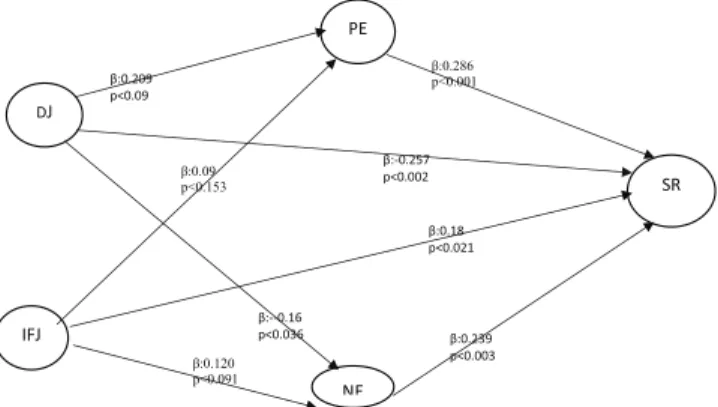
The next analysis is a full model Structural Equation Model (SEM) analysis with WarpPLS software to test the hypotheses of this study. The result is as follows:
Based on Table 2 and Figure 1, the following conclusions can be drawn H1: Distributive justice (DJ) has a significant effect on positive emotion (PE) with a path coefficient of 0.209. H2: Distributive justice (DJ) has a significant effect on negative emotions (NE) with a path coefficient of -0.160. H3: Distributive Justice (DJ) has a significant effect on satisfaction over complaint handling (SR) with a path coefficient of -0.286. H4:
Informational Justice (IFJ) has no significant effect on Positive Emotions (PE) with a path coefficient of 0.092.
H5: Informational Justice (IFJ) has no significant effect on Negative Emotions (NE) with a path coefficient of -0.120. H6: Informational Justice (IFJ) has a significant effect on satisfaction over complaint handling (SR) with a path coefficient of 0.180. H7: Positive Emotion (PE) has a significant effect on satisfaction over complaint handling (SR) with a path coefficient of 0.286. H8: Negative Emotion (NE) has a significant effect on satisfaction over complaint handling (SR) with a path coefficient of 0.239.
The results of indirect effect and total effect for hypothesis 9 are explained in Table 2.
Table 3 shows that PE is significant as mediation in the relationship between distributive justice (DJ) to satisfaction over complaint handling (SR). Whereas NE does not mediate the relationship between distributive justice (DJ) to satisfaction over complaint handling (SR). Positive emotion (PE) and negative emotion (NE) do not mediate in the relationship between informational justice (IFJ) to satisfaction over complaint handling (SR).
Table 2: Hypothesis Testing
Hypothesis Relationship Path coefficient p-value Standard Error Descriptions
H1 DJ→ PE 0,209 0,009 0,087 Significant
H2 DJ → NE -0,160 0,036 0,088 Significant
H3 DJ → SR -0,257 0,002 0,086 Significant
H4 IFJ→ PE 0,092 0,153 0,090 Not significant
H5 IFJ → NE -0,120 0,091 0,089 Not significant
H6 IFJ → SR 0,180 0,021 0,088 Significant
H7 PE → SR 0,286 0,001 0,085 Significant
H8 NE → SR 0,239 0,003 0,086 Significant
DJ: Distributive justice. IFJ: informational justice, PE: positive emotion, NE: Negative emotion, SR: Satisfaction over Complaint Handling Table 3: Indirect and Total Effects of Distributive Justice and Informational Justice
Independent Variable Path Coefficient Z Test
Statistics p-value Description
PE as mediation on DJ → SR 0.060 1.955 0.025 Significant
NE as mediation on DJ → SR -0.038 -1.521 0.936 Not significant
PE as mediation on IFJ → SR 0.026 0.978 0.164 Not significant
NE as mediation on IFJ → SR -0.029 -1.213 0.887 Not significant
Figure 1: Path coefficient model
D
J
IFJ
PE
NE
SR
β:0.286 p<0.001
β:-0.257 p<0.002
β:--0.16
p<0.036 β:0.239
p<0.003 β:0.18 p<0.021 β:0.209
p<0.09
β:0.120 p<0.091 β:0.09 p<0.153