species such as crossbred hybrids (Park et al. 2006, 2015, 2017).
Traditional morphometrics have been used to study the characteristics of fish for over 30 years, and are focused on lengths, widths, and heights of fish, in addition to axes of fish bodies, including their tails and heads (Straüss and Bond 1990; Park et al. 2006; Caillon et al. 2018). Conse
quently, the original shape cannot be unequivocally recon
structed from the measurements (Caillon et al. 2018). To avoid this drawback of traditional measurements, the truss network system may be used as an alternative (Rawat et al.
2017). The truss network consists of a systematically arran
ged set of distances that are measured between a set of pre
selected anatomic landmarks, which are points identified
https://doi.org/10.11626/KJEB.2021.39.1.006
INTRODUCTION
Morphological differences between species or popula
tions are usually understood and compared in terms of general or specific anatomical shapes (Straüss and Bond 1990; Park et al. 2015; Lim et al. 2016; Park 2020a). The morphometric characteristics of fish can be measured in millimeters, unlike countable meristic characteristics.
Although our understanding of the morphometric charac
teristics of fish is limited because they can be readily modified by the environment, the general shape of a fish is often determined by genetic factors (Park et al. 2006, 2015). Morphometric characteristics are primarily used to discriminate sexes and species and to identify confusing
Original article
Comparison of morphological characteristics of the river puffer, Takifugu obscurus, the tiger puffer, T. rubripes, their hybrids, and their triploid hybrids
In-Seok Park* and Ji Su Oh
1Division of Convergence on Marine Science, College of Ocean Science and Engineering, Korea Maritime & Ocean University, Busan 49112, Republic of Korea
1
National Agency for Marine Seed Improvement, National Institute of Fisheries Science, Busan 46083, Republic of Korea
Korean J. Environ. Biol.
39(1) : 6-15 (2021) ISSN 1226-9999 (print) ISSN 2287-7851 (online)
* Corresponding author In-Seok Park
Tel. 051-410-4321 E-mail. [email protected]
Received: 4 January 2021 Revised: 18 January 2021
Revision accepted: 8 February 2021
Abstract: Various biometric and geometric measures were used to discriminate between
the morphologically similar river puffer, Takifugu obscurus, tiger puffer, T. rubripes, their hybrids, and their triploid hybrids. The hybrids and triploid hybrids had greater anal fin width, nostril width, and snout length than the parental species (p
<0.05). However, they had less caudal peduncle depth, inter-orbital width, head length, and head width (p
<0.05).
The morphometric and meristic characteristics of the hybrids and triploid hybrids were either intermediate between the parental species or more similar to those of one paren- tal species. However, the external morphology of the hybrids and triploid hybrids was pre dominantly maternal. The triploid hybrids had asymmetry in the fin rays and gill raker numbers. This study identified phenotypic characteristics by distinguishing the morpho- logical variables of river puffer, tiger puffer, their hybrids, and their triploid hybrids.
Keywords: hybrids, triploid hybrids, morphometric characteristic, river puffer
(Takifugu
obscurus), tiger puffer (T. rubripes)
based on local morphological features and are chosen to di
vide the body into functional units (Straüss and Bookstein 1982; Straüss and Bond 1990). The truss network, which includes components of body depth and length along the longitudinal axis, covers the entire fish body with no loss of information, and is therefore more sensitive to change (Park et al. 2006; Mojekwu and Anumudu 2015; Park 2020a).
The Korean domestic consumption of puffer fish is 10,000 tons year
-1, most of which is imported from China and Japan; puffer fish is a highvalue fish in Japan and Rep
ublic of Korea (Kang et al. 2007; Park et al. 2019). The river puffer, Takifugu obscurus (Tetraodontiformes, Tetraodon
tidae) inhabits rivers during the fry stage, brackish water zones during juve nile stage, coastal zones during adult stage, and migrate back up the rivers during the spawning season (Park et al. 2019). The tiger puffer, T. rubripes (Tetraodontiformes, Tetraodontidae), inhabits the coastal waters of Korea and China (Kotaro and Takeshi 2007; Park et al. 2017). River puffers can reach up to 45 cm in length and are highly priced owing to their highquality meat;
however, it takes more than 30 months for fish to reach maturity (Yang and Chen 2003; Kotaro and Takeshi 2007).
Tiger puffers, in contrast, reach up to 75 cm and grow faster than river puffers (Park et al. 2017).
Hybridization is a method of combining desirable geno
types and phenotypes from two different species and can be used to generate sterile fish. Interspecific and intergene
ric hybrids may be functionally sterile because of genetic incompatibility; however, several hybrids showing fertile gonad development have been obtained (Chevassus 1983).
Furthermore, hybrid fish offer opportunities to improve production characteristics, including flesh quality, disease resistance, morphology, and growth. Many variables affect the early survival, hatching, and abnormality rates of inter
specific hybrids (Chevassus 1983). Heterosis is demonstra
ted when artificiallyinduced hybrid offspring have higher performance than the parental fish, and have high overall vigor and resistance to environmental change (Chevassus 1983; Kim et al. 1995; Park et al. 2017; Yoo et al. 2018). In addition, hybrids may have greater tolerance to lowoxy gen conditions, increased resistance to many diseases, and high tolerance to sulfide concentrations, low temperatures, and water pH variations (Chevassus 1983; Kim et al. 1995).
The hybrid of the river puffer ( ♀) and the tiger puffer (♂), which was produced by artificial hybridization experi
ments, has large potential economic value because of the combination of their individual advantageous characteris tics (Park et al. 2017; Dou et al. 2019). Furthermore, the toxi
city of the ovaries, liver, and intestines from hybrid puffer fish has been reported to be lower than that of cultured and wild puffer fish, resulting from their infertility (Kim et al. 2006; NunezVazquez et al. 2012; Hamasaki et al.
2013).
Triploidy induction in fish has been used to generate ster
ility for applications in commercial farming and fisheries management (Benfey 1999). Triploid fish have impaired gametogenesis, so investment in somatic growth is not re
duced by the metabolic costs of sexual maturation. Triploid sterility can also be used to prevent the decline in flesh qual
ity associated with sexual maturation, and to address con
cerns regarding the environmental impact of farm escapees
(Peruzzi et al. 2004; Park 2019; Park et al. 2019; Park 2020b).
In addition, growth rates tend to slow or cease in matur
ing fish; a growth advantage of triploid fish over diploids is most likely to be observed during the later stages of sexual maturation (Gray et al. 1993; Benfey 1999). This growth advantage is most likely to be demonstrated by species that have diploids with high or complete mortality associated with sexual maturation and spawning, such as ayu, Pleco
glossus altivelis, and twicespawned rainbow trout, Onco
rhynchus mykiss (Benfey 1999). One cause of unsuccessful interspecific fish hybridization is high mortality rates during the hybrids’ early life stages (Chevassus 1983; Yoo et al. 2018). This problem has been partially solved in inter
specific hybrid fish by inducing triploidy (Scheerer and Thorgaard 1983; Gray et al. 1993; Park et al. 1997). There
fore, hybrid triploidy in fish provides advantageous syner
gistic effects for commercial farming and fisheries manage
ment applications (Park et al. 2006, 2017; Yoo et al. 2018).
Several studies on the characteristics of hybrids, triploid hybrids, and their parental species have been studied to compare their biological characteristics and to identify their abnormal deformities and growth advantages (Park et al.
1997, 2006, 2017). Triploid animals generally have similar, if not identical, morphological and meristic characteristics to those of their diploid counterparts (Bonar et al. 1988;
Kim et al. 1995; Park 2020a). However, several morpho
logical differences and abnormalities have been associated with triploidy in fish. A variety of deformities have been reported in the triploid pejerrey, Odontesthes bonariensis
(Strüssmann and Takashima 1993), but it is unclear whether the examined fish were triploid or aneuploid (i.e., having a chromosome number other than a complete multiple of the haploid genome). In this study, we investigated and com
pared the external traits of the river puffer, the tiger puffer,
their hybrids, and their triploid hybrids using morphologi
cal methods, including morphometric analysis and meristic characteristics.
MATERIALS AND METHODS
1. Fish sampling
Hybrids and triploid hybrids between the river puffer, Takifugu obscurus, and the tiger puffer, T. rubripes were in
duced using the methods of Park et al. (2017) and Yoo et al.
(2018). Twohundred river puffers and 200 tiger puffers were injected with human chorionic gonadotropin (Sigma, USA). After 24 hours, the eggs and sperm of the river puffer and the tiger puffer were combined to induce interspecific hybrids (river puffer ♀ × tiger puffer ♂). A total of 3,000 fertilized interspecific hybrid eggs were subjected to cold shock treatment (4°C) to prevent extrusion of the second polar body. Threethousand untreated fertilized eggs were used as the hybrid group.
Onehundred individuals from each experimental group (river puffer, tiger puffer, hybrids, and triploid hybrids) were reared over a period of 5 months at a water temperature of 25°C and 30 ppt salinity in an aquarium system. They were fed a commercial feed (Cheonhajaeil Feed Corp., Republic of Korea) twice daily. Following the methods of Yoo et al.
(2018), to distinguish hybrids and triploid hybrids flow cyto metry analysis was used to estimate the average cellular DNA content of each group. Tissue was collected from each experimental fish’s caudal fin and fixed in 10 mL of cold 70% ethanol. Cells (10
6) were collected and stained using a highresolution DNA staining kit (Partec GmbH, Ger
many) under dark conditions for ~15 min. The stained cells were analyzed using a PAII flow cytometer (Partec GmbH, Germany) to determine the relative DNA content.
All experiments performed in this study complied with the current laws Republic of Korea (Ordinance of Agricul
ture, Food and Fisheries, No. 1: The Law Regarding Experi
mental Ani mals, No. 9932) and the Ethical Guidelines of
Table 1. Body shape measurements of the river puffer, Takifugu obscurus, the tiger puffer, T. rubripes, their hybrids, and their triploid hybrids
Traditional measurements
Standard length (Ls) 1×4
The most anterior extension of the head - origin of the dorsal fin base 1 ×2
The most anterior extension of the head - origin of the caudal fin base 1 ×3
The most anterior extension of the head - origin of the anal fin base 1 ×5
The most anterior extension of the head - most posterior aspect of the operculum 1×6
Truss measurements
Origin of dorsal fin base - origin of the anal fin base 2 ×5
Origin of dorsal fin base - the most posterior aspect of the operculum 2 ×6
Dorsal fin width 2×7
Dorsal origin of the caudal fin - insertion of the dorsal fin 3 ×7
Dorsal origin of the caudal fin - ventral origin of the caudal fin 3 ×8
Dorsal origin of the caudal fin - insertion of the anal fin 3 ×9
Origin of the anal fin base - the most posterior aspect of the operculum 5×6
Anal fin width 5 ×9
Pectoral fin width 6 ×10
Insertion of the dorsal fin - ventral origin of the caudal fin 7 ×8
Ventral origin of the caudal fin - insertion of the anal fin 8×9
Head part measurements
Head length (HL) 1 ×14
Upper side Lateral side
Nostril width 11 ×17 The most anterior extension of the head - Above of the nostril 1 ×11 Inter-orbital width (IW) 12 ×16 The most anterior extension of the head - Above of the eye 1 ×12 Head width 13 ×15 The most anterior extension of the head - The posterior end of the supraoccipital 1 ×13
Eye diameter (ED) 18×19
Hybrids and triploid hybrids from river puffer(♀)
×
tiger puffer(♂).Korea Maritime & Ocean University, Republic of Korea.
2. Landmark-based morphometrics
Morphometric analyses were conducted using the meth
ods reported by Turan (1999), Cardin (2000), Albertson and Kocher (2001), and Park et al. (2006). The linear di
mensions (Table 1 and Fig. 1) of 30 fish from each group were measured to the nearest 0.1 cm using a digital Vernier caliper. Traditional measurements (TRAs), truss measure
ments (TRUs), and head part measurements (HDs) were obtained using a total of 19 landmarks and 24 distances.
TRAs were obtained using 6 landmarks and 5 distances (Fig. 1A), TRUs using 8 landmarks and 11 distances (Fig.
1B), and HDs using 10 landmarks and 8 distances (Fig. 1C, D). In the following text, the bold numbers separated by “ × ”
refer to landmarks (the first number), from which distances were measured to a specific point on the body (the second number) (Table 1; Figs. 1 and 2). All TRAs and TRUs were divided by standard length measurements (1 × 4: Ls). To ensure that variations in this study were only attributed to body shape differences and not to the fish’s relative sizes, size effects were eliminated by standardizing the morpho
metric parameters (Normala et al. 2017).
The TRAs included 1 × 2 (the most anterior extension of the head (MAEH) to the origin of the dorsal fin base);
Fig. 1. Morphometric characteristic landmarks for obtaining (A)
traditional measurements, (B) truss measurements, (C) the dorsal view of the head part measurements, and (D) the lateral view of the head part measurements of the river puffer, Takifugu ob- scurus, the tiger puffer, T. rubripes, their hybrids, and their triploid hybrids. Scale bars indicate 3 cm. The landmark numbers are re- ferred to in Table 1.
A
B
C D
Fig. 2. Morphometric characteristic results using landmarks to
obtain traditional measurements, truss measurements, and head part measurements in the river puffer, Takifugu obscurus, the tiger puffer, T. rubripes, their hybrids, and their triploid hybrids. The panels indicate (A) traditional measurements, (B) truss measure- ments, (C) the dorsal view of the head part measurements, and (D) the lateral view of the head part measurements. The longest measurement in the river puffer is indicated by a blue line, in the tiger puffer by a red line, in the hybrid by a violet line, and in the hybrid triploid by a violet double line. The white dotted lines indi- cate the longest measurements of both the river puffer and tiger puffer. The yellow dotted lines indicate the longest measurements of both the hybrids and triploid hybrids. Scale bars indicate 3 cm.
The landmark numbers are referred to in Table 1.
A
B
C D
1 × 3 (MAEH to the origin of the caudal fin base); 1 × 5 (MAEH to the origin of the anal fin base); and 1 × 6 (MAEH to the most posterior aspect of the operculum).
The TRUs included 2 × 5 (the origin of the dorsal fin base to the origin of the anal fin base); 2 × 6 (the origin of the dorsal fin base to the most posterior aspect of the opercu
lum); 2 × 7 (dorsal fin width); 3 × 7 (dorsal origin of the caudal fin to the insertion of the dorsal fin); 3 × 8 (the dor
sal origin of the caudal fin to the ventral origin of the caudal fin); 3 × 9 (the dorsal origin of the caudal fin to the inser
tion of the anal fin); 5 × 6 (the origin of the anal fin base to the most posterior aspect of the operculum); 5 × 9 (anal fin width); 6 × 10 (pectoral fin width); 7 × 8 (insertion of the
dorsal fin to the ventral origin of the caudal fin); and 8 × 9 (ventral origin of the caudal fin to the insertion of the anal fin). The HDs were separated into upper and lateral sides, and the measurements were divided by the head length measurement (1 × 14: HL). They were convergently con
structed with distances including the eye diameter (18 × 19:
ED) and the interorbital width (12 × 16: IW). The upper side HDs included: 11 × 17 (nostril width), 12 × 16 (IW), and 13 × 15 (head width). The lateral side HDs included:
1 × 11 (MAEH above the nostril), 1 × 12 (MAEH above the eye), 1 × 13 (MAEH to the posterior end of the supra
occipital), and 18 × 19 (the ED).
Table 2. Results of traditional measurements, truss measurements, and head part measurements of the river puffer, Takifugu obscurus,
the tiger puffer, T. rubripes, their hybrids, and their triploid hybrids
Morphometric
measurement River puffer Hybrids Triploid hybrids Tiger puffer
Traditional measurements
Ls (cm) 8.3±0.61
a10.6±0.46
c9.6±0.58
b16.2±1.33
d1×2/Ls 67.6±4.88
b69.1±3.61
bc74.1±3.61
c66.1±1.12
a1×3/Ls 97.2±1.74
c95.3±2.56
a96.5±1.48
b97.2±2.36
c1×5/Ls 69.7±2.15
b70.3±2.38
c70.1±3.47
c68.5±1.88
a1×6/Ls 33.9±1.52
b32.3±3.04
a32.9±1.17
a35.2±2.08
cTruss measurements
2×5/Ls 20.6±1.42
a19.2±2.71
a20.3±1.86
ab24.1±0.92
b2×6/Ls 36.4±2.81
a39.2±2.14
b38.8±1.97
b41.9±1.57
c2×7/Ls 12.1±0.47
a13.1±1.52
b14.1±1.64
c14.9±2.03
d3×7/Ls 18.3±3.42
b17.8±1.61
a17.1±2.34
a21.2±0.42
c3×8/Ls 9.2±0.51
b7.5±0.83
a7.1±0.61
a9.7±0.91
b3×9/Ls 22.1±1.74
a24.9±1.03
c23.9±0.98
b22.3±1.36
a5×6/Ls 37.7±2.45
a41.6±2.27
b40.5±1.93
b42.4±1.83
bc5×9/Ls 11.6±1.25
a14.6±2.19
b14.1±1.75
b11.9±0.83
a6×10/Ls 9.2±1.36
a9.2±2.15
a9.3±1.88
a10.6±1.95
b7×8/Ls 21.8±1.93
a20.6±1.25
a20.5±1.54
a24.6±1.85
b8×9/Ls 16.1±1.83
a19.2±2.65
b19.0±2.27
b21.2±1.67
cHead measurements
HL (cm) 2.3±0.24
a3.3±0.35
b2.8±0.87
ab4.5±1.15
c1×11/HL 22.6±3.27
a26.6±2.56
b27.4±1.42
c32.1±4.12
d1×12/HL 53.9±7.52
b56.3±7.18
c58.1±4.48
d48.7±6.08
a1×13/HL 116.7±6.15
b105.3±3.27
a104.9±4.89
a120.1±7.88
c11×17/HL 24.6±8.24
b26.0±2.61
c26.7±1.94
c22.6±6.35
a12×16/HL 75.6±5.31
c53.0±4.73
a54.8±3.81
a62.0±2.53
b13×15/HL 86.8±4.73
b75.2±5.84
a76.8±6.60
a90.8±3.28
c18×19/HL 15.7±2.33
a16.9±1.42
b16.0±1.11
a15.9±1.79
aHybrids and triploid hybrids from river puffer(♀)×tiger puffer(♂). Each value (mean of triplicate±SD) with a different superscript indicates significant difference(p<0.05). Refer to the landmarks in Fig. 1 and Table 1 for morphometric measurement definitions.
3. Meristic characteristics
Measurements of 6 meristic characteristics were repeat
ed on 100 fish from each group. The meristic characteris
tics included the number of fin rays (including the anal fin, caudal fin, dorsal fin, and pectoral fin), vertebrae, and gill rakers. Gill rakers were observed using a stereomicroscope (Carl Zeiss, Germany); each meristic measurement was performed three times by the same observer.
4. Statistical analysis
All measurements of morphometric and meristic char
acteristics were performed in triplicate; unless otherwise
stated, the results are reported as means of triplicate ± SD.
Data were analyzed using the SPSS statistical package v 9.0 (SPSS Inc., Chicago, IL, USA) using oneway ANOVA and Duncan’s multiple range test (Duncan 1955). Differences were considered statistically significant when p < 0.05.
RESULTS
The standard length of the river puffer, Takifugu obs
curus, the tiger puffer, T. rubripes, their hybrids, and their triploid hybrids were 8.3±0.61 cm, 16.2±1.33 cm, 10.6±
0.46 cm, and 9.6±0.58 cm, respectively (Table 2). The TRAs and TRUs of the experimental fish were divided
Fig. 3. External morphology of the river puffer, Takifugu obscurus, the tiger puffer, T. rubripes, their hybrids, and their triploid hybrids. Left
side: lateral view of external morphology; right side: dorsal view of external morphology. The panels indicate (A) river puffer, (B) hybrids, (C) triploid hybrids, and (D) tiger puffer. Scale bars indicate 3 cm.
A
B
C
D
by the standard length (1 × 4; Ls), and the HDs were divided by the HL (1 × 14). The HDs were enlarged to des
cribe the head of the fish (Fig. 1). Morphometric data for TRAs/Ls , TRUs/Ls, and HDs/HL are listed in Table 2.
The maximum dimensions for each group are shown in Fig. 2. The Ls and HL, beginning with the greatest values, were tiger puffer, hybrids, triploid hybrids, and river puffer
(p < 0.05). The 1 × 2 and 1 × 5 measurements (linked to head and trunk regions) for river puffer were greater than those of tiger puffer and lower than those of the hybrids and triploid hybrids (p < 0.05). The 2 × 5 and 6 × 10 mea
surements for tiger puffer were the largest of all groups (p < 0.05). The 2 × 6, 5 × 6, and 8 × 9 measurements for the hybrids and triploid hybrids were greater than those of the river puffer, but less than those of the tiger puffer
(p < 0.05). The 3 × 9 and 5 × 9 linked to tail region, and the 3 × 8 measurements of the hybrids and triploid hybrids, were greater and smaller, res pectively, than those of their parental species (p < 0.05). Measurements 3 × 9, 5 × 9, and 3 × 8 were not significantly different between the river puffer and the tiger puffer (p > 0.05). The 12 × 16, 13 × 15, and 1 × 13 measurements of the river puffer and the tiger puffer were greater than those of their hybrids and triploid hybrids (p < 0.05). The 12 × 16 measurements of river puffer were greater than those of the tiger puffer, whereas the opposite was true for measure ments 13 × 15 and 1 × 13 (p < 0.05). The hybrids’ 18 × 19 mea sure ments were the greatest among all groups (p < 0.05); the other groups did not significantly differ (p > 0.05).
The external morphologies of the experimental groups are shown in Fig. 3. The river puffer had black spots behind
the pectoral fin and at the insertion of the dorsal fins and had a white dotted line in the upper part (Fig. 3A). The river puffer had yellow anal and caudal fins but yellowbrown dorsal fins (Fig. 3A). The tiger puffer had large black spots outlined in white behind the pectoral fin and at the insertion of the dorsal fins; on each side, round black spots and white patterns were observed until the caudal peduncle (Fig.
3D). The tiger puffer had white anal fins but black caudal and dorsal fins (Fig. 3D). The hybrids and triploid hybrids had black spots back of the pectoral fin, at the insertion of the dorsal fins, and on each side (Fig. 3B, C). They also had many more white spots on the upper part, and their fin colors were more like those of the river puffer (Fig. 3B, C).
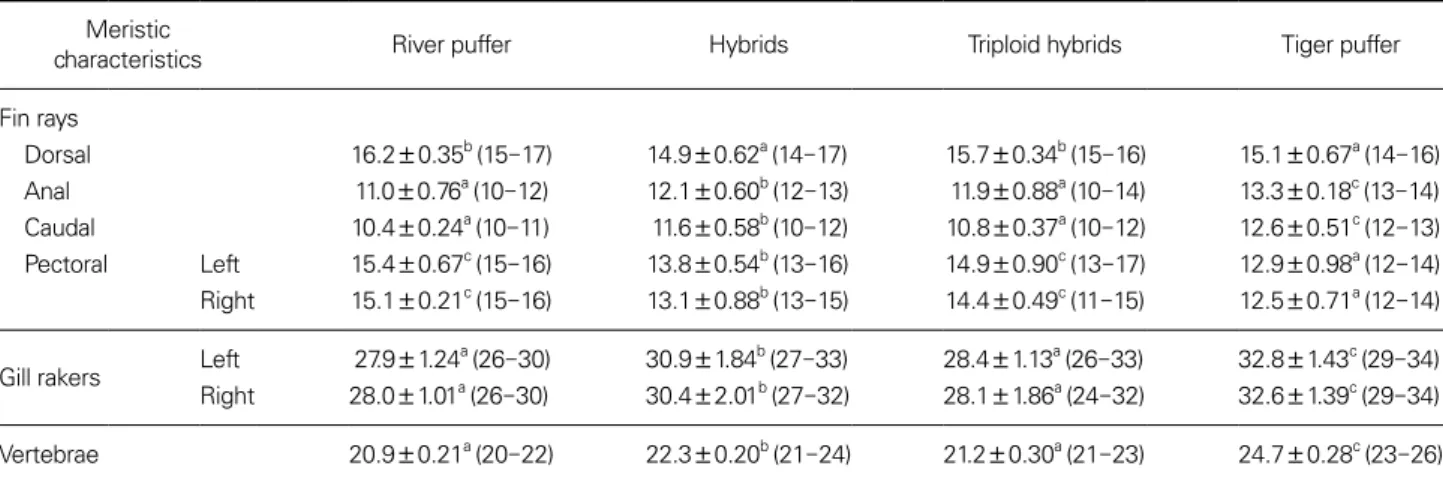
The meristic characteristics of the various experimental groups are listed in Table 3. The river puffer and triploid hybrids had a higher mean number of dorsal fin rays than the other groups (p < 0.05), while those in river puffer and tiger puffer were not significantly different from the triploid hybrids and the hybrids, respectively (p > 0.05). The mean numbers of hybrids’ anal fin rays, caudal fin rays, gill rakers, and vertebrae were higher than those for the river puffer and triploid hybrids, but lower than those of tiger puffer (p < 0.05). The mean numbers of left and right pectoral fin rays of the hybrids were higher than those of the tiger puffer, but lower than those of the river puffer and triploid hybrids (p < 0.05). The mean numbers of pectoral fin rays and gill rakers in the hybrids and triploid hybrids were not significantly different between the left and right sides (Table 3). The asymmetry in the number of pectoral fin rays and gill rakers was greater in the triploid hybrids than in the hybrids (Table 3).
Table 3. Meristic characteristics of the river puffer, Takifugu obscurus, the tiger puffer, T. rubripes, their hybrids, and their triploid hybrids