http://dx.doi.org/10.7585/kjps.2013.17.4.371
Open Access
371
벼 근권에서 분리한 방선균의 다양성과 항균 활성
이혜원·안재형·원항연·송재경·김병용*
농촌진흥청 국립농업과학원 농업미생물과
Diversity and Antimicrobial Activity of Actinomycetes Isolated from Rhizosphere of Rice (Oryza sativa L.)
Hye-Won Lee, Jae-Hyung Ahn, Hang-Yeon Weon, Jaekyeong Song, Byung-Yong Kim*
Division of Agricultural Microbiology, National Academy of Agricultural Science, RDA, Suwon 441-853, Korea
(Received on November 14, 2013. Revised on November 28, 2013. Accepted on December 10, 2013)
Abstract Various microorganisms live in soil, of which those colonizing rhizosphere interact with nearby plants and tend to develop unique microbial communities. In this study, we isolated diverse actinomycetes from rhizosphere of rice (Oryza sativa L.) cultivated in fertilized (APK) and non-fertilized (NF) paddy soils, and investigated the diversity and antimicrobial activity of them. Using four kinds of selective media, 152 isolates were obtained from the soil samples and identified by determining 16S rRNA gene sequence. All of the isolates showed 99.0%~100.0% similarities with type strains and were classified into six genera:
Dactylosporangium, Micromonospora, Kitasatospora, Promicromonospora, Streptomyces and Streptosporangium.
Most of the isolates, 143 isolates, were classified into the genus Streptomyces. Additionally, many isolates had antimicrobial activity against plant pathogens, especially Magnaporthe oryzae (rice blast pathogen) in fungi.
These findings demonstrated that rice rhizosphere can be a rich source of antagonistic actinomycetes producing diverse bioactive compounds.
Key words Actinomycetes, Rice rhizosphere. Antimicrobial activity
서 론
호기성 그램 양성 세균인 방선균은 토양 환경에 널리 분 포하는 주요한 토양 미생물 분류군이다. 토양 환경에서 서 식하는 방선균의 수와 종은 토양의 온도, pH, 유기물함량, 경작상태, 통기 및 습도 등에 영향을 받는다(Goodfellow, 2010). 방선균은 풍부한 이차 대사산물들을 생산하는 것으 로 잘 알려져 있으며, 다양한 기능성을 가지고 있어 식품, 환경 및 농산업 분야에도 널리 활용될 수 있는 유용한 생물 소재 자원이다(Morales et al., 2007; Jog et al., 2012). 지금 까지 발견된 항생물질 중의 75% 이상이 방선균에서 유래되 었고, 항암제, 면역조절제, 유용효소 등 다양한 생리활성물
질의 약 64% 정도가 방선균에서 유래된 것으로 보고되어 있다(Brdy, 2005). 이러한 특성으로 방선균을 활용해서 식물 병을 억제하고 식물 생장을 촉진시키는 다양한 연구들이 보 고되고 있다(El-Tarabily et al., 2010; Ruanpanun et al., 2010; Kinkel et al., 2012).
식물 근권은 식물의 뿌리가 직접적으로 토양과 접촉하는 영역으로, 식물 뿌리와 토양 미생물의 직·간접적인 상호작 용이 다양하게 이루어지고 있는 곳이다(Dennis et al., 2009). 근권에 서식하는 미생물은 식물로부터 유래된 뿌리 삼출물 속의 키틴, 셀룰로즈, 펙틴과 같은 양분에 쉽게 접할 수 있고 일부는 이를 통해 빠르게 성장하여 군집을 형성한 다. 이러한 근권 미생물들은 식물 근권 부위에서 양분과 수 분의 흡수를 촉진하여 식물 뿌리의 신장에 관여하며, 근권 내 병원성 유해미생물 및 병해충의 발생을 억제함으로써 작 물의 생육을 조절하는 매우 중요한 역할을 수행한다(Zhang et al., 2012). 이들 미생물들은 식물과도 활발한 상호작용을
*Corresponding author
Tel: +82-31-290-8475, Fax: +82-31-290-8488 E-mail: [email protected]
ORIGINAL ARTICLES / CONTROL
한다. 예를 들어 식물 뿌리에서는 다양한 방향족 화합물, 당, 아미노산, 유기산, 탄수화물과 같은 물질들이 분비되어 특정 근권 미생물의 군집 형성을 결정짓기도 한다(Dennis et al., 2009). 즉, 식물의 근권 속 미생물 군집이 단순히 무작위적 으로 형성되는 것이 아니라 식물 스스로에게 유익한 미생물 들을 선별하는 기능이 작용하고 있음을 유추할 수 있다 (Berg and Smalla, 2009; Ladygina and Hedlund, 2010). 따 라서 근권 토양은 작물의 생육에 도움을 주는 미생물의 분 리원으로서 유용가치가 매우 높으며, 이와 같은 관점에서 다양한 연구가 이루어져 왔다. 최근에는 근권 미생물 전체 를 통일된 군집으로 간주하여 식물의 생장 건전성을 근권 미생물의 군집구조와 연결시켜 파악하고, 미생물 군집을 조 작하여 식물의 생장을 변화시키려는 새로운 연구들이 시도 되고 있다(Berendsen et al., 2012; Bulgarelli et al., 2012;
Chaparro et al., 2012)
벼(Oryza sativa L.)는 아시아 전역에서 널리 재배되며, 세계적으로 매우 중요한 핵심적인 식량작물이다. 벼의 생산 성을 증대시키기 위하여 다양한 농법의 개량 및 육종이 오 랜 기간 동안 끊임없이 이루어져 왔다(Knief et al., 2012).
현대에 이르러서는 벼와 같은 주요 식량 작물의 병해충 방 제에 유기합성 농약을 기본으로 하는 화학방제 시스템을 널 리 이용하였는데, 이는 효과가 빠르고 좋으며, 비용이 적게 드는 장점이 있다. 그러나 화학 농약의 오남용, 독성, 환경 오염 및 자연생태계에 미치는 악영향과 약제내성의 출현 등 에 의한 약효감소 등 부작용이 증가하고 있다는 사실이 점 차 사회적으로 논란을 일으키고 있다. 따라서 이를 극복할 수 있는 대안으로 환경오염을 최소화하면서 지속적인 농업 이 가능한 친환경 농법이 제시되었다. 자연 상태에 존재하 는 토착미생물을 이용하여 만드는 미생물 제제를 이용한 친 환경 농업은 생태계에 영향을 주지 않으면서도 병, 해충을 억제하며, 농작물의 생장을 촉진하는 기능이 있다(Prez- Garca et al., 2011). 따라서 친환경 농업과 차별화된 고품질 의 안전농산물 생산을 위해서 유용한 토착 미생물을 새롭게 발굴하여 활용하는 것은 매우 중요한 접근방법이다.
본 연구에서는 벼 근권에 존재하는 방선균의 다양성과 기 능성을 조사하기 위해서, 근권으로부터 가능한 한 많은 방 선균을 직접 분리하였다. 분리된 방선균들을 대상으로 계통 학적 방법으로 다양성을 조사하였다. 또한 식물병원성 곰팡 이와 세균들을 대상으로 항균활성을 분석하여, 유용한 균주 를 확보하여 친환경 농업에 활용 가능한 생물소재로서 활용 하고자 하였다.
재료 및 방법
시료 채취 및 처리
본 연구에 이용할 벼 근권 토양 시료를 채취하기 위해서
경기도 수원시 서둔동 소재 국립농업과학원 장기 연용 시험 포장(37 16' N, 126, 59' E)을 선정하였다. 시험 포장은 1954년 이후로 각기 다른 조합의 비료 성분을 구획(6.3 × 8.3 m) 별로 시용하여 왔으며, 이들 처리구 중 3요소구(APK) 와 무비구(NF)에서 시료를 채취하였다. 공시 토양의 특성, 공시품종, 경종 개요 등은 기존 연구에 자세히 기술되어 있 다 (Yeon et al., 2007; Kim et al., 2012a). 시료를 채취한 시기는 2012년 2월이었으며 각 시험 포장 안에서 세 군데를 무작위적으로 선택하여 벼(삼광벼, Oryza sativa L.) 의 뿌 리를 근권 토양과 함께 채취하였다. 채취한 벼의 뿌리를 3 회에 걸쳐 멸균 증류수로 세척한 후 최종적으로 세척한 증 류수를 원심분리하여 근권 토양을 분리하였다. 같은 시험 포장에서 분리한 근권 토양과는 혼합하여 실험을 위한 재료 로 사용하였다
방선균의 선택적인 배양 및 분리
각각의 토양 시료 2 g에 멸균 생리식염수(0.85% NaCl) 18 ml을 첨가하고 30분간 충분히 현탁하여 10
−1로 희석하였 다. 항온수조에서 55
oC, 20 분간 처리 후 멸균 생리식염수로 10배 단위로 10
−7까지 단계적으로 희석(serial dilution) 하였 다. 희석액 중 10
−2~10
−7까지 6개의 희석액을 선택배지에 100 µl씩 도말하였다. 선택배지는 Humic-acid vitamin agar (HV), Starch casein agar (SCA), Streptomyces isolation media (SIM), Tap water-yeast extract agar (TWYE) 를 사 용하였다. 도말한 배지를 28
oC 에서 14일 동안 배양하였고, 배지상에 형성된 콜로니중 방선균으로 추정되는 것을 무작 위로 선별하여 oatmeal agar 배지에 계대하였다. 계대한 균 주들은 14일간 더 배양하여 개별 콜로니들을 최종적으로 순 수 분리하였다.
분리균주의 Genomic DNA 추출 및 16S rRNA 유전자 서 열분석
계대배양하여 순수 분리한 방선균 균주들을 Trypic Soy Broth (TSB) 3 ml 에 3일간 배양하여 PureHelix
TMGenomic DNA Prep Kit (NanoHelix, Korea) 로 genomic DNA를 추 출하였다. 추출한 genomic DNA를 주형으로 하여 27F (5'- AGAGTTTGATCCTGGCTCAG-3')와 1492R (5'-AAGGA GGTGATCCAGCCGC-3') primer를 사용한 PCR 반응을 실 시하였다. PCR 반응물의 조성은 10 µM의 forward primer 0.5 µl, 10 µM의 reverse primer 0.5 µl, 10X buffer 2.5 µl (Inclone, Korea), 10 mM 의 dNTP (Inclone, Korea) 0.5 µl, 5 U/ µl의 Taq polymerase (Inclone, Korea) 0.25 µl, 1.10 g/
ml 의 dimethyl sulphoxide (DMSO; Sigma-Aldrich) 1.25 µl,
H
2O 18.5 µl, DNA 시료 (20 ng/ µl)를 PCR tube에 넣고 혼
합하였다. PCR 반응은 95
oC, 5 분간 initial denaturation 후
에, 30 cycle 반복수행으로 95
oC 에서 1분 denaturation, 55
oC
에서 45초 annealing, 72
oC 에서 1분 extension 수행한 후 72
oC 에서 5분간 final extension하는 조건으로 실시하였다.
증폭된 PCR 산물은 정제 후에 Genotech사 (Korea)에 의뢰 하여 염기서열을 결정하였고, EzBioCloud (http://www.
ezbiocloud.net; Kim et al., 2012b) 에서 표준균주들과 염기 서열의 상동성을 비교하였다.
염기서열 분석 및 계통수 작성
순수 분리한 방선균의 16S rDNA 염기서열을 분석하여 표준균주와 비교하였다. EzBioCloud에서 염기서열이 표준 균주와 99.0% 이상의 상동성을 나타낸 서열들만을 선별하 여 계통분석을 수행하였다. 표준균주들의 계통도를 작성하 기 위해서 EzBioCloud로 부터 염기서열을 얻어 CLASTAL W (Thompson et al., 1997) 를 사용하여 alignment를 수행하 였다. 계통수의 작성은 MEGA program version 4.0 (Tamura et al., 2007)을 사용하였고, 알고리즘으로 UPGMA (Sneath and Sokal, 1973) 방법을 사용하였다.
분리 균주의 항균활성능 분석
분리한 균주들의 항균 활성능을 조사하기 위하여 식물병 원성 곰팡이 및 세균들을 대상으로 검정하였다. 식물병원성 곰팡이는 상추 균핵병균(Sclerotinia sclerotiorum KACC 40457), 고추 탄저병균(Colletotrichum acutatum KACC 40804), 호박 덩굴마름병균(Didymella bryoniae KACC 40938), 잿빛곰팡이균(Botrytis cinerea KACC 40573), 시들
음병균(Fusarium oxysporum KACC 40037), 벼 도열병균 (Magnaporthe oryzae KACC 40435), 오이 잘록병균(Pythium ultimum KACC 40705), 벼 깨씨무늬병균(Bipolaris oryzae KACC 41025), 뿌리썩음병균(Fusarium solani KACC 44891), 인삼 잘록병균(Rhizoctonia solani KACC 40123) 등으로 총 10균주이다. 곰팡이의 항균활성 검정은 Potato Dextrose Agar (PDA; Difco) 배지에 검정균주를 각각 접종한 후 분 리된 방선균 균주를 대치배양하여 균체 주위에 형성된 생 육저지대 (clear zone) 의 크기에 따라 항균 활성을 측정하 였다.
세균은 Xanthomonas oryzae KACC 10331, Pectobacterium carotovorum subsp. carotovorum KACC 11130 등을 사용 하였다. 세균의 항균활성 검정은 LB broth 배지(Difco)에 검 정균주 배양액 1 ml을 각각 접종하여 분주한 후에 분리균주 와 대치 배양하여 균체 주위에 형성된 생육저지대의 크기에 따라 항균활성을 측정하였다.
결과 및 고찰
벼 근권에서 분리한 방선균의 동정
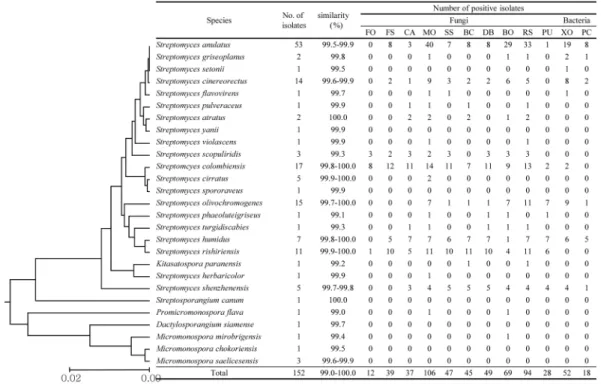
본 연구에서 벼 근권 토양으로부터 분리된 방선균 전체 균주의 수는 152균주였으며, 각 균주들의 16S rRNA 유전 자 염기서열은 표준균주 27종과 99.0%~100.0%의 높은 상 동성을 나타내는 것으로 확인되었다(Fig. 1). 표준균주 27종 은 각각 Streptomyces 속(20종), Micromonospora 속(3종),
Fig. 1. Phylogenetic diversity and antimicrobial activities of isolates from the rice rhizosphere.
FO, F. oxysporum; FS, F. solani; CA, C. acutatum; MO, M. oryzae; SS, S. sclerotiorum; BC, B. cinerea; DB, D. bryoniae; BO, B.
oryzae; RS, R. solani; PU, P. ultimum; XO, X. oryzae; PC, P. carotovorum.
Dactylosporangium 속(1종) Kitasatospora 속(1종), Promi- cromonospora 속(1종), Streptosporangium 속(1종) 등의 6개 속(genus)으로 분류되었다. 이 중 Streptomyces 속에 속하는 것이 전체 분리 균주의 94%에 해당하는 143균주이였다. 그 외에 Micromonospora 속에 5균주(3%) 가 속하였고, 나머지 4 속에는 각각 1균주 밖에 분리되지 않았다. 특히 Strep- tomyces 속의 균주 중에서는 S. anulatus 종에 포함되는 균 주가 53균주로 가장 많았으며 그 외에 S. colombiensis, S.
olivochromogenes, S. cinereorectus, S. rishiriensis 에 해당
되는 균주들이 10균주 이상으로 많았다. Streptomyces가 근 권 방선균중에서 우점종으로 분리된 이번 연구 결과는 이전 에 보고된 다른 연구와도 일치하는 결과이다(Lee et al., 2006; Tian et al., 2007). 그러나 이전의 결과들에서는 S.
bungoensis, S. caviscabies, S. canus, S. galbus, S.
olivochromogenes, S. spororaveus, S. tauricus 등의 종들이 우점종으로 보고되었으나, 본 연구에서는 S. olivochro- mogenes 를 제외한 대부분의 우점종이 이전에 보고되지 않 은 종들이었다. 특히, S. anulatus에 포함되는 균주가 이전 Table 1. Representative actinobacterial strains isolated from rhizosphere of rice cultivated in the fertilized paddy soil (APK)
Isolation media Total no. of isolates Species No. of isolates
HV 2 Streptomyces colombiensis 2
SCA 19
Streptomyces anulatus 7
Streptomyces cinereorectus 3
Streptomyces cirratus 1
Streptomyces flavovirens 1
Streptomyces griseoplanus 1
Streptomyces herbaricolor 1
Streptomyces olivochromogenes 1
Streptomyces rishiriensis 1
Streptomyces setonii 1
Streptomyces shenzhenensis 1 Streptomyces turgidiscabies 1
SIM 38
Streptomyces anulatus 16
Streptomyces rishiriensis 7
Streptomyces humidus 5
Streptomyces cinereorectus 4
Streptomyces yanii 1
Streptomyces spororaveus 1
Streptomyces shenzhenensis 1 Streptomyces olivochromogenes 1
Streptomyces colombiensis 1
Kitasatospora paranensis 1
43
Streptomyces anulatus 13
TWYE
Streptomyces colombiensis 9
Streptomyces shenzhenensis 3
Streptomyces scopuliridis 3
Streptomyces olivochromogenes 3 Streptomyces cinereorectus 3
Streptomyces humidus 2
Streptomyces atratus 2
Streptomyces violascens 1
Streptomyces rishiriensis 1
Streptomyces phaeoluteigriseus 1 Micromonospora mirobrigensis 1
Promicromonospora flava 1
연구들과는 달리 전체 Streptomyces 중에서도 가장 많이 존 재하여 벼 근권 내 방선균에서는 가장 우점하고 있는 종으 로 확인되었다.
분리원 및 분리배지에 따른 방선균 다양성 비교
근권 토양 분리원을 3요소구(APK)와 무비구(NF)로 나누 어서 분석한 결과 3요소구와 무비구로부터 분리된 방선균은 각각 102균주와 50균주였다(Table 1, 2). 16S rRNA 유전자 분석을 통해 동정한 결과, 3요소구와 무비구로부터 분리된 균주들은 각각 22종과 12종의 표준균주와 높은 상동성을 나 타내어, 분리 균주의 다양성에 있어서 3요소구가 두 배 정 도 높았다. 두 분리원에서 공통적으로 나타난 종은 7종이었 으며, 각각 S. anulatus, S. cinereorectus, S. cirratus, S.
colombiensis, S. griseoplanus, S. olivochromogenes, S.
rishiriensis 등으로 모두 Streptomyces 속에 포함되었다. 분 리배지에 따라 비교해 보았을 때, HV 배지로부터는 두 분 리원에서 각각 두 균주만이 분리되었고, 이들 균주들은 모 두 S. colombiensis와 높은 상동성을 나타냈다. SCA, SIM 배지로부터 분리된 균주는 두 분리원간에 비교적 큰 차이가 없었지만, TWYE의 경우에는 뚜렷한 차이를 보였다. 즉, HV 배지는 벼 근권 방선균 분리배지로서는 적절한 배지가 아니며, TWYE 배지는 분리원에 따라서 매우 큰 차이를 보 이는 선택배지라고 판단되었다. 또한 분리원이나 분리배지 와 관계없이 S. anulatus와 상동성이 높은 균주들이 가장 많
이 분리되었다. 따라서 이런 결과는 적절한 분리원을 대상 으로 여러가지 선택배지를 사용해야 다양한 방선균의 선택 적 분리 배양이 가능하다는 점을 보여준다.
분리균주의 항균 활성
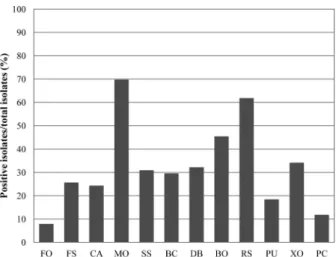
전체 분리된 방선균 152균주를 대상으로 여러 가지 식물 병원성 곰팡이에 대한 항균활성을 검정하였다(Fig. 1, 2). 전 체 검정균주 10개 중 벼 도열병균(Magnaporthe oryzae KACC 40435)에 항균활성을 나타내는 균주가 전체 152균 주 중 106균주(70%)로 가장 많았으며, 인삼 잘록병균 (Rhizoctonia solani KACC 40123) 에 항균활성을 보이는 균 주가 94균주(62%), 벼 깨씨무늬병균(Bipolaris oryzae KACC 41025) 에 항균활성을 보이는 균주가 69균주(45%)로 그 뒤를 이었다(Fig. 2). 반면 항균효과를 상대적으로 적게 보였던 검정균주는 오이 잘록병균(Pythium ultimum KACC 40705) 과 시들음병균(Fusarium oxysporum KACC 40037) 으로 항균활성을 나타낸 분리 균주는 각각 12균주(8%)와 28균주(18%) 이었다. 흥미로운 점은 분리된 균주들이 가장 큰 항균 활성을 보인 M. oryzae KACC 40435, B. oryzae KACC 41025 이 모두 벼에서 직접 병을 일으키는 병원성 균주들이라는 점이다. 검정균주로 활용한 인삼 잘록병균(R.
solani KACC 40123) 도 인삼에서 분리된 균주이기는 하지 만, R. solani 균이 벼에 감염하여 벼 잎집무늬마름병을 유 발하는 곰팡이로도 알려져 있다. 즉, 벼 근권에서 분리한 방 Table 2. Representative actinobacterial strains isolated from rhizosphere of rice cultivated in the non-fertilized paddy soil (NF)
Isolation media Total no. of isolates Species No. of isolates
HV 2 Streptomyces colombiensis 2
SCA 14
Streptomyces anulatus 4
Streptomyces olivochromogenes 4
Streptomyces cirratus 3
Streptomyces colombiensis 1
Streptomyces griseoplanus 1
Streptomyces pulveraceus 1
SIM 29
Streptomyces anulatus 11
Streptomyces olivochromogenes 6
Streptomyces cinereorectus 4
Streptomyces colombiensis 2
Streptomyces rishiriensis 2
Micromonospora saelicesensis 2
Streptomyces cirratus 1
Streptosporangium canum 1
TWYE 5
Streptomyces anulatus 2
Dactylosporangium siamense 1
Micromonospora chokoriensis 1
Micromonospora saelicesensis 1
선균들이 벼와 관련된 병원균들에 대해서 높은 항균 활성을 보이는 것은, 이들 미생물들이 벼 생육과정에서 병을 억제 하는 기능을 수행할 수 있음을 보여주는 간접적인 증거라고 할 수 있을 것이다.
항진균 활성 분석과 마찬가지로 전체 방선균 152균주를 대상으로 식물 병원성 세균(Xanthomonas oryzae KACC 10331, Pectobacterium carotovorum subsp. carotovorum KACC 11130) 에 대한 항세균 활성을 조사하였다(Fig. 1, 2).
벼 흰잎 마름병을 유발하는 병원성 세균인 X. oryzae KACC 10331 균주에 대해서 활성(34%)을 보이는 경향이 P. carotovorum KACC 11330 에 대한 활성(12%)보다 크게 나타났다. 이를 통해 볼 때 벼 근권 내에 서식하는 방선균이 벼에 감염하는 유해 곰팡이 및 세균의 발생을 억제시키는 효과를 나타내고 있을 가능성이 높다고 판단된다.
분리 균주의 분류학적 위치와 항균 활성능의 연관성 분석 같은 종에 해당하는 분리 균주들을 대상으로, 항균활성을 나타내는 균주수를 계산하여 균주들의 분류학적 위치와 항 균활성능의 연관성을 분석하였다(Fig. 1). 가장 많이 분리된 S. anulatus 종(53 균주)의 경우 곰팡이 항균활성은 M.
oryzae, R. solani, B. oryzae 에 항균활성을 나타내는 균주의 수가 가장 많았고, F. oxysporum, P. ultimum에는 항균활성 을 나타내는 균주의 수가 각각 0개, 1개로 가장 낮았다. 세 균 항균활성의 경우 X. oryzae과, P. carotovorum 에 항균활 성을 나타내는 균주가 각각 19개, 8개로 대체로 적었다. 이 결과는 전체 분리 균주 152균주의 경향성과 대체로 일치하 는 결과이다. 전체 검정균주에 우수한 항균활성을 나타낸 균주들은 S. humidus, S. shenzhenensis에 포함되는 균주들
이었으며, S. colombiensis, S. rishiriensis, S. scopuliridis로 분류된 균주들은 항진균 활성은 높았으나, 항세균 활성은 낮았다. S. humidus, S. rishiriensis, S. scopuliridis 등의 분 류군에 대해서는 항균활성 효과 및 항생물질에 대한 기존의 여러 보고들이 있다. S. humidus는 Dihydrostreptomycin이 라는 항생물질을 생산하는 새로운 종으로서 최초로 발견되 었으며(Tatsuoka et al., 1957), 근래에는 Collectotrichum gloeosporidoides, Fusarium oxysporum, Rhizoctonia solani 등의 식물병원성균에 항균활성을 나타내는 S. humidus S5- 55가 보고된 바 있다(Hwang et al., 2001). S. rishiriensis 로 부터는 Coumermycin A
1, Lactonamycin 등의 항생물질이 보고되었다(Matsumoto et al., 1999; Li et al., 2002). S.
scopuliridis 종은 bacteriocin을 다양하게 생산하는 Strepto- myces 종으로 처음 보고되었으며, S. scopuliridis RB72
T균 주는 식물에 병을 유발하는 곰팡이 및 세균의 조절기능과 생장증대효과를 나타내는 것으로 밝혀졌다(Farris et al., 2011).
결과적으로 Streptomyces 속의 균주들이 다른 속에 해당 하는 균주들보다 항균활성이 더 높았고, Streptomyces 속 내 에서도 몇몇 특정 종에 속하는 분리 균주들이 항균 활성이 높은 것을 조사하였다. 이 결과들은 분리 균주들의 분류학 적 위치와 항균 활성능이 일정 정도 연관성이 있음을 제시 한다. 이러한 사실은 이전에 보고된 다른 연구결과에서도 이미 확인된 바 있다(Anzai et al., 2008). 따라서 본 연구를 통해 분리된 미생물들 중에서 높은 항균 활성을 갖는 균주 들은 다양한 생리활성 물질을 생산할 가능성이 높고, 추후 에 유용한 미생물 제제로 활용될 가능성이 충분하다고 판단 된다.
감사의 글
이 논문은 농촌진흥청 국립농업과학원(PJ90712704)의 재 원으로 수행되었으며 이에 감사드립니다. 논문을 검토해주 시고 부족한 점을 지적해주신 심사자들께도 깊이 감사드립 니다.
Literature Cited