DOI : http://dx.doi.org/10.5394/KINPR.2011.35.7.597
Suggestions for the competitiveness of the Port-Logistics industry in Busan port area
- Focus on the port transport industry and port transport related industry -
Dong-Seok Lim*․†Kyu-Seok Kwak․Ki-Chan Nam**
* Graduate school of National Korea Maritime University, Busan 606-791, Korea
†,** Dept. of Logistics Engineering, National Korea Maritime University, Busan 606-791, Korea
Abstract : An environment of world marine port today is rapidly changing. Importance of a hub port is being maximized along with appearance of a large container ship, and Busan port is also growing with the goal as a hub port of Northeast Asia.
Busan port currently has competitive power as the 5th top port in the world, but increase rate of transportation quantity, is low compared to Shanghai port in China and other ports in Northeast Asia. For a port to obtain competitiveness, investment on infrastructures of a port is necessary and also it has close relation with an intraregional port logistics industry.
However, a port logistics industry in Busan area has a hard time avoiding a small size due to the government support on major companies. Therefore, this study will analyze difficulties of small port logistics companies and the related companies as to vitalize port logistics industry in Busan area in hopes to help vitalizing regional economy.
Key words : Busan port, Competitiveness, Port-Logistics industry, Port transport industry, Port transport related industry
* [email protected] 051)410-4912
†Corresponding author, [email protected] 051)410-4332
** [email protected] 051)410-4336
1. Introduction
Due to rapid globalization following development in information communication and transportation technology etc. during recent years, production and sales network of entrepreneurs have been extended to all over the World which make various forms of international logistics increased including raw materials supply etc. Especially, with shipping and logistics takes over 97% of traffic volume in the World, its importance is being increased day by day.
Also, the industries which are related with shipping and port have large linking and ripple effect son employment etc., invigoration of this industry has been one of the most important strategies in state economy.
As economy is globalized, World’s shipping and port environment is also being changed rapidly. Europe and Northern America region as well as Northeast Asia region which had traditionally high importance, competition for goods transportation is being accelerated in between regions.
Especially, in Northeast Asia regions, the quantity of goods transport is being rapidly increased centering from
Korea, Japan, and China which ultimately have occupied 30% of total goods transport quantity of World in year 2010.
Therefore, while competition between ports in the region is going to be deepened recently, to have competitiveness for not only invest on infrastructure but also it is closely related with port-logistics industries within region. Port logistics industry in Busan region has high importance with figure 49.8% of state, but due to government policy focusing only on conglomerates and tax benefit for those, these industries cannot get rid of smallness.
This study aims to help regional economy by analyzing difficulties of small sea carriers and related industries at invigoration level for sea logistics industry in Busan region to integrally seek the solutions.
2. Analysis of Precedent Researches
2.1 Researches on securing competitiveness of Port logistics Industry
Kang(2005) has proposed invigoration plan of port logistics industries in Pyungtaek port area at its
invigoration level with SCM strategy concept by analyzing each process wise constraint factors in port logistic systems.
The largest difficulties factors in port logistics industry found by the above research were; lacking in shippers, lacking in port facilities infrastructure, lacking in logistics hinterlands facility, and lacking in access facilities.
As an invigoration plan for the above problems, he proposed various supporting strategies in systematic aspect as well as hardware infrastructure aspect for the attraction of import and export enterprises at shippers view point.
Also, he proposed expansion plan of port facility and hinterland logistics facility, and also proposed fostering and attracting integrated logistics enterprises plan to get rid of smallness of port logistics industries and the above proposal are in accordance with this study.
Problems Activation plan Details
Lacking in shippers
Activation of port through attracting export enterprises
Overseas publication of product from small and medium industries at initial stage of
export
Expansion of policy fund support for export oriented industry in
Gyeonggi-do area Simplifying application process for the export industries lodged
in Industrial park
Lacking in port facilities
Expansion of port supporting logistics facility of port and hinterland region
Early building of Pyeongtaek port dock Early building of dredged soils
arena in inner harbor Necessity of extension and
increases in sea route
Smallness of port logistics industry
Promoting and inviting of integrated logistics
enterprises
Support for logistics activities by introducing various tax exemption policy for corporate
tax and VAT Tax exemption for the shippers
who are using integrated logistics enterprises
Table 1 Problems and solutions for Pyeongtaek Port
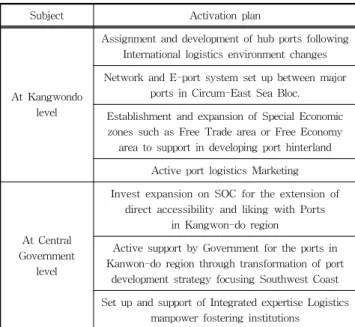
Cha(2008) has attempted to attribute regional economy development by seeking invigoration plan for port logistics industries which have location priorities in Circum-East Sea Bloc. He also has proposed the invigoration plans for port logistics industries in Kangwon-do region by classifying Kangwon-do and central government levels, and proposed assigning and development of hub port as per
international logistics environment changes, network and electronic port system set up between major ports in Circum-East Sea Bloc, and construction and expansion etc.
of economic specialized zone for the support of port hinterland at Kangwon-do level, and at Central Government level, he proposed SOC(Social Overhead Capital) invest expansion plan, active support for the ports in Kangwon-do region through port development policy focusing Southern West sea coast, and necessity of establishment and support of integrated expert logistics manpower fostering Institutions.
Subject Activation plan
At Kangwondo level
Assignment and development of hub ports following International logistics environment changes Network and E-port system set up between major
ports in Circum-East Sea Bloc.
Establishment and expansion of Special Economic zones such as Free Trade area or Free Economy area to support in developing port hinterland
Active port logistics Marketing
At Central Government
level
Invest expansion on SOC for the extension of direct accessibility and liking with Ports
in Kangwon-do region
Active support by Government for the ports in Kanwon-do region through transformation of port
development strategy focusing Southwest Coast Set up and support of Integrated expertise Logistics
manpower fostering institutions
Table 2 Support subject wise activation plan for Port logistics industries in Kangwon-do region
Choi(2008) has proposed invigoration plan for logistics industries in Jeonnam region by linking port logistics including Mokpo port, Yeosu port, and Wando port with Gwangyang port as a logistics base, airway logistics in Muan International Airport, and inland cargo base in Complex cargo terminal in Jangseong to set up efficient logistics network. He also asserted that total logistics management system on the bases of RFID/USN for U-logistics system in Jeonnam region by strengthening capability of regional innovation subject and industrial innovation through making systematic regional innovation plan.
Also, he reported that it is required to advance integrate smaller import and export logistics bases which presently scattered in downtown Gwangju and its suburban area and to set up development plan in relation with driving traffic network linking to the above triangular logistics bases and
to set up plan to develop Muan International Airport to the status of a hub airport, and to strengthen its function as an air freight terminal.
Fig. 1 Structure for Promotion of logistics industries in Jeonnam Region
2.2 Researches on support plan for small and medium logistics industries
Kim(2009) has assumed survival rate and risk rate of entire small and medium logistics industries to figure out survival rate after IMF and have verified its difference per factors. Further, they have conducted exploratory researches about which factors could be considered as survival factors for small and medium transportation logistics industries.
The research results showed that there have been difference in survival rate as per factors such as location of logistics industries, gender of CEO, business period, and industries with new technology, but no differences were found in the factors of business category wise number of employee and industry’s business type.
Those factors can be regarded as important in their study since it has proposed the methods which could be adopted for survival analysis in various fields of small and medium size logistics industries about which, as of now, researches have not been carried out yet.
Han(2009) have carried out positive analysis about priority for the decision making on participation factors in logistics cooperation in Jeju area with AHP(Analytic Hierarchy Process) and attempted to elicit reasonable strategies for the activation of this process.
Preceding researches were reviewed for decision factor and hierarchy structure in logistics corporations and through interview with site operators and experts, logistics characteristics, characteristic of small and medium industries, and recent logistics environment in Jeju area have been investigated.
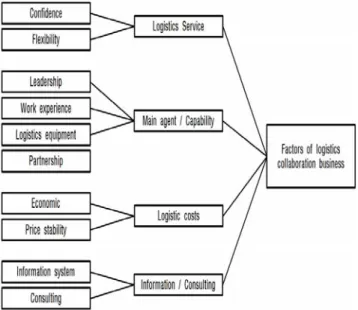
As higher factors 4 criteria of logistics services, driving force and enterprise operation capability, logistics cost, information and consulting were constructed, and lower criteria were constructed with 10 items i.e., credibility, adaptability, leadership, implementation, logistics facility, partnership, economical efficiency, logistics cost stability, information system and sharing, consulting and education.
Fig. 2 Compositional Factors in Logistics Cooperation in Jeju
3. Analysis method
3.1 Research Scope and sample designing
In this research, for the correct tally in port- transportation industry and port-transportation related industry, the industries which were registered in each Regional Maritime Affairs & Port Office as of July 2011 were examined.
The number of port-transportation industry and port-transportation related industry has been found to be 1,475. All in all, the registration rate of port-transportation related industry in Busan region was higher than that of port-transportation industry, and in case of goods supply company, it occupied 69% of total in entire country.
Besides, to secure objectivity of this study, survey study has been carried out with 30 port-transportation industries, 100 port-transportation related industries in Busan area and 22 copies from port-transportation industries and 66 copies from port-transportation related industries among returned questionnaire were used for analysis.
Category
port-transportation industries
Total Stevedoring Tally
(checker)
Sworn Measurer /surveyor
Busan No. of
industry 61 6 15 82
Weight 17.2 12 26.8 17.8
Total
No. of
industry 355 50 56 461
Weight 100 100 100 100
Source : Internal data, Busan Regional Maritime Affairs & Port Office(2011)
Table 3 Outline of port-transportation industries in Busan area
Category
port-transportation related industries
Total Port
contract Goods supplier
Vessel fueling
Container repair
Busan No. of
industry 161 1,082 112 38 1,393
Weight 41.4 69.0 24.1 49.4 55.7
Total
No. of
industry 389 1,569 464 77 2,499
Weight 100 100 100 100 100
Source : Internal data, Busan Regional Maritime Affairs & Port Office(2011)
Table 4 Outline of port-transportation related industries in Busan area
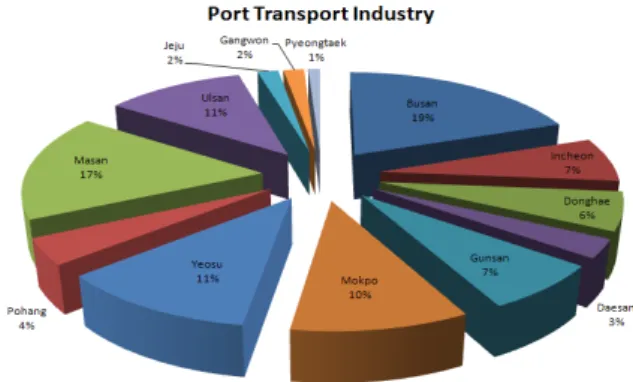
If we look at registration of port-transportation industry, the highest number was located in Busan region with figure of 19% followed by Masan and Ulsan etc.<Fig. 3>.
In case of port-transportation related industry, the weight occupied by Busan area was 56% which was higher than that of port-transportation industry <Fig. 4>. Not only weight of occupancy, but also in number of industries, it was 1,393 which was dominantly higher than that of port-transportation industry of 82.
Fig. 3 Occupancy of port-transportation industry in different area as against national total
Fig. 4 Occupancy of port-transportation related industry in different area as against national total
3.2 Construction of Questionnaire and analysis method
The materials for this study has been collected in the form of questionnaire, and in questionnaire, support policy for small and medium industry 2011 published by Small and Medium Business Administration was used.
The background of selecting the above report was that port-transportation industry and port-transportation related industry in Busan region have occupied more than 99% of national total, thus the importance was absolute, but still those industries cannot get rid of smallness. Therefore, it has been selected to elicit the support policies which port-transportation industry and port-transportation related industry need among policies proposed by Small and Medium Business Administration for the promotion of small and medium sized industries in Korea.
Besides, to evaluate item wise importance, 5 point criteria have been used, and higher 10 items whose average values were high extracted from 22 copies(55% responsiveness) and 68 copies(68% responsiveness) of returned questionnaires were selected. For the selected items, factor analysis and reliability test was carried out using SPSS 12.0.
First of all, through exploratory factor analysis, 4 factors were drawn, and further analysis was carried out to evaluate reliability to elicit development criteria of port logistics Industries in Busan region.
4. Analysis of Result
4.1 Exploratory factor analysis
Factor analysis is an analysis tool by which potential factors between parameters are analyzed and the parameters which have high relationship are grouped and then these relationships are expressed as formula.
In this study, principal component analysis and
orthogonal factor rotation method were used and Eigen value was made to be higher than 1.0 and then factor analysis was carried out. 4 factors were calculated through above process.
From the result, in accumulation distribution ratio, in case of port-transportation industry group, this was 75.9 and in port-transportation related industry, this figure was 78.206.
Compon ents
Extraction sums of Squared Loadings
Rotation sums of squared loadings
Total %
variance
% accumul
ation
Total %
variance
% accumul
ation
1 2.610 26.101 26.101 2.071 20.712 20.712
2 1.932 19.319 45.420 2.004 20.039 40.751
3 1.640 16.396 61.816 1.913 19.133 59.883
4 1.408 14.085 75.900 1.602 16.017 75.900
Table 5 Factor analysis result for Port-transportation industry
Compo nents
Extraction sums of Squared Loadings
Rotation sums of squared loadings
Total %
variance
% accumul
ation
Total %
variance
% accumul
ation
1 2.618 26.180 26.180 2.053 20.526 20.526
2 1.999 19.994 46.174 2.000 19.996 40.522
3 1.810 18.095 64.269 1.981 19.815 60.337
4 1.394 13.937 78.206 1.787 17.869 78.206
Table 6 Factor analysis result for Port-transportation related industry
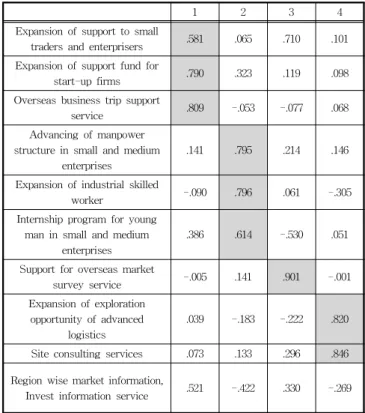
Generally, if factor loading is higher than 0.4, it has got normal level significance, while if it is higher than 0.5, it could be considered as having high significance difference, thus in this study, the factors were analyzed with 0.5 level of factor loading.
The results are presented as factor loading value of port-transportation industry group and port-transportation related industry group in <Table 7> and <Table 8>.
However, among those items, in case of ‘region wise market information invest information service(port- transportation industry)', ‘Expansion of opportunity to visit advanced logistics(port-transportation related industry)’, and
‘On-line export support(port-transportation related industry)’, factor loading values were turned out as low, thereby these were deleted before going through reliability test.
1 2 3 4
Expansion of support to small
traders and enterprisers .581 .065 .710 .101
Expansion of support fund for
start-up firms .790 .323 .119 .098
Overseas business trip support
service .809 -.053 -.077 .068
Advancing of manpower structure in small and medium
enterprises
.141 .795 .214 .146
Expansion of industrial skilled
worker -.090 .796 .061 -.305
Internship program for young man in small and medium
enterprises
.386 .614 -.530 .051
Support for overseas market
survey service -.005 .141 .901 -.001
Expansion of exploration opportunity of advanced
logistics
.039 -.183 -.222 .820
Site consulting services .073 .133 .296 .846
Region wise market information,
Invest information service .521 -.422 .330 -.269 Factor extraction method : principal component Analysis
Rotation method : Varymax with Kaiser Normalization
Table 7 Factor analysis result for Port-transportation industry
1 2 3 4
Support of technical exchanges between Business type wise in between
groups
.797 .429 .124 .155
Job opportunity in best small
and medium enterprises .197 .839 .214 .160
Advancement in manpower structure in small and medium
enterprises
.054 .784 -.173 -.064
Expansion of support to small
traders and enterprisers .268 .190 .830 .232
Expansion of support fund for
start-up firms -.007 -.098 .807 -.442
Support in joint business invest for Korea Federation of Small
Business
-.343 .585 .505 .099
Support in domestic sourcing
for Global buyers -.299 .096 -.200 .774
Support in overseas market
survey service .177 .000 .166 .919
Expansion of exploration opportunity of advanced
logistics
.627 .223 -.414 -.156
On-line export support .820 -.225 .237 -.081
Factor extraction method : principal component Analysis Rotation method : Varymax with Kaiser Normalization
Table 8 Factor Analysis result for Port-transportation related industry
4.2 Reliability verification
Reliability is a concept related with consistence, accuracy, reliable possibility, stability, and prediction possibility and it shows the possibility of getting measurement value when the measurement is repeated for the same concept.
In this study, Cronbach’s Alpha coefficient was used with which reliability is increased by excluding items which hamper reliability in case many numbers of items are used to measure the same concept.
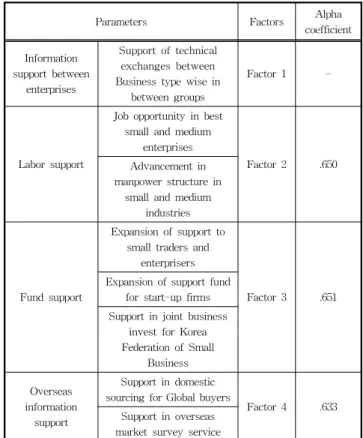
Reliability analysis using Cronbach's Alpha showed that the grouped factors in port-transportation industry as well as port-transportation related industry parts had values higher than 0.606, 0.633 respectively.
Especially, in port-transportation industry, Alpha coefficient in fund support showed highest value amongst with figure 0.736. Because Alpha coefficient all showed higher than 0.6 in all the factors, it means that internal consistency within grouped factors is being maintained strongly.
Parameters Factors Alpha
coefficient
Fund support
Expansion of support to small traders and
enterprisers
Factor 1 .736 Expansion of support fund
for start-up firms Overseas business trip
support service
Labor support
Advancement in manpower structure in small and medium
industries
Factor 2 .661 Expansion of industrial
skilled worker Internship program for young man in small and
medium industries Overseas
information support
Support in overseas
market survey service Factor 3 -
Educational support
Expansion of exploration opportunity of advanced
logistics Factor 4 .606
Site consulting services
Table 9 Factor analysis result for Port-transportation industry
Parameters Factors Alpha
coefficient
Information support between
enterprises
Support of technical exchanges between Business type wise in
between groups
Factor 1 -
Labor support
Job opportunity in best small and medium
enterprises
Factor 2 .650 Advancement in
manpower structure in small and medium
industries
Fund support
Expansion of support to small traders and
enterprisers
Factor 3 .651 Expansion of support fund
for start-up firms Support in joint business
invest for Korea Federation of Small
Business
Overseas information
support
Support in domestic sourcing for Global buyers
Factor 4 .633 Support in overseas
market survey service
Table 10 Factor analysis result for Port-transportation related industry
4.3 Analysis results
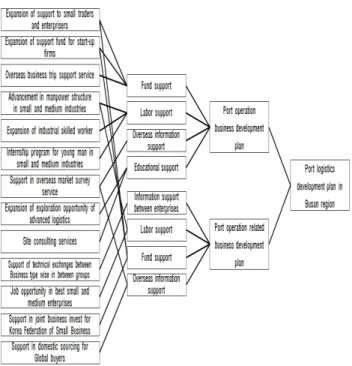
As a factor analysis result and reliability verification, invigoration of port logistics industries in Busan region was drawn as 4 factors of fund support, labor support, overseas information support, and education support etc. from port-transportation industry category and 4 factors of support of information between companies, labor support, fund support, and overseas information support etc. were drawn from port-transportation related industry category.
3 factors i.e., fund support, labor support, and overseas information support etc. turned out to be common necessary factors in both port-transportation industry and port-transportation related industry. However, education support and information support between industries have been applicable only to port-transportation related industry, therefore it is judged that more education is required for tally/sworn and survey in port-transportation industry due to characteristic of work, and goods supply, fueling to vessel etc. which need information sharing are applicable to port-transportation related industry.
Fig. 5 Plan for securing competitiveness in Port logistics Industries in Buasn Region
5. Conclusion and future study plan
5.1 Conclusion
In this study, invigoration plan of port logistics industries to secure competitiveness in Basan port which handles more than 73% of moving cargo in port container(as of year 2010) was surveyed by categorizing port- transportation industry and port-transportation related industry.
While existing researches have been focused on the constitutional aspect and infra set up to solve problems of current port logistics industry, this study was pursued to get rid of smallness of related industry by adopting support plans to small and medium industries.
By examining various problems which hinder smallness of port logistics industry in Busan region, it has been elucidated what could be practical help to solve the problems.
As a result of research, 4 factors including fund support in port-transportation industry part for the invigoration plan and 4 other factors including information support between industries have been drawn.
We hope that these results would be referred by various supporting bodies including Government to help in policy set up for supporting small and medium industry in future.
5.2 Future research plan
This study has been conducted within Busan Region where 49.8% of port-transportation industries and
port-transportation related industries among whole country are located, but there is need to extend the scope of research towards Kyungnam Region(Masan, Ulsan) which are under influential zone of Busan port.
Also, by carrying out research focusing Incheon, Pyeongtaek regions whose bases are being developed as the 2nd ports following Busan port to expect overall development in Port logistics Industry in this Country.
References
[1] Cha, S. G.(2008), Around East Sea Region Port Logistics Industry Activation Scheme with Gangwon Province, Korea Port Economic Association, Journal of Korea Port Economic Association,, Vol.24, No.4 [2] Choi, D. O.(2008), A Plan to Promote Jeonnam
Region's Port Logistics through Establish of a Logistics Network, Korea Port Economic Association, Journal of Korea Port Economic Association, Vol.24, No.1
[3] Choi, S. B.(2005), Activation of Korea Certification System of Total Logistics Provider for the Strength of Logistics Service Industry, Korea Port Economic Association, Journal of Korea Port Economic Association, Vol.21, No.4
[4] Chung, T. W., Choi, S. K.(2007), A Study on Marketing Analysis of Incheon Container Ports, Korea Navigation and Port Research, Journal of Korea Navigation and Port Research, Vol.31, No.3
[5] Han, S. C., Kim, J. H.(2009), A Study on Priority Analysis Using the AHP in Logistics Cooperation of The Small and Medium Firms Focused on Jeju Area, Korea Logistics Review, Vol.19, No.3
[6] Hur, Y. S., Kim, Y. S.(2008), An Evaluation of Action Plan for Busan Port to grow as Complex Port in 21st Century, Korea Navigation and Port Research, Journal of Korea Navigation and Port Research, Vol.32, No.1 [7] Kang, S. W.(2005), Suggestions for the promotion of
the Port-Logistics industry in Pyeongtaek port area, Gyeonggi Research Institute
[8] Kim, T. H., Kim S. Y.(2009), A Study on Small &
Medium Size Company's Survival Analysis After IMF for Transportation Logistics, The Korea Association of Shipping and Logistics, The Asian Journal of Shipping
and Logistics, Vol.25, No.1
[9] Kwon S. M., Park, J. Y., Jung, H. J., Wang, Y., Yeo G.
T.(2011), A Study on the role of port operation organizations for the development of a region port, Korea Navigation and Port Research, Journal of Korea Navigation and Port Research, Vol.35, No.5
[10] Lee D. H.(2007), A Study on the Strategic Development Plan of the Port-logistics Cluster in Busan, Korea Navigation and Port Research, Autumn Conference, Vol.31, No.2
[11] Lee J. W.(2007), A Study on Harbor Logistics in China, Korea Navigation and Port Research, Journal of Korea Navigation and Port Research, Vol.31, No.3
[12] Small and Medium Business Administration(2011), 2011 Small and Medium Business Support Manual
Received 1 September 2011 Revised 25 September 2011 Accepted 26 September 2011