38
한 국 균 학 회 지 The Korean Journal of Mycology
Botrytis cinerea에 의한 무화과 잿빛곰팡이병
정성수
1·최인영
1*·이왕휴21전라북도농업기술원, 2전북대학교 농업생명과학대학 농생물학과
Occurrence of Gray Mold Caused by Botrytis cinerea on Common Fig in Korea
Seong-Soo Cheong
1, In-Young Choi
1* and Wang-Hyu Lee
21Jeollabuk-do Agricultural Research and Extension Services, Iksan 570-704, Korea
2Department of Agricultural Biology, Chonbuk National University, Jeonju 561-765, Korea
ABSTRACT : In 2010 and 2011, gray mold was found on common fig (Ficus carica) fruit grown at the research field of Jeollabuk- do Agricultural Research and Extension Services, Korea. Gray mold symptoms on common fig fruit mainly occurred after harvest season until December. The typical symptom included brown water-soaked rot and fruit decay. The diseased fruit was covered by gray to brown colored conidiophore and conidia. The conidiophores were tree shape and measured 15-33 × 2 µm. Conidia on conidiophore were ellipsoidal or lemon shape, colorless, single cell, and measured 7.3-14.6 × 6.8-11.1 µm. The nucleotide sequences of the rDNA ITS region obtained from the pure culture of the gray mold on common fig were 100% similar to the sequences of the GenBank accession number HQ171052, EU519210, HQ171053, FN812726, HM849615, and EU563120 of B.
cinerea isolates. In phylogenetic tree, the representative isolate was placed within same clade of B. cinerea. Based on the morphological characteristics and analysis of rDNA ITS sequence data, the fungus was identified as B. cinerea.
KEYWORDS : Botrytis cinerea, Common fig, Ficus carica, Gray mold
서 론
이산화탄소 발생량 증가에 따른 온실효과로 지구온난화 가 빠르게 진행되고 있다. 지구온난화는 작물의 재배여건 의 변화를 가져오는데, 그중에 재배적지의 감소와 주산단 지의 이동을 예로 들 수 있다. 전국적으로 재배되어왔던 사과의 경우 주산단지가 경북에서 전라북도의 장수, 무주 와 강원도의 영월까지 북상하고 있으며, 쌀보리의 안전지
대는 충청도 이남에서 경기도 중북부까지 북상하였다. 제 주도 역시 지구온난화로 주요 원예작물이 육지로 북상하 고 있는 실정이다. 예를 들면 제주도에서 주로 재배되고 있는 월동배추는 해남으로, 난지형 마늘은 남해와 서산 등 으로, 겨울감자의 경우는 보성으로 북상하고 있다.
또한 지구온난화로 주요작물의 생육 및 품질의 변화에 영향을 미치는데, 고랭지에서 재배되고 있는 채소작물의 경우 품질저하를 가져오기도 한다. 이뿐만 아니라 지구온 난화는 새로운 소득원으로 열대 및 아열대작물의 재배면 적 증가를 가져오고 있다. 전북도의 경우 아 열대작목으 로 무화과, 한라봉, 석류, 오크라, 여주, 공심채 등을 50여 농가에서 재배를 시범적으로 하고 있는 실정이다.
무화과(Ficus carica)는 뽕나무과(Moraceae)의 무화과나 무속(Ficus Linn)으로 600여종이 알려져 있는데, 과수로서 는 아열대성의 무화과 뿐으로 젖빛의 수액을 내며, 원산지 는 소아시아의 카리카(Carica)이다. 우리나라의 경우 무화 과 주산지는 전라남도 영암으로 전국 재배면적의 70%인 250.2 ha에서 재배되고 있으며, 연간 생산량은 4,270톤으로 10 ha 1,706 kg이 생산되고 있다(Ministry for food, Agriculture, Forest and Fisheries, Republic of Korea, 2011). 전라북도 의 경우 고창, 김제, 전주 등에서 약 9.5 ha가 재배되고 있
Kor. J. Mycol. 2013 March 41(1): 38-41 http://dx.doi.org/10.4489/KJM.2013.41.1.38 pISSN 0253-651X
© The Korean Society of Mycology
*Corresponding author E-mail : [email protected] Received October 25, 2012 Revised November 12, 2012 Accepted November 26, 2012
This is an Open Access article distributed under the terms of the Creative Commons Attribution Non-Commercial License (http://
creativecommons.org/licenses/by-nc/3.0/) which permits unrestricted non-commercial use, distribution, and reproduction in any medium, provided the original work is properly cited.
Research Article
무화과 수확기 과실에 발생하는 잿빛곰팡이병
39
으며, 지구온난화에 따라 향후 재배면적은 더욱 증가될 것으로 예측된다.
무화과에 발생되는 병해로는 열매썩음병(Macrophoma sp.) 과실점무늬병(Phoma sp.), 줄기마름병(Phomopsis cinerescens), 역병(Phytophthora citrophthora, P. palmivora), 점무늬병 (Pseudocercospora fici-caricae), 더뎅이병(Sphaceloma caricae), 탄저병(Colletotrichum caricae), 잿빛곰팡이병(Botrytis cinerea) 이 보고되어 있다(The Korean Society of Plant Pathology, 2009). 잿빛곰팡이병은 기주범위가 넓어 초본류와 목본류 에서 blight, blossom-end rot, gray mold, bulb rot, blossom blight, damping-off 등을 유발하며 가장 일반적인 종은 B.
cinerea로 보고되고 있다(Plant Disease Diagnostic Clinic, 2011). 잿빛곰팡이병은 주로 저온기나 봄, 여름의 15oC 정 도의 우기에서 발병되며, 관상식물이나 과채류에 피해를 일으킨다. 또한 B. cinerea에 의한 잿빛곰팡이병은 중요한 식물병원균으로 235종의 식물의 다양한 부위와 작기에 감 염을 일으키며, 전형적인 사물기생균으로 식물세포를 죽 이고 영양원으로 활용한다(ten Have et al., 2010). 무화과 잿빛곰팡이병은 Ryu 등(1993)이 「과수병해 원색도감」을 통해 B. cinerea로 보고하였으며, 잎과 과실에서 발생되는 병원균의 병징에 대해서만 기록하였고, 병원균의 형태적 특징에 대해서는 기록되지 않았다. 따라서 무화과에 발생 되는 잿빛곰팡이병의 정확한 분류·동정을 위해서는 병원 균의 형태적 특성 및 유전자의 염기서열 분석이 필요하다.
따라서 본 연구에서는 무화과 수확기 과실에서 발생되 는 잿빛곰팡이병에 대하여 형태적 특성 및 유전자의 염 기서열 분석을 기초로 동정하였고, 그 결과를 보고하고자 한다.
재료 및 방법
병원균 분리 및 형태적 특징 관찰
무화과에 발생되는 잿빛곰팡이병은 2010부터 2011년도 에 아열대작목을 시범적으로 재배하고 있는 전북 농업기 술원 하우스 포장에서 처음 관찰되었다. 농가포장에서는 무화과를 주로 수확하는 여름과 초가을에 병든 과실을 즉 시 제거하기 때문에 발병이 적지만 전북농업기술원 포장 에서는 늦가을까지 무화과 열매를 수확하지 않았기 때문 에 병든 과실을 쉽게 발견할 수 있었다. 병원균 분리를 위 해 실험실에서 병든 과실을 덮고 있는 병원균의 포자를 감 자한천배지(PDA)에 옮겨 25oC에서 2-3일간 배양하였다.
병원균의 형태적 특징은 주사전자현미경(SEM)을 이용하 여 병든 주에서 발생된 병원균과 PDA에서 배양된 병원균 의 분생자경과 분생포자를 관찰하였다.
rDNA의 ITS 염기서열 분석
분리 배양된 병원균의 정확한 동정을 위해서 ribosomal DNA(rDNA)의 internal transcribed spacer(ITS) 영역의
염기서열을 분석하였다. PDA에서 1주일동안 배양된 병원 균의 균총을 긁어 마쇄한 후 DNeasy Plant Mini kit (QIAGEN, Valencia, CA)를 이용하여 genomic DNA를 분 리하였다. rDNA ITS 영역을 프라이머 ITS1(5’-TCCGTA GGTGAAC CTGCGG-3’)과 ITS4(5’-TCCTC CGCTTA TTGATATGC-3’) 를 사용하여 PCR로 증폭시켰다(White et al., 1990). 증폭된 산물은 1.5% agarose gel에서 분리한 후 PCR purification kit(Core-oneTM, Core-bio, Korea)로 정제하였다. ABI 3030 autosequencer를 이용하여 ITS1과 ITS4 염기서열을 분석하였으며, ITS rDNA sequence data는 DNASTAR program(DNASTAR Inc, USA)에서 CLUSTAL W method(Thompson et al., 1994)로 정렬하였다. Phylogenetic analysis은 GenBank BLAST로 ITS 영역의 염기서열을 검색한 후 MEGA 4 program으로 neighbor-joining하였다.
Sequence distance는 Tamura-Nei parameter model로 계산 하였고, bootstrap analysis은 1,000반복으로 수행하였다 (Tamura et al., 2007).
병원성 검정
무화과에 대한 잿빛곰팡이병 병원성 검정은 전북농업기 술원 하우스 포장에서 수확기에 있는 무화과 열매에 접종 하여 확인하였다. 접종원은 PDA에서 1주일간 배양된 잿 빛곰팡이 균사의 균총을 cork-borer(No. 2)로 찍어 무화과 열매의 주머니 모양으로 오목하게 열개된 입구부분에 접 종하였다. 접종된 열매는 오염이나 건조한 상태를 방지하 고자 비닐로 포장하였다. 또한 대조로는 병원균이 없는 PDA 절편을 병원성 검정과 같은 방법으로 접종하였다.
결과 및 고찰
발병 및 증상
2010년과 2011년도 늦가을에 전북 농업기술원 아열대작 목 시험포장의 무화과 열매에서 발생된 잿빛곰팡이병은 50% 이상의 발병률을 나타냈다(Fig. 1A). 과실에 발생된 잿빛곰팡이병의 병징은 무화과 열매의 주머니 모양으로 오목하게 들어간 열개된 부분부터 발생하기 시작하였으며, 과실의 윗부분인 꼭지까지 전개되기 시작하였다. 병원균 은 갈색의 일부분으로 시작하여 점차 진전되었으며, 후기 에는 과실 전체까지 잿빛곰팡이로 뒤덮였다. 잿빛곰팡이 로 뒤덮인 과실은 갈색 솜털을 덮고 있는 모양이었으며, 육안으로도 곰팡이 포자를 쉽게 관찰할 수 있었다. 병원균 에 감염된 과실은 발병초기에 갈색 또는 암갈색으로 부패 하기 시작하고 점차 진전된 후에는 과실전체가 부패하였 으며, 병반부에는 잿빛곰팡이 균사와 포자가 밀생하여 마 치 시멘트 가루를 뿌려놓은 모양으로 주변 과실로 점차 번 지면서 급속히 확산되었다(Fig. 1B, C). Ryu 등(1993)이 보 고한 무화과에 발생하는 잿빛곰팡이병의 병징과 잘 일치 하였다.
40
정성수·최인영·이왕휴 병원균의 균학적 특성분리된 병원균은 PDA배지상에서 25oC, 7일간 배양하였 을 때 60-72 mm의 생육을 보였으며, 균총은 쥐색 모양의 원형으로 배양되었다(Fig. 1D). 잿빛곰팡이병의 분생포자 는 구형으로 7.3-14.6 × 6.8-11.1 µm이며, 무색으로 단세포 이었다. 또한 수지상으로 분지한 분생자경위에 무수히 형 성하였다. 분생자경의 크기는 15-33 × 2 µm이며, 갈색 또 는 투명한 색을 띄고 있었다(Table 1, Fig. 1E, F). B.
cinerea는 분생포자와 균핵을 형성하며 온도가 20oC 이하 로 내려가면 낙과된 과실이나 병든 주에서 균핵이 형성되 는 것을 볼 수 있다. 병원균의 발육온도는 22~24oC 내외로 저온성균에 속하며, 기주범위가 매우 넓어 대부분의 작물 에 피해를 일으킨다. 또한 잿빛곰팡이병은 시설재배지의 저온 다습한 환경에서 많이 발생하는데, 분생포자나 균핵 의 형태로 이병잔사물이나 토양에서 월동하여 1차 전염원 이 되며, 이른 봄부터 분생포자가 형성되면 바람에 의해 다른 곳으로 전파되거나 다른 병든 주에서 형성된 분생 포자가 날아와 발병되기도 한다. 잿빛곰팡이병은 95% 이 상의 상대습도가 유지될 때 발생이 많으며, 노지보다는 하
우스 포장에서 재배되는 작물에 더 큰 피해를 준다(Plant Disease Diagnostic Clinic, 2011).
rDNA ITS 염기서열 분석
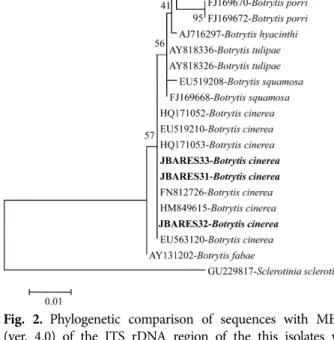
ITS rDNA 영역의 염기서열을 분석하였다. 무화과에서 분리하여 GenBank에 등록된 JBARES31(KC184410), JBARES32, JBARES 33 균주(PCR product 515 bp)는 B.
cinerea로 등록된 GenBank accession number HQ171052, EU519210, HQ171053, FN812726, HM849615, EU563120 과 100% 일치하는 것으로 나타났다. 또한 ITS영역에 대해 Botrytis spp.의 종간 비교에서도 B. cinerea와 같은 clade에 속함을 확인할 수 있었으며, 다른 group과는 57%의 similarity를 보였다(Fig. 2). 따라서 무화과 잿빛곰팡이병 을 일으키는 병원균을 분리배양하여 균학적 특성과 rDNA ITS영역의 염기서열을 분석한 결과 Yu 등(2011)과 Kwon 등(2011)이 보고한 B. cinerea와 일치하였다.
병원성 검정
무화과 열매에서 병원성 검정결과 병원균 접종 5일후에
Fig. 1. Gray mold of common fig (Ficus carica) infected with Botrytis cinerea. A-C, Infected common fig fruits. D, Mycelial colony grown on PDA for 7 days. E and F, Conidiophore and conidia from infected common fig fruits.
Table 1. Comparison of mycological characteristics of the present isolate obtained from common fig (Ficus carica) and Botrytis cinerea as previously described
Characteristics Present isolate B. cinereaa B. cinereab
Conidia
shape ellipsoidal or lemon lemon or ovoid ellipsoidal or ovoid size (µm) 7.3-14.6 × 6.8-11.1 4.4-15.0 × 7.0-10.0 6.0-18.0 × 4.0-11.0 color colorless colorless to light color colorless or pale brown
Conidiophore size (µm) 15-33 × 2 16-31 × 2 16-30 × 2
Colony color grayish brown gray to brown grayish brown
aYu et al. (2011), bEllis and Waller (1974).
무화과 수확기 과실에 발생하는 잿빛곰팡이병
41
꽃대의 주머니모양 열개된 입구에서부터 병징이 발생하 였다. 또한 1주일이후에도 병원균은 주머니모양 열 개된 입구에서 계속 성장하면서 위쪽으로 확산되는 것이 관찰 되었다. 이는 무화과의 열매는 주머니 모양으로 오목하게 쑥 들어가 있고 안쪽에 잔꽃이 많이 달려있어 단맛의 점 액성 물질이 병원균 생장의 영양분으로 작용하였기 때문 이다. 따라서 무화과에 잿빛곰팡이병을 일으키는 B. cinerea 는 병원성을 가지는 것으로 판단되었으며, 대조구로 병원 균이 없는 PDA만을 접종한 처리에서는 발병되지 않았다.
적 요
무화과 잿빛곰팡이병은 2010년부터 2011년에 아열대작 목을 시범적으로 재배하고 있는 전북 농업기술원 하우스 포장에서 발병하였다. 잿빛곰팡이병은 11월경의 저온상태 에서 발병이 심하였으며, 병원균은 갈색의 일부분으로 시 작하여 점차 진전되어 후기에는 과실 전체가 잿빛곰팡이 로 뒤덮였다. 잿빛곰팡이로 뒤덮인 과실은 갈색 솜털을 덮 고 있는 모양이었으며, 육안으로도 곰팡이 포자를 쉽게 관 찰할 수 있었다. 병원균에 감염된 과실은 처음에 갈색~암 갈색 수침상으로 부패하기 시작하였고, 잿빛곰팡이균사와
포자가 밀생하였다. 무화과 잿빛곰팡이병의 분생포자는 구형으로 7.3-14.6 × 6.8-11.1 µm이며, 무색으로 단세포이 었다. 또한 수지상으로 분지한 분생자경위에 무수히 형성 하였다. 분생자경의 크기는 15-33 × 2 µm이며, 갈색 또는 투명한 색을 띄고 있었다. rDNA ITS 영역의 염기서열 분 석결과 무화과 잿빛곰팡이병을 일으키는 병원균은 Botrytis cinerea로 등록된 GenBank accession number HQ171052, EU519210, HQ171053, FN812726, HM849615, EU563120 과 100% 일치하는 것으로 나타났다. 또한 Botrytis spp. 종간 비교에서도 B. cinerea와 같은 clade에 속함을 확인할 수 있었으며, 다른 group과는 57%의 similarity를 보였다. 따 라서 무화과 잿빛곰팡이병을 일으키는 병원균을 분리배양 하여 균학적 특성과 rDNA ITS영역의 염기서열을 분석한 결과 이미 보고된 B. cinerea와 일치하였다.
참고문헌
Kwon, J. H., Cheon, J. G., Choi, O. H. and Kim, J. W. 2011. First report of Botrytis cinerea as a postharvest pathogen of blueberry in Korea. Mycobiology 39:52-53.
Plant Disease Diagnostic Clinic. 2011. Botrytis blight(Botrytis cinerea; Botrytis spp.). Cornell University, Department of Plant Pathology and Plant-Microbe Biology Report.
Ryu, H. Y., Lee, Y. H., Cho, W. D., Kim, W. G., Myung, I. S. and Jin, K. S. 1993. Compendium of fruit tree diseases with colour plates. RDA, Suwon, Korea. pp. 182-183.(In Korean).
Tamura, K., Dudley, J., Nei, M. and Kumar, S. 2007. MEGA4:
molecular evolutionary genetics analysis (MEGA) software version 4.0. Mol. Bio.l Evol. 24:1596-1599.
ten Have, A. Espino, J. J., Dekkers E., Van Sluyter, S. C., Brito, N., Kay, J. Gonzalez, C. and van Kan, J. A. 2010. The Botrytis cinerea aspartic proteinase family. Fungal Genetics and Biology 47:53-65.
The Korean Society of Plant Pathology. 2009. List of plant diseases in Korea. 5th ed., Suwon, Korea. 182-184 pp. (In Korean).
Thompson, J. D., Higgins, D. G. and Gibson, T. J. 1994.
CLUSTAL W: improving the sensitivity of progressive multiple sequence alignment through sequence weighting, position specific gap penalties and weight matrix choice.
Nucl. Acids. Res. 22:4673-4680.
Yu, R. H., Wang, J. G. and Wang, X. 2011. First report of Botrytis leaf blight and fruit rot on Schisandra chinensis caused by Botrytis cinerea in China. Plant Disease 95: 769.
White, T. J., Bruns, T., Lee, S. and Taylor, J. 1990. Amplification and direct sequencing of fungi ribosomal RNA genes for phylogenetics. In: PCR protocols: A guide to methods and applications, ed. by Innis, M. A., Gelfand, D. H., Sninsky, J. J., White, T. J. pp. 315-322. Academic Press, Inc., New York, USA.
Fig. 2. Phylogenetic comparison of sequences with MEGA (ver. 4.0) of the ITS rDNA region of the this isolates with closely related strains and other species of Botrytis spp. from GenBank. The tree was constructed based on the neighbor- joining analysis and confidence intervals in tree topology were estimated by bootstrap analysis with 1,000 replicates.