Trend of Research Studies Related to Independent Metering Valves for Construction Vehicles
하룬 칸 . 윤소남 H. A. Khan and S. N. Yun
1. Introduction
Construction vehicles are an integral part of building small to large scale infrastructures. Functions like digging, lifting, moving, rotating etc of soil or other materials are commonly witnessed in the construction industry. Excavators are one of the most important construction vehicles. Most of the attention in this study is given to the excavators.
IMV stands for independent metering valve.
Independent metering is a technology, whereby, the two sides of an actuator are metered by separate valves. This enables us to avoid the unnecessary pressure drops which are created because of the attached meter-in and meter-out edges. The main problem in IMV arises because of the increase in the size and weight of the IMV type design but the utility of IMV idea is quite simple. A variety of research works have been done in different parts of the world on independent metering technology an overview of which is presented in this article. In Korea, Germany, UK, USA and other countries IMV valves are studied extensively as will be shown in the next part of this study.
Most of the studies focus on the difference of energy consumption between the conventional metering systems and the independent metering systems. They include simulation modeling and testing of IMV systems. The limitation of these studies is that most of them do not focus on the real problem of applicability i.e. how to solve the problem of increased size and weight of IMV based vehicles.
To have an overview of the ongoing progress that has been done in the field of independent metering technology let’s have a look at the studies conducted by different institutions.
2. Past Studies on Independent Metering
Table 1 shows a list of different studies conducted to study various topics related to independent metering systems in a chronological order.
2.1 Aspects of IMV Research
As can be clearly seen in table 1, the titles of the papers point towards different aspects of IMV technology research. Some are about the configuration of valves, some are related to the control technique and others are related to the comparison between IMV and conventional systems in terms of energy efficiency.
2.2 Valve Configurations Discussed in Previous Literature
Different valve configurations are possible to achieve independent metering. Each study considers one or more of such type of combination of hydraulic valves.
These valves vary from directional control valves to flow control valve.
The study conducted by Amir shenouda [1], investigates the IMV configuration shown in figure 1:
Fig. 1 IMV layout investigated by Shenouda [1]
S. Title of Paper Institution Year and Journal
1
Quasi-Static Hydraulic Control Systems and Energy Savings Potential Using Independent Metering Four-Valve Assembly Configuration
Georgia Tech.
USA 2006 Ph.D. Thesis
2 A Generation Step for An Electric Excavator with a Control Strategy and Verifications of Energy Consumption
University of Ulsan, Korea
2013 International Journal of Precision Engineering and Manufacturing
3 STEAM - A Mobile Hydraulic System With Engine Integration
RWTH Aachen University Germany
2013 ASME/BATH Symposium on Fluid Power & Motion Control 4 Single Edge Meter Out Control For Mobile Machinery RWTH Aachen
University Germany
2014 Presented at the FPMC, Bath, U.K
5 Introduction of Independent Metering Valve for Energy Saving
Excavator System Unviersity of Ulsan 2015 Journal of Drive and Control 6 Energy-Saving Analysis Of The Independent Metering System
With Pressure Compensation For Excavator’S Manipulator
Yanshan University, China
2016 Journal of Process Mechanical Engineering
7 STEAM – a hydraulic hybrid architecture for excavators RWTH Aachen University Germany
2016 International Fluid Power Conference
8 Development Of The Independent Metering Valve Control System And Analysis Of Its Performance For An Excavator
Hyundae Heavy Industries, Korea
2016 ASME/BATH Symposium on Fluid Power & Motion Control
9 Load-Force-Adaptive Outlet Throttling – An Easily Commissionable Independent Metering Control Strategy
Technische Universitat Dresden, Germany
2016 ASME/BATH Symposium on Fluid Power & Motion Control
10
Research on the performance of hydraulic excavator boom based pressure and flow accordance control with independent metering circuit
Taiyuan
University of Technology
2017 Journal of Process Mechanical Engineering
11 Reducing Fuel Consumption in Hydraulic Excavators—A Comprehensive Analysis
RWTH Aachen
University Germany 2017 Energies
12 Enhancing Safety Of Independent Metering Systems For Mobile Machines By Means Of Fault Detection
Technische Universitat Dresden, Germany
2017 Scandinavian International Conference on Fluid Power
13
Advanced Energy Management of a Novel Independent Metering Meter-Out Control System: A Case Study of an Excavator
Z h e j i a n g
University, China 2018 IEEE Acces, Multidisciplinary Table 1: List of Research Papers on IMV
Fig. 2 IMV layout 1 proposed by STEAM [3,6,10]
In figure 2 and figure 3, we can see two different layouts proposed by STEAM in RWTH Aachen University Germany [3, 6, 101]. Both layouts contain accumulators as an important part which helps increase the efficiency but adds to the weight and size of the excavator.
Fig. 3 IMV layout 2 proposed by STEAM [3,6,10]
Figure 3 allows higher energy efficiency as compared to the one in figure 2 but at the cost of an increase in number of the accumulator.
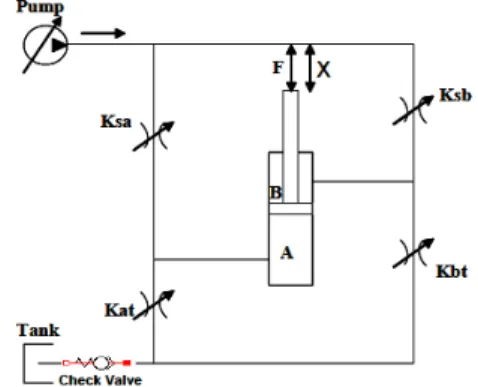
The layout shown in figure 4 was proposed by [4]
for an electric excavator as an alternative to that of figure 1. Both of the IMV systems were compared and it was found that the proposed 3-valve IMV is more efficient than the 4-valve IMV system.
Fig. 4 IMV layout proposed by [4]
Fig. 5 Two operational modes studied by [5]
The study in [5] was conducted using AMEsim to compare conventional load sensing excavator to the proposed IMV configuration. Hydromechanical-pressure compensation method was adopted in the designing of independent metering system for excavator’s manipulator because it responds quickly to the disturbance variables. This work presented that powered extension and powered retraction as shown in figure 5 involve higher efficiency for the IMV system as compared to the load sensing type.
Fig. 6 Valve configuration for IMV by [7]
Fig. 7 Excavator control algorithm [7]
Figure 6 shows the valve configuration discussed and proposed by Hyundae Heavy industries which was integrated into a 20-ton crawler excavator for testing.
The pump used was electrically controlled single type pump and a separate control algorithm was developed for the pump and excavator. Experimental tests were performed on the IMV excavator and the conventional excavator for digging and leveling observing an increase in energy efficiency by 11.5 % (digging) and 17.6 % (leveling).
Fig. 8 System architecture by [8]
Figure 8 presents the overall layout which contains software and hardware basic configuration in the medium size excavator [8]. As in [7], the pump in [8]
is electronically controlled and a mechanical pressure compensator is used to enable a SISO control
Fig. 9 Valve layout [8]
algorithm. Experiments were conducted to compare the coupled metering flow sharing system and the proposed system.
As is visible in figure 9, the number of valves per actuator are 9 which would discourage its applicability because of its heavy weight. On the bright side, the experiments which involved low load situations for the proposed IMV design e.g. leveling operation, a saving of 35% in hydraulic pump energy was achieved.
The control system for IMV presented by [9] is given in the following steps shown in figure 10.
Fig. 10 Independent metering system layout by [9]
Three control strategies were developed I.e. control strategy for valves when boom extends, for pump when boom extends, strategy of regeneration when boom retracts and for power retraction when boom retracts. These modes can be understood by refering to figure 11 below
Fig. 11 IMV operational modes
Figure 11 shows different modes of IMV operation.
Quadrant I refers to extension opposite to a resistive load, Quadrant II to Retraction in the direction of an assistive load, Quadrant III to retraction with an opposing load, and Quadrant IV to extension with an
assistive load. Energy recovery is possible in cases of II and IV as shown in figure 2. Switching between these modes is what the control strategy needs to handle.
One of the reason for limited usage of IMV in construction machinery is the safety issue. A detection algorithm for faults in an IMV system was derived by [11] from certain software-in-the-loop simulations of independent metering system applied to the arm of an excavator.
Fig. 12 Test rig setup for fault detection study[11]
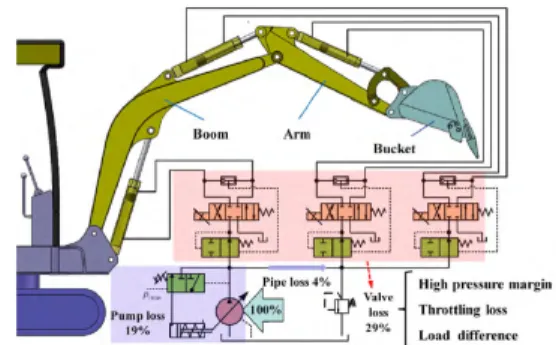
In 2018, a case study of an excavator was done by [12]. In this study, a novel energy management algorithm was presented which linked meter-out valve control with the pump control. It was claimed that the proposed method allows lower throttling losses, better dynamic control and application adaptability. 2-ton mini excavator was used to compare the proposed control system and load sensing system while using the processes of digging and dumping for the said comparison. Figure 13 shows energy consumption distribution of a load sensing excavator system. In this study it was acknowledged that an resulting IMV design would be more costly and certain recommendations were given to lower the cost and weight of the system. A reference to the study [13]
was given as shown in figure 14 to get the simplified optimized layout for IMV.
Fig. 13 Power Distribution in Conventional Excavators hydraulic system
Fig. 14 IMV layout simplification [12, 13]
3. Common Pattern in Previous Studies From all the studies mentioned above there is a clear pattern that researchers had mainly focused on how much energy can be saved if we use independent metering system in different ways. The STEAM excavator was established at Germany, in which the main problem is the high number of valves and the accumulator(s) but it was not discussed in the study.
Most of these studies were conducted using modeling and simulation followed by experiments performed on test rigs. Control strategy is one of the main part of each of these studies because it is one of the critical aspect in saving the energy. The case study of [12]
carries an advantage over most of the other studies because it has shown how the complexity and number of valves can be reduced in IMV systems to increase its applicability in practical systems. This gives an indication towards a direction in which the current research of IMV systems is being headed.
4. Conclusion
There is a need to perform studies which can increase the applicability of independent metering systems in practical situations. All of the studies conducted, show that there is a high potential in independent metering systems for energy systems but
most of them do not consider the increase in complexity of control and the increase in cost, weight and size of excavator. From this trend, it can be predicted that in future, most of the studies related to IMV would be related to answering other questions related to the feasibility of using IMV type construction vehicles. Is the increase in cost and weight of the excavator worth the energy saving or not? Questions like these are becoming more and more important if we analyze the current trend of research work on different independent metering systems.
References
1. A. Shenouda, “Quasi-Static Hydraulic Control Systems and Energy Savings Potential Using Independent Metering Four-Valve Assembly Configuration”, Ph.D Thesis, Georgia Tech. USA, 2006
2. Jong Il Yoon et. al, “A generation step for an electric excavator with a control strategy and verifications of energy consumption”, International Journal Of Precision Engineering And Manufacturing, Vol. 14, No. 5, pp 755-766, 2013.
3. Milos Vukovic et al, “STEAM - A MOBILE HYDRAULIC SYSTEM WITH ENGINE INTEGRATION”, ASME/BATH 2013 Symposium on Fluid Power & Motion Control. USA, 2013 4. S. A. Nahian et al, “ Introduction of Independent
Metering Valve for Energy Saving Excavator System”, Journal of Drive and Control 12(1), 2015, pp.45∼52.
5. Kailei Liu et al, “Energy-saving analysis of the independent metering system with pressure compensation for excavator’s manipulator”, J. of Systems and Control Engineering, 2016, Vol.
230(9), pp. 905∼920.
6. Milos Vukovic et al, “STEAM–a hydraulic hybrid architecture for excavators”, International Fluid Power Conference, Dresdon, pp. 151∼162, 2016 7. Jong-Chan Lee et al, “DEVELOPMENT OF THE
INDEPENDENT METERING VALVE CONTROL SYSTEM AND ANALYSIS OF ITS PERFORMANCE FOR AN EXCAVATOR”, Proceedings of the BATH/ASME Symposium on Fluid Power and
Motion Control, 2016
8. Jan Lubert et al, “Load-Force-Adaptive Outlet Throttling – An Easily Commissionable Independent Metering Control Strategy”, Proceedings of the BATH/ASME Symposium on Fluid Power and Motion Control, 2016
9. Bin Liu et al, “Research on the performance of hydraulic excavator boom based pressure and flow accordance control with independent metering circuit”, Journal of Process Mechanical Engineering, Vol. 231(5), pp. 901–913, 2017.
10. Milos Vukovic et al, “Reducing Fuel Consumption in Hydraulic Excavators—A Comprehensive Analysis”, energies 10(5), 687, 2017
11. B. Beck et al, “Enhancing safety of independent metering systems for mobile machines by means of fault detection”, 15th Scandinavian International Conference on Fluid Power, pp. 92–102, 2017.
12. RUQI DING et al, “Advanced Energy Management of a Novel Independent Metering Meter-Out Control System A Case Study of an Excavator”, IEEE Access, Volume 6, pp. 45782–45795, 2018.
13. M. Vukovic and H. Murrenhoff, ``Single edge meter out control for mobile machinery,'' presented at the FPMC, Bath, U.K., 2014.
[저자 소개]
윤 소 남
E-mail : [email protected] Tel : 042-868-7155
1986년 제주대학교 기계공학과 학사 1990년 부경대학교 기계공학과 석사 1994년 부경대학교 공과대학 박사 2005년 어번대 마이크로나노시스템/재료 연구실 객원연구원, 1994년∼현재 한국기계연구원 책임연구 원, 스마트 액추에이터, 유공압 밸브, 다축 시뮬레이터, 극한 지 및 심해잠수정용 유압기기 개발 연구에 종사, KSFC, KSME, KSPSE, KSPE, KSAE, KSAS, SASE, ICROS, KHNES, JFPS 등 회원, 공학박사
Haroon Ahmad Khan E-mail : [email protected] Tel: 042-868-7767
Born in 1992, currently, a PhD candidate at Dept. of Plant System and Machinery, University of Science and Technology, Korea. He received Master’s degree in Plant System and Machinery at University of Science and Technology, Korea. His research interests include independent metering systems, solenoid valve and hydraulic systems modeling.
![Fig. 2 IMV layout 1 proposed by STEAM [3,6,10]](https://thumb-ap.123doks.com/thumbv2/123dokinfo/5530895.462994/2.918.100.822.148.848/fig-imv-layout-proposed-steam.webp)
![Fig. 10 Independent metering system layout by [9]](https://thumb-ap.123doks.com/thumbv2/123dokinfo/5530895.462994/4.918.482.810.364.711/fig-independent-metering-system-layout-by.webp)