Bt
벼의 토양미생물상 영향 비교평가손수인*·안병옥·지희연1·조병관2·조민석1·신공식 농촌진흥청 국립농업과학원, 1충남대학교, 2㈜스마테움
Assessment of Microbial Community in Paddy Soils Cultivated with Bt and Nakdong Rice
Soo-In Sohn*, Byung-Ohg Ahn, Hee-Youn Chi1, Byung-Kwan Cho2, Min-Seok Cho1, and Kong Sik Shin National Academy of Agricultural Science, Suwon, 441-707, Korea
1Smateome Co., Ltd., Suwon, 441-100, Korea
2Chungnam National University, Daejeon, 305-764, Korea
The cultivation of genetically modified (GM) crops has increased due to their economic and agronomic advantages. Before commercialization of GM crops, however, we must assess the potential risks of GM crops on human health and environment. The aim of this study was to investigate the possible impact of Bt rice on the soil microbial community. Microbial communities were isolated from the rhizosphere soil cultivated with Bt rice and Nakdong, parental cultivar and were subjected to be analyzed using both culture-dependent and molecular methods. The total counts of bacteria, fungi, and actinomycetes in the rhizosphere of transgenic and conventional rice were not significantly different. Denaturing gradient gel electrophoresis (DGGE) analysis of PCR-amplified 16S rRNA genes revealed that the bacterial community structures during cultural periods were very similar each other. Analysis of dominant isolates in the rhizosphere cultivated with Bt and Nakdong rice showed that the dominant isolates from the soil of Bt rice and Nakdong belonged to the Proteobacteria, Cloroflexi, Actinobacteria, Firmicutes, and Acidobacteria. These results indicate that the Bt rice has no significant impact on the soil microbial communities during cultivation period. Further study remains to be investigated whether the residue of Bt rice effect on the soil environment.
Key words: Bt rice, Soil microbial community, 16S rDNA, pyrosequencing
접수 : 2012. 9. 26 수리 : 2012. 10. 12
*연락저자 : Phone: +82312991144 E-mail: [email protected]
서 언
유전자변형작물 (GMO, Genetically Modified Organism) 은 그 재배면적이 해마다 증가하고 있는 추세이다. 2011년 에는 전 세계적으로 1억 6,000만 헥터의 유전자변형 작물이 재배되었으며, 이는 2010년도에 비해 8%가 증가한 것이다 (James, 2011). 2011년은 세계 인구가 70억 명에 달한 해로 이로 인한 식량안보의 문제가 현실로 다가왔으며, 세계적으 로 기후변화에 대처하고 지속가능한 농업생산을 위한 생명 공학의 중요성이 강조되고 있다. 그 중 GMO를 하나의 대안 으로 주목하고 있으나 GMO가 환경에 미치는 잠재적 위험 성, 즉, 도입유전자가 표적 및 비표적 생물체로 전이될 가능 성 (Nap et al., 1992; de Vries and Wackernagel, 2004), 잡초화, 생태계 교란 등에 대한 안전성 시비는 끊임없이 대 두되고 있는 실정이다 (Stewart et al., 2003; Sohn et al.,
2010). 따라서 개발된 GMO가 환경에 방출되어 재배되기 전 에 환경에 미칠 수 있는 요인들의 면밀한 분석이 이루어져 야 한다.
Bt (Bacillus thuringiensis)는 토양 유래 세균으로서, Bt 에서 유래한 단백질은 특정한 곤충에 대해 저항성을 가진다.
Bt형질전환 작물들은 경제적, 환경적 이익뿐만 아니라 인간 건강에도 이로움을 주는데, 이는 살충제를 기존 작물재배시 보다 적게 처리할 수 있기 때문이다 (Raney, 2006; Carpenter, 2010). Bt 단백질 중 한 부류에 속하는 Cry (crystal) 단백질 은 Bacteria의 sporulation phase에서 주로 생성되는 것으로 알려졌고, 역시 Bt 단백질에 속하는, Bacillus thuringiensis AD88에서 최초로 분리된 Vip (vegetative insecticidal protein) 단백질은Bacteria의 vegetative stage와 stationary stage에 서 생성되는 것으로 보고되고 있다 (Estruch et al., 1996).
Vip 단백질은 Agrotis ipsilon (black cutworm), Spodoptera frugiperda (fall armyworm), Heliothis virescens (tobacco budworm), Helicoverpa zea (corn earworm or cotton bollworm), Ostrinia nublilalis (European corn borer),
Danaus plexippus (the monarch butterfly)등 많은 인시목 해충 (lepidopterous pest)에 대해서 저항성을 가진다. 그러 나, Vip 단백질은 Cry1Ab와는 다른 기작으로 저항성을 가지 는 것으로 보고되었다 (Raybould and Vlachos, 2011).
Bt 단백질의 안정성 분석 결과 Bt를 살포한 작물은 인체 나 포유류에 무해한 것으로 알려졌으며, 미국환경보건국 (USEPA: US Environmental Protection Agency)의 조사에 의하면, Bt 작물은 환경이나 인간 건강에 어떠한 위해요 소도 보이지 않는 것으로 보고되었다 (Betz et al., 2000;
Mendelsohn et al., 2003). 그러나, Cry1Ab 단백질은 대부 분의 토양에서 4년이나 지속되는 것으로 조사되어 (Icoz et al., 2008), 이들 단백질의 토양에 대한 영향은 단기 뿐만 아니라 장기적인 측면에서 고려되어야 할 것이다. 현재까 지 Bt 형질전환은 토마토 (Kumar and Kumar, 2004), 면화 (Perlak et al., 1990; He et al., 2006), 콩 (Duformantel et al., 2005), 옥수수 (Koziel et al., 1993; Meissle et al., 2005), 벼 (Shu et al., 2000; Tu et al., 2000; Maqbool et al., 2001; Ye et al., 2001, 2003; Bashir et al., 2004) 등에 서 이루어졌으며, 일부 Bt 형질전환 작물 재배 시 토양미생 물상에 미치는 영향에 대한 연구도 이루어져 왔다 (Icoz and Stotzky, 2008). Bt벼는 현재 상업적으로 이용되고 있 는 면화나 옥수수에 비해 늦게 개발되었으며, Bt벼의 토양 미생물 생태계에 미치는 영향을 분석한 보고도 많지 않은 실정이다. Bt벼는 벼를 가해하는 여러 해충에 대해서 저항 성을 나타내는 것으로 보고되었고 (Kim et al., 2009), 이로 인한 농약사용 절감 및 벼 생산성 증대에 이익을 줄 수 있으 므로 Bt 옥수수나 면화와 같이 향후 재배 승인이 이루어질 가능성이 높을 것으로 사료된다. 따라서 본 연구에서는 기 개발된 변형 cry1Ac1 유전자로 형질전환된, 여러 해충에 저 항성인 Bt 벼 (Kim et al., 2009)의 실용화에 앞서 Bt 벼가 포장수준에서 환경에 방출되었을 때 토양미생물 생태계에 미칠 수 있는 영향을 형질전환 모품종인 낙동벼와 비교하여 분석하였다.
재료 및 방법
토양시료 Bt벼의 토양미생물상에 미치는 영향을 조사 하기 위한 시험구는 경기도 수원에 위치한 국립농업과학원 GMO 논 격리포장에 설치되었고, Bt벼 시험구와 형질전환 모품종인 낙동벼 시험구를 각각 3반복하여 재배하였다. 각 시험구의 크기는 4 x 4 m로 하였다. 벼 종자는 육묘상자에 파종 후 3주 경과한 식물체를 2011년 월 6월 초순에 포장에 이식하였고, 이로부터 토양시료 채취는 5월, 6월, 7월 하순 에 수행하였다. 근권토양은 벼를 뿌리째 뽑은 후 분석을 위 해 2 mm 체를 이용, 주변토양의 수분을 제거한 것을 시료 로서 사용하였다.
근권토양 화학분석 Bt 벼와 낙동벼 근권 토양시료를 채취하여 음건시킨 후 2 mm 체를 통과한 토양시료를 분석 에 이용하였다. 토양 화학분석은 농업과학기술원 토양 및 식물체 분석법 (NAAS, 2000)에 준하여 pH는 토양과 증류수 의 비율을 1:5로 하여 pH meter로 측정하였고, 토양 총질소 및 총탄소 함량은 Elemental analyzer (Vario Max CN, Elementar, Germany), 유효인산은 Lancaster 법을 이용하여 비색정량하였으며, 칼륨, 칼슘, 마그네슘, 나트륨 등 치환 성양이온은 1N Ammonium acetate로 침출하여 유도결합플 라즈마 발광광도계 (ICP, Intergra, GBC, Australia) 로 분석하였다.
미생물 군집밀도 조사 채취한 토양 10 g을 90 mL의 멸균된 0.85% NaCl 용액에 넣어 진탕배양기 (Vision Co., Bucheon, Korea)에서 200 rpm으로 30분간 현탁하였다. 현 탁액은 일련의 희석계열을 만든 후, 세균은 cycloheximide (0.05 g L-1)를 첨가한 R2A agar (NA, Difco, Detroit MI)배 지에, 사상균은 chloramphenicol (0.02%)을 첨가한 R2A agar (Difco, Detroit MI) 배지에, 방선균은 sodium caseinate agar 배지에 도말하여 배양하였다. 도말된 평판은 세균의 경우 28℃에서 2일간, 방선균은 4일간, 사상균은 5일간 배 양한 후 출현한 colony를 계수하였다. 각 시료당 미생물 수 는 3개의 petridish에 나타난 colony를 각각 계수한 후 평균 한 값을 생균수 (colony forming unit : CFU g-1 건토)로 산 출하였다.
DGGE 분석 Bt벼와 낙동벼가 재배된 토양에서 토양 미생물 군집의 변화가 있는지 조사하기 위해 DGGE 분석을 수행하였다. 토양미생물로부터 DNA는 FastDNA Spin Kit (Qbiogen, Carsbad. U.S.A.)를 사용하여 추출하였으며, 16S rRNA 유전자를 PCR 증폭하였다. PCR을 위한 프라이머는 eubacteria의 V9 부위를 포함하도록, 두개 프라이머, 1070f -1392r을 사용하였다. 프라이머 염기서열은 1070f:5’- ATGGCTGTCGTCAGCT-3’, 1392r:5’- CGCCCGCCGCGCCC CGCGCCCGGCCCGCCGCCCCCGCCCCA CGGGCGGTGTGTAC-3’
이었다. PCR 반응물은 총량을 50 µL로 하여, 5 µL의 10x PCR buffer, 10 ng의 주형 DNA, 각 25 pmol의 양방향 프 라이머, 200 µM의 각각의 dNTP, 2.5 U의 f-Taq DNA polymerase (Solgent, Daejeon, Korea)를 첨가하였다. PCR 조건은 95℃에서 5분간 변성과정을 거친 후, 95℃에서 1분, 55℃에서 1분, 72℃에서 1분의 조건으로 30 cycle을 수행하 였으며, 마지막으로 72℃에서 7분간 반응시켰다. PCR 산물 은 Dcode Universal Mutation Detection System (Bio-Rad, Hercules, U.S.A)을 사용하여 변성제인 formamide가 40-70%
로 농도구배된 8% 아크릴아미드젤에서 전기영동하였다. 전 개된 DNA를 SYBR Green I (Cambrex BioScience, Rockland,
Table 1. Chemical charateristics of rhizosphere soil of Bt and Nakdong rice.
Treatment pH Avail.
P2O5† ECc T-N OM† Exch.Cation
K Ca Mg Na†
1:5 mg kg-1 ds m-1 % g kg-1 --- cmolc kg-1 --- Bt 6.39±0.02 81.98±0.38* 0.62±0.00 0.18±0.01 20.38±0.20** 0.62±0.00 7.36±0.05 1.92±0.03 0.21±0.00**
Nakdong 6.35±0.02 63.37±0.33* 0.58±0.01 0.19±0.01 19.46±0.34** 0.60±0.00 7.21±0.09 1.89±0.02 0.27±0.01**
†Asterisks denote a significant difference(**P<0.05, *P<0.1)
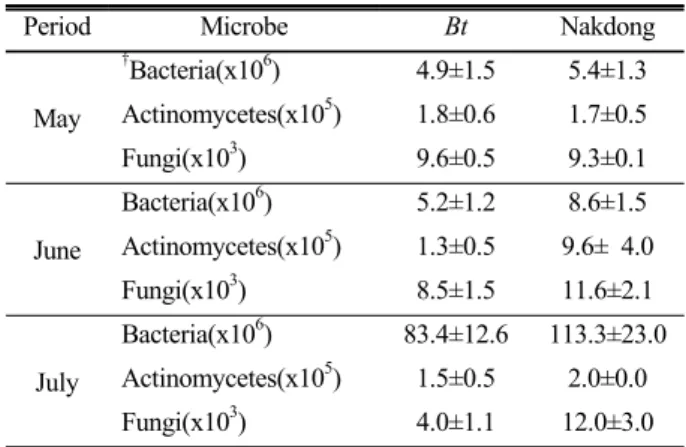
Table 2. Number of microbes in rhizosphere soil of Bt and Nakdong rice
Period Microbe Bt Nakdong
May
†Bacteria(x106) 4.9±1.5 5.4±1.3 Actinomycetes(x105) 1.8±0.6 1.7±0.5 Fungi(x103) 9.6±0.5 9.3±0.1 June
Bacteria(x106) 5.2±1.2 8.6±1.5 Actinomycetes(x105) 1.3±0.5 9.6± 4.0 Fungi(x103) 8.5±1.5 11.6±2.1 July
Bacteria(x106) 83.4±12.6 113.3±23.0 Actinomycetes(x105) 1.5±0.5 2.0±0.0 Fungi(x103) 4.0±1.1 12.0±3.0
†colony forming unit (CFU) g-1 fresh weight ± standard deviation from three replications.
ME, USA)과 EtBr로 염색하여 Gel Doc 2000 (Bio-Rad Laboratories, Hercules, CA)을 이용, UV transilluminator 하에서 관찰하였다.
Pyrosequencing을 이용한 16S rRNA gene 염기서열 분석 및 종다양성 분석 토양으로부터 추출한 DNA를 주 형으로 사용하여, 16S rRNA gene의 증폭을 위하여 fusion primer인 B16S-F (5’-CCTATCCCCTGTGTGCCTTGGCAGTC -TCAG-AC-GAGTTTGATCMTGGCTCAG-3’와 B16-8-62 (5’-CCATCTCATCCCTGCGTGTCTCCGAC-TCAG-TAG ATGCG-AC-WTTACCGCGGCTGCTGG-3’)를 사용하였다. PCR 반응은 10x buffer+MgCL2 5 μL, 10 mM dNTPs 1 μL, 20 pmol μL-1 primers (forward/reverse) 2 μL, 5U μL-1Taq Polymerase (Roche, Brandord, USA), 0.25μL, DNA template (100 ng) 1 μL를 넣고 총 부피가 50 μL가 되도록 증류수를 넣어 PCR 증폭을 하였다. PCR 반응은 Touch-down program 을 사용하여 denaturation (94℃, 5분), denaturation (94℃, 30초), annealing (60℃, 45초), extension (72℃, 90초)단 계를 10회 반복하면서 각 단계마다 annealing 온도를 0.5℃씩 낮추면서 실시한 후, denaturation (94℃, 30초), annealing (55℃, 45초), extension (72℃, 90초)단계를 20 회 반복하였다. 증폭된 PCR 산물을 주형으로 하여 한 개의 bead 당 한 개의 DNA fragment가 부착되도록 하여, PCR을 하고 필요한 기질 및 효소와 함께 PicoTiterPlate의 well에 첨가한 뒤 GS FLX Titanium system (Roche, Brandord, USA) 염기 서열 분석기를 이용하여 pyrosequencing반응을 진행 시켰다. 얻어진 염기서열은 EzTaxon (http://www.eztaxon.org) 의 16S rDNA sequence와 비교하여 동정하였다. 벼 근권토 양 세균의 종다양성 분석은 Shannon-Wiener’index를 통해 분석하였다 (Odum, 1998).
결과 및 고찰
토양 화학 성분 분석 Bt벼와 형질전환 모품종인 낙 동벼 근권 토양의 화학성분을 조사하였다. 토양 화학성분의 차이는 토양미생물 군집에 영향을 미칠 수 있기 때문에, Bt 벼와 낙동벼 근권토양의 화학성분에 차이가 있는지 조사하
기 위해 토양 pH, 유효인산, 전기전도도, 양이온, 전질소, 유기물 함량 등을 분석하였다 (Table 1). 토양 pH는 Bt벼와 낙동벼 모두 6.4로 조사되었고 이는 우리나라 논 토양의 평 균값인 5.6에 비해 약간 높은 수준을 보였다 (Jung et al., 1998). 토양의 pH는 토양에 존재하는 양분의 유효도에 영향 을 미치는데, 일반적으로 강산성 (pH4.5)에서는 유효도가 낮아지고 약산성 (약 pH6.5)에서는 높아지는 경향이 있다.
유효인산은 낙동벼는 65 mg kg-1, Bt벼는 74 mg kg-1로 나 타나 큰 차이는 없는 것으로 조사되었다. 두 토양 모두 우리 나라 논 토양의 평균 유효인산 값인 95 mg kg-1에 비해서는 다소 낮은 것으로 조사되었다. 토양 전기 전도도는 Bt벼와 낙동벼에서 0.5 dS m-1로 같은 수준인 것으로 나타났으며, 전질소량도 두 토양에서 0.2%로 조사되었다. K, Ca, Mg, Na 등의 양이온 함량에 있어서도 Bt벼와 낙동벼가 비슷한 수준인 것으로 조사되었다. 양이온 함량은 유기물 함량과 연관성이 있는 것으로 알려져 있고 (Clark et al., 1998) 본 화학분석에서는 Bt벼와 낙동벼간 유기물 함량은 거의 같은 수치를 나타내는 것으로 조사되었다.
토양미생물 군집밀도 분석 Bt벼 재배에 따른 토양미 생물상 영향을 조사하기 위해 이앙전 (5월), 재배초기 (6 월), 최대분얼기 (7월) 토양의 세균, 방선균, 진균의 미생물 군집밀도를 조사하였다 (Table 2). 벼를 이앙하기 전 토양의
Fig. 1. DGGE analysis of 16S rRNA gene V9 region obtained after PCR amplification with eubacterial primers 1070f and 1392r. DGGE profile for May (1 & 2), June (3 & 4), July (5
& 6) field soils of Nakdong (1, 3 & 5) and Bt (2, 4, & 6) rice soils. M, DGGE molecular weight marker
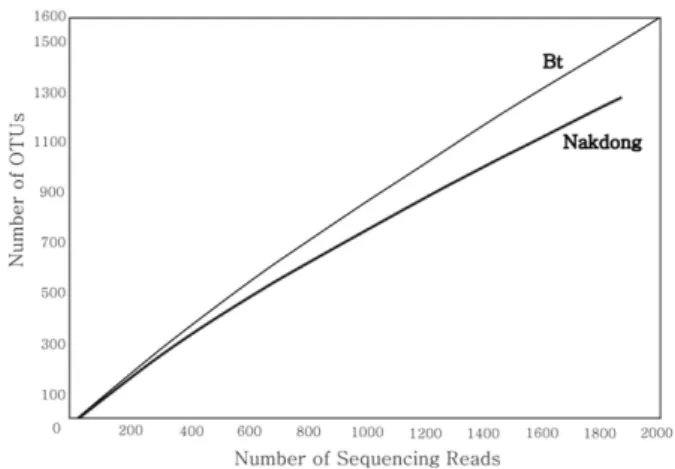
Fig. 2. Rarefaction curves of OTUs (operational taxonomic units) defined by sequence variations in Bt and Nakdong rice soils. The X-axis shows the number of sequences in each sample, while the Y-axis shows the numbers of OTUs encountered.
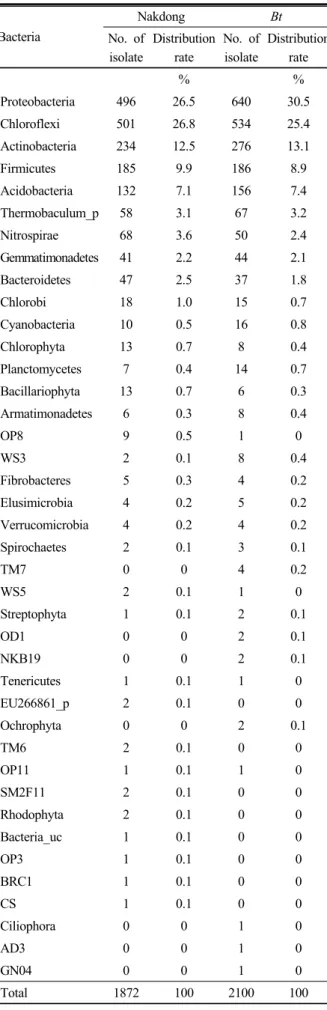
Fig. 3. Bacterial composition in the rhizosphere soil of Nakdong and Bt rice. Relative abundance of operational taxonomic units classified to each taxon was determined with partial sequences of bacterial 16S rRNA genes from soils by EzTaxon.
세균, 방선균, 진균 군집밀도는 매우 유사한 것으로 조사되 었으며, 6월 재배초기 Bt벼 낙동벼 토양과 최고분얼기 7월 Bt벼와 낙동벼 근권 토양의 세균, 방선균, 진균의 군집밀도 는 7월 낙동벼 세균 군집밀도가 Bt벼에 비해 약간 높은 수 준을 나타낸 것을 제외하고 시기별 두 토양간 유의성 있는 차이는 없는 것으로 조사되었다. 이와 같은 결과는 최근 Bt 벼의 토양 효소 활성, 미생물 군집 조성 및 기능적 다양성에 대한 분석에서 Bt벼의 재배가 이들에 대해 명확을 영향을 준다는 증거가 없음을 보고한 내용과 일치하는 것으로 사료 된다 (Liu et al., 2008; Lu et al., 2010; Wei et al., 2012).
DGGE 분석에 의한 토양미생물 군집변이 비교 Bt 벼 와 낙동벼 근권토양의 시기별 근권 토양미생물 군집변이 양 상을 비교하기 위해 DGGE 분석을 수행하였다. PCR을 이 용, 16S rRNA 유전자의 V9부위를 증폭하였으며 증폭산물 은 아가로오스 젤에 전기영동하여 예상 증폭 산물 크기인 323 bp 임을 확인하였다 (data not shown). Bt 벼와 낙동벼 의 시기별 토양미생물 변화를 분석하기 위해 16S rRNA 유 전자의 V9부위 증폭산물을 같은 DGGE gel에 전개하였고, 그 결과, Bt 벼와 낙동벼의 근권 토양간 DGGE profile은 시 기별 밴드의 차이는 있어도 Bt 벼와 낙동벼 근권토양간 밴 드의 차이는 거의 없는 것으로 관찰되었다 (Fig. 1). 일부 동 일 위치에 있는 밴드의 강도에 차이가 있는 것은 토양이 가
진 이질성에 기인하는 것으로 사료되었다. 이는 Cry1Ab로 형질전환된 Bt벼와 모품종의 DGGE profile의 차이가 없었 던 분석결과와 일치하였다 (Liu et al., 2008).
16S rDNA 염기서열 분석 및 세균 종다양성 분석 Pyrosequencing 방법으로 Bt벼와 낙동벼 토양미생물 군집 을 분석한 결과, Bt벼는 2,100개, 낙동벼는 1,872개의 16S rRNA gene sequence를 획득하였다. 두 개 토양시료의 미생 물 군집의 종 다양성 (species richness)을 비교하기 위해 rarefaction curve를 분석한 결과 (Fig. 2), 분석된 염기서열 갯수에 대한 Operational taxanomic unit (OTU)의 기울기는
Fig. 4. Bacterial species diversity index in the rhizosphere soil of Bt and Nakdong rice.
Table 3. Phylogenetic distribution of the dominant isolates obtained from Bt and Nakdong rice soils.
Bacteria
Nakdong Bt
No. of isolate
Distribution rate
No. of isolate
Distribution rate
% %
Proteobacteria 496 26.5 640 30.5
Chloroflexi 501 26.8 534 25.4
Actinobacteria 234 12.5 276 13.1
Firmicutes 185 9.9 186 8.9
Acidobacteria 132 7.1 156 7.4
Thermobaculum_p 58 3.1 67 3.2
Nitrospirae 68 3.6 50 2.4
Gemmatimonadetes 41 2.2 44 2.1
Bacteroidetes 47 2.5 37 1.8
Chlorobi 18 1.0 15 0.7
Cyanobacteria 10 0.5 16 0.8
Chlorophyta 13 0.7 8 0.4
Planctomycetes 7 0.4 14 0.7
Bacillariophyta 13 0.7 6 0.3
Armatimonadetes 6 0.3 8 0.4
OP8 9 0.5 1 0
WS3 2 0.1 8 0.4
Fibrobacteres 5 0.3 4 0.2
Elusimicrobia 4 0.2 5 0.2
Verrucomicrobia 4 0.2 4 0.2
Spirochaetes 2 0.1 3 0.1
TM7 0 0 4 0.2
WS5 2 0.1 1 0
Streptophyta 1 0.1 2 0.1
OD1 0 0 2 0.1
NKB19 0 0 2 0.1
Tenericutes 1 0.1 1 0
EU266861_p 2 0.1 0 0
Ochrophyta 0 0 2 0.1
TM6 2 0.1 0 0
OP11 1 0.1 1 0
SM2F11 2 0.1 0 0
Rhodophyta 2 0.1 0 0
Bacteria_uc 1 0.1 0 0
OP3 1 0.1 0 0
BRC1 1 0.1 0 0
CS 1 0.1 0 0
Ciliophora 0 0 1 0
AD3 0 0 1 0
GN04 0 0 1 0
Total 1872 100 2100 100
두 개 토양시료에서 유사한 것으로 나타났다. Phylum 수준 에서 미생물의 분포비율을 비교한 결과, Bt벼 토양미생물은 Proteobacteria (30.5%), Cloroflexi (25.4%), Actinobacteria (13.1%), Firmicutes (8.9%), Acidobacteria (7.4%) 낙동벼 토양미생물은 Cloroflexi (26.8%), Proteobacteria (26.5%), Actinobacteria (12.5%), Firmicutes (9.9%), Acidobacteria (7.1%) 순으로 분포하였다 (Fig. 3, Table 3). 분자생물학적 기법을 통해서는 배양하기 힘든 균의 분석도 가능한데, Bt 벼 근권토양과 낙동벼 근권토양에서 모두 나타나는 Acidobacteria는 배양이 어려운 것으로 알려져 있다 (Kim and Whang, 2007). 두 토양간 종 다양성 지수를 Shannon- Weiner’s index에 근거하여 분석한 결과 두 근권토양 세균 종 다양성 정도는 낙동벼가 6.9, Bt벼가 7.2로 유사한 수준 인 것으로 조사되었다 (Fig. 4). Phylum수준에서의 우점미 생물 분포비율은 Bt벼와 낙동벼에서 매우 유사한 것으로 나 타났으며, 이로 미루어보아 Bt벼 재배가 토양미생물 군집구 조에 큰 영향을 미치지 않을 것으로 사료된다.
Pyrosequencing 방법은 PCR 증폭 후 염기서열 분석을 하게 되는데, DGGE 와 달리 denaturing gradient gel을 이 용하지 않고 DNA fragment로부터 직접적인 염기서열 분석 을 함으로써 DGGE 분석에 비해 더 많은 미생물의 확인이 가능하다 (Kim et al., 2011). 따라서 GM 작물의 토양미생 물상에 대한 영향을 분석하는데 있어서도 현재 pyrosequencing 방법이 도입되고 있으며 (Lee et al., 2011), 향후 차세대 염 기서열 분석기법 (NGS: next generation sequencing)기법 의 발달에 따른 비용 절감이 이루어진다면 GM 작물의 토양 미생물상 영향 조사를 위한 다른 분석법들을 대체할 수 있 는 방법으로도 이용 가능할 것으로 사료된다.
요 약
경제적 및 농업적 장점은 유전자 변형 작물 재배면적의
증가를 가져왔다. 그러나 유전자 변형 작물의 상업적 재배 전에 유전자 변형 작물의 인간건강 및 환경에 미칠 잠재적 위해성에 대한 면밀한 검토가 필수적이다. 본 연구에서는 Bt벼의 토양미생물 군집에 미치는 영향을 조사하였다. 토양 화학성분을 분석한 결과, Bt벼와 낙동벼 근권토양 간 화학 성분의 유의성 있는 차이는 없는 것으로 조사되었다. 재배 전, 재배초기, 최고분얼기의 토양미생물 군집밀도를 조사했 을 때 Bt벼 근권토양의 세균, 방선균, 진균 군집밀도는 낙동 벼와 유사한 수준으로 나타났다. 시기별 DGGE 분석결과 Bt 벼 근권토양 전체미생물상은 낙동벼와 차이가 없는 것으로 조사되었다. Pyrosequencing을 통한 Bt벼와 낙동벼의 미생 물 군집조성을 조사한 결과 주요 미생물상 분포에 있어서도 매우 유사한 양상을 나타내었다. 위의 결과들을 종합해볼 때 Bt 재배에 따른 토양미생물상에 미치는 영향은 미미한 것으로 사료된다. 수확 후 벼 잔존물이 토양환경에 미치는 영향에 대해서는 좀 더 연구가 진행되어야 할 것이다.
사 사
본 연구는 농촌진흥청 국립농업과학원의 지원 (과제번 호: PJ008055)에 의해 수행되었음.
인 용 문 헌
Bashir, K., T. Husnain, T. Fatima, Z. Latif, S.A. Mehdi, and S.
Riazuddin. 2004. Field evaluation and risk assessment of transgenic indica basmati rice. Mol. Breed. 13:301-312.
Betz, F. S., B.G. Hammond, and R. L. Fuchs. 2000. Safety and advantages of Bacillus thringiensis-protected plants to control insect pests. Regul. Toxicol. Pharmacol. 32: 156-173.
Carpenter, J. E. 2010. Peer-reviewed surveys indicate positive impact of commercialized GM crops. Nat. Biotechnol. 28:
319-321.
Clark, M. S., M. S. Smith, and J. W. Doran. 1998. Changes in soil chemical properties resulting from organic and low-input farming practices. Agron. J. 90: 662-671.
de Vries, J. and W. Wackernagel. 2004. Microbial horizontal gene transfer and the DNA release from transgenic crop plants. Plant Soil. 266: 91-104.
Duformantel, N., G. Tissot, F. Goutorbe, F. Garçon, C. Muhr, S. Jansens, B. Pelissier, G. Peltier, and M. Dubald. 2005.
Generation and analysis of soybean plastid transformants expressing Bacillus thuringiensis Cry1Ab protoxin. Plant Mol. Biol. 58: 659-668.
Estruch, J. J., G. W. Warren, M. A. Mullins, G. J. Nye, J. A.
Craig, and M. G. Koziel. 1996. Vip3A, a novel Bacillus thuringiensis vegetative insecticidal protein with a spectrum of activities against lepidopteran insect. Proc. Natl. Acad.
Sci. USA. 93: 5389-5394.
He, K., Z. Wang, S. Bai, L. Zheng, Y. Wang, and H. Cui.
2006. Efficacy of transgenic Bt cotton resistance to the Asian corn borer (Lepidoptera: Crambidae). Crop Prot. 25:
167-173.
Icoz, I., D. Saxena, D.A. Andow, C. Zwahlen, and G. Stotzky.
2008. Microbial populations and enzyme activities in soil in situ under transgenic corn expressing cry proteins from Bacillus thuringiensis. J. Environ. Qual. 37(2), 647-662.
Icoz, I. and G. Stotzky. 2008. Fate and effects of insect-resistant Bt crops in soil ecosystems. Soil Biol. Biochem.
40:559-586.
James, C. 2011. Global status of commercialized biotech/GM crops: 2011. ISAAA Briefs No. 43, Ithaka, NY.
Jung, B. G., G. H. Jo, E. S. Yun, J. H. Yoon, and Y. H. Kim.
1998. Monitoring on chemical properties of bench marked paddy soils in Korea. Korean J. Soil Sci. Fert. 31(3) 246-252.
Kim, E. S., S. W. Hong, and K. S. Chung. 2011. Comparative analysis of bacterial diversity in the intestinal tract of earthworm (Eisenia fetida) using DGGE and pyrosequencing.
Korean J. Microbiol. Biotechnol. 39(4): 374-381
Kim E. H., S. C. Suh, B. S. Park, K. S. Shin, S. J. Kweon, E.
J. Han, S. H. Park, Y. S. Kim, and J. K. Kim. 2009.
Chloroplast-targeted expression of synthetic cry1Ac in transgenic rice as an alternative strategy for increased pest protection. Planta. 230: 397-405.
Kim, Y.J. and K.S. Whang. 2007. Phylogenetic characteristics of viable but nonculturable bacterial populations in a pine mushroom (Tricholloma matcutake) forest soil. The Korean J. Microbiol. 43: 201-209.
Koziel, M. G., G. L. Beland, C. Bowman, N. B. Carozzi, R.
Crenshaw, L. Crossland, J. Dawson, N. Desai, M. Hill, S.
Kadwell, K. Lauris, K. Lewis, D. Maddox, K. McPherson, M. R. Meghji, E. Merlin, R. Rhodes, G. W. Warren, M.
Wright, and S. V. Evola. 1993. Field performance of elite transgenic maize plants expressing an insecticidal protein derived from Bacillus thuringiensis. Bio. Technol. 11:
194-200.
Kumar, H. and V. Kumar. 2004. Tomato expressing Cry1A(b) insecticidal protein from Bacillus thuringiensis protected against tomato fruit borer, Helicoverpa armigera (Hübner) (Lepidoptera: Noctuidae) damage in the laboratory, greenhouse and field. Crop Protect. 23:135-139.
Lee, S. H., C. G. Kim, and H. J. Kang. 2011. Temporal dynamics of bacterial and fungal communities in a genetically modified(GM) rice ecosystem. Microb. Ecol. 61: 646-659.
Liu, W., H. H. Lu, W. Wu, Q. K. Wei, Y. X. Chen, and J. E.
Thies. 2008. Transgenic Bt rice does not affect enzyme activities and microbial composition in the rhizosphere during crop development. Soil Biol. Biochem. 40:
475-486.
Lu, H., W. Wu, Y Chen, H. Wang, M. Devare, and J. E. Thies.
2010. Soil microbial community responses to Bt transgenic rice residue decomposition in a paddy field. J. Soils Sediments. 10:1598-1605.
Maqbool, S. B., S. Riazuddin, N. T. Loc, A. M. R. Gatehouse, J. A. Gatehouse, and P. Christou 2001. Expression of multiple insecticidal genes confers broad resistance against a range of different rice pests. Mol. Breed. 7: 85-93.
Meissle, M., E. Vojtech, and G. M. Poppy. 2005. Effects of Bt maize-fed prey on the generalist predator Poecilus cupreus L. (Coleoptera: Carabidae). Transgenic Res. 14:123-132.
Mendelsohn, M., J. Kough, Z. Vaituzis, and K. Matthews.
2003. Are Bt crops safe? Nature Biotech. 21: 1003-1009.
Nap, J.P., J. Bijvoet, and W. J. Stiekema. 1992, Biosafety of kanamycin-resistant transgenic plants. Transgenic Res. 1:
239-249.
NAAS (National Academy of Agricultural Science). 2000.
Analysis method of soil and plant: Physics, chemistry and microorganism. RDA, Korea.
Odum. 1998. Fundamental of ecology. Gadjah Mada Uni- versity Press. Yogyakarta. 800p.
Perlak, F. J., R. W. Deaton, T. A. Amstrong, R. L. Fuchs, S. R.
Sims, J. T. Greenplate, and D. A. Fischhoff. 1990. Insect resistant cotton plants. Bio. Technol. 8: 939-943.
Raney, T. 2006. Economic impact of transgenic crops in developing contries. Curr. Opin. Plant Biol. 17: 1-5.
Raybould, A. and D. Vlachos. 2011. Non-target organism effects rests on Vip3A and their application to the ecological risk assessment for cultivation of MIR162 maize.
Transgenic Res. 20: 599-611.
Shu, Q., G. Ye, H. Cui, X. Cheng, Y. Xiang, D. Wu, M. Gao,
Y. Xia, C. Hu, R. Sardana, and I. Altosaar. 2000. Transgenic rice plants with a synthetic cry1Ab gene Bacillus thuringiensis were highly resistant to eight lepidopteran rice pest species.
Mol. Breed. 6: 433-439.
Sohn, S. I., Y. J. Oh, S. D. Oh, M. K. Kim, T. H. Ryu, K. J. Lee, S. C. Suh, H. J. Baek, and J. S. Park. 2010. Molecular analysis of microbial community in soils cultivating Bt Chinese cabbage. Korean J. Environ. Agric. 29(3): 293-299.
Stewart, C. N., M. D. Jr., Halfhill, and S. I. Warwick. 2003.
Transgene introgression from genetically modified crops to their wild relatives. Nat. Rev. Gen. 4: 806-817.
Tu, J., G. Zhang, K. Datta, C. Xu, Y. He, Q. Zhang, G. S.
Khush, and S. K. Datta. 2000. Field performance of transgenic elite commercial hybrid rice expressing Bacillus thuringiensis δ-endotoxin. Nat. Biotechnol. 18:1101-1104.
Wei, M., F. Tan, H. Zhu, K. Cheng, X. Wu, J. Wang, K. Zhao, and X. Tang. 2012. Impact of Bt-transgenic rice (SHK601) on soil ecosystems in the rhizosphere during crop development. Plant Soil Environ. 58(5): 217-223.
Ye, G. Y., Q. Y. Shu, H. W. Yao, H. R. Cui, X. Y. Cheng, C.
Hu, Y. W. Xia, M. W. Gao, and I. Altosaar. 2001. Field evaluation of resistance of transgenic rice containing a synthetic cry1Ab gene from Bacillus thuringiensis Berliner to two stem borers. J. Econ. Entomol. 94: 271-276.
Ye, G. Y., H. W. Yao, Q. Y. Shu, X. Cheng, C. Hu, Y. W. Xia, M. W. Gao, and I. Altosaar. 2003. High levels of stable resistance in transgenic rice with a cry1Ab gene from Bacillus thuringiensis Berliner to rice leaffilder, Cnaphalocrocis medinalis (Guenee) under field conditions. Crop Protect.
22: 171-178.