• 검색 결과가 없습니다.

IEEE 802.15.4 power efficiency analysis using high-speed Wireless Personal Area Network transceiver in the environment for Internet of Things

N/A
N/A
Protected

Academic year: 2021

Share "IEEE 802.15.4 power efficiency analysis using high-speed Wireless Personal Area Network transceiver in the environment for Internet of Things"

Copied!
4
0
0

로드 중.... (전체 텍스트 보기)

전체 글

(1)

Ⅰ. Introduction

Recent IoT (Internet of Things) technology trend is classified as a core technology of the 4th industrial revolution and has a close relationship with everyday life. Also, based on network technology composed of short distance wireless communication technology among devices, it is used on a large scale from general consumer products to military products and so on widely.

The IEEE standard 802.15.4 has been enacted to provide a basic sub-network layer of a Wireless Personal Area Network (WPAN).

Especially, among devices, it aims at low cost, low speed ubiquitous communication. By contrast, there is Wi-Fi that has for end users in mind.

The basic framework has preceding conditions of a transfer rate of approximately 250 Kbit/s

within a distance of 10 meters.

And several physical layers were defined to trade off several physical layers in the case of embedded systems that requires less power consumption. When transmitting data, the algorithm with focusing on the power consumption in the range of the initial slow speed, 20, 40 Kbit/s to about 100 Kbit/s was designed.

The basic data packet required a simulation packet for WPAN efficiency as shown in Table 1 for testing. As mentioned earlier, one of the WPAN standards that exists only 802.15.4 is that it pursues extremely low manufacturing costs and pursues technological simplicity, but it must be performed within the limits of technical flexibility and universality. Key features in the IEEE 802.15.4 include the ability to reserve guaranteed time slots for real time application,

IEEE 802.15.4 power efficiency analysis using high-speed Wireless Personal Area Network

transceiver in the environment for Internet of Things

Eun-Ju Woo

*

, Yu-Sung Moon

*

, Jung-Won Kim

*

Abstract

In this paper, experiments through performance evaluation under real operation environment were conducted.

Transceiver and microcontroller shows the characteristics for the amount of current consumption and software protocol was optimized by controlling the time of Report Attribute and electric current level. To reduce current consumption when using battery, with designing transmission of the same amount of data as soon as possible, power consumption efficiency was enhanced.

Key words: IEEE802.15.4, PHY, MAC, transceiver system, current consumption, WPAN, IoT

* JIANGXI HOLITECH KOREA BRANCH

★ Corresponding author

E-mail:[email protected], Tel:+82-2-783-8322

Manuscript received Sep. 13, 2018; revised Sep. 19, 2018; accepted Sep. 20, 2018

This is an Open-Access article distributed under the terms of the Creative Commons Attribution Non-Commercial License (http://creativecommons.org/licenses/by-nc/3.0) which permits unrestricted non-commercial use, distribution, and reproduction in any medium, provided the original work is properly cited.

ISSN:1226-7244 (Print)

ISSN:2288-243X (Online) j.inst.Korean.electr.electron.eng.Vol.22,No.3,878∼881,September 2018

논문번호 18-03-58 http://dx.doi.org/10.7471/ikeee.2018.22.3.878

357

(878)

(2)

358 j.inst.Korean.electr.electron.eng.Vol.22,No.3,878∼881,September 2018

collision avoidance using CSMA/CA, and support for secure communications. [1], [2]

Table 1. Simulation packet structure.

Field STX Type Size Data Chk ETX

Byte 1 1 size xxx 1 1

Table 2. WPAN layer structure.

No. Layer Structure Layer Range

5 Application

Framework (AF) ZigBee Application

4 Application Support Sublayer (APS)

ZigBee Platform 3 Network Layer (NWK)

2 Medium Access Control Layer (MAC)

IEEE 802.15.4 1 Physical Layer

(PHY)

Also in the devices, power management features can be included such as link quality and energy detection. [3], [4]

The core layer of WPAN wireless communication shown in the simulation of this paper is shown in Table 2 below.

Ⅱ. Transmission scenario for network devices

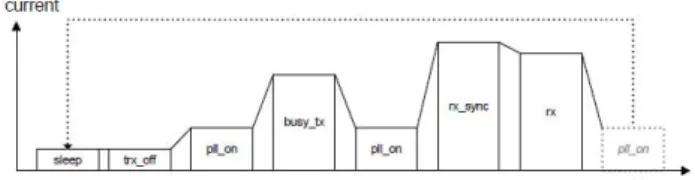
The standard scenario recognizes all data frames, but if the first attempt fails, it does not retransmit even if IEEE 802.15.4 retries. The flow of current consumption of the device over time is shown in Fig. 1. Fig. 1 shows the condition of the transceiver’s main state machines and their current consumption. [5]

The PHY transmission method follows the standards procedure shown in Fig. 1.

When the initialization is complete, the transceiver starts as IDLE mode at the power saving mode and switch.

Fig. 1. Standards transmission scenarios for PHY.

When an approval frame is received, the microcontroller switches to sleep mode as soon as possible. If it switches into sleep mode, the microprocessor’s function will last as long as it does not start a new transmission. [6]

The MAC transmission method is the next from PHY procedure, but the IEEE 802.15.4 standards have the same rules as Fig. 2.

The scenario suggested in this paper calculates energy for one of the network device nodes. It assumes that the device only has one major task when it sends sensor data to a router or a coordinator. This device transmits given data for given time. That is, an application that transmits 100 bytes in 5 seconds requires more energy than an application that transmits 10 bytes in 10 minutes. [7]

Fig. 2. Standards transmission scenarios for MAC.

Ⅲ. Current consumption mode

Fig. 3 shows the available functions under the sleep mode condition to reduce current consumption when using a microprocessor.

By changing ‘Report Attribute On / Off’ value,

‘Report Attribute Level Control Current Level’

value, we reduced unnecessary current consumption.

We used the MAC to select the sleep mode for reducing the transceiver’s current.

(879)

(3)

IEEE 802.15.4 power efficiency analysis using high-speed Wireless Personal Area Network transceiver in the environment for Internet of Things

359

Fig. 3. ZigBee IoT demonstration flow diagram.

This and other MAC layers are designed to enable communication using only the necessary functions by using the sleep mode in the middle of data transmission with wireless method. To save MAC power, IDLE mode was used. [8] When measuring by recognizing the basic offset as 0.05mAh, there is almost no difference between calculated current consumption used microprocessor formula and real current consumption.

(1)

Equation (1) represents electric current calculation about microprocessor.

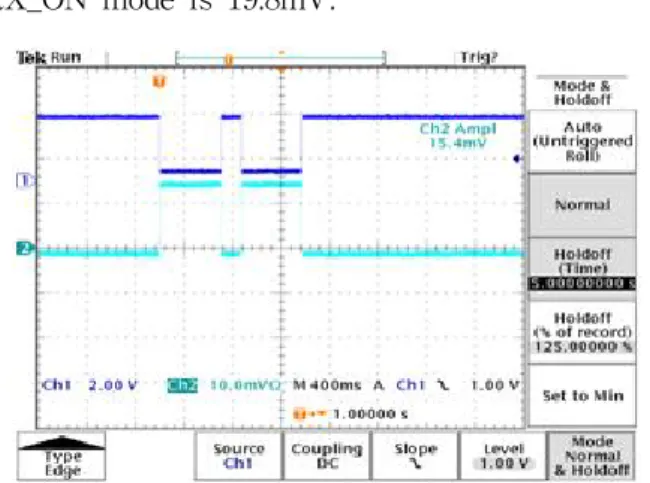
Fig. 4. Amount of current consumption when giving power supply to Sample 1.

By changing the ‘Report Attribute’ value for two samples 1 and 2, the amount of current consumption during power supply was measured by an oscilloscope. In Fig. 4, the ‘Report Attribute’ of the Configure response is 110 seconds per one time, and when the ‘Report Attribute Level Control Current Level’ is 50, RX_ON mode is 19.8mV.

Fig. 5. Amount of current consumption when giving power supply to Sample 2.

In the same procedure, by changing ‘Report Attribute’ of Sample 2 to 120 second per one time and ‘Report Attribute Level Control Current Level’ to 40, RX_ON mode is 15.4mV like Fig. 5.

The microprocessor current depends on operating conditions. The microprocessor clock is 8MHz and the microprocessor supply voltage is 3V. The amount of current during microprocessor use can be calculated using Equation (1). In order to implement the wake-up function in the sleep mode having a certain delay, the current consumption of each function can be also checked by using a Watchdog, which is a unique function of the microprocessor. [9], [10] Table 3 shows measurement value of RX_ON mode current consumption of Sample 1 and Sample 2.

Table 3. Comparing sample voltage measurement.

Sample 1 Sample 2 Report Attribute time 110s 120s Report Attribute Level

Control Current Level 50 40

RX_ON Volt Value 19.8mV 15.4mV

(880)

(4)

360 j.inst.Korean.electr.electron.eng.Vol.22,No.3,878∼881,September 2018

Ⅳ. Conclusion

In this paper, IEEE 802.15.4 current consumption was measured and analyzed through the experiments. Software protocol was optimized by controlling the time and voltage level of ‘Report Attribute’. The power consumption of the existing MCU was improved by 22% from the origin 19.8mV to 15.4mV. This software implemented the node architecture required for the basic operation of transceiver and microcontroller.

To check the current consumption over time, the rate of energy consumption was designed based on the amount of basic current consumed by the microprocessor during the sleep mode. The program was designed to reduce current consumption as much as possible during various operations and it was tested. To reduce current consumption when using battery, with designing transmission of the same amount of data as soon as possible, power consumption efficiency was enhanced.

References

[1] IEEE Computer Society, (August 31, 2007).

IEEE Standard 802.15.4a-2007.

[2] IEEE Computer Society, (April 17, 2009).

IEEE Standard 802.15.4c-2009.

[3] J. Zeng et al., “Will IEEE 802.15.4 Make Ubiquitous Networking a Reality?: A Discussion on Potential Low Power, Low Bit Rate Standard,”

IEEE Communications Magazine, vol.42, pp.140-146, 2004. DOI:10.1109/MCOM.2004.1304251

[4] P. Choi et al., “An Experimental Coin-Size Radio for Extremely Low-Power WPAN (IEEE 802.15.4) Application at 2.4 GHz,” IEEE Journal of Solid-State Circuits, vol.38, pp.2258-2268, 2003. DOI:10.1109/JSSC.2003.819083

[5] IEEE Computer Society, (April 17, 2009).

IEEE Standard 802.15.4d-2009.

[6] IEEE 802.15.4/D18, Low Rate Wireless Personal Area Networks, std. 2003.

[7] Myung-han Yu, Sangkyung Kim, “TinyAP:

Lightweight Application Protocol for LoRa Environment,” The Journal of Korean Institute of Communications and Information Sciences ’18-01, vol.43, no.1, pp.27-36, 2018.

DOI:10.7840/kics.2018.43.1.27

[8] Eun-Ju Woo, Yu-Sung Moon, Jung-Won Kim, “Suggestion for method to improve power consumption of the ZigBee RF4CE platform,”

j.inst.Korean.electr.electron.eng, vol.22, no.2, pp.

476-479, 2018. DOI:10.7471/ikeee.2018.22.2.476 [9] Artem Dementyev, Steve Hodges, Stuart Taylor, Joshua Smith, “Power consumption analysis of Bluetooth Low Energy, ZigBee and ANT sensor nodes in a cyclic sleep scenario,”

2013 IEEE International Wireless Symposium (IWS), 2013. DOI:10.1109/IEEE-IWS.2013.6616827 [10] Tae-ho Hwang, Dong-Sun Kim, Gwang-ho Won, “The Optimization of IEEE 802.15.4 PHY/

MAC with Hardwired Low-MAC,” The Journal of Korea Institute of Communication Sciences, vol.35, no.1, pp.95-105, 2010.

(881)

수치

Table  1.  Simulation  packet  structure.
Fig.  4.  Amount  of  current  consumption  when  giving  power  supply  to  Sample  1.

참조

관련 문서