• 검색 결과가 없습니다.

Deformation of the AlGaN/GaN metal-oxide-semiconductor heterostructure field-effect transistor characteristics by UV irradiation

N/A
N/A
Protected

Academic year: 2021

Share "Deformation of the AlGaN/GaN metal-oxide-semiconductor heterostructure field-effect transistor characteristics by UV irradiation"

Copied!
6
0
0

로드 중.... (전체 텍스트 보기)

전체 글

(1)

Deformation of the AlGaN/GaN

metal-oxide-semiconductor heterostructure field-effect transistor characteristics by UV irradiation

Jin Hong Lim * , Jeong Jin Kim * , Jeon Wook Yang *

Abstract

The impact of UV irradiation process on the AlGaN/GaN metal-oxide-semiconductor heterostructure field-effect transistor was investigated. Due to the high intensity UV irradiation before the gate dielectric deposition, the conductivity of AlGaN/GaN structure and the drain saturation current of the transistor increased by about 10 %. However, the pinch off characteristics of transistor was severely deformed by the process. By comparing the electrical characteristics of the transistors, it was proposed that the high intensity UV irradiation formed a sub-channel under the two dimensional electron gas of AlGaN/GaN structure even without additional impurity injection.

Key words: AlGaN/GaN, MOSHFET, UV, 2-DEG, Deformation

* Dept. of Semiconductor Science and Technology /SPRC, Chonbuk National University

★ Corresponding author : [email protected], 063-270-2830

※ Acknowledgment : Following are results of a study on the "Leaders in INdustry-university Cooperation" Project, supported by the Ministry of Education, Science & Technology(MEST) and the National Research Foundation of Korea(NRF).

Manuscript received Nov. 28, 2013; revised Dec. 09,

I. Introduction

AlGaN/GaN high electron mobility transistors (HEMTs) and metal-insulator-semiconductor heterostructure field-effect transistors (MISHFETs) are suitable for high power and high frequency operation, especially in harsh environments, due to its inherent material property.[1-3] However, studies for better and reliable electrical characteristics of the devices have continued up to date, because there are needs for high voltage, low leakage current, less degradation in pulsed operation, etc.[4, 5] The electrical characteristics of AlGaN/GaN based transistors are very sensitive to the surface, because

conductive channels with high carrier density form without any dopant injection, and lots of traps exist on the surface. Surface traps act as leakage current paths, and decrease the breakdown voltage. Also, charged traps can modify the channel, and be operated as a virtual gate. Moreover, traps capture and release charges with time delay, thereby degrading the frequency dependent characteristics of the HEMT, as in many reports.[6, 7] Process related physical damage and chemical reaction have been considered as reasons for generation of surface traps. The ionic bombardment at the plasma process induces damage, and leaves traps behind the surface, because the surface is exposed to chemicals and ions during the process.[8] To reduce traps and their effects, surface passivation using SiN x , SiO 2 , and Al 2 O 3 has been proposed and examined. Also, surface treatments with either chemicals or plasma were investigated, to cure the surface for improved electrical characteristics.[9, 10] There is another possible source that degrades the surface.: the UV energy, of which the wave length is less than 365 nm, is higher than the bandgap energy of GaN.

When GaN surface is irradiated by UV shorter than

(2)

the wave length, Ga atoms are excited to an active state, and easily changed their state to generate carriers. Also, there is a possibility to make traps.

During the optical lithography, UV is irradiated to the photoresist, and some of the energy is delivered to the surface, despite the masking of photoresist.

Further, the surface can be exposed to UV during the plasma process, such as substrate etching and dielectric deposition, because UV generation is possible at the plasma. The lithography and the plasma processes are repeated many times for device fabrication, and the accumulation of exposure can make the surface change from the beginning, although the effect is small at each process. This can degrade the surface and channel properties, and thereby the electrical characteristics of the transistor. However, there was no report of the UV irradiation effect on the device characteristics, although the process is always done in the fabrication. Most of the reports have studied the effect of UV response on the fabricated device, by measuring the electrical characteristics under, or after, UV illumination.[11]

In this study, the effect of UV irradiation process on the electric characteristics of an AlGaN/GaN metal-oxide-semiconductor heterostructure field effect transistor (MOSHFET) was investigated, by irradiating the surface with high intensity UV, before the gate dielectric deposition. We report that the UV severely deformed the electrical characteristics of AlGaN/GaN MOSHFET, by introducing a sub-channel under the two- dimensional electron gas (2-DEG).

II. Experiment

To investigate the UV radiation effect, AlGaN/GaN MOSHFETs were fabricated, using an Al0.25 Ga0.75 N/GaN structure with a 3 nm GaN cap layer. The AlGaN/GaN structure was prepared by the sequential growth of 30 nm AlGaN layers over a GaN buffer layer, by metal organic chemical vapor deposition, on a 4-H SiC substrate. The AlGaN/GaN structure was etched by dry etching technique, to define an isolated active region of the

transistor. Source and drain ohmic contacts were formed on the active region by deposition of Ti/Al/Ni/Au metals, and 30 seconds annealing at a temperature of 900 °C in N 2 ambient. After that, gate dielectric of SiO 2 was deposited with 15 nm thickness on the surface of two samples, by the plasma enhanced chemical deposition (PECVD) process. Just before the deposition, one of the samples was UV irradiated, and the other was not, for the comparison, as shown in figure 1. UV irradiation was performed on one of the samples, using a 150 W deuterium lamp by the energy 150 mJ/cm 2 . Most of the energy of the lamp is distributed below 360 nm, which is higher energy than the band gap of GaN. After irradiation, The UV irradiation and SiO 2 deposition processes were performed continuously in the same chamber to minimize surface variation and the temperature was 250 °C. Ni/Au gate metals were deposited on SiO 2

between the source and drain ohmic contact, and SiO 2 on the source and drain ohmic contacts were selectively etched.

Fig. 1. Fabrication of AlGaN/GaN MOSHFET: (a) The UV irradiation was performed on one sample before SiO2 deposition, and (b) the other was not irradiated.

III. Results and Discussion

Fig. 2 shows the leakage current characteristics

between the two isolated pads, with a same width

and distance of 100 μm. Although the 2-DEG was

removed by the etching of AlGaN, leakage current

(3)

of the order of 10 -7 A flowed between the two pads. The leakage current was decreased to less than 10 -8 A after SiO 2 deposition. Because all the process was performed at the same condition, except for the UV irradiation 250 °C, it is thought that the leakage current lowering came from the surface modification due to the SiO 2 deposition, as in other reports.19, 20 The UV process had little effect on the isolation leakage current variation.

However, there was a difference in the channel resistance of AlGaN/GaN structures, between the UV irradiated and non-irradiated sample. The sheet resistances of the channel determined by the transfer length method were similar as 535 Ω/sq.

before and after SiO 2 deposition, as shown in figure 3. But it was decreased to 503 Ω/sq. for the UV irradiated sample. Since the sheet resistance distributed within the variation of 9 Ω/sq. for examined sample, it was regarded that UV induced a decrease of the sheet resistance.

-10 -5 0 5 10

10

-12

10

-11

10

-10

10

-9

10

-8

10

-7

10

-6

10

-5

10

-4

10

-3

C u rr e n t (A )

Voltage (V)

Without SiO

2

passivaion SiO

2

passivation SiO

2

passivation after UV irradiation

Fig. 2. Leakage current characteristics between two isolated pads.

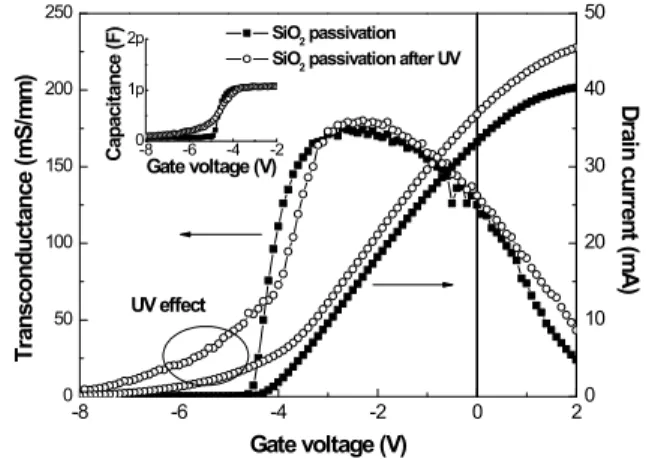
In addition, UV irradiation seriously modified the electrical characteristics of MOSHFET. Fig. 4 shows the transconductance and drain current characteristics on gate voltage at drain source voltage of 5 V for the two MOSHFETs, with gate length and width of 1 μm and 50 μm, respectively.

The drain current of MOSHFET was 33.2 mA at 0 V of gate voltage at the sample without UV irradiation. But the current was increased to 36.8 mA by UV irradiation, which is 10% higher for UV irradiated sample.

Moreover, there was a marked difference in the

transconductance curve. Although the transconductance curve was typical for the transistor of a sample without UV process, it has a tail below -4 V of gate voltage for the UV

0 20 40 60 80 100

0 200 400 600

R e si st a n ce ( W )

Pad distance (mm)

Without SiO

2

passivaion SiO

2

passivation SiO

2

passivation after UV irradiation

Fig. 3. resistance between the pads on the AlGaN/GaN channel corresponding to the pad distance.

irradiated sample. These variations were shown for all transistors of the sample, though there is a little difference in the amount of the variation. Since the transconductance of AlGaN/GaN MOSHFET increases rapidly at the threshold voltage due to the two-dimensional carrier distribution, the tail from – 4 V to –8 V of figure 4 indicated that the 2-DEG channel of AlGaN/GaN structure was modified to have sub-channel under 2-DEG by UV process.

-8 -6 -4 -2 0 2

0 50 100 150 200 250

0 10 20 30 40 50

-8 -6 -4 -2

0 1p 2p

D ra in c u rr e n t ( m A )

T ra n s c o n d u c ta n c e ( m S /m m )

Gate voltage (V) SiO

2

passivation SiO

2

passivation after UV

UV effect

C a p a c it a n c e ( F )

Gate voltage (V)

Fig. 4. Transconductance, drain current, and capacitance

characteristics corresponding to the gate voltage of

AlGaN/GaN MOSHFET.

(4)

The sub-channel needs larger negative voltage for modulation than the 2-DEG because it is located under the 2-DEG. The sub-channel seemed to contribute to the increase of drain current and the decrease of sheet resistance in figure 3. However, the formation of sub-channel is not possible at room temperature without any dopant. Also, the dissociation of GaN is not easy because the dissociation energy is very high as 206 kcal/mole for GaN.21 But, GaN can be excited by UV irradiation and the excitation reduced the dissociation energy. In our case, bond breaking seemed to be happened at the process temperature of 250 °C under UV irradiation and some of the broken bond seemed to be left a broken state, because there was no remarkable variation of the electrical characteristics for a transistor with UV irradiation at room temperature. When UV is irradiated on the GaN surface, where the AlGaN layer is etched out, Ga atoms are excited and there is an opportunity to break the bonding of GaN. The broken bonding forms faults, nitrogen and Ga vacancies in GaN and the nitrogen vacancies can act as donors in GaN. But, the donors did not contribute to current conduction because they were depleted by the surface states as in figure 5(a).

Fig. 5. Band diagrams of AlGaN/GaN and GaN after the UV irradiation process.

As like nitrogen vacancies, Ga vacancies can be acceptor, but the possibility is much lower than nitrogen vacancies. On the contrary, donors of GaN generated by UV irradiation revealed different

results in AlGaN/GaN, due to its layered structure.

The difference in band-gap energy between AlGaN and GaN forms a quantum well at the interface, and the energy barrier toward AlGaN prevents electrons from moving to AlGaN. The confined electrons act as a carrier with high electron mobility. In a similar way, the electrons on donors generated by UV in GaN cannot move to AlGaN, due to its barrier, in contrast with the case without AlGaN, where the carrier can contribute to current conduction. The electrons on donors in GaN have lower mobility than the confined electrons, and are spatially distributed corresponding to the UV penetration, like a low mobility sub channel formed under 2-DEG. The carrier distribution under 2-DEG was confirmed by CV measurement results of the gate electrodes. As shown in the inset of figure 4, the two samples have different capacitance profiles.

The steep capacitance profile of the MOSHFET without UV irradiation revealed two- dimensional carrier distribution in AlGaN/GaN structure because carrier density can be estimated by the integration of capacitance over gate voltage. But, the capacitance distributed widely at gate voltage of the MOSHFET with UV irradiation process. It indicated the existence of carriers below 2-DEG. From the above results, it was confirmed that carriers are generated under 2-DEG by the high intensity UV irradiation on the AlGaN/GaN surface even without impurity injection and thermal treatment, and the carriers modify the channel properties, to degrade the pinch off characteristics of MOSFET. During the MOSHFET and HEMT fabrication processes using AlGaN/GaN structure, the AlGaN/GaN surface is exposed many times to UV by lithographic process using UV source or plasma processes emitting UV. Since the UV exposed surface has the possibility of changing the 2-DEG channel, notwithstanding that the impact is not as much as in our experiment, its impact on the device characteristics has to be considered.

III. Conclusion

As a conclusion, it was found that by comparing

the electrical characteristics of the AlGaN/GaN

MOSHFETs, the high intensity UV irradiation

(5)

before the gate dielectric deposition formed a sub-channel under the 2-DEG of AlGaN/GaN structure even without additional impurity injection.

The AlGaN barrier seemed to prevent from moving carriers generated by donors that resulted from the broken bond of GaN by high energy UV irradiation and the donor formed sub-channel with lesser electrical properties than 2-DEG. The sub-channel provided an improved conductivity of the AlGaN/GaN channel, and drain current increase of the MOSHFET by about 10%. But, the pinch-off characteristics of MOSHFET were severely deformed by the sub-channel.

References

[1] M. A. Khan, M. S. Shur, Q. C. Chen, and J. N.

Kuznia,“Current/voltage characteristic collapse in AIGaN/GaN heterostructure insulated gate field effect transistors at high drain bias”, Electron. Lett.

30. 2175-2176, 1994

[2] H. Kambayashi, Y. Satoh, S. Ootomo, T.

Kokawa, T. Nomura, S. Kato, and T. P. Chow,

“Over 100 A operation normally-off AlGaN/GaN hybrid MOS-HFET on Si substrate with high breakdown voltage”, Solid-State Electron. 54, 660-664, 2010

[3] Diego Marti, Stefano Tirelli, Andreas R. Alt, John Roberts, and C. R. Bolognesi, “150-GHz Cutoff Frequencies and 2-W/mm Output Power at 40 GHz in a Millimeter-Wave AlGaN/GaN HEMT Technology on Silicon”, IEEE Electron Device Lett.

33, 1372-1374. 2012

[4] H.-Y. Liu, B.-Y. Chou, W.-C. Hsu, C.-S. Lee, J.-K. Sheu, and C.-S. Ho,“ Enhanced AlGaN/GaN MOS-HEMT Performance by Using Hydrogen Peroxide Oxidation Technique”, IEEE Trans.

Electron Devices 60, 213-220. 2013

[5] W. Chen, J. Zhang, B. Zhang, and Z. Li,“

Analysis and reduction of the gate forward leakage current in AlGaN/GaN HEMTs employing energy-band modulation technology”, Solid-State Electron. 80 (2013) 76-80. 2013

[6] S. C. Binari, K. Ikossi, J. A. Roussos, W.

Kruppa, D. Park, H. B. Dietrich, D. D. Koleske, A.

E. Wickenden, and R. L. Henry, “ Trapping Effects and Microwave Power Performance in AlGaN/GaN HEMTs”, IEEE Trans. Electron Devices 48, 465-471, 2001

[7] T. Mizutani, Y. Ohno, M. Akita, S. Kishimoto, and K. Maezawa: IEEE Trans. Electron Devices,“ A Study on Current Collapse in AlGaN/GaN HEMTs Induced by Bias Stress”, 50, 2015-2020, 2003

[8] T. Hashizume, and H. Hasegawa,“ Effects of nitrogen deficiency on electronic properties of AlGaN surfaces subjected to thermal and plasma processes”, Appl. Surf. Sci. 234, 387-394, 2004 [9] G. Koley, V. Tilak, L. F. Eastman, and M. G.

Spencer,“ Slow Transients Observed in AlGaN/GaN HFETs: Effects of SiNx Passivation and UV Illumination”, IEEE Trans. Electron Devices 50, 886-893, 2003

[10] S.K. Hong, K.H. Shim and J.W. Yang,“

Reduced gate leakage current in AlGaN/GaN HEMT by oxygen passivation of AlGaN surface”, Electron.

Lett. 44, 1091-1092, 2008

[11] P. Valizadeh, E. Alekseev, D. Pavlidis, F. Yun, and H. Morkoc,“Anomalous effects of temperature and UV illumination on the operation of AlGaN/GaN MODFET”, Solid-State Electron. 50, 282-286, 2006

BIOGRAPHY

Jin Hong Lim(Student Member)

2012 : BS degree in Dept. of Semiconductor Science and Technology, Chonbuk National University.

2013~ : MS degree in Dept. of

Semiconductor Science and

Technology and Chemical

Engineering, Chonbuk National University.

(6)

Jeong Jin Kim (Student Member)

2009 : BS degree in Dept. of Semiconductor Science and Technology, Chonbuk National University.

2011 : MS degree in Dept. of Semiconductor Science and Technology and Chemical Engineering, Chonbuk National University.

2011~ : PhD degree in Dept. of Semiconductor Science and Technology and Chemical Engineering, Chonbuk National University.

Jeon Wook Yang (Member)

1981 : BS degree in Dept. of Electronics Engineering, Kwang Woon University.

1983 : MS degree in Dept. of Electronics Engineering, Yonsei University.

1994 : PhD degree in Dept. of Electronics Engineering, Yonsei University.

1983~1998 : Member of Research Staff, ETRI

1998~ : Professor, Chonbuk National University

수치

Fig. 1. Fabrication of AlGaN/GaN MOSHFET: (a) The UV irradiation was performed on one sample before SiO2 deposition, and (b) the other was not irradiated.
Fig. 4. Transconductance, drain current, and capacitance characteristics corresponding to the gate voltage of AlGaN/GaN MOSHFET.
Fig. 5. Band diagrams of AlGaN/GaN and GaN after the UV irradiation process.

참조

관련 문서

Bactericidal effect of photocatalytic reactor depending on the UV-A illumination time and flow rate of V.. Bactericidal effect of photocatalytic reactor

In this regard, this study analyzes the effect of the job characteristics and work environment of workers with physical disabilities on job satisfaction

J.(2009), Characteristics of transformational leadership of nursery director child care teacher was late effect on the organization and Indications immersive

This study the changes in structure and mechanical characteristics by the analysis on mechanical characteristics of the welding part and the post weld

mould with rapid and uniform cooling characteristics using the deposition of the multi-materials based on the direct metal rapid tooling process.. In order

The purpose of this research was to identify the mediating effect of unconditional self-acceptance and the moderated mediating effect of emotional

This study examined the mediating effect of Executive Function in The Effect of Mother’s Play Participation in Child’s Emotion Regulation.. The participants

Activated H-Ras expression in human fibroblast cell lines increases the activity of Ku80 to bind injuried DNA, reduces γ-H2AX expression by UV irradiation,