Synthesis of New N,N-Bis(5-acetylpyridin-2-yl)- phenylamine Derivatives and Their Solvatochromic
Effects
Ibrahim Mustafa El-Deeb*․So-Ha Lee†
*Department of Biomolecular Science, University of Science and Technology, 113 Gwahangno, Yuseong-gu, Daejeon 305-333, Korea
†Life Sciences Research Division, Korea Institute of Science and Technology, P.O.Box 131, Cheongryang, Seoul 130-650, Korea
(Received July 29, 2008 ; Accepted December 11, 2008)
Abstract : A group of new N,N-bis(5-acetylpyridin-2-yl)phenylamine derivatives was synthesized in good yield applying an optimized Buchwald-Hartwig amination protocol. The synthesized compounds showed UV absorption maxima in the range of 320-360 nm, and showed good luminescence at dilute concentrations in the blue region of the spectra (in the range of 480-497 nm). They showed also a bathochromic shift associating the increase in solvent polarity. The synthesized compounds could be investigated for use in OLEDs or as potential monomers for PLEDs.
Keywords : Pyridine, triarylamine, photoinduced charge transfer, photoluminescence.
1. Introduction
Organic light-emitting diodes (OLEDs) have attracted great attention in recent years with their potential to form the next generation of flat-panel displays, due to their low-voltage operation, wide-viewing angle, excellent color quality, high contrast and mechanical flexibility[1-2]. More recently, intense efforts have been made for more improvements of OLEDs, by developing new materials with better required properties, such as high emission quantum yield[3], high thermal and photochemical stability[4], high photoemission[5], and good color purity[6].
✝Corresponding author
(e-mail : LSH62112kist.re.kr)
Triphenylamine is a common group in both OLEDs and PLEDs because of its excellent hole-injection ability and good UV-light harvesting properties[7-9]. Herein, we report the synthesis and photoluminescent properties of triarylamine analogues. These analogues were designed in such a way that an electron donating phenylamine part and an electron deficient acetyl pyridine part are present together within the same molecule as shown in Figure 1. By this design, photoinduced charge transfer (PICT) could be initiated in the excited state [10-11].
Furthermore, the presence of two acetyl groups in all the molecules makes them to be potential precursors for polymerization with suitable polymerizing agents, such as biscarboxaldehydes[12-13], for application in PLEDs. Although the synthesis of this typical
scaffold is new, the synthesis of N,N-bis(pyridin-2-yl)phenylamine has been reported before[14-15]. However, in these reported procedures the target triarylamines was obtained in low yields, specially for derivatives substituted by electron withdrawing groups[14]. A high yield synthesis was also successfully achieved, but by using specially designed Pd catalyst that’s not available commercially[15], while in this work, we succeeded in the preparation of the target triarylamines in good yields using commercially available Pd catalyst.
N
N N
O O
R
Figure 1. The dipolar design of the target compounds
2. Experimental 2.1 General
1
H-NMR (300 MHz) and 13C-NMR(75 MHz) were recorded on a Bruker Avance 300 spectrometer with TMS as an internal reference. Melting points were taken on a Thomas-Hoover capillary melting apparatus and were uncorrected. UV-visible spectra and luminescence spectra were recorded on S-2130 spectroscopy and RF-5301-PC luminescent spectroscopy, respectively.
Column chromatography was performed on Merck silica gel 60 (230 - 400 mesh). TLC was carried out using glass sheets precoated with silica gel 60 F254 prepared by E.
Merck. All the commercially available reagents were obtained from Aldrich and Tokyo Kasei Chemical and generally used without further purification.
2.2. 5-Acetyl-2-bromopyridine (1) Under N2 atmosphere, n-BuLi (8.1 mL, 13 mmol, 1.6 M in hexane) was added to a mixture of 2,5-dibromopyridine (3.1 g, 13 mmol) and anhydrous diethyl ether (50 mL) at -78 oC. The reaction mixture was stirred
for 30 minutes and then
N,N-dimethylacetamide (1.4 mL, 15 mmol) was added and stirred at -78 oC to ambient temperature within 1 hour. The whole mixture was poured into saturated NH4Cl solution and then extracted with diethyl ether (150 mL x 3). The combined organic layer was washed with brine, dried, and concentrated. The crude product was purified by column chromatography (silica gel, hexane:EtOAc = 7.5:1) to give 1 as a yellowish white solid (1.3 g, 51 %). mp 124-128 oC (124-128 oC [16]); 1H NMR (CDCl3) δ 2.62 (s, 3H, CH3), 7.61 (d, J = 8.2 Hz, 1H, H3), 8.07 (d, J = 7.6 Hz, 1H, H4), 8.89 (s, 1H, H6); 13C NMR (CDCl3): δ 26.79 (CH3), 128.44 (C3), 131.41 (C5), 137.70 (C4), 146.96 (C2), 150.42 (C6), 195.65 (C=O).
2.3. General procedure for the preparation of compounds 2a-g
A mixture of dichlorobis
(triphenylphosphine)palladium(II) (27 mg, 0.038 mmol), Xantphos (4,5-bis (diphenylphosphino)-9,9-dimethylxanthene) (22 mg, 0.038 mmol) and 18-crown-6 (20 mg, 0.076 mmol) in toluene (1 mL) was stirred at 60 oC under N2 atmosphere for 30 minutes. A mixture of 5-acetyl-2-bromopyridine (155 mg, 0.76 mmol), the appropriate aniline derivative (0.38 mmol) and NaOt-Bu in toluene (2 mL) was added to this slurry. The reaction mixture was refluxed under N2
atmosphere for the specified reaction time.
The reaction mixture was evaporated under vacuum, and the residue was triturated with water (20 mL) and extracted with dichloromethane (50 mL x 3). The organic layer was separated, dried over anhydrous MgSO4, and evaporated under vacuum. The
crude product was purified by column chromatography (silica gel, hexane:EtOAc = 4:1) to give the pure products.
2.3.1. N,N-Bis(5-acetylpyridin-2-yl) -N-phenylamine (2a)
It was obtained as yellow powder (78 mg, 62 % yield). mp 145 146 oC; 1H NMR (CDCl3) δ 2.59 (s, 6H, 2CH3), 7.12 (d, J = 8.7 Hz, 2H, Pyr-H3), 7.23-7.28 (m, 2H, Ar-H), 7.38 7.42 (m, 1H, Ar-H), 7.46 7.51 (m, 2H, Ar-H), 8.14 (dd, J = 2.2, 6.6 Hz, 2H, Pyr-H4), 8.92 (d, J = 1.6 Hz, 2H, Pyr-H6);
13C NMR (CDCl3): δ 26.50 (2CH3), 116.16, 127.69, 128.29, 130.35, 137.24, 143.12, 149.80, 159.83, 195.45 (2C=O).
2.3.2. N,N-Bis(5-acetylpyridin-2-yl) -N-(4-methoxyphenyl)amine (2b) It was obtained as brown powder (76 mg, 55 % yield). mp 94 95 oC; 1H NMR (CDCl3):
δ 2.59 (s, 6H, 2CH3), 3.87 (s, 3H, OCH3), 7.03 (d, J = 8.9 Hz, 2H, Ar-H), 7.09 (d, J = 8.8 Hz, 2H, Pyr-H3), 7.17 (d, J = 8.9 Hz, 2H, Ar-H), 8.15 (dd, J = 2.3, 6.5 Hz, 2H, Pyr-H4), 8.98 (s, 2H, Pyr-H6); 13C NMR (CDCl3): δ 26.40 (2CH3), 55.52 (OCH3), 103.28, 103.43, 115.63, 115.81, 127.52, 129.67, 137.14, 149.60, 158.94, 159.81, 195.31 (2C=O).
2.3.3. N,N-Bis(5-acetylpyridin-2-yl) -N-(4-dimethylaminophenyl)amine (2c)
It was obtained as dark brown powder (85 mg, 60 % yield). mp 133 134 oC; 1H NMR (CDCl3): δ 2.57 (s, 6H, 2CH3), 3.02 (s, 6H, 2NCH3), 6.79 (d, J = 8.6 Hz, 2H, Pyr-H3), 7.07 7.12 (m, 4H, Ar-H), 8.12 (d, J = 8.7 Hz, 2H, Pyr-H4), 8.89 (s, 2H, Pyr-H6); 13C NMR (CDCl3): δ 26.37 (2CH3), 40.53 (2NCH3), 99.99, 113.50, 115.86, 127.27, 129.18, 136.90, 149.79, 160.28, 195.45 (2C=O).
2.3.4. N,N-Bis(5-acetylpyridin-2-yl) -N-(4-cyanophenyl)amine (2d) It was obtained as yellow powder (92 mg,
68 % yield). mp 202 203 oC; 1H NMR (CDCl3): δ 2.61 (s, 6H, 2CH3), 7.14 (d, J = 8.7 Hz, 2H, Pyr-H3), 7.29 (d, J = 8.7 Hz, 2H, Ar-H), 7.73 (d, J = 8.4 Hz, 2H, Ar-H), 8.21 (dd, J = 2.2, 6.5 Hz, 2H, Pyr-H4), 8.91 (s, 2H, Pyr-H6); 13C NMR (CDCl3): δ 26.53 (2CH3), 116.76, 127.89, 128.69, 133.86, 137.77, 149.94, 159.16, 195.17 (2C=O).
2.3.5. N,N-Bis(5-acetylpyridin-2-yl) -N-(4-phenoxyphenyl)amine (2e) It was obtained as yellow powder (117 mg, 73 % yield). mp 55 56 oC; 1H NMR (CDCl3):
δ 2.59 (s, 6H, 2CH3), 7.11 7.28 (m, 9H, Ar-H), 7.41 (d, J = 7.1 Hz, 2H, Ar-H), 8.17 (dd, J = 2.0, 6.3 Hz, 2H, Pyr-H4), 8.95 (s, 2H, Pyr-H6); 13C NMR (CDCl3): δ 26.43 (2CH3), 103.15, 115.93, 119.67, 119.79, 124.19, 127.72, 129.77, 129.97, 137.42, 149.52, 195.23 (2C=O).
2.3.6. N,N-Bis(5-acetylpyridin-2-yl) -N-(4'-biphenyl)amine (2f) It was obtained as orange powder (110 mg, 71 % yield). mp 103 104 oC; 1H NMR (CDCl3): δ 2.61 (s, 6H, 2CH3), 7.15 (d, J = 8.8 Hz, 2H, Pyr-H3), 7.18 7.51 (m, 5H, Ar-H), 7.63 (d, J = 7.5 Hz, 2H, Ar-H), 7.71 (d, J = 8.3 Hz, 2H, Ar-H), 8.19 (dd, J = 2.1, 6.7 Hz, 2H, Pyr-H4), 8.98 (d, J = 1.6 Hz, 2H, Pyr-H6); 13C NMR (CDCl3): δ 26.48 (2CH3), 116.27, 127.13, 127.77, 127.88, 128.42, 128.93, 129.07, 137.57, 139.93, 141.88, 149.56, 159.44, 195.23 (2C=O).
2.3.7. 1-(4'-(N,N-Bis(5-acetylpyridin -2-yl)amino)biphenyl-4-yl) ethanone (2g)
It was obtained as yellowish orange powder (80 mg, 47% yield). mp 165 166 oC;
1H NMR (CDCl3): δ 2.60 (s, 6H, 2CH3), 2.66 (s, 3H, C1-CH3) 7.19 (d, J = 8.7 Hz, 2H, Pyr-H3), 7.72 (d, J = 6.3 Hz, 4H, Ar-H), 8.06 (d, J = 8.1 Hz, 2H, Ar-H), 8.18 (dd, J = 1.5, 7.2 Hz, 2H, Pyr-H4), 8.92 (s, 2H, Pyr-H6); 13C NMR (CDCl3): δ 26.47 (2CH3),
Compound No. 2a 2b 2c 2d 2e 2f 2g
R H -OCH3 -N(CH3)2 -CN -OPh -Ph -(Ph)-4-Ac
Reaction time (h) 6 4 6 10 6 6 8
Yield (%)* 62 55 60 68 73 71 47
*Yield is for product of reaction step b after purification with column chromatography.
N Br
Br Br N
O +
NH2
R
N N N
O O
R
a b
Reaction conditions: a) i) n-BuLi, Et2O, -78 oC, ii) N,N-dimethylacetamide, b) Pd(PPh3)2Cl2 (10 mol%), Xantphos (10 mol%), 18-crown-6 (10 mol%), NaOt-Bu, toluene, 110 oC.
Scheme 1.
26.71 (C1-CH3), 101.99, 116.35, 127.19, 127.95, 128.50, 129.04, 136.13, 137.30, 138.82, 143.35, 149.92, 159.79, 195.38 (2C=O), 206.44 (C1-C=O).
2.4. 1-(6-(Phenylamino)pyridin-3-yl) ethanone
A mixture of dichlorobis
(triphenylphosphine)Palladium(II) (27 mg, 0.038 mmol) and Xantphos (22 mg, 0.038 mmol) in toluene (1 mL) was stirred at 60
oC under N2 atmosphere for 30 minutes. A mixture of 5-acetyl-2-bromopyridine (155 mg, 0.76 mmol), aniline (35 mg, 0.38 mmol) and NaOt-Bu in toluene (2 mL) was added to this slurry. The reaction mixture was refluxed under N2 atmosphere for 24 h. The reaction mixture was evaporated under vacuum, and the residue was triturated with water (20 mL) and extracted with dichloromethane (50 mL x 3). The organic layer was separated, dried over anhydrous
MgSO4, and evaporated under vacuum. The crude product was purified by column chromatography (silica gel, hexane:EtOAc = 4:1) to give 3 as a yellow powder (45 mg, 56 % yield). mp 126-127 oC; 1H NMR (CDCl3): δ2.53 (s, 3H, CH3), 6.85 (d, J = 8.9 Hz, 1H, Pyr-H3), 7.14 7.20 (m, 1H, Ar-H), 7.39 (d, J = 4.3 Hz, 4H, Ar-H), 7.97 (s, 1H, NH), 8.04 (dd, J = 2.1, 6.8 Hz, 1H, Pyr-H4), 8.79 (d, J = 1.7 Hz, 1H, Pyr-H6); 13C NMR (CDCl3): δ 26.12 (CH3), 107.19, 121.96, 124.55, 124.63, 129.52, 137.65, 138.96, 150.98, 159.02, 195.37 (C=O).
3. Results and discussion
As shown in Scheme 1, the synthesis of the target compounds started with the preparation of 5-acetyl-2-bromopyridine (1) in 51% yield, by lithiation of 2,5-dibromopyridine in diethyl ether at -78 oC
under nitrogen atmosphere, followed by acetylation at 5-position by N,N-dimethylacetamide[16].
5-Acetyl-2-bromopyridine (1) was allowed to react with 4-substituted anilines in order to obtain the target N,N-bis(5- acetylpyridin-2-yl)phenylamine derivatives (2a-g). The reaction was carried out in boiling toluene, under nitrogen atmosphere, following an optimized Buchwald-Hartwig N-arylation protocol [17], using dichlorobis triphenylphosphine)palladium(II) as a catalyst, Xantphos as a phosphine ligand, and sodium tert-butoxide as a base.
en these typical conditions were applied for the reaction, only the mono-N-arylaniline product, 1-(6-(phenylamino)pyridin3-yl) thanone, was obtained in the reaction of 5-acetyl-2-bromopyridine (1) with aniline.
The reason that only 1-(6-(phenylamino) yridin-3-yl)ethanone was obtained under these conditions is that the highly acidic NH proton of the N-arylaniline generated at the first step of the reaction undergoes a rapid exchange with the Na+ ion species of sodium tert-butoxide, forming a stable sodium amide that is too polar to keep inside the reaction phase[18].
Table 1. The λmax values for compounds 2a-2g
Compound λmax (nm) FWHMd UVa PLb,c (nm)
2a 355 480 99
2b 357 494 133
2c 320 446 119
2d 341 448 135
2e 355 494 91
2f 355 497 100
2g 349 485 99
aIn CH2Cl2 solution on 50 μM, bIn CH2Cl2
solution on 100 nM, cPL spectra recorded by single beam excitation at UV λmax, dThe full widths at half maximum value of PL spectra.
In order to solve this problem, a phase transferring agent such as crown ethers (e.g.
18-crown-6) or quaternary ammonium salts (e.g. tetrabutylammonium bromide) was used.
The use of quaternary ammonium salts, however, was found to be ineffective, producing only minute amount of the desired product, while the yields obtained by using crown ether were much more convenient as shown in Scheme 1.
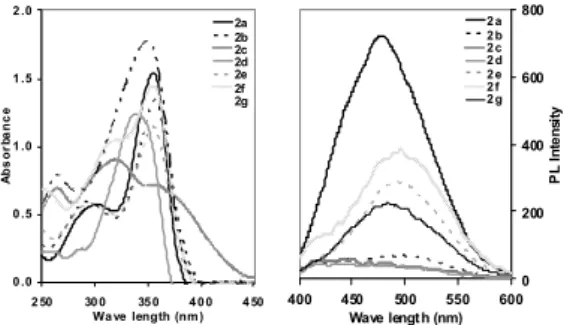
The absorption and photoluminescence (PL) spectra of compounds 2a-g were recorded in dichloromethane using UV-vis and luminescence spectroscopy, respectively. The results are shown in Table 1 and the typical spectra are shown in Figure 2.
0 .0 0 .5 1 .0 1 .5 2 .0
2 50 30 0 35 0 4 0 0 4 50
Wa ve length (nm)
Absorbance
2a 2b2c 2d 2e 2f2g
0 200 400 600 800
400 450 500 550 600
Wave length (nm)
PL Intensity
2 a 2 b2 c 2 d 2 e2 f 2 g
Figure 2. UV (left) and PL (right) spectra for compounds 2a-2g.
As shown in Figure 2, the UV spectra of all the recorded compounds showed absorption maxima in the range of (340 - 360 nm) except for compound 2c which shows maximum absorption at 320 nm, and extended absorption until 450 nm.
Excitation of these compounds by a single beam UV light at the λmax of their absorption spectra resulted in an intense emission at the range of (480 500 nm) in compounds 2a and 2e-2f, while compounds 2b-2d showed only weak emissions at 100 nM concentration.
By comparing the PL intensities of the tested compounds, it was revealed that the most intense luminescence was produced by compounds 2a and 2f. Consequently, the
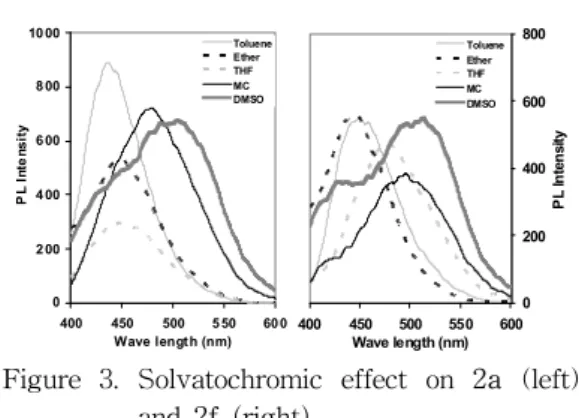
photoluminescence of these two compounds was measured in various solvents, and the intensities as a percent of PL relative to dichloromethane were calculated. The results are shown in Table 2 and the typical spectra are shown in Figure 3.
Table 2. Solvatochromic effect on the compounds 2a and 2f in various solvents.
Solvent
λmax (nm)a RIb (%)
2a 2f 2a 2f
Toluene 436 450 123 144
Diethyl ether 450 447 74 147
THF 450 478 41 124
CH2Cl2 480 497 100 100
DMSO 505 513 94 144
aAll readings were made at 100nM, bRI = Relative intensity of PL as a percent of PL in CH2Cl2.
The emission peaks showed a stepwise red-shift with increasing solvent polarity, from (436 450 nm) in toluene to (505 513 nm) in DMSO. This effect proves that photoinduced charge transfer (PICT) occurs in the excited state, and that the excited state is highly polarized and hence, stabilized by solvation with the polar solvent after photoexcitation[6].
4. Conclusion
We have synthesized a group of new N,N-bis(5-acetylpyridin-2-yl)phenylamines 2a-2g having good luminescence, at dilute concentration, in the blue region of the spectra. The synthesized compounds showed bathochromic shift associating the increase in solvent polarity, which indicates that photoinduced charge transfer (PICT) occurs in the excited state. The synthesized
compounds could be used in OLEDs or as potential monomers for PLEDs.
0 2 00 4 00 6 00 8 00 10 00
400 450 500 5 50 600
Wave length (nm)
PL Intensity
Toluene Ether THF MC DMSO
0 200 400 600 800
400 450 500 550 600 Wave length (nm)
PL Intensity
Toluene Ether THF MC DMSO
Figure 3. Solvatochromic effect on 2a (left) and 2f (right).
Acknowledgements
Research fund of this work was supported by Korea Institute of Science and Technology.
References
1. J. Kido, M. Kimura, and K. Nagai, Multilayer white light-emitting organic electroluminescent device. Science, 267, 1332 (1995).
2. Y. Sun, Y. N. C. Giebink, H. Kanno, B.
Ma, M. E. Thompson, and S. R. Forrest, Management of singlet and triplet excitons for efficient white organic light-emitting devices. Nature, 440, 908 (2006).
3. J. Qiao, L. D. Wang, J. F. Xie, G. T.
Lei, G. S. Wu, and Y. Qiu, Strongly luminescent binuclear aluminium chelate with polymer-like molecular packing and solution-processibility. Chem. Commun., 36, 4560 (2005).
4. Y.-L. Liao, C.-Y. Lin, K.-T. Wong, T.-H. Hou, and W.-Y. Hung, A Novel ambipolar spirobifluorene derivative that behaves as an efficient blue-light emitter in organic light-emitting diodes. Org.
Lett., 9, 4511 (2007).
5. Y. Lee, J. Kim. S. Kwon, C.-K. Min, Y.
Yi, J. W. Kim, B. Koo, and M. Hong, Interface studies of aluminum, 8-hydroxyquinolatolithium (Liq) and Alq3
for inverted OLED application. Org.
Electron., 9, 407 (2008).
6. D.-E. Kim, W.-S. Kim, B.-S. Kim, B.-J.
Lee, and Y.-S. Kwon, Improvement of color purity in white OLED based on Zn(HPB)2 as blue emitting layer. Thin Solid Films, 516, 3637 (2008).
7. Z. Tan, R. Tang, F. Xi, and Y. Li, Synthesis, characterization, and electroluminescence of new conjugated PPV derivatives bearing triphenylamine side-chain through a vinylene bridge.
Polym. Adv. Technol., 18, 963 (2007).
8. J. A. Mikroyannidis, K. M. Gibbons, A.
P. Kulkarni, and S. A. Jenekhe, Poly(fluorenevinylene) copolymers containing bis(phenyl)oxadiazole and triphenylamine moieties: synthesis, photophysics, and redox and electroluminescent properties.
Macromolecules, 41, 663 (2008).
9. C.-H. Ku, C.-H. Kuo, C.-Y. Chen, M.-K. Leung, and K.-H. Hsieh, PLED devices containing triphenylamine-derived polyurethanes as hole-transporting layers exhibit high current efficiencies. J. Mater.
Chem., 18, 1296 (2008).
10. T.-I. Ho, A. Elangovan, H.-Y. Hsu, and S.-W. Yang, Highly fluorescent N,N-dimethylaminophenylethynylarenes:
synthesis, photophysical properties, and electrochemiluminescence. J. Phys. Chem.
B, 109, 8626 (2005).
11. S. Chen, X. Xu, Y. Liu, W. Qiu, G. Yu, H. Wang, and D. Zhu, New organic light-emitting materials: synthesis, thermal, pphotophysical, electrochemical, and electroluminescent properties. J. Phys.
Chem. C, 111, 1029 (2007).
12. D. C. G. Pinto, A. M. S. Silva, J. A. S.
Cavalerio, and J. Elguero, New bis(chalcones) and their transformation into bis(pyrazoline) and bis(pyrazole) derivatives. Eur. J. Org. Chem., 4, 747 (2003).
13. J. B. Baell, R. W. Gable, A. J. Harvey, N. Toovey, T. Herzog, W. Hansel, and H.
Wulff, Khellinone derivatives as blockers of the voltage-gated potassium channel Kv1.3: synthesis and immunosuppressive activity. J. Med. Chem., 47, 2326 (2004).
14. J.-S. Yang, Y.-D. Lin, Y.-H. Lin, and F.-L. Liao, Zn(II)-Induced ground-state π -deconjugation and excited-state electron transfer in N,N-bis(2-pyridyl) amino-substituted arenes. J. Org. Chem., 69, 3517 (2004).
15. O. Navarro, N. Marion, N. M. Scott, J.
Gonzalez, D. Amoroso, A. Bell, and S. P.
Nolan, Synthesis of novel
(NHC)Pd(acac)Cl complexes (acac = acetylacetonate) and their activity in cross-coupling reactions. Tetrahedron, 61, 9716 (2005).
16. M. Hatanaka, K. Takahashi, S.
Nakamura, and T. Mashino, Preparation and antioxidant activity of alpha-pyridoin and its derivatives. Bioorg. Med. Chem., 13, 6763 (2005).
17. I. M. El-Deeb, J. C. Ryu, and S. H. Lee, Synthesis of new N-arylpyrimidin-2 -amine derivatives using a palladium catalyst. Molecules, 13, 818 (2008).
18. T. Miyazaki, M. Nishiyama, and N.
Matsumoto, Production of arylamines in presence of palladium catalyst. U.S. Pat.
Appl. Publ., US 2007282111 A1 (2007).