2004, Vol. 15, No. 4, pp. 1033∼1043
Bayesian Estimation Using Noninformative Priors in Hierarchical Model
Dal Ho Kim1)․Jin Kap Choi2)․Hee Jo Choi3)
Abstract
We consider the simultaneous Bayesian estimation for the normal means based on different noninformative type hyperpriors in hierarchical model.
We provide numerical example using the famous baseball data in Efron and Morris (1975) for illustration.
Keywords : Bayesian estimation, hierarchical model, matching priors, normal means
1. Introduction
Bayesian methods have become increasingly popular in the theory and practice of statistics. This is partly due to the fact that even with little or no prior information, one can often employ noninformative priors to draw reliable inference.
In practice, empirical and hierarchical Bayes methods are useful, especially in the context of simultaneous estimation of several parameters.
For example, agencies of the federal government have been involved in obtaining estimates of per capita income, unemployment rates, crop yields and so forth simultaneously for several state and local government areas. In such situations, quite often estimates of certain area means, or simultaneous estimates of several area means can be improved by incorporating information from similar neighboring areas. Examples of this type are especially suitable for empirical Bayes (EB) and hierarchical Bayes (HB) analyses.
EB and HB methods are being routinely used whenever there is a need to 1) First Author : Associate Professor, Department of Statistics, Kyungpook National
University, Taegu, 702-701, Korea E-Mail : [email protected]
2) Professor, Department of Statistics, Kyungpook National University, Taegu, 702-701, Korea
3) M.S., Department of Statistics, Kyungpook National University, Taegu, 702-701, Korea
"borrow strength" either for inference related to a particular parameter of interest, or simultaneous inference for several parameters. In particular HB methods are gaining increasing popularity in recent years partly due to overcoming the difficulty in calculation even if we use vague or noninformative priors. Thus, not surprisingly, over the years, a wide range of noninformative priors has been proposed and studied. One popular criterion for the development of such priors is to match asymptotically the posterior coverage probability of a Bayesian credible set with the corresponding frequentist coverage probability.
The outline of this paper is as follows. In Section 2, we introduce a matching prior for the hyperparameter in the normal HB model following Datta, Ghosh and Mukerjee (2000). This prior turns out to be different from the one proposed by Morris(1983). In Section 3, we derive expressions for the posterior means and variances with different hyperpriors in the normal HB setup. And in Section 4, we provide numerical example using the famous data of Efron and Morris(1975) for illustration.
2. Matching Priors in Hierarchical Model
We consider the following normal HB model
Ⅰ. Yi| θi, μ, τ2 ∼ ind N( θi, σ2), i = 1,..., n ;
Ⅱ. θi| μ, τ2 ∼iid N( μ , τ2), i = 1,..., n ;
Ⅲ. π ( μ, τ2) ∝ π( τ2)
where σ2 is assumed to be known. For the hyperparameter ( μ, τ2), we assign a hyperprior π( μ,τ2) in step (III). We assume μ and τ2 are independent with a uniform ( - ∞, ∞) prior for μ and a suitable prior π( τ2) (to be determined below) on τ2. A uniform prior on μ is widely accepted as a reasonable objective prior. We determine the prior π( τ2) via posterior and frequentist quantile matching of θi. To this end we find an asymptotic expansion of the posterior distribution of θi.
Let d = ( yi, ...,yn)T denote the observed value of Y = ( Y1, ..., Yn)T and ˆτ2 denote the residual maximum likelihood estimate of τ2 obtained by maximizing the log residual likelihood. This is equivalent to minimizing h( τ2) where
nh( τ2) = ( n - 1)
2 log ( τ2+ σ2) + 1
2 ∑
n i = 1
(yi- y)2
τ2+ σ2 . (2.1) Let π ( θi| τ2, d ) denote the conditional posterior of θi given τ2, and π ρ(θi| d ) denote the posterior pdf of θi under the prior π( τ2), where ρ( τ2) = log π( τ2). By the Laplace approximation (see, for example, Kass and Steffey, 1989) it can be shown that
πρ(θi| d ) = π( θi| τˆ2, d ) + Dπ( θi| τˆ2, d )
2nh2 (2ρ1- h3h2- 1) + D2π(θi| τˆ2, d )
2nh2 + o(n - 1)
(2.2)
where
D =∂τ2/∂, ρ1= D log π( τˆ2), hk= Dkh( τˆ2),k = 2,3, Dkw( τˆ2) = Dkw(τ2)|τ2= τˆ2. Let
G(θ*i|τ2, d ) = ⌠⌡
θ*i
-∞π(θi|τ2, d )dθi
be the conditional posterior cdf of θi. Also define qi(τ2,α ; d ), the conditional posterior quantile function by
G( qi( τ2, α ; d ) | τ2, d ) = 1 - α. (2.3)
Let hi(π, τˆ2,α ; d ) be such that
Pπ{θi> hi(π, τˆ2, α ; d )| d}= α + o( n - 1). (2.4) From (2.2)-(2.4) it follows that
hi(π, τˆ2,α ; d ) = qi( τˆ2,α ; d ) + 1
n u( π) (2.5) where u( π) may depend on the prior π, in addition to α and d, and is at most of the order O( 1). Let Pτ2(⋅) denote the probability measure based on the joint
distribution of ( Yi, θi),i = 1,…, n, as specified by (I) and (II) of the hierarchical model. We will now find an expansion of the probability P τ2[θi> hi(π, τˆ2, α ; Y )]
up to the order o( n - 1). We develop this expansion based on a limiting argument as outlined in Ghosh (1994, p.84) or Datta and Ghosh (1995, p.40). To this end, for an alternative prior π( τ2) we obtain an expansion of the posterior density
π ρ(θi| d ), where ρ( τ2) = log π( τ2). As in (2.2), we get
π ρ(θi| d ) = π( θi| τˆ2, d ) + Dπ( θi| τˆ2, d )
2nh2 (2 ρ1- h3h2- 1) + D2π( θi| τˆ2, d )
2nh2 + o( n - 1)
. (2.6)
From (2.2) and (2.6) it follows that
π ρ(θi| d ) = πρ(θi| d ) + Dπ( θi| τˆ2, d )
nh2 ( ρ1- ρ1) + o( n - 1). (2.7)
From (2.4), (2.5), and (2.7) it follows that P π{θi> hi(π, τˆ2,α ; d )| d} simplifies to
α + ( ρ1- ρ1) nh2
⌠⌡
∞
hi(π, τˆ2, α; d )Dπ( θi| τˆ2, d )dθi+ o( n - 1) which is same as
α + ( ρ1- ρ1) nh2
⌠⌡
∞ qi( τˆ2, α; d )
Dπ( θi| τˆ2, d )dθi+ o( n - 1).
Hence E τ2[P τ{θi> hi(π , τˆ2, α ; Y )| Y}] reduces to
α + {ρ1(τ2) - ρ1(τ2)}
nJ( τ2) E τ2[⌠⌡q∞i(τ2, α ; Y )Dπ( θi|τ2, Y )dθi]+ o( n - 1) (2.8) since h2= J( τ2) + o( 1), where J( τ2) = ( τ2+ α2)- 2/2.
From (I) and (II), note that π( θi|τ2, d ) = N( μi(τ2, d ),V( τ2)), where μi( τ2, d ) = yi- B( τ2)( yi- y), V( τ2) = σ2(1- B(τ2)) + σ2B(τ2)/n and
B(τ2) = σ2(σ2+ τ2)- 1.
From this it follows that qi(τ2,α, d ) = μi(τ2, d ) + zα V(τ2), where zα is the 1 - αth quantile of a standard normal distribution. Hence it can be shown that
⌠⌡
∞
qi( τ2, α ; d )Dπ( θi|τ2, d )dθi simplifies to
[ V '( τ2V( τ2)z2)α + μV( τi'( τ22)) ]φ( zα) + o( 1)
which in turn is given by
-[ 2{B'( τ1 - B( τ2)zα2)} + B'( τσ 1 - B( τ2)( yi- y)2) ]φ( zα) + o( 1), (2.9) where φ( z) is the standard normal pdf. Since E τ2[Yi- Y]= 0, by (2.8) and (2.9) we get
E τ2[P π{θi> hi(π, τˆ2, α ; Y | Y}]
= α- { ρ1( τ2) - ρ1(τ2)}B'( τ2)zαφ( zα) 2nJ( τ2){1 - B( τ2)} + o( n
- 1)
(2.10)
It follows from (2.10) that
⌠
⌡
∞
0 E τ2[P π{θi> hi(π, τˆ2, α ; Y )| Y}]π ( τ2)dτ2
= α- zαφ(zα) 2n
⌠⌡
∞ 0
{ρ1(τ2)- ρ1(τ2)}B'( τ2)
J( τ2){1 - B( τ2)} π( τ
2)dτ2+ o( n - 1) (2.11)
Now making π( τ2) weakly converge to τ2 as in Ghosh(1994) or Datta and Ghosh (1995) we get from (2.11),
P τ2[θi> hi(π, τˆ2, α ; Y )]= α + zαφ( z2n α) [ J( τρ21)( τ{1 - B( τ2)B'( τ22))} ]
+ D{ J( τ2)B'( τ{1 - B( τ2) 2)} }+ o( n- 1)
= α + zαφ( zα)
2nπ( τ2) D[ J( τπ( τ2){21 - B( τ)B'( τ2)2)} ]+ o( n - 1)
(2.12)
The right hand side of (2.12) will be equal to α to the order o( n- 1) if and only if
π( τ2) ∝ J( τ2 ){1 - B( τ2 )} B'( τ2) i.e.,
π(τ2) ∝ τ2(σ2+ τ2)- 1
Remark: The prior given above is the unique matching prior. This prior is different from the uniform prior on τ2 (especially for small τ2) proposed by Morris(1983). Since it is bounded in τ2, the resulting posterior is proper provided
n>3.
3. Estimation of the Multivariate Normal Mean
This section is devoted to the HB procedures for estimating the multivariate normal mean. Now we consider the following HB model
Ⅰ. Yi| θi, μ, τ2 ∼ ind N( θi, σ2), i = 1,..., n ;
Ⅱ. θi| μ, τ2 ∼iid N( μ , τ2), i = 1,..., n ;
Ⅲ(a). π ( μ, τ2) ∝ 1,
Ⅲ(b). π ( μ, τ2) ∝ τ2(σ2+ τ2)- 1,
where σ2 is assumed to be known.
First we consider the hyperprior π( μ, τ2) ∝ 1 in step III(a) for the hyperparameter ( μ, τ2). Then the joint pdf of y , θ , μ and τ2 is given by
f( y, θ,μ,τ2) ∝ exp[ - 2σ12 ( y - θ )' ( y - θ )]
×( τ2)-
n
2 exp[- 2τ12 ( θ - μ 1 )'( θ - μ 1 )]
(3.1)
Now integrating with respect to μ, it follows from (3.1) that the joint (improper) pdf of y , θ and τ2 is
f( y , θ , τ2)∝ ( τ2)
n - 1 2
exp[- 2σ12 ( θ - σ12 E - 1y )' E ( θ - 1
σ2 E - 1y )]
exp[ σ12 y' y - σ14 y' E - 1y]
(3.2)
where E - 1= σ2(1- B ) In+ σ2Bn- 1Jn with Jn= 1 1' . Hence, conditional on y and τ2,
f( θ ) ∝ N[( 1 - B) y + B y 1n, σ2{( 1 - B) In+ Bn Jn}].
Also, integrating with respect to θ in (3.2), one gets the joint pdf of y and τ2 given by
f( y, τ2) ∝ ( σ2+ τ2)-
n - 1
2 exp[- 2( σ2 +1 τ2) ∑n
1(yi- y)2]. (3.3) Since B = σ2/ ( σ2+ τ2), it follows from (3.3) that the joint pdf of Y and B is given by
f( y, B ) ∝ B
n - 5
2 exp[- 2σB2 ∑n1(yi- y)2] (3.4) The HB approaching like the above was first proposed by Strawderman(1971). It follow from (3.4) that
E( B| y ) = ⌠⌡
1 0 B
1 2( n - 3)
exp[- 2σB2 ∑n1(yi- y)2]dB
÷ ⌠⌡
1 0 B
1 2( n - 5)
exp[- 2σB2 ∑1n(yi- y)2]dB
(3.5)
and
E( B2| y ) = ⌠⌡
1 0 B
1 2( n - 1)
exp[- 2σB2 ∑n1(yi- y)2]dB
÷ ⌠⌡
1 0 B
1 2( n - 5)
exp[- 2σB2 ∑n1(yi- y)2]dB
(3.6)
Hence one can obtain
E( θ| y ) = E[y - B( y - y 1 )| y]= y -E( B| y )( y - y 1 ) and
V( θ| y ) = E[V( θ|B, y )| y]+ V[E( θ|B, y )| y]
= E[σ2(1-B ) In+ σn2B Jn| y]+ V[y - B( y - y 1 )| y]
= σ2In-σ2E(B| y )( In- 1
n Jn) + V( B| y )( y - y 1 )( y - y 1 )' Next, we consider the hyperprior π ( μ, τ2) ∝ τ2(σ2+ τ2)- 1 given by III(b), which is the type II Beta density for τ2. It is easy to see that the joint pdf of
y , θ , μ and τ2 is given by
f( y, θ,μ,τ2) ∝( τ2)- (
n 2- 1)
(σ2+ τ2)- 1
× exp[- 2σ12 ( y - θ )'( y - θ) - 1
2τ2 ( θ - μ 1 )'( θ -μ 1 )]
(3.7)
Now integrating with respect to μ, it follows from (3.7) that the joint (improper) pdf of y , θ and τ2 is
f( y, θ,τ2) ∝ ( τ2)-
n - 3
2 (σ2+ τ2)- 1
exp[- 2σ12 ( θ - 1
σ2 E - 1y )' E ( θ - 1
σ2 E - 1y )]
exp[ σ12 y' y - σ14 y' E - 1y]
(3.8)
one gets the joint pdf of y and τ2 given by
f( y, τ2)∝σ2τ2(σ2+ τ2)-
n + 1
2 exp[- 2( σ2 +1 τ2) 2∑n1(yi- y)2] (3.9) The joint pdf of y and B is given by
f( y,B) ∝ ( 1 - B)B
n - 5
2 exp[- 2σB2 ∑n1(yi- y)2] (3.10) It follows from (3.10) that
E( B| y ) = ⌠⌡
1
0(1- B)B
1 2( n - 3)
exp[- 2σB2 ∑n1(yi- y)2]dB
÷ ⌠⌡
1
0(1- B)B
1 2( n - 5)
exp[- 2σB2 ∑n1(yi- y)2]dB
(3.11)
and
E( B2| y ) = ⌠⌡
1
0(1- B)B
1 2( n - 1)
exp[- 2σB2 ∑n1(yi- y)2]dB
÷ ⌠⌡
1
0 (1- B)B
1 2( n - 5)
exp[- 2σB2 ∑1n(yi- y)2]dB
(3.12)
One can obtain V( B| y) from (3.11) and (3.12) to obtain E(θ | y) and V( θ | y).
4. Numerical Example
We now revisit the famous baseball data of Efron and Morris(1975). They considered the batting averages of 18 baseball players in 1970 after each had batted 45 times. Based on these batting averages, they estimated the players' batting averages for the remainder of the season. Actually the values Yi are minor adjustments to the observed averages after 45 appearances given by
Yi= 0.4841+ 0.0659 45 arcsin ( 2 ˆp
i- 1), rounded to three significant figures.
The observed average actually is ˆp
i; for example ˆp
1= 18 / 45 = 0.400 for player 1 (Roberto Clemente). The arcsin transformation stabilizes variances, and the constants 0.4841 and 0.0659 are chosen so that the { Yi} and {ˆpi} have the same mean 0.26567 and standard deviation 0.0659. The same transformation θi= 0.4841+ 0.0659 45 arcsin ( 2 pi- 1) was made to the true value pi, being the proportion of success during the remainder of the season for batter i. The name of the players and other information about this problems are contained in Efron and Morris(1975).
We used for formulas (3.5) and (3.6) in case 1 having uniform hyperprior which is III(a). Also we used for formulas (3.16) and (3.17) in case 2 using the hyperprior which is III(b). Then eventually we calculate E( θi| y ) and V( θi| y ).
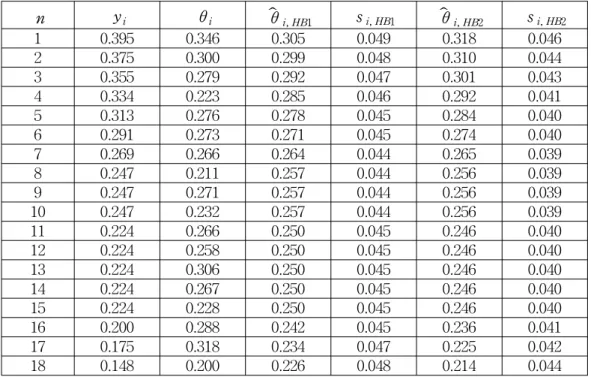
The results are summarized in Table 1.
What follows the true values θi's refer to the baseball players' actual batting averages for the remainder of the season. Also, θˆ
i, HB1 and θˆ
i, HB2 are denoted by the two different HB estimates of θi respectively. The stand errors associated with θˆ
i, HB1 and θˆ
i, HB2 are denoted by s i, HB1 and si, HB2 respectively.
It turns out that
( 18σ2)- 1∑
18
1 (yi- θi)2= 0.9345 ( 18σ2)- 1∑
18 1 ( θˆ
i, HB1- θi)2= 0.2937 ( 18σ2)- 1∑18
1 ( θˆ
i, HB2- θi)2= 0.3295
The HB estimates serve well as point estimates. The HB1 estimates are slightly better than HB2 estimates overall. But two HB estimates are quite a comparable.
Table 1. The true value, the maximum likelihood estimates and the two HB estimates with standard errors.
n yi θi ˆθ
i, HB1 si, HB1 ˆθ
i, HB2 si, HB2
1 0.395 0.346 0.305 0.049 0.318 0.046
2 0.375 0.300 0.299 0.048 0.310 0.044
3 0.355 0.279 0.292 0.047 0.301 0.043
4 0.334 0.223 0.285 0.046 0.292 0.041
5 0.313 0.276 0.278 0.045 0.284 0.040
6 0.291 0.273 0.271 0.045 0.274 0.040
7 0.269 0.266 0.264 0.044 0.265 0.039
8 0.247 0.211 0.257 0.044 0.256 0.039
9 0.247 0.271 0.257 0.044 0.256 0.039
10 0.247 0.232 0.257 0.044 0.256 0.039
11 0.224 0.266 0.250 0.045 0.246 0.040
12 0.224 0.258 0.250 0.045 0.246 0.040
13 0.224 0.306 0.250 0.045 0.246 0.040
14 0.224 0.267 0.250 0.045 0.246 0.040
15 0.224 0.228 0.250 0.045 0.246 0.040
16 0.200 0.288 0.242 0.045 0.236 0.041
17 0.175 0.318 0.234 0.047 0.225 0.042
18 0.148 0.200 0.226 0.048 0.214 0.044
References
1. Datta, G. S. and Ghosh, J. K. (1995). On Priors Providing Frequentist Validity for Bayesian Inference. Biometrika 82, 37-45.
2. Datta, G. S., Ghosh, M. and Mukerjee, R. (2000). Some New Results on Probability Matching Priors. Calcutta Statistical Association Bulletin 50, 179-192.
3. Efron, B. and Morris, C. N. (1975) Data Analysis Using Stein's Estimator and Its Generalizations. Journal of the American Statistical Association 70, 311-319.
4. Ghosh, J. K. (1994). Higher Order Asymptotics. Institute of Mathematical Statistics and American Statistical Association, Hayward, California, USA.
5. Kass, R. E. and Steffey, D. (1989). Approximate Bayesian Inference in Conditionally Independent Hierarchical Models (Parametric Empirical Bayes Models). Journal of the American Statistical Association 84, 717-726.
6. Morris, C. N. (1983). Parametric Empirical Bayes Confidence Intervals. In Scientific Inference, Data Analysis and Robustness, Academic Press, New York, 25-50.
[ received date : Oct. 2004, accepted date : Nov. 2004 ]